Key Findings
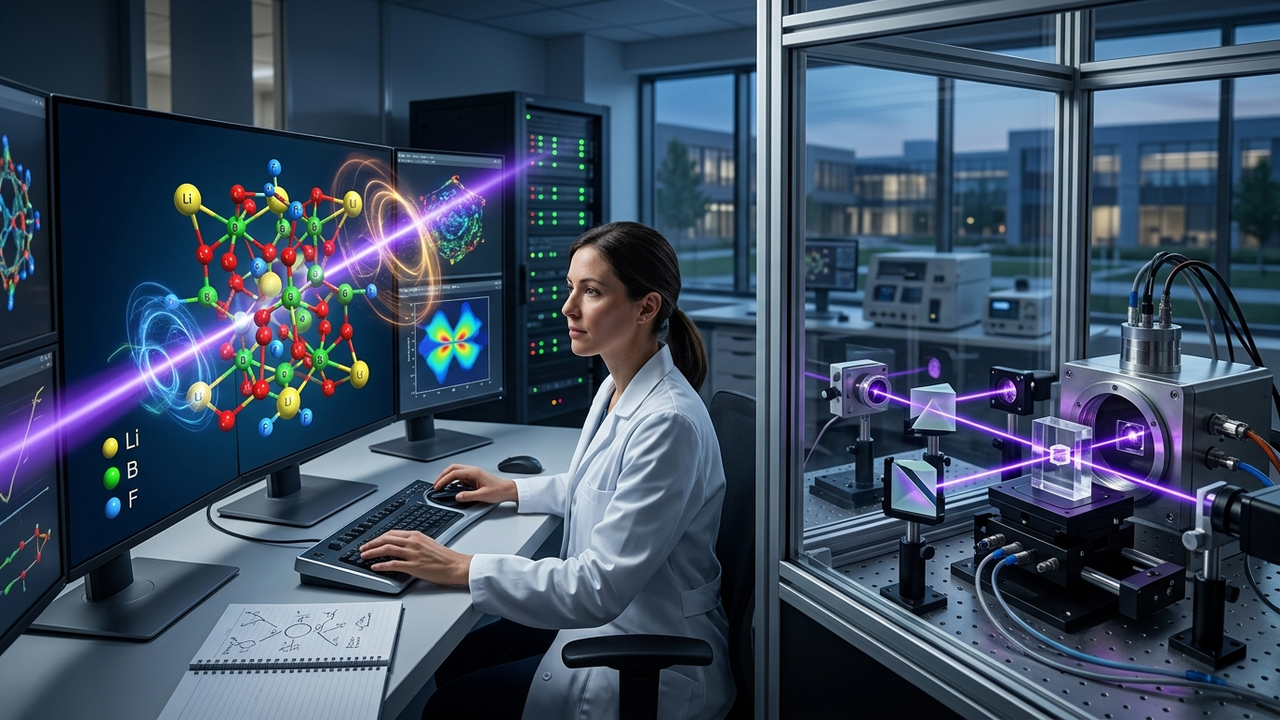
A groundbreaking integrated framework has been established to dramatically accelerate the discovery of deep-ultraviolet (deep-UV) nonlinear optical materials. This innovative approach combines three powerful methodologies: the construction of machine-learned interatomic potentials (MLIPs), MLIP-assisted crystal structure prediction (CSP), and subsequent first-principles property calculations. Its efficacy was demonstrated in the LiB2O3F system, where 40 thermodynamically competitive low-energy candidate structures were identified, significantly enhancing the efficiency of novel material exploration.
Technical / Clinical Details
The core of this framework lies in the synergy between the computational efficiency provided by MLIPs and the high accuracy guaranteed by first-principles calculations. Initially, a small amount of first-principles data is used to construct a high-fidelity MLIP. This MLIP, being orders of magnitude faster than direct first-principles calculations, enables an efficient sampling of the vast crystal structure search space during the CSP phase. From hundreds to thousands of generated structural candidates, the MLIP rapidly screens for thermodynamically stable, low-energy configurations. Finally, detailed properties, such as deep-UV nonlinear optical characteristics, are precisely evaluated using high-accuracy first-principles calculations for these selected few candidates. For the LiB2O3F system, this integrated approach allowed for the identification of promising new material candidates at a speed unattainable by traditional trial-and-error or pure first-principles methods.
Background & Context
Deep-UV nonlinear optical materials are crucial components for wavelength conversion and frequency doubling in numerous cutting-edge technologies, including semiconductor lithography, laser processing, medical diagnostics, and quantum information technology. However, the search and development of these materials have faced significant challenges due to chemical complexity, synthesis difficulties, and the limited screening of available candidates. Given the scarcity of high-performance existing deep-UV nonlinear optical materials, the discovery of new materials is a critical driver for technological innovation across industries. This framework aims to overcome these challenges and enhance the ‘inverse design’ approach in materials science.
Strategic Significance & Outlook
This integrated framework, combining MLIPs and first-principles calculations, is a versatile approach applicable not only to deep-UV nonlinear optical materials but also to the exploration of various other functional materials (e e.g., catalysts, thermoelectric materials, battery materials). Its widespread adoption is expected to resolve bottlenecks in materials R&D, enabling faster and more efficient discovery of new materials. In the future, by integrating with AI-driven autonomous material discovery laboratories, this approach is anticipated to accelerate the realization of ‘materials foundries,’ where materials with desired properties can be automatically designed and synthesized with minimal human intervention. This represents a pivotal advancement for supporting next-generation industrial technologies.
Get our weekly technology intelligence — free
Receive an infographic that lets you judge at a glance whether each field’s analysis report is worth reading.
Subscribe Free — Weekly Tech Intelligence
By subscribing, you’ll receive Troy-Technical’s weekly technology intelligence newsletter.
- Your email and selected fields are used only to deliver the newsletter.
- We never share your information with third parties.
- You can unsubscribe anytime via the link in each email.
See our Privacy Policy for details.
Takes about a minute · Unsubscribe anytime