Key Findings
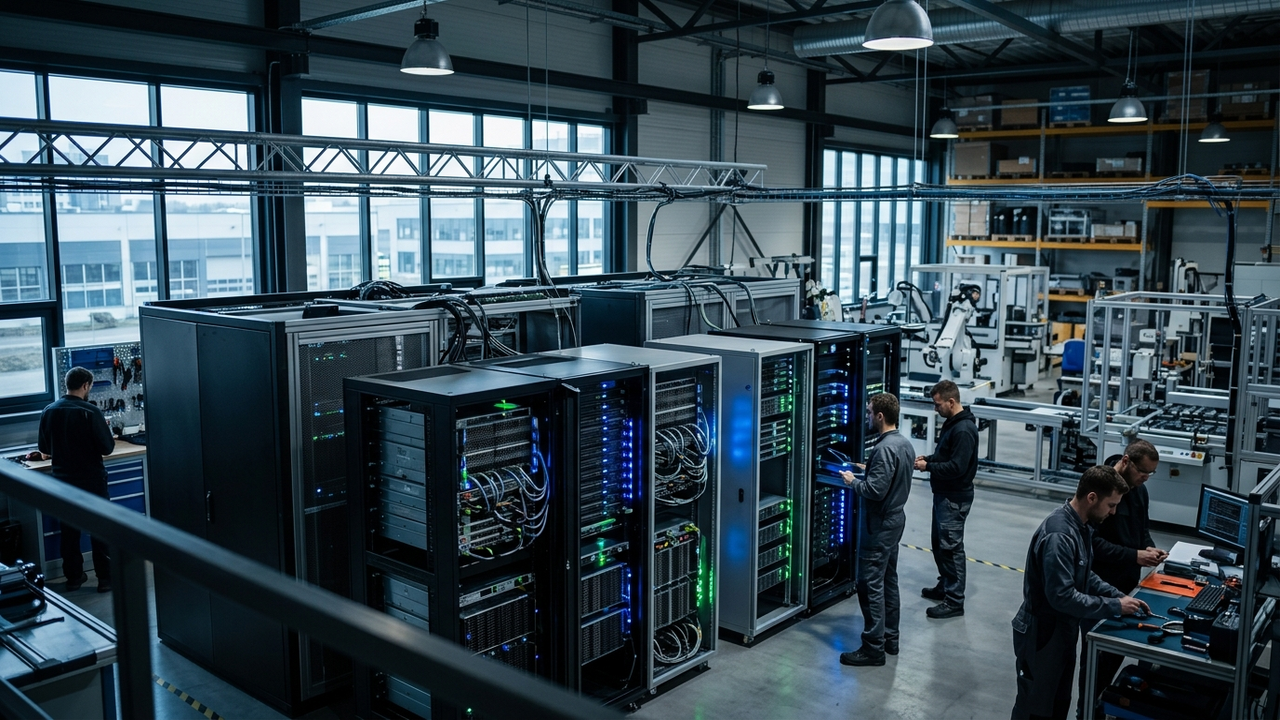
NVIDIA’s recent earnings report starkly illustrates the market’s insatiable demand for AI compute, with a significant surge in its data center revenue. Notably, hyperscalers are investing massively in liquid-cooled mega-clusters. CEO Jensen Huang announced that NVIDIA’s flagship AI chips, ‘Vera Rubin,’ have entered full production, signaling that AI technology has reached a critical inflection point in its growth trajectory. NVIDIA’s next substantial market opportunity lies in decentralizing AI computing capabilities from traditional centralized data centers, deploying them into smaller, modular, distributed AI nodes via high-speed network fabrics.
Technical / Clinical Details
- NVIDIA’s Vera Rubin AI chips offer substantial performance and efficiency improvements over the previous Blackwell architecture, providing high-speed processing capabilities for complex AI workloads. When combined with liquid cooling systems, they achieve extremely high computational densities.
- The concept of an “AI factory” refers to large-scale computational resources for AI model training and inference. The strategy of “breaking out” this factory from the data center implies moving AI computing closer to where it’s needed, specifically to edge devices and local systems.
- High-bandwidth network fabrics are indispensable for enabling data transfer and collaborative work among distributed AI nodes. This allows data-center-scale AI capabilities to be utilized in more locations with smaller footprints.
- This decentralization accelerates the development of edge AI, enabling deeper integration of AI into applications requiring real-time processing, such as IoT devices, autonomous vehicles, and robotics.
- NVIDIA is robustly driving this distributed AI strategy by building an ecosystem that encompasses both software platforms (like CUDA) and hardware (GPUs, NICs).
Background & Context
As AI becomes ubiquitous, the demand for computational resources is relentless. However, constructing and operating large data centers pose challenges such as power consumption, site limitations, and data transfer latencies. NVIDIA’s shift towards distributed AI is a strategic move to address these issues and integrate AI into a broader range of industries and applications. This trend is driving demand for micro data centers and on-device AI, creating new market segments.
Strategic Significance & Outlook
NVIDIA’s proposed distributed AI factory has the potential to define the next phase of AI technology’s societal penetration. This implies a shift in AI processing from the cloud to the edge, enabling lower-latency and more private AI applications. If successful, NVIDIA will further unlock multi-billion-dollar markets beyond data centers, including industrial IoT, smart cities, robotics, and autonomous driving. However, security, data management, and unified orchestration in distributed environments will be key technical challenges moving forward.
Get our weekly technology intelligence — free
Receive an infographic that lets you judge at a glance whether each field’s analysis report is worth reading.
Subscribe Free — Weekly Tech Intelligence
By subscribing, you’ll receive Troy-Technical’s weekly technology intelligence newsletter.
- Your email and selected fields are used only to deliver the newsletter.
- We never share your information with third parties.
- You can unsubscribe anytime via the link in each email.
See our Privacy Policy for details.
Takes about a minute · Unsubscribe anytime








Comments