Key Findings
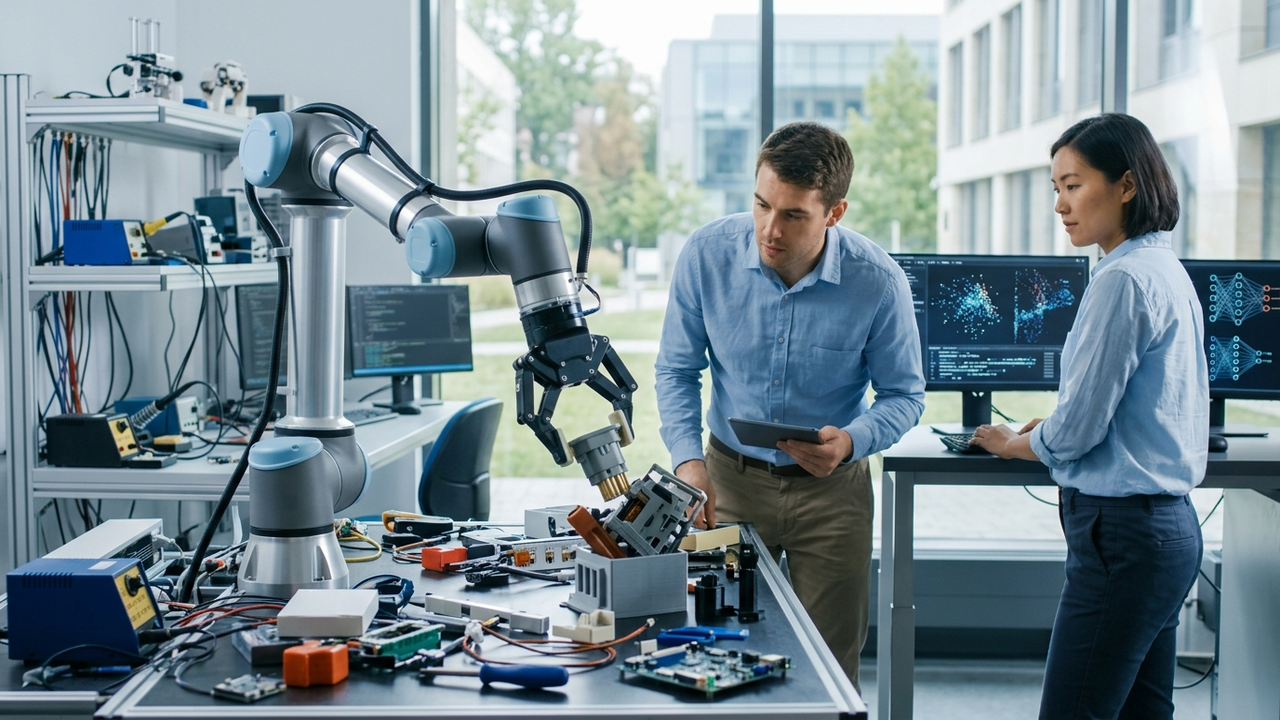
A collaborative research team from the Massachusetts Institute of Technology (MIT) and Stanford University has released a preprint paper detailing a new foundation model that represents a groundbreaking advancement in robotics. This model possesses the ability to learn complex manipulation tasks directly from raw sensory data, achieving an unprecedented level of “Embodied AI.” It allows robots to autonomously adapt to novel, previously unseen environments and execute delicate operations with minimal human intervention.
Technical / Clinical Details
- Multi-modal Perception-Action Architecture: The core of this new foundation model lies in its multi-modal perception module, which integrally processes diverse sensory inputs such as vision, touch, and hearing (raw data). This enables robots to comprehend their surrounding environment more richly and in greater detail. The perception module is closely linked with an action module that generates complex action plans in real-time based on the perceived information, translating them into precise physical movements.
- End-to-End Learning: Traditionally, robot programming involved separate modules for perception, planning, and action, each requiring human design. However, this model adopts an end-to-end approach, learning directly from raw sensory data to the final manipulation outcome. This allows robots to autonomously improve skills through experience, acquiring more flexible and adaptive behaviors without explicit human programming.
- Adaptability to Novel Environments: Particularly noteworthy is the model’s ability to generalize its knowledge and respond appropriately even to “novel environments” or “unseen objects” not present in its training data. This marks a critical step towards achieving more generalized robotic intelligence, not specialized for specific tasks or environments.
Background & Context
Embodied AI in robotics refers to AI that interacts with the physical world and learns/acts within it. Previous robots were often designed to perform specific tasks in limited environments, but there is a growing demand for robots with more general-purpose capabilities. This research, similar to how large language models (LLMs) established themselves as “foundation models” applicable to various text tasks, provides a common learning foundation for robots to handle diverse physical tasks. This is expected to accelerate the adoption of robots in manufacturing, logistics, healthcare, and home services.
Strategic Significance & Outlook
The development of this robotics foundation model will significantly accelerate the creation of general-purpose humanoid robots and more autonomous industrial robots. With minimal human intervention required, the deployment of robots in hazardous work environments and sectors facing severe labor shortages becomes more feasible. As further data collection and model refinement progress, it is anticipated that robots will become more deeply integrated into our lives and industries, creating new value and bringing the future closer.
Source: #
Get our weekly technology intelligence — free
Receive an infographic that lets you judge at a glance whether each field’s analysis report is worth reading.
Subscribe Free — Weekly Tech Intelligence
By subscribing, you’ll receive Troy-Technical’s weekly technology intelligence newsletter.
- Your email and selected fields are used only to deliver the newsletter.
- We never share your information with third parties.
- You can unsubscribe anytime via the link in each email.
See our Privacy Policy for details.
Takes about a minute · Unsubscribe anytime








Comments