Key Findings
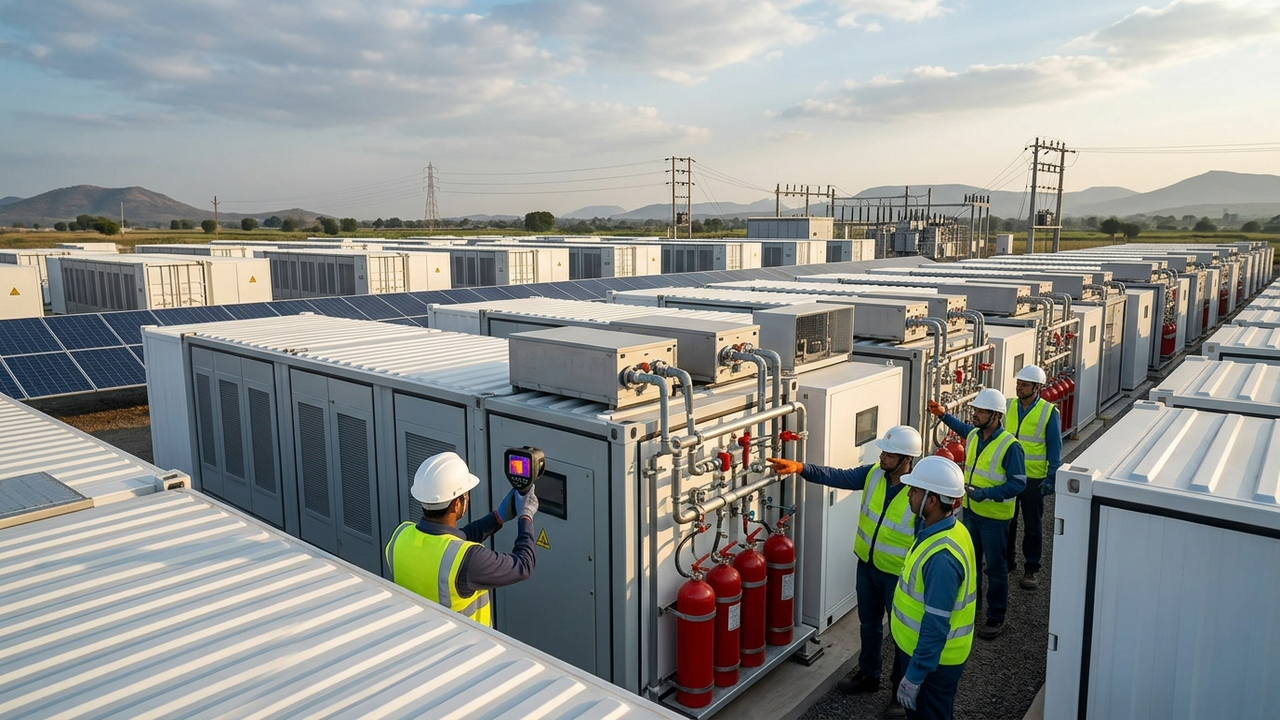
The Central Electricity Authority (CEA) of India has incorporated a dedicated Chapter XA addressing Battery Energy Storage System (BESS) fire safety into its 2026 amended regulations. These comprehensive rules, slated to become effective on April 1, 2027, meticulously outline BESS safety requirements encompassing fault tolerance, Battery Management System (BMS) monitoring, fire and explosion protection, specifications for battery containers, ventilation, hazard detection, and automatic extinguishing systems. Crucially, the regulations underscore the importance of a multi-layered approach to managing the underlying causes of battery fires, such as thermal runaway and gas generation.
Technical / Clinical Details
The new regulations mandate stringent safety standards for the design, installation, and operation of BESS. This includes the principle of ‘fault tolerance,’ requiring systems to be designed such that a single point of failure does not propagate throughout the entire system. The BMS is tasked with continuous monitoring of cell-level voltage, current, and temperature, enabling early detection of anomalies to prevent thermal runaway chain reactions. Fire and explosion protection measures include robust battery container designs, adequate ventilation systems for expelling flammable gases (particularly those produced during thermal runaway), hazard detection via gas and smoke sensors, and automatic extinguishing systems employing agents like nitrogen gas or aerosols. These measures collectively aim to minimize risks through comprehensive system-level safety assessments.
Background & Context
India is experiencing a rapid surge in BESS demand driven by the accelerated integration of renewable energy. However, global incidents of BESS fires have heightened safety concerns, particularly regarding lithium-ion battery thermal runaway, which can lead to severe fires and explosions. The introduction of these comprehensive regulations by the CEA is vital for ensuring BESS safety and fostering public confidence. This move is expected to steer India’s BESS market towards the development of safer and more reliable infrastructure.
Strategic Significance & Outlook
The enforcement of the new regulations on April 1, 2027, will significantly impact the entire BESS industry in India. Suppliers, installers, and operators of BESS will be required to adapt their designs and operational protocols to comply with these new safety requirements. The mandate for system-level safety assessments will stimulate investment in high-quality, safer BESS technologies, potentially positioning India as a leader in global energy storage safety standards. This initiative is expected to strengthen the foundation for secure integration of renewable energy and the realization of a sustainable power supply.
Source: https://www.thebatterymagazine.com/fire-safety-in-bess-can-india-prevent-the-next-battery-fire/
Get our weekly technology intelligence — free
Receive an infographic that lets you judge at a glance whether each field’s analysis report is worth reading.
Subscribe Free — Weekly Tech Intelligence
By subscribing, you’ll receive Troy-Technical’s weekly technology intelligence newsletter.
- Your email and selected fields are used only to deliver the newsletter.
- We never share your information with third parties.
- You can unsubscribe anytime via the link in each email.
See our Privacy Policy for details.
Takes about a minute · Unsubscribe anytime









Comments