COMPANY PROFILE / SEMICONDUCTOR BACK-END
Hanmi Semiconductor
A company of 737 people that holds the tool for stacking HBM
Hanmi Semiconductor is a back-end equipment maker in Incheon, South Korea. Since it was founded in 1980 it has built tools that cut, place and inspect semiconductors, but the reason its name comes up today is essentially one product: the TC bonder used to build HBM by stacking DRAM. This profile follows how a company with 737 employees and KRW 576.7bn of revenue came to hold part of the supply of AI silicon, using only its statutory filings.
- Hanmi Semiconductor in 30 seconds
- The logo and how the name is written
- What the company actually does: vertical integration in equipment
- Scale: five years of revenue
- Company category and position in the back-end industry
- Sites and the countries where it manufactures
- Leading products and share in semiconductor back-end work
- Current investment plans
- Major corporate partners and customers
- Where the company is heading in this field
- The risks this company carries
- Glossary, references and claim-to-source audit
1. Hanmi Semiconductor in 30 seconds
042700Listed on 22 July 2005, on the main board rather than KOSDAQ
(back-end equipment)It makes no chips; it makes the machines that assemble them
Plant 8: KRW 56.0bnPlant 7 by November 2026; Plant 8 to be acquired in February 2027
What is striking about this company is the ratio of size to influence. It has only 737 employees, yet 2025 revenue was KRW 576.7bn, which works out at about KRW 780m per head Our calculation. The operating margin of 43.6% is high even for an equipment maker. That is the flip side of selling a very narrow range of tools to a very narrow set of customers at a high price. In June 2026 the company filed a disclosure for a single order from SK hynix alone worth KRW 44.2bn, equivalent to 7.66% of 2025 revenue Sourced. A handful of orders moves several per cent of annual revenue.
2. The logo and how the name is written
The Hanmi Semiconductor logo is a trademark of the company.
A note on the name: the English name is HANMI Semiconductor Co., Ltd., and the company uses HANMI in capitals in its own English materials. It is an entirely separate company from Hanmi Pharmaceutical, which shares the same Korean word in its name and is easily confused with it. Kwakshin Holdings, which appears in the filings, is an affiliate connected to the largest shareholder.
Official site: https://www.hanmisemi.com3. What the company actually does: vertical integration in equipment
Hanmi Semiconductor builds and sells equipment for making semiconductors. It does not make semiconductors itself. Its customers are memory makers and OSATs.
What stands out in the company's own account is the statement that it has built a vertically integrated manufacturing system covering everything from castings through design, fabrication, assembly, inspection and test Sourced. Equipment makers generally outsource structural parts; this company says it produces in house even the cast components that form the base of a tool.
| Main product | What it does | How the company positions it |
|---|---|---|
| HBM TC bonder | Applies precise heat and pressure to memory dies to build 12-high and 16-high HBM stacks | The current mainstay. Demand rose sharply with investment in AI servers and data centres, the company says |
| 6-SIDE INSPECTION | Inspects all six faces of individual dies before and after TC bonding, and the appearance and joints of the finished stack | Positioned as essential to yield management |
| BOC COB bonder | Handles the Board On Chip and Chip On Board processes in a single machine | The company calls it the world's first two-in-one tool of this kind, deployed for GDDR and enterprise SSD |
| micro SAW & VISION PLACEMENT (MSVP) | Cuts, cleans, dries, performs 2D and 3D image inspection, sorts and loads packages in one pass | The company states it has held the top global share since the mid-2000s |
| EMI SHIELD | Shields a package so that electromagnetic emissions do not disturb neighbouring chips | First shipped in 2016. The company states it holds the top share |
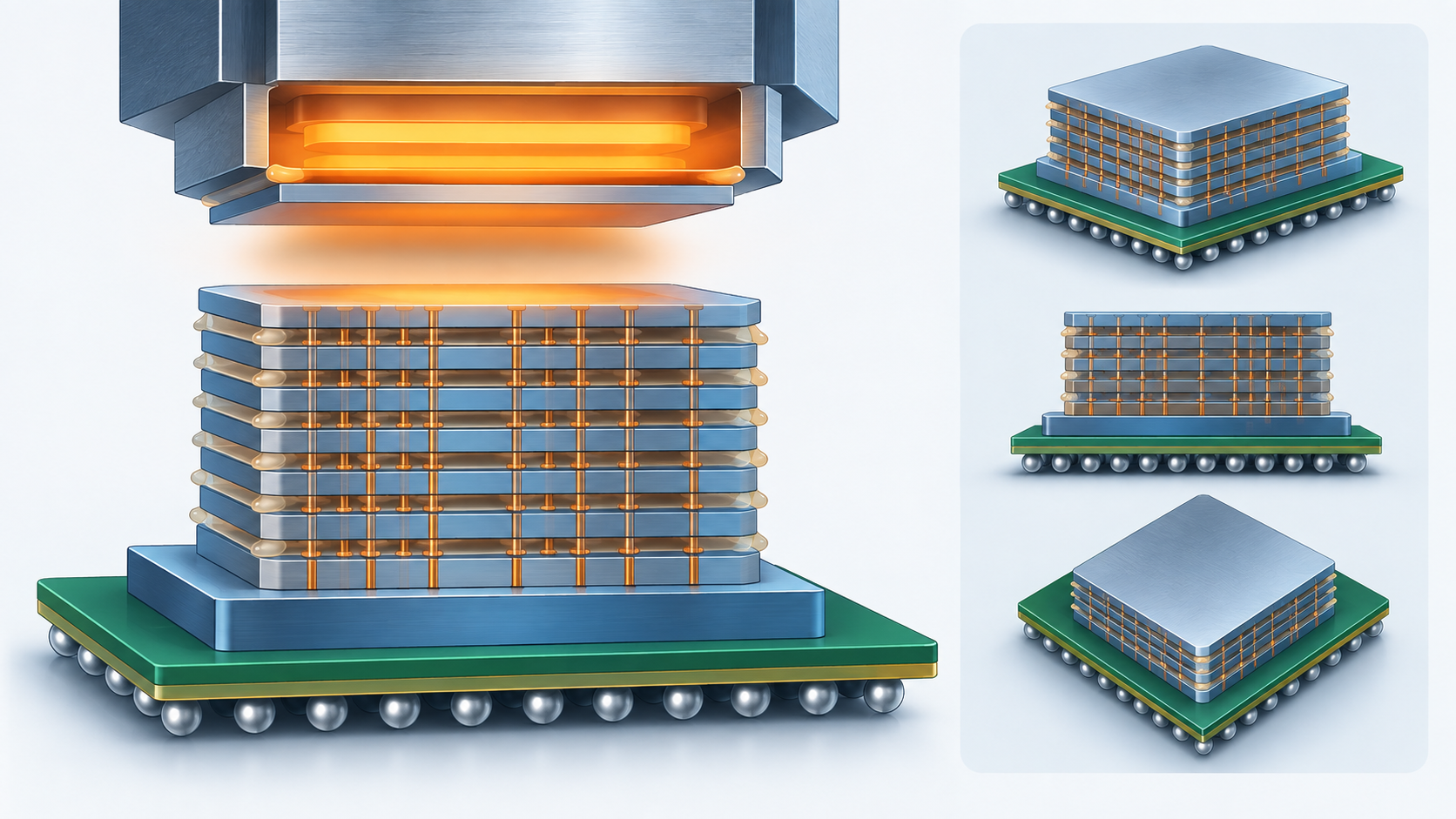
TC bonding stacks dies while a head presses down and heats them at the same time. What the tool fixes is the ramp rate of the applied load, the heating and cooling time profile, and the parallelism of the head. The material has to be designed around those three.
In practice what matters is the melt viscosity and cure onset temperature of the non-conductive film or underfill placed between the dies, the melting point and wetting behaviour of the solder bumps, and, increasingly as the stack grows, the warpage of the substrate and the dies. The more layers an HBM stack has, the more times a single thermal cycle is re-applied to the layers below, so the material in the lower layers is reheated again and again while the upper layers go on. Once the tool determines how many layers can be stacked and at what temperature, the required number of thermal excursions for the material follows from that.
In its business report the company states that because hybrid bonding development has been delayed by technical difficulties, stacking HBM beyond 20 layers has created a need for a new tool able to stack wider HBM dies, and that a "WIDE TC bonder" capable of wide-die bonding is due for release Sourced. From the materials side that is advance notice of a larger bond area, and with it a tougher set of warpage and stress conditions.
4. Scale: five years of revenue
| Year | Revenue (KRW m) | Operating income (KRW m) | Profit for the year (KRW m) | Operating margin |
|---|---|---|---|---|
| 2021 | 373,169 | 122,419 | 104,438 | 32.8% Our calculation |
| 2022 | 327,592 | 111,859 | 92,259 | 34.1% Our calculation |
| 2023 | 159,009 | 34,571 | 267,168 | 21.7% Our calculation |
| 2024 | 558,917 | 255,392 | 152,614 | 45.7% Our calculation |
| 2025 | 576,685 | 251,390 | 214,008 | 43.6% |
All figures are consolidated. Profit for 2023 exceeds revenue because non-operating items, chiefly the revaluation and disposal of affiliate shares, were large that year; it is not operating profit. The 43.6% operating margin for 2025 is the company's own figure, as is the 31.0% return on equity it reports for that year.
What 737 employees looks like
| Category | Permanent | Fixed term | Total | Average tenure |
|---|---|---|---|---|
| Men | 679 | 10 | 689 | 9 years 12 months |
| Women | 35 | 13 | 48 | 5 years 10 months |
| Total | 714 | 23 | 737 | 9 years 9 months |
At 31 December 2025, excluding registered officers. A further 18 people work on site under other employers. Total annual payroll was KRW 51.087bn and average pay KRW 64.81m. The company states that about 30% of all staff work in research and development.
| Item (KRW m) | 2023 | 2024 | 2025 |
|---|---|---|---|
| R&D expense, total | 18,052 | 22,135 | 23,938 |
| of which personnel costs | 11,554 | 13,425 | 14,642 |
| As a share of revenue | 11.5% | 4.0% | 4.3% |
The ratios are the company's own, calculated against revenue in the separate financial statements. The high ratio in 2023 reflects the collapse in revenue, not a rise in R&D spending.
5. Company category and position in the back-end industry
The category is a manufacturer of semiconductor back-end equipment. Not a university, not a government body and not an OSAT. Under Korean definitions it falls into the mid-sized enterprise bracket, being neither a small and medium enterprise nor a venture company, as the company itself records Sourced.
In the structure of the back-end industry it sits on the side that delivers equipment, the same layer as ASMPT and Besi, with memory makers and OSATs as customers. Its product range, however, is narrow: concentrated on bonding, and on cutting and inspection.
6. Sites and the countries where it manufactures
Production and research and development are concentrated on a single site in Incheon, Korea Sourced. The overseas entities are sales and service subsidiaries only.
| Site | Location | Role | Established |
|---|---|---|---|
| Head office, plant and research institute | Gajwa-dong, Seo-gu, Incheon | Head office functions, equipment manufacturing and R&D, all together. A dedicated micro SAW plant opened in 2021 and a bonder factory in 2023 | 1980 |
| HANMI Taiwan Co., Ltd. | Luzhu District, Taoyuan, Taiwan | Development and sale of equipment, parts and materials. Wholly owned | 19 October 2015 |
| HANMI Vietnam Co., Ltd. | Bac Ninh, Vietnam | The same. Wholly owned | 24 April 2023 |
| HANMI SINGAPORE Pte. Ltd. | Woodlands Industrial Park, Singapore | The same. Established for local support of global customers as the AI semiconductor industry grows | 23 October 2025 |
The company also states that it sells and services through 16 partner companies acting as local agents worldwide. Among its affiliates is the unlisted Kwakshin Holdings; in January 2025 the company transferred a 9% interest in it to the chief executive, reducing its own holding to 40%.
An equipment maker with KRW 576.7bn of revenue keeping its only manufacturing site in Incheon is a clear concentration risk in supply chain terms. At the same time it is part of what makes building each tool to order possible. Castings are made in house, and assembly, inspection and shipment happen on the same site. The commercial flow, in which a tool ships only after a buy-off inspection witnessed by the customer, also assumes that the sites are not split up Sourced.
For anyone supplying parts that go into the tool, bonding tool tips, heaters, ceramic components, materials for precision stages, both the point of contact and the qualification testing are consolidated in Incheon. Qualification is easier to obtain for that reason, but if this one site stops there is no alternative. That the company is securing land and buildings in Incheon one after another, with Plant 7 due in November 2026 and Plant 8 to be acquired in February 2027, is investment that thickens the concentration further.
7. Leading products and share in semiconductor back-end work
The TC bonder
The TC bonder, or thermal compression bonder, is used in making HBM. When DRAM dies are stacked layer on layer, it presses from above while heating, joining them in one pass. The company explains that HBM demand rose sharply with investment in AI servers and data centres, and that the more layers there are, the more important the TC bonder becomes Sourced.
The product line is split by generation, and from published material alone the company is developing the TC bonder 4, the WIDE TC bonder and a hybrid bonder in parallel as of 2026. The tool ordered by SK hynix in June 2026 is named "TC BONDER 4.5 GRIFFIN, for HBM4 manufacturing" Sourced.
On market share, with the distinctions that matter
In its 2025 annual business report Hanmi Semiconductor states that it "recorded first place in the global TC bonder market with a 71.2% share, as published by the research firm TechInsights". It also states that it holds the top global share for micro SAW & VISION PLACEMENT and for EMI SHIELD.
However, these are estimates by a third-party research firm that the company is quoting, not results the company itself calculated. Because this article does not adopt research-firm estimates, it reports only the fact that the company makes this statement, and does not treat the share figures themselves as established Not yet confirmed. No share figure calculated by the company appears anywhere in its statutory filings.
In place of a share, three things can be stated from primary material.
- Of KRW 576.7bn of 2025 revenue, 84.62% was equipment and 15.38% conversion kits and similar items Sourced
- On 8 June 2026 the company received an order from SK hynix for HBM4 TC bonders worth KRW 44.2bn, equal to 7.66% of 2025 revenue, for delivery by 2 September 2026 Sourced
- In November 2025 the HBM TC BONDER was designated a World Class Product of Korea Sourced
On its order position the company states plainly that in the semiconductor equipment business orders and production proceed by purchase order after mutual consultation with the customer, and that because contract terms could expose the customer's investment plans, nothing beyond what has been formally disclosed is recorded Sourced. The order backlog is therefore unknown Not yet confirmed. What appears in the order table of the semi-annual report is only the individual contracts disclosed as single sale and supply agreements.
8. Current investment plans
Investment goes entirely into expanding the Incheon site. The content of the two plant projects, according to the company's filings, is as follows Sourced.
| Item | Plant 7 | Plant 8 |
|---|---|---|
| Amount | KRW 57.824bn | KRW 56.0bn, the contract amount excluding taxes and incidental costs |
| Purpose | Construction of a plant dedicated to the latest hybrid bonders, to serve next-generation premium HBM production | Getting ahead of an equipment shortage as global semiconductor companies expand capital spending |
| Timing | By 30 November 2026, subject to adjustment as circumstances require | Balance due on 17 February 2027 |
| Size | Not published | Land of 20,582.1 sq m and buildings of 25,694.3 sq m. The company calls it the largest plant land acquisition since its founding |
| Counterparty | Not published | Mercury Co., Ltd. |
What deserves attention is that Plant 7 is planned as dedicated to hybrid bonders Sourced. In the body of the same business report the company says hybrid bonder development has been delayed by technical difficulties. In other words, it is building a dedicated plant for a tool that is not yet its mainstay. That is investment well ahead of demand: preparing the vessel for the next method while the money still comes from TC bonders.
The stated purpose of the Plant 8 acquisition resolved in August 2026 is getting ahead of an equipment shortage. The company's view that it cannot currently build enough is on the record in a public filing. That said, the production capacity of neither plant once operating has been published Not yet confirmed.
9. Major corporate partners and customers
Unusually, this company lists its customers by name. The same list appears in the 2025 annual business report and the first-half 2026 semi-annual report Sourced.
| Category | Companies the company names |
|---|---|
| Overseas customers | SK hynix, Micron Technology, ASE, Amkor, JCET, Huatian Technology, TFME, Infineon, STMicroelectronics, Powertech Technology, Skyworks, Luxshare |
| Domestic customers in Korea | JCET STATS ChipPAC Korea, ASE Korea, Amkor Korea, Samsung Electro-Mechanics, LG Innotek, Korea Circuit, SFA Semicon, Signetics |
On the relationship readers will most want to understand, the one with SK hynix, only two things can be confirmed from the company's published material.
First, SK hynix is named as a customer in the principal customers section of both the annual business report and the semi-annual report Sourced.
Second, the single sale and supply agreement disclosure dated 8 June 2026 records that the counterparty is SK Hynix Inc., the contract covers TC BONDER 4.5 GRIFFIN tools for HBM4 manufacturing, the value is KRW 44.2bn excluding VAT, equal to 7.66% of 2025 consolidated revenue, and the term runs from 8 June 2026 to 2 September 2026 Sourced.
Everything else is unconfirmed. How much revenue comes from SK hynix in a year, what share of its purchases the company supplies, whether supply is exclusive or dual-sourced, whether a long-term contract exists: none of this appears anywhere in the company's published material Not yet confirmed. Claims found in the press about exclusive supply of HBM TC bonders, or about the relationship ending, are not treated as primary material here.
| Kind | Counterparty | Substance |
|---|---|---|
| Largest shareholder | The chairman and chief executive | 31,937,861 shares, a 33.51% interest at 31 December 2025. Including related parties, 55.70% |
| Affiliate | Kwakshin Holdings | Unlisted. In January 2025 the company transferred a 9% interest to the chief executive, cutting its own holding to 40% |
| Consolidated subsidiaries | HANMI Taiwan, HANMI Vietnam, HANMI SINGAPORE | All wholly owned. Development and sale of equipment, parts and materials |
| Notable institutional holder | Mirae Asset Global Investments | Filed abbreviated large-holding reports in February, April and July 2026 |
10. Where the company is heading in this field
Anything said here is a forecast, so the established facts and the outlook drawn from them are kept apart.
What is established
| Fact | What it implies for the back end |
|---|---|
| 2025 revenue of KRW 576.7bn at a 43.6% operating margin, the best in the company's history | The TC bonder is established as the pillar of earnings |
| Second-quarter 2026 revenue of KRW 251.2bn, up 39.5% year on year | On a quarterly basis the upswing continues |
| First-half 2026 revenue of KRW 302.1bn, down 7.7% year on year | A weak first quarter, at KRW 50.9bn, makes the full year hard to read |
| A KRW 44.2bn order from SK hynix for HBM4 TC bonders in June 2026 | Adoption continues into the HBM4 generation |
| Plant 7, dedicated to hybrid bonders, to be built by November 2026 | Preparation for the next-generation method is under way |
| An August 2026 resolution to acquire the largest plant land in the company's history | The company is working on the assumption of a supply shortage |
| 737 employees and a single manufacturing site in Incheon | Capacity growth is rate-limited by buildings and hiring |
Outlook
Not yet confirmed Confined to the back end, Hanmi Semiconductor's position depends almost entirely on whether HBM stacks keep growing taller. More layers mean longer processing time per tool and therefore more tools. That the company says stacking beyond 20 layers has created a need for a tool able to handle wider HBM dies, and has pre-announced a WIDE TC bonder, shows it is looking in that direction.
Not yet confirmed The same documents also show how that could unwind. One route is the move to hybrid bonding: if joining copper surfaces directly without solder reaches volume production, the role of the TC bonder shrinks. The company is developing a hybrid bonder in anticipation, and is even building a dedicated plant, but there has been no announcement that volume adoption is settled. The other route is the customers' capital spending cycle. Revenue falling to KRW 50.9bn in the first quarter of 2026 and jumping to KRW 251.2bn in the second shows plainly that this company's revenue is decided by the delivery timing of a handful of orders.
11. The risks this company carries
| Risk | Substance | Supporting figures |
|---|---|---|
| Swings in revenue | Revenue fell 51.5% from 2022 to 2023 and returned 3.5 times in 2024. Quarterly it moved from KRW 50.9bn in Q1 2026 to KRW 251.2bn in Q2 | KRW 327,592m to 159,009m to 558,917m Our calculation |
| Product concentration | 84.62% of revenue is equipment, and at the centre of that are bonders for HBM. The product range is narrow | 2025 revenue by product Sourced |
| Site concentration | The only manufacturing site is in Incheon. The overseas entities are limited to sales and service | The site and subsidiary lists in the business report |
| Technology substitution | The company says hybrid bonder development has been delayed, yet is building a plant dedicated to it. If the method changes, demand for the existing tools falls | KRW 57.8bn invested in Plant 7 Sourced |
| Currency | The only market risk the company lists is currency. 80.7% of revenue is exported, mainly in U.S. dollars and Japanese yen | Exports of KRW 465.3bn against total revenue of KRW 576.7bn in 2025 Our calculation |
| Swelling receivables | Trade receivables at the end of June 2026 were KRW 258.3bn, 4.1 times the KRW 62.4bn at the end of 2025. Shipments are bunching at period ends | Summary financial information in the semi-annual report Our calculation |
| Control structure | The largest shareholder and related parties hold 55.70% of the shares in issue. Minority influence is limited | Shareholding position at 31 December 2025 |
| No visible backlog | The company withholds its order position beyond individually disclosed contracts, on the ground that it would expose customers' investment plans | Stated in the business report Not yet confirmed |
The most striking thing in this company's accounts is the movement in trade receivables. Receivables of KRW 62.4bn at the end of 2025 swelled 4.1 times to KRW 258.3bn by the end of June 2026 Our calculation, while cash fell from KRW 276.2bn to KRW 88.6bn.
The company's stated payment terms are 30% thirty days after the purchase order is received, 60% thirty days before delivery and 10% thirty days after acceptance Sourced. A mountain of receivables therefore means tools already shipped or about to ship. Once a tool is installed, consumption of consumable parts and bonding materials begins downstream. From the materials side, an equipment maker's receivables read as a leading indicator of your own demand a few months out. A swell of this size suggests HBM materials will move through the second half of 2026 and into 2027.
12. Glossary
- TC bonder
- Thermal Compression Bonder. A tool that joins chips under simultaneous heat and pressure, used to stack HBM.
- HBM
- High Bandwidth Memory. DRAM stacked vertically to gain bandwidth, placed beside an AI accelerator.
- Hybrid bonding
- Joining copper electrodes and dielectric surfaces directly without solder. The next-generation method, allowing a finer joint pitch.
- BOC and COB
- Board On Chip and Chip On Board, two mounting schemes in which the board and the chip are the other way up.
- EMI shield
- The process of covering a package, usually with a metal film, so its electromagnetic emissions do not disturb neighbouring chips.
- Conversion kit
- A set of parts that respecifies an already delivered tool for a different product. A steady revenue source for equipment makers.
- Buy-off
- An inspection witnessed by the customer before shipment to confirm a tool's performance. The tool ships once it passes, and part of the price becomes payable.
- DART
- The electronic disclosure system of Korea's Financial Supervisory Service, where listed Korean companies file business reports and other statutory disclosures.
 AI-generated concept
13. References
- Hanmi Semiconductor Annual business report for 2025 (filed with DART, 12 March 2026). Legal name, date of incorporation, head office address and listing date, descriptions of the principal products, revenue by product, export and domestic revenue, the list of principal customers, R&D expense, headcount with tenure and pay, the Plant 7 investment, the largest shareholder and related-party holdings, dividends, subsidiaries and affiliates, summary financial information for 2023 to 2025, and management's discussion. https://dart.fss.or.kr/dsaf001/main.do?rcpNo=20260312001230
- Hanmi Semiconductor Semi-annual report for the first half of 2026 (filed with DART, 14 August 2026). First-half revenue, operating income and net income, trade receivable and cash balances, export and domestic split, principal customers, the order table for the TC BONDER 4.5 GRIFFIN, and progress on the Plant 7 investment. https://dart.fss.or.kr/dsaf001/main.do?rcpNo=20260814003665
- Hanmi Semiconductor Annual business report for 2023 (filed with DART, 14 March 2024). Revenue, operating income and profit for 2021, 2022 and 2023 in the summary financial information. https://dart.fss.or.kr/dsaf001/main.do?rcpNo=20240314001257
- Hanmi Semiconductor Disclosure, "Conclusion of a single sale and supply agreement" (8 June 2026). Counterparty SK Hynix Inc., an order for TC BONDER 4.5 GRIFFIN tools for HBM4 manufacturing, contract value KRW 44.2bn excluding VAT, 7.66% of 2025 consolidated revenue, term 8 June 2026 to 2 September 2026. https://dart.fss.or.kr/dsaf001/main.do?rcpNo=20260608800436
- Hanmi Semiconductor Disclosure, "Decision to acquire tangible assets" (18 August 2026). Acquisition of land and buildings in Gajwa-dong, Seo-gu, Incheon as Plant 8, at KRW 56.0bn, land of 20,582.1 sq m and buildings of 25,694.3 sq m, scheduled acquisition on 17 February 2027, counterparty Mercury Co., Ltd., and the stated purpose of getting ahead of an equipment shortage. https://dart.fss.or.kr/dsaf001/main.do?rcpNo=20260818800167
- Hanmi Semiconductor Disclosure, "Provisional consolidated operating results, fair disclosure" (14 July 2026). Second-quarter 2026 revenue of KRW 251.2bn, up 39.5% year on year, operating income of KRW 130.3bn, up 51.0%, and first-half revenue of KRW 302.1bn, down 7.7%. https://dart.fss.or.kr/dsaf001/main.do?rcpNo=20260714800204
- Hanmi Semiconductor Official website, used to check the corporate profile and the brand wordmark. https://www.hanmisemi.com
14. Claim-to-source audit
| Claim in the article | Category | Source |
|---|---|---|
| Legal name, incorporation on 24 December 1980, head office address, listing venue and date of 22 July 2005, stock code 042700 | Sourced | Reference 1 https://dart.fss.or.kr/dsaf001/main.do?rcpNo=20260312001230 |
| Revenue, operating income and profit for 2023, 2024 and 2025 | Sourced | The summary financial information in reference 1 https://dart.fss.or.kr/dsaf001/main.do?rcpNo=20260312001230 |
| Revenue, operating income and profit for 2021 and 2022 | Sourced | The summary financial information in reference 3 https://dart.fss.or.kr/dsaf001/main.do?rcpNo=20240314001257 |
| Operating margins for 2021 to 2024, the 3.2% rise in 2025 and the 51.5% fall from 2022 to 2023 | Our calculation | Derived from the disclosed figures in references 1 and 3 https://dart.fss.or.kr/dsaf001/main.do?rcpNo=20240314001257 |
| The 43.6% operating margin and 31.0% return on equity for 2025, and the description of record results | Sourced | Management's discussion in reference 1 https://dart.fss.or.kr/dsaf001/main.do?rcpNo=20260312001230 |
| 737 employees, tenure, total payroll and the statement that about 30% work in R&D | Sourced | Reference 1 https://dart.fss.or.kr/dsaf001/main.do?rcpNo=20260312001230 |
| Revenue per employee of about KRW 780m | Our calculation | Revenue in reference 1 divided by headcount https://dart.fss.or.kr/dsaf001/main.do?rcpNo=20260312001230 |
| R&D expense and its ratio to revenue for 2023 to 2025 | Sourced | Reference 1 https://dart.fss.or.kr/dsaf001/main.do?rcpNo=20260312001230 |
| 2025 revenue by product: equipment 84.62% and conversion kits 15.38% | Sourced | Reference 1 https://dart.fss.or.kr/dsaf001/main.do?rcpNo=20260312001230 |
| Export and domestic revenue for 2023 to 2025 and the 80.7% export share in 2025 | Our calculation | Derived from the revenue table in reference 1 https://dart.fss.or.kr/dsaf001/main.do?rcpNo=20260312001230 |
| Descriptions of the main products and the pre-announcement of the WIDE TC bonder | Sourced | Reference 1 https://dart.fss.or.kr/dsaf001/main.do?rcpNo=20260312001230 |
| The vertically integrated manufacturing system, the 16 partner companies, buy-off inspection and payment terms | Sourced | Reference 1 https://dart.fss.or.kr/dsaf001/main.do?rcpNo=20260312001230 |
| The list of customer names including SK hynix, Micron, ASE, Amkor and Powertech Technology | Sourced | References 1 and 2 https://dart.fss.or.kr/dsaf001/main.do?rcpNo=20260814003665 |
| The SK hynix order for TC BONDER 4.5 GRIFFIN at KRW 44.2bn, 7.66% of revenue, due 2 September 2026 | Sourced | Reference 4 https://dart.fss.or.kr/dsaf001/main.do?rcpNo=20260608800436 |
| The three subsidiaries in Taiwan, Vietnam and Singapore with their dates and locations, and the change in the Kwakshin Holdings interest | Sourced | Reference 1 https://dart.fss.or.kr/dsaf001/main.do?rcpNo=20260312001230 |
| Plant 7 at KRW 57.824bn, dedicated to hybrid bonders, due by 30 November 2026 | Sourced | References 1 and 2 https://dart.fss.or.kr/dsaf001/main.do?rcpNo=20260814003665 |
| Plant 8 at KRW 56.0bn, land 20,582.1 sq m and buildings 25,694.3 sq m, acquisition due 17 February 2027, counterparty Mercury Co., Ltd. | Sourced | Reference 5 https://dart.fss.or.kr/dsaf001/main.do?rcpNo=20260818800167 |
| Second-quarter 2026 revenue of KRW 251.2bn, up 39.5%, and first-half revenue of KRW 302.1bn, down 7.7% | Sourced | References 6 and 2 https://dart.fss.or.kr/dsaf001/main.do?rcpNo=20260714800204 |
| Trade receivables of KRW 258.3bn at the end of June 2026, 4.1 times the level at the end of 2025 | Our calculation | Derived from the summary financial information in reference 2 https://dart.fss.or.kr/dsaf001/main.do?rcpNo=20260814003665 |
| The largest shareholder's 33.51% interest, 55.70% including related parties, and the KRW 800 dividend for 2025 | Sourced | Reference 1 https://dart.fss.or.kr/dsaf001/main.do?rcpNo=20260312001230 |
| The 71.2% TC bonder share the company quotes, and the claimed top positions for MSVP and EMI SHIELD | Not yet confirmed | Stated in reference 1, but all are third-party research estimates. This article does not treat the figures as established https://dart.fss.or.kr/dsaf001/main.do?rcpNo=20260312001230 |
| Annual revenue from SK hynix, the share of its purchases supplied, whether supply is exclusive, and whether a long-term contract exists | Not yet confirmed | Absent from the published material. This article does not rely on press reports |
| The order backlog | Not yet confirmed | Withheld by the company on the ground that it would expose customers' investment plans. Only individually disclosed contracts are known, so this article gives no total |
| The production capacity of Plant 7 and Plant 8 once operating | Not yet confirmed | Absent from the published material, and this article does not estimate it |
| Whether and when the hybrid bonder will be adopted for volume production | Not yet confirmed | Only its development is announced. There is no announcement of adoption, and this article does not estimate a date |
| The outlook in section 10 | Not yet confirmed | An interpretation by this article, drawn from the seven items in the facts table |
Last updated 21 September 2026 / Troy Technical
Every figure in this article comes from the statutory filings Hanmi Semiconductor submitted to DART, Korea's electronic disclosure system. No research-firm estimates or press-based figures have been used, other than those the company itself quotes and which are identified as such.