COMPANY PROFILE / SEMICONDUCTOR BACK-END
Intel
The only one of these companies that owns its back-end factories
NVIDIA and AMD own no back-end equipment at all. Intel is different. It owns and operates assembly and test plants in New Mexico, Malaysia, Vietnam and China, and it uses two proprietary advanced packaging technologies, EMIB and Foveros, in volume production. It has also made it company policy to sell that capacity to other firms. That contract business, however, has barely got off the ground. This profile follows where Intel actually stands, owning the capability but not yet selling it, using only published figures.
- Intel in 30 seconds
- The logo and how the name is written
- What the company actually does: the IDM model
- Scale: five years of revenue
- Company category and position in the back-end industry
- Sites and the countries where it manufactures
- Leading products and share in semiconductor back-end work
- Current investment plans
- Major corporate partners
- Where the company is heading in this field
- The risks this company carries
- Glossary, references and claim-to-source audit
1. Intel in 30 seconds
(Nasdaq Global Select Market)Ticker INTC. 4,994m shares outstanding at the end of FY2025
(US$52,853m)Down 0.5% year on year. The fiscal year ends on the last Saturday of December; this one closed on 27 December 2025
(IDM, vertically integrated)Does design, front end and back end in house, and wants contract work too
Of the three companies covered in this series, Intel is the only one that owns its back-end factories. The 10-K states that the company operates numerous fabs and assembly and test facilities supporting high-volume production of advanced logic chips Sourced. Its main assembly and test sites in 2025 were in China, New Mexico, Vietnam and Malaysia, with New Mexico as the lead site for advanced packaging and a new advanced packaging plant under construction in Malaysia.
And yet, of the US$17,826m of FY2025 revenue in the manufacturing arm that contains the back end, Intel Foundry, only US$307m, or 1.7%, came from customers outside the company Our calculation. That segment posted an operating loss of US$10,318m. It owns the plants and the technology, external sales have barely begun, and the losses continue. That is where Intel stands.
2. The logo and how the name is written
The Intel logo is a registered trademark of the company. The 10-Q states that Intel Core, Gaudi and the Intel logo are trademarks of Intel Corporation or its subsidiaries Sourced.
A note on style: the legal name in statutory documents is Intel Corporation. Since 2024 the manufacturing arm has been a separate reporting segment under the name Intel Foundry. Process generations use the company's own convention, Intel 7, Intel 4, Intel 3, Intel 18A and Intel 14A, with no nanometre unit after the number.
Official site: https://www.intel.com/content/www/us/en/homepage.html3. What the company actually does: the IDM model
Sorted by business model, Intel is an IDM, an integrated device manufacturer: design, wafer fabrication, assembly and test all happen in house.
| Model | Design | Front end | Back end |
|---|---|---|---|
| Fabless | In house | Outsourced | Outsourced (NVIDIA, AMD) |
| Foundry | None | Contract | Partly on contract (TSMC) |
| OSAT | None | None | Contract only |
| IDM | In house | In house | In house (Intel) |
From FY2026 Intel reports in the following three segments Sourced.
| Segment | Contents | FY2025 revenue | FY2025 operating result |
|---|---|---|---|
| CCG (client) | CPUs for PCs and notebooks. Renamed CCPG, client computing and physical AI, from FY2026 | US$32,228m | US$9,317m |
| DCAI (data centre and AI) | Xeon server processors, AI accelerators and custom silicon | US$16,919m | US$3,422m |
| Intel Products total | The two above combined | US$49,147m | US$12,739m |
| Intel Foundry | Process technology development, manufacturing, assembly and test, advanced packaging and design services | US$17,826m | minus US$10,318m |
The segment figures include intersegment transactions, so they do not simply add up to consolidated revenue of US$52,853m; the company discloses a separate reconciliation. Of FY2025 CCG revenue, the company attributes US$27,600m to client products, notebooks and desktops, and US$4,600m to other CCG lines.
In the NVIDIA and AMD profiles, the companies actually buying back-end materials were the OSATs and the foundries. Intel is different. Because it runs its own assembly and test plants, it buys the encapsulant, the substrate and the underfill itself. The 10-K says its manufacturing depends on a global supply chain of thousands of suppliers worldwide, and that it sources tools and materials critical to semiconductor development and manufacturing, including rare earth elements, minerals and metals, from multiple suppliers Sourced.
Of the three, in other words, Intel is the only one that can be a direct customer for a materials maker. And because Intel is trying to sell its back-end capacity externally, any growth in that business would bring the materials demand of the design houses behind it through Intel as well. Small in scale, but the closest of the three in commercial structure.
4. Scale: five years of revenue
| Fiscal year | Revenue (US$m) | R&D expense (US$m) | Operating result (US$m) | Capital spending (US$m) |
|---|---|---|---|---|
| FY2021 | 79,024 | 15,190 | 19,456 | 18,733 |
| FY2022 | 63,054 | 17,528 | 2,334 | 24,844 |
| FY2023 | 54,228 | 16,046 | 93 | 25,750 |
| FY2024 | 53,101 | 16,546 | minus 11,678 | 23,944 |
| FY2025 | 52,853 | 13,774 | minus 2,214 | 14,646 |
The FY2025 net loss was US$267m. Capital spending is more than 40% below its FY2023 peak; the company says it moved to more disciplined capital allocation in 2025. Net of government incentives and partner contributions, FY2025 capital spending was US$11,204m.
The weight that sits on the balance sheet
The decisive difference between Intel and the other two shows up in the balance sheet Sourced.
| Item | End of FY2025 (US$m) | End of FY2024 (US$m) |
|---|---|---|
| Property, plant and equipment, net | 105,414 | 107,919 |
| of which United States | 71,158 | 72,068 |
| of which Ireland | 17,120 | 18,152 |
| of which Israel | 10,620 | 10,414 |
| of which other countries | 6,516 | 7,285 |
| Total assets | 211,429 | 196,485 |
Property, plant and equipment of US$105.4bn means Intel carries roughly twice its revenue of US$52.9bn in fixed assets Our calculation. NVIDIA's comes to US$10.4bn and AMD's to US$2.3bn, two orders of magnitude apart. The company says as much in its own risk factors: it had over US$100bn of property, plant and equipment as of 27 December 2025, and estimates that the majority of it relates to the foundry business Sourced.
5. Company category and position in the back-end industry
The category is manufacturer, specifically an IDM. Its position in the back-end industry is unlike the other two, because Intel is also an operator of back-end capacity. What it sells outside, though, is still small.
Intel Foundry recorded an operating loss of US$10,318m in FY2025, equal to 58% of its revenue. The losses were US$13,291m in FY2024 and US$7,083m in FY2023 Sourced. This is a division maintaining its plants through three straight years of losses in the tens of billions of dollars.
The composition of the loss is improving, though. The company attributes the FY2025 narrowing mainly to lower asset impairments and accelerated depreciation, and the operating loss for the first half of FY2026 narrowed to US$4,526m from US$5,488m a year earlier Sourced.
For anyone in the back end, the striking number is how small that US$307m of external revenue is. The company explains the FY2024 decline in external revenue as lower traditional packaging services, which shows that Intel has been selling back-end services externally for some time Sourced. The question is therefore not whether it can start from nothing, but whether it can lift a small existing business up into advanced packaging.
6. Sites and the countries where it manufactures
The scale of the facilities is as follows Sourced.
| Category | United States (m sq ft) | Other countries (m sq ft) | Total |
|---|---|---|---|
| Owned | 35 | 25 | 60 |
| Leased | 2 | 3 | 5 |
| Total | 37 | 28 | 65 |
65 million square feet is nearly ten times AMD's 6.8 million Our calculation. The company states that most of its facilities support manufacturing capacity used by the Intel Foundry segment.
This is the section of the Intel profile with the most operationally useful information. In the course of 2025 the following happened Sourced.
- Costa Rica assembly and test is being consolidated into Vietnam and Malaysia, due to complete by the end of 2026
- A new advanced packaging plant is under construction in Malaysia
- The planned expansion of assembly and test in Poland was cancelled
- The planned new fab in Germany was cancelled and construction of the new Ohio fab was slowed
Framed as a question of where materials get delivered, Intel's back end is being pulled towards Malaysia and Vietnam. Europe is being exited on both the front and back end, leaving advanced packaging with two poles, New Mexico and Malaysia. The move is expected to settle by the end of 2026, so anyone planning a supply arrangement should treat Malaysia and Vietnam as the pivot. Capacity and start-up dates by site are not disclosed Not yet confirmed.
7. Leading products and share in semiconductor back-end work
EMIB and Foveros
Intel's advanced packaging splits into two families. The "Packaging Technology" section of the 10-K gives the volume production date for each Sourced.
- EMIB
- Embedded Multi-die Interconnect Bridge. A small silicon bridge is embedded in the package substrate to connect neighbouring dies at high density. In volume production since 2017, it handles dense 2.5D integration.
- EMIB-T
- An improved EMIB, introduced in 2025 with wider adoption expected from 2026. It raises power delivery and bandwidth scalability to support larger packages and next-generation memory.
- Foveros
- Intel's three-dimensional die-stacking technology, introduced in 2019. Intel Core Ultra Series 2 was the first desktop CPU to use Foveros.
- Foveros-B and Foveros-R
- Foveros variants, both targeting volume production in 2027. They aim at greater interconnect flexibility, cost efficiency and integration density.
- Foveros-S
- A Foveros variant aimed at disaggregating high-speed I/O.
- Foveros Direct
- Announced in 2025, with support for hybrid bonding on the Intel 18A-PT process planned for 2028. The goals are higher interconnect density and lower energy consumption.
The 10-K also names the products that use them Sourced. The 4th generation Xeon Scalable processor, introduced in early 2023, is a multi-die design connected with EMIB. The Xeon 6 family builds the compute die on Intel 3 and the I/O die on Intel 7 and joins them with EMIB in a single package. Intel, in other words, can no longer build its flagship server products without EMIB.
Neither Intel's advanced packaging capacity nor its market share can be established from primary sources. Figures of the form "EMIB capacity is X a month" or "its share of the advanced packaging market is Y per cent" are estimates from research firms or the press and are not used here Not yet confirmed.
Nor is back-end revenue, meaning assembly, test and packaging on its own, disclosed. It is contained within Intel Foundry's US$17,826m but is not broken out. The 10-Q notes that within Intel Foundry segment revenue, back-end services revenue is recognised on completion of assembly and test milestones, which shows that the category exists internally, but no amount is given Not yet confirmed.
The intent to sell outside, and where that stands
The 10-K is explicit about the intention Sourced.
One of the company's core strategic priorities is to use its U.S.-based leading-edge process technology development, manufacturing and advanced packaging capabilities to become a trusted foundry partner for third-party semiconductor customers.
Its foundry offering allows those external organisations to design and build semiconductor products using Intel's process technologies and the associated packaging, assembly and test services, and also to use Intel's advanced packaging services on wafers fabricated at other foundries.
That last sentence is the important one from a back-end point of view. A customer can bring in wafers built by TSMC or anyone else and use only Intel's advanced packaging. It amounts to a declaration that Intel intends to compete on the same ground as the OSATs. The external revenue that resulted, however, came to US$307m in FY2025 Sourced.
8. Current investment plans
2025 was the year Intel changed course. The company describes it as follows Sourced.
| Period | Substance |
|---|---|
| 2021 to 2024 | Heavy investment across three areas: technology development, factory shells, and leading-edge manufacturing equipment. EUV lithography was brought in and shells were built ahead of anticipated demand |
| 2025 | A shift to more disciplined capital allocation. Consolidation of Costa Rica assembly and test into Vietnam and Malaysia began, construction of the new Ohio fab was slowed, and the German fab and the Poland assembly and test expansion were cancelled |
| 22 August 2025 | Entered into a Warrant and Common Stock Agreement with the U.S. Department of Commerce. Milestone and similar requirements were removed from the CHIPS Act arrangements in exchange for issuing the government 275 million shares plus a warrant, the right to buy up to 241 million shares at US$20 each should Intel's holding in Intel Foundry fall below 51% |
| 26 September 2025 | Issued 87 million shares to SoftBank Group at US$23.00 each, US$2bn in total |
| 26 December 2025 | Issued 215 million shares to NVIDIA at US$23.28 each, US$5bn in total |
The risk factors in the 10-K contain an unusual passage Sourced.
If the company is unable to secure a significant external customer for Intel 14A, it may pause or discontinue the pursuit of Intel 14A and successor leading-edge process technologies. It adds that discontinuing would cause a material impairment of foundry assets, and that the new plant under construction in Ohio would most likely be cancelled.
Read from the back end, that passage shows Intel's advanced packaging investment is coupled to winning external front-end orders. If 14A finds no customer, expansion of packaging capacity beyond it is likely to fall under the same decision. The company does not state any equivalent condition for packaging, however, so this article does not assert how tight that coupling is Not yet confirmed.
9. Major corporate partners
| Kind | Counterparty | Substance | Primary source |
|---|---|---|---|
| Equity and product collaboration | NVIDIA | Subscribed for US$5bn of shares in December 2025. The two also announced joint development, over multiple generations, of custom products combining x86 CPUs with NVIDIA AI and accelerated computing | Stated in the 10-K Sourced |
| Equity | SoftBank Group | Subscribed for US$2bn of shares in September 2025, described as a strategic investment supporting advanced manufacturing, AI infrastructure and long-term growth initiatives | Stated in the 10-K Sourced |
| Equity and policy | U.S. Department of Commerce | The CHIPS Act framework was restructured and 275 million shares plus a warrant were issued. Continuing to hold at least 51% of Intel Foundry is built into the terms | Stated in the 10-K Sourced |
| Manufacturing collaboration | UMC (United Microelectronics) | Announced in 2024. Joint development of a 12nm process platform to strengthen mature-node capacity inside the United States. Volume production is planned for 2027 | Stated in the 10-K Sourced |
| Joint venture (facilities) | SCIP partners | Ireland SCIP and Arizona SCIP, each with a 49% non-controlling interest, a structure for co-owning factory equipment. Mobileye (20% non-controlling interest) and IMS Nanofabrication (32%) are also consolidated subsidiaries | Stated in the 10-K Sourced |
| Equipment supply | ASML | Named as the sole source for the EUV lithography systems required by leading-edge processes | Stated in the 10-K Sourced |
Several companies are reported to have adopted Intel 18A or 14A, but no external foundry customer is named in the 10-K Not yet confirmed. The only related disclosure is that Altera, separated from Intel in the third quarter of FY2025 with 51% sold to a Silver Lake vehicle, became an external customer after the separation, and that this was the main driver of the increase in external revenue in the second quarter of FY2026 Sourced. In other words, much of the growth in external revenue comes from a business that used to be internal.
10. Where the company is heading in this field
Anything said here is a forecast, so the established facts and the outlook drawn from them are kept apart.
What is established
| Fact | What it implies for the back end |
|---|---|
| It owns back-end plants in the United States, China, Vietnam and Malaysia | Alone among the three, it holds back-end capability in house |
| An advanced packaging plant is under construction in Malaysia | Advanced packaging will sit on two poles, the United States and Malaysia |
| EMIB-T was introduced in 2025 with wider adoption expected from 2026 | A generation change is coming that supports larger packages and next-generation memory |
| Foveros-B and R target 2027, and Foveros Direct hybrid bonding targets 2028 | The technology roadmap comes with explicit dates |
| The filing states that packaging services are offered on wafers made at other foundries | There is a stated intent to compete in the same market as the OSATs |
| Intel Foundry external revenue was US$307m, 1.7% of the segment, against an operating loss of US$10,318m | The intent is there; the business is not yet |
Outlook
Not yet confirmed What the facts above suggest is that Intel is the best-equipped player in the back end and the one with the least to show for it. The plants and the technology are in house, and an advanced packaging plant inside the United States is exactly what a customer looking to spread geopolitical risk would value. That external revenue nevertheless stops at 1.7% is best explained not by absent demand but by a lack of track record and design environment for combining Intel packaging with someone else's logic.
Not yet confirmed If that changes, the key will be whether "wafers from someone else, packaging from Intel" becomes an established pattern. Intel writes that use case into its own 10-K, so the intent exists. The company also writes down the downside. If Intel 14A finds no external customer, it may stop pursuing leading-edge processes altogether. What would then happen to advanced packaging investment is not stated in the 10-K, and this article asserts nothing about it.
11. The risks this company carries
| Risk | Substance | Supporting figures |
|---|---|---|
| Asset impairment | Over US$100bn of property, plant and equipment, most of it tied to the foundry business. The company states that discontinuing 14A would cause a material impairment | Property, plant and equipment, net, of US$105,414m |
| Losses in manufacturing | Intel Foundry has posted operating losses in the tens of billions of dollars for three years running, US$10,318m in FY2025 | FY2023 minus 7,083, FY2024 minus 13,291, FY2025 minus 10,318 (US$m) |
| Customer concentration | The top three customers are 43% of revenue, and the top three are 47% of accounts receivable | Largest customer 19%, second 12%, third 12% in FY2025 |
| Supply constraints | In the fourth quarter of 2025 the company could not meet demand because of wafer supply constraints on the Intel 7 node, and says the tightest point will be the first quarter of 2026 | Stated in the 10-K; the timing is the first half of 2026 |
| Reliance on sole sources | EUV lithography systems come from ASML alone. The filing also notes that China is a principal source of the world's supply of rare earth minerals | The supply chain discussion in the 10-K |
| Government shareholding | The U.S. government becoming a major shareholder is listed as a risk factor, and the warrant embeds a constraint to keep holding at least 51% of Intel Foundry | 275 million shares issued to the Department of Commerce |
Supplying materials into Intel's back end means supplying a division that has lost tens of billions of dollars three years running. The character of that relationship is nothing like selling to NVIDIA or AMD.
Two practical consequences follow. The first is cost pressure. With the company moving to disciplined capital allocation and cancelling expansions in Poland and Germany, price negotiations on materials should be expected to get harder. The second is plan volatility. In the course of 2025 Intel decided on consolidations, slowdowns and cancellations one after another. Site-by-site supply plans need to be built on the assumption of a shorter review cycle than elsewhere.
There is an upside too. Intel is one of the few companies that writes the dates of its technology roadmap into its 10-K. EMIB-T adoption widening from 2026, Foveros-B and R targeting volume production in 2027, Foveros Direct hybrid bonding in 2028: the timeline for materials development can be read off published material rather than guessed, which the other two do not offer.
12. Glossary
- IDM
- Integrated Device Manufacturer. A vertically integrated semiconductor company that does design, manufacturing and assembly and test in house. Intel, Samsung Electronics and Micron are examples.
- EMIB
- Embedded Multi-die Interconnect Bridge. Intel's approach of embedding a silicon bridge in the package substrate to connect dies at high density. In volume production since 2017.
- Foveros
- Intel's three-dimensional die-stacking technology, introduced in 2019. It has several variants whose volume production targets are given in the 10-K.
- Hybrid bonding
- Stacking dies by joining copper pads and dielectric directly, with no adhesive or solder. Intel plans to support it on Intel 18A-PT in 2028.
- Disaggregation
- Splitting functions that once sat on one die across several dies, or tiles. Intel says most of its own advanced products and those of its external customers are built this way.
- Intel Foundry
- Intel's manufacturing arm, a separate reporting segment since 2024. It covers process development, manufacturing, assembly and test, advanced packaging and design services.
- SCIP
- Semiconductor Co-Investment Program. A structure for co-owning factory equipment with an outside partner. Partners hold 49% non-controlling interests in Ireland and Arizona.
- Form 10-K and 10-Q
- The annual and quarterly reports a U.S. company files with the Securities and Exchange Commission. They are audited or reviewed and carry legal liability for their contents.
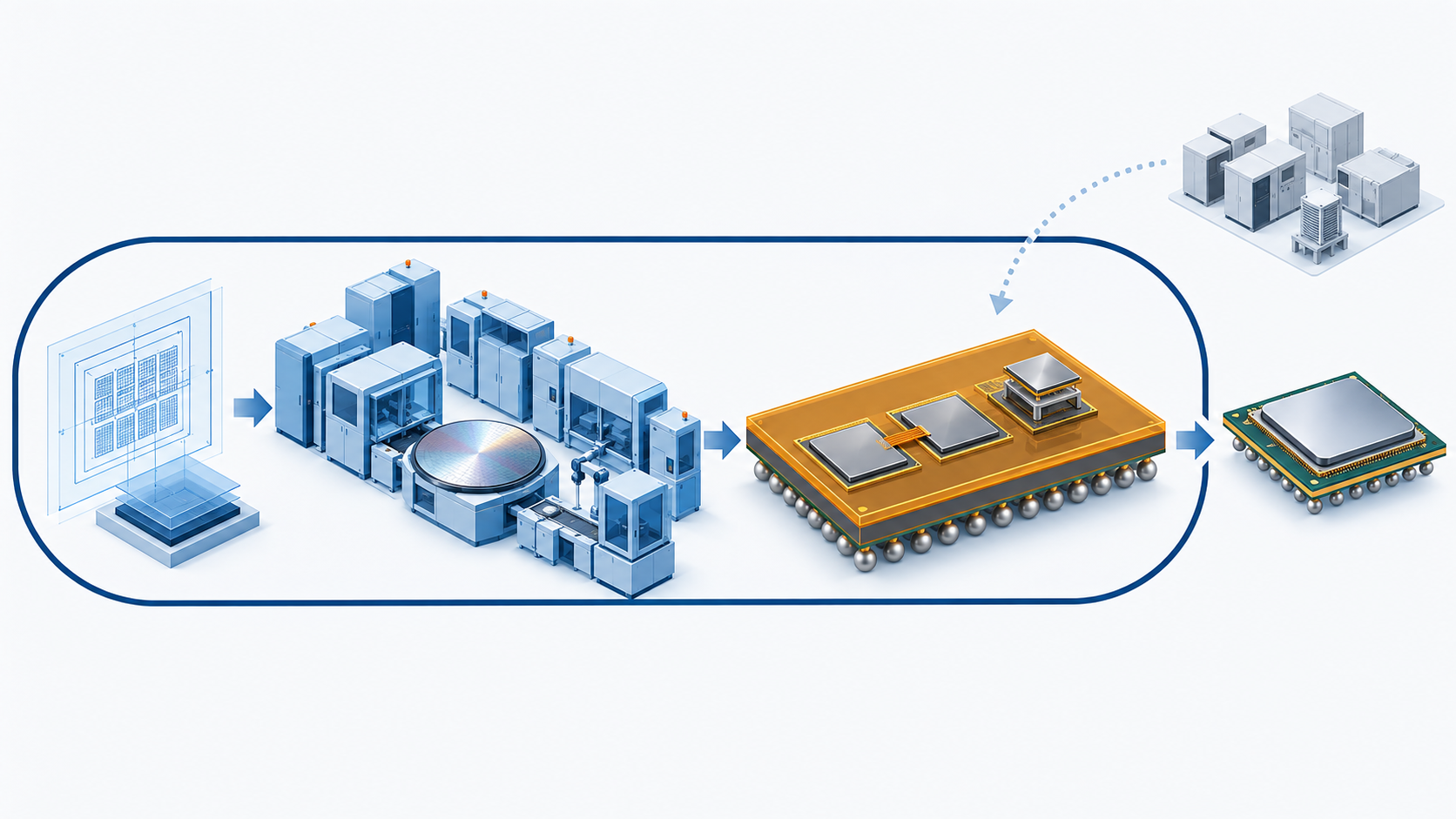 AI-generated concept
13. References
- Intel Form 10-K for the fiscal year ended 27 December 2025 (filed with the U.S. SEC on 23 January 2026). Revenue, R&D expense, operating result, capital spending, segment information, Intel Foundry external revenue and operating loss, headcount, Properties, property and equipment by country, manufacturing sites, the EMIB and Foveros generations and their production dates, the share agreements with the U.S. government, SoftBank and NVIDIA, the UMC collaboration, customer concentration and risk factors. sec.gov/Archives/edgar/data/50863/000005086326000011/intc-20251227.htm
- Intel Form 10-Q for the quarter ended 27 June 2026 (filed with the U.S. SEC on 24 July 2026). Quarterly revenue and operating result, Intel Foundry quarterly performance and external revenue, the revenue recognition basis for back-end services, the change in segment structure, and Altera becoming an external customer. sec.gov/Archives/edgar/data/50863/000005086326000157/intc-20260627.htm
- U.S. SEC EDGAR XBRL company facts API (CIK 0000050863). Revenue, R&D expense, operating result and capital spending for FY2021 to FY2025, as tagged in each year's Form 10-K. data.sec.gov/api/xbrl/companyfacts/CIK0000050863.json
- Intel Official website, used to check how the name is written and the logo. https://www.intel.com/content/www/us/en/homepage.html
14. Claim-to-source audit
| Claim in the article | Category | Source |
|---|---|---|
| Legal name, head office address, state of incorporation (Delaware), listing (Nasdaq, INTC), shares outstanding | Sourced | Reference 1 sec.gov/.../intc-20251227.htm |
| FY2025 revenue of US$52,853m, net loss of US$267m and 85,100 employees | Sourced | Reference 1 sec.gov/.../intc-20251227.htm |
| Revenue, R&D expense, operating result and capital spending for FY2021 to FY2024 | Sourced | Reference 3 data.sec.gov/.../CIK0000050863.json |
| The year-on-year figures in Fig. 1 (+1.5%, -20.2%, -14.0%, -2.1%, -0.5%) and the 66.9% of FY2021 | Our calculation | Derived from the annual revenue in reference 3 data.sec.gov/.../CIK0000050863.json |
| Revenue and operating result by segment (CCG 32,228, DCAI 16,919, Intel Products 49,147, US$m) | Sourced | Reference 1 sec.gov/.../intc-20251227.htm |
| That the company operates its own assembly and test facilities, and the 2025 back-end sites in China, New Mexico, Vietnam and Malaysia | Sourced | Reference 1 sec.gov/.../intc-20251227.htm |
| New Mexico as the lead site for advanced packaging and the new plant under construction in Malaysia | Sourced | Reference 1 sec.gov/.../intc-20251227.htm |
| The Costa Rica consolidation, the cancellations in Poland and Germany and the slower build in Ohio | Sourced | Reference 1 sec.gov/.../intc-20251227.htm |
| Intel Foundry revenue of US$17,826m, external revenue of US$307m and an operating loss of US$10,318m | Sourced | Reference 1 sec.gov/.../intc-20251227.htm |
| The 1.7% external share, the US$17,519m internal figure and the US$547m of external revenue in 2023 | Our calculation | Derived from the amounts and the change disclosed in reference 1 sec.gov/.../intc-20251227.htm |
| EMIB (volume production 2017), EMIB-T (2025), Foveros (2019), Foveros-B and R (2027 target), Foveros Direct hybrid bonding (2028) | Sourced | Reference 1 sec.gov/.../intc-20251227.htm |
| EMIB in the 4th generation Xeon, and the EMIB link between compute and I/O dies in Xeon 6 | Sourced | Reference 1 sec.gov/.../intc-20251227.htm |
| The statement that advanced packaging services are offered on wafers made at other foundries | Sourced | Reference 1 sec.gov/.../intc-20251227.htm |
| Property, plant and equipment of US$105,414m with the country split, and total assets of US$211,429m | Sourced | Reference 1 sec.gov/.../intc-20251227.htm |
| Fixed assets being twice revenue, the floor-area comparison and the 43% fall in capital spending | Our calculation | Derived from the amounts in reference 1 sec.gov/.../intc-20251227.htm |
| The 275 million shares and warrant issued to the Department of Commerce, the US$5.7bn of CHIPS Act funds, US$2bn from SoftBank and US$5bn from NVIDIA | Sourced | Reference 1 sec.gov/.../intc-20251227.htm |
| The x86 custom product collaboration with NVIDIA and the 12nm collaboration with UMC (volume production planned for 2027) | Sourced | Reference 1 sec.gov/.../intc-20251227.htm |
| The possible pause or discontinuation if Intel 14A finds no external customer, and the reference to the Ohio plant | Sourced | Reference 1, risk factors sec.gov/.../intc-20251227.htm |
| Customer concentration (top three 43%, largest 19%, receivables 47%) and ASML as sole source | Sourced | Reference 1 sec.gov/.../intc-20251227.htm |
| The US$4,526m Intel Foundry operating loss in the first half of FY2026, the recognition basis for back-end services revenue and Altera becoming an external customer | Sourced | Reference 2 sec.gov/.../intc-20260627.htm |
| The year Intel was founded | Not yet confirmed | Not given in the FY2025 10-K, so this article does not state one |
| Revenue from back-end work (assembly, test and packaging) on its own | Not yet confirmed | Not disclosed. It is inside Intel Foundry revenue but never broken out, and this article makes no estimate |
| EMIB and Foveros capacity, and share of the advanced packaging market | Not yet confirmed | No primary source exists, so this article states no figure |
| Capacity, headcount and start-up dates for each manufacturing site | Not yet confirmed | Absent from reference 1, so this article makes no estimate |
| The names of Intel Foundry's external customers | Not yet confirmed | Absent from the 10-K, so this article does not use names reported in the press |
| How a decision to stop 14A would affect advanced packaging investment | Not yet confirmed | The company states no equivalent condition for packaging, so this article asserts nothing |
| The outlook in section 10 | Not yet confirmed | An interpretation by this article, drawn from the six items in the facts table |
Last updated 21 September 2026 / Troy Technical
Every figure in this article comes from Intel's statutory filings with the U.S. Securities and Exchange Commission. No research-firm estimates or press-based figures have been used.