COMPANY PROFILE / SEMICONDUCTOR BACK-END
SPIL
The world's number three OSAT, and the year its numbers disappeared
SPIL is a Taiwanese OSAT that was once an independent company listed both in Taipei and on Nasdaq. Today it is a wholly owned subsidiary of ASE Technology Holding, and since March 2024 it has stopped publishing results of its own. A company of roughly Amkor's size, third in the world by scale, has gone dark. This profile reconstructs what was published before it did, from primary sources, and sets out where it now sits inside ASE Group, as far as that can be confirmed.
- SPIL in 30 seconds
- The logo and how the name is written
- What the company actually does: before and after ASE bought it
- Scale: the five years of revenue up to the last disclosure
- Company category and position in the back-end industry
- Sites and the countries where it manufactures
- Leading products and share in semiconductor back-end work
- Current investment plans
- Major corporate partners
- Where the company is heading in this field
- The risks this company carries
- Glossary, references and claim-to-source audit
1. SPIL in 30 seconds
(2023)The last full-year revenue published on a stand-alone basis. Nothing since
(OSAT, wholly owned by ASE)One wing of its parent's back-end business
The figures in the TSMC, ASE and Amkor profiles all came from current statutory filings. SPIL is different. It became a wholly owned subsidiary of ASE Technology Holding on 30 April 2018, ended its U.S. registration in May 2018, and stopped publishing results of its own after the monthly revenue report issued on 11 March 2024 Sourced. Its parent's Form 20-F records SPIL as a wholly owned subsidiary and nothing more; it discloses no SPIL revenue or profit. The financial figures here therefore stop at 2023, and that for revenue only. Profit and the employee breakdown stop at 2021. Stating that limit rather than papering over it is this article's policy.
2. The logo and how the name is written

The SPIL logo is a registered trademark of the company, and its parent's Form 20-F confirms that SPIL is a registered trademark in Taiwan. Nothing here is redrawn or generated; where the mark is shown it is the official file taken from the company's own website Sourced.
A note on style: in English the company is simply SPIL. Its Chinese-language short name is built on the character for silicon, so the name itself reads as precision engineering in silicon. The website has also moved, from spil.com.tw to spilglobal.com, and the old address now redirects.
Official site: https://www.spilglobal.com/About/Overview3. What the company actually does: before and after ASE bought it
SPIL's core business is exactly what ASE's and Amkor's is: contract back-end work. Its website describes its services as one-stop coverage from wafer bumping and wafer test through IC packaging, IC test and direct shipment Sourced. On that alone this article would simply repeat the ASE profile. SPIL is worth treating on its own because this company is itself the process by which an independent OSAT disappears.
How the merger came about
| When | What happened |
|---|---|
| May 1984 | Founded |
| April 1993 | Listed on the Taiwan Stock Exchange |
| June 2000 | ADSs listed on Nasdaq under the ticker SPIL, one ADS representing five ordinary shares |
| August and September 2015 | ASE's first tender offer: 779 million ordinary shares at NT$45 each |
| December 2015 to March 2016 | ASE's second tender offer, at NT$55. It lapsed when Taiwan's Fair Trade Commission did not clear it within the deadline |
| 30 June 2016 | ASE and SPIL signed a joint share exchange agreement |
| November 2017 | China's antitrust authority cleared the combination with conditions |
| 30 April 2018 | The share exchange completed. ASE and SPIL both became wholly owned subsidiaries of ASE Technology Holding |
| 2 May 2018 | SPIL filed a Form 15 with the U.S. SEC, ending its U.S. registration |
| March and April 2024 | The last monthly revenue report, issued 11 March. Taiwanese authorities approved the termination of public issuance for both ASE and SPIL |
The shape of the acquisition is what matters. ASE did not absorb SPIL by merger. A new holding company, ASE Technology Holding, was created above both, and the two were hung beneath it as equals Sourced. The parent's Form 20-F writes SPIL in parallel with ASE, saying the holding company directly controls ASE Group, SPIL Group and USI Group. For that reason SPIL has gone on operating as a separate legal entity, a separate brand and a separate set of plants. It was not swallowed and erased.
A holding-company merger has direct consequences for selling materials. SPIL has its own plants across Taichung, Changhua, Yunlin and Hsinchu, and as of 2021 it ran 10,634 wire bonders and 1,521 testers on its own account Sourced. Set against the whole of ASE Group, 25,001 wire bonders and 7,456 testers as of January 2026, SPIL clearly accounted for a substantial part of the group's equipment Our calculation. Separate entities with separate plants normally means separate material qualification runs. A record of being designed into ASE Group does not automatically carry into SPIL's plants, and in the practical business of selling back-end materials that matters.
4. Scale: the five years of revenue up to the last disclosure
| Year | Revenue (NT$m) | Operating income (NT$m) | Net income (NT$m) | Earnings per share (NT$) |
|---|---|---|---|---|
| 2017 | 83,554 | 8,675 | 6,900 | 2.21 |
| 2018 | 87,417 | 9,198 | 7,690 | 2.38 |
| 2019 | 88,988 | 9,108 | 7,511 | 2.24 |
| 2020 | 102,036 | 12,368 | 11,496 | 3.15 |
| 2021 | 107,839 | 20,708 | 17,716 | 4.85 |
| 2022 | 130,787 | not disclosed | not disclosed | not disclosed |
| 2023 | 113,166 | not disclosed | not disclosed | not disclosed |
The 2017 to 2021 rows come from the five-year consolidated income statement in the 2021 annual report and are audited. Revenue for 2022 and 2023 is the full-year figure printed in the December monthly revenue report; no profit figures were published. From 2024 onwards not even revenue is published.
What stands out is how profit jumped in 2021. Revenue rose only 5.7%, yet operating income went from NT$12.4bn to NT$20.7bn, up 67%, and net income from NT$11.5bn to NT$17.7bn, up 54% Our calculation. Gross margin rose from 21.9% to 27.9% as well, which reads as a year when prices and utilisation went up together in the middle of the chip shortage. Then, right after revenue hit an all-time high of NT$130.8bn in 2022, 2023 fell 13.5%. The swing of the back-end cycle shows up undiluted.
The workforce, as last disclosed in 2021
| Category | End 2020 | End 2021 | 28 February 2022 |
|---|---|---|---|
| Engineers | 8,195 | 8,163 | 8,170 |
| Managers | 1,737 | 2,095 | 2,201 |
| Clerical staff | 1,073 | 1,084 | 1,083 |
| Operators (shop floor) | 11,315 | 11,703 | 11,178 |
| Total | 22,320 | 23,045 | 22,632 |
At the end of 2021 the average age was 36.2 and average tenure 8.3 years. By education the split was 0.1% PhDs, 6.2% master's degrees, 54.6% bachelor's and junior college, 35.2% high school and 3.9% other. That is the exact inverse of TSMC, where more than half hold a master's degree or above, and it shows how far the back end rests on shop-floor work.
The official website currently says about 32,000 people worldwide Sourced. That would be an increase of roughly 9,000 on the 23,045 of end 2021, but the website gives no date for the figure, so which point in time it refers to cannot be confirmed Not yet confirmed.
5. Company category and position in the back-end industry
The category is manufacturer, an OSAT, but not an independent one: it is effectively a division of ASE Group. How much weight it carries inside the group can be seen from the figures that exist.
Ranked by back-end revenue alone, the three companies in this series line up as follows Our calculation.
| Company | Annual back-end revenue | As of | Note |
|---|---|---|---|
| ASE Group (ATM) | NT$380.2bn (US$12.1bn) | 2025 | The whole group's back end, SPIL included |
| Amkor | US$6.7bn | 2025 | The whole company is back end. U.S. head office |
| SPIL | NT$113.2bn (2023) | 2023 | Contained within ASE Group. Nothing published from 2024 |
Exchange rates differ by year and by company, so a strict cross-currency ranking is not possible. Even so, SPIL's 2023 revenue of NT$113.2bn was about 37% of ASE Group's ATM revenue of NT$306.7bn that year, which puts it, on its own, close to Amkor in scale. Had SPIL stayed independent it would be counted today among the world's three largest OSATs Not yet confirmed.
6. Sites and the countries where it manufactures
Its sites are in three countries: Taiwan, China and the United States. The concentration in Taiwan is even higher than at ASE or Amkor Sourced.
| Country or region | Sites | Role |
|---|---|---|
| Taiwan, Taichung | Dafeng (head office), Zhongshan, Central Taiwan Science Park at Daya, Tanzi Technology Park, Xitun, Houli | The core. Six sites cluster inside Taichung around the Dafeng plant at head office |
| Taiwan, Changhua | Changhua (Hemei) and the second Central Taiwan Science Park plant at Erlin | Erlin is an expansion site inside the science park |
| Taiwan, Yunlin | Huwei | The company's foothold in Yunlin County |
| Taiwan, Hsinchu | Hsinchu plants 1 and 3, and Jieshou Building A | Inside Hsinchu Science Park, close to the front-end foundries |
| China | Suzhou (Siliconware Technology (SuZhou) Limited) | Assembly and test. The parent's Form 20-F gives 2,171 thousand sq. ft. of floor space |
| United States | San Jose, California (Siliconware USA, Inc.) | Sales and technical support |
The parent's Form 20-F puts the combined floor space of SPIL's Taiwanese sites, across Taichung, Changhua, Yunlin and Hsinchu, at 11,429 thousand sq. ft. That is larger than ASE's own Kaohsiung plant, at 10,795 thousand sq. ft. Sourced. Labelled a subsidiary inside the group, SPIL is nonetheless a physical equal of ASE proper. That is why it should not be read as merely a division.
ASE's centre of gravity is Kaohsiung, a port city in the south, and TSMC's advanced packaging is in Tainan, in the southern science park. SPIL's weight sits in central Taiwan, across Taichung, Changhua and Yunlin Sourced. Since 2021 it has added central sites one after another: Erlin in Changhua, Tanzi and Houli in Taichung, and Huwei in Yunlin. For the practical business of delivering materials and supporting them technically, that means selling to Taiwan's OSATs splits into a southern route, for ASE and TSMC, and a central route, for SPIL. Within the same island, Hsinchu, Taichung, Tainan and Kaohsiung are separate logistics and separate travel.
7. Leading products and share in semiconductor back-end work
The revenue mix, as last disclosed in 2021
Technology: it had 2.5D and fan-out of its own
Through the merger and after it, SPIL has kept adding advanced packaging to volume production Sourced.
- 2.5D platform
- In volume production since April 2017. Several dies placed side by side on a silicon interposer, the same ground TSMC's CoWoS occupies.
- HBW-PoP
- In volume production since September 2016. High-bandwidth package-on-package, in which one package is stacked on another.
- AiP-SiP
- In volume production for the 28 and 39GHz bands since December 2018, and for large antenna arrays since January 2020. Antenna-in-package for 5G millimetre wave.
- FO-MCM
- In volume production since May 2020. A fan-out module carrying several dies in one package.
- FO-EB
- In volume production since March 2021. A silicon bridge embedded in the fan-out layers to link dies at high density.
- FCCSP and FCBGA
- The main flip chip families. FCCSP using 5nm wafers entered volume production in July 2019. FCBGA covers sizes from 11mm square up to 89 by 98mm.
R&D expense in 2021 was NT$4.39bn, or 4.1% of revenue Our calculation. Against ASE Group as a whole that year, NT$21.05bn and 3.7% of revenue, SPIL was the heavier spender on research relative to its size.
On market share, plainly
No primary source gives SPIL a world market share. The 2021 annual report carries no share figure of its own, only an industry observation that the top three back-end contractors would approach their 2022 expansion plans positively but prudently Sourced. And from 2022 onwards the breakdowns by business, customer and region have not been published at all Not yet confirmed. Estimates from research firms or the press are not used here.
8. Current investment plans
On SPIL's investment plans, there is no primary source that speaks in money Not yet confirmed. Its parent's Form 20-F splits capital expenditure only by segment, between packaging, test, EMS and other, and does not separate SPIL from ASE proper.
What can be confirmed instead is the growth in the number of sites. The history in the 2021 annual report records an investment in the Erlin park of the Central Taiwan Science Park in April 2021, and the acquisition of a new plant in the Tanzi technology park in Taichung in October 2021 Sourced. The current site list on the official website then adds two more that were not there at the time of that report: Houli in Taichung and Huwei in Yunlin County Sourced. The amounts are unknown, but the site count keeps rising. That is the whole of what the primary sources support.
When a counterparty stops disclosing, as SPIL has, three handles remain outside the financials: (1) the site list on the official website and how it changes, (2) floor space and equipment counts that appear in the parent's statutory filings, and (3) job postings. This article has used the first two. The 11,429 thousand sq. ft. of Taiwanese floor space in ASE's Form 20-F is one of the few handles from which a subsidiary's scale can be worked back out of a parent's disclosure. Put the other way round, the capital spending of a back-end company that has gone private becomes hard for a materials supplier to see coming, and the further consolidation goes, the worse that gets Not yet confirmed.
9. Major corporate partners
| Kind | Counterparty | Substance | Primary source |
|---|---|---|---|
| Parent | ASE Technology Holding | The sole shareholder, holding 100% of SPIL's 3,651,748,878 issued shares as of 28 February 2022. The shareholder count is one, a single corporate holder | SPIL's 2021 annual report Sourced |
| Sister companies | ASE Inc. and USI | SPIL's own website states that it sits under ASE Technology Holding alongside ASE and USI | SPIL's official website Sourced |
| Subsidiaries | Siliconware Technology (SuZhou), Siliconware USA, Siliconware Precision Malaysia, Siliconware Investment | The subsidiary list in ASE's Form 20-F records each of these as held through SPIL | ASE's FY2025 Form 20-F Sourced |
| Past alliances | None on record | Before the merger SPIL served a wide customer base as an independent, but it has never disclosed a customer name; even the annual report writes them as A, B and C | SPIL's 2021 annual report Not yet confirmed |
The ASE profile noted that ASE has been designated a non-exclusive preferred packaging supplier to TSMC since 1997. That alliance is between ASE Inc. and TSMC, and that is how ASE's Form 20-F puts it. No separate alliance between SPIL and TSMC could be confirmed from the primary sources consulted here Not yet confirmed. SPIL's Hsinchu plants sit inside Hsinchu Science Park, geographically right next to TSMC's main fabs, but proximity is not evidence of an alliance.
10. Where the company is heading in this field
What is established
| Fact | What it implies for the back end |
|---|---|
| Stand-alone reporting stopped after March 2024 | There is no longer any way to follow results from outside. The parent's figures are all that is left |
| As of 2023 SPIL was about 37% of ASE Group's back-end revenue | Too large to ignore inside the group. More than a third of ASE's number can be taken to come from SPIL |
| Taiwanese floor space of 11,429 thousand sq. ft. exceeds ASE's own Kaohsiung plant | It has kept a production base of its own since the merger |
| Since 2021 it has added Erlin, Tanzi, Houli and Huwei in central Taiwan | Expansion is continuing |
| 2.5D entered volume production in 2017 and FO-EB in 2021 | It brought advanced packaging assets into the group |
| The merger used a holding company, and SPIL survives as a separate entity | Unlike an absorption, the plants and their qualifications keep running separately |
Outlook
Not yet confirmed Read plainly, the facts above point to SPIL fading as a brand while surviving as capacity. Now that stand-alone disclosure has stopped, the name will gradually drop out of industry writing and statistics. Meanwhile the plants spread across central Taiwan, and more than twenty thousand people, keep working as ASE Group's back-end capacity. When AI demand washes through to the OSATs, it is natural, going by floor space and site count, to expect SPIL's sites to carry a substantial share of ASE Group's headroom to expand.
Not yet confirmed The practical implication for a reader is a switch: stop following SPIL as a company and start treating it as ASE Group's central-Taiwan cluster. In a materials or equipment negotiation it behaves as a separate entity with separate qualifications; in investment analysis or market sizing it counts inside ASE's numbers. That double handling is the realistic one. SPIL could start reporting on its own again, but no primary source currently suggests it will.
11. The risks this company carries
| Risk | Substance | Supporting figures |
|---|---|---|
| The break in disclosure | Since March 2024 neither results nor investment plans have been published. Customers and materials suppliers have little to go on for credit or capacity planning | The last monthly revenue report, for February, was issued on 11 March 2024 |
| Customer concentration | In 2021 the top two customers were 33.7% of revenue; in 2020 three customers exceeded 10% and the largest, customer C, was 26.7%. The mix moves sharply from year to year | 2021: customer A 18.8% plus customer B 14.9% Our calculation |
| Cyclicality | The year after an all-time high of NT$130.8bn in 2022, revenue fell 13.5% in 2023. It takes the back-end swing full on | NT$130.8bn in 2022 against NT$113.2bn in 2023 |
| Geographic concentration | Production sits only in Taiwan and Suzhou in China. Against ASE in 17 countries and Amkor in eight, almost no dispersal has happened | The site list on the official website Our calculation |
| Litigation from the merger | Criminal insider dealing proceedings over the 2015 and 2016 tender offers for SPIL are still live. On 11 February 2026 the Kaohsiung District Court acquitted one officer, and prosecutors appealed on 2 March | Stated in ASE's FY2025 Form 20-F. The outcome is undetermined |
| Its standing inside the group | Both capital allocation and customer assignment rest with the parent. Nothing observable from outside is a decision SPIL made alone | The holding company owns 100% of the votes |
12. Glossary
- OSAT
- Outsourced Semiconductor Assembly and Test. A company that takes on semiconductor back-end work, meaning assembly and test, on contract. SPIL, ASE and Amkor are examples.
- Share exchange
- A reorganisation in which a single new holding company is created above two companies, each becoming its wholly owned subsidiary. Unlike a merger, both survive as separate entities.
- Tender offer
- A procedure in which a buyer publishes a price and a period and gathers shares outside the market. ASE ran two of them at SPIL in 2015.
- Form 15
- The filing that ends a registration with the U.S. SEC. Once submitted, obligations such as the annual Form 20-F cease.
- Termination of public issuance
- A Taiwanese procedure that ends the public disclosure obligations which survive a delisting. ASE and SPIL were approved for it in March and April 2024.
- 2.5D
- Several dies placed side by side on a silicon interposer and wired together at high density. SPIL began volume production in April 2017.
- FO-EB
- Fan-Out Embedded Bridge. A small silicon bridge embedded in the redistribution layers of a fan-out package to link dies at high density.
- AiP
- Antenna in Package, building the antenna into the package itself. Required in 5G millimetre-wave devices.
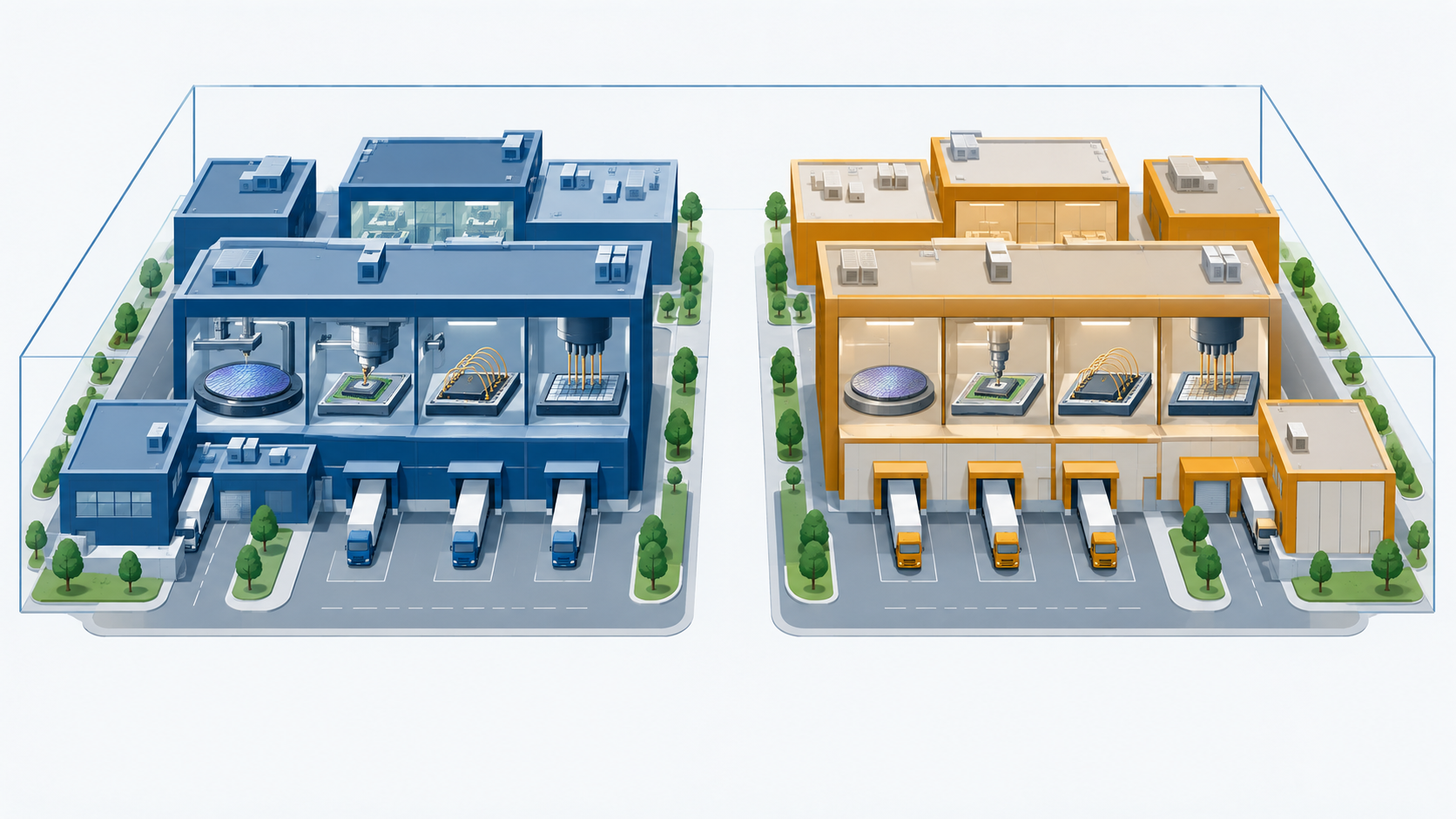 AI-generated concept
13. References
- SPIL 2021 Annual Report, English edition. Date of incorporation, head office address, shareholder structure with the holding company at 100%, the consolidated income statement and balance sheet for 2017 to 2021, the workforce by job type and education, revenue by business and by region, the amounts and percentages for customers above 10%, wire bonder and tester counts, R&D expense, the years each technology entered volume production, and the company history. https://www.spilglobal.com/Files/reports/2286/110%E8%8B%B1%E6%96%87%E5%B9%B4%E5%A0%B1-EN.pdf
- SPIL Monthly Sales Report, December 2023 (issued 9 January 2024). Full-year 2023 consolidated revenue of NT$113,166m, down 13.5% year on year, and full-year 2022 of NT$130,787m. https://www.spilglobal.com/Files/reports/Monthly_Sales/2023/Monthly%20revenue%20Dec%202023%20ENG.pdf
- SPIL Monthly Sales Report, February 2024 (issued 11 March 2024). The last monthly revenue report SPIL published. Consolidated revenue of NT$8,054m for February 2024. https://www.spilglobal.com/Files/reports/Monthly_Sales/2024/Monthly%20revenue%20Feb%202024%20ENG.pdf
- SPIL Financials (the financial information page of the official website). The index of monthly revenue reports, used to confirm that it stops at February 2024 after running from 2015. https://www.spilglobal.com/Finance
- SPIL Company Profile (the corporate overview on the official website). Incorporation in May 1984, head office address, capital, about 32,000 employees, 2023 revenue of about NT$113.2bn, its place under the holding company, and the services it offers. https://www.spilglobal.com/About/Overview
- SPIL Location and Contact (the site list on the official website). The addresses of the twelve Taiwanese sites, Suzhou in China and San Jose in the United States. https://www.spilglobal.com/About/Locations
- ASE Technology Holding Form 20-F for the fiscal year ended December 31, 2025 (filed with the U.S. SEC on 1 April 2026). How SPIL became a wholly owned subsidiary, when public issuance was terminated, SPIL's plant locations and floor space, the list of SPIL's own subsidiaries, 2023 revenue by segment, group capital expenditure and the litigation. https://www.sec.gov/Archives/edgar/data/1122411/000119312526135585/d50802d20f.htm
- SPIL Form 20-F for the fiscal year ended December 31, 2017 (filed with the U.S. SEC on 27 March 2018). The last annual report SPIL filed on its own. The Taiwan Stock Exchange listing of April 1993, the Nasdaq ADS listing of June 2000 with one ADS representing five ordinary shares, and the terms of the share exchange agreement with ASE. https://www.sec.gov/Archives/edgar/data/1111759/000119312518096596/d447435d20f.htm
- SPIL Form 15-12G (filed with the U.S. SEC on 2 May 2018). The notice ending its registration in the United States. https://www.sec.gov/Archives/edgar/data/1111759/000119312518147418/d570294d1512g.htm
- U.S. SEC EDGAR XBRL company facts API (CIK 0001111759). Revenue, operating income, R&D expense and capital expenditure for 2015 to 2017, as tagged in SPIL's final Form 20-F. https://data.sec.gov/api/xbrl/companyfacts/CIK0001111759.json
14. Claim-to-source audit
| Claim in the article | Category | Source |
|---|---|---|
| Legal name, head office address, incorporation in May 1984, capital, about 32,000 employees, 2023 revenue of about NT$113.2bn, and its place under ASE | Sourced | Reference 5 https://www.spilglobal.com/About/Overview |
| The Taiwan Stock Exchange listing of April 1993 and the Nasdaq listing as SPIL of June 2000, one ADS representing five ordinary shares | Sourced | Reference 8 https://www.sec.gov/Archives/edgar/data/1111759/000119312518096596/d447435d20f.htm |
| The course of the merger from 2015 to 2018, the two tender offers, the share exchange and the completion on 30 April 2018, and the termination of public issuance in March and April 2024 | Sourced | Reference 7 https://www.sec.gov/Archives/edgar/data/1122411/000119312526135585/d50802d20f.htm |
| The end of U.S. registration on 2 May 2018 | Sourced | Reference 9 https://www.sec.gov/Archives/edgar/data/1111759/000119312518147418/d570294d1512g.htm |
| Revenue, operating income, net income and earnings per share for 2017 to 2021, the workforce by job type and education, and an average age of 36.2 with average tenure of 8.3 years | Sourced | Reference 1 https://www.spilglobal.com/Files/reports/2286/110%E8%8B%B1%E6%96%87%E5%B9%B4%E5%A0%B1-EN.pdf |
| NT$130,787m in 2022 and NT$113,166m in 2023, down 13.5% | Sourced | Reference 2 https://www.spilglobal.com/Files/reports/Monthly_Sales/2023/Monthly%20revenue%20Dec%202023%20ENG.pdf |
| That stand-alone reporting stops with the issue of 11 March 2024 | Sourced | References 3 and 4 https://www.spilglobal.com/Finance |
| Operating income up 67% and net income up 54% in 2021, gross margin from 21.9% to 27.9%, and R&D at 4.1% of revenue | Our calculation | Derived from the amounts in reference 1 https://www.spilglobal.com/Files/reports/2286/110%E8%8B%B1%E6%96%87%E5%B9%B4%E5%A0%B1-EN.pdf |
| The 2021 business mix (packaging 82.6%, test 15.3%, other 2.1%), the 26.0% domestic and 74.0% overseas split, customer A at 18.8% and B at 14.9%, and customer C at 26.7% in 2020 | Our calculation | Percentages derived from the amounts in reference 1 https://www.spilglobal.com/Files/reports/2286/110%E8%8B%B1%E6%96%87%E5%B9%B4%E5%A0%B1-EN.pdf |
| 10,634 wire bonders and 1,521 testers at the end of 2021, and R&D expense of NT$4.39bn | Sourced | Reference 1 https://www.spilglobal.com/Files/reports/2286/110%E8%8B%B1%E6%96%87%E5%B9%B4%E5%A0%B1-EN.pdf |
| The years each technology entered volume production (2.5D April 2017, AiP-SiP December 2018, FO-MCM May 2020, FO-EB March 2021, 5nm FCCSP July 2019) and the 2021 investments at Erlin and Tanzi | Sourced | The company history in reference 1 https://www.spilglobal.com/Files/reports/2286/110%E8%8B%B1%E6%96%87%E5%B9%B4%E5%A0%B1-EN.pdf |
| Twelve Taiwanese sites plus Suzhou and San Jose, and the existence of the Houli and Huwei plants | Sourced | Reference 6 https://www.spilglobal.com/About/Locations |
| SPIL's Taiwanese floor space of 11,429 thousand sq. ft., larger than ASE's Kaohsiung plant at 10,795 thousand, and Suzhou at 2,171 thousand | Sourced | The plant list in reference 7 https://www.sec.gov/Archives/edgar/data/1122411/000119312526135585/d50802d20f.htm |
| Fig. 2: SPIL at 19.4% of ASE Group revenue in 2023 and about 37% of its back end | Our calculation | Derived by setting the 2023 segment revenue in reference 7 against SPIL's revenue in reference 2. The definitions do not match exactly, so this is an approximation https://www.sec.gov/Archives/edgar/data/1122411/000119312526135585/d50802d20f.htm |
| The holding company owning 100% of SPIL's 3,651,748,878 shares, with a shareholder count of one | Sourced | Reference 1, as of 28 February 2022 https://www.spilglobal.com/Files/reports/2286/110%E8%8B%B1%E6%96%87%E5%B9%B4%E5%A0%B1-EN.pdf |
| SPIL's profit, capital expenditure and business mix from 2022 onwards | Not yet confirmed | Not published. The parent does not break SPIL out either https://www.sec.gov/Archives/edgar/data/1122411/000119312526135585/d50802d20f.htm |
| SPIL's world market share, its advanced packaging capacity and the names of its customers | Not yet confirmed | No primary source exists. Even the annual report writes customers only as A, B and C https://www.spilglobal.com/Files/reports/2286/110%E8%8B%B1%E6%96%87%E5%B9%B4%E5%A0%B1-EN.pdf |
| The date to which the "about 32,000 employees" figure refers | Not yet confirmed | The website gives no date, so the gap against 23,045 at end 2021 cannot be verified https://www.spilglobal.com/About/Overview |
| A separate alliance between SPIL and TSMC | Not yet confirmed | Could not be confirmed. The alliance recorded in ASE's Form 20-F is between ASE Inc. and TSMC https://www.sec.gov/Archives/edgar/data/1122411/000119312526135585/d50802d20f.htm |
| The outlook in section 10, and the reading on the loss of visibility after going private | Not yet confirmed | An interpretation by this article, drawn from the six items in the facts table https://www.spilglobal.com/About/Overview |
Last updated 21 September 2026 / Troy Technical
Every figure in this article comes from SPIL's own annual report, monthly revenue reports and website, from the statutory filings its parent ASE Technology Holding has made with the U.S. Securities and Exchange Commission, or from SPIL's own earlier SEC filings. No research-firm estimates or press-based figures have been used.