TECHNOLOGY EXPLAINER
What an Anode-Free Cell Is
— the anode you do not build, and what it removes from the factory
Ship the cell without an anode and let the first charge create one in place. It sounds like a materials story, but the biggest effect lands on manufacturing. Coating, drying, pressing — the whole line goes. In their place, the surface of the current collector, until now a supporting part, takes the lead.

- What an anode-free cell is (the short version)
- Three ways to provide an anode, seen from the factory floor
- The process steps that vanish
- A materials engineer's view (1): the lead role moves from anode material to collector surface
- A materials engineer's view (2): the cell that ships is unfinished
- The numbers — what 900 Wh/L means
- Where industry stands
- What is still hard
- Glossary / Primary sources / Claim-to-source audit
Sourced = a value stated in published material from a research institute or manufacturer (link given)
Our calculation = a figure this article derived, with the assumptions spelled out
Not yet confirmed = a plan or a target with no confirmed production record
Structural readings and materials-design interpretations are marked separately as Commentary.
This series also has a Lithium metal anode article, which covers lithium metal as a material (theoretical capacity, why no host structure is needed, the properties of plated lithium). This article looks at the same technology from the structural and manufacturing side. To avoid repetition, capacity comparisons and plating mechanisms are left to that article, and this one stays on process, plant and quality assurance.
1. What an anode-free cell is (the short version)
An anode-free structure is a cell assembled without any anode active material, in which the anode is generated in place during the first charge.
QuantumScape describes its own design this waySourced.
"The QuantumScape design is 'anode-free' in that the battery is manufactured anode free in a discharged state, and the anode forms in situ on the first charge."
Of the anode itself: "a pure lithium-metal anode with zero excess lithium" (QuantumScape technology page)
- What is not made: the anode active material. Neither graphite nor lithium foil exists at shipment
- What is there: the current collector foil alone, plus the solid electrolyte and the cathode
- When the anode appears: on the first charge, as lithium moving out of the cathode plates onto the collector
QuantumScape uses anode-free; Samsung SDI uses anode-lessSourced. This article uses anode-free throughout for consistency (our own choice).
2. Three ways to provide an anode, seen from the factory floor
There are three ways to arrive at an anode. Line them up by number of process steps rather than by cell performance.
Three ways to prepare the negative-electrode side
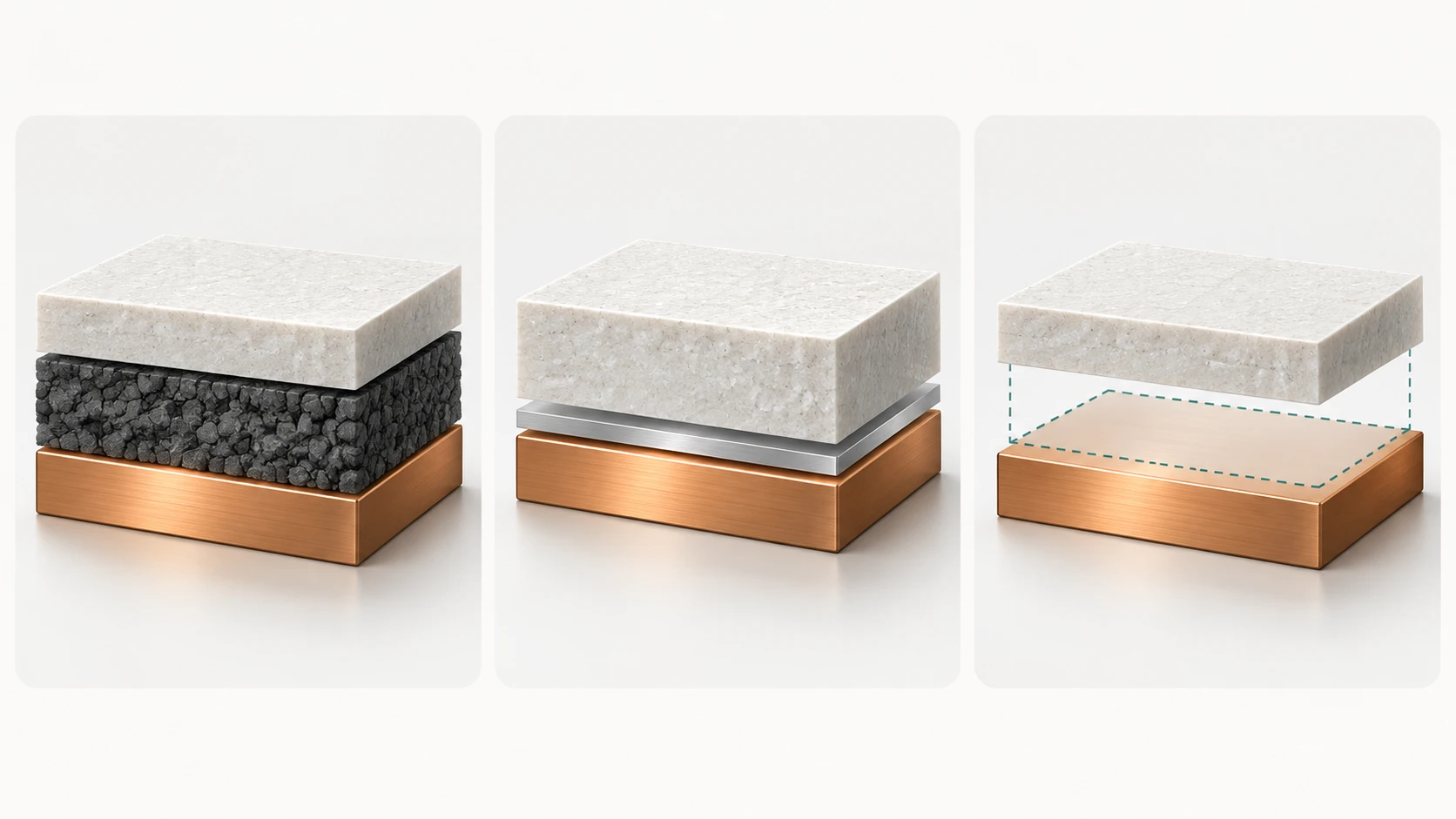
- Graphite: coat a graphite layer on the current collector
- Lithium metal: place a thin lithium foil on the collector
- Anode-free: ship without anode material; lithium plates on first charge
3. The process steps that vanish
This is where anode-free really pays. Not making an anode means not needing the equipment that makes one.
Electrode coating is one of the most equipment-hungry parts of lithium-ion manufacture. Mix the slurry, coat the foil evenly, run it through a long drying oven, recover the solvent, press it to density. With no anode, half that line goes.
Samsung SDI describes its anode-less technology as "innovative anode-less technology to reduce the volume of the anode and increase the energy density"Sourced. What is published is about volume and energy density, but less volume also means fewer processes making that volume (our commentary).
The Dry electrode article in this series covers how sulfide electrolytes' sensitivity to water narrows the choice of solvent and pushes towards dry routes. Anode-free solves the same problem on the anode side by deleting the process altogether. Rather than agonising over the solvent, do not coat at all (our commentary).
4. A materials engineer's view (1): the lead role moves from anode material to collector surface
Take away the anode material and responsibility moves with it. What decides where and how lithium plates is now only the surface that receives it.

A conventional collector (copper foil) exists to gather current and to hold the coated active material. What it needs is conductivity, strength and adhesion to the active material.
In an anode-free cell a new duty is added: to receive lithium uniformly. That is a requirement of an entirely different character (our commentary).
- Uniform nucleation: if plating concentrates at particular points, those points thicken and eventually start a short
- Wetting: does the lithium spread across the face or bead up? If it does not spread, contact is lost
- Surface cleanliness: oxide films and contamination change the distribution of nucleation
- Reversibility: on discharge the lithium has to strip away cleanly. What stays behind seeds the next non-uniformity
In short, the collector turns from a component that carries current into a functional surface that controls plating. The point made in the Interfacial resistance article in this series, that contact decides performance, appears here in the form of contact that has to be rebuilt from nothing every single cycle (our commentary).
Putting down a layer that helps nucleation
Instead of engineering the collector surface itself, one design choice is to place a thin interlayer on it.
In 2020 the Samsung Advanced Institute of Technology and co-authors published a paper in Nature Energy titled "High-energy long-cycling all-solid-state lithium metal batteries enabled by silver–carbon composite anodes"Sourced.
At the time of writing, the full text of the paper was behind authentication on the publisher's site, so neither the abstract nor any figures could be checked directly. This article therefore gives only the title, the journal and the year of publication, and quotes no numbers at all for layer thickness, energy density or cycle count.
Samsung SDI's own pages, likewise, describe the anode-less technology only as a technology that reduces the volume of the anode and do not state the composition of the material used for the anodeSourced. This article does not identify the anode material in the company's products.
The idea itself — giving lithium a scaffold to attach to on the collector — shows that the object of materials design has changed (our commentary).
A conventional anode material is a container for lithium: ions move in and out between graphite layers. An anode-free interlayer stores nothing. What stores the charge is the plated lithium metal itself. The interlayer's only job is to decide where and how the lithium attaches.
A material with no capacity governs the capacity. That shape is familiar in adhesives, encapsulants and functional materials, but its arrival at the anode of a battery is new (our commentary).
5. A materials engineer's view (2): the cell that ships is unfinished
There is a second way the logic of manufacturing changes. Read the QuantumScape sentence again.
"the battery is manufactured anode free in a discharged state, and the anode forms in situ on the first charge"Sourced.
When the cell leaves the factory it has no anode. It is not yet a complete battery.
For a materials supplier this is a heavy consequence. The anode does not exist as a part, so its quality cannot be measured before shipment.
What, then, do you guarantee? The collector surface, and the repeatability of the plating that happens on it. But the plating happens after the cell is assembled and sealed. The anode first appears where nobody can see inside.
The shape of the guarantee therefore changes (our commentary).
- Conventional: make the anode, measure it, assemble only the good ones
- Anode-free: fix a surface specification for the collector, lock the process conditions, and confirm from the behaviour of the finished cell
The idea of known good die (KGD) covered in the Test article of the semiconductor back-end series does not apply. There is no part that can be known good before assembly. The first charge becomes the last step of manufacturing (our commentary).
6. The numbers — what 900 Wh/L means
Samsung SDI publishes specific figures for its all-solid-state batterySourced.
| Item | As published |
|---|---|
| Energy density | 900 Wh/L, 40% higher than the prismatic cells the company produces today |
| Anode | "innovative anode-less technology to reduce the volume of the anode and increase the energy density" |
| Effect on the cathode side | "anode-less technologies, the latter of which enables higher cathode capacity" |
| Separator | "solid electrolytes can replace the role of a separator, the energy density can be increased by removing the separator" |
| Production timing | Targeting volume production in 2027Not yet confirmed |
| Pilot line | A 6,500 m² "S-line" at the Suwon R&D centre, supplying prototype samples |
All Sourced (Samsung SDI newsroom [Source 2] and press release [Source 3]).
What is published is two things: 900 Wh/L and 40% higher than the prismatic cells in production. From those, work out the volume needed to carry the same energyOur calculation.
- Energy density of the comparison cell = 900 divided by 1.40 = about 643 Wh/L
- Volume to carry 75 kWh
comparison cell: 75,000 divided by 643 = about 117 L
at 900 Wh/L: 75,000 divided by 900 = about 83 L - A difference of about 34 L, so volume falls by about 29%
Assumptions and limits: the 75 kWh is our own assumption and varies by vehicle. And 900 Wh/L is a cell-level volumetric energy density; a real automotive pack adds modules, cooling and housing, so it does not mean that a whole pack shrinks by 29%. The specific product used as the 40% baseline, described only as prismatic cells in production, is not named publicly either.
7. Where industry stands
QuantumScape — not building them, but handing over how to build them
On 18 June 2026 QuantumScape announced a joint development agreement with Honda R&D Co., Ltd., Honda's research subsidiarySourced. The company describes it as "a multi-year plan focused on solid-state battery development and associated manufacturing processes"Sourced. On applications it states: "We see potential for QS technology to add value across a range of applications, including automotive"Sourced.
What stands out in the announcement is that the joint work explicitly covers not only the battery itself but "associated manufacturing processes"Sourced.
As Section 3 showed, anode-free is a technology that changes the whole process. Handing over a material is not enough; how it is built has to be settled jointly — which is how the wording of the agreement reads (our commentary).
The PLP and OSAT articles in this series cover the same move towards developing material, equipment and design together. The newer the process, the less a material can be sold on its own. Same shape (our commentary).
Samsung SDI — a 2027 production target
Samsung SDI states a target of volume production in 2027 for all-solid-state batteries using its anode-less technologySourcedNot yet confirmed. It says it is supplying prototype samples from the 6,500 m² "S-line" at its Suwon R&D centreSourced.
8. What is still hard
(1) No margin — zero excess lithium
QuantumScape describes its anode as "a pure lithium-metal anode with zero excess lithium"Sourced.
Excess lithium is, in effect, stock. A little is lost on every cycle, but while the stock lasts the capacity holds up. The price is that the cell is thicker and heavier by exactly that much.
Anode-free carries no stock. What is lost comes straight off the capacity. Which is why it is light — and why the reversibility of a single cycle sits at the centre of the design (our commentary).
This is where Section 4 comes back. A poor collector surface skews the plating, leaves residue behind on stripping, and seeds the non-uniformity of the next cycle. The surface specification is the life specification.
(2) You cannot see what is happening from outside
The anode forms inside a sealed cell. There is no way to check directly, before shipment, whether the plating is uniform. As Section 5 set out, quality assurance ends up resting on fixed process conditions and indirect confirmation from cell behaviour (our commentary).
(3) No production record yet
Samsung SDI's production target is 2027, and the QuantumScape and Honda agreement is at the stage of a multi-year joint developmentSourced. At the time of writing (September 2026), no official announcement confirming that an anode-free automotive all-solid-state battery has entered full volume production could be foundNot yet confirmed.
- Anode-free means shipping without an anode and generating it in place on the first charge. QuantumScape states that the battery is manufactured anode free in a discharged state and the anode forms in situ on the first chargeSourced
- The largest effect lands on manufacturing. Slurry mixing, coating, drying, pressing and slitting of the anode all become unnecessary (our summary)
- The lead role moves to the collector surface. Uniform nucleation, wetting, cleanliness and reversibility set performance and life directly (our commentary)
- The cell that ships is unfinished. With no anode present, there is nothing to inspect on receipt (our commentary)
- Samsung SDI states 900 Wh/L and a 2027 production target. For the same 75 kWh the volume works out about 29% smallerOur calculation
- With zero excess lithium, the reversibility of each cycle sets the life directlySourced
9. Glossary
- Anode-free
- Assembling a cell with no anode active material and generating the anode in place on the first charge.
- Anode-less
- Another name for the same structure. Samsung SDI uses this one.
- Current collector
- The metal foil that gathers current from the electrode and carries it out. In an anode-free cell it also receives the plated lithium.
- Nucleation
- The formation of the first points at which plating begins. An uneven distribution gives uneven thickness.
- Wetting
- Whether plated lithium spreads across the face or beads up. Without spreading, contact is lost.
- Reversibility
- How completely the plated lithium returns on discharge, without leaving anything behind.
- Excess lithium
- Lithium deliberately included beyond the design requirement, acting as stock against losses.
- First charge
- The first charge after manufacture. In an anode-free cell this is where the anode is created.
- Slurry
- The paint-like mixture of active material, binder and solvent from which electrodes are coated.
- Coating
- The step of applying slurry evenly to the collector. Together with the drying oven it makes for large plant.
- Wh/L
- Energy per unit volume. How much can be packed into a given size.
- Pilot line
- Prototype plant used to validate a process before volume production.
10. Primary sources
- QuantumScape "Solid State Battery Technology", technology page — quantumscape.com
- Samsung SDI "[SDI Focus] 900Wh/L All Solid Battery Becomes Reality", newsroom — news.samsungsdi.com
- Samsung SDI "SAMSUNG SDI to Present Essence of Super-Gap Battery Technology at InterBattery 2024", press release — samsungsdi.com
- QuantumScape "QuantumScape Announces Agreement with Honda on Solid-State Battery Technology", 18 June 2026 — quantumscape.com
- Nature Energy "High-energy long-cycling all-solid-state lithium metal batteries enabled by silver–carbon composite anodes", 2020 (the full text requires authentication and its content could not be checked for this article) — nature.com
11. Claim-to-source audit
| Claim in the text | Basis | Label |
|---|---|---|
| The statements that the QuantumScape design is anode-free in that the battery is manufactured anode free in a discharged state and the anode forms in situ on the first charge, and that it uses a pure lithium-metal anode with zero excess lithium; and that QuantumScape uses the term anode-free | QuantumScape technology page[Source 1] https://www.quantumscape.com/technology/ | Sourced |
| That the energy density is 900 Wh/L, 40% higher than the prismatic cells in production; the phrases about innovative anode-less technology to reduce the volume of the anode and increase the energy density, and about solid electrolytes replacing the role of a separator so that energy density can be increased by removing the separator; that there is a 6,500 m² S-line at the Suwon R&D centre; and that volume production is targeted for 2027 | Samsung SDI newsroom[Source 2] https://news.samsungsdi.com/global/articleView?seq=203 | Sourced |
| The phrases about an industry-highest energy density of 900Wh/L and about anode-less technologies, the latter of which enables higher cathode capacity; the statement about mass-producing all solid-state battery in 2027; that the pilot line is at the Suwon R&D centre and is supplying prototype samples; and that Samsung SDI uses the term anode-less | Samsung SDI press release (InterBattery 2024)[Source 3] https://www.samsungsdi.com/sdi-now/sdi-news/3522.html | Sourced |
| That a joint development agreement with Honda R&D was announced on 18 June 2026; the phrase about a multi-year plan focused on solid-state battery development and associated manufacturing processes; and the statement that QS technology has potential to add value across a range of applications, including automotive | QuantumScape press release, 18 June 2026[Source 4] https://www.quantumscape.com/quantumscape-announces-agreement-with-honda-on-solid-state-battery-technology/ | Sourced |
| That a 2020 paper titled "High-energy long-cycling all-solid-state lithium metal batteries enabled by silver–carbon composite anodes" exists in Nature Energy | Only the existence of the publication page was confirmed. The full text requires authentication on the publisher's site, so neither abstract nor figures could be checked, and no numbers for layer thickness, energy density or cycle count are quoted[Source 5] https://www.nature.com/articles/s41560-020-0575-z | Sourced |
| Back-calculating the comparison cell at about 643 Wh/L, and putting the volume for 75 kWh at about 117 L and about 83 L, a difference of about 29% | Our calculation. A back-calculation of 900 divided by 1.40 and a plain division resting on our own assumption of 75 kWh. These are cell-level volumes, not the volume of a complete automotive pack including modules, cooling and housing. The specific product used as the 40% baseline is not named publicly | Our calculation |
| The composition of the anode material in Samsung SDI products | The company's pages describe the anode-less technology only as a technology that reduces the volume of the anode and do not state the material composition. This article does not identify the anode material in its products | Commentary |
| The framing that anode slurry mixing, coating, drying, pressing and slitting become unnecessary; the point that what disappears includes the supply chain, the energy and the floor area as well as the steps; the reading that the collector turns from a current-carrying component into a functional surface that controls plating; the four requirements of uniform nucleation, wetting, cleanliness and reversibility; the point that the shipped cell is unfinished and cannot be inspected on receipt; the assessment that an interlayer with no capacity governs capacity; the comparison of excess lithium to stock and the reading that reversibility sets the life; and the significance attached to manufacturing processes being inside the scope of the agreement | Our summary and commentary based on published content. Not views expressed by the companies | Commentary |
| Full volume production of anode-free automotive all-solid-state batteries | No official announcement declaring the start of volume production could be confirmed at the time of writing (September 2026) by this article. The stated targets and stages are 2027 and a multi-year joint development | Not yet confirmed |
| That Figs. 1, 2, 4, 5 and 7 are explanatory drawings rather than real structural or process diagrams | Our note | Commentary |
Last updated 21 September 2026. Sources are limited to primary material (official announcements and technology pages from battery makers and battery ventures). Because the article includes structural readings and interpretations about manufacturing and quality assurance, those are marked as Commentary and kept separate from sourced fact. For the academic paper whose full text could not be checked, only the title, journal and year are given, and no figures are quoted. Lithium metal as a material (theoretical capacity, the properties of plated lithium) is covered in the Lithium metal anode article. All figures are explanatory concept graphics. Figs. 1, 2, 4, 5 and 7 are vector drawings; Figs. 3 and 6 are AI-generated images, and none of them shows a real cross-section, micrograph or physical product.