TECHNOLOGY EXPLAINER
Argyrodite Solid Electrolytes
— what it means to become a customer's development standard
Of the sulfide family, this is the crystal type whose route to volume production is furthest along. Mitsui Kinzoku states that its solid electrolyte is positioned as the development standard material at several customers, and an investment plan of about 19.8 billion yen has been certified by Japan's Ministry of Economy, Trade and Industry. The material also reacts with water.
- What the argyrodite type is (the short version)
- The road to production — building up since 2019
- Our calculation: what 19.8 billion yen and 3 GWh per year amount to
- A materials engineer's view (1): the weight of the phrase "development standard material"
- The weakness is water — what actually happens
- In 2024 the mechanism came into view — single crystal turning polycrystalline
- Our calculation: how much hydrogen sulfide 1 kg can release
- A materials engineer's view (2): an inert atmosphere is a cost, not a solution
- It is already a product
- Strengths, weaknesses and what is still hard
- Glossary / Primary sources / Claim-to-source audit
Sourced = a value stated in published material from a research institute or manufacturer (link given)
Our calculation = a figure this article derived, with the assumptions spelled out
Not yet confirmed = a plan or a target with no confirmed production record
Structural readings and materials-design interpretations are marked separately as Commentary.
1. What the argyrodite type is (the short version)
Argyrodite is one crystal structure within the sulfide solid electrolyte family. Its representative composition is Li6PS5Cl (lithium, phosphorus, sulfur, chlorine), and it is the type Mitsui Kinzoku produces under the brand A-SOLiD.
- What the material is: Mitsui Kinzoku describes it as an argyrodite-type sulfide solid electrolyte with lithium-ion conductivity on a par with organic liquid electrolytes, and electrochemically stable as wellSourced
- How easy it is to process: the company lists high lithium-ion conductivity, excellent electrochemical stability and excellent flexibility, allowing sheet forming as its strengthsSourced
- The weakness: being a sulfide, it reacts with moisture. The Osaka Metropolitan University research report states that exposed to the atmosphere it reacts with moisture to generate toxic hydrogen sulfide, and its ionic conductivity falls sharplySourced
What marks where this material stands is not a performance figure. It is a sentence Mitsui Kinzoku published in May 2025 — our solid electrolyte is positioned as the development standard material at several customers, and demand is already expected to exceed our production capacitySourced. It is no longer a research material; it is the premise of other companies' development programmes.
2. The road to production — building up since 2019
The scale-up path toward production
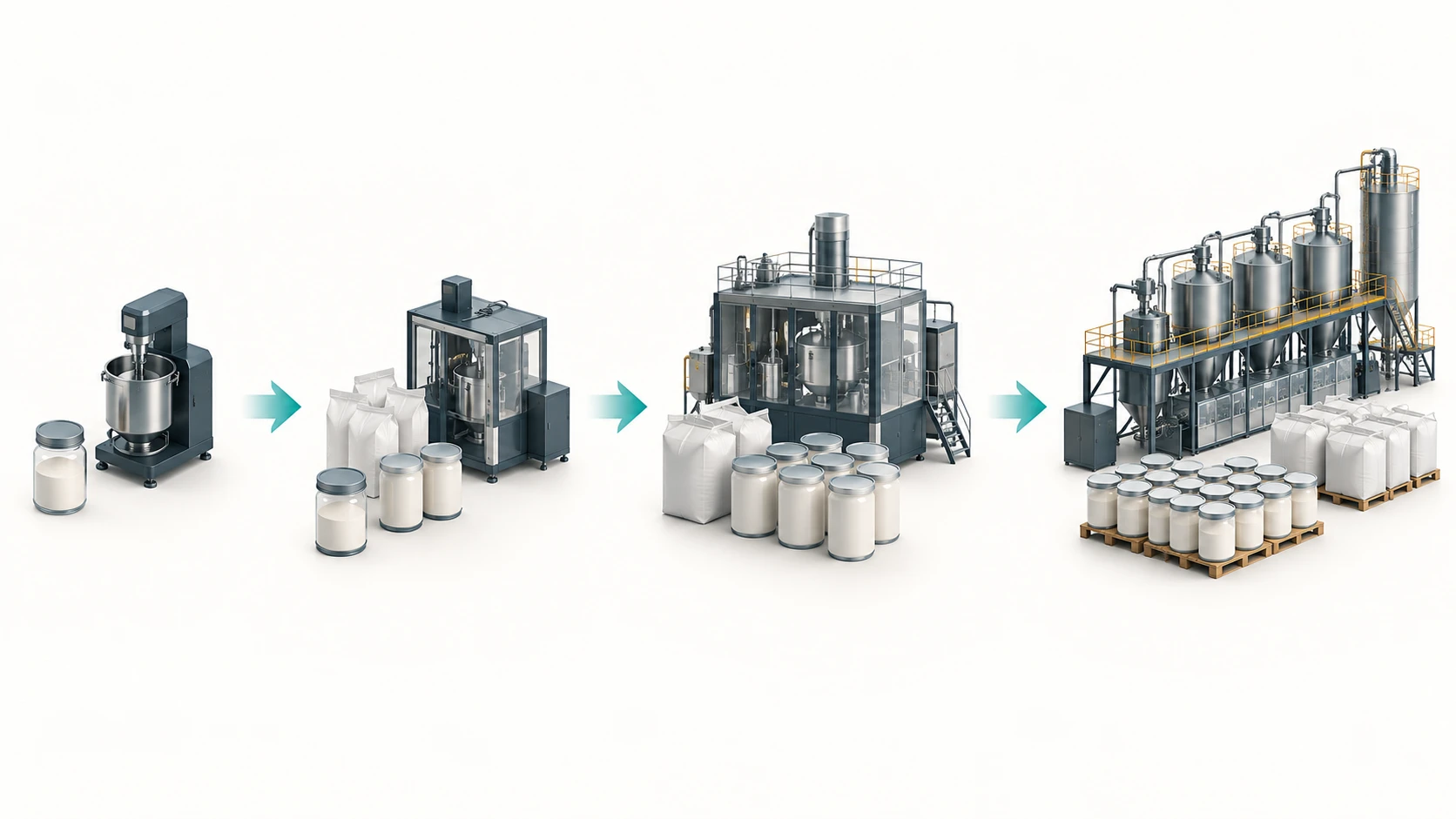
- 2019: pilot production equipment introduced
- 2021: sample supply starts from the pilot facility
- 2024: supply-security plan certified and investment announced
- 2027 plan: initial mass-production plant scheduled to operate
| When | What was published |
|---|---|
| 2019 | Pilot production equipment for solid electrolyte installed at the Ageo site, Saitama |
| November 2021 | Supply begins from the pilot production equipment |
| February 2023 | Capacity expanded |
| 26 January 2024 | Second capacity expansion approved (planned at three times the level at installation) |
| September 2024 | Construction of an initial production plant announced |
| 20 December 2024 | Certified under the Ministry of Economy, Trade and Industry supply assurance plan for storage batteries. Investment about 19.8 billion yen, subsidy up to about 9.9 billion yen. A decision on production investment at a scale of 3 GWh per year or more is to be made by the end of the subsidised project |
| 13 May 2025 | Second expansion revised: capacity to four times the level at installation (previously three times). Located at 1333-2 Haraichi, Ageo, Saitama, within the corporate research laboratory site |
| 2027 | Initial production plant scheduled to start up, expected to give the company the largest solid electrolyte production capacity in the worldNot yet confirmed |
All Sourced (Mitsui Kinzoku news releases [Sources 2 and 4], A-SOLiD page [Source 1]). The 2027 start-up is a plan.
3. Our calculation: what 19.8 billion yen and 3 GWh per year amount to
A few conversions from the published figuresOur calculation.
- Share of subsidy: 9.9 divided by 19.8 = about 50%
- In EVs: 3 GWh = 3,000,000 kWh. Assumption: at 60 kWh per EV, 3,000,000 divided by 60 = about 50,000 vehicles per year
- For reference: Idemitsu Kosan's large lithium sulfide plant is about 21.3 billion yen with up to about 7.1 billion yen of subsidySourced, a subsidy share of 7.1 divided by 21.3 = about 33%
Assumptions and limits: the 60 kWh per EV is our own assumption and varies widely by model. And the two investments are not the same thing: Mitsui Kinzoku's 19.8 billion yen is production technology for the solid electrolyte itself, while Idemitsu Kosan's 21.3 billion yen is a plant for lithium sulfide, an intermediate material. The sizes of the two sums cannot be read as a ranking. The difference in subsidy share may also reflect different programme categories or different applications.
4. A materials engineer's view (1): the weight of the phrase "development standard material"
Mitsui Kinzoku's May 2025 release contains this passage.
Our solid electrolyte is positioned as the development standard material at several customers, and demand is already expected to exceed our production capacitySourced
In a materials business, becoming the development standard is a particular kind of position.
- the customer's development data accumulates on the assumption of that material
- electrode formulations and pressing conditions are optimised around its properties
- swapping in another material later invalidates part of everything already accumulated
So even a competitor of equal performance cannot simply be swapped in. The switching cost arises somewhere other than the unit price of the material.
The same release also notes since introducing pilot production equipment for solid electrolyte at the Ageo site in Saitama in 2019Sourced. The company has had equipment capable of supplying samples consistently for six years.
The Sulfide solid electrolyte article in this series noted that Idemitsu Kosan had established volume production of lithium sulfide in 1994. The company that had supply capability before the application settled takes the standard position. The same shape appears here (our commentary).
5. The weakness is water — what actually happens
Being a sulfide, it cannot escape reacting with moisture. The Osaka Metropolitan University research report sets out the background.
Sulfide solid electrolytes have a serious problem with stability in air. Exposed to the atmosphere they react with moisture to generate toxic hydrogen sulfide (H2S), and their ionic conductivity falls sharply. For this reason an inert, moisture-free atmosphere is essential for fabricating sulfide-type all-solid-state batteries, and this is a cause of increased process cost.Sourced
It adds that if installation in EVs or PHEVs is realised, safety measures will also be needed for the case where the electrode body is exposed to the atmosphere in a traffic accident or similar eventSourced.
The same report also sets out the difference in character between sulfides and oxidesSourced.
| Family | As the report puts it | Ionic conductivity |
|---|---|---|
| Oxide | Chemically stable in air, but low in plasticity | 10⁻⁶ to 10⁻³ S cm⁻¹ |
| Sulfide | High in plasticity and easy to form, with the advantage of making an undisturbed interface with the active material | 10⁻³ to 10⁻² S cm⁻¹ |
All Sourced (Osaka Metropolitan University research report [Source 3]). The sulfide examples given are Li10GP2S12, Li7P3S11 and Li6PS5Cl.
6. In 2024 the mechanism came into view — single crystal turning polycrystalline
That it reacts with water and loses conductivity was already known. But what happens inside the material? Associate Professor Tsukasaki of Osaka Metropolitan University reports following it with transmission electron microscopy (TEM)Sourced. The sample is the argyrodite Li7-xPS6-xClx.
What happens when argyrodite meets moisture
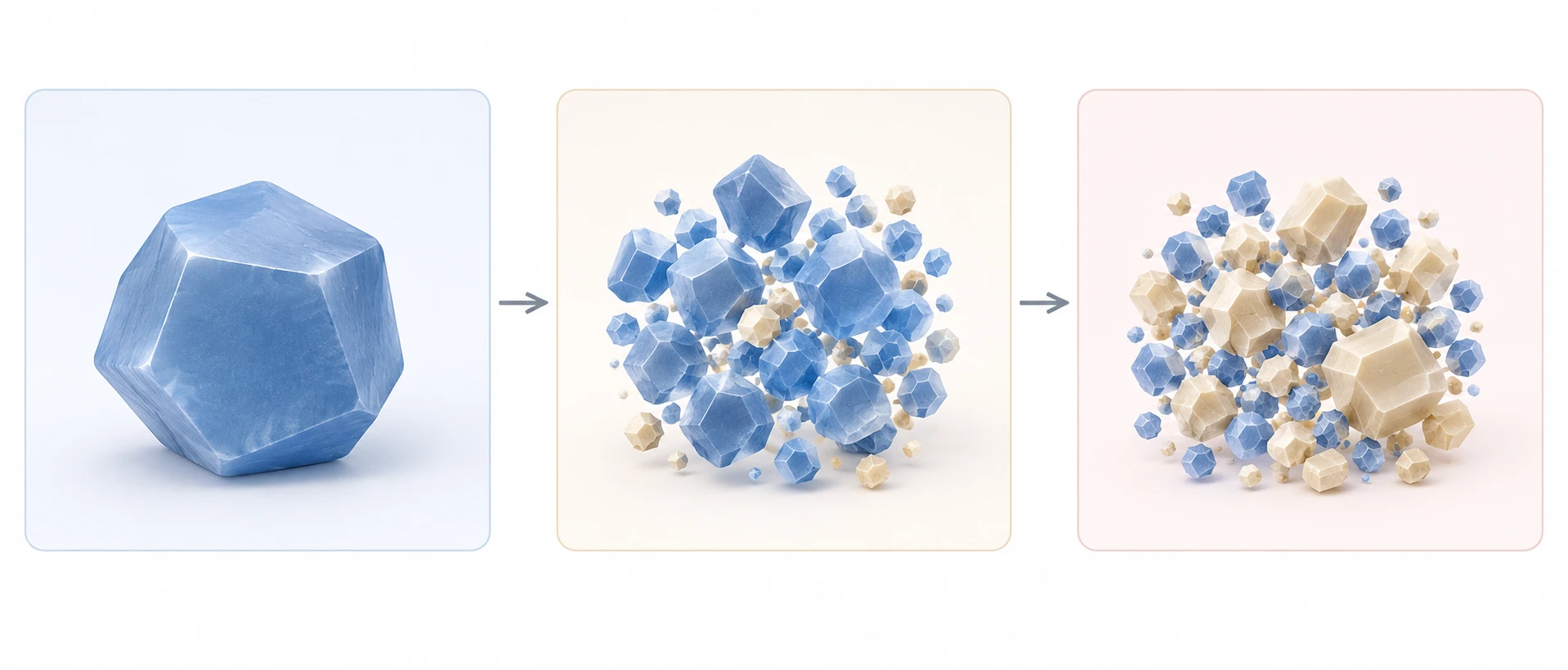
- Before degradation: particles of a few µm and a single-domain single crystal
- After 1 hour at −20°C dew point: polycrystals of tens of nm, reduced crystallinity and LiCl precipitation
- After 24 hours: ionic conductivity near zero, with LiCl, Li2CO3, Li2SO4 and other products
The report's conclusion is the technically most interesting thing in this article.
In the course of changing from a single-crystal state to a polycrystalline one, an increase in grain boundaries is expected. These TEM observations showed that the rise in grain-boundary resistance accompanying that change influences the fall in conductivitySourced
In other words, conductivity does not fall only because the material turned into something else. A single crystal a few micrometres across breaking up into an aggregate of tens-of-nanometre grains — an explosion in the number of grain boundaries — is part of it.
As the Oxide solid electrolyte article in this series shows, the biggest wall for oxides is also grain boundaries. Sulfides won on having few of them, and contact with moisture destroys that advantage. Degradation is a change of composition and, at the same time, a change of microstructure (our commentary).
One more thing matters: the state after 24 hours. After 24 hours of degradation at a dew point of -20 °C the ionic conductivity is essentially zeroSourced. A dew point of -20 °C is a dry environment. Even so, a day renders the material unusable.
7. Our calculation: how much hydrogen sulfide 1 kg can release
From the reaction products observed, the report indicates that the following degradation reactions may be occurringSourced.
(1) Li6PS5Cl + 6H2O gives LiCl + Li3PO4 + 5H2S + 2LiOH (hydrolysis)
(2) 2LiOH + CO2 gives Li2CO3 + H2O (neutralisation)
(3) Li6PS5Cl + 4H2O + 2O2 gives LiCl + Li3PO4 + 4H2S + Li2SO4 (reaction with water and oxygen)
The report says that the following degradation reactions are suggested as a possibility, presenting them as inferences from observation rather than as established equationsSourced.
Using reaction (1) to check the order of magnitudeOur calculation.
- Assumption: molar mass of Li6PS5Cl taken as 268 g/mol (from Li 6.94, P 30.97, S 32.06, Cl 35.45)
- Assumption: one mole of gas occupies 22.4 L at standard conditions
- Assumption: following reaction (1), 1 mol of Li6PS5Cl yields 5 mol of H2S
Working
- 1,000 g divided by 268 g/mol = 3.73 mol
- 3.73 × 5 = 18.6 mol of H2S
- 18.6 × 22.4 L = about 417 L
If 1 kg of solid electrolyte reacted completely, it would give roughly 417 litres of hydrogen sulfide.
Assumptions and limits: in practice not all of it necessarily reacts, and the reaction itself is presented in the report as a suggested possibilitySourced. This calculation is not an assessment of hazard; it exists to give an order-of-magnitude sense of why an inert atmosphere is called essential. Specific exposure limits or safety assessments could not be found in published primary sources within the scope of this article and are not given.
8. A materials engineer's view (2): an inert atmosphere is a cost, not a solution
The report states that an inert, moisture-free atmosphere is essential for fabricating sulfide-type all-solid-state batteries, and this is a cause of increased process costSourced.
Read from the process side, that single sentence splits into three burdens.
- Capital cost: drying plant, airtight construction, inert gas supply
- Running cost: dew-point control, gas consumption, purging at every start-up and shutdown
- Design constraint: every step that touches the material has to sit inside that environment
The third is in practice the heaviest. Transport, weighing, forming, inspection — not once, anywhere, can the material meet the air. As Section 6 showed, even at a dew point of -20 °C the conductivity is essentially zero after 24 hoursSourced.
And the report looks one step further: if installation in EVs or PHEVs is realised, safety measures will also be needed for the case where the electrode body is exposed to the atmosphere in a traffic accident or similar eventSourced.
An inert atmosphere only solves the problem inside the factory. What happens when a shipped product is damaged has to be solved separately. Which is why the report's proposed answer is not a better atmosphere but the development of highly stable sulfide solid electrolytes with good water resistanceSourced.
Solve it in the material or solve it in the environment — in this field the judgement that it has to be solved in the material to become a product already seems to have been made (our commentary).
9. It is already a product
Sulfide solid electrolytes, argyrodite among them, are already products in small-format applications. Maxell publishes all-solid-state batteries using a sulfide solid electrolyteSourced.
| Item | As Maxell publishes it |
|---|---|
| Solid electrolyte | Achieved by adopting a sulfide solid electrolyte of high ionic conductivity |
| Operating temperature | -50 °C to +125 °C (base specification), with a 150 °C model (PSB401010T) in the line-up |
| High-temperature endurance | In an accelerated test at 60 °C storage, the number of days over which 90% of capacity is retained is 100 days for the all-solid-state battery against 10 days for the conventional product |
| Form factors | Ceramic package, power module, coin type (bipolar PSB2032), cylindrical (PSB23280) |
| Applications | Factory automation, automotive devices, measurement in harsh environments, infrastructure, wearables, hearing aids, medical and health devices, infrastructure monitoring, sensing |
All Sourced (Maxell all-solid-state battery page [Source 6]). Whether these products use the argyrodite type could not be confirmed from Maxell's public information.
An operating range of -50 °C to +125 °C is territory conventional liquid lithium-ion cells do not reachSourced.
And 100 days against 10 days for retaining 90% of capacity in 60 °C storage is a factor of tenOur calculation (100 divided by 10).
What that says is that the first market for all-solid-state batteries is not the EV. High temperature, wide temperature range, long-term reliability — commercialisation begins where liquid cells cannot reach in principle.
For a materials maker, that order matters. Large-scale production for EVs is a story for 2027 and beyond, but small, high-value applications are buying the material already. There is somewhere to be tempered under real manufacturing conditions before the production ramp begins (our commentary).
10. Strengths, weaknesses and what is still hard
(1) No published figure for ionic conductivity
Mitsui Kinzoku describes A-SOLiD as having lithium-ion conductivity on a par with organic liquid electrolytesSourced, but a specific value in S/cm could not be found in the company material this article consulted, so none is given. The Osaka Metropolitan University report gives a range of 10⁻³ to 10⁻² S cm⁻¹ for sulfides in generalSourced.
(2) Full volume production has not begun
Start-up of the initial production plant is a plan for 2027, and the decision on production investment at 3 GWh per year or more is to be made by the end of the subsidised projectNot yet confirmed. At the time of writing (September 2026), no primary source confirming that volume production for automotive use has begun could be found.
(3) The link between crystal structure and ionic conduction could not be confirmed
As for the structural reason why the argyrodite type conducts lithium ions so well, no sufficient account could be found in the primary sources accessible within the scope of this article, so it is not explained here.
(4) The relation to Maxell's products cannot be confirmed
Maxell publishes that its all-solid-state batteries use a sulfide solid electrolyteSourced, but whether that is the argyrodite type, or whose material it is, could not be confirmed from public information.
- The argyrodite type has become a development standard material. Mitsui Kinzoku states that several customers position it that waySourced
- A plan of about 19.8 billion yen with up to about 9.9 billion yen of subsidy has been certified by the Ministry of Economy, Trade and IndustrySourced, a subsidy share of about 50%Our calculation
- The weakness is water. Even at a dew point of -20 °C the ionic conductivity is essentially zero after 24 hoursSourced
- Degradation turned out to be a rise in grain-boundary resistance as the material becomes polycrystallineSourced
- Complete reaction of 1 kg would give about 417 L of hydrogen sulfideOur calculation
- It is already a product in small formats, starting from -50 °C to +125 °C, territory liquid cells cannot reachSourced
11. Glossary
- Argyrodite type
- One crystal structure among sulfide solid electrolytes. Representative composition Li6PS5Cl.
- A-SOLiD
- Mitsui Kinzoku's brand name for its argyrodite-type sulfide solid electrolyte.
- Sulfide solid electrolyte
- A solid electrolyte built on a sulfur framework. High in plasticity and easy to form.
- Plasticity
- The property of deforming under load and keeping that shape. It matters when compacting powder.
- Dew point
- The temperature at which moisture in the air begins to condense. The lower it is, the drier the air.
- Hydrolysis
- Decomposition into other substances by reaction with water. In sulfides it produces hydrogen sulfide.
- Hydrogen sulfide (H2S)
- A toxic gas, generated when a sulfide solid electrolyte reacts with moisture.
- Grain boundary
- The boundary where grains meet in a polycrystal. The more of them, the harder it is for ions to pass.
- TEM
- Transmission electron microscope. An instrument for observing crystal structure and grains at atomic scale.
- Development standard material
- The material a customer has adopted as the baseline for its development work. Switching away from it carries a cost.
- Supply assurance plan for storage batteries
- A Japanese government certification programme for strengthening battery-related supply chains.
- GWh
- Gigawatt hour. A unit of battery capacity. 1 GWh = 1,000,000 kWh.
12. Primary sources
- Mitsui Kinzoku "Introducing A-SOLiD, a solid electrolyte for all-solid-state batteries" (Japanese-language page) — mitsui-kinzoku.co.jp
- Mitsui Kinzoku "Supply assurance plan for storage batteries covering development and volume production of the sulfide solid electrolyte A-SOLiD certified by the Ministry of Economy, Trade and Industry", 20 December 2024 (PDF, Japanese-language release) — mitsui-kinzoku.com
- H. Tsukasaki (Osaka Metropolitan University) "Elucidating the degradation mechanism of sulfide solid electrolytes in ambient atmosphere", Murata Science Foundation research report, 25 March 2024 (PDF, Japanese-language page) — corporate.murata.com
- Mitsui Kinzoku "Notice on the second capacity expansion investment in the pilot production equipment for the solid electrolyte A-SOLiD (further capacity increase)", 13 May 2025 (PDF, Japanese-language release) — mitsui-kinzoku.com
- Idemitsu Kosan "Decision to build a large production plant for lithium sulfide, the intermediate raw material, towards volume production of all-solid-state battery materials (solid electrolytes)", 27 February 2025 (PDF, Japanese-language release) — idemitsu.com
- Maxell "All-solid-state batteries", product page (Japanese-language page) — biz.maxell.com
13. Claim-to-source audit
| Claim in the text | Basis | Label |
|---|---|---|
| That A-SOLiD is an argyrodite-type sulfide solid electrolyte whose listed strengths are high lithium-ion conductivity, excellent electrochemical stability and excellent flexibility allowing sheet forming; and that pilot production equipment was approved in December 2019, supply from it began in November 2021, capacity was expanded in February 2023, a second capacity expansion was approved in February 2024 and construction of an initial production plant was announced in September 2024 | Mitsui Kinzoku A-SOLiD page[Source 1] https://www.mitsui-kinzoku.co.jp/mlab/attempt/asolid/ | Sourced |
| That the plan was certified under the Ministry of Economy, Trade and Industry supply assurance plan for storage batteries; that the item is sulfide solid electrolyte, the type of undertaking the introduction, development and improvement of production technology, the investment about 19.8 billion yen and the subsidy up to about 9.9 billion yen; that a decision on production investment at a scale of 3 GWh per year or more will be made by the end of the subsidised project in the light of market conditions; that since introducing pilot production equipment at the Ageo site in Saitama in 2019 the company has approved two capacity expansions; that the solid electrolyte is positioned as the development standard material at several customers; that A-SOLiD is an argyrodite-type sulfide solid electrolyte with lithium-ion conductivity on a par with organic liquid electrolytes and electrochemical stability; and that the release is dated 20 December 2024 | Mitsui Kinzoku news release, 20 December 2024[Source 2] https://www.mitsui-kinzoku.com/LinkClick.aspx?fileticket=F3o8uUaVzB0%3D&tabid=100&mid=826 | Sourced |
| The statements that sulfide solid electrolytes have a serious problem with stability in air, that exposure generates toxic hydrogen sulfide with a sharp fall in ionic conductivity, that an inert moisture-free atmosphere is therefore essential and raises process cost, that safety measures will be needed for atmospheric exposure of the electrode body in an accident if EV or PHEV installation is realised, and that highly stable sulfide solid electrolytes with good water resistance are wanted; that oxides are chemically stable in air but low in plasticity with conductivity of 10⁻⁶ to 10⁻³ S cm⁻¹ while sulfides are high in plasticity, easy to form, able to make an undisturbed interface with the active material, and conduct at 10⁻³ to 10⁻² S cm⁻¹; that the sample is argyrodite Li7-xPS6-xClx; that before degradation it is a single-domain single crystal of a few micrometres, that after one hour at a dew point of -20 °C it becomes polycrystalline with grains of tens of nanometres and LiCl appears, and that after 24 hours the ionic conductivity is essentially zero with LiCl, Li2CO3 and Li2SO4 present; that rising grain-boundary resistance on becoming polycrystalline influences the fall in conductivity; and the three degradation reactions presented as a suggested possibility | Murata Science Foundation research report, 25 March 2024[Source 3] https://corporate.murata.com/-/media/corporate/group/zaidan/report/study/202406/2024-002.ashx?la=ja-jp&cvid=20240802012731000000 | Sourced |
| The revision of the second capacity expansion to four times the level at installation, previously three times; the location at 1333-2 Haraichi, Ageo, Saitama, within the corporate research laboratory site; the statement that the solid electrolyte is positioned as the development standard material at several customers and that demand is already expected to exceed production capacity; the statement that an initial production plant is planned to start up in 2027 and that the company expects to have the largest solid electrolyte production capacity in the world; and that the release is dated 13 May 2025 | Mitsui Kinzoku news release, 13 May 2025[Source 4] https://www.mitsui-kinzoku.com/LinkClick.aspx?TabModule950=0&fileticket=wHOd2fFXCiQ%3D&mid=826&tabid=199 | Sourced |
| That Idemitsu Kosan's large lithium sulfide plant carries a total project cost of about 21.3 billion yen with a maximum subsidy of about 7.1 billion yen, and that volume production technology for lithium sulfide was established in 1994 | Idemitsu Kosan news release, 27 February 2025[Source 5] https://www.idemitsu.com/jp/news/2024/250227.pdf | Sourced |
| That Maxell's all-solid-state batteries are achieved by adopting a sulfide solid electrolyte of high ionic conductivity; that the operating range is -50 °C to +125 °C with a 150 °C model (PSB401010T); that in an accelerated test at 60 °C storage the days for retaining 90% of capacity are 100 against 10 for the conventional product; and the line-up of ceramic package, power module, coin type (bipolar PSB2032) and cylindrical (PSB23280) together with the listed applications | Maxell all-solid-state battery product page[Source 6] https://biz.maxell.com/ja/rechargeable_batteries/allsolidstate.html | Sourced |
| The 2027 start-up of the initial production plant, the expectation of the largest solid electrolyte capacity in the world, and the decision on production investment at 3 GWh per year or more | These are Mitsui Kinzoku's plans, not records of achievement. The decision is stated as one to be taken by the end of the subsidised project[Source 4] https://www.mitsui-kinzoku.com/LinkClick.aspx?TabModule950=0&fileticket=wHOd2fFXCiQ%3D&mid=826&tabid=199 | Not yet confirmed |
| Putting the subsidy shares at 9.9 divided by 19.8 = about 50% and 7.1 divided by 21.3 = about 33%; converting 3 GWh per year into about 50,000 EVs; taking the molar mass of Li6PS5Cl as 268 g/mol and calculating about 417 L of hydrogen sulfide from 1 kg; and putting Maxell's 100 days against 10 days at a factor of ten | Our calculation. The 60 kWh per EV, the 22.4 L per mole of gas at standard conditions, and complete reaction following equation (1) are all assumptions set by this article. The Mitsui Kinzoku and Idemitsu Kosan investments cover different plant, so neither the sums nor the subsidy shares are a direct comparison. The 417 L is not a measure of hazard | Our calculation |
| A specific numerical value in S/cm for the ionic conductivity of A-SOLiD | The qualitative statement of conductivity on a par with organic liquid electrolytes was confirmed, but no specific figure could be found in the Mitsui Kinzoku material this article consulted, so none is given | Commentary |
| The structural reason why the argyrodite type shows high ionic conductivity | No sufficient account could be found in the primary sources accessible within the scope of this article, so it is not explained | Commentary |
| Whether Maxell's all-solid-state batteries use the argyrodite type, and who supplies the material | Maxell's public information states only sulfide solid electrolyte, and neither crystal type nor supplier could be confirmed, so neither is stated | Commentary |
| Exposure limits or safety assessments for hydrogen sulfide | None could be found in published primary sources within the scope of this article, so none are given. The calculation in Section 7 shows an order of magnitude and is not an assessment of hazard | Commentary |
| The start of full volume production for automotive use | No primary source indicating the start of volume production could be confirmed at the time of writing (September 2026) by this article | Not yet confirmed |
| The reading that becoming a development standard material creates a switching cost; the framing that degradation is a change of microstructure as well as of composition; the division of the inert-atmosphere burden into capital, running and design constraints; the reading that the first market is not the EV; the framing that the company with supply capability before the application settled takes the standard position; and the two-column sorting of strengths and weaknesses | Our summary and commentary based on published content. Not views expressed by the companies or institutions | Commentary |
| That Figs. 1, 2, 3, 4 and 6 are explanatory concepts rather than real observations or design drawings, and that the hero image and Figs. 1, 3 and 5 are AI-generated | Our note | Commentary |
Last updated 21 September 2026. Sources are limited to primary material (official company news releases and product pages, and research reports funded by public grants). Because the article includes structural readings and materials-design interpretations, those are marked as Commentary and kept separate from sourced fact. A specific conductivity for A-SOLiD, the conduction mechanism of the argyrodite type, the crystal type in Maxell's products, safety limits for hydrogen sulfide, and any automotive production record are not stated here because no published primary source could be confirmed. The reactions in Section 7 are presented by the report itself as a suggested possibility. All figures are explanatory concept graphics. Figs. 2, 4 and 6 are vector drawings; the hero image and Figs. 1, 3 and 5 are AI-generated images, and none of them shows a real cross-section, micrograph or physical product.