TECHNOLOGY EXPLAINER
Lithium Metal Anodes and Anode-Free Cells
— taking the anode off the bill of materials
Lithium metal is called the ultimate anode active material. Not because its capacity is large, but because you no longer need a container to keep the lithium in. Take that to its limit and you get the anode-free cell, which ships with no anode at all, and grows one on the first charge.

- What a lithium metal anode is (the short version)
- Our calculation: is the theoretical capacity really an order of magnitude larger
- The point is not capacity but not needing a container
- Anode-free — no anode exists at shipment
- A materials engineer's view (1): quality assurance moves from part to process
- Our calculation: making and unmaking 14.5 µm every cycle
- A materials engineer's view (2): room temperature is the creep regime, and how to use that
- Plated lithium is not just lithium
- Five conditions for making it work
- Where industry stands, and what is still hard
- Glossary / Primary sources / Claim-to-source audit
Sourced = a value stated in published material from a research institute or manufacturer (link given)
Our calculation = a figure this article derived, with the assumptions spelled out
Not yet confirmed = a plan or a target with no confirmed production record
Structural readings and materials-design interpretations are marked separately as Commentary.
1. What a lithium metal anode is (the short version)
A lithium metal anode is an arrangement that uses lithium metal itself at the anode, rather than a material such as graphite.
- Why you would want it: a review by a Nagoya University group states that Li metal has a theoretical capacity an order of magnitude larger than graphite and that Li metal can be called the ultimate anode active materialSourced
- How much it changes: the same review states that using Li metal at the anode allows an energy density of 300 to 500 Wh kg⁻¹, beyond the lithium-ion battery (for which about 250 Wh kg⁻¹ is considered the ceiling)Sourced
- Why it is not in use yet: the review notes that Li metal anodes are at present used only in primary batteries, because on charging the lithium grows in branches and shorts the cellSourced
The essence of the lithium metal anode is not swapping in a higher-capacity material. It is removing the container as a component altogether. Its limit is anode-free: no anode present at shipment, and one created in place on the first charge.
2. Our calculation: is the theoretical capacity really an order of magnitude larger
Check the claim for yourself. Theoretical capacity is simply the Faraday constant divided by the atomic (or molar) mass.
AssumptionsOur calculation
- Faraday constant 96,485 C/mol, atomic mass of lithium 6.94, of carbon 12.011 (all widely known values, taken as assumptions here)
- The graphite anode is taken as LiC6 (six carbons accept one lithium)
- 1 mAh = 3.6 C
Working
- Lithium metal: 96,485 divided by 6.94 = 13,903 C/g, divided by 3.6 = about 3,862 mAh/g
- Graphite (LiC6): 96,485 divided by (6 × 12.011) = 1,339 C/g, divided by 3.6 = about 372 mAh/g
- Ratio: 3,862 divided by 372 = about 10.4 times
Consistent with the review's phrase, an order of magnitude largerSourced.
Assumptions and limits: these are theoretical values per unit mass of active material alone. A real cell adds current collector, electrolyte, binder and casing, so cell energy density does not go up tenfold. The realistic expectation is the review's range of 250 rising to 300 to 500 Wh/kgSourced.
3. The point is not capacity but not needing a container
This is the most important thing about the technology.
A graphite anode is a material that takes lithium ions in and out between the layers of its crystal. As the calculation showed, six carbon atoms accept one lithium. Which means the framework for storing the lithium is permanently inside the cell.
With a lithium metal anode there is no framework. The lithium simply stacks up. And in an anode-free cell, only the place where it stacks up (the current collector) is shipped.
Where lithium resides on the negative-electrode side
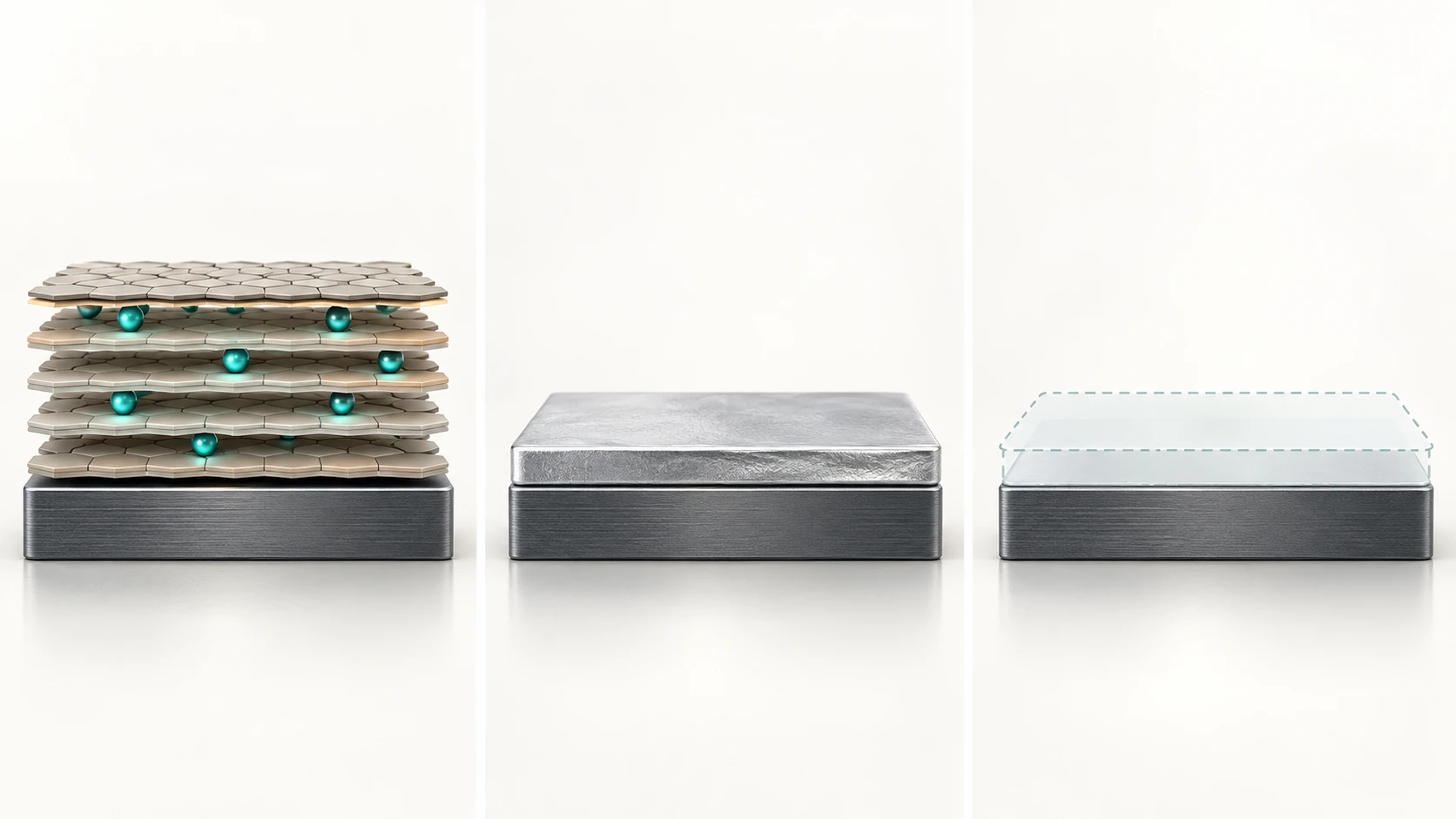
- Graphite: lithium is inserted between graphite layers
- Lithium metal: a metal foil itself acts as the negative electrode
- Anode-free: no anode material at shipment; lithium plates on the collector during first charge
4. Anode-free — no anode exists at shipment
QuantumScape describes its own design as follows.
"The QuantumScape design is 'anode-free' in that the battery is manufactured anode free in a discharged state, and the anode forms in situ on the first charge."Sourced
Of the anode: "a pure lithium-metal anode with zero excess lithium"; of the separator: "The QuantumScape separator material is a ceramic capable of meeting the key requirements of high conductivity, stability to lithium metal, resistance to dendrite formation, and low interfacial impedance."Sourced (QuantumScape technology page)
5. A materials engineer's view (1): quality assurance moves from part to process
When an anode-free cell ships, the anode is not in the box. What is in the box is only the place where an anode will form.
In an ordinary materials business, what you deliver has a specification: thickness, purity, surface roughness, tensile strength. The customer inspects it on receipt and uses it if it passes.
In an anode-free cell, the quality of the anode is not settled at the moment of delivery. It is settled at the first charge, by the temperature, the pressure and the current density at which the lithium plates.
So what has to be guaranteed shifts from the specification of a part to the conditions of a process. A collector supplier delivers metal foil, but the surface condition of that foil governs what kind of anode will form.
This is the same picture as in the Interfacial resistance article in this series. Unless you hand over the method along with the material, the numbers do not reproduce at the customer. In an anode-free cell part of that method reaches into the cell maker's formation process, and beyond it into conditions of use (our commentary).
6. Our calculation: making and unmaking 14.5 µm every cycle
In an anode-free cell the anode thickness starts at zero and returns to zero on every cycle. How thick does it get?
AssumptionsOur calculation
- Take the areal capacity of the electrode as 3 mAh/cm² (typical of lithium-ion electrodes)
- Take the density of lithium as 0.534 g/cm³, its atomic mass as 6.94 and the Faraday constant as 96,485 C/mol
Working
- 3 mAh = 10.8 C, so 10.8 divided by 96,485 = 1.12×10⁻⁴ mol
- × 6.94 g/mol divided by 0.534 g/cm³ = 1.46×10⁻³ cm³ per cm²
- As a thickness, about 14.5 µm
- A useful rule of thumb: about 4.85 µm per mAh/cm²
On excess lithium
- Assumption: suppose a 20 µm lithium foil is included as excess for margin
- 20 µm divided by 4.85 µm = lithium worth about 4.1 mAh/cm²
- Against the cathode's 3 mAh/cm², that is about 1.4 times
Anode-free is the design that takes that 1.4 times to zero. That is what QuantumScape means by zero excess lithiumSourced.
Assumptions and limits: the 20 µm of excess lithium foil is our own assumption, not the design value of any particular product. Real designs vary widely with life requirements and safety margins. The areal capacity of 3 mAh/cm² is also an assumption.

7. A materials engineer's view (2): room temperature is the creep regime, and how to use that
The least intuitive property in handling lithium metal is this one.
The melting point of Li is 181 °C, so room temperature is already, in absolute terms, above half the melting point. At such temperatures, grain-boundary diffusion of atoms and motion of dislocations become active, and strain increases with time under a constant stress even below the yield stress (creep deformation).Sourced
- Assumption: room temperature 25 °C (298 K) and the melting point of lithium 181 °C (454 K), the melting point being the review's value
- 298 K divided by 454 K = about 0.66 (homologous temperature)
- Assumption: the melting point of iron as 1,538 °C (1,811 K), a widely known property value taken as an assumption here with no source link
- 1,811 K × 0.66 = about 1,190 K = about 920 °C
Room temperature for lithium corresponds to something close to 1,000 °C for ironOur calculation.
Assumptions and limits: equal homologous temperature does not make creep behaviour equal between metals. This is a conversion for intuition.
A metal that creeps at room temperature would normally be disqualified as a structural material. In a lithium metal anode, the property is usable.
The review states that raising cell pressure or temperature accelerates the deformation of Li and promotes the disappearance of voids, and several groups including the authors have reported that short circuits are suppressed as a resultSourced.
In other words, hold it down and it will flow of its own accord and fill the gaps. No heating required. That is why all-solid-state cells are designed around being clamped.
The same property is also a design constraint.
- Deformation continues in storage. The assumption that nothing happens while it sits on a shelf does not hold
- The clamping mechanism has to follow a thickness that cycles between 14.5 µm and 0 µmOur calculation
- Spring rate becomes a design variable: too stiff and the pressure spikes, too soft and it fails to hold (our commentary)
8. Plated lithium is not just lithium
So far this article has written "lithium metal" as if it were one thing. In March 2026, Rice University and the University of Houston published results, from a paper in Science, that unsettle that premiseSourced.
Plated lithium did not behave like bulk lithium. It shows unexpectedly high strength and brittle behavior under mechanical stress — the cause being the SEI shell covering its surfaceSourced. That shell enhances their structural rigidity and prevents the dendrites' lithium core from deforming plasticallySourced. The University of Houston release puts it as having proven they are actually brittle and snap like glassSourced.
This result carries weight for lithium metal anode design.
Lithium is soft, so pressure will make it conform — that was the premise in Section 7. But an SEI forms immediately on the surface of plated lithium and acts as a shellSourced. What you have is a composite: a soft core wrapped in a hard thin film.
Anyone who works with composites knows the picture. Put a thin hard coating on a slender core and apparent strength rises while ductility disappears.
What follows is that designing the SEI is designing the mechanics of the anode. The SEI has long been treated as the by-product of an electrochemical side reaction, but its composition and thickness may be what decides whether the anode creeps or snaps (our commentary). The SEI is covered in the SEI article in this series.
9. Five conditions for making it work
| Condition | Why it is needed | The published clue | Source |
|---|---|---|---|
| 1 No branching | A dendrite piercing the electrolyte shorts the cell | Many researchers have reported that even LLZ short-circuits, and it is coming to be recognised that the Monroe and Newman theory does not apply | Review (2020) |
| 2 No voids | Voids left by stripping focus the next plating onto one point | Raising cell pressure or temperature accelerates the deformation of Li and promotes the disappearance of voids, suppressing short circuits | Review (2020) |
| 3 Control the shell | The SEI shell decides the mechanical behaviour of plated lithium | The SEI coating enhances their structural rigidity and prevents the dendrites' lithium core from deforming plastically | Rice University and University of Houston (2026) |
| 4 No excess | Excess lithium wastes mass and volume | "a pure lithium-metal anode with zero excess lithium" | QuantumScape |
| 5 Lower resistance | The lithium metal and electrolyte interface is the main source of resistance | For Li and LLZO, about 225 Ω cm² with ultrasonic bonding, and about 1.5 Ω cm² with a thin Au layer as well | Tohoku University (March 2026) |
All Sourced (review [Source 1], Rice University [Source 4], University of Houston [Source 5], QuantumScape [Source 2], Tohoku University [Source 6]). The "why it is needed" column is this article's own framing.
10. Where industry stands, and what is still hard
| Who | What was published | Label |
|---|---|---|
| QuantumScape | Reports that a 24-layer A0 prototype cell achieved more than 95% energy retention over the equivalent of more than 1,000 charge-discharge cycles | Sourced |
| QuantumScape | Commercial target for energy density of 800 to 1,000 Wh/L (as of December 2023), expected to extend range from 350 miles to 400 to 500 miles | Not yet confirmed |
| Nissan | States that its all-solid-state battery is expected to offer roughly twice the energy density of conventional cells, substantially shorter charging times, and lower cost through cheaper material combinations. Holds prototype production equipment | Sourced |
| Nissan | Aims to bring an EV carrying its own all-solid-state battery to market by fiscal 2028 | Not yet confirmed |
| Research stage | Every approach reported so far has shown some effect, but none has achieved complete suppression of short circuits | Sourced |
QuantumScape [Source 2], Nissan [Source 3], review [Source 1].
(1) No production record can be confirmed yet
At the time of writing (September 2026), no primary source confirming the start of volume production of an all-solid-state battery with a lithium metal anode or an anode-free configuration could be foundNot yet confirmed. QuantumScape's figures are prototype results and targets; Nissan's are targets.
(2) The basis of "roughly twice" is not published
Nissan states roughly twice the energy density of conventional cellsSourced, but neither the specific value of the baseline cell nor that of the all-solid-state cell appears on the page this article consulted. This article therefore does not convert that factor of two into a figure in Wh/kg or Wh/L.
(3) The strength of plated lithium is not published as a number
For the brittleness discussed in Section 8, specific values of strength or elastic modulus could not be found in published primary sources within the scope of this article and are not given.
- The theoretical capacity of lithium metal is about 10.4 times that of graphiteOur calculation, consistent with the review's order of magnitudeSourced
- The point is not capacity but the disappearance of the container as a component (our commentary)
- In an anode-free cell no anode exists at shipment. It forms in place on the first chargeSourced
- So quality assurance moves from part to process (our commentary)
- The anode thickness cycles between 14.5 µm and 0 µm every timeOur calculation
- Room temperature is the creep regime for lithium. That is both a constraint and a tool you can use through clamping pressureSourced
- Plated lithium turned out to be a hard, brittle composite wearing an SEI shellSourced
11. Glossary
- Lithium metal anode
- An anode made of lithium metal itself. High theoretical capacity, and no host structure needed.
- Anode-free
- Building the cell with no anode and forming one in place on the first charge.
- Excess lithium
- Extra lithium included on the anode side to secure life. Zero in an anode-free cell.
- Theoretical capacity
- The theoretical charge one gram of active material can deliver: the Faraday constant divided by molar mass.
- Areal capacity (mAh/cm²)
- Capacity per unit area of electrode. It sets the thickness of the plated lithium.
- Current collector
- The metal foil that carries current out. In an anode-free cell it is where the lithium plates.
- Graphite anode
- An anode that takes lithium in and out between carbon layers, up to the composition LiC6.
- Creep deformation
- Strain that grows with time under constant stress, even below the yield stress.
- Homologous temperature
- Temperature as a fraction of the melting point, in absolute terms. A measure for comparing high-temperature behaviour.
- SEI
- Solid electrolyte interphase. It covers plated lithium and changes even its mechanical behaviour.
- Clamping pressure (cell pressure)
- Pressure applied to the cell from outside, to close voids and maintain contact.
- Dendrite
- The branching growth of lithium during charging. A cause of short circuits.
12. Primary sources
- Soshu Motoyama, Takayuki Yamamoto and Yasutoshi Iriyama (Nagoya University) "Elucidating the short-circuit mechanism of solid electrolytes towards higher performance in all-solid-state Li batteries", Oyo Buturi vol. 89 no. 4 (2020) 213-217 (PDF, Japanese-language page) — jstage.jst.go.jp
- QuantumScape "Solid State Battery Technology", technology page — quantumscape.com
- Nissan "All-solid-state batteries", innovation and technology page (Japanese-language page) — nissan-global.com
- Rice University "Thorny issue plaguing lithium-ion batteries laid bare in new study", 12 March 2026 — news.rice.edu
- University of Houston "UH Research Reveals Lithium Dendrites Cause Battery Safety Risks", 8 April 2026 — uh.edu
- Tohoku University "Interface between lithium metal and a garnet-type oxide solid electrolyte formed at room temperature in a short time", 24 March 2026 (Japanese-language release) — tohoku.ac.jp
- SLAC National Accelerator Laboratory "Giving solid-state batteries a squeeze keeps them from short-circuiting", 28 August 2026 — slac.stanford.edu
13. Claim-to-source audit
| Claim in the text | Basis | Label |
|---|---|---|
| That Li metal has a theoretical capacity an order of magnitude larger than graphite and can be called the ultimate anode active material; that using Li metal allows 300 to 500 Wh kg⁻¹, beyond the lithium-ion battery, for which about 250 Wh kg⁻¹ is considered the ceiling; that Li metal anodes are at present used only in primary batteries; that the melting point of Li is 181 °C so room temperature is already above half the melting point in absolute terms, with the account of creep deformation; that raising cell pressure or temperature accelerates the deformation of Li and promotes the disappearance of voids, suppressing short circuits, as reported by several groups including the authors; that many researchers have reported that even LLZ short-circuits and that the Monroe and Newman theory is coming to be seen as inapplicable; and that no approach reported so far has achieved complete suppression of short circuits | Review, Oyo Buturi vol. 89 no. 4 (2020)[Source 1] https://www.jstage.jst.go.jp/article/oubutsu/89/4/89_213/_pdf | Sourced |
| The statements that the design is anode-free in that the battery is manufactured anode free in a discharged state and the anode forms in situ on the first charge; that it uses a pure lithium-metal anode with zero excess lithium; the separator description; and that a 24-layer A0 prototype cell achieved more than 95% energy retention over the equivalent of more than 1,000 cycles | QuantumScape technology page[Source 2] https://www.quantumscape.com/battery-technology/ | Sourced |
| That QuantumScape's commercial energy-density target is 800 to 1,000 Wh/L (as of December 2023) and that it expects range to extend from 350 miles to 400 to 500 miles, these being targets rather than production records | QuantumScape technology page (values the company presents as a commercial target)[Source 2] https://www.quantumscape.com/battery-technology/ | Not yet confirmed |
| That Nissan cites roughly twice the energy density of conventional cells, substantially shorter charging times and lower cost through cheaper material combinations; that it holds prototype production equipment; and that fewer side reactions with a solid electrolyte allow a wider range of material combinations | Nissan all-solid-state battery page[Source 3] https://www.nissan-global.com/JP/INNOVATION/TECHNOLOGY/ARCHIVE/ASSB/ | Sourced |
| That Nissan aims to bring an EV carrying its own all-solid-state battery to market by fiscal 2028 | Nissan all-solid-state battery page (a company target)[Source 3] https://www.nissan-global.com/JP/INNOVATION/TECHNOLOGY/ARCHIVE/ASSB/ | Not yet confirmed |
| That plated lithium shows unexpectedly high strength and brittle behavior under mechanical stress; that the SEI coating enhances their structural rigidity and prevents the dendrites' lithium core from deforming plastically; that bulk lithium is soft and ductile; and that the paper appeared in Science on 12 March 2026 | Rice University news, 12 March 2026[Source 4] https://news.rice.edu/news/2026/thorny-issue-plaguing-lithium-ion-batteries-laid-bare-new-study | Sourced |
| The wording that the work has proven they are actually brittle and snap like glass, and that operando SEM observed the snapping inside an operating solid-state cell | University of Houston news, 8 April 2026[Source 5] https://www.uh.edu/news-events/stories/2026/april/04082026-lithium-battery-weakness.php | Sourced |
| That at the lithium metal and LLZO interface an insulating lithium carbonate layer (Li2CO3) is the source of high interfacial resistance, and that ultrasonic bonding gave about 225 Ω cm² while adding a thin Au layer gave about 1.5 Ω cm² | Tohoku University press release, 24 March 2026[Source 6] https://www.tohoku.ac.jp/japanese/2026/03/press20260324-02-Lithium.html | Sourced |
| That dendrites originate at defects inside the electrolyte and that compression spreads them laterally | SLAC National Accelerator Laboratory news, 28 August 2026[Source 7] https://www6.slac.stanford.edu/news/2026-08-28-giving-solid-state-batteries-squeeze-keeps-them-short-circuiting | Sourced |
| Putting the theoretical capacity of lithium metal at about 3,862 mAh/g and graphite (LiC6) at about 372 mAh/g, a ratio of about 10.4; putting the thickness of 3 mAh/cm² of lithium at about 14.5 µm and about 4.85 µm per mAh/cm²; putting a 20 µm excess lithium foil at about 4.1 mAh/cm², about 1.4 times the cathode capacity; and computing 298 K divided by 454 K = about 0.66 and 1,811 K × 0.66 = about 920 °C | Our calculation. The Faraday constant 96,485 C/mol, atomic masses of 6.94 for lithium and 12.011 for carbon, lithium density 0.534 g/cm³, room temperature 25 °C, melting point of iron 1,538 °C, areal capacity 3 mAh/cm² and 20 µm of excess lithium foil are all assumptions set by this article, being general property values and assumptions without source links | Our calculation |
| The baseline for Nissan's roughly twice, and the specific value on the all-solid-state side | Not stated on the page this article consulted, so no conversion into Wh/kg or Wh/L has been made | Commentary |
| Specific values of strength or elastic modulus for plated lithium | The qualitative statements of unexpectedly high strength and brittleness were confirmed, but no specific figures could be found in published primary sources within the scope of this article, so none are given | Commentary |
| The start of volume production of all-solid-state batteries with a lithium metal anode or an anode-free configuration | No primary source indicating the start of volume production could be confirmed at the time of writing (September 2026) by this article. The figures given are prototype results and targets | Not yet confirmed |
| The reading that the point is not capacity but not needing a container; the observation that quality assurance moves from part to process; the point that the clamping mechanism has to follow a thickness that cycles; the reading that designing the SEI is designing the mechanics of the anode; the grouping of the conditions into five; and the side-by-side comparison of graphite, lithium metal and anode-free configurations | Our summary and commentary based on published content. Not views expressed by the companies or institutions | Commentary |
| That Figs. 1, 2, 3, 4, 6 and 7 are explanatory drawings rather than real observations or design drawings, and that the hero image and Fig. 5 are AI-generated images | Our note | Commentary |
Last updated 21 September 2026. Sources are limited to primary material (a review in a peer-reviewed journal, official announcements from universities and national laboratories, and company technology pages). Because the article includes structural readings and materials-design interpretations, those are marked as Commentary and kept separate from sourced fact. Specific strength values for plated lithium, the basis of Nissan's roughly twice, and any production record are not stated here because no published primary source could be confirmed. The calculated theoretical capacities are theoretical values per unit mass of active material, not cell energy densities. All figures are explanatory concept graphics. Figs. 1, 2, 3, 4, 6 and 7 are vector drawings; the hero image and Fig. 5 are AI-generated images, and none of them shows a real cross-section, micrograph or physical product.