TECHNOLOGY EXPLAINER
What Sulfide Solid Electrolytes Are
— being soft is what decides whether you can build them at scale
This is the material most often called the front-runner for all-solid-state batteries. But it was not chosen only because ions move through it well. It is soft, and it clings to whatever it touches — that single property separates a laboratory cell from a manufacturable one. And the raw material comes from an unexpected place.
- What a sulfide solid electrolyte is (the short version)
- Why going solid is hard — the contact problem
- Where it sits among the three material families
- A materials engineer's view (1): softness decides manufacturability
- A materials engineer's view (2): the feedstock is a refinery by-product
- What scale is production actually moving at
- What is still hard
- Glossary / Primary sources / Claim-to-source audit
Sourced = a value stated in published material from a research institute or manufacturer (link given)
Our calculation = a figure this article derived, with the assumptions spelled out
Not yet confirmed = a plan or a target with no confirmed production record
Structural readings and materials-design interpretations are marked separately as Commentary.
1. What a sulfide solid electrolyte is (the short version)
A sulfide solid electrolyte is a solid material built on a sulfur framework that conducts lithium ions. Among electrolytes for all-solid-state batteries, it is currently regarded as the family closest to practical use.
- What it does: carries lithium ions between cathode and anode — the job a liquid used to do
- Why go solid: Idemitsu Kosan states that because the electrolyte is solid, ions can move faster than in a conventional liquid cell, and expects further reductions in charging time and higher output plus higher energy density and longer life, because the material withstands high voltage and high temperatureSourced
- Why sulfide: Toyota describes sulfide solid electrolytes as soft and prone to adhere closely to other materials, which makes batteries easier to mass-produceSourced
The reason sulfides were chosen is not primarily electrical performance. It is softness. High ionic conductivity is of course a precondition, but what the companies actually put into words is adhesion, flexibility and the ability to be formed into sheets — properties about processing and assembly. Sections 2 onward set out why that turns out to be decisive.
2. Why going solid is hard — the contact problem
Make the electrolyte solid and a purely physical problem arrives before any question of performance.
A liquid works its way into the gaps between electrode particles by itself. However complicated the shape, a liquid makes area contact. Two solids pressed together, by contrast, touch only at points.
Why contact differs between liquids and solids
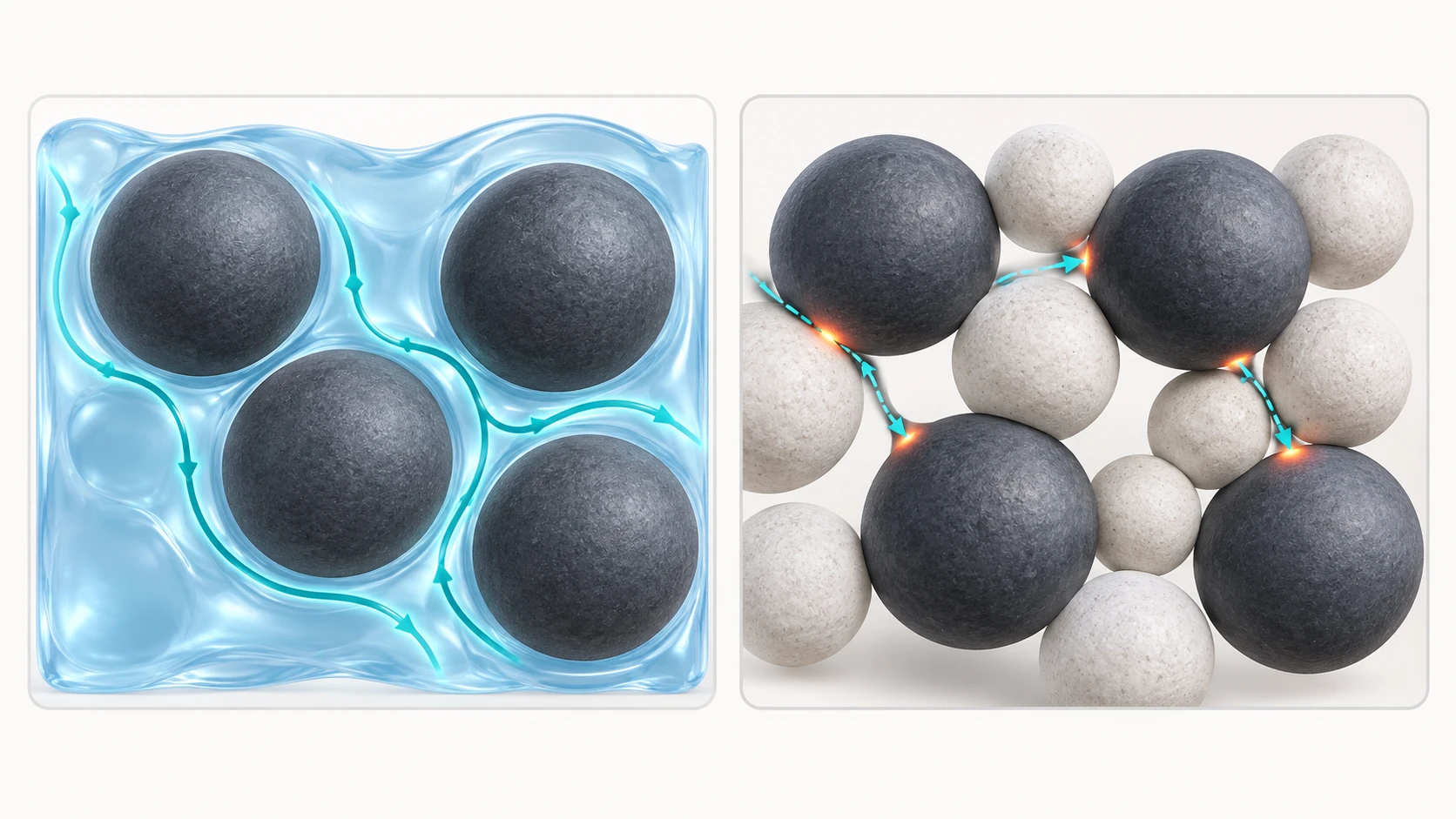
- Liquid: fills gaps and wets a large fraction of particle surfaces
- Solid: ion paths depend on discrete contacts and voids remain
Getting solid to cling to solid without adding interfacial resistance is, put another way, a bonding problem. The same picture that the adhesives and encapsulants field deals with turns up here, with the extra condition that current has to keep flowing through the joint.
And a battery swells and shrinks on every cycle. You do not bond once and walk away; you have to hold an interface that never stops moving. Which is why a soft electrolyte that follows the movement beats a hard, strong one (our commentary).
3. Where it sits among the three material families
Solid electrolytes fall into three broad families, each with its own strengths and weaknesses.
Of the three, sulfides are the only family with a production roadmap published against specific dates. Toyota and Idemitsu Kosan both state a target of practical use of all-solid-state batteries in 2027 to 2028Sourced. Mitsui Kinzoku likewise states that its argyrodite-type sulfide solid electrolyte, A-SOLiD, has been selected for a customer's all-solid-state battery aimed at practical use in 2027 to 2028Sourced.

4. A materials engineer's view (1): softness decides manufacturability
Line up what the companies themselves say about sulfides.
| Source | How the sulfide solid electrolyte is described |
|---|---|
| Toyota | Soft and prone to adhere closely to other materials, which makes batteries easier to mass-produce |
| Toyota | Solid electrolyte technology with high flexibility and adhesion that resists cracking / we were able to develop a material that resists cracking and delivers high performance |
| Mitsui Kinzoku | High lithium-ion conductivity, excellent electrochemical stability, excellent flexibility, allowing sheet forming |
All Sourced (Toyota [Source 2], Mitsui Kinzoku [Source 4]).
What the three quotations have in common is soft, adheres, does not crack, can be made into sheets — mechanical and process properties. Ionic conductivity is assumed, of course, but it is not what any of them chose to spell out.
The reason is Section 2. A solid electrolyte cannot perform if it is not touching, and the softer the material, the more the contact spreads when you press it. A material that adheres well beats a material that conducts well in cell terms — that inversion is why sulfides became the front-runner (our commentary).
Then the phrase sheet forming is possible starts to matterSourced. Powder is not a battery. Only once it can be rolled thin, wide and even does it get onto roll-to-roll continuous production. Softness translates directly into which manufacturing routes are open to you.
5. A materials engineer's view (2): the feedstock is a refinery by-product
Trace the raw material for a sulfide solid electrolyte and you end up somewhere unexpected. Idemitsu Kosan spells it outSourced.
Lithium sulfide is a key intermediate raw material for the solid electrolytes we work on, and it is produced from the sulfur fraction that arises as a by-product of making petroleum products. We recognised the usefulness of that sulfur fraction early and established volume production technology for lithium sulfide in 1994. Drawing on the know-how gained from handling a difficult sulfur fraction over many years, and on our proprietary technology for producing high-purity lithium sulfide... (Idemitsu Kosan news release, 27 February 2025)
All-solid-state batteries became an automotive preoccupation only in the last decade or so. Idemitsu Kosan established volume production technology for lithium sulfide in 1994 — more than thirty years agoSourced.
In other words, the company held the feedstock technology before the application existed. A technology that began from a completely different motive — what to do with the sulfur left over from refining — ended up holding the entrance to the next generation of batteries.
What that tells you is something about the timescale of a materials business. Know-how gained from handling a difficult sulfur fraction over many years cannot be bought later with capitalSourced. The same shape of argument appears in the Adhesives and encapsulants and Functional materials articles in this series: competitiveness in materials often exists before the application does (our commentary).
6. What scale is production actually moving at
On 27 February 2025 Idemitsu Kosan announced that it had decided to build a large-scale lithium sulfide production plantSourced. The published numbers line up as follows.
| Item | As published |
|---|---|
| Production capacity | Expanded to world-leading scale (equivalent to 3 GWh of storage batteries per year) |
| Site | Within the Chiba plant (Ichihara, Chiba prefecture) |
| Completion | Planned for June 2027 |
| Total project cost | About 21.3 billion yen |
| Public support | Certified under the Ministry of Economy, Trade and Industry supply assurance plan for storage batteries. Maximum subsidy about 7.1 billion yen |
| Status today | Two small demonstration facilities in operation. Basic design of a large pilot plant started in October 2024 |
| Target | Practical use of all-solid-state batteries in 2027 to 2028Not yet confirmed |
All Sourced (Idemitsu Kosan news release, 27 February 2025 [Source 1]).
What is published is a capacity equivalent to 3 GWh of storage batteries per year. Convert that into vehiclesOur calculation.
- Assumption: take 60 kWh of battery per EV (a typical passenger EV)
- 3 GWh = 3,000,000 kWh
- 3,000,000 kWh divided by 60 kWh = 50,000 vehicles per year
Roughly 50,000 cars a year. The weight of the capital investment follows from the same numbers.
- 21.3 billion yen divided by 3 GWh = about 7.1 billion yen per GWh
- 7.1 billion yen of subsidy against 21.3 billion yen of cost = about 33% publicly funded
Assumptions and limits: the 60 kWh per vehicle is our own assumption and varies widely by model. And the 21.3 billion yen is investment in a plant for lithium sulfide, the intermediate material; it does not include equipment for the solid electrolyte itself or for cell manufacture. It is not the total investment needed to build batteries for 50,000 EVs.
7. What is still hard
(1) Durability — the interface breaks a little on every cycle
Toyota calls durability the single biggest problem for all-solid-state batteries and describes it this way: repeated charging and discharging produces cracks between the cathode or anode and the solid electrolyte, degrading cell performance, and this has been a technical problem for many yearsSourced.
Every cycle can pull the interface apart
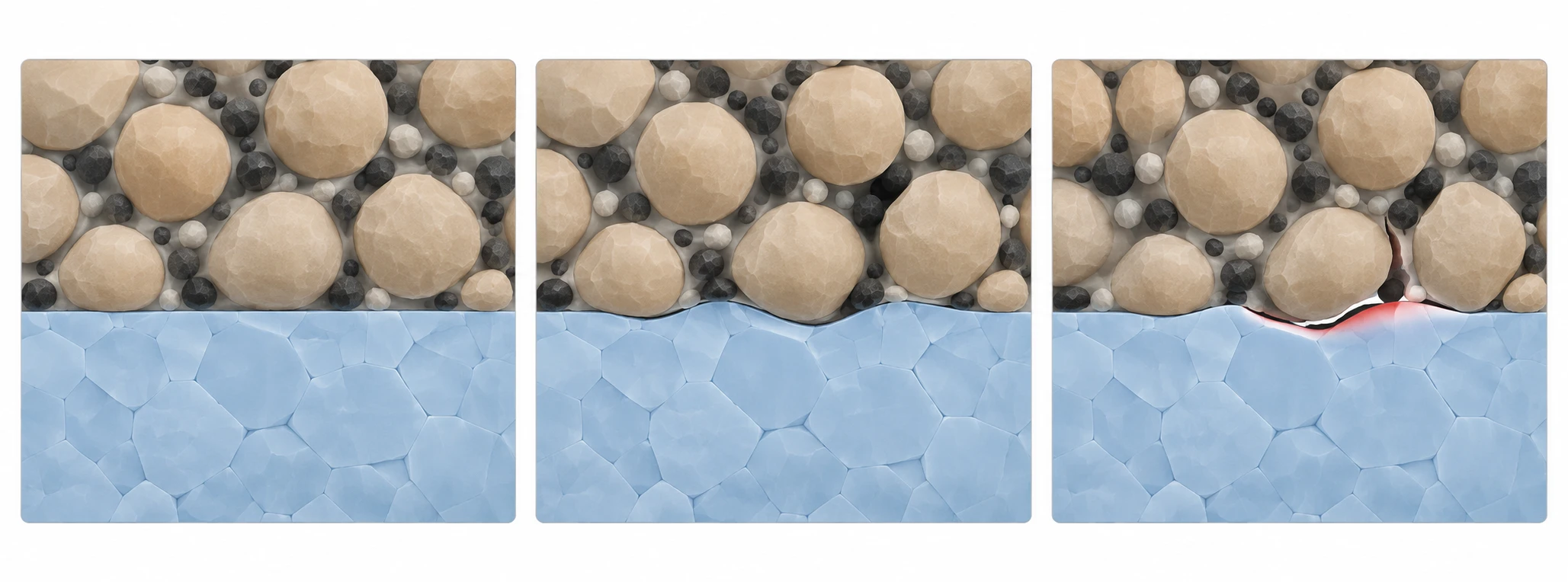
- Before charging: cathode and solid electrolyte are in intimate contact
- Cycling: active material expands and contracts, creating mechanical mismatch at the interface
- After repetition: cracking or delamination reduces the true contact area
Toyota's answer to that problem is phrased as solid electrolyte technology with high flexibility and adhesion that resists crackingSourced.
Making contact, in Section 2, and keeping contact, here, rest on the same property. Whether the active material swells or shrinks, the electrolyte follows it and does not let go. A hard material, once separated, does not come back.
It is the same picture as the Coefficient of thermal expansion article in this series. Can you follow a partner whose dimensions move, without storing up stress? In a battery the movement comes from cycling rather than temperature, but what is asked of the material is unchanged (our commentary).
(2) The reaction with moisture
Sulfides are vulnerable to moisture, so production and handling require a dry environment. When Idemitsu Kosan writes of a difficult sulfur fraction to handle, this is what it refers toSourced. Maintaining a dry environment feeds straight into equipment cost, so the choice of material effectively decides the design of the factory (our commentary).
(3) Volume production is still ahead
Idemitsu Kosan's large plant is due for completion in June 2027, with practical use targeted for 2027 to 2028Not yet confirmed. Mitsui Kinzoku's A-SOLiD has been selected for a customer programme, but that programme is still aiming at practical use in 2027 to 2028Sourced. At the time of writing (September 2026), no official announcement confirming that full volume production of all-solid-state batteries using sulfide solid electrolytes has begun could be foundNot yet confirmed.
- Sulfides lead mainly because they are soft. Toyota describes them as soft and prone to adhere closely to other materials, making batteries easier to mass-produceSourced
- A solid electrolyte performs only as well as it makes contact, because two solids touch only at points (our commentary)
- The feedstock is a refinery by-product. Idemitsu Kosan had established volume production of lithium sulfide by 1994Sourced
- Investment is moving at the scale of 3 GWh per year and 21.3 billion yen, equivalent to about 50,000 EVsOur calculation
- The biggest open problem is durability. Repeated cycling cracks the interfaceSourced
8. Glossary
- Solid electrolyte
- A solid material that conducts lithium ions in place of a liquid electrolyte. The key material in an all-solid-state battery.
- Sulfide solid electrolyte
- A solid electrolyte built on a sulfur framework. Soft and adherent, and regarded as closest to practical use.
- Oxide solid electrolyte
- A solid electrolyte built on an oxygen framework. Chemically stable but hard, and difficult to bring into close contact.
- Halide solid electrolyte
- A solid electrolyte containing halogens such as chlorine. Said to tolerate high voltages, and the subject of growing research.
- Argyrodite
- A representative crystal structure among sulfide solid electrolytes. Mitsui Kinzoku's A-SOLiD is of this type.
- Lithium sulfide (Li2S)
- The intermediate raw material from which sulfide solid electrolytes are made.
- Ionic conductivity
- How readily ions move through a material. The basic performance measure for an electrolyte.
- Interfacial resistance
- Electrical resistance arising at a boundary between materials. In solid electrolytes it comes mainly from insufficient contact.
- Active material
- The material in the cathode or anode that actually carries the charge and discharge reaction.
- Sheet forming
- Rolling a powder out thin and even into a film. A precondition for continuous production.
- GWh
- Gigawatt hour. A unit of battery capacity. 1 GWh = 1,000,000 kWh.
- All-solid-state battery
- A lithium-ion secondary battery whose electrolyte is a solid.
9. Primary sources
- Idemitsu Kosan "Decision to build a large production plant for lithium sulfide, the intermediate raw material, towards volume production of all-solid-state battery materials (solid electrolytes)", 27 February 2025 (PDF, Japanese-language release) — idemitsu.com
- Toyota Motor "Idemitsu and Toyota begin collaboration towards volume production of all-solid-state batteries for battery EVs" (Japanese-language release) — global.toyota
- Idemitsu Kosan "Lithium Battery Materials Department", research and development page (Japanese-language page) — idemitsu.com
- Mitsui Kinzoku "Introducing A-SOLiD, a solid electrolyte for all-solid-state batteries" (Japanese-language page) — mitsui-kinzoku.co.jp
- Mitsui Kinzoku "A-SOLiD, a solid electrolyte for all-solid-state batteries", purpose activity report (Japanese-language page) — mitsui-kinzoku.com
10. Claim-to-source audit
| Claim in the text | Basis | Label |
|---|---|---|
| The decision to build a large lithium sulfide plant (27 February 2025); capacity expanded to world-leading scale, equivalent to 3 GWh of storage batteries per year; the site within the Chiba plant in Ichihara, with completion planned for June 2027; a total project cost of about 21.3 billion yen of which up to about 7.1 billion yen is subsidy, certified under the Ministry of Economy, Trade and Industry supply assurance plan for storage batteries; two small demonstration facilities in operation, with basic design of a large pilot plant started in October 2024; that ions move faster than in a conventional liquid cell because the electrolyte is solid, with further reductions in charging time, higher output, higher energy density and longer life expected; that lithium sulfide is a key intermediate made from the sulfur fraction arising as a by-product of petroleum production; that volume production technology for lithium sulfide was established in 1994; the phrase about know-how from handling a difficult sulfur fraction over many years; and the 2027 to 2028 target | Idemitsu Kosan news release, 27 February 2025[Source 1] https://www.idemitsu.com/jp/news/2024/250227.pdf | Sourced |
| That sulfide solid electrolytes are soft and prone to adhere closely to other materials, which makes batteries easier to mass-produce; the phrases about solid electrolyte technology with high flexibility and adhesion that resists cracking, and about developing a material that resists cracking and delivers high performance; that durability is the single biggest problem and that repeated cycling cracks the boundary between the electrodes and the solid electrolyte; that the collaboration proceeds in three phases; and that practical use of all-solid-state batteries in 2027 to 2028 is the target | Toyota newsroom[Source 2] https://global.toyota/jp/newsroom/corporate/39898897.html | Sourced |
| That the company has generated many inventions in sulfide solid electrolytes made from lithium sulfide and holds one of the largest patent application counts in the field worldwide, and that it is advancing development and a volume production system for solid electrolytes as the key material of all-solid-state batteries | Idemitsu Kosan Lithium Battery Materials Department page[Source 3] https://www.idemitsu.com/jp/company/rd/lithium/index.html | Sourced |
| That A-SOLiD is an argyrodite-type sulfide solid electrolyte with high lithium-ion conductivity, excellent electrochemical stability and excellent flexibility allowing sheet forming; that supply from volume-production test equipment began in November 2021; and that the construction of an initial production plant was announced in September 2024 | Mitsui Kinzoku A-SOLiD page[Source 4] https://www.mitsui-kinzoku.co.jp/mlab/attempt/asolid/ | Sourced |
| That A-SOLiD has high ionic conductivity, that sulfide solid electrolytes are expected to deliver high energy density, fast charging and safety, and that a doubling of the capacity of the volume-production test equipment was decided | Mitsui Kinzoku purpose activity report[Source 5] https://www.mitsui-kinzoku.com/purpose/reports/20230901.html | Sourced |
| Converting 3 GWh per year into about 50,000 EVs; converting the 21.3 billion yen project cost into about 7.1 billion yen per GWh; and putting the subsidy at about 33% of the total cost | Our calculation. A plain division assuming 60 kWh of battery per EV, which varies widely by model. The 21.3 billion yen is investment in a plant for lithium sulfide, the intermediate material, and excludes equipment for the solid electrolyte itself or for cell manufacture | Our calculation |
| Specific numerical values for the ionic conductivity of sulfide solid electrolytes | The companies describe it qualitatively as high lithium-ion conductivity, and no specific published figure could be confirmed within the scope of this article, so no number is given in the text | Commentary |
| The start of full volume production of all-solid-state batteries using sulfide solid electrolytes | No official announcement declaring the start of volume production could be confirmed at the time of writing (September 2026) by this article. The stated targets are 2027 to 2028 | Not yet confirmed |
| The explanation that two solids touch only at points so securing contact becomes the problem; the three-family summary in Fig. 2, including the properties of the non-sulfide families; the reading that softness decides the manufacturing route through sheet forming; the judgement, read off the year 1994, that the feedstock technology existed before the application; the point that maintaining a dry environment decides factory design; and the framing that following a partner whose dimensions move is the same picture as the thermal expansion discussion | Our summary and commentary based on published content. Not a view expressed by any of the companies | Commentary |
| That Figs. 1, 2, 4, 5 and 6 are explanatory drawings rather than real observations or design drawings | Our note | Commentary |
Last updated 21 September 2026. Sources are limited to primary material (official announcements and technical pages from materials makers and carmakers). Because the article includes structural readings and materials-design interpretations, those are marked as Commentary and kept separate from sourced fact. Where no published primary figure could be confirmed, such as ionic conductivity, no estimated value is given. All figures are explanatory concept graphics. Figs. 2, 4 and 5 are vector drawings; the hero image and Figs. 1, 3 and 6 are AI-generated images, and none of them shows a real cross-section, micrograph or physical product.