TECHNOLOGY EXPLAINER
Oxide Solid Electrolytes and LLZO
— they do not burn, but they will not consolidate
Oxides are the safest solid electrolytes: non-flammable and handleable in air. They have still ceded the front-runner position to sulfides, and not because ions struggle to move through them. Everything has stumbled at the point of sticking the powder together into a solid.
- What an oxide solid electrolyte is (the short version)
- Why oxides at all — the single point of safety
- The road to LLZO — three dead ends
- The biggest wall is not conductivity but the space between grains
- Our calculation: how much do grain boundaries actually cost
- A materials engineer's view (1): bulk conductivity is already enough
- Technology for consolidating — what sintering revealed
- In 2026, oxides drew level with liquid electrolyte
- A materials engineer's view (2): stable in air does not apply to the surface
- Strengths, weaknesses and what is still hard
- Glossary / Primary sources / Claim-to-source audit
Sourced = a value stated in published material from a research institute or manufacturer (link given)
Our calculation = a figure this article derived, with the assumptions spelled out
Not yet confirmed = a plan or a target with no confirmed production record
Structural readings and materials-design interpretations are marked separately as Commentary.
1. What an oxide solid electrolyte is (the short version)
An oxide solid electrolyte is a solid material built on an oxygen framework that conducts lithium ions. The leading example is the garnet-type LLZO (Li7La3Zr2O12), and this article centres on it.
- The main advantage: a review by a Nagoya University group states that oxide solid electrolytes have major safety advantages, being non-flammable and generating no toxic gas even in airSourced
- The second advantage: the garnet type showed properties stable even in contact with Li metal — one of the few families that can be paired with a lithium metal anodeSourced
- The main drawback: powder does not make a battery. Joining grain to grain into a dense solid is this family's hardest gate
The problem with oxides is no longer that ions struggle to pass through them. In 2026 AIST reported 15 mS/cm at room temperature, a value comparable to organic liquid electrolyteSourced. What remains is how to consolidate the powder and how to keep the surface intact — both process problems rather than electrical ones.
2. Why oxides at all — the single point of safety
As the Sulfide solid electrolyte article in this series shows, the family closest to practical use is the sulfides, because they are soft, adhere well and can be formed into sheets.
So what is the case for oxides? One sentence in the review states it outright.
Oxide solid electrolytes have major safety advantages, being non-flammable and generating no toxic gas even in air.Sourced (Oyo Buturi vol. 89 no. 4 (2020))
Sulfides react with moisture, so production and handling need a dry environment, and the choice of material decides the capital investment in the plant.
Generating no toxic gas in air means, in reverse, no dry-room running cost and no emergency-response equipment.
On unit price the comparison with sulfides is one thing, but across the whole line the axis of comparison changes. That is why oxides have not been dismissed as a bad bet, and why the research continues (our commentary).
3. The road to LLZO — three dead ends
There is a clear history behind the choice of garnet-type LLZO, and the review sets it out.
Development path of oxide solid electrolytes
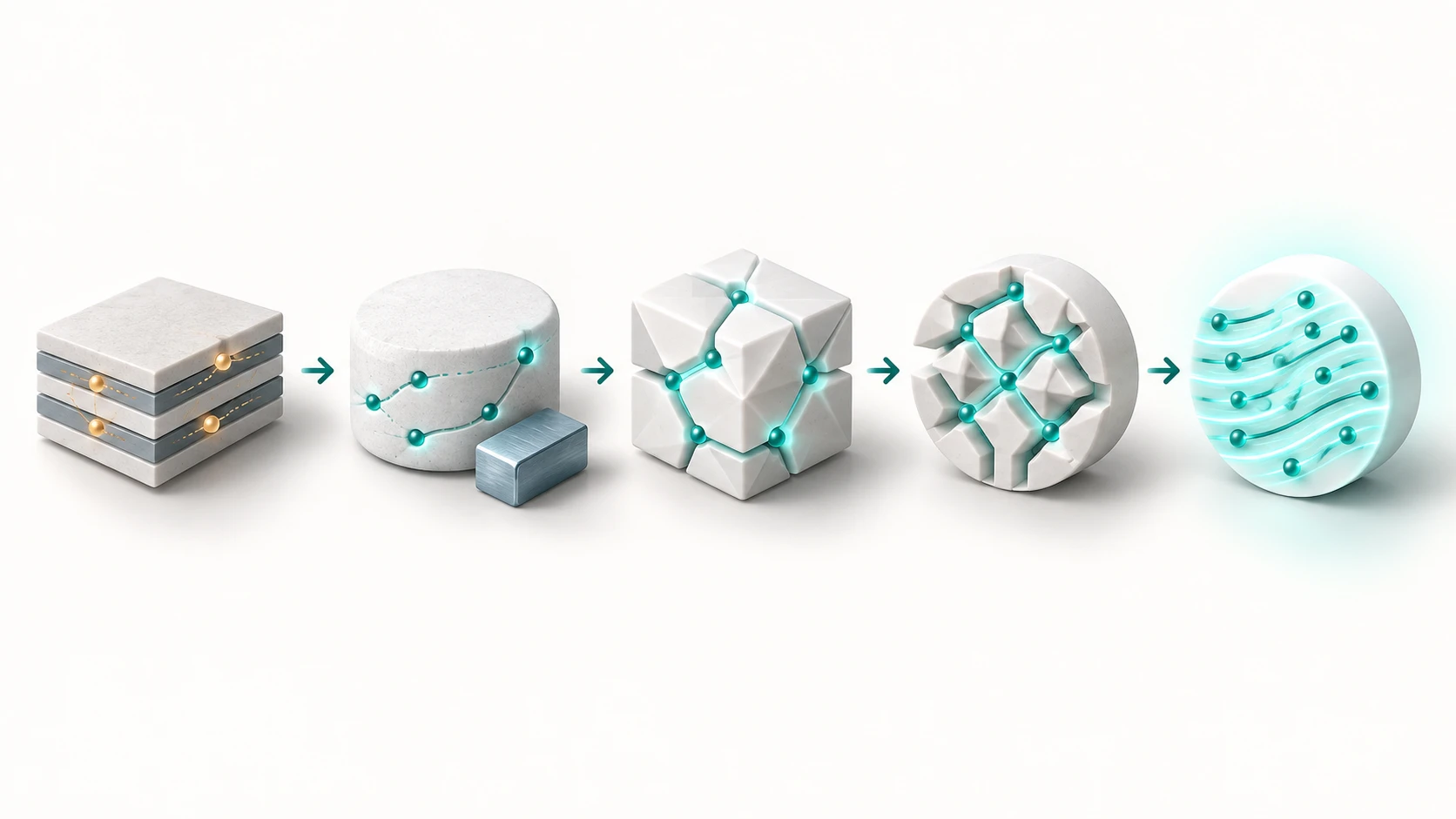
- 1970s: layered-structure materials
- 1990s: NASICON-type materials
- 1990s: perovskite-type materials
- From the 2000s: garnet-type materials
- Recent work: oxide materials with higher reported conductivity
| Family | Representative composition | Ionic conductivity | Compatibility with lithium metal |
|---|---|---|---|
| Layered materials (early 1970s) | — | 1.3×10⁻⁴ S/cm (25 °C) | — |
| NASICON type (1990s) | LiTi2(PO4)3 | 10⁻³ S/cm range | Not usable (contains Ti) |
| Perovskite type (1990s) | Li3xLa2/3-xTiO3 | 10⁻³ S/cm range | Not usable (Ti⁴⁺ is reduced to Ti³⁺) |
| Garnet type | Li6ALa2Ta2O12 (A = Sr, Ba) and LLZ | 10⁻⁵, rising to 10⁻⁴ with Al doping and to the 10⁻³ S/cm range with Nb or Ta substitution | Stable |
| Pyrochlore type (2026) | Li1.25La0.58Nb2O6F | 15 mS/cm in the grain, 11 mS/cm for the sintered body | No statement found within the scope of this article |
Everything up to the garnet type is Sourced (review [Source 1]); the pyrochlore type is Sourced (AIST [Source 2]).
The important column in that table is not the conductivity but the one on the right.
Both the NASICON and the perovskite types had reached an adequate 10⁻³ S/cm by the 1990sSourced. The review explains why neither became the front-runner: in the above solid electrolytes, the strong reducing power of Li reduces Ti⁴⁺ in the electrolyte to Ti³⁺, so they cannot be brought into direct contact with Li metalSourced.
The performance was there; the material reacts with what it has to be paired with. A property table for the material alone does not show that dead end.
Nor did the garnet type survive because of high conductivity. The conductivity first reported for Li6ALa2Ta2O12 is explicitly described as 10⁻⁵ S cm⁻¹, by no means highSourced. It was chosen because it showed properties stable even in contact with Li metalSourced.
Conductivity could be raised afterwards. Stability could not be added afterwards. As an order of priorities in material selection, that is worth noting (our commentary).
4. The biggest wall is not conductivity but the space between grains
Substituting Nb or Ta brought the garnet type into the 10⁻³ S/cm rangeSourced, the same territory as sulfides. It is still behind in practical use.
The reason lies in what the powder looks like once consolidated. An announcement from Nagoya Institute of Technology puts numbers on it.
The chloride material it developed (monoclinic LiAlCl4) had a high relative density of 94% and an almost negligible (7.5%) solid-to-solid resistance, whereas the garnet-type oxide used for comparison had a relative density of 63%, with the solid-to-solid resistance accounting for 99.9% of the totalSourced (Nagoya Institute of Technology, 23 June 2020)
99.9% of the resistance sits between the grains. However well the material itself conducts ions, current does not flow if the grains are not joined.
5. Our calculation: how much do grain boundaries actually cost
The figures AIST published in March 2026 for a pyrochlore-type solid electrolyte contain something valuable for thinking about this problem.
At room temperature the lithium-ion conductivity within the pyrochlore-type solid electrolyte is 15 mS cm⁻¹, and the ionic conductivity of the sintered body as a whole is 11 mS cm⁻¹.Sourced
The material has been known as difficult to densify, with many gaps forming between particles through which lithium ions cannot pass, but spark plasma sintering densified it to 98% of theoretical densitySourced (AIST, 11 March 2026)
Two values are published: within the grain (15 mS/cm) and for the sintered body (11 mS/cm). The difference is what is lost between grainsOur calculation.
- Assumption: treat the in-grain resistance and the grain-boundary resistance as being in series
- Share of the total taken by the grain interior = 11 divided by 15 = 0.733
- The remainder is grain boundary = 1 minus 0.733 = about 27%
Even consolidated to 98% of theoretical density, roughly a quarter of the resistance is still between grains.
Assumptions and limits: the series-resistance model is a simplification for seeing orders of magnitude. In a real polycrystal the behaviour depends on the shape, distribution and composition of the boundaries. And this 27% belongs to this material under these sintering conditions; it does not generalise to other oxides.
Convert conductivity into the area-specific resistance (Ω cm²) used in cell designOur calculation. For a layer of thickness t, the area resistance is R = t divided by σ.
- Assumption: take the electrolyte layer as 20 µm thick (= 2×10⁻³ cm)
- Pyrochlore type (11 mS/cm = 0.011 S/cm): 2×10⁻³ divided by 0.011 = about 0.18 Ω cm²
- Garnet type (taking the 10⁻³ range as 1×10⁻³ S/cm): 2×10⁻³ divided by 0.001 = about 2 Ω cm²
Set that beside the figures in the Interfacial resistance article of this series. Tohoku University reported an interfacial resistance between lithium metal and LLZO of about 225 Ω cm² with ultrasonic bonding aloneSourced.
The electrolyte layer itself is 0.18 to 2 Ω cm². The interface is 225 Ω cm². Different orders of magnitude.
Assumptions and limits: the 20 µm thickness is our own assumption, and the interfacial resistance comes from a different experiment on a different material system under different conditions, so this is not a strict like-for-like comparison. It does, however, give a sense of which term dominates.
6. A materials engineer's view (1): bulk conductivity is already enough
What calculation (2) shows is an inversion of priorities.
- The electrolyte layer itself: 0.18 to 2 Ω cm²Our calculation
- The interface with lithium metal: about 225 Ω cm² (ultrasonic bonding alone)Sourced
Doubling the bulk conductivity takes only 0.09 Ω cm² off the total. Taking the interface from 225 to 1.5 Ω cm² removes 223.5 Ω cm² (Tohoku University achieved exactly that by adding a thin Au layer)Sourced.
So in this family, the only champion-data race still worth running is at grain boundaries and interfaces.
That is also the significance of AIST publishing 15 mS/cm and 11 mS/cm separately. Reporting the grain interior and the sintered body apart means the gap between them is understood to be the contest (our commentary).
From a materials maker's seat it means the product moves from the conductivity of the powder to the conductivity after consolidation. And in most cases the consolidating is done by whoever bought the powder.
7. Technology for consolidating — what sintering revealed
How, then, do you consolidate it? There are two principal methods.
- Hot pressing (HP): load it into a die and apply pressure while heating from outside
- Spark plasma sintering (SPS): pass a pulsed current through it, heating from within while applying pressure
For a long time SPS was thought to be the better method, on the explanation that a plasma effect from the current specially promotes sintering.
In September 2025 a Tohoku University group published a direct comparison of the twoSourced.
For the garnet-type oxide Li7La3Zr2O12 (LLZO), the work established that either method achieves equivalent densification with a few minutes of processing at the sintering temperature. And no plasma effect of the kind conventionally attributed to SPS was observed; what decides the structure and function of the sintered body is pressure and heatSourced (Tohoku University, 16 September 2025; published in Small)
A conclusion of "either works" looks unremarkable. In practice it carries weight.
SPS needs a power supply and tooling to pass pulsed current. If that is not essential, existing hot-press equipment will do. The announcement itself makes the point that flexibility in the choice of technique accelerates all-solid-state battery developmentSourced.
The other important phrase is a few minutes of processing at the sintering temperatureSourced. Ceramic sintering usually means hours, but with pressure applied, minutes are enough.
Short times matter especially for lithium-containing materials. Long holds at high temperature invite compositional drift and reaction with neighbouring materials. Deciding it quickly, with pressure, looks like a sound direction for putting oxides into production (our commentary).
8. In 2026, oxides drew level with liquid electrolyte
The result AIST published on 11 March 2026 changed where this family standsSourced.
| Item | As published |
|---|---|
| Material | Pyrochlore-type oxide solid electrolyte Li1.25La0.58Nb2O6F |
| Ionic conductivity | At room temperature, 15 mS/cm within the grain and 11 mS/cm for the sintered body. The highest value in the world for an oxide solid electrolyte |
| Densification | Spark plasma sintering to 98% of theoretical density |
| Stability | Very high resistance to air and humidity; stable to air and water |
| The problem until now | Known as difficult to densify, with many gaps forming between particles through which lithium ions cannot pass; conventional materials are an order of magnitude lower in ionic conductivity than organic liquid electrolytes or other solid electrolytes |
| Announcement | 11 March 2026, by Yuji Fujita, Tomonari Takeuchi, Yuta Ito and Toyoki Okumura of the AIST Battery Technology Research Institute; published in ACS Materials Letters |
All Sourced (AIST [Source 2]).
15 mS/cm = 0.015 S/cm = 1.5×10⁻² S/cmOur calculation (a unit conversion, nothing more).
Since the garnet type's best in the Section 3 table is the 10⁻³ S/cm rangeSourced, that is roughly an order of magnitude higherOur calculation. It is the level AIST describes as comparable to organic liquid electrolyteSourced.
What deserves a materials engineer's attention, though, is the other statement: known as difficult to densify, with many gaps forming between particles through which lithium ions cannot passSourced.
It is not that a new material was found. A way of consolidating it was found. The wall between grains from Sections 4 and 5 was crossed by packing it to 98% with spark plasma sintering.
Once again in this field, what settles the result is often process rather than composition (our commentary).
9. A materials engineer's view (2): stable in air does not apply to the surface
The great selling point of oxides was that they can be handled in air. And yet, when the time comes to pair them with lithium metal, that advantage turns inside out.
On bonding lithium metal to LLZO, it describes as a major obstacle to practical use that an insulating lithium carbonate layer (Li2CO3) forming on the surface produces high interfacial resistanceSourced (Tohoku University, 24 March 2026)
The review makes the same point: LLZ is known to form Li2CO3 and similar species on its surface in air. The poor wettability of the LLZ surface to Li noted above originates in these impurities.Sourced
A material not decomposing in air and an interface being sound are two entirely different statements.
LLZO does not fall apart in air. It gives off no toxic gas. But if the outermost few nanometres turn into lithium carbonate, those nanometres are an insulator. As the Interfacial resistance article in this series shows, a layer of exactly that thickness is what sets interfacial resistance.
The review adds another trap: a damaged layer from polishing. In general, mechanically polishing a ceramic surface forms a damaged layer containing a great many defects — and that damaged surface has poor wettability to molten Li, making Li deposition less likelySourced.
The countermeasure reported is immersing the polished LLZ in aqueous hydrochloric acid to remove the damaged layer, which improved wettability to molten Li and dramatically improved the cycling stability of the Li metal anodeSourced.
What that says is that process design for oxides becomes a chain of surface-finishing decisions. Sinter it dense. Polish it to shape. But polishing creates a damaged layer. Removing that lets carbonate form. Fix one thing and the next appears. Anyone who has worked on surface treatment of precision parts knows the view (our commentary).
10. Strengths, weaknesses and what is still hard
(1) Almost no numbers for sintering conditions are published
The Tohoku University announcement shows 1100 °C in a figure caption, but specific values for pressure, hold time, the relative density achieved and the ionic conductivity do not appear in the body of the press release this article consulted. They are therefore not stated here. Likewise, the temperature, pressure and time of the densification could not be confirmed in the AIST announcement either.
(2) The compatibility of the pyrochlore type with lithium metal cannot be confirmed
The AIST announcement says the material is stable to air and waterSourced, but no statement about its stability in direct contact with lithium metal could be found within the scope of this article. That cell is left blank in the Section 3 table.
(3) No production record can be confirmed
At the time of writing (September 2026), no primary source confirming that full volume production of all-solid-state batteries using oxide solid electrolytes has begun could be foundNot yet confirmed. Both the AIST result and the Tohoku University sintering work are reports at the research stage.
- The case for oxides is safety: non-flammable and generating no toxic gas even in airSourced
- The garnet type was chosen for stability with Li metal, not for conductivity. The first reported value was 10⁻⁵ S/cmSourced
- The biggest wall is between grains. In a garnet at 63% relative density, 99.9% of the resistance was solid-to-solidSourced
- Even densified to 98%, about 27% of the resistance is still at grain boundariesOur calculation
- The electrolyte layer itself is 0.18 to 2 Ω cm²; the interface is about 225 Ω cm². The problem is no longer bulkOur calculation
- What decides sintering is pressure and heat. No plasma effect was found for SPSSourced
- In 2026, 15 mS/cm at room temperature was reported for an oxide. An achievement in consolidation, not in material discoverySourced
11. Glossary
- Oxide solid electrolyte
- A solid electrolyte built on an oxygen framework. Non-flammable and easy to handle in air.
- LLZO (LLZ)
- The garnet-type oxide solid electrolyte Li7La3Zr2O12. Stable with lithium metal.
- Garnet type
- The family sharing the crystal structure of garnet. Some members are stable in contact with lithium metal.
- NASICON type
- A structure type derived from the sodium superionic conductor. Ti-containing members cannot meet Li metal.
- Perovskite type
- A major oxide structure type, including Li3xLa2/3-xTiO3.
- Pyrochlore type
- Another oxide structure type. 15 mS/cm at room temperature was reported for one in 2026.
- Grain boundary
- The boundary where grains meet in a polycrystal. Without a path for ions there, it becomes resistance.
- Relative density
- Actual density as a fraction of theoretical density. The closer to 100%, the fewer the voids.
- Sintering
- Heating powder, usually under pressure, to bond the grains into a dense solid.
- Hot pressing (HP)
- Sintering in a die with pressure applied while heating from outside.
- Spark plasma sintering (SPS)
- Sintering by passing a pulsed current to heat from within while applying pressure.
- Area-specific resistance (Ω cm²)
- Resistance per unit area. Thickness divided by conductivity gives it.
12. Primary sources
- Soshu Motoyama, Takayuki Yamamoto and Yasutoshi Iriyama (Nagoya University) "Elucidating the short-circuit mechanism of solid electrolytes towards higher performance in all-solid-state Li batteries", Oyo Buturi vol. 89 no. 4 (2020) 213-217 (PDF, Japanese-language page) — jstage.jst.go.jp
- AIST "Ionic conductivity at the level of organic liquid electrolytes achieved in a pyrochlore-type oxide solid electrolyte", 11 March 2026 (Japanese-language release) — aist.go.jp
- Nagoya Institute of Technology "A new material for safe, high-capacity all-solid-state lithium batteries", 23 June 2020 (Japanese-language release) — nitech.ac.jp
- Tohoku University "Interface between lithium metal and a garnet-type oxide solid electrolyte formed at room temperature in a short time", 24 March 2026 (Japanese-language release) — tohoku.ac.jp
- Tohoku University "No difference in properties between the two established sintering methods for solid electrolytes", 16 September 2025 (Japanese-language release) — tohoku.ac.jp
- Tohoku University Graduate School of Engineering "Interface between lithium metal and a garnet-type oxide solid electrolyte formed at room temperature in a short time" (Japanese-language page) — eng.tohoku.ac.jp
13. Claim-to-source audit
| Claim in the text | Basis | Label |
|---|---|---|
| That oxide solid electrolytes have major safety advantages, being non-flammable and generating no toxic gas even in air; that materials with a layered structure were reported in the early 1970s at 1.3×10⁻⁴ S cm⁻¹ (25 °C); that in the 1990s NASICON-type LiTi2(PO4)3 and perovskite-type Li3xLa2/3-xTiO3 reached the 10⁻³ S cm⁻¹ range; that in those electrolytes the strong reducing power of Li reduces Ti⁴⁺ to Ti³⁺ so they cannot be placed in direct contact with Li metal; that garnet-type Li6ALa2Ta2O12 (A = Sr, Ba) showed properties stable in contact with Li metal while its conductivity of 10⁻⁵ S cm⁻¹ was by no means high; that Al doping brings the cubic phase into the 10⁻⁴ S cm⁻¹ range and Nb or Ta substitution into the 10⁻³ range; that LLZ forms Li2CO3 and similar species on its surface in air and that poor wettability to Li originates in those impurities; that mechanical polishing of a ceramic surface forms a damaged layer with many defects whose surface wets poorly to molten Li; and that immersing polished LLZ in aqueous hydrochloric acid to remove the damaged layer improved wettability and dramatically improved cycling stability | Review, Oyo Buturi vol. 89 no. 4 (2020)[Source 1] https://www.jstage.jst.go.jp/article/oubutsu/89/4/89_213/_pdf | Sourced |
| That the pyrochlore-type solid electrolyte has the composition Li1.25La0.58Nb2O6F; that at room temperature its lithium-ion conductivity within the grain is 15 mS cm⁻¹ and that of the sintered body 11 mS cm⁻¹; that spark plasma sintering densified it to 98% of theoretical density; that it has very high resistance to air and humidity and is stable to air and water; that it has been known as difficult to densify with many gaps between particles through which lithium ions cannot pass; that conventional materials are an order of magnitude lower in conductivity than organic liquid electrolytes or other solid electrolytes; that this is the highest value in the world for an oxide solid electrolyte; and the announcement date of 11 March 2026, the researchers named, and publication in ACS Materials Letters | AIST press release, 11 March 2026[Source 2] https://www.aist.go.jp/aist_j/press_release/pr2026/pr20260311/pr20260311.html | Sourced |
| That monoclinic LiAlCl4 had a high relative density of 94% with an almost negligible (7.5%) solid-to-solid resistance, and that the garnet-type oxide used for comparison had a relative density of 63% with solid-to-solid resistance accounting for 99.9% of the total | Nagoya Institute of Technology press release, 23 June 2020[Source 3] https://www.nitech.ac.jp/news/press/2020/8406.html | Sourced |
| That in bonding lithium metal to LLZO an insulating lithium carbonate layer (Li2CO3) on the surface produces high interfacial resistance and has been a major obstacle to practical use, and that ultrasonic bonding gave about 225 Ω cm² while adding a thin Au layer gave about 1.5 Ω cm² | Tohoku University press release, 24 March 2026[Source 4] https://www.tohoku.ac.jp/japanese/2026/03/press20260324-02-Lithium.html | Sourced |
| That for garnet-type Li7La3Zr2O12 and aluminium-added LLZO, a comparison of hot pressing and spark plasma sintering established that either method achieves equivalent densification within a few minutes at the sintering temperature; that no plasma effect conventionally attributed to SPS was observed and that pressure and heat decide the structure and function of the sintered body; that flexibility in the choice of technique is said to accelerate all-solid-state battery development; the announcement date of 16 September 2025, the researchers named, and publication in Small; and that 1100 °C appears in a figure caption | Tohoku University press release, 16 September 2025[Source 5] https://www.tohoku.ac.jp/japanese/2025/09/press20250916-02-Garnet.html | Sourced |
| That the same values of about 225 Ω cm² and about 1.5 Ω cm² with an Au layer were confirmed on the Tohoku University Graduate School of Engineering page | Tohoku University Graduate School of Engineering news[Source 6] https://www.eng.tohoku.ac.jp/news/detail-,-id,3532.html | Sourced |
| Putting the grain-boundary share of resistance at 1 minus 11/15 = about 27%; putting the area resistance of a 20 µm layer at about 0.18 Ω cm² for 11 mS/cm and about 2 Ω cm² for 1×10⁻³ S/cm; putting the reduction from doubling bulk conductivity at about 0.09 Ω cm²; and converting 15 mS/cm to 1.5×10⁻² S/cm, roughly an order of magnitude above the 10⁻³ S/cm range | Our calculation. It is a simplification assuming in-grain and grain-boundary resistances in series; real polycrystalline behaviour depends on the shape, distribution and composition of boundaries. The 20 µm electrolyte layer and taking the garnet type as 1×10⁻³ S/cm are both assumptions of this article. The interfacial resistance comes from a different system and measurement conditions, so this is not a strict direct comparison | Our calculation |
| Specific values for sintering temperature, pressure and hold time, and for the relative density and ionic conductivity obtained (the Tohoku sintering study and the AIST densification conditions) | Not found in the body of the press releases this article consulted, so not stated. The Tohoku announcement shows only 1100 °C in a figure caption | Commentary |
| The stability of pyrochlore-type Li1.25La0.58Nb2O6F in direct contact with lithium metal | No statement could be confirmed within the scope of this article, so that cell is left blank in the Section 3 table | Commentary |
| The start of full volume production of all-solid-state batteries using oxide solid electrolytes | No primary source indicating the start of volume production could be confirmed at the time of writing (September 2026) by this article | Not yet confirmed |
| Placing five families on a timeline; the reading that conductivity could be raised afterwards while stability could not be added afterwards; the framing that the problem has moved from conductivity to grain boundaries and interfaces; the observation that what is sold moves from the conductivity of the powder to the conductivity after consolidation; the reading that short sintering times favour lithium-containing materials; the two-column sorting of strengths and weaknesses; and the reading that what was found was a way of consolidating rather than a new material | Our summary and commentary based on published content. Not views expressed by the institutions | Commentary |
| That Figs. 1, 2, 3, 4 and 6 are explanatory drawings rather than real observations or design drawings, and that the hero image and Fig. 5 are AI-generated images | Our note | Commentary |
Last updated 21 September 2026. Sources are limited to primary material (a review in a peer-reviewed journal and official announcements from national research institutes and universities). Because the article includes structural readings and materials-design interpretations, those are marked as Commentary and kept separate from sourced fact. Sintering conditions such as temperature, pressure and time, the compatibility of the pyrochlore type with lithium metal, and any production record are not stated here because no published primary source could be confirmed. The values set side by side in Figs. 2 and 3 come from different material systems and measurement conditions and are not strict direct comparisons. All figures are explanatory concept graphics. Figs. 1, 2, 3, 4 and 6 are vector drawings; the hero image and Fig. 5 are AI-generated images, and none of them shows a real cross-section, micrograph or physical product.