INSTITUTION PROFILE / SOLID-STATE BATTERIES
U.S. Department of Energy
The federal department that pays for America's solid-state battery research and production lines
The U.S. Department of Energy (DOE) is a federal executive department. It does not make batteries. Its role in solid-state batteries is that several of its offices hand out grants covering everything from early research to production equipment. The "DOE grant of up to $50 million" mentioned in our Solid Power profile also shows up in the federal government's spending database, as an award of $50 million. This profile concentrates on two questions: how much influence DOE really has over solid-state batteries, and how the policy shift since 2025 is affecting that support.
- DOE in 30 seconds
- What kind of body it is: the four types of influence
- What it does for solid-state batteries
- How far its influence reaches (powers and geography)
- Where the money goes
- Outlook
- Glossary, references and claim-to-source audit
1. DOE in 30 seconds
Department of EnergyUsually shortened to DOE
production equipmentRuns its own calls, selections, awards and terminations
Unlike NEDO, DOE houses both the people who decide what to support and the people who hand out the money. Congress, however, has the last word on the budget, and DOE's own budget documents keep the "Request" and the "Enacted" amounts separate Sourced. Since 2025, the administration's priorities have sharply cut the budget requests for vehicle battery work. The office that runs battery research (formerly the Vehicle Technologies Office) had $397 million enacted for FY2026; the FY2027 request is $20 million, a 95% cut Sourced.
2. What kind of body it is: the four types of influence
Unlike the companies in this series, none of the institutions that appear in solid-state battery coverage makes batteries. What separates them is the route by which they influence the industry, and that gives four types.
3. What it does for solid-state batteries
DOE's solid-state battery work is split between different offices depending on the stage of development Sourced. Where an office has been renamed in the reorganisation since 2025, we give both the new and the former name.
| Programme | Office | Period and amount | Link to solid-state batteries |
|---|---|---|---|
| EVs4ALL | ARPA-E (funds high-risk research) | Announced January 2023 12 projects, $42 million in total | Three of the 12 are solid-state: Solid Power ($5.6 million), the University of Maryland ($4.85 million) and Ampcera ($2.12 million) |
| FY23 AMMTO Battery Manufacturing Lab Call | AMMTO (Advanced Materials & Manufacturing Technologies Office) | $16 million in total $11 million of it for three solid-state projects | National laboratories lead, with industry partners: ORNL (continuous manufacturing of oxide electrolytes, $4 million), NREL (dry-process electrodes, $4 million) and Argonne (roll-to-roll manufacturing, $3 million) |
| Battery500 Consortium, Phase II | Former VTO (now TTO, the Transportation Technologies Office) | October 2021 to September 2026 DOE share $75 million | Led by PNNL. Targets 500 Wh/kg and 1,000 cycles at cell level. The main focus is lithium-metal batteries, with solid electrolytes treated as one possible pathway |
| Battery Manufacturing and Recycling Grants (Round 2) | Former MESC (now MDO, the Manufacturing Deployment Office) | January 2025 to December 2026 $50 million awarded | Solid Power's equipment for continuous production of sulfide solid electrolyte. Funded under Section 40207 of the Infrastructure Investment and Jobs Act (IIJA). Solid Power contributes $60 million |
ARPA-E and the national laboratory programmes are research and prototyping in the single-digit millions of dollars. MDO (formerly MESC) grants are a different animal altogether: tens of millions of dollars for factory equipment. As far as we could confirm, the only case of DOE funding production equipment for solid-state batteries is Solid Power's solid electrolyte plant in Colorado, and what it funds is not battery cells but a material, sulfide solid electrolyte. For a materials supplier, the message is that in the United States "making electrolyte in volume and at low cost" has become something public money will back.
Is the policy shift since 2025 hitting solid-state battery support?
| When | What DOE did (primary sources) | Effect on solid-state batteries (as far as we can confirm) |
|---|---|---|
| May 2025 | The Secretary issued a memorandum, "Ensuring Responsibility for Financial Assistance", setting out case-by-case reviews of awards | The review mechanism was put in place |
| 1 October 2025 | Terminated 321 awards (223 projects) worth about $7.56 billion. They included awards from the former EERE, MESC and ARPA-E among others, and 26% had been made between Election Day and Inauguration Day | The announcement does not list the awards, so it alone does not tell us whether any solid-state battery awards were among them |
| July 2025 and March 2026 | Solid Power's grant (awarded 30 December 2024) shows a "modification" and a "continuation" | The award is still $50 million, of which about $9.69 million has been paid out. There is no record of termination |
| April 2026 | FY2027 budget request. Cuts the former VTO by 95% and ARPA-E by 43%, and proposes cancelling $15.2 billion in unspent IIJA funds | If Congress enacts the request as proposed, vehicle battery research funding will fall sharply (section 6) |
| 20 August 2026 | Selected seven projects worth $500 million in the third round of battery manufacturing grants, a call that put domestic processing of critical minerals and materials front and centre | Of the five projects made public, none names solid-state batteries (one covers lithium-metal thin films) |
4. How far its influence reaches (powers and geography)
| Aspect | What DOE has | What it does not have |
|---|---|---|
| Powers | The power to solicit, select, award, review and terminate grants for R&D and production equipment. As a grant condition, its interpretive guidance restricts entities controlled by the governments of China, Russia, Iran and North Korea (foreign entities of concern, or FEOC) from battery supply chains | The final decision on its budget (it follows what Congress enacts). The power to set product safety standards or international standards for batteries, which does not appear in any of the DOE material we reviewed. Any power to require private companies to mass-produce |
| Geography | Programmes funded from the U.S. federal budget. Production grants go to equipment located in the United States (Colorado, in Solid Power's case) | Direct authority over foreign companies or other countries' policies. The FEOC conditions do, however, extend to overseas sourcing by the companies receiving grants |
| Time horizon | IIJA battery grants are multi-year money, "available until expended". DOE oversees 17 national laboratories, which gives research continuity | Any guarantee that support survives a change of administration. In 2025 awards already made were terminated, and cancelling unspent IIJA funds has been proposed |
| Scale | About 15,000 federal staff (down by more than 3,500 in 2025) and over 100,000 contractor staff. $49.1 billion in discretionary budget (FY2026 enacted) | The total available for solid-state batteries alone has not been published |
Most of DOE's budget goes to nuclear weapons stewardship (NNSA) and environmental cleanup. Of the $53.9 billion FY2027 request, NNSA accounts for $32.8 billion and Environmental Management for $8.18 billion Sourced. The office that includes battery research (the Office of Critical Minerals and Energy Innovation, formerly EERE) requests $1.12 billion; within that the former VTO gets $20 million, while ARPA-E as a whole gets $200 million. The same goes for the "about 15,000 staff": only a small fraction work on batteries. National laboratory researchers are contractor staff employed by the universities and companies that run the labs, and are not counted as federal employees Sourced. The total spent on solid-state batteries alone has not been published Not yet confirmed.
5. Where the money goes
Links to companies in this series
| Company | What DOE-side primary sources confirm | Link to this series |
|---|---|---|
| Solid Power | A $50 million production grant from MDO (formerly MESC), $5.6 million from ARPA-E's EVs4ALL, and a role in the NREL-led lab call project. Records also show two earlier awards from the former EERE, 2019 to 2023 (about $4.6 million in total) | Matches the "DOE grant of up to $50 million" in our Solid Power profile, and the $60 million company contribution matches too |
| Solidion Technology | A record of one award under ARPA-E's OPEN solicitation (about $0.6 million, from November 2025), but its description does not show any link to solid-state batteries | Our Solidion profile mentions "two awards from the Department of Energy". We could not confirm what they cover from DOE-side records |
| QuantumScape and Factorial | We searched USAspending.gov for DOE awards and found none | We found no DOE funding for either company's solid-state battery development |
USAspending.gov is the U.S. government's official spending database. It lists the award amount, outlays and period of performance for grants reported by each department. Figures are as retrieved in September 2026 Sourced.
6. Outlook
| What the evidence suggests | Primary information it rests on | Category |
|---|---|---|
| U.S. R&D funding for vehicle batteries is likely to fall sharply in FY2027, though the final figure is up to Congress | The FY2027 request cuts the former VTO by 95% and ARPA-E by 43%. The budget documents show requested and enacted amounts separately, and the final figure is set when Congress enacts the budget | Inference |
| The large lithium-metal battery research effort (Battery500) reaches a natural end at the close of September 2026 | Phase II is scheduled to end on 30 September 2026. We found no successor programme in DOE's primary sources | Inference |
| DOE's battery support is shifting its weight from batteries themselves towards domestic processing of critical minerals and materials | The former EERE has been renamed the Office of Critical Minerals and Energy Innovation, and the third round of battery manufacturing grants put critical minerals processing front and centre | Inference |
| Whether Solid Power's $50 million grant will be paid in full as planned will not be clear until the award period ends in late 2026 | About $9.69 million had been paid out when we retrieved the record. The period of performance runs to 31 December 2026 | Inference |
7. Glossary
- ARPA-E
- The Advanced Research Projects Agency-Energy, a unit within DOE that funds high-risk, high-reward early-stage research. It was set up under a 2007 law.
- IIJA (Bipartisan Infrastructure Law)
- The Infrastructure Investment and Jobs Act, signed into law on 15 November 2021. Section 40207 provides grants for battery materials processing and for battery manufacturing and recycling.
- National laboratories
- The 17 laboratories overseen by DOE. The facilities are government-owned but run under contract by universities and companies, so their researchers are not federal employees.
- FEOC (foreign entity of concern)
- A concept defined in the IIJA. DOE's interpretive guidance applies it to entities controlled by the governments of China, Russia, Iran and North Korea, among others, and uses it as a condition of its battery grants.
- Battery500
- A DOE research consortium led by PNNL. It aims for 500 Wh/kg and 1,000 cycles at cell level and works mainly on lithium-metal batteries.
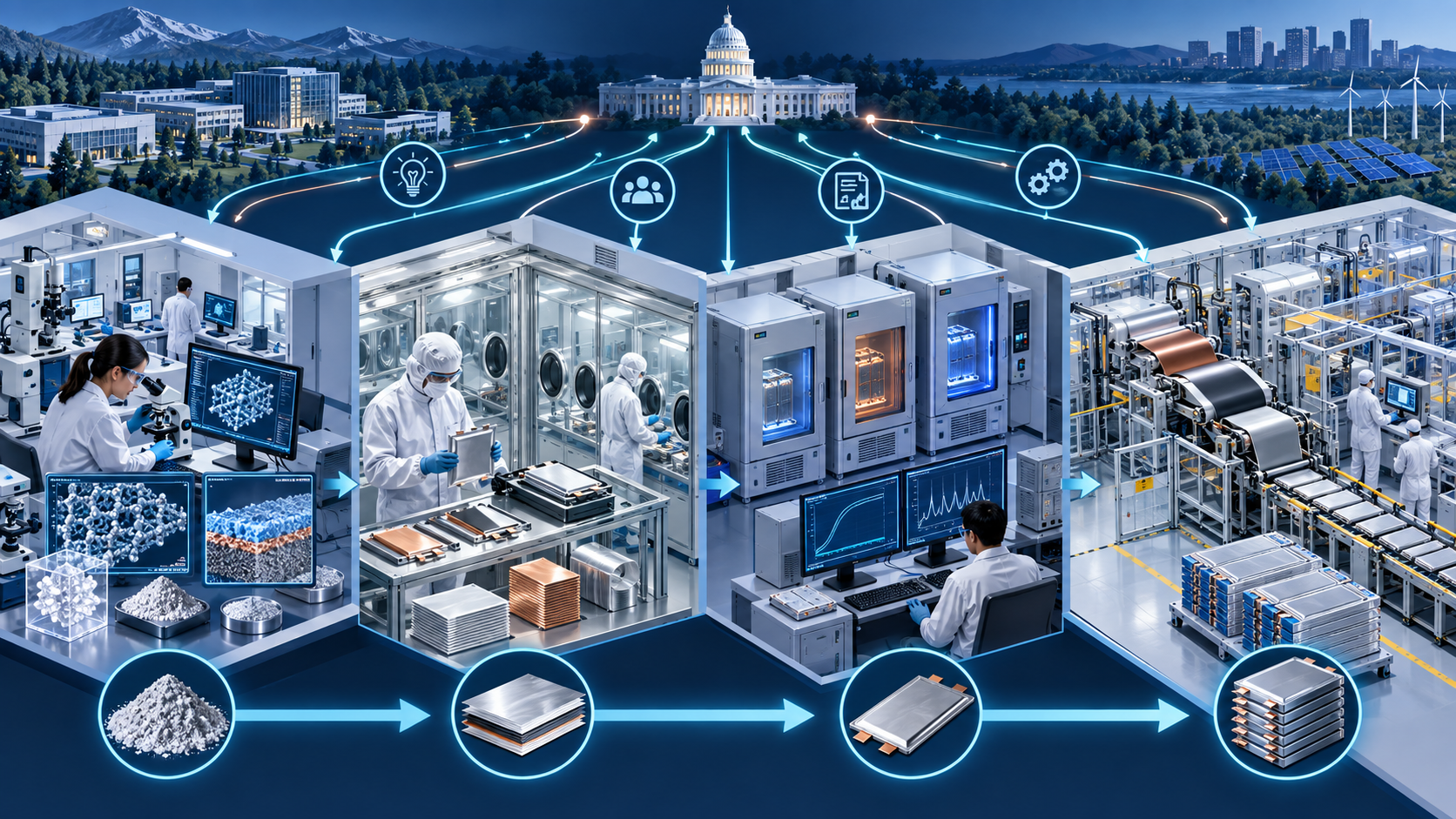 AI-generated conceptual illustration
8. References
- DOE FY 2027 Budget in Brief (April 2026): budgets for FY2025 to FY2027 (total discretionary funding; NNSA, Environmental Management, CMEI and ARPA-E; and "Transportation Technologies", the successor to VTO), the proposed cancellation of $15.2 billion in unspent IIJA funds, the IIJA's enactment date (15 November 2021), the renaming of EERE as CMEI, ARPA-E's founding statute (a 2007 law) and the 17 national laboratories. https://www.energy.gov/documents/doe-fy-2027-budget-brief
- DOE FY 2025 Agency Financial Report (December 2025): establishment in 1977 under the Department of Energy Organization Act, about 15,000 federal staff and more than 100,000 contractor staff, and the loss in 2025 of more than 3,500 of the 15,705 federal staff. https://www.energy.gov/sites/default/files/2025-12/fy-2025-doe-agency-financial-report.pdf
- USAspending.gov (U.S. government) Award record DE-MS0000122 (Solid Power Operating): continuous manufacturing of sulfide solid electrolyte under the IIJA, $50 million award, $60 million non-federal share, awarded 30 December 2024, period of performance January 2025 to December 2026, funded by MESC, a modification in July 2025 and a continuation in March 2026, and outlays to date. https://www.usaspending.gov/award/ASST_NON_DEMS0000122_089
- USAspending.gov (U.S. government) Award record DE-AR0001727 (Solid Power Operating, ARPA-E EVs4ALL): a high-energy, fast-charging all-solid-state battery, $5.6 million award, period of performance April 2023 to April 2026. https://www.usaspending.gov/award/ASST_NON_DEAR0001727_089
- USAspending.gov (U.S. government) Award record DE-EE0009189 (Solid Power; an all-solid-state lithium-ion battery with a silicon composite anode; about $3.6 million; 2020 to 2023). A similar record exists for DE-EE0008861 (an all-solid-state battery using multifunctional electrolyte materials; about $1.0 million; 2019 to 2022). https://www.usaspending.gov/award/ASST_NON_DEEE0009189_089
- USAspending.gov (U.S. government) Award record DE-AR0002043 (Solidion Technology; ARPA-E OPEN; about $0.6 million; November 2025 to November 2028). https://www.usaspending.gov/award/ASST_NON_DEAR0002043_089
- DOE News release, "DOE Announces $42 Million to Develop More Affordable and Efficient Advanced Electric Vehicle Batteries in America" (10 January 2023): the 12 EVs4ALL selectees and their award amounts. https://www.energy.gov/articles/doe-announces-42-million-develop-more-affordable-and-efficient-advanced-electric-vehicle
- DOE AMMTO Funding Selections: FY23 AMMTO Battery Manufacturing Lab Call: the three solid-state battery manufacturing projects (ORNL, NREL and Argonne, $11 million in total) and their industry partners. https://www.energy.gov/cmei/ammto/funding-selections-fy23-ammto-battery-manufacturing-lab-call
- PNNL (presentation at DOE's Annual Merit Review) Progress and Status of Battery500 Consortium Phase II (June 2023): period October 2021 to September 2026, DOE share of $75 million, targets, participating institutions and the role of solid electrolytes. https://www1.eere.energy.gov/vehiclesandfuels/downloads/2023_AMR/bat317_liu_2023_o%20-%20jun%20liu.pdf
- DOE MDO Battery Manufacturing and Recycling Grants: IIJA Section 40207, funds "available until expended", Round 2 selections announced 20 September 2024, and the Round 3 selection of seven projects worth $500 million with descriptions of the five made public. https://www.energy.gov/cmei/manufacturing/battery-manufacturing-and-recycling-grants
- DOE News release, "Energy Department Announces Termination of 223 Projects, Saving Over $7.5 Billion" (1 October 2025): 321 awards terminated, the offices involved and the Secretary's May 2025 memorandum. https://www.energy.gov/articles/energy-department-announces-termination-223-projects-saving-over-75-billion
- DOE MDO Foreign Entity of Concern Interpretive Guidance: application of the FEOC guidance to the Section 40207 battery grants, and the countries covered. https://www.energy.gov/cmei/manufacturing/foreign-entity-concern-interpretive-guidance
- DOE TTO Transportation Technologies Office: the current name of the former VTO, its place within CMEI and its Washington, D.C. location. https://www.energy.gov/cmei/vehicles/transportation-technologies-office
- DOE National Laboratories: the operator of each laboratory (Argonne by an entity affiliated with the University of Chicago, ORNL by UT-Battelle). https://www.energy.gov/national-laboratories
9. Claim-to-source audit
| Claim in the article | Category | Source |
|---|---|---|
| Budget of $49.1 billion (FY2026 enacted) and $53.9 billion (FY2027 request); NNSA $32.8 billion, Environmental Management $8.18 billion, CMEI $1.12 billion; former VTO from $397 million to $20 million; ARPA-E from $350 million to $200 million; proposed cancellation of $15.2 billion in unspent IIJA funds; 17 national laboratories | Sourced | Reference 1 https://www.energy.gov/documents/doe-fy-2027-budget-brief |
| Established in 1977; about 15,000 federal staff and more than 100,000 contractor staff; a reduction of more than 3,500 in 2025 | Sourced | Reference 2 https://www.energy.gov/sites/default/files/2025-12/fy-2025-doe-agency-financial-report.pdf |
| Solid Power's $50 million production grant, its $60 million contribution, the award period, the modification and continuation records, and about $9.69 million paid out | Sourced | Reference 3 https://www.usaspending.gov/award/ASST_NON_DEMS0000122_089 |
| Solid Power's $5.6 million ARPA-E grant | Sourced | Reference 4 https://www.usaspending.gov/award/ASST_NON_DEAR0001727_089 |
| Solid Power's two awards from the former EERE | Sourced | Reference 5 https://www.usaspending.gov/award/ASST_NON_DEEE0009189_089 |
| The two former EERE awards totalling about $4.6 million | Our calculation | This article's sum of the two award amounts in reference 5 |
| Solidion's ARPA-E award (about $0.6 million) | Sourced | Reference 6 https://www.usaspending.gov/award/ASST_NON_DEAR0002043_089 |
| EVs4ALL's 12 projects and $42 million, and the amounts for the three solid-state projects | Sourced | Reference 7 https://www.energy.gov/articles/doe-announces-42-million-develop-more-affordable-and-efficient-advanced-electric-vehicle |
| The three solid-state projects in the battery manufacturing lab call (ORNL, NREL, Argonne) and Solid Power's participation | Sourced | Reference 8 https://www.energy.gov/cmei/ammto/funding-selections-fy23-ammto-battery-manufacturing-lab-call |
| Battery500 Phase II period, DOE share of $75 million, targets and PNNL's lead role | Sourced | Reference 9 https://www1.eere.energy.gov/vehiclesandfuels/downloads/2023_AMR/bat317_liu_2023_o%20-%20jun%20liu.pdf |
| The battery manufacturing grants' basis in IIJA Section 40207, and the Round 3 selection of seven projects worth $500 million with the five published descriptions | Sourced | Reference 10 https://www.energy.gov/cmei/manufacturing/battery-manufacturing-and-recycling-grants |
| The October 2025 termination of 321 awards worth about $7.56 billion, and the Secretary's May 2025 memorandum | Sourced | Reference 11 https://www.energy.gov/articles/energy-department-announces-termination-223-projects-saving-over-75-billion |
| The FEOC interpretive guidance and the countries covered | Sourced | Reference 12 https://www.energy.gov/cmei/manufacturing/foreign-entity-concern-interpretive-guidance |
| The renaming of the former VTO as TTO within CMEI, and its location | Sourced | Reference 13 https://www.energy.gov/cmei/vehicles/transportation-technologies-office |
| National laboratories being run under contract by outside entities | Sourced | Reference 14 https://www.energy.gov/national-laboratories |
| No DOE award records for QuantumScape or Factorial | Sourced | Our own search of USAspending.gov in September 2026 |
| The four types of institution, and the choice of which programmes count as solid-state related | Our calculation | Our own classification |
| DOE having no power to set battery standards or safety requirements | Our calculation | Our own reading, based on no such power being stated in references 1 to 14 |
| The total budget spent on solid-state batteries alone, and whether any solid-state battery awards were among those terminated in October 2025 | Not yet confirmed | Not stated in references 1 or 11; this article does not estimate them |
| The four points in the outlook (section 6) | Inference | This article's reading of the budgets, periods and calls in references 1, 3, 9 and 10 |
Last updated 23 September 2026 / Troy Technical
All figures come from DOE's budget documents, financial report, official announcements and programme pages, and from the federal spending database USAspending.gov. Items marked "Inference" are this article's reading of the primary information, not statements by DOE.