INSTITUTION PROFILE / SOLID-STATE BATTERIES
Ministry of Economy, Trade and Industry (METI)
The ministry that sets Japan's solid-state battery targets and funding frameworks
METI is one of Japan's central government ministries. It does not do research and it does not build batteries. Its role in solid-state batteries is to set national targets, create the frameworks that fund R&D and capital investment, and approve which companies' plans receive support. When our NEDO profile said that "the ministry sets the direction", this upstream role is what it meant. This profile looks at one question only: how much influence METI actually has over solid-state batteries.
- METI in 30 seconds
- What kind of body it is: the four types of influence
- What it does for solid-state batteries
- How far its influence reaches (powers and geography)
- How the work is split with NEDO, and who gets support
- Outlook
- Glossary, references and claim-to-source audit
1. METI in 30 seconds
For solid-state batteries, METI decides the national target for when the technology should be commercialised and the two frameworks that channel money towards it: the Green Innovation Fund for R&D, and economic security support for capital investment Sourced. The practical work of running calls, selecting projects, monitoring progress and paying out grants is done by NEDO. METI sets the direction and the frameworks; NEDO actually hands out the money. One other point matters just as much: in its 2022 strategy, METI moved away from concentrating investment on solid-state batteries (section 3).
2. What kind of body it is: the four types of influence
Unlike the companies in this series, none of the institutions that appear in solid-state battery coverage makes batteries. What separates them is the route by which they influence the industry, and that gives four types.
3. What it does for solid-state batteries
METI's involvement in solid-state batteries comes down to three things: setting targets, creating the R&D framework and approving capital investment Sourced.
| Tool | Timing and scale | What it means for solid-state batteries | Who does the practical work |
|---|---|---|---|
| National strategy Battery Industry Strategy, now the Battery and Power Industry Strategy | Adopted 31 August 2022 Revised 2 June 2026 | One of its three targets is "full-scale commercialisation of all-solid-state batteries around 2030". The 2026 revision added "establishing a manufacturing base in line with demand by the mid-2030s" | Drawn up by a public-private council and published by METI |
| R&D framework Green Innovation Fund project "Development of Next-generation Batteries and Next-generation Motors" | Plan adopted 11 November 2021 Government funding capped at ¥151 billion (¥120.5 billion of it for batteries, materials and recycling) | Develop technology that puts within reach, by 2030, batteries with a volumetric energy density of 700 to 800 Wh/L or more, with all-solid-state batteries given as an example. Examples of research topics include solid-solid interfaces and higher-performance solid electrolytes and their mass production | NEDO runs the calls, selection and progress monitoring |
| Capital investment approvals Storage batteries as a "Specified Critical Product" under the Economic Security Promotion Act | Policy issued 19 January 2023 (revised 26 March 2024) 42 plans approved, up to about ¥671.1 billion in grants | Four approved plans list all-solid-state battery materials, sulfide solid electrolytes or anode current collectors for all-solid-state batteries among their products (section 5) | The Minister of Economy, Trade and Industry approves the plans; NEDO pays out the grants |
The 2022 strategy states openly that earlier policy had concentrated investment on developing solid-state battery technology, and warns that if this continued, "Japanese companies could be worn down and exit the market before all-solid-state batteries reach practical use". It therefore made a domestic manufacturing base for liquid-electrolyte lithium-ion batteries (150 GWh a year) the top priority Sourced. Solid-state batteries stayed on as the third target, and the 2026 revision extends that target to building a manufacturing base for mass production. Seen from the supplier side, government support now runs on two tracks: mass production of liquid-electrolyte cells, and solid-state batteries from R&D through to preparing for mass production. Sulfide solid electrolytes, for example, show up in both frameworks: in R&D (Idemitsu Kosan's Green Innovation Fund theme) and in capital investment (the economic security approvals for Mitsui Mining & Smelting and Idemitsu Kosan).
National targets (solid-state batteries and manufacturing capacity)
| Target | August 2022 strategy | After the June 2026 revision |
|---|---|---|
| Solid-state batteries | Full-scale commercialisation around 2030, and keeping technological leadership beyond 2030 | Full-scale commercialisation around 2030. Establish a manufacturing base in line with demand by the mid-2030s and win market share, including overseas |
| Domestic manufacturing capacity | 150 GWh a year of batteries and materials by 2030 at the latest | 150 GWh a year of batteries, components and materials, and manufacturing equipment over the period from 2030 to the mid-2030s (the deadline was pushed back) |
| Scale including overseas | 600 GWh a year of manufacturing capacity across all Japanese companies in 2030 | Triple Japanese companies' battery-related sales between 2025 and 2035 (a sales target in place of a GWh target) |
The revised strategy says that support under the Economic Security Promotion Act and other measures means domestic manufacturing capacity is expected to grow to 100 GWh a year or more Sourced. It does not say how much of the 150 GWh a year will be solid-state batteries.
4. How far its influence reaches (powers and geography)
| Aspect | What METI has | What it does not have |
|---|---|---|
| Direction | Sets national targets in its strategy (full-scale commercialisation around 2030, a manufacturing base). Writes the Green Innovation Fund's R&D and Social Implementation Plan | Power to require companies to develop or mass-produce solid-state batteries |
| Money | Uses supplementary budgets and similar measures to set up funds at NEDO. Approves plans for capital investment and technology development under the Economic Security Promotion Act (in the sixth round of approvals, in February 2026, grants covered one third of capital investment and half of technology development) | The practical work of running calls, selecting projects, monitoring progress and reviewing grant payments (done by NEDO) |
| Standards | One of the strategy's seven pillars is "strategic formation of global alliances and global standards" | Power to set international battery standards (the domain of international standards bodies such as the IEC) |
| Geography | Support based on the Japanese budget and Japanese law. It mainly covers R&D in Japan and manufacturing sites in Japan | Any direct authority over foreign companies or other countries' policies |
| Scale | 8,068 authorised staff (including external agencies). Economic security support for batteries of up to about ¥671.1 billion in grants | The number of staff working on solid-state batteries, and the total budget spent on solid-state batteries alone (neither is published) |
The 8,068 figure is the authorised headcount for the whole of METI, including the Agency for Natural Resources and Energy, the Japan Patent Office and the Small and Medium Enterprise Agency. It is not the number of people working on solid-state batteries. Battery policy is handled by the Battery Industry Division of the Commerce and Information Policy Bureau, but that division's headcount has not been published Not yet confirmed. Likewise, the maximum of about ¥671.1 billion in grants is the total for approvals covering all batteries, including liquid-electrolyte lithium-ion batteries. Solid-state batteries account for only part of it (section 5).
5. How the work is split with NEDO, and who gets support
Money for solid-state batteries travels through two frameworks set up by METI and reaches companies via NEDO. In both, METI does the deciding and NEDO does the paying out Sourced.
Economic security approvals with a solid-state battery link
| Company | Product (METI's wording, translated) | Approved | Total project cost / maximum grant | Link to this series |
|---|---|---|---|---|
| Toyota Motor, Prime Planet Energy & Solutions and Toyota Battery | Next-generation prismatic batteries for vehicles and all-solid-state battery materials (capacity of 9 GWh a year, with supply starting in stages from November 2026) | 6 September 2024 | About ¥245 billion / about ¥85.6 billion | See our Toyota profile |
| Mitsui Mining & Smelting | Sulfide solid electrolytes (introduction, development and improvement of production technology) | 20 December 2024 | About ¥19.8 billion / about ¥9.9 billion | Not covered in this series |
| Toyo Kohan | Anode current collectors for all-solid-state batteries (introduction, development and improvement of production technology) | 20 December 2024 | About ¥2.8 billion / about ¥1.4 billion | Not covered in this series |
| Idemitsu Kosan | Sulfide-based solid electrolytes (introduction, development and improvement of production technology) | 13 June 2025 | About ¥1.1 billion / about ¥0.6 billion | Toyota's solid electrolyte partner (see our Toyota profile) |
The maximum grants for the four plans add up to about ¥97.5 billion, but Toyota's plan is a single approval covering both prismatic batteries and all-solid-state battery materials, so this is not a figure for solid-state batteries alone Our calculation. Idemitsu Kosan also has a separate approved plan (20 December 2024) for a production base for lithium sulfide, but its summary does not mention all-solid-state batteries, so it is left out of the table above.
6. Outlook
| What the evidence suggests | Primary information it rests on | Category |
|---|---|---|
| The focus of support for solid-state batteries will shift from R&D towards capital investment for mass production | The 2026 revision added the target of "establishing a manufacturing base in line with demand by the mid-2030s" and says it will "promote technology development and capital investment". The economic security approvals already include production bases for solid-state battery materials | Inference |
| High-value applications beyond vehicles (medical, disaster preparedness, data centres and so on) will become easier to treat as targets for support | For solid-state batteries, the revised strategy talks of "developing use cases that take advantage of properties such as lifetime in high-temperature environments" and "winning markets in high-value use cases in addition to vehicles" | Inference |
| Whether the "full-scale commercialisation around 2030" target is met will become clear from companies' mass-production decisions around 2027 and 2028 | A METI paper from March 2026 compiles the timings companies have announced: Toyota 2027 to 2028, Nissan FY2028, Honda the second half of the 2020s and GS Yuasa around 2030 | Inference |
7. Glossary
- Battery and Power Industry Strategy
- The June 2026 revision of the August 2022 Battery Industry Strategy. It widens the scope to power supply systems as a whole, with batteries at the centre.
- Specified Critical Products
- Goods designated under the Economic Security Promotion Act as essential to people's lives and economic activity, for which securing a stable supply is especially necessary. Storage batteries are one of them.
- Supply plan
- A company's plan to build production capacity or otherwise secure supply of a Specified Critical Product (an "ensuring supply plan" in the official translation of the Act). Once approved by the Minister of Economy, Trade and Industry, it becomes eligible for grants.
- R&D and Social Implementation Plan
- The plan that sets the targets, budget and research topics for each Green Innovation Fund project. The responsible ministry writes it, and NEDO runs its calls on that basis.
- Authorised staff
- The legal ceiling on the number of staff. It does not always match the number of people actually employed.
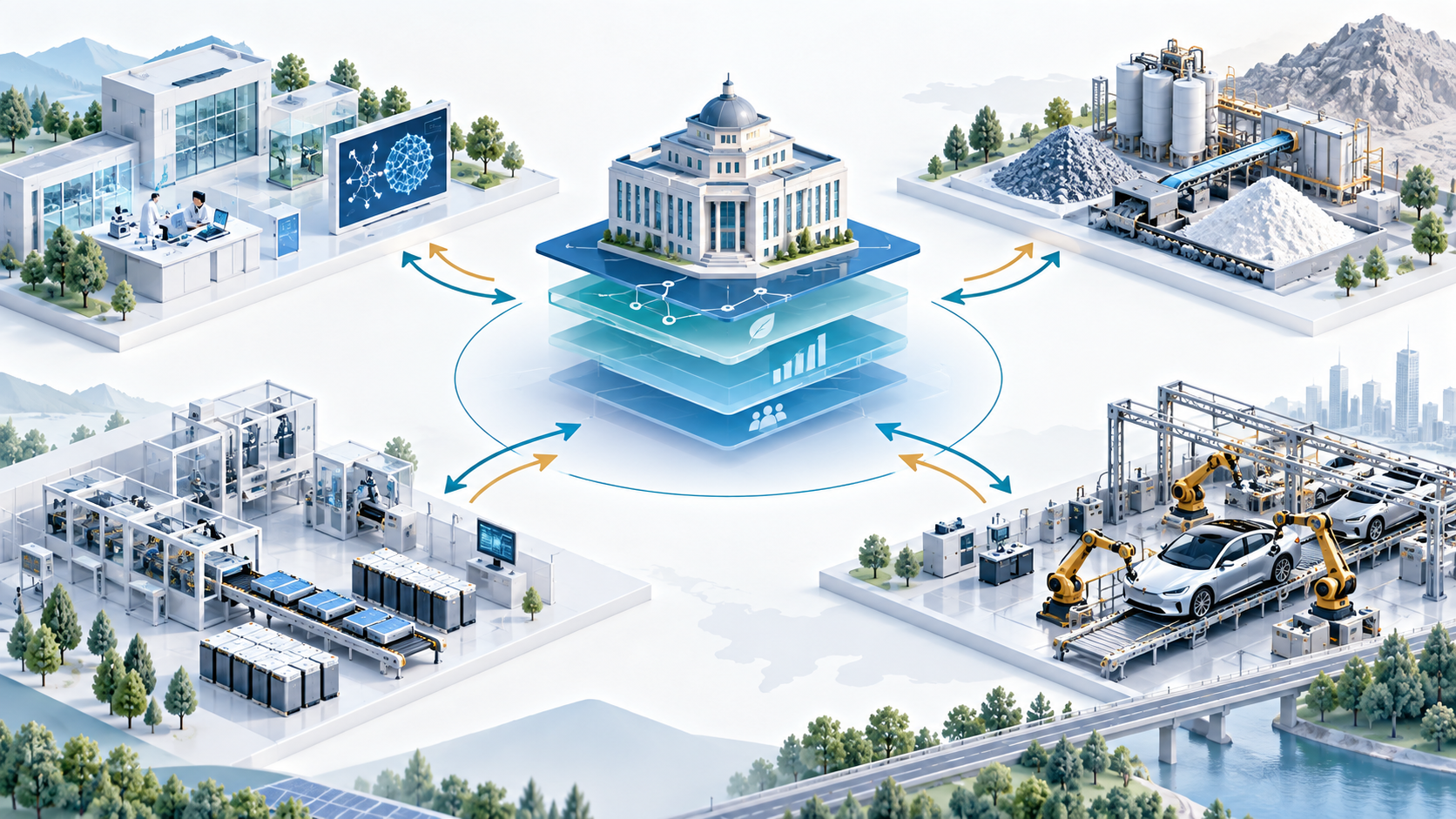 AI-generated conceptual illustration
8. References
- METI News release, "'Battery Industry Strategy' revised as the 'Battery and Power Industry Strategy'" (in Japanese, 2 June 2026): the background to the revision and the changes to the three targets. https://www.meti.go.jp/press/2026/06/20260602001/20260602001.html
- Battery Industry Strategy Promotion Council (published by METI) Battery and Power Industry Strategy (in Japanese, 2 June 2026): progress against the 2022 targets, the targets for full-scale commercialisation of solid-state batteries and a manufacturing base, the outlook for 100 GWh a year or more of domestic capacity, and the research targets under the Green Innovation Fund. https://www.meti.go.jp/files/000001097.pdf
- Public-Private Council on the Battery Industry Strategy (published by METI) Battery Industry Strategy (in Japanese, 31 August 2022): the move away from concentrated investment in solid-state batteries, the targets of 150 GWh and 600 GWh a year, and full-scale commercialisation of solid-state batteries around 2030. https://www.meti.go.jp/policy/mono_info_service/joho/conference/battery_strategy/battery_saisyu_torimatome.pdf
- METI "Storage batteries" economic security policy page (in Japanese): how supply plans are approved, the division in charge, and the list of approved plans with each plan's maximum grant. https://www.meti.go.jp/policy/economy/economic_security/battery/index.html
- METI Policy on initiatives for ensuring a stable supply of storage batteries (in Japanese, 19 January 2023, revised 26 March 2024): the place of R&D on next-generation batteries, including all-solid-state batteries, and NEDO's role in running the stable-supply support operations and fund. https://www.meti.go.jp/policy/economy/economic_security/battery/battery_economic_security_02.pdf
- METI Summary of an approved supply plan (in Japanese): Toyota Motor and others, 2024 storage battery plan No. 4, approved 6 September 2024. Products "next-generation prismatic batteries for vehicles and all-solid-state battery materials", 9 GWh a year, total project cost of about ¥245 billion and maximum grant of about ¥85.6 billion. https://www.meti.go.jp/policy/economy/economic_security/battery/file/battery_19_2.pdf
- METI Summary of an approved supply plan (in Japanese): Mitsui Mining & Smelting, 2024 storage battery plan No. 15, approved 20 December 2024. Product "sulfide solid electrolytes", total project cost of about ¥19.8 billion and maximum grant of about ¥9.9 billion. https://www.meti.go.jp/policy/economy/economic_security/battery/file/battery_30_1.pdf
- METI Summary of an approved supply plan (in Japanese): Toyo Kohan, 2024 storage battery plan No. 16, approved 20 December 2024. Product "anode current collectors for all-solid-state batteries", total project cost of about ¥2.8 billion and maximum grant of about ¥1.4 billion. https://www.meti.go.jp/policy/economy/economic_security/battery/file/battery_31_1.pdf
- METI Summary of an approved supply plan (in Japanese): Idemitsu Kosan, 2025 storage battery plan No. 1, approved 13 June 2025. Product "sulfide-based solid electrolytes", total project cost of about ¥1.1 billion and maximum grant of about ¥0.6 billion. https://www.meti.go.jp/policy/economy/economic_security/battery/file/battery_33_1.pdf
- METI Summary of an approved supply plan (in Japanese): Idemitsu Kosan, 2024 storage battery plan No. 14, approved 20 December 2024. Product "lithium sulfide", total project cost of about ¥21.3 billion and maximum grant of about ¥7.1 billion. https://www.meti.go.jp/policy/economy/economic_security/battery/file/battery_29_1.pdf
- METI Council paper, "Towards implementing the Battery Industry Strategy" (in Japanese, 5 March 2026, Document 3): 42 approvals with a total project cost of about ¥1.8906 trillion and maximum grants of about ¥671.1 billion, the grant rates in the sixth round (one third for capital investment, half for technology development), the strategy's seven pillars, and companies' timings for commercialising solid-state batteries. https://www.meti.go.jp/policy/mono_info_service/joho/conference/battery_strategy2/shiryo03.pdf
- METI "Green Innovation Fund" (in Japanese): a ¥2 trillion fund set up at NEDO under the FY2020 third supplementary budget, a total of ¥2.7564 trillion, and the responsible ministries' role in writing R&D and Social Implementation Plans. https://www.meti.go.jp/policy/energy_environment/global_warming/gifund/index.html
- METI (Manufacturing Industries Bureau and Commerce and Information Policy Bureau) R&D and Social Implementation Plan for the "Development of Next-generation Batteries and Next-generation Motors" project (in Japanese, 11 November 2021): the target of 700 to 800 Wh/L or more, the challenges facing all-solid-state batteries, and the ¥151 billion budget cap and its breakdown. https://www.meti.go.jp/policy/energy_environment/global_warming/gifund/pdf/gif_12_randd.pdf
- e-Gov Laws Search Cabinet Order on the Authorised Number of Staff of Administrative Organs (Cabinet Order No. 121 of 1969, reflecting the amendment in force from 31 July 2026) (in Japanese): METI's authorised staff of 8,068, and the temporary figure of 8,146 until 30 September 2026. https://laws.e-gov.go.jp/law/344CO0000000121
- e-Gov Laws Search Act for Establishment of the Ministry of Economy, Trade and Industry (Act No. 99 of 1999) (in Japanese): in force from 6 January 2001, the Minister of Economy, Trade and Industry, and the external agencies (Agency for Natural Resources and Energy, Japan Patent Office, Small and Medium Enterprise Agency). https://laws.e-gov.go.jp/law/411AC0000000099
- NEDO Green Innovation Fund website, "Development of Next-generation Batteries and Next-generation Motors" (in Japanese): implementers by R&D category (Honda Motor and Honda R&D, Nissan Motor, Sumitomo Metal Mining, and Idemitsu Kosan with "mass-production technology for sulfide solid electrolytes", among others). https://green-innovation.nedo.go.jp/project/next-generation-storage-batteries-motors/scheme/
9. Claim-to-source audit
| Claim in the article | Category | Source |
|---|---|---|
| The revision of 2 June 2026 and the three revised targets (full-scale commercialisation of solid-state batteries around 2030 plus a manufacturing base, 150 GWh a year, tripling sales) | Sourced | Reference 1 https://www.meti.go.jp/press/2026/06/20260602001/20260602001.html |
| The outlook for 100 GWh a year or more of domestic capacity, winning markets in high-value use cases, and promoting technology development and capital investment | Sourced | Reference 2 https://www.meti.go.jp/files/000001097.pdf |
| The 2022 strategy's targets (150 GWh a year, 600 GWh a year, full-scale commercialisation of solid-state batteries around 2030) and the move away from concentrated investment in solid-state batteries | Sourced | Reference 3 https://www.meti.go.jp/policy/mono_info_service/joho/conference/battery_strategy/battery_saisyu_torimatome.pdf |
| The minister's approval of supply plans, the Battery Industry Division as the division in charge, and the list of approved plans | Sourced | Reference 4 https://www.meti.go.jp/policy/economy/economic_security/battery/index.html |
| The dates the policy was issued and revised, and NEDO's role in the stable-supply support operations and fund | Sourced | Reference 5 https://www.meti.go.jp/policy/economy/economic_security/battery/battery_economic_security_02.pdf |
| The approved plan of Toyota and others (all-solid-state battery materials, 9 GWh a year, about ¥245 billion, maximum of about ¥85.6 billion) | Sourced | Reference 6 https://www.meti.go.jp/policy/economy/economic_security/battery/file/battery_19_2.pdf |
| Mitsui Mining & Smelting's approved plan (sulfide solid electrolytes) | Sourced | Reference 7 https://www.meti.go.jp/policy/economy/economic_security/battery/file/battery_30_1.pdf |
| Toyo Kohan's approved plan (anode current collectors for all-solid-state batteries) | Sourced | Reference 8 https://www.meti.go.jp/policy/economy/economic_security/battery/file/battery_31_1.pdf |
| Idemitsu Kosan's approved plan (sulfide-based solid electrolytes) | Sourced | Reference 9 https://www.meti.go.jp/policy/economy/economic_security/battery/file/battery_33_1.pdf |
| Idemitsu Kosan's approved lithium sulfide plan, and the absence of any mention of all-solid-state batteries in its summary | Sourced | Reference 10 https://www.meti.go.jp/policy/economy/economic_security/battery/file/battery_29_1.pdf |
| 42 approvals, total project cost of about ¥1.8906 trillion, maximum grants of about ¥671.1 billion, sixth-round grant rates, the strategy's seven pillars, and companies' timings for commercialising solid-state batteries | Sourced | Reference 11 https://www.meti.go.jp/policy/mono_info_service/joho/conference/battery_strategy2/shiryo03.pdf |
| The ¥2 trillion fund set up at NEDO, the ¥2.7564 trillion total, and the responsible ministries writing R&D and Social Implementation Plans | Sourced | Reference 12 https://www.meti.go.jp/policy/energy_environment/global_warming/gifund/index.html |
| The date of the R&D and Social Implementation Plan, the 700 to 800 Wh/L or more target, the ¥151 billion budget cap and the ¥120.5 billion within it | Sourced | Reference 13 https://www.meti.go.jp/policy/energy_environment/global_warming/gifund/pdf/gif_12_randd.pdf |
| Authorised staff of 8,068, and the temporary figure of 8,146 until 30 September 2026 | Sourced | Reference 14 https://laws.e-gov.go.jp/law/344CO0000000121 |
| Establishment (in force from 6 January 2001), the minister, and the external agencies | Sourced | Reference 15 https://laws.e-gov.go.jp/law/411AC0000000099 |
| The Green Innovation Fund's solid-state related awardees (Honda, Nissan, Idemitsu Kosan, Sumitomo Metal Mining) and the title of Idemitsu Kosan's theme | Sourced | Reference 16 https://green-innovation.nedo.go.jp/project/next-generation-storage-batteries-motors/scheme/ |
| The four types of institution, the selection of four solid-state related approvals, and the total of about ¥97.5 billion in maximum grants for those four | Our calculation | Our own classification (summing the figures in references 6 to 9) |
| The headcount of the division responsible for solid-state batteries, and the total budget spent on solid-state batteries alone | Not yet confirmed | Not stated in references 1 to 16; this article does not estimate them |
| The three points in the outlook (section 6) | Inference | This article's reading of references 2 and 11 |
Last updated 23 September 2026 / Troy Technical
All figures come from METI's published materials (the strategy, council papers, summaries of approved plans and the fund's plan), NEDO's published materials and Japanese legislation. Items marked "Inference" are this article's reading of the primary information, not statements by METI.