COMPANY PROFILE / Solid-State Battery
Honda (Honda R&D Co., Ltd.)
— Building a pilot line of approximately 43 billion yen in Tochigi and manufacturing full-solid-state batteries ‘in-house’ is an automaker
The mention of Honda in connection with full-solid-state batteries is because An automaker that does not buy batteries from outside but develops the method of production internallyfrom. The pilot line in Sakuramachi, Tochigi Prefecture, which was released in November 2024, has a floor area of approximately 27,400 square meters and an investment amount of approximately 43 billion yen. According to the company’s IR materials,The solid electrolyte is a sulfide system.is written. In this article, the scale of the automotive business is kept to a minimum,what is being invested in all-solid-state batteries, who is collaborating with whom, and what are the goals?focuses on.
- Understand Honda in 30 seconds and its position with solid-state batteries.
- About the logo and company name
- Where is this company in the world of solid-state batteries
- Company size (automotive industry is concise)
- Resources invested in solid-state batteries
- Previous efforts
- Future plans
- What is this company aiming for with solid-state batteries?
- Mapping of collaborations in the field of all-solid-state batteries
- Techniques and methods adopted
- Risks faced by this company
- Glossary / References / Claims and Corresponding References Table
1. Understanding Honda in 30 seconds and its position with full-solid-state batteries
NYSE: HMCListed on Tokyo Stock Exchange in 1957, ADRs from 1977
(Manufactures batteries internally)Not a battery specialist or startup
Floor area approximately 27,400 square metersScheduled to start operation in January 2025 and announced
Companies working on solid-state batteriesAutomotive manufacturers, battery manufacturers, and startupsare divided into three types. Honda is one of theseAutomotive manufacturersHowever, in this field,invests in startups to secure technologyThis is not the approach often taken by European companies.Honda Technical Research Institute is developing both materials and manufacturing processes independentlyThe points are characteristic. fact. The official news release states ‘towards mass production’aloneis advancing research and development of all-solid-state batteries as written in the IR materials, which also mention ‘batteries and mass production technology’alone developmentthe company highlights as its strengths. Furthermore, it has disclosed details such as the amount (approximately 43 billion yen), location (Sakura City, Tochigi Prefecture), electrolyte system (sulfide system), and the content of the process, making it one of the few automobile manufacturers in this series that have the most materials for external verification of all-solid-state batteries. The company is one of the few automobile manufacturers in this series that have the most materials for external verification of all-solid-state batteries..
However, on June 18, 2026,Honda Technical Research Institute entered into a joint research agreement with the U.S. startup QuantumScape.This was announced in the official release by QuantumScape. factThisInvestment is not a contractTherefore, QuantumScape’s approach (ceramic separator and anode-free configuration) is a different method from Honda’s independently developed sulfide-based system. Moreover, this contract isnot mentioned in Honda’s own press release or 20-F filing(At the time of writing this article)
2. Regarding logo and company name display
Note on notation: The company name is ‘Honda Research Institute Co., Ltd.’ in English, and Honda Motor Co., Ltd.. The development of all-solid-state batteries and the pilot line in Tochigi is handled by a subsidiary of Honda Research & Development Co., Ltd. (Honda R&D Co., Ltd.) which is a separate legal entity.. In official documents, it is often written as ‘Honda’ in one go, so in this article, I will distinguish where it is important to note that the research institute’s side is being referred to.
Official website:https://global.honda/jp/tech/All-solid-state_battery_technology/3. Among the world of all-solid-state batteries, where is this company located?
4. Company Size (Automotive Business is Briefly Covered)
The automotive business itself is not the main topic of this article, so we will only focus on its size. fact. All figures are sourced from the Form 20-F for the fiscal year ending March 2026.
| Index (in millions of yen) | Fiscal Year Ending March 2024 | Fiscal Year Ending March 2025 | Fiscal Year 2026 March |
|---|---|---|---|
| sales revenue | 20,428,802 | 21,688,767 | 21,796,610 |
| Research and Development Expenses (Amounts Recognized as Expenses) | 923,627 | 1,099,482 | 1,540,646 |
| Operating Income (A minus sign indicates a loss) | 1,381,977 | 1,213,486 | △414,346 |
| Number of Full-Time Employees (As of March 31 of Each Year) | 2024 year | 2025 year | 2026 |
|---|---|---|---|
| Total company-wide | 194,993 | 194,173 | 195,109 |
| of which four-wheeled business | 135,829 | 133,665 | 131,856 |
| of which two-wheeled business | 47,980 | 49,548 | 52,013 |
The number above isfor the entire company.It does not represent the scale of business for solid-state batteries. The research and development expenses of 154.06 billion yen for the fiscal year ending March 2026 increased by 40.1% from the previous period, but the company explained that it is due to ‘the impact of losses related to EVs’and it is not because the development expenses for solid-state batteries have increased Unconfirmed / Future. The amount directly associated with the solid-state battery as announced is, as will be described laterResearch and development investment of approximately 43 billion yenonly. Please keep in mind that the scale of the company and the scale invested in this technology are separate.
5. Resources invested in solid-state batteries
Honda’s features are,uncommonly for an automobile manufacturer, they have publicly disclosed specific amounts and locations.Please read the ‘Company Size’ up to Chapter 4 separately.
| Resource types | The content that has been made public. | Classification |
|---|---|---|
| money (investment amount) | research and development on solid-state batteries forInvestment of approximately 43 billion yen is planned. This includes the construction of a pilot line and other research and development activities | fact |
| funding (public subsidy) | NEDO Green Innovation Fundwill partially utilize the results of the subsidized projects. The subsidy amount isapproximately 20 billion yen(over a five-year period from fiscal year 2022 to 2026) | fact |
| Location (Demonstration Line) | Sakura City, Tochigi Prefecture, 1220-32, Shikaeto(Inside the grounds of Honda Technical Research Institute, Sakura, Tochigi). Land area approximately 12,900m², floor area approximately 27,400m², consists of three buildings C1 to C3 | fact |
| Personnel (Development Team) | Advanced Technology Research Laboratory of Honda Technical Research InstituteDevice Process domain responsible for cell development、Engineering domain is responsible for production technology developmentParticipates from the stage when cell specifications are finalized. The production technology department | fact |
| person (number of personnel) | number of full-time staff for solid-state batteries | Not disclosed |
| Investment (startup) | Investment in a solid-state battery startup is not mentioned in either the 20-F official release or IR documents | Unconfirmed |
| Collaborative research with startups | Honda Technical Research Institute has a joint research agreement with QuantumScape(June 18, 2026). A multi-year plan focused on the development of all-solid-state batteries and related manufacturing processes, where Honda had previously implementedCompletion of a technology evaluation contractThe amount, exclusivity, and target products are not disclosed.The source is QuantumScape’s official release(Including comments from Koji Ogawa at Honda Technical Research Institute) | fact |
| Investment in external entities (shares of battery manufacturer) | measured as capital financial instruments through comprehensive gains, at fair valueCATL shares ¥38.43 billion、GS Yuasa shares ¥2.59 billionheld (fair value as of March 31, 2026). However, it is not stated to be for all-solid-state batteries | fact |
| joint venture (both are liquid-based) | Joint venture with GS Yuasa, joint venture with LG Energy Solutions in the United StatesL-H Battery。Both are for liquid lithium-ion battery business, not solid-state batteries | fact |
| Collaboration with universities and research institutions | Collaborative research with universities is not recorded in official documents. The only way to confirm the connection with public institutions isNEDO’s grant projectsonly | Unconfirmed |
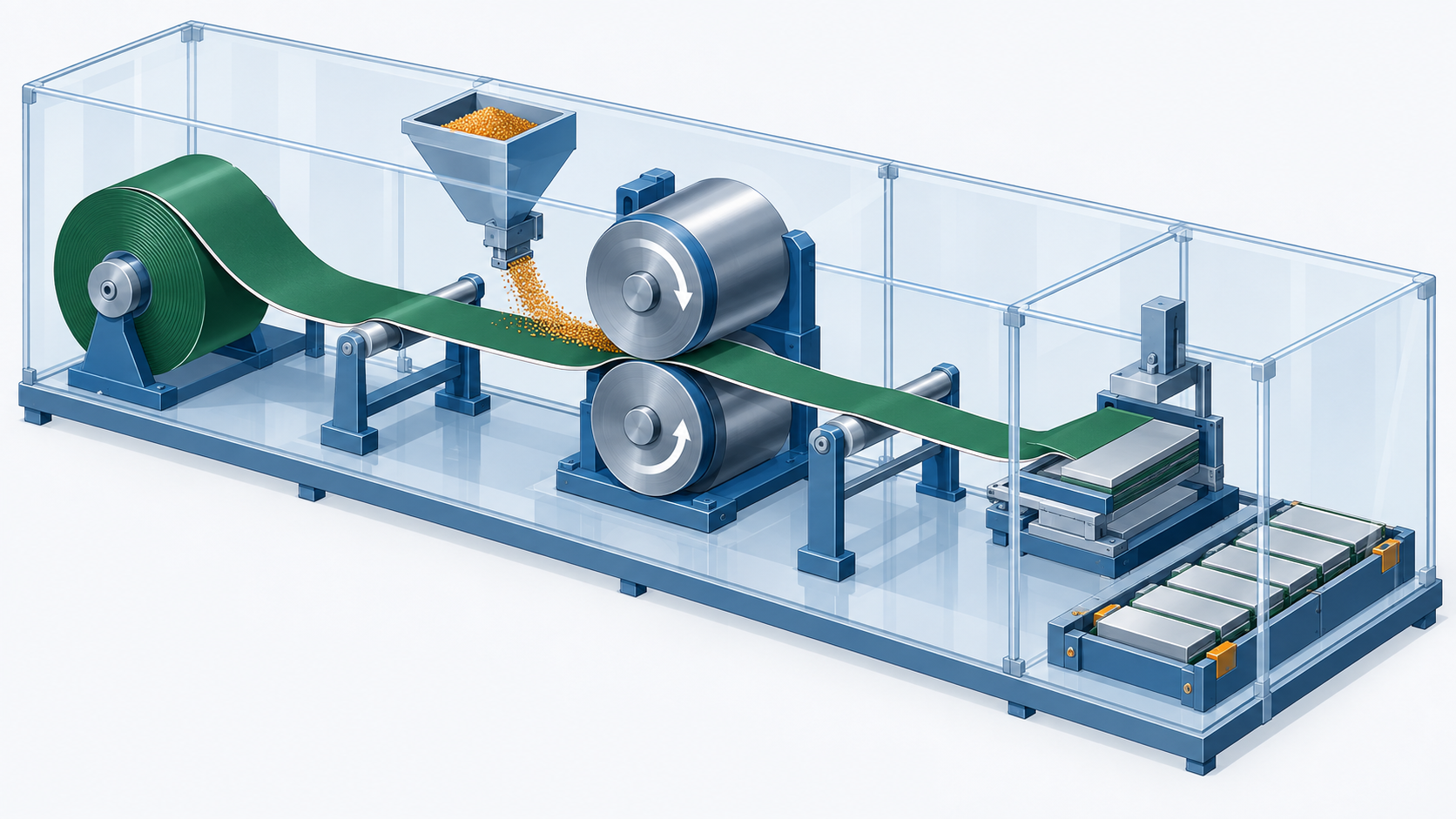
Approximately 43 billion yen is a moderate scale, being small for the construction cost of a mass production factory and large for research expenses Calculations in this article. Honda itself describes this equipment as‘the smallest lot that can be verified with equipment configuration’and explains that it is a setup where all processes are arranged in the same way as the production line, but with only the capacity. The important point here isthat the processes are connectedand that a single line of equipment connecting weighing, mixing, painting, roller pressing, stacking, lamination sealing, and electrolysis, and module assembly is different from arranging test machines for each process in the lab.
The most prone to failure in all-solid-state batteries isthe process and the processis The absorption of moisture, breakage during transportation, and misalignment during stacking while transporting the pressed electrode to the next process. These issues do not appear in single-process trials but only when connected together. Honda israising the issue of how small they can make the low-dew-point environment (dew point management at −60°C)is because the sulfide-based solid electrolyte reacts with moisture to produce hydrogen sulfide, and this environmental cost directly affects the production costs fact。
6. Previous Efforts
| period | incident | Meaning |
|---|---|---|
| 2003 year ~ | Established our own manufacturing technology for fuel cell stacks (process development and mass production including thin film coating and electrode attachment) | The foundation of the painting and bonding technology for all-solid-state batteries, as the company explains. |
| 2006 to 2014 years | Solar cell business. Establish and mass-produce semiconductor devices, accumulate know-how in controlling clean environment | Similarly, as resources explicitly stated by the company |
| 2022 fiscal year | Research and development investment for solid-state batteries begins (the starting point in the investment plan is the 2022 fiscal year).NEDO Green Innovation Fundis included as a grant recipient | Approximately 20 billion yen in grants over five years from this fiscal year |
| Spring 2024 | in Sakura City, Tochigi Prefecturethe building of the pilot line is completed(3-building configuration) | The building was completed first, followed by the equipment installation |
| November 21, 2024 | The pilot line was initially unveiled. Investment amount: approximately ¥43 billion, floor area: approximately 27,400 square meters, announced the adoption of roll press method | This is an unprecedented level of information disclosure for an automobile manufacturer |
| January 2025 | pilot lineScheduled to start operationand announced | The performance results after operation are not yet announced as of the date this article was written |
| The timing is not announced | Honda Technical Research Institute and QuantumScapeTechnical Evaluation Contracthas been completed. It includes detailed technical verification using a prototype and competitive comparison in standard technical tests | Announced by QuantumScape’s release. The start and end dates have not been disclosed |
| May 14, 2026 | Announced the restructuring of the four-wheel business. EV investment will be suppressed to a scale of 80 billion yen over three years whileThe research and development of all-solid-state batteries is ‘continuously being pursued’ as stated | Even in the phase where EV investment is being restrained, all-solid-state batteries remained as a continuing target |
| June 18, 2026 | Honda Technical Research Institute has a joint research agreement with QuantumScape(QuantumScape announced). Professor Koji Ogawa of Honda Research Institute commented: ‘In the evaluation, QuantumScape’s technology demonstrated convincing unique advantages. There is potential to add value in a wide range of applications including automobiles.’ | all-solid-state batteriesThe outside party was first publicly announced with the company name.Honda’s side could not confirm this. |
7. Future Plans
(500km→1000km)Comparison with liquid lithium-ion batteries
Size reduced by 50%In the case of equal range. Cost basis
Cost reduced by 40%Size reduced by 60%, weight reduced by 45% also noted
The company places all-solid-state batteries in the framework of ‘innovative battery technology’ within its battery development roadmapwithin the framework separate from the framework for liquid lithium-ion batteries (cost reduction target ▲20%, late 2020s) ▲25% (basis: principle cost)This indicates the target fact. Additionally, the application scope is limited to four-wheel vehiclesTwo-wheeled vehicles or aircrafthas also considered expanding to these areas, explaining that by leveraging scale benefits, costs can be further reduced.
Next, all of the following are not recorded in official documents Unconfirmed / Future。
solid-state batterylocation of the mass production factory/production capacity during mass production (GWh)/Vehicle model name to be equipped/ price range/Absolute value of energy density per cell/Actual performance after the pilot line was actually in operation. Performance targets are all expressed as relative values compared to ‘liquid lithium-ion batteries’, and absolute values such as Wh/kg or Wh/L are not provided. Numerical values based on press reports are not adopted in this article.
8. What does this company aim to achieve with solid-state batteries?
This part includes information that the company has not directly stated.Inferred from primary sources within the scope of what can be read.Along with the basis, I will write it down.
| What can be read | primary information | Classification |
|---|---|---|
| The purpose is not to sell batteriesbut rather for installation in our own electric models | The official release consistently states ‘aiming to install in electric models,’ and there is no mention of selling | speculation |
| Honda is really competing in materialsrather than production methods (manufacturing technology) | Most of the pilot line data consists of descriptions of processes, equipment, and production efficiency, with production efficiency presented separately for each process as 2x, 3x, or 8x compared to liquid ratio | speculation |
| solid-state batteries aredeparture from cobalt and nickeland is set together | in the ‘reason for tackling’ sectionEscalation from geopoliticsis mentioned, and it is stated that the use of Co・Ni in the cathode should be 0 or minimized | fact |
| They believe that four-wheel vehicles alone are not sufficient in quantity | It is noted that they aim to scale up by applying to various mobility such as two-wheelers and aircraft | speculation |
| The latter half of the 2020sis limited to installationis likely to become | Mass production factory, production capacity, and vehicle models are all undisclosed except for the timing. | speculation |
| is different from our own sulfur-based systemAnother method is also being studied externally by the company, giving us options.as planned | The method that Honda Technical Research Institute entered into a joint research agreement with QuantumScape is different from the sulfur-based system that Honda has disclosed. The agreement was made without investment and after evaluation. | speculation |
| Even in a situation where EV investment is being curtailed, full-solid-state batteries arenot an area to be cut back onplaced | In the business restructuring explanation given in May 2026, it was stated that EV investment would be suppressed to a scale of 80 billion yen over three years, while research and development for full-solid-state batteries would continue | fact |
The IR materials include a comparison of the manufacturing process for liquid lithium-ion batteriesproduction efficiency multiplieris written by process fact. Continuously mixed using our proprietary continuous blending method for weighing and mixing2 times, and the cathode coating and insulation layer coating are combined into a continuous intermittent coating process3 times, and from pressing to electrode formation is continuously rolled-to-rolled8 times. The company is deliberately using the three words ‘consolidation, continuous operation, and high-speed’ as its concept, which, when combined with what Honda is trying to solve, suggests that the problem Honda is addressing is not‘creating cells that work well’, but rather ‘creating cells cheaply and quickly’. This can be interpreted as the fact that they are not selling their novelty in terms of materials. This is a crucial difference from the startup’s announcement and decision. Unconfirmed / Future。
9. Mapping of solid-state battery collaborations
10. Technology Approach Used
Honda is, for an automobile manufacturer in this field, unusuallyexplicit about its system of solid electrolytes fact。
| Item | The content that has been made public. |
|---|---|
| solid electrolyte | sulfide-based。「Mastering the use of solid electrolytes (sulfide-based) and gaining the freedom to select positive and negative electrodes as desired」is clearly stated in the IR materials |
| Positive electrode | In all-solid-state batteriessingle-particle active materialis adopted. It is explained that it has high crack resistance because there are no grain boundaries in primary particles. |
| negative electrode (future) | In the ‘future innovation battery’ of the 2030slithium metal negative electrodeis envisioned. Solid-state batteries are positioned as a foothold for this. |
| method of densification | roll press method。Solid electrolyte layer can be densified while continuous processing is possible. Instead of leaflets, it is roll-to-roll. |
| Process difference with liquid systems | Liquid systemThe liquid injection process in all-solid-state batteries is replaced by integrated pressing process. Other processes (weighing, mixing, coating, drying, slitting, stacking, tab bonding, lamination sealing, and formation) are based on the liquid system process |
| Manufacturing environment | Dew point−60℃DPmanaging low dew point booth. They are aiming to reduce power costs by making the booth smaller |
| Production efficiency target | Comparison with fluid processing methods for weighing, mixing2 timespainting3 timespressing to electrode formation8 times |
positive electrodesingle-particle active materialchoosing it and densification witha roller presschoosing it is not a separate judgment but the front and back of one judgment Unconfirmed / Future. In general, polycrystalline NCM in liquid cell batteries consists of secondary particles formed by aggregates of small primary particles, with many grain boundaries inside. When subjected to strong pressure, they break at the grain boundaries. The solid electrolyte cannot encircle the broken surface, so in all-solid-state batteries, cracking leads directly to a decrease in capacity and an increase in resistance. Honda explains that single-particle active materials have higher crack resistance because there are no grain boundarieseven when subjected to high loadsMaterials are.
That is to say,materials that can be pressed strongly and quicklywere chosen because only with such materials can continuous high loads be applied.a roller pressOn the other hand, if polycrystalline materials are used as they are, there is no other option but to reduce the load or press them slowly over time, which makes it impossible to achieve a production efficiency target of 8 times. The fact that these two points are combined is the most easily understandable characteristic of Honda’s technology selection. Calculations in this article。
11. The risks this company faces
| Risks | Content | Classification |
|---|---|---|
| Rebuilding the four-wheel business itself | The fiscal year ending March 2026 recorded a business loss of ¥414.3 billion. The company has positioned the next three years as a period for reconstructing its four-wheel business, and investing in full-solid-state batteries is seen as an investment in adverse conditions. | fact |
| Suppression of EV investment | The plan is to keep EV investment at 80 billion yen over the next three years and redirect 4.4 trillion yen to ICE and hybrid vehicles. There is a possibility that the plan for investing in EVs with solid-state batteries will be scaled back. | speculation |
| The installation location is not specified | Only ‘electric models in the latter half of the 2020s’ have been announced, and the vehicle model, number of units, and production factory are still undecided. There is no evidence for verification | Unconfirmed / Future |
| Manufacturing risks inherent to sulfur-based systems | Sulfur-based systems are weak against moisture and require an environment with a dew point of -60°C. This environmental cost directly pushes up the production costs. The company itself has listed minimizing this as a challenge | speculation |
| Whether materials can be procured externally is not disclosed | Solid electrolytes or single-particle cathode materials are not mentioned at all in the official documents. Mass production will not be established if suppliers do not grow. | Unconfirmed / Future |
| The period of the grant ends in the fiscal year 2026. | The approximately 2 billion yen NEDO grant is for the total from 2022 to 2026. From then on, the ratio of self-funding will increase. | speculation |
| The thickness of the alternative route is not visible. | Investments in startups have not been disclosed. The only external party is QuantumScape with a joint research agreement signed in June 2026, which remains at the research stage. QuantumScape’s own 10-Q filing lists only one commercialization-related contract with PowerCo of the Volkswagen group. | speculation |
12. Glossary
- All-solid-state battery
- A battery with electrolyte in solid form instead of liquid. It is said to have a low risk of fire and be strong against high voltage and high temperature.
- Sulfide-type solid electrolyte
- Solid electrolyte containing sulfur. It is soft and allows ions to move easily, but it reacts with moisture to produce hydrogen sulfide, so it requires a dry environment.
- a roller press
- A continuous processing method where materials are pressed together between two rolls. It is faster than the sheet-fed method.
- single-particle active material
- A cathode material where the primary particle is a single grain. It has no grain boundaries inside and is unlikely to crack under pressure.
- Dew Point (DP)
- The temperature at which moisture in the air starts to condense. A dew point of −60°C indicates an extremely dry environment.
- Activation
- A process where the initial charge and discharge are performed on a newly assembled battery to create a stable film on the electrode surface.
- NEDO
- National Institute of Advanced Industrial Science and Technology. An organization that assists in national research and development.
- Form 20-F
- An annual report submitted by a foreign company listed in the United States to the U.S. Securities and Exchange Commission. It is audited and carries legal responsibility.
 AI-generated conceptual diagram
13. Source
- Honda R&D Co., Ltd. Form 20-F for the fiscal year ended March 31, 2026 (filed with the U.S. SEC on June 18, 2026). Sales revenue, research and development expenses, operating income, number of employees, listing market, headquarters location, fair value of CATL and GS Yuasa shares, and a statement about advancing research and development for next-generation batteries including solid-state batteries. https://www.sec.gov/Archives/edgar/data/715153/000119312526274991/d116494d20f.htm
- Honda R&D Co., Ltd. News Release ‘Initial public unveiling of the pilot line for solid-state batteries in Sakuramachi, Tochigi Prefecture’ (November 21, 2024). Location, land area, floor space, investment of approximately 43 billion yen, NEDO funding, completion in spring 2024, scheduled start-up in January 2025, roll-to-roll process, target for installation in the latter half of the 2020s. https://global.honda/jp/news/2024/c241121.html
- Honda R&D Co., Ltd. IR Materials “Honda Full-Solid-State Battery Pilot Line Explanation Open House” (2025 Fiscal Year). Sulfide-type solid electrolyte, single particle active material, 3-building layout, NEDO grant of approximately 2 billion yen, performance targets (double the range, 25% cost reduction, etc.), production efficiency doubled, tripled, quadrupled, dew point -60°C DP, development structure. https://global.honda/jp/investors/library/road_show/main/00/teaserItems3/01/linkList/03/link/FYE202503_Honda_Demonstration_Production_Line_for_All-Solid-State_Batteries_j.pdf
- Honda R&D Co., Ltd. News Release ‘2026 Business Update Summary’ (May 14, 2026). Description of the reconstruction of four-wheel business and investment in EVs at a scale of 80 billion yen. Continuation of research and development on L-H Battery and all-solid-state batteries. https://global.honda/jp/news/2026/c260514b.html
- QuantumScape Corporation Press Release ‘QuantumScape Announces Agreement with Honda on Solid-State Battery Technology’ (June 18, 2026). Completion of a joint research agreement with Honda Research Institute, multiple-year joint program, completion of technology evaluation agreement, comments from Professor Kozo Ogawa of Honda Research Center of Excellence. At the time of writing this article, there is no mention of this content in Honda’s own press release. https://www.quantumscape.com/quantumscape-announces-agreement-with-honda-on-solid-state-battery-technology/
- Honda R&D Co., Ltd. Technology ‘What are solid-state batteries?’ (Official Website). Development strategy focused on mass production; reasons for focusing on roll-to-roll process; affiliation of the development responsible person. https://global.honda/jp/tech/All-solid-state_battery_technology/
14. Table of Correspondence between Claims and Sources
| Main Argument in the Body | Classification | Sources |
|---|---|---|
| Official name, headquarters location, listed market (Tokyo Stock Exchange 7267, NYSE HMC) | fact | Source 1 https://www.sec.gov/Archives/edgar/data/715153/000119312526274991/d116494d20f.htm |
| Revenue, research and development expenses, operating income (2024 to 2026 fiscal year), number of full-time employees | fact | Source 1 https://www.sec.gov/Archives/edgar/data/715153/000119312526274991/d116494d20f.htm |
| The reason for the increase in research and development expenses in the fiscal year ending March 2026 is due to losses related to electric vehicles. | fact | Source 1 https://www.sec.gov/Archives/edgar/data/715153/000119312526274991/d116494d20f.htm |
| CATL shares: ¥38.43 billion, GS Yuasa shares: ¥2.59 billion (fair value as of March 31, 2026) | fact | Source 1 https://www.sec.gov/Archives/edgar/data/715153/000119312526274991/d116494d20f.htm |
| Location of the pilot line, land area, floor area, and investment amount approximately ¥4.3 billion | fact | Source 2 https://global.honda/jp/news/2024/c241121.html |
| Scheduled completion of building construction in spring 2024, with operations to begin in January 2025 | fact | Source 2 https://global.honda/jp/news/2024/c241121.html |
| ‘We are independently conducting research and development,’ is the company’s positioning | fact | Source 2 https://global.honda/jp/news/2024/c241121.html |
| NEDO Green Innovation Fund Grant of approximately 20 billion yen (total for the fiscal years 2022 to 2026) | fact | Source 3 https://global.honda/jp/investors/library/road_show/main/00/teaserItems3/01/linkList/03/link/FYE202503_Honda_Demonstration_Production_Line_for_All-Solid-State_Batteries_j.pdf |
| The solid electrolyte is a sulfide system, and the cathode is a single particle active material | fact | Source 3 https://global.honda/jp/investors/library/road_show/main/00/teaserItems3/01/linkList/03/link/FYE202503_Honda_Demonstration_Production_Line_for_All-Solid-State_Batteries_j.pdf |
| Performance targets (late 2020s: double range, 50% smaller size, 35% lighter weight, 25% lower cost / late 2040s: over 2.5 times the range, 60% smaller size, 45% lighter weight, 40% lower cost) | fact | Source 3 https://global.honda/jp/investors/library/road_show/main/00/teaserItems3/01/linkList/03/link/FYE202503_Honda_Demonstration_Production_Line_for_All-Solid-State_Batteries_j.pdf |
| Production efficiency targets (weighing and mixing doubled, painting tripled, pressing to electrode formation eightfold) and dew point management at -60°C DP | fact | Source 3 https://global.honda/jp/investors/library/road_show/main/00/teaserItems3/01/linkList/03/link/FYE202503_Honda_Demonstration_Production_Line_for_All-Solid-State_Batteries_j.pdf |
| The plan to use Co and Ni in the anode either at 0 or minimize it, with the aim of escaping from geopolitical risks. | fact | Source 3 https://global.honda/jp/investors/library/road_show/main/00/teaserItems3/01/linkList/03/link/FYE202503_Honda_Demonstration_Production_Line_for_All-Solid-State_Batteries_j.pdf |
| Development Structure (Division of Device and Process Areas between the Advanced Technology Research Institute’s Engineering and Research Domains) | fact | Source 3 https://global.honda/jp/investors/library/road_show/main/00/teaserItems3/01/linkList/03/link/FYE202503_Honda_Demonstration_Production_Line_for_All-Solid-State_Batteries_j.pdf |
| The plan to keep EV investment at 0.8 trillion yen scale for three years and continue research and development of all-solid-state batteries | fact | Source 4 https://global.honda/jp/news/2026/c260514b.html |
| L-H Battery (LG Energy Solution’s joint venture with the U.S.) | fact | Source 4 https://global.honda/jp/news/2026/c260514b.html |
| Production-focused development strategy, reasons for focusing on roll press | fact | Source 6 https://global.honda/jp/tech/All-solid-state_battery_technology/ |
| Classification of three types of all-solid-state batteries (Automotive / Battery / Startup) | Calculations in this article | Arrangement by this article. Company names are exemplified from the 23 companies in this series |
| number of full-time staff for solid-state batteries | Unconfirmed / Future | Non-disclosed. This article does not estimate either. |
| Honda Technical Research Institute entered into a joint research agreement with QuantumScape (June 18, 2026), after multiple years of planning, completion of the technology evaluation agreement, and comments from Professor Ogawa, Kozo. | fact | Source 5 https://www.quantumscape.com/quantumscape-announces-agreement-with-honda-on-solid-state-battery-technology/ |
| The agreement with QuantumScape is not mentioned in Honda’s own news release. | fact | This article can be confirmed by checking Honda Technical Research Institute’s list of news releases (global.honda, English-Japanese, up to the edition published on September 1, 2026). |
| The amount, exclusivity, target products, duration, and date of the technology evaluation agreement for the agreement with QuantumScape | Unconfirmed / Future | Not mentioned in reference 5. This article does not estimate. |
| They are also researching a different method from their own sulfide system outside the company and are trying to have options. | speculation | The interpretation of this article is based on the differences between QuantumScape’s method (reference 5) and Honda’s public disclosure method (reference 3). |
| Investment in solid-state battery startups and joint research with universities | Unconfirmed / Future | No mention in sources 1-6. This paper does not assert that it does not exist. https://global.honda/jp/investors/library/road_show/main/00/teaserItems3/01/linkList/03/link/FYE202503_Honda_Demonstration_Production_Line_for_All-Solid-State_Batteries_j.pdf |
| Production factory location, production capacity, installed vehicle types, price range, absolute value of energy density | Unconfirmed / Future | Not recorded in references 1-6. Do not adopt reported values based on news https://global.honda/jp/news/2024/c241121.html |
| Actual performance after pilot line operation (yield, measured performance, etc.) | Unconfirmed / Future | As of the date this article was written, it could not be confirmed that it has been publicly disclosed. It is expected to wait for future disclosures |
| The purpose is self-installation rather than external sales | speculation | The interpretation of this article from the description in the official release |
| The reading that the battle is not between materials but production technology | speculation | The interpretation of this article from the structure of IR materials and production efficiency targets |
| The reading that they believe it is not enough with just four wheels | speculation | The interpretation of this article from the description of consideration for application to two-wheeled vehicles and aircraft |
| The reading that it will start with limited installation in the latter half of the 2020s | speculation | The interpretation of this article based on the fact that mass production factories and vehicle models are not publicly announced |
| The reading that single-particle biological substances and roll presses are two sides of the same coin | speculation | Explanation of this article from the general properties of polycrystalline materials regarding stress cracking |
| Manufacturing risks in sulfide systems, increased self-burden after grant termination, and the inability to see the thickness of alternative routes | speculation | The interpretation of this article based on selection of methods and grant periods |
Last Updated: September 23, 2026 / Troy Technical
The numbers in this article are based on documents filed by Honda R&D Co., Ltd. with the U.S. Securities and Exchange Commission (SEC), the company’s official press releases, and materials published for investors. We have not used estimates or values from news reports. The ‘estimated’ sections are interpretations derived from primary information within this article and do not reflect the company’s official statements.