COMPANY PROFILE / Solid-State Battery
Panasonic
“We entered the battery manufacturer market not from EVs but from industrial applications at temperatures of 105°C and above.”
Panasonic’s solid-state batteries are,The business company Panasonic Energy Co., Ltd.is responsible for. The company’s stance is different from others in that, it proclaims that it will not start with solid-state batteries for EVs.It is. In official announcements, the first target isbackup batteries for industrial robots exposed to temperatures of 105°C or higher and tire pressure monitoring systemsAnd, and alsoa form (standard) that is compatible with existing equipmentIt explains that it can be used as a starting point and the production equipment for the liquid system can be reused. Sample shipment by the end of fiscal year 2026It is also written that development is being advanced with this in mind. On the other hand, there is no mention of solid-state batteries in the prospectus of Panasonic Holdings, a listed company, as far as I have confirmed in this article.There is not even one mention of solid-state batteries.。
- Understand Panasonic in 30 seconds and its position with solid-state batteries
- About the logo and company name (which corporation is being discussed)
- Where is this company in the world of solid-state batteries
- Company size
- Resources invested in solid-state batteries
- Previous efforts
- Future plans
- What is this company aiming for with solid-state batteries?
- Mapping of collaborations in the field of all-solid-state batteries
- Techniques and methods adopted
- Risks faced by this company
- Glossary / References / Claims and Corresponding References Table
1. Understand Panasonic in 30 seconds and its position with solid-state batteries
holding company stockTokyo Stock Exchange Prime 6752
Energy Co., Ltd.Osaka Prefecture Moriguchi City. 100% subsidiary business company
High-temperature environmentIndustrial robot encoder, TPMS, etc.
from a form that is compatiblewith liquid production facilities
sample shipmentmention ‘in the scope of vision’ in official announcements
Companies working on solid-state batteriesAutomotive manufacturers, battery manufacturers, and startupsare divided into three types. Panasonic isbattery manufacturer. fact. It is known for its cylindrical car-mounted batteries for Tesla, but as it does not make cars itself, solid-state batteries are alsoIf it is not adopted, it will not become sales.。
Furthermore, the characteristics of this company are,They don’t mention solid-state batteries as the main technology for EVs.The official statement is that ‘Lithium-ion batteries in liquid form still have room for performance improvement as a technology,’ and then it mentions solid-state batteries asa ‘next option’ on the same line as liquid systemsand positioned as the most suitable application for its features and implement in societyand written fact. Toyota, which aims to install EVs from 2027 to 2028, and Korean companies aiming for mass production in 2027 and 2029 The overall goal is different。
2. Regarding logo and company name display
Note on notation: This article containsthree corporations.① A publicly listed holding companyPanasonic Holdings Corporation(Panasonic Corporation changed its name to this in April 2022), ② a company that operates battery businessPanasonic Energy Co., Ltd., ③ a joint venture company with Toyota Motor Corporation for prismatic batteries used in vehiclesPrime Planet Energy & Solutions Co., Ltd.(Established in April 2020). The one that bears the full-solid-state battery is②and, the fundamental research of materials is① Technology Headquartersis in charge of.
Official Newsroom:https://news.panasonic.com/jp//Panasonic Energy Official Owned Media:https://energy-note.jpn.panasonic.com/3. Among the world of all-solid-state batteries, where is this company located?
4. Company Size
Panasonic Holdings also has many other businesses besides batteries. It will show the group’s overall numbers and the ‘Energy’ segment numbers, including batteries, separately.. fact The source is all from the 2026 fiscal year’s securities reports.
| Group consolidated (in millions of yen) | Fiscal Year Ending March 2024 | Fiscal Year Ending March 2025 | Fiscal Year 2026 March |
|---|---|---|---|
| Revenue | 8,496,420 | 8,458,185 | 8,048,722 |
| Pre-tax Profit | 425,239 | 486,289 | 263,109 |
| Net income attributable to the parent company’s owners for the current period | 443,994 | 366,205 | 189,540 |
| Employee count (people) | 228,420 | 207,548 | 183,685 |
| Energy Segment (million yen) | Fiscal Year Ending March 2025 | Fiscal Year 2026 March | Remarks |
|---|---|---|---|
| Sales Revenue (Including Inter-Segment Transactions) | 873,244 | 984,245 | 13% Increase from the Previous Year |
| Segment Profit (Based on Operating Profit) | 120,188 | 69,795 | Vehicle-mounted revenue decreases, while data center-related revenue grows |
| Capital expenditure | 508,915 | 434,102 | The largest among the six segments. Centered on the new factory in North America |
| Research and Development Expenses | ― | 48,600 | Of the group’s total of 426.4 billion yen, the energy portion |
| Employee count (people) | ― | 19,189 | As of March 31, 2026 |
| Capital investment plan for the fiscal year ending March 2027 | ― | 238,000 | Production of new products for in-vehicle batteries, new factory in North America, AI infrastructure-related |
The number above isEnergy Segment Overall. It does not represent the scale of business for solid-state batteries. Panasonic is selling solid-state batteries, investment amounts, and dedicated personnel numbers forAll of these have not been made public. Unconfirmed / Future. Energy’s capital expenditure of ¥434.1 billion is mostlyNorth American vehicle-mounted lithium-ion battery factoryis heading there.
Furthermore important is,the word ‘solid-state battery’ does not appear once in the securities report.. factIt means that the company has not positioned this as an important business plan to be disclosed according to legal requirements.The company is not positioning it as a significant business plan that should be explained to investors.It is a stage. In this article, the content related to all-solid-state batteries is also quoted from the official website and official owned media.All quotes are from the official website and official owned media.and, we explicitly state that there is no support from mandatory disclosure.
5. Resources invested in solid-state batteries
The amount and number are not disclosed, butWhat resources are being invested in?The following is a table that has been organized.
| Resource types | Content | Classification |
|---|---|---|
| Person (internal staff member) | Material side isPanasonic Holdings Technology Headquarters Material Application Technology Centeris responsible for the synthesis of solid electrolytes. Commercialization is handled by Panasonic Energy. | fact |
| person (number of personnel) | number of full-time staff for solid-state batteries | Not disclosed |
| Energy (Research and Development Budget) | March Quarter of 2026: ¥4.86 billion (Part of ¥42.64 billion for the Group as a Whole) | fact |
| Gold (Composition of all-solid-state batteries) | Research and development expenses and equipment investment for solid-state batteries. There is no corresponding entry in the securities report. | Not disclosed |
| Facilities (Research and Development Hub) | Will be established in Moriguchi City, Osaka Prefecture in September 2026Energy Innovation SquareWith a total floor area of approximately 245,000 square meters and about 500 employees. Combined with the production development hub in Suminoe (approximately 300 people), it will form an approximate 800-person system. However, its positioning according to public documents isA research and development hub for lithium-ion batteriesIt is not explicitly stated as a dedicated facility for all-solid-state batteries | In fact (the limitation of use)Unconfirmed) |
| Facilities (All-Solid-State Battery Trial Line) | Presence or absence of a pilot line dedicated to all-solid-state batteries and its location | Unconfirmed |
| Investment in external ventures | Investment in startups related to all-solid-state batteries. There is no mention in the securities report or official announcements | Not recorded |
| Collaboration with universities and research institutions | Joint research with universities and public research institutions on all-solid-state batteries. The papers on solid electrolytes areSigned by six researchers within the companyand published, but the documentation of joint research with external organizations could not be confirmed | Unconfirmed |
Among the statements made officially, the one that engineers should take most seriously is ‘The production equipment for liquid systems can be reused, which helps to suppress investment costs while making mass production possible.’This is the reason for entering the market. fact。
The most expensive part of solid-state batteries is not materials.equipmentIt is. If you choose the sulfide system, the material will react with moisture, so it will be necessary to put the entire manufacturing line into a completely dry room with ultra-low dew point, and also create new processes that require high pressure.The more you choose the new method, the less usable the existing battery factory becomes.。
Panasonic took the opposite approach, within the range of existing equipment and the existing form (specifications)They declared that if you focus on it, the performance limit will decrease.The investment recovery is on track.. The company itself states, ‘Focusing on what can be used rather than what can be made,’ and ‘Narrowing down to the maximum common denominator of performance that the market needs,’ which is a declaration of consciously choosing this trade-off. Unconfirmed / Future。
6. Previous Efforts
| period | incident | Meaning |
|---|---|---|
| 30 years ago | as a Panasonic Group memberresearch on solid electrolytesWe are starting. The number of patent applications related to solid electrolytes is at the top level in the world. | It is claimed that the history of research is longer than that of competitors. |
| April 2020 | Toyota Motor and joint venture company for automotive prismatic batteriesPrime Planet Energy & Solutionsin Paris-Saclay | Joint venture in liquid systems. Not a joint venture for all-solid-state batteries. |
| April 2022 | transition to a business company system, andPanasonic Energy Co., Ltd.was established. The holding company changed its name to Panasonic Holdings Corporation. | An entity responsible for the commercialization of all-solid-state batteries was born here. |
| February 17, 2023 | researchers from the holding companypublished a paper on new oxide halide solid electrolytes.on lithium ion conductivity10 mS/cm overand described as the world’s highest class (Angewandte Chemie International Edition) | The numbers were presented in the ceramic system rather than the sulfide system. |
| May 28, 2026 | Panasonic Energy is featured in its official owned mediaRoadmap for the Practicalization of All-Solid-State Batteriesto be released. The initial target uses, the approach to entry, and technical issues will be made explicit (a partial revision towards content emphasizing compatibility on June 26th) | It was explained systematically for the first time from industrial uses with high temperatures, not from EVs |
| September 16, 2026 | opened in Moriguchi City, Osaka PrefectureEnergy Innovation SquareMaterials development, cell design, and prototype production are concentrated, and combined with the production development base in Sumiyoshi, aiming for a total of approximately 800 people. The target is to double the development efficiency from the March 2024 period until the fiscal year ending March 2031 | The development system for next-generation batteries was physically concentrated into one location |
7. Future Plans
High-temperature environmentIndustrial robot encoder, TPMS
2 timesCompared to the fiscal year ending March 2024. This is not just a target for solid-state batteries alone
The company states that ‘it is a realistic approach to gradually implement social implementation, starting with sizes that are easier to control during manufacturing and accumulating experience while evaluating and incorporating feedback from applications’ fact。 Starting with small cellsThis point where the company’s strategy is explicitly stated to differ significantly from other companies
Next, all of these are not recorded in the prospectus, official website, or official owned media. Unconfirmed / Future。
solid-state batterythe start-up period for mass production/location of the mass production factory/Production Capacity/investment amount/ Customer supply contract/Price/Energy density and lifespan numerical targets/Presence or absence of a dedicated pilot line. and especiallyThe timing for solid-state batteries specifically for EVs is not mentioned at all. ‘Panasonic will mass-produce solid-state batteries for EVs in ○ year’ such statements are often based on reports and market research company estimates, and this article does not adopt them.
8. What does this company aim to achieve with solid-state batteries?
This part includes information that the company has not directly stated.Inferred from primary sources within the scope of what can be read.Along with the basis, I will write it down.
| What can be read | primary information | Classification |
|---|---|---|
| solid-state batteries areA replacement for the liquid system, not a supplementand positioning it | ‘Liquid cell LIB has room for further performance improvement as a technology,’ and ‘All-solid-state batteries are the next choice on the extension of liquid batteries’ as explicit statements. | fact |
| The aim is not performance.Maintenance costs including replacement time | It explains that when the battery in an industrial robot encoder fails, it stops the equipment for inspection and replacement, which incurs costs. | fact |
| For EVs, we are not doing this for now.This is the choice being made. | “Such as EV, where mass production is required, it should not be applied suddenly” and the fact that there is no indication of when it will be applicable for EV. | speculation |
| The system of materialsCentered around ceramics (oxides, oxysalts) | A researcher from the holding company stated that it is a broad sense ceramic with superior heat resistance and has published a paper on oxide solid electrolytes. | speculation |
| This strategyHas not yet reached the scale that would be reported in legal disclosures | There is not a single mention of solid-state batteries in the financial statements for the fiscal year ending March 2026. | speculation |
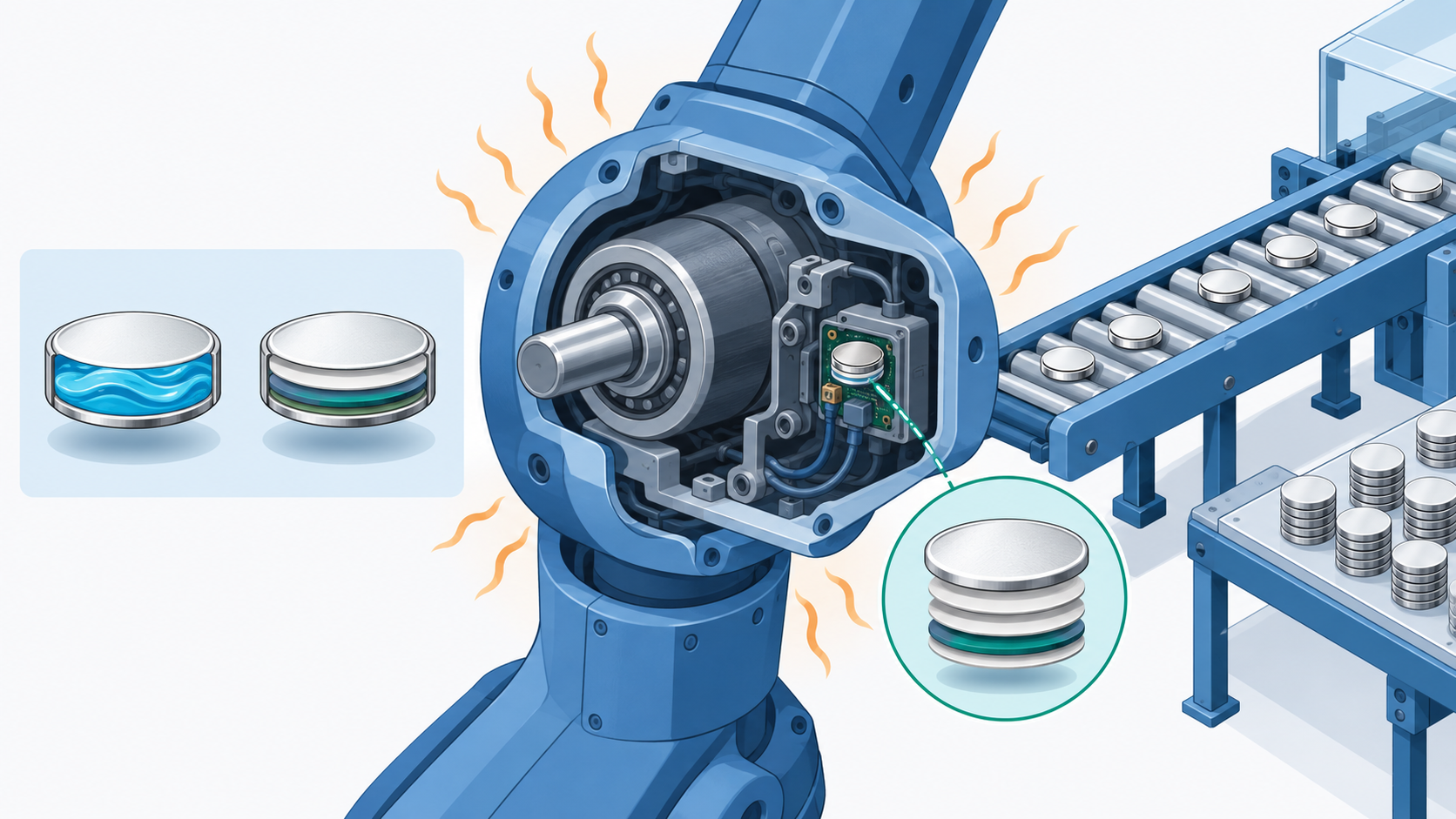
The official announcement states that the first application isthe backup battery for encoders used in industrial robots.. fact The encoder is a component that stores the position information of a machine to allow it to resume operation correctly after a restart. A small battery is included to retain this memory. It is located near the motor and can get very hot, so liquid batteries have a shorter lifespan. The battery keeps running outStop the entire line and replaceit will be.
What is sold here is not ‘high-energy-density batteries’ but ‘batteries that don’t need to be replaced for 10 years’It is. That means Panasonic Energy’s solid-state battery does not start on the playing field competing in Wh/L. Wh/L where it doesn’t start from the beginning.The article states that the design is being made. The numerical target is not about energy density but rather ‘heat resistance temperature’ and ‘total maintenance cost’, which serves as its support. Unconfirmed / Future。
9. Mapping of solid-state battery collaborations
10. Technology Approach Used
Panasonic describes the method of all-solid-state batteries as“ceramics” in words. fact. The expression ‘sulfide system’ does not appear in the official statements confirmed in this article.
| Item | The content that has been made public. |
|---|---|
| System of solid electrolytes | ‘Heat Resistance is SuperiorWider sense ceramicsand explained. In 2023,Oxide Halide Typeand published a paper on new materials with lithium ion conductivity exceeding 10 mS/cm |
| Definition of solid-state batteries | The company isfully solidified electrolytesonly calling them all-solid-state batteries and explicitly excluding gel polymers or hybrid systems with both solid and liquid components |
| Technical Challenge 1 | Design of the interface between electrodes and solid electrolytes. Positioned as the most challenging technical issue, including material selection, surface design, and structural design |
| Technical Challenge 2 | Development of highly ion-conductive solid electrolytes |
| Manufacturing | ceramicslaminating processutilizing the knowledge of. Designing within the range that can be reused for liquid-based production equipment |
| targeted properties | high thermal resistance (above 105°C) and longevity. Highlighting its ability to function stably at high temperatures |
oxide-based or oxyhalide-based ceramic electrolytes are compared with sulfide-based Hard and strong against moisture, heat-resistantis a feature of Unconfirmed / Future. This system can directly respond to the requirement of being able to withstand temperatures above 105°C, Panasonic chose high-temperature applications as its firstThe material’s properties and uses match upfrom that standpoint.
Instead, the difficult part ishardnessis. With sulfide systems, deformation of the particles occurs simply by applying pressure and they adhere to the electrode. However, with ceramics, deformation does not occur, so contact must be created using other means such as sintering or thin-film formation. The company says that ‘designing the interface is the most difficult challenge’.MLCC (multilayer ceramic capacitor) stacking processThe reason they are citing their experience in stacking this hard material is because they already have the technology to produce it at a mass production scale. In other words, the company’s strength does not lie in the novelty of the materials.accumulation of experience in stacking and firing ceramic layers Unconfirmed / Future。
11. The risks this company faces
| Risks | Content | Classification |
|---|---|---|
| All-solid-state battery customers are zero | As a battery manufacturer, it is only after adoption that the business will be established, but neither the adopters nor the supply contracts have been disclosed. | Unconfirmed / Future |
| Not disclosed in the mandatory disclosure. | There is no mention of solid-state batteries in the annual report. There is no investor-facing information that fulfills the duty of explanation. | fact |
| The market is small | Initially targeting backup batteries for industrial robots and TPMS, compared to EV batteries, the quantity per unit is orders of magnitude smaller | speculation |
| Risk of falling behind in EV applications | Competitors have set production targets for 2027-2029 for EV applications. Panasonic has not indicated a timeline for EV applications | speculation |
| Investment burden on the liquid side is large | Energy’s capital expenditure was ¥43.41 billion in the fiscal year ending March 2026, and plans for the fiscal year ending March 2027 are ¥23.8 billion. The ability to allocate resources to next-generation technologies depends on the start-up of the North American factory | speculation |
| The profits of the energy business have decreased | Segment profits fell from 120.2 billion yen in the March 2025 period to 69.8 billion yen in the March 2026 period. Vehicle-mounted batteries saw a decline in revenue | fact |
12. Glossary
- All-solid-state battery
- A battery that uses a solid electrolyte instead of a liquid. Panasonic refers to this as a fully solidified one.
- Quasi-solid/half-solid
- Batteries that use gels or polymers as electrolytes. They are sometimes introduced as all-solid-state batteries, but distinction is necessary.
- Oxide halide
- Compounds containing oxygen and halogens (such as chlorine and bromine). One of the systems of solid electrolyte materials.
- mS/cm
- A unit that represents the ease with which ions pass through. The larger the number, the easier electricity flows.
- Encoder
- A sensor that detects and records the position or rotation of a machine. It uses a backup battery for data storage.
- TPMS
- Tire Pressure Monitoring System. A vehicle-mounted system that monitors the air pressure inside tires.
- MLCC
- Stacked ceramic capacitor. An electronic component made by stacking thin ceramic films in multiple layers.
- Financial Report
- The annual statutory disclosure document submitted by listed companies in Japan based on the Financial Instruments and Exchange Act. Audited.
 AI-generated conceptual diagram
13. Source
- Panasonic Holdings The 119th Period (2026 Fiscal Year) Financial Report (Submitted on June 19, 2026, to EDINET). Consolidated Revenue, Pre-tax Profit, Net Profit, Number of Employees, Sales by Segment (Revenue, Profit, Capital Expenditure), Research and Development Expenses, Equipment Investment Plan, History, Status of Related Companies. There is no mention of solid-state batteries in this report. https://disclosure2dl.edinet-fsa.go.jp/searchdocument/pdf/S100YETA.pdf
- Panasonic Energy Official Owned Media ‘Panasonic Energy’s Latest Technology – Practical Approach Towards the Commercialization of Solid-State Batteries’ (Published on May 28, 2026, Updated on June 26, 2026). Positioning of solid-state batteries, initial target applications (105°C and above high-temperature environment, battery for industrial robot encoders, TPMS), entry strategy prioritizing compatibility with existing equipment, repurposing liquid-based equipment, two technical challenges, over 30 years of research on solid electrolytes and patent applications, aiming to ship samples by the end of the fiscal year. https://energy-note.jpn.panasonic.com/n/naba5e7551e05
- Panasonic Holdings Technology Site ‘Regarding New Solid Electrolyte Materials for Solid-State Batteries, a Paper was Published in “Angewandte Chemie International Edition”‘. The electrolyte has lithium-ion conductivity exceeding 10 mS/cm using oxides. The authors are six internal researchers. https://tech.panasonic.com/jp/td/news/20230217.html
- Panasonic Holdings Technology Site Voice of Engineer ‘Ceramic Materials and Devices Expert Challenges in Developing Solid-State Batteries’. They have developed a broad sense of ceramic materials with superior heat resistance as the material for solid electrolytes. The Material Application Technology Center under the Technology Headquarters is responsible for material synthesis, and they have knowledge of layered processes represented by MLCC. https://tech.panasonic.com/jp/td/interview/voice_koga.html
- Panasonic Official press release ‘Panasonic Energy Launches New Global Battery R&D Hub in Japan to Accelerate Development and Production for Automotive and Data Center Applications’ (September 16, 2026). Opening of the Energy Innovation Square in Moriguchi, approximately 24,500 square meters in floor area, with about 500 people, combined with the production development base in Suminoe to be around 800 people, aiming for a doubling of development efficiency by March 2031. https://news.panasonic.com/global/press/en260916-3
14. Table of Correspondence between Claims and Sources
| Main Argument in the Body | Classification | Sources |
|---|---|---|
| The listed company is Panasonic Holdings, and the battery business company is Panasonic Energy | fact | Source 1 https://disclosure2dl.edinet-fsa.go.jp/searchdocument/pdf/S100YETA.pdf |
| 2024-2026 fiscal year consolidated sales revenue, pre-tax profit, net profit, and number of employees | fact | Source 1 https://disclosure2dl.edinet-fsa.go.jp/searchdocument/pdf/S100YETA.pdf |
| Energy segment sales revenue, profit, capital expenditure, research and development expenses 48.6 billion yen, employees 19,189 | fact | Source 1 https://disclosure2dl.edinet-fsa.go.jp/searchdocument/pdf/S100YETA.pdf |
| Investment plan for energy equipment in the fiscal year ending March 2027: ¥238 billion | Unconfirmed / Future | The company plan as recorded in Reference 1 is not a record of achievements. https://disclosure2dl.edinet-fsa.go.jp/searchdocument/pdf/S100YETA.pdf |
| Establishment of Prime Planet Energy & Solutions in April 2020 and transition to a business company structure in April 2022. | fact | Source 1 https://disclosure2dl.edinet-fsa.go.jp/searchdocument/pdf/S100YETA.pdf |
| There is no mention of solid-state batteries in the annual report on securities. | fact | After reviewing the full text of Reference 1. https://disclosure2dl.edinet-fsa.go.jp/searchdocument/pdf/S100YETA.pdf |
| Positioning solid-state batteries as a ‘next option’ beyond the liquid system. | fact | Source 2 https://energy-note.jpn.panasonic.com/n/naba5e7551e05 |
| Firstly, it aims for a high-temperature environment of 105°C or above and exemplifies industrial robots’ encoder batteries and TPMS | fact | Source 2 https://energy-note.jpn.panasonic.com/n/naba5e7551e05 |
| Enter by adopting a form that is compatible with existing equipment and repurpose the liquid production facilities | fact | Source 2 https://energy-note.jpn.panasonic.com/n/naba5e7551e05 |
| We are considering the shipment of samples by the end of the fiscal year 2026. | Unconfirmed / Future | The company’s outlook as mentioned in reference 2. https://energy-note.jpn.panasonic.com/n/naba5e7551e05 |
| The two technical challenges are interface design and high ion conductivity solid electrolytes. | fact | Source 2 https://energy-note.jpn.panasonic.com/n/naba5e7551e05 |
| Research on solid electrolytes has been conducted for over 30 years, with a top-class number of patent applications worldwide. | fact | Source 2 https://energy-note.jpn.panasonic.com/n/naba5e7551e05 |
| A paper was published in February 2023, reporting on oxide halide solid electrolytes with a conductivity exceeding 10 mS/cm | fact | Source 3 https://tech.panasonic.com/jp/td/news/20230217.html |
| They have developed ceramics with superior thermal resistance as solid electrolytes, and the person in charge is from the Technology Department | fact | Source 4 https://tech.panasonic.com/jp/td/interview/voice_koga.html |
| Energy Innovation Square’s establishment, scale, personnel, and target of doubling development efficiency | fact | Source 5 https://news.panasonic.com/global/press/en260916-3 |
| Energy Innovation Square is described as a research and development hub for lithium-ion batteries. | fact | Source 5 https://news.panasonic.com/global/press/en260916-3 |
| Classification of three types of all-solid-state batteries (Automotive / Battery / Startup) | Calculations in this article | Arrangement by this article. Company names are exemplified from the 23 companies in this series |
| Sales, investment amount, and number of full-solid-state battery personnel | Unconfirmed / Future | All are not disclosed. This article does not estimate either. |
| Mass production timing, mass production factory, production capacity, customers, price, target energy density of all-solid-state batteries | Unconfirmed / Future | Not recorded in references 1-5. Do not adopt reported values. https://energy-note.jpn.panasonic.com/n/naba5e7551e05 |
| Presence and location of a dedicated pilot line for all-solid-state batteries | Unconfirmed / Future | Not mentioned in references 1-5. It is not concluded that it does not exist. https://news.panasonic.com/global/press/en260916-3 |
| Joint research with universities and research institutions related to solid-state batteries, startup funding | Unconfirmed / Future | Not mentioned in references 1-5. It is not concluded that it does not exist. https://tech.panasonic.com/jp/td/news/20230217.html |
| The interpretation is that they are not planning to do so for EVs at the moment. | speculation | Interpretation based on the lack of a stated timeline for EVs in this article. |
| The interpretation is that the system of materials is primarily ceramics. | speculation | The interpretation of this paper based on the description in references 3 and 4 |
| The reading that it has not reached the scale mentioned in the legal disclosure | speculation | The observation that it is not recorded in the financial statements |
| The reading that it is a design that cannot get on the stage where it competes with Wh/L from the beginning | speculation | The interpretation of this paper based on the fact that the numerical targets are expressed in terms of heat resistance temperature and total maintenance cost |
| Explanation of the hardness of ceramics and the lamination process | speculation | General properties of solid electrolytes and explanation from the description in reference 4 |
| Market size, possibility of being late to the electric vehicle market, and investment capacity risk | speculation | Interpretation from the expected use and investment in equipment |
Last Updated: September 23, 2026 / Troy Technical
The financial figures in this article are all based on reports submitted by Panasonic Holdings Corporation in accordance with the Financial Instruments Trading Act. Since there is no content related to full-solid-state batteries in these reports, the sources for this article include Panasonic Energy’s official website, official owned media, and official press releases. We have not used estimates from research companies or news-based figures. The ‘assumed’ sections are interpretations derived from primary information in this article and do not reflect the company’s public statements.