COMPANY PROFILE / Solid-State Battery
SAIC Motor
― China’s largest state-owned automobile manufacturer is teaming up with a venture-backed startup to move towards solid-state batteries
The mention of SAIC Group in the discussion about solid-state batteries is because it is a Chinese automobile manufacturer that has announced early on ‘mass production of solid-state batteries’from 2025’s annual report where the company states that they mass-produced itsemi-solid batteryand, all-solid-state battery is at the pilot line completion stageis. In this article, we will strictly distinguish between these two and limit the scale of the automotive industry to a minimum, what is being invested in all-solid-state batteries, who is collaborating with whom, and what are the goals?focuses on.
- Understand in 30 seconds: Uchiwa Seikatsu and its position with solid-state batteries
- About the logo and company name
- Where is this company in the world of solid-state batteries
- Company size (automotive industry is concise)
- Resources invested in solid-state batteries
- Previous efforts
- Future plans
- What is this company aiming for with solid-state batteries?
- Mapping of collaborations in the field of all-solid-state batteries
- Techniques and methods adopted
- Risks faced by this company
- Glossary / References / Claims and Corresponding References Table
1. Understanding SAIC in 30 seconds and its position with solid-state batteries
Limited CompanyEnglish Name SAIC Motor Corporation Limited
600104 (A Shares)The controlling shareholder is Shanghai Automotive Industry (Group). The de facto controller is the Shanghai Municipal State-owned Assets Supervision and Administration Commission
(China, state-owned enterprise)Not a battery specialist or startup
been completed2025 Annual Report entry. Not a production line.
(equipped on the new MG4)Second generation. Not a full-solid-state battery
(QingTao Energy)Investment as a Related Company under the Equity Method
Companies working on solid-state batteriesAutomotive manufacturers, battery manufacturers, and startupsIt is divided into three types. SAIC Group is one of theseAutomotive manufacturersand alsoShanghai Municipal Government that effectively controls state-owned enterprises. fact. Unlike Toyota, which develops batteries in-house, it invests in a startup called QingTao Energy and incorporates its technology into vehicles. In other words, for SAIC, solid-state batteries arenot so much their own invention as a target for industrialization with their investment partners.It is.
And another point, there is an important note to keep in mind when reading this article. What SAIC wrote in its annual report that it ‘pioneered mass production in the industry’ is semi-solid batteryis that,it is not a solid-state (all-solid) battery. fact In Chinese, ‘semi-solid’ and ‘all-solid’ differ by only one character. In Japanese news reports, both are sometimes translated as ‘solid-state batteries.’ This article will always distinguish between the two.
2. Regarding logo and company name display
Note on notation: The corporate name is “Shanghai Automotive Industry Corporation” in Chinese, SAIC Motor Corporation Limited It is. In JapaneseSAIC GrouporShanghai Automotiveis written as the Shanghai Automotive Industry (Group) Co., Ltd. (SAIC Group, controlling shareholder) is a separate legal entityso be careful. In this article, the listed company will be referred to as ‘SAIC Group’.
Official website:https://www.saicmotor.com/english/index.shtml3. Among the world of all-solid-state batteries, where is this company located?
4. Company Size (Automotive Business is Briefly Covered)
The automotive business itself is not the main topic of this article, so we will only focus on its size. fact. The amount isstill in Chinese Yuan (CNY) and no exchange rate conversion has been made.And we have not converted to exchange rates.
| Indicator (Unit: Yuan) | Fiscal Year 2023 | Fiscal year ending December 2024 | Fiscal Year Ending December 2025 |
|---|---|---|---|
| Total operating revenue | 744,705,132,922 | 627,589,946,568 | 656,243,812,081 |
| listed company shareholder attributable net income | 14,106,165,143 | 1,666,376,761 | 10,105,800,270 |
| Same (after non-operating income and expenses deduction) | 10,044,669,855 | -5,409,062,450 | 7,422,891,748 |
The year-end net profit for 2025 is reported to have increased by 506.5% from the previous year, according to the annual report, which attributes this significant increase largely to the reaction against asset impairment charges recorded by SAIC GM and others in 2024.
| The other scale for the fiscal year ending December 2025 | Numerical |
|---|---|
| Number of Employees (Parent Company + Major Subsidiaries) | 179,797 people |
| Number of Research and Development Personnel | 30,329 people (17.6% of all employees) |
| Total Research and Development Investment | ¥21,706,037,747 (Sales Ratio 3.36%) |
| Including Costs Recorded as Expenses | 18,104,061,920 yuan |
| of which the asset accounting portion | 3,601,975,827 yuan (asset ratio 16.59%) |
| Sales volume | 450.7 ten thousand units (up by +12.3% from the previous year) |
| including new energy vehicles | 164.3 ten thousand units |
The number above isfor the entire company. It does not represent the scale of business for solid-state batteries. SAIC Group is reporting sales, investment amounts, and the number of dedicated personnel related to solid-state batteries.All of these have not been made public. Unconfirmed / FutureOf the R&D investment of 21.7 billion yuan, the amount allocated specifically for solid-state batteries has not been disclosed. Also, the figure of 30,329 people engaged in R&D is the total across the company and does not represent the number of dedicated personnel for solid-state battery development.
5. Resources invested in solid-state batteries
The amount and number are not disclosed, butHow much is being invested in the form of equity?The amount can be read from the notes in the annual report. This is a rare case in the corporate profile of full-solid-state batteries.
| Resource types | Content | Classification |
|---|---|---|
| Investment to external parties (amount included) | Qingtao (Kunshan) Energy Development Groupheld as a subsidiary under the equity method. Book value at the end of 2025 2,799,551,243 yuan(approximately 28.0 billion yuan) | fact |
| Investment to external parties (amount included) | Qingtao Power Technology (Shanghai)(formerly known as Shanghai Auto Qingtao Energy Technology) also held as a subsidiary under the equity method. Book value at the end of 2025 386,827,674 yuan(approximately 3.87 billion yuan) | fact |
| equipment | solid-state batteryThe pilot production line has officially been completedThe core indicators such as low-temperature endurance and battery safety are claimed to be industry-leading in the annual report | fact |
| Group structure | Positions the ‘solid-state battery’ as the core technology of intelligent electric vehicles within the component segments and integrates resources to accelerate industrialization | fact |
| Investment amount (for all solid-state batteries) | Investment amount for equipment and research and development expenses focused on all solid-state batteries | Not disclosed |
| Special personnel | Number of personnel involved in the development of all solid-state batteries. The only company-wide figure is 30,329 people in research and development personnel | Not disclosed |
| Collaboration with universities and research institutions | The annual report only mentions a general statement about ‘deepening the mechanism for industry-academia-research collaboration’ in terms of talent cultivation.There is no specific mention of university or research institution names related to all-solid-state batteries | Unconfirmed |
| All-solid-state battery production capacity | It only states ‘pilot line completion’, and neither the capacity (GWh) nor the location are mentioned | Unconfirmed |
Proportionate share method applied company’s book valueApproximately 2.8 billion yuanis the end-of-period valuation amount of the proportionate share held by SAIC in Qingtai (Kunshan) Energy Development Group, and it is not the amount used for research and development of all-solid-state batteries fact Note: In the same year▲99,385,000 yuandecrease (recorded through the equity method, etc.) is also noted, and it appears that the invested company is not generating profits. Unconfirmed / Future。
despite this,The amount is readableThis point is important. Toyota and Honda have not disclosed at all how much they used for solid-state batteries. In the case of SAICAccounting treatment through equity investmentTherefore, as a result, it has become a rare example where the scale is visible from the outside. However, Qingtai Energy also raises funds from other sources besides SAIC, and This 2.8 billion yuan does not cover all of Qingtai’s solid-state battery development costs。
6. Previous Efforts
| period | incident | Meaning |
|---|---|---|
| ― | Qing Tao Energy and ‘Vehicle OS, Intelligent Driving, Network Security, Power Batteries’ in the field of collaboration. The company name is listed alongside Huawei, CATL, etc., under the section ‘Innovation Ecosystem’ on the official website. | The official website officially positions Qing Tao Energy as a partner for battery collaborations. |
| May 24, 2024 | The company announced the evolution of its ‘Seven Major Technology Foundations’ on the official website.Mass production of all-solid-state batteries in 2026, and mass production of vehicles equipped with them to be delivered to customers in 2027and it is explicitly stated | The company’s first public disclosure showing the period for all-solid-state batteries using numbers |
| October 2024 | Delivery of Ji Zi L6 equipped with ‘Light Year Solid-State Battery’ (energy density over 300Wh/kg, range over 1,000km) | The company only writes ‘solid-state battery’ and does not write ‘all-solid-state’.This article does not treat all-solid-state batteries |
| 2025 year | Second Generation Semi-Solid BatteryIntegrating and Mass Producing the New MG4 (Industry First) (2025 Annual Report) | The mass production was achieved with semi-solid, not fully solid. |
| 2025 year | The pilot production line for fully solid batteries has officially been completed(2025 Annual Report) | From the laboratory to the prototype line. Not a mass production line. |
| April 21, 2026 | Publish the annual report for 2025. In the explanation of core competitiveness, explicitly mention ‘all-solid-state batteries’ as a target for upgrading advanced technologies. | Referenced in the mandatory disclosure regarding all-solid-state batteries. |
7. Future Plans
Revenue exceeding 70 billion yuanThese are not just numbers for solid-state batteries alone
One of the top six key areashybrid main raw materials, intelligent chassis, etc.,
in the ‘technology innovation’ section of the 2025 annual report, as areas to build competitiveness solid-state batteries, hybrid power technology, main raw material systems, full-stack software, intelligent chassis, hydrogen fuel cellsare mentioned, and solid-state batteries are placed at the forefront fact. Additionally, in the 2026 business plan, it is written that they will accelerate mass production and application of ‘solid-state batteries’ in the parts segment.
Next, all of these were not confirmed with primary information Unconfirmed / Future。
solid-state batteryproduction facilities/production capacity (GWh)/the model(s) to which it will be installed/price range/ Investment amount for solid-state battery equipment/Number of full-time staff。
Furthermore, in the news, the full-solid-state battery developed by SAIC is referred to asGuangqi Batteryin some reports, but this name was not found on the official website’s technology introduction page or in the 2025 annual report. In this paper, we will use the term ‘all-solid-state battery’ instead of the product name. This is not a definitive statement that the name does not exist, but ratherit was confirmed by primary information.in this sense.
8. What does this company aim to achieve with solid-state batteries?
This part includes information that the company has not directly stated.Inferred from primary sources within the scope of what can be read.Along with the basis, I will write it down.
| What can be read | primary information | Classification |
|---|---|---|
| solid-state batteries areSelf-developed instead of industrialization through a joint ventureto take away | The annual report does not mention the company’s research institute, but it states that the company has made equity investments in two companies, Shengtai, and ‘intends to integrate resources and accelerate industrialization’ | speculation |
| Producing the semi-solid first and building a bridge to full solid | The fact that the second-generation semi-solid battery was produced at MG4 and the completion of the pilot line for full solid was recorded in the same year | speculation |
| solid-state batteries arealso sell as a parts businessis possible | All-solid-state batteries are described as ‘parts and components segment’ technology, not vehicle segment | speculation |
| solid-state batteries areone of the six key technologiesbut not the sole pillar | listed alongside other technological innovations such as hybrid and hydrogen fuel cells | fact |
| The target of mass production in 2026 isnot reaffirmed in the annual report | The goal announced in May 2024 has not been repeated in the form of a deadline in the annual report for April 2026 | speculation |
The appearance of all-solid-state batteries in the 2025 annual report is the ‘parts and components’ segmentthe context fact. ‘To strengthen the synergy of component segments and accelerate the mass production and application of solid-state batteries, intelligent chassis, and intelligent cabins as new technologies,’ is written in the business plan for 2026, but it does not appear in the vehicle segment plans.
automobile manufacturers producecomponents for their own vehiclesAs long as you are only thinking about it, it is usually written in the vehicle side’s plan. Being placed in a parts segment means that the group’s parts company makes and sells products to the outside worldas a possibility they are treating it Unconfirmed / Future. However, the annual report does not explicitly mention sales, which is the interpretation of this article.
9. Mapping of solid-state battery collaborations
10. Technology Approach Used
SAIC Group has announced the electrolyte method for all-solid-state batterieson its official website, which is one of the few car manufacturers. fact. Based on the official announcement made on May 24, 2024.
| Item | The content that has been made public. |
|---|---|
| for the electrolyte method | Polymer-Inorganic Composite Electrolyte(Polymer-Inorganic Composite Electrolyte). I do not use the terms ‘sulfide system’ or ‘oxide system’. |
| Weight Energy Density | 400Wh/kg super |
| Volume Energy Density | 820Wh/L Extraordinary |
| Cell capacity | 75 Ah Ultra |
| safety | Punch-through test and flame test at 200°C without ignition or explosion |
| low-temperature performance | Capacity retention rate exceeds 90% at low temperatures |
| cost | By simplifying and innovating materials and processes, it is possible to reduce costs by up to 40% from cell to pack |
| Expression in the annual report | As a key performance indicator for the pilot lineLow-temperature endurance and battery safetyis noted to lead the industry |
Solid-state batteries have solid electrolytes, roughlyclassified into sulfide-based, oxide-based, halide-based, and polymer-basedis divided into three categories. Sulfide-based materials are ion-conductive but weak against water, while oxide-based materials are stable but hard and difficult to adhere to electrodes, polymer-based materials are soft and easy to process but have low ion conductivity.
SAIC · Qingshao says‘Polymer-Inorganic Composite’is, using a soft polymer as the framework and mixing in inorganic particles that allow ions to pass throughdirection is Unconfirmed / Future. The aim is to avoidelectrode interface peeling, which can be unavoidable with only hard inorganic electrolytes, by absorbing it with the polymer’s flexibility. This is more aboutease of production and yieldis a design philosophy that prioritizes.
Shanghai Automotive Group.has not disclosed which polymer and what percentage of inorganic materials are mixed. Unconfirmed / Future Furthermore, it is unclear from primary information whether this method has reached a state where it can be called ‘all-solid’ (completely free of liquids), as it lies on the extension line of semi-solid batteries. Therefore, the line that distinguishes what part is all-solid depends on the company’s definition.。
11. The risks this company faces
| Risks | Content | Classification |
|---|---|---|
| The target period has not been updated | ‘Mass production in 2026, delivery to vehicles equipped in 2027’ was announced in May 2024, and the period was not reconfirmed in the annual report for April 2026 | fact |
| The mass production line is incomplete | The annual report only mentions ‘Pilot production line completed’. There is no mention of the construction of the mass production line, its capacity, or its location | fact |
| rely on the technology provided by the investment recipient | The core technology of all-solid-state batteries is with Qingtáo Energy, while SAIC is merely a shareholder under the equity method. The mass production launch of Qingtáo will be a constraint for SAIC | speculation |
| profitability of the investment recipient | Qingtáo (Kunshan) Energy Development Group’s equity investment decreased by 99,385,000 yuan in 2025 | fact |
| External verification is not possible | The investment amount, personnel, production capacity, and installed vehicle types are all not disclosed, making it impossible to verify the progress from the outside | Unconfirmed / Future |
| Misunderstanding with semi-solid | The company itself uses the term ‘solid-state battery’ for semi-solid batteries as well, which makes it easy for outsiders to misread its progress | speculation |
| Changes in the environment related to the core business | The annual report lists its own risks, including the instability of overseas trade and geopolitical conditions, the reduction in incentives for purchasing new energy vehicles, and the price increases of upstream raw materials and memory chips | fact |
12. Glossary
- All-Solid-State Battery (All-Solid-State Battery)
- A battery that uses a solid rather than liquid electrolyte. In Chinese, it is referred to as “all-solid-state.
- Half-solid-state battery (half-solid battery)
- A battery where part of the electrolyte is liquid or gel, distinct from all-solid-state batteries and should not be confused with them.
- Polymer-Inorganic Composite Electrolyte
- A solid electrolyte made of soft polymers mixed with inorganic particles that allow ions to pass. The method used by Asahi Glass.
- Subsidiary applying the equity method
- A company holding a portion of voting rights and having significant influence, but not controlling it. It only takes its share of profits and losses.
- Pilot Line (Mid-Test Line)
- A small-scale line used for prototype production and process validation before mass production. It is not a mass production line.
- Qingtao Energy
- Chinese solid-state battery startup. Invested by SAIC Group.
- NEV (New Energy Vehicle)
- In China’s institutional classification, it includes electric vehicles, plug-in hybrids, and fuel cell vehicles.
- Shanghai Municipal State-owned Assets Supervision and Administration Commission
- The Shanghai Municipal State-owned Assets Supervision and Administration Commission. The de facto controller of SAIC Group.
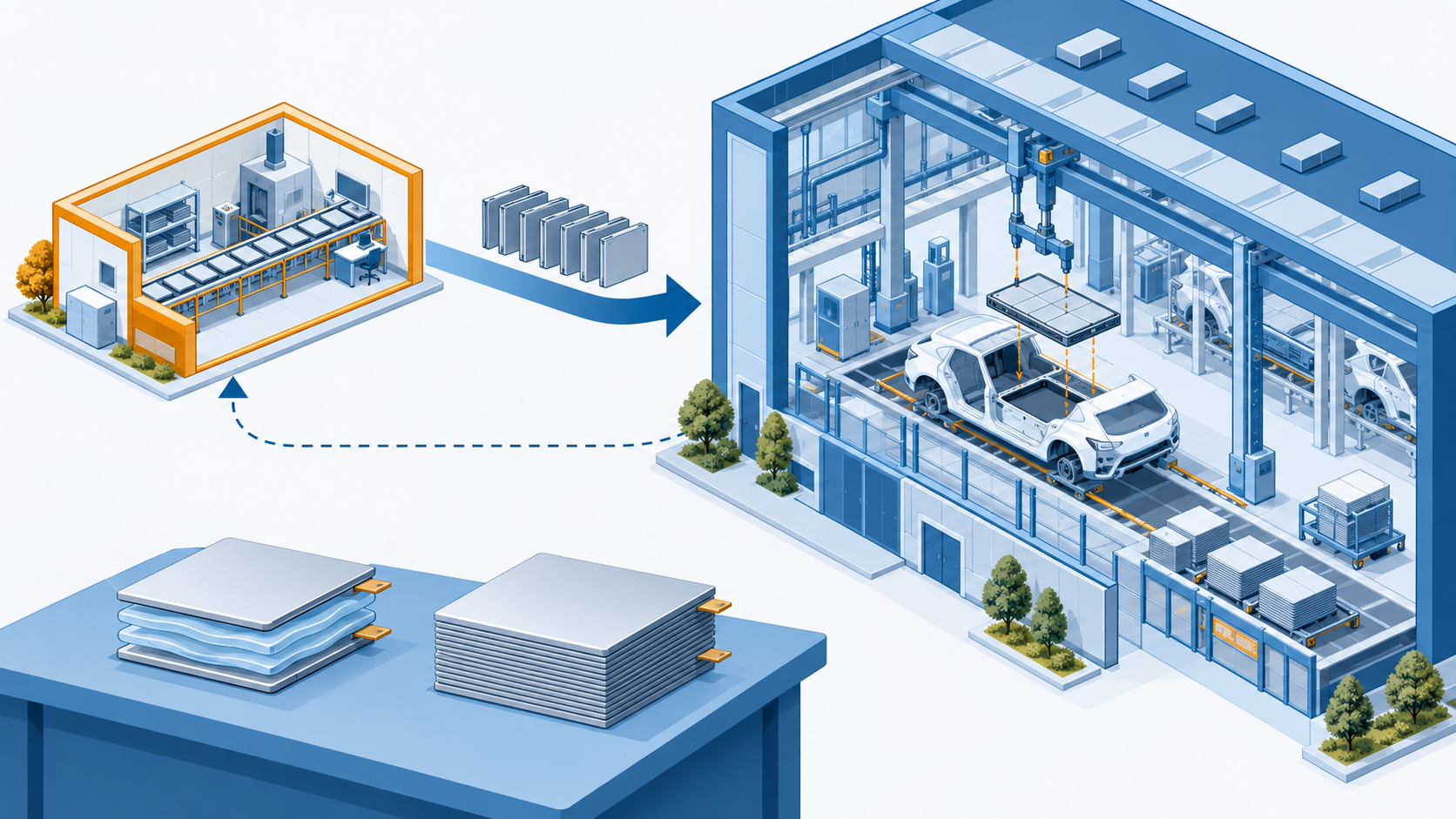 AI-generated conceptual diagram
13. Source
- SAIC Group SAIC Motor Corporation Limited Annual Report 2025 (April 21, 2026, PDF published on the official website). Total operating revenue, net profit, research and development investment, number of R&D personnel, number of employees, sales volume, mass production of semi-solid batteries, completion of pilot line for solid-state batteries, book value of equity method investments in Qingtai Group, 2026 business plan, risks. https://www.saicmotor.com/english/images/investor_relations/annual_report/2026/4/21/0DFE68E4BCB74B01ACFAE92C344763FF.pdf
- SAIC Group The official website news “SASG’s ‘Seven Major Technology Foundations’ Leap Upgrade” (May 24, 2024). Solid-state battery technology (polymer-inorganic composite electrolyte), over 400Wh/kg, over 820Wh/L, over 75Ah, safety tests, low-temperature capacity retention rate, cost reduction margin, target of mass production in 2026 and delivery of vehicles equipped with the solid-state battery in 2027, Gionee solid-state battery-equipped Zhiji L6. https://www.saicmotor.com/chinese/xwzx/xwk/2024/59726.shtml
- SAIC Group The official website ‘Innovative Technology’. Positioning of solid-state batteries in the technology foundation, cooperative partners in the innovative ecosystem (Qingtai Energy, Ningde Times and others), specifications of Gionee solid-state battery. https://www.saicmotor.com/chinese/xwzx/kjcx/index.shtml
- SAIC Group The official website Investor Relations – Financial Data (January to June 2026). Total operating revenue for the first half of 2026: 298.652 billion yuan, attributable net profit: 51.52 billion yuan. https://www.saicmotor.com/english/investor_relations/financial_data/index.shtml
- SAIC Group The official website English version top (for verification of company name and headquarters location). https://www.saicmotor.com/english/index.shtml
14. Table of Correspondence between Claims and Sources
| Main Argument in the Body | Classification | Sources |
|---|---|---|
| Official name, headquarters location, listed market (Shanghai Stock Exchange 600104), controlling shareholder and de facto controller | fact | Source 1-5 https://www.saicmotor.com/english/images/investor_relations/annual_report/2026/4/21/0DFE68E4BCB74B01ACFAE92C344763FF.pdf |
| Total operating income and net profit (2023 to December 2025 fiscal year), 179,797 employees, R&D personnel 30,329, R&D investment 21.7 billion yuan, sales 450.7 million units | fact | Source 1 https://www.saicmotor.com/english/images/investor_relations/annual_report/2026/4/21/0DFE68E4BCB74B01ACFAE92C344763FF.pdf |
| The production deployment of the second-generation semi-solid battery in the new MG4 (it is not a fully solid state) | fact | Source 1 https://www.saicmotor.com/english/images/investor_relations/annual_report/2026/4/21/0DFE68E4BCB74B01ACFAE92C344763FF.pdf |
| The completion of the pilot production line for fully solid-state batteries was officially announced | fact | Source 1 https://www.saicmotor.com/english/images/investor_relations/annual_report/2026/4/21/0DFE68E4BCB74B01ACFAE92C344763FF.pdf |
| Investment in Qingtai Energy Development Group (Kunshan) by equity method: 2,799,551,243 yuan; investment in Qingtai Power Technology (Shanghai): 386,827,674 yuan; a decrease of 99,385,000 yuan | fact | Source 1 https://www.saicmotor.com/english/images/investor_relations/annual_report/2026/4/21/0DFE68E4BCB74B01ACFAE92C344763FF.pdf |
| All-solid-state batteries are at the forefront of six key areas of technological innovation, with a 2026 target (sales of 5 million units and sales exceeding 700 billion yuan) | fact | Source 1 https://www.saicmotor.com/english/images/investor_relations/annual_report/2026/4/21/0DFE68E4BCB74B01ACFAE92C344763FF.pdf |
| SAIC Automotive Power Battery · SAIC Times Power Battery System · SAIC Volkswagen Power Battery are equity method applied companies or related companies | fact | Source 1 https://www.saicmotor.com/english/images/investor_relations/annual_report/2026/4/21/0DFE68E4BCB74B01ACFAE92C344763FF.pdf |
| The risks cited by the company itself (trade environment, reduction in purchase tax benefits, price increases for raw materials and memory chips) | fact | Source 1 https://www.saicmotor.com/english/images/investor_relations/annual_report/2026/4/21/0DFE68E4BCB74B01ACFAE92C344763FF.pdf |
| The method of all-solid-state batteries is polymer-inorganic composite electrolyte, over 400Wh/kg, over 820Wh/L, over 75Ah, pricking and a hot box at 200°C, maintenance rate below -90%, cost reduction up to 40% | fact | Source 2 https://www.saicmotor.com/chinese/xwzx/xwk/2024/59726.shtml |
| The goal is to mass-produce all-solid-state batteries by 2026 and deliver vehicles equipped with them to customers in 2027 | fact | Source 2 https://www.saicmotor.com/chinese/xwzx/xwk/2024/59726.shtml |
| In October 2024, Jiayi L6 with a light-year solid-state battery will be delivered (over 300Wh/kg and over 1,000km range). The company does not write ‘all-solid-state’. | fact | Source 3 https://www.saicmotor.com/chinese/xwzx/kjcx/index.shtml |
| It is mentioned that companies such as Qingtáo Energy and Ningde Times are cited as cooperation partners for the innovative ecosystem. | fact | Source 3 https://www.saicmotor.com/chinese/xwzx/kjcx/index.shtml |
| Total operating revenue for the first half of 2026: ¥298.652 billion; attributable net profit: ¥51.52 billion | fact | Source 4 https://www.saicmotor.com/english/investor_relations/financial_data/index.shtml |
| Classification of three types of all-solid-state batteries (Automotive / Battery / Startup) | Calculations in this article | This article provides an overview. Company names are examples from the companies covered in this series. |
| Sales, investment amount, and number of full-solid-state battery personnel | Unconfirmed / Future | All are not disclosed. This article does not estimate either. |
| Production sites, production capacity, installed vehicle types, and price range for solid-state batteries | Unconfirmed / Future | Not mentioned in references 1-3. Do not adopt values based on news reports. https://www.saicmotor.com/english/images/investor_relations/annual_report/2026/4/21/0DFE68E4BCB74B01ACFAE92C344763FF.pdf |
| Product name ‘Kōki Battery’ | Unconfirmed / Future | Neither mentioned in references 1-3, so not used in this article https://www.saicmotor.com/chinese/xwzx/kjcx/index.shtml |
| Specific collaboration with universities and research institutions related to solid-state batteries | Unconfirmed / Future | There is a general description of industry-academia-research collaboration in Source 1, but specific names related to all-solid-state batteries could not be confirmed. It cannot be definitively stated that they do not exist. https://www.saicmotor.com/english/images/investor_relations/annual_report/2026/4/21/0DFE68E4BCB74B01ACFAE92C344763FF.pdf |
| The specific composition of the polymer and inorganic materials used, as well as whether they have reached a state that can be called ‘all-solid-state’, | Unconfirmed / Future | Not mentioned in reference 2. This article does not estimate https://www.saicmotor.com/chinese/xwzx/xwk/2024/59726.shtml |
| The interpretation is that they are going through industrialization with their own development rather than independently. | speculation | The interpretation of this article based on the shareholding method investment in Qingshao and the description in the annual report. |
| The interpretation is that they are mass-producing semi-solid state first to build a bridge to all-solid-state. | speculation | The observation of this paper that both were recorded in the same year |
| The interpretation that there is a possibility to sell solid-state batteries as components | speculation | The interpretation of this paper from the context of the component segment |
| The observation that the goal of mass production in 2026 was not reaffirmed in the annual report | speculation | The observation of this paper regarding the difference between the descriptions in reference 1 and reference 2 |
| The design absorbs interfacial delamination by the polymer’s flexibility in a polymer-inorganic composite | speculation | Explanation based on the general properties of solid electrolytes in this paper |
| Risks of relying on technology provided to the investment partner, and risks of confusion with semi-solid materials | speculation | Interpretation of this article based on the structure of collaboration and the company’s terminology |
Last Updated: September 23, 2026 / Troy Technical
The numbers in this article are all based on the annual reports and announcements from the parent company’s official website. We have not used estimates or figures from news reports. The amounts are in Chinese Yuan (CNY) and no currency conversion has been performed. The ‘estimated’ sections are interpretations derived from primary information within this article, not the company’s official statements.