TECHNOLOGY EXPLAINER
CDMOs (contract development and manufacturing organisations)
— the contractor makes it, the drug company holds the approval. So who chooses the materials?
Pharmaceutical companies do not necessarily make their own medicines. CDMOs, which take on everything from process development to commercial manufacture, are growing in importance, especially in cell and gene therapy. It is a contract business, much like OSATs in semiconductor back-end assembly and test, but the way materials get adopted is very different.

- What a CDMO is (the short version)
- CRO, CMO and CDMO — the differences
- Why drug companies outsource manufacturing
- Outsourcing the work does not outsource the responsibility
- Why CDMOs matter especially in cell and gene therapy
- A materials engineer's view (1): getting into a CDMO's “standard process”
- The OSAT comparison — where the door to adoption is
- A materials engineer's view (2): there are two doors, and approval shuts the window
- Companies whose business model we confirmed from official information
- Open problems and what is still undecided
- Glossary / References / Claim-to-source audit
Sourced = stated in a law, guideline or official company information (link given)
Our calculation = a figure this article derived, with the assumptions spelled out (not used in this article)
Not yet confirmed = a plan, a draft or anything else not yet settled
Our own structuring of the industry and readings from the materials-supplier side are marked separately as Commentary.
Quotations from Japanese ordinances are our own translations; quotations from US, EU, ICH and company texts are in the original English.
No estimates of market size, share or revenue ranking are used. Companies are named only where their business model could be confirmed from their own official information.
1. What a CDMO is (the short version)
A CDMO (Contract Development and Manufacturing Organization) is a company that takes on process development and manufacturing of medicines on behalf of drug companies and others. Within the scope of this article's research we found no law or ICH guideline that defines the term; it is an industry label (commentary).
- What it takes on: developing processes such as cell culture and purification, and manufacturing everything from clinical supplies to commercial product. AGC Biologics describes itself as “a global CDMO” providing development and manufacturing services for protein-based biologics, cell and gene therapies, and messenger RNASourced
- Who it works for: the drug companies and biotech ventures that obtain approval and put products on the market. The regulations are built to work even when the party that holds the approval and the party that makes the product are different (Section 4)
- What sets it apart: compared with a company that only manufactures (a CMO), it is involved from the process-development stage (commentary)
FDA's guidance on quality agreements puts it like this: “When an owner uses a contract facility, the owner's quality unit is legally responsible for approving or rejecting drug products manufactured by the contract facility, including for final release.”Sourced
The CDMO may make it, but the drug company is responsible for the product and holds the approval. And the same guidance says a quality agreement “should indicate which party will establish specifications for components as well as which party will establish processes for auditing, qualifying, and monitoring component suppliers”Sourced. Who decides on materials is settled contract by contract. That is where this article starts (commentary).
2. CRO, CMO and CDMO — the differences
| Term | How published sources treat it | Typical scope (commentary) |
|---|---|---|
| CRO | ICH E6(R3) folds “CRO” into the entry for “service provider”, defined as “a person or organisation (commercial, academic or other) providing a service used by either the sponsor or the investigator to fulfil trial-related activities” | Running, monitoring and managing data for clinical trials, and so on |
| CMO | ICH Q12 lists the stakeholders in a supply chain as MAHs, R&D organisations, manufacturers, Contract Manufacturing Organisations and suppliers | Manufacturing to a defined process |
| CDMO | No definition found in law or ICH. Companies describe themselves as “a global CDMO” (AGC Biologics) or as offering, “from preclinical to commercial manufacture, … a full end-to-end service in a wide range of modalities” (FUJIFILM Biotechnologies' cell therapy CDMO page) | From process development through clinical supply to commercial manufacture |
“How published sources treat it” is Sourced (ICH E6(R3) [Ref. 5], ICH Q12 [Ref. 4], AGC Biologics [Ref. 11], FUJIFILM Biotechnologies [Ref. 12]). The right-hand column is this article's commentary.
3. Why drug companies outsource manufacturing
FDA's quality agreement guidance sums up the benefit of contract manufacturing in one sentence: “Contracting can enhance speed and efficiency, provide technological expertise, and expand capacity.”Sourced As examples of work done by contract facilities, the same guidance lists formulation, fill and finish, chemical synthesis, cell culture and fermentation (including for biological products), analytical testing, packaging and labelling, and sterilisationSourced.
| Reason | FDA guidance wording | What it means for the drug company (commentary) |
|---|---|---|
| Speed | speed and efficiency | Clinical and commercial supply can be ready sooner than by building its own plant |
| Expertise | technological expertise | Access to technology and experience it lacks in-house, such as viral vectors or cell processing |
| Capacity | expand capacity | Output can be secured without carrying fixed costs while demand is still uncertain |
The middle column is Sourced (FDA quality agreement guidance [Ref. 1]). The right-hand column is this article's commentary.
In development especially, building a dedicated plant for a product that may never be approved is a big bet. Handing process development and clinical supply to a contractor, and taking only the products that succeed on to commercial manufacture, is the core logic of using a CDMO (commentary).
4. Outsourcing the work does not outsource the responsibility
In Japan, the US and the EU alike, work can be contracted out, but responsibility for the product stays with the party that contracts it outSourced. The two sides are bound by written arrangements.
- Japan: Article 3 of the GCTP Ordinance says the marketing authorisation holder “shall have” the manufacturer carry out manufacturing control and quality control at the manufacturing siteSourced. Article 7 of the GQP Ordinance lists what the MAH must agree with the manufacturer: the scope of the manufacturing work, technical conditions such as manufacturing and test methods, periodic checks and “the method of, and person responsible for, notifying the marketing authorisation holder in advance where a change to manufacturing methods, test methods, etc. is thought likely to affect the quality of the product”Sourced
- US: each party is responsible for CGMP compliance in the manufacturing activities it performs, and the owner's quality unit is legally responsible for approving or rejecting, including for final release, drug products made by the contract facilitySourced
- EU: Chapter 7 of EU GMP requires any outsourced activity to be “appropriately defined, agreed and controlled”, a written contract between contract giver and contract acceptor, and the contract giver's quality management system to state clearly how the Qualified Person (QP) certifying each batch exercises his full responsibilitySourced
- ICH Q10: the quality system extends to control of outsourced activities and quality of purchased materials, and “the pharmaceutical company is ultimately responsible”Sourced
5. Why CDMOs matter especially in cell and gene therapy
In its May 2026 guidance, FDA lists the following among the challenges of developing cell and gene therapy productsSourced.
- Product complexity, patient-specific manufacturing
- Sophisticated processes and advanced technologies
- Limited patient population size, fewer manufacturing runs
- Product characterization and analytical testing
- Short product shelf-life necessitating a narrow window of time from production to administration
The EU's GMP for ATMPs (Part IV) notes that advanced therapies “are also often developed in an academic or hospital setting operating under quality systems different to those typically required for the manufacture of conventional medicinal products”Sourced.
| What is needed | What the published text says | Why that leads to CDMOs (commentary) |
|---|---|---|
| Segregated facilities | Concurrent production of two different ATMPs/batches in the same area is not acceptable. Separation with closed systems such as isolators is allowed (EU GMP Part IV 4.18 to 4.19)Sourced | Making several products or patients' batches in parallel needs many rooms or closed systems. Owned by a single company, they tend to sit underused |
| A GMP quality system | Academic and hospital settings often develop products under quality systems different from those for conventional medicines (2.11)Sourced | Rebuilding a laboratory process into one that can run under GMP takes experience |
| Understanding automated equipment | For automated equipment, a CE mark does not suffice to demonstrate suitability. The manufacturer should get enough information from the equipment maker to fully understand how it works and identify the steps critical to quality (Section 17)Sourced | Equipment evaluation and qualification need not be redone from scratch for every product |
| Modalities covered | FUJIFILM Biotechnologies' cell therapy CDMO page lists autologous and allogeneic stem cells and immune cells (CTL, NK, CAR-T, TCR-T), and iPS cells in partnership with a group companySourced | Experience of the different processes each product type needs can be held in one place |
“What the published text says” is Sourced (EU GMP Part IV [Ref. 10], FUJIFILM Biotechnologies [Ref. 12]). The right-hand column is this article's commentary.
6. A materials engineer's view (1): getting into a CDMO's “standard process”
FDA's May 2026 guidance says it may consider proposals to leverage CMC knowledge across similar cell and gene therapy products, covering analytical methods, method validation, lot release specifications, stability data, comparability data, and process development and process validation dataSourced. One example it gives is the use of a “platform analytical procedure”Sourced.
For a CDMO, this supports reusing its own standard process (platform) across many customers' products (commentary). For a materials supplier it means the following (commentary).
- One adoption becomes adoption in many products: the media, bags and filters built into a CDMO's standard process go into every customer product that uses that process
- Evaluation data get reused too: a component whose extractables assessment and qualification have been done once at the CDMO becomes an “already checked” option for the next customer
- Conversely, miss it and you are locked out: once the standard process is set, proposing a different material means extra work for both the CDMO and its customers
In short, a CDMO is where adoption multiplies. For a materials supplier, the customer to sell to is not only each drug company but also the CDMO's process-development department (commentary).
7. The OSAT comparison — where the door to adoption is
In our explainer on OSATs, which take on semiconductor back-end assembly and test, we saw that who decides on materials shifts with who does the back-end work. Pharmaceutical CDMOs are similar in being contractors, but materials get adopted in a very different way (commentary).
| Aspect | OSAT (semiconductor back end) | CDMO (medicines) |
|---|---|---|
| What is contracted | Assembly and test; scope varies by customer | Process development, clinical supply, commercial manufacture; scope varies by customer |
| Responsibility for the product | Depends on the contract | The owner's (drug company's) quality unit is legally responsible for final releaseSourced |
| Who decides on materials | The back-end player (OSAT or foundry) or the design firm; if the player changes, so does the decision-maker | The quality agreement sets which party handles component specifications and supplier controlSourced |
| Can the contractor change materials? | Depends on the agreement with the customer and requalification | In an FDA case study, under the quality agreement the contract facility could not implement process or component changes without the owner's approvalSourced |
| Weight of a change | Customer requalification (reliability testing and so on) | If it touches the approved particulars (ECs), a submission to the regulator is neededSourced |
Sourced items in the CDMO column follow FDA's quality agreement guidance [Ref. 1] and ICH Q12 [Ref. 4]. The OSAT column and unmarked CDMO items are this article's commentary (the OSAT column summarises our OSAT explainer).
8. A materials engineer's view (2): there are two doors, and approval shuts the window
FDA's quality agreement guidance contains a telling case. A contract facility found problems in a process and concluded that process redesign and component changes were needed. Under the quality agreement, however, it could not implement them without the owner's approval, and the owner refused to approve the recommended changes. The guidance comments: “Owners may be reluctant to approve changes recommended by contract facilities, even if changes are necessary to continue manufacturing the drug in compliance with CGMP.”Sourced
From this we can read that materials adoption in pharmaceutical contract manufacturing has two doors (commentary).
- Door 1: the CDMO's process-development department. It evaluates and proposes materials while building its standard process or a customer's process
- Door 2: the drug company, which holds the approval. It approves component specifications and suppliers and writes them into the application (CMC)
With an OSAT, once the OSAT decides to adopt a material, that material can be used. With medicines, even a material the CDMO wants to adopt is not used unless the drug company approves it and puts it in the application. And changing a material after approval is heavy work involving regulatory procedures (see our explainer on QbD and CMC).
So the window for adoption should be thought of as opening early in development and being nearly shut by the time of approval (commentary). The key in this market is to get in at the CDMO's process-development stage, and from that point to have ready the documentation a drug company needs in order to approve the material: specifications, a system for notifying changes in advance, and continuity of supply.
One more point: because early-stage clinical supplies are generally exempt from 21 CFR Part 211 in the USSourced, processes are sometimes built with research-grade materials. The EU's GMP for ATMPs acknowledges that sometimes only research-grade materials are available, while asking manufacturers to understand the risks, “including the risks to the continuity of supply when larger amounts of product are manufactured”Sourced. Moving a material that came in at research grade up to a GMP grade before approval can itself be a “change”. The practical answer for a materials supplier is to come in through Door 1 with a GMP grade and its documentation from the start (commentary).
9. Companies whose business model we confirmed from official information
The following are examples whose CDMO business we could confirm on each company's official website. They do not indicate market rank or size, and the list is not exhaustive.
| Company | What official information confirms |
|---|---|
| AGC Biologics | A global CDMO headquartered in the Seattle area, US, providing development and manufacturing services for protein-based biologics, cell and gene therapies, and messenger RNA. Part of the AGC Inc. group. Sites in Bothell (US), Copenhagen (Denmark), Heidelberg (Germany), Milan (Italy), Chiba and Yokohama (Japan) |
| FUJIFILM Biotechnologies | As a cell therapy CDMO, offers “a full end-to-end service in a wide range of modalities”, from preclinical to commercial manufacture. Process development and manufacturing, science & technology (MSAT) teams; cGMP manufacturing space with electronic batch records. Lists autologous and allogeneic stem cells and immune cells (CTL, NK, CAR-T, TCR-T), and iPS cells in partnership with FUJIFILM Cellular Dynamics |
All Sourced (AGC Biologics “About Us” [Ref. 11], FUJIFILM Biotechnologies cell therapy CDMO page [Ref. 12]).
Both companies above belong to Japanese corporate groups: AGC Biologics states it is part of the AGC Inc. groupSourced, and FUJIFILM Biotechnologies presents itself as the CDMO within the FUJIFILM groupSourced. Both groups are also known in materials and chemicals (commentary). Seen through the “doors to adoption” in Section 8, this can be read as materials groups moving themselves onto the side that decides adoption (contract manufacturing). Whether either company holds its CDMO business with that intention, however, is not stated in the official information we checked (commentary).
10. Open problems and what is still undecided
(1) Mismatch over who drives change
As Section 8 showed, FDA itself points out that owners may not approve changes their contract facilities consider necessarySourced. When a material is discontinued or improved, who decides, and when — the CDMO or the drug company — needs to be settled in the agreement beforehand (commentary).
(2) Dependence on standard processes
A material built into a CDMO's standard process spreads into many products, but if it stops, many products can be hit at once (commentary). Continuity of supply becomes a promise not only to individual customers but to the CDMO's whole process.
(3) New forms of manufacturing, such as decentralised manufacturing
EU GMP Part IV says new manufacturing models, such as decentralised manufacturing, are emerging to address the challenges of autologous productsSourced. How the CDMO's role would change under such models is something no primary source allows us to state with certainty as of this article's research (September 2026)Not yet confirmed.
(4) Scope of the guidance
FDA's quality agreement guidance covers commercial manufacturing and does not explicitly apply to the manufacture of investigational materials, though it says many of its principles could be applied in pre-commercial stages. It also excludes human cells, tissues, and cellular or tissue-based products regulated solely under section 361 of the Public Health Service ActSourced.
- A CDMO takes on work from process development to manufacture. No legal definition was found; the term is used in companies' own descriptionsSourced
- FDA writes that contracting can bring “speed and efficiency, … technological expertise, and … capacity”Sourced
- Contracting out the work leaves final responsibility for the product with the contracting partySourced
- Cell and gene therapy needs specialised facilities and people, because of patient-specific manufacturing, sophisticated processes and limits on concurrent productionSourced
- There are two doors to materials adoption: the CDMO's process development and the drug company's approval (commentary)
- The adoption window opens early in development and is nearly shut by approval (commentary)
11. Glossary
- CDMO
- Contract Development and Manufacturing Organization. A company that takes on process development and manufacturing of medicines.
- CMO
- Contract Manufacturing Organization. A company that takes on manufacturing of medicines.
- CRO
- Contract Research Organisation. A company that takes on clinical trial work and similar. Folded into “service provider” in ICH E6(R3).
- OSAT
- Outsourced Semiconductor Assembly and Test. A company that takes on semiconductor assembly and test.
- Owner
- FDA guidance term for the party that contracts manufacturing to a contract facility and is responsible for release decisions.
- Contract facility
- FDA guidance term for a facility that performs manufacturing operations under contract.
- Quality agreement
- A document setting out the quality roles and responsibilities of the contracting and contracted parties.
- Marketing authorisation holder (MAH)
- In Japan, the party that holds the approval and is responsible for putting the product on the market.
- QP
- Qualified Person. In the EU, the person responsible for certifying each batch for release.
- Platform
- A standard process or analytical method that can be used across several products.
- Modality
- The type or form of a medicine (small molecule, antibody, cell, gene and so on).
- MSAT
- Manufacturing Science and Technology. The function that deals with technical manufacturing issues.
- Decentralised manufacturing
- Manufacturing at several locations, such as close to patients, rather than in one central place.
12. References
- U.S. FDA (CDER, CBER, CVM) “Contract Manufacturing Arrangements for Drugs: Quality Agreements — Guidance for Industry”, November 2016 https://www.fda.gov/media/86193/download
- European Commission “EudraLex Volume 4, Chapter 7: Outsourced Activities”, in operation from 31 January 2013 https://health.ec.europa.eu/system/files/2016-11/vol4-chap7_2012-06_en_0.pdf
- ICH “Q10 Pharmaceutical Quality System”, June 2008 https://database.ich.org/sites/default/files/Q10%20Guideline.pdf
- ICH “Q12 Technical and Regulatory Considerations for Pharmaceutical Product Lifecycle Management”, November 2019 https://database.ich.org/sites/default/files/Q12_Guideline_Step4_2019_1119.pdf
- ICH “E6(R3) Guideline for Good Clinical Practice”, January 2025 https://database.ich.org/sites/default/files/ICH_E6%28R3%29_Step4_FinalGuideline_2025_0106.pdf
- Ministry of Health, Labour and Welfare (e-Gov Law Search) “Ministerial Ordinance on Standards for Manufacturing Control and Quality Control of Regenerative Medical Products”, MHLW Ordinance No. 93 of 2014 (in Japanese) https://laws.e-gov.go.jp/law/426M60000100093
- Ministry of Health, Labour and Welfare (e-Gov Law Search) “Ministerial Ordinance on Standards for Quality Control of Drugs, Quasi-drugs, Cosmetics and Regenerative Medical Products”, MHLW Ordinance No. 136 of 2004 (in Japanese) https://laws.e-gov.go.jp/law/416M60000100136
- Ministry of Health, Labour and Welfare (e-Gov Law Search) “Ministerial Ordinance on Standards for Manufacturing Control and Quality Control of Drugs and Quasi-drugs”, MHLW Ordinance No. 179 of 2004 (in Japanese) https://laws.e-gov.go.jp/law/416M60000100179
- U.S. FDA (CBER) “Chemistry, Manufacturing, and Controls Flexibilities for Developing Human Cellular and Gene Therapy Products for a Biologics License Application” (Guidance for Industry), May 2026 https://www.fda.gov/media/192321/download
- European Commission “Guidelines on Good Manufacturing Practice specific to Advanced Therapy Medicinal Products”, 22 November 2017 https://health.ec.europa.eu/system/files/2017-11/2017_11_22_guidelines_gmp_for_atmps_0.pdf
- AGC Biologics “About Us” https://www.agcbio.com/about
- FUJIFILM Biotechnologies “Your Cell Therapy CDMO Partner” https://fujifilmbiotechnologies.fujifilm.com/capabilities/advanced-therapies/cell-therapy-cdmo/
13. Claim-to-source audit
| Claim in the text | Basis | Label |
|---|---|---|
| That the owner's quality unit is legally responsible for approving or rejecting products made by the contract facility, including for final release. That each party is responsible for CGMP compliance in the activities it performs. That the quality agreement should state which party establishes component specifications and which audits, qualifies and monitors component suppliers. That contracting can enhance “speed and efficiency”, provide “technological expertise” and “expand capacity”. Examples of contract work (formulation, fill and finish, chemical synthesis, cell culture and fermentation including for biological products, analytical testing, packaging and labelling, sterilisation). Case 5 (the contract facility concluded process redesign and component changes were needed but could not implement them without the owner's approval, and the owner refused) and the statement that owners may be reluctant to approve changes. That the guidance covers commercial manufacturing and does not explicitly apply to investigational materials though its principles could be applied, and that HCT/Ps regulated solely under section 361 are excluded. That it is dated November 2016 | FDA quality agreement guidance, Reference 1 https://www.fda.gov/media/86193/download | Sourced |
| That outsourced activities be defined, agreed and controlled; a written contract between contract giver and contract acceptor; that the contract giver's quality management system state how the QP exercises full responsibility. In operation from 31 January 2013 | EU GMP Chapter 7, Reference 2 https://health.ec.europa.eu/system/files/2016-11/vol4-chap7_2012-06_en_0.pdf | Sourced |
| That the quality system extends to control of outsourced activities and quality of purchased materials, with the pharmaceutical company ultimately responsible | ICH Q10 2.7, Reference 3 https://database.ich.org/sites/default/files/Q10%20Guideline.pdf | Sourced |
| That supply-chain stakeholders include Contract Manufacturing Organisations and suppliers. That ECs are legally binding information and changes to them need a submission | ICH Q12, Reference 4 https://database.ich.org/sites/default/files/Q12_Guideline_Step4_2019_1119.pdf | Sourced |
| That CRO is folded into the service provider entry, with a service provider defined as a person or organisation providing a service for trial-related activities. That final responsibility for the sponsor's activities rests with the sponsor | ICH E6(R3), Reference 5 https://database.ich.org/sites/default/files/ICH_E6%28R3%29_Step4_FinalGuideline_2025_0106.pdf | Sourced |
| That the MAH must have the manufacturer carry out manufacturing control and quality control (Article 3) | GCTP Ordinance, Reference 6 https://laws.e-gov.go.jp/law/426M60000100093 | Sourced |
| What the MAH and manufacturer must agree (scope of manufacturing work, technical conditions, periodic checks, the method of and person responsible for advance notice of changes affecting quality, and so on; Article 7) | GQP Ordinance, Reference 7 https://laws.e-gov.go.jp/law/416M60000100136 | Sourced |
| Written arrangements with outsourced parties and confirmation of their suitability and competence (Article 11-5). Cited as part of Japan's GMP framework | GMP Ordinance, Reference 8 https://laws.e-gov.go.jp/law/416M60000100179 | Sourced |
| Challenges in CGT product development (product complexity, patient-specific manufacturing, sophisticated processes and advanced technologies, limited patient population size, fewer manufacturing runs, product characterization and analytical testing, short shelf-life with a narrow window from production to administration). Proposals to leverage CMC knowledge across similar products and what they cover; the example of platform analytical procedures. That production of Phase 1 investigational drugs is generally exempt from Part 211 | FDA guidance (May 2026), Reference 9 https://www.fda.gov/media/192321/download | Sourced |
| That ATMPs are often developed in academic or hospital settings under different quality systems; decentralised manufacturing (2.11). No concurrent production of different ATMPs/batches in one area, and separation by closed systems (4.18 to 4.19). Research-grade materials and continuity-of-supply risk (7.13). That for automated equipment a CE mark does not suffice and enough information should be obtained from the equipment maker (Section 17) | EU GMP Part IV (ATMPs), Reference 10 https://health.ec.europa.eu/system/files/2017-11/2017_11_22_guidelines_gmp_for_atmps_0.pdf | Sourced |
| That AGC Biologics is a global CDMO headquartered in the Seattle area providing development and manufacturing services for protein-based biologics, cell and gene therapies and messenger RNA, and is part of the AGC Inc. group. Its sites (Bothell, Copenhagen, Heidelberg, Milan, Chiba, Yokohama) | AGC Biologics official website, Reference 11 https://www.agcbio.com/about | Sourced |
| FUJIFILM Biotechnologies' cell therapy CDMO services (end-to-end from preclinical to commercial; process development and MSAT; cGMP manufacturing space with electronic batch records; autologous and allogeneic stem and immune cells; iPS cells in partnership with FUJIFILM Cellular Dynamics) | FUJIFILM Biotechnologies official website, Reference 12 https://fujifilmbiotechnologies.fujifilm.com/capabilities/advanced-therapies/cell-therapy-cdmo/ | Sourced |
| How the CDMO's role would change under new models such as decentralised manufacturing | Nothing can be stated with certainty from primary sources as of this article's research (September 2026) | Not yet confirmed |
| The statement that CDMO is an industry label not defined in law or ICH (because no definition could be found within the scope of this article's research). The structuring of CRO, CMO and CDMO scope. The meaning of outsourcing reasons for drug companies. The explanation of building a plant as a bet. The reading of why companies turn to CDMOs. The framing of CDMOs as where adoption multiplies. The OSAT comparison (the OSAT column summarises our OSAT explainer). The two doors to adoption and the view that the window opens early and nearly shuts at approval. The suggestion to come in through Door 1 with a GMP grade. The reading of materials and chemicals groups owning CDMOs. The points on mismatched control over change and dependence on standard processes. The layouts, bands and flows of Figs. 1 to 4 | This article's own structuring and commentary based on the published material. Not views expressed by regulators or companies | Commentary |
| Market size, share and revenue ranking | Not used in this article because they involve estimates (commentary) | Commentary |
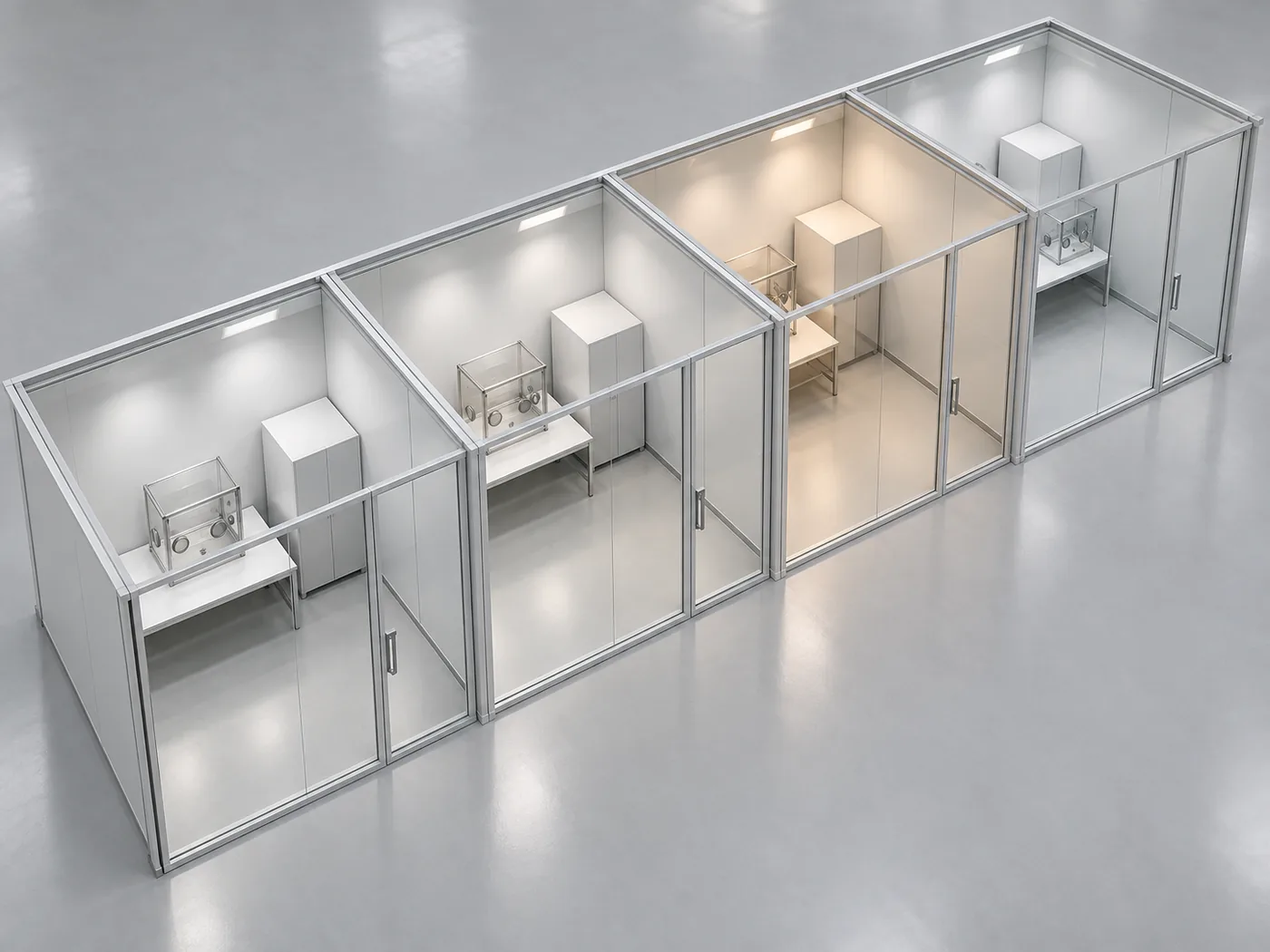
| That Figs. 1 to 4 are explanatory drawings, and that the hero image and Fig. 5 are AI-generated images | Our note | Commentary |
Last updated 23 September 2026. Sources are limited to primary material (FDA guidance, European Commission GMP guidelines, ICH guidelines, Japanese ministerial ordinances and official company websites). Because the article includes our own structuring of the industry and readings from the materials-supplier side, those are marked as Commentary and kept separate from sourced fact. No estimates of market size, share or revenue ranking are used, and company examples are limited to those whose business model we could confirm from official information. In the OSAT comparison, the OSAT side summarises our OSAT explainer. Figs. 1 to 4 are vector drawings; the hero image and Fig. 5 are AI-generated images, and none of them depicts a real company's facility or contract.