COMPANY PROFILE / PEROVSKITE SOLAR CELLS
LONGi Green Energy Technology
One of the world's largest silicon solar makers, stacking up tandem cell efficiency records
LONGi is a listed Chinese company and one of the largest makers of monocrystalline silicon solar cells in the world. It comes up in perovskite coverage for one reason: its tandem cells, which place a perovskite layer on top of silicon, have repeatedly set world records for certified efficiency. In July 2026 it announced 35.5%, certified by JRC-ESTI in Europe. Yet its annual report says nothing at all about a tandem production line, investment in one or a launch date. Using primary sources only, this profile separates what the records actually are (cell area and certifying body) from what the company has not yet disclosed.
- LONGi in 30 seconds, and where it stands in perovskite solar cells
- The logo and how the name is written
- Where the company sits in the perovskite solar cell field
- Scale (the silicon business in brief)
- Resources committed to perovskites
- What it has done so far
- What comes next
- What the company is aiming for in perovskite solar cells
- Map of perovskite partnerships
- Technology, products and services
- The risks this company carries
- Glossary, references and claim-to-source audit
1. LONGi in 30 seconds, and where it stands in perovskite solar cells
601012A shares. Founded in 2000
(entering from silicon mass production)Not a perovskite specialist
(two-terminal)No film-type or glass-type single-junction product announced
Companies working on perovskite solar cells fall into three broad types: established PV makers, perovskite start-ups, and materials and electronics firms coming in from other industries. LONGi is an established PV maker, and what it is pursuing is not a stand-alone perovskite cell but a "tandem" that adds one perovskite layer on top of the silicon cell it already does best Sourced. The 2025 annual report describes tandems as its "reserve of next-generation ultra-high-efficiency tandem technology", placing them as the generation after its mainstay BC (back-contact) cells. For LONGi, in other words, perovskite is not a replacement for silicon but an add-on that breaks through silicon's efficiency ceiling. That is the decisive difference from the start-ups that stake everything on perovskites alone.
2. The logo and how the name is written

The LONGi logo is the company's trademark. Rather than recreate it with an image generator,
this article uses the logo image (SVG) embedded in the official website, saved as img/longi_logo.svg.
A note on names: the legal name is registered in Chinese, and the company's English name is LONGi Green Energy Technology Co., Ltd. Its short name on the Shanghai Stock Exchange translates as "LONGi Green Energy"; according to the annual report, the earlier short name was "LONGi Shares". Japanese coverage writes the name in several ways, and English coverage sometimes spells it Longi; this article uses LONGi throughout.
Official site: https://www.longi.com/en/3. Where the company sits in the perovskite solar cell field
In terms of product format, every result LONGi has published is a two-terminal (monolithic) tandem, with the perovskite cell built directly on top of the silicon cell as a single device Sourced. The company has not announced any plan to commercialise a film-type or glass-type single-junction perovskite module. How tandems work is covered in detail in our explainer on perovskite-silicon tandems.
4. Scale (the silicon business in brief)
The solar business as a whole is not the subject of this article, so only its size is noted Sourced. Amounts are in Chinese yuan (CNY).
| CNY million (years to December) | 2023 | 2024 | 2025 |
|---|---|---|---|
| Operating revenue | 129,498 | 82,582 | 70,347 |
| Net profit attributable to shareholders of the parent | 10,780 | −8,592 | −6,420 |
| R&D expense (income statement) | – | 1,815 | 1,547 |
| R&D input (company definition, including pilot-scale costs) | – | – | 4,299 (6.11% of revenue) |
The 2024 net result is the figure restated in the 2025 annual report after a change in accounting policy. Figures rounded to the nearest CNY million Our calculation.
| Item | Figure | As of |
|---|---|---|
| Employees (parent company and main subsidiaries) | 32,775 | End of December 2025 |
| R&D staff | 3,096 (9.45% of the total) | End of December 2025. Of these, 71 hold doctorates and 517 master's degrees |
| Operating revenue, first half of 2026 | CNY 27,045 million (down 17.58% year on year) | Six months to June 2026 |
| Net loss attributable to the parent, first half of 2026 | CNY 3,684 million | Six months to June 2026 |
The figures above are for the company as a whole, and most of that business is silicon wafers, cells and modules. They say nothing about the scale of the perovskite effort. LONGi discloses none of the relevant numbers for perovskites (tandems): revenue, R&D spending, dedicated headcount or capital expenditure Not yet confirmed. The company also posted net losses in both 2024 and 2025, and again in the first half of 2026. How the money available for R&D is being allocated while it is losing money cannot be seen from outside.
5. Resources committed to perovskites
Amounts and headcount are not published, but the press releases are quite specific about who is doing the work and with whom.
| Type of resource | What it is | Category |
|---|---|---|
| People (dedicated organisation) | The tandem cell team at the Central R&D Institute. In a June 2024 release, a company vice-president said the institute's research team numbered "more than 5,000" and that the tandem team's average age was 28. The size of the tandem team itself is not disclosed | Sourced (headcount not disclosed) |
| People (leadership) | Founder Li Zhenguo serves as both president of the Central R&D Institute and CTO (June 2025 release). Xu Xixiang and He Bo of the Central R&D Institute are named in tandem-related releases | Sourced |
| Money (R&D spending) | Company-wide R&D input was CNY 4,299 million in 2025. The share going to tandems and perovskites is not disclosed | Not disclosed |
| Money (line investment) | No investment amount or capacity has been disclosed for a tandem production line or pilot line | Not confirmed |
| Outside stakes, acquisitions and joint ventures | No investment in, acquisition of or joint venture with a perovskite company appears in the annual report, interim report or releases (the 2025 acquisition was in energy storage) | Not confirmed |
| Universities and research institutes | Joint papers with Soochow University (a new self-assembled monolayer material; flexible tandems), the Changchun Institute of Applied Chemistry, Chinese Academy of Sciences (a diradical SAM; Science, 2025), and Xi'an Jiaotong University and others (flexible tandems; Nature, 2025) | Sourced |
| Public funding | No selection for a government project on perovskite tandems, and no subsidy amount, has been found in the disclosures | Not confirmed |
The June 2024 release puts the Central R&D Institute's research team at "more than 5,000", while the 2025 annual report gives 3,096 R&D staff Sourced. The two figures date from different times, and one is a public-relations description while the other is a statutory count, so their definitions do not match. Neither is a count of people dedicated to tandems, so it cannot be said that "LONGi has thousands of people working on perovskites". What the primary sources do support is narrower: tandems are handled by one team within the Central R&D Institute, and a young team (average age 28) is setting new records in quick succession.
6. What it has done so far
LONGi's perovskite history is, almost entirely, a history of certified efficiency records. The table separates small cells from large-area cells and modules. Cells of about 1 cm² are small research devices, and their efficiency is not product efficiency.
| When | What happened | Area and certification |
|---|---|---|
| May and June 2023 | Announced 31.8% at SNEC 2023 and 33.5% at Intersolar Europe 2023 | Company-reported (recapped in a November 2023 release) |
| November 2023 | Announced 33.9%, which it described as the first result to exceed the theoretical limit for single-junction cells (33.7%) | About 1 cm² / NREL. Listed in NLR's efficiency data table |
| June 2024 | Announced 34.6% (SNEC 2024) | About 1 cm² / JRC-ESTI. Listed in NLR's efficiency data table |
| June 2024 | 30.1% on a wafer-scale tandem in the commercial M6 size. The company said it began research on mass-production technology in October 2023 and had overcome large-area film formation in ambient air and ultra-low-temperature metallisation | M6 wafer scale / Fraunhofer ISE (company-reported) |
| September 2024 | Published the technology behind 33.9% (dual-layer passivation using an ultra-thin LiF layer and diammonium molecules) in Nature | Paper |
| April 2025 | Announced 34.85% | About 1 cm² / NREL. Listed in NLR's efficiency data table |
| June 2025 | 33% on a large-area (260.9 cm²) two-terminal tandem cell, which the company said was included in the efficiency tables (Version 66) | 260.9 cm² / NREL (company-reported) |
| June and July 2025 | Published a diradical SAM (Science, with the Changchun Institute of Applied Chemistry and others) and an asymmetric SAM, "HTL201" (Nature, with Soochow University) | Papers |
| November 2025 | Published a flexible tandem about 60 µm thick in Nature: 33.4% on a small area and 29.8% at full wafer size | Small area by NREL, full size by Fraunhofer ISE (company-reported) |
| Full year 2025 | The annual report states "35.1% on an NREL-certified prototype device (1 cm²) and 34.11% on a large area (261.1 cm²)" | Statutory disclosure (the company's statement) |
| March 2026 | "High-efficiency, stable flexible perovskite/silicon tandem technology", developed with Soochow University, was selected as one of China's Top 10 Scientific Advances of 2025 | Company-reported |
| May 2026 | 35.2% included in the efficiency tables (Version 68), as described in the July 2026 release | About 1 cm² / JRC-ESTI. Listed in NLR's efficiency data table |
| July 2026 | Announced 35.5%, together with 34.3% (261 cm²) and 32.2% (274 cm²) on large areas and 31.4% and 29.4% on tandem modules | 35.5% by JRC-ESTI (company-reported). Not yet in NLR's table when we checked |
This is what could be confirmed in third-party tables Sourced. NLR's (formerly NREL's) cell efficiency data table lists LONGi perovskite/silicon tandems at 33.9% (measured by NREL), 34.6% (JRC-ESTI), 34.85% (NREL), 35.0% (JRC-ESTI) and 35.2% (JRC-ESTI), all with an area of about 1 cm². NLR's champion module efficiency chart also names LONGi as the holder of the perovskite/silicon module record of 31.6%.
By contrast, 35.5% and the large-area cell figures (33%, 34.11%, 34.3% and 32.2%) could be confirmed only from the company's own announcements and disclosures Not yet confirmed. Even for "large area", the annual report gives 34.11% on 261.1 cm² while the July 2026 release gives 34.3% on 261 cm², which may reflect measurements taken at different times. The module figures also disagree, with 31.4% in the release and 31.6% in NLR's chart; this article does not favour either and shows both.
7. What comes next
The 2025 annual report says the tandem results have "laid the foundation for moving from the laboratory to industrial application" Sourced. Put another way, the company itself acknowledges that it is not yet at the industrialisation stage. In the 2026 interim report, too, the only mention of tandems is the 35.5% record; no production timetable appears.
None of the following appears in the annual report, the interim report or the official releases Not yet confirmed.
When tandem mass production will start; the location and capacity of a production line; whether a pilot line exists and how large it is; capital expenditure and R&D spending on tandems; product model numbers and prices; and long-term outdoor reliability data. Figures of the form "LONGi will mass-produce tandems in year X" mostly come from press reports or research firms, and this article does not use them.
8. What the company is aiming for in perovskite solar cells
This section goes beyond what the company says directly. It sets out inferences that can be drawn from primary sources, each with its basis.
| What can be read | Primary evidence behind it | Category |
|---|---|---|
| Perovskite is a way to add value to LONGi's own silicon cells, not a business in its own right | Every published result is a two-terminal tandem with silicon. The June 2024 release says the technology "can be integrated with existing silicon cell processes" as an upgrade to current technology | Inference |
| BC cells are the mainstay for now, and tandems come after them | The annual report covers BC mass production and patents in detail but gives tandems a single sentence as a "next-generation technology reserve". Also the three-tier R&D policy (production, development, reserve) | Inference |
| It uses records to show a technical lead while keeping its production timing under wraps | Of the nine tandem-related releases since November 2023 that we checked, not one gives the timing, location or capacity of mass production | Inference |
| Research on larger areas and production processes is already under way | The June 2024 release states that research on mass-production technology "began in October 2023" and that large-area film formation in ambient air and ultra-low-temperature metallisation had been overcome. A certified value for a 260.9 cm² cell has also been published | Sourced |
| Flexible tandems will enter through high-value uses such as space and vehicles | The November 2025 release names space and vehicle applications and highlights a specific power of 1.77 W/g | Inference |
In the June 2024 release on 30.1% at M6 wafer scale, He Bo of the Central R&D Institute said the company "began research on tandem mass-production technology in October 2023 and, within six months, overcame two challenges: forming large-area perovskite films in ambient air and ultra-low-temperature metallisation (electrode formation)" Sourced. Neither is a problem for small cells made in a laboratory glovebox or by evaporation; both only become obstacles when the cells are made in a factory. LONGi is therefore showing, in its own words, that alongside its record cells (about 1 cm²) it is working on problems that only arise in mass production. That it still gives no timing, location or capacity for production is, in this article's reading, because it is not yet confident of large-area yield and outdoor durability Not yet confirmed. The company has not explained its reasons, however, and this remains our interpretation.
9. Map of perovskite partnerships
10. Technology, products and services
As of September 2026, LONGi does not sell any product that uses perovskites Not yet confirmed. What it has published is technology at the research stage. The table below breaks it down, based on the releases and the company's summaries of its papers.
| Item | What the primary sources say |
|---|---|
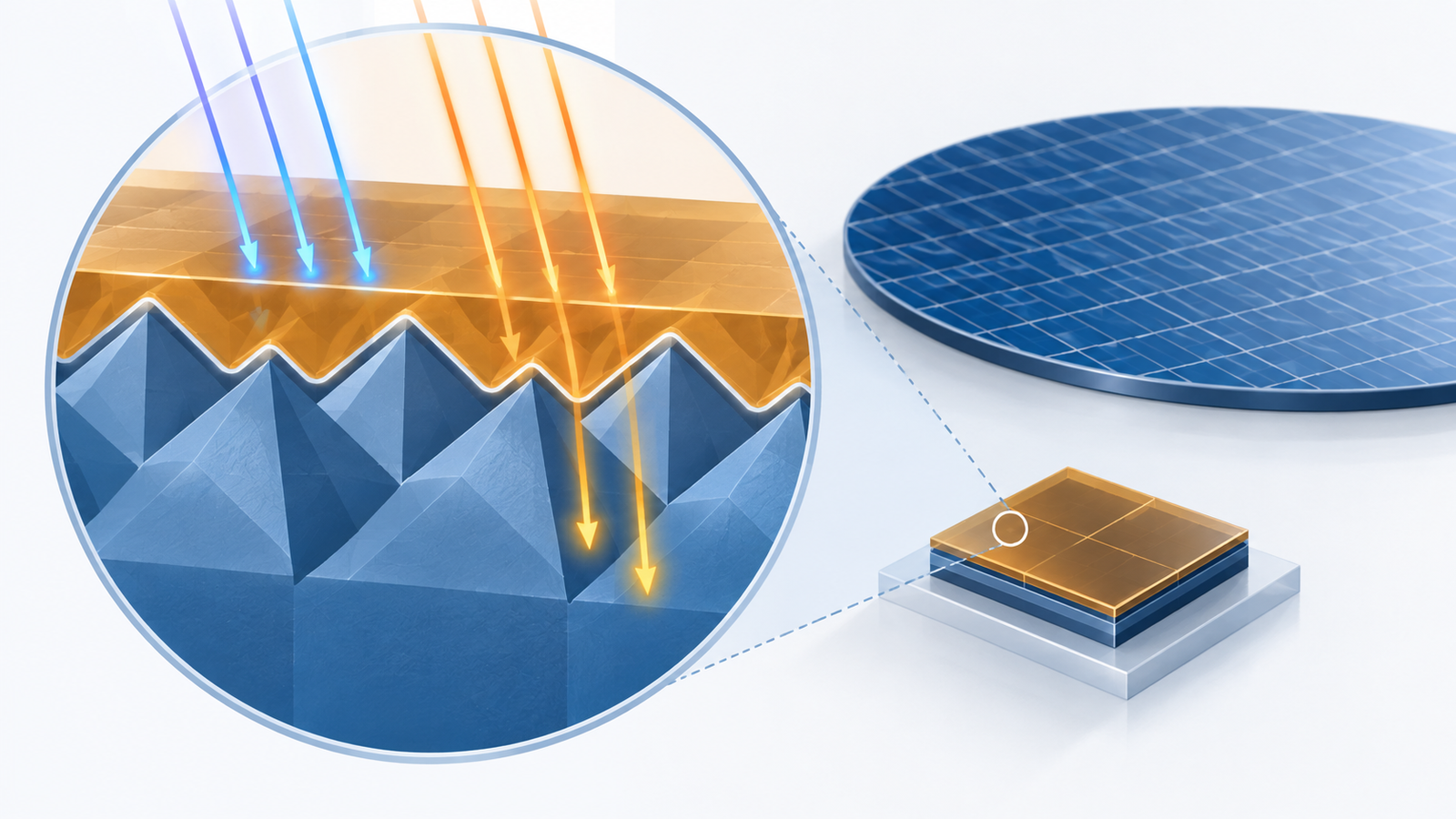
| Structure | A two-terminal (monolithic) perovskite/silicon tandem. The bottom cell is a double-side-textured heterojunction (HJT) silicon cell (from the company's summary of the July 2025 Nature paper) |
| Top surface of the upper cell | Dual-layer passivation, combining an ultra-thin lithium fluoride (LiF) layer dotted at the nanoscale with diammonium molecules, suppresses recombination at the interface with the electron transport layer (the technology behind 33.9%) |
| Underside of the upper cell | An asymmetric carbazole-based SAM, "HTL201", used as the hole transport layer, coats the textured silicon surface evenly and delivered a voltage of about 2 V (the technology behind 34.6%) |
| Material stability | A donor-acceptor diradical SAM combines efficiency with stability (Science, 2025) |
| Flexibility | Uses ultra-thin silicon about 60 µm thick, with a "dense" and a "sparse" double buffer layer to prevent the interfaces from peeling apart when bent. Specific power of 1.77 W/g |
| Processes with production in mind | Large-area perovskite film formation in ambient air and ultra-low-temperature metallisation (as described in June 2024) |
Production silicon cells carry pyramid-shaped texturing a few micrometres high on their surface to trap light. Stack perovskite on top and the film thickness varies between peaks and valleys; wherever the bottom-most layer, the hole transport layer, ends up too thin, current leaks away. LONGi keeps publishing papers on the molecular design of self-assembled monolayers (SAMs) because covering the textured surface without gaps, with a layer just one molecule thick, is what decides efficiency Sourced (the asymmetric SAM is described as improving "coverage and uniformity on textured surfaces").
The other challenge, ultra-low-temperature metallisation, also comes from a materials constraint. Silicon cell electrodes are normally fired at several hundred degrees Celsius, but perovskites contain organic components and cannot withstand such heat. In a tandem, the electrodes have to be formed at low temperature after the perovskite is in place, and achieving low resistance and good adhesion with silver paste becomes a difficult step in the process. For encapsulation and barrier layers, see also our explainer on encapsulation and barrier layers.
11. The risks this company carries
| Risk | Substance | Category |
|---|---|---|
| Losses in the core business | Net losses in two consecutive years, 2024 and 2025 (a net loss of CNY 6.42 billion in 2025), and a net loss of CNY 3.68 billion in the first half of 2026. R&D expense in the income statement fell 14.79% year on year in 2025 | Sourced |
| No published production plan | The timing, capacity and investment for tandem mass production are all undisclosed, so progress cannot be verified from outside | Not yet confirmed |
| Records are mostly on small cells | The cell records that can be confirmed in third-party tables are about 1 cm². Large-area cell values are company-reported and vary depending on when they were measured | Sourced |
| No visible durability data | Compared with the efficiency announcements, no figures for long-term outdoor reliability appear in the primary sources | Not yet confirmed |
| Internal competition with its own BC cells | BC cell production and patents are the company's top priority, and it is unclear whether tandems will move up the list for capital investment | Inference |
| Records do not stay records for long | Other companies and research institutes also keep setting efficiency records, so no single record is held for long | Inference |
12. Glossary
- Tandem solar cell
- Two cells that absorb different parts of the light spectrum, stacked on top of each other. LONGi places perovskite on top of silicon.
- Two-terminal (monolithic)
- A structure in which the upper and lower cells are built as a single device with just one pair of electrodes. The wiring is simpler than a four-terminal design, but the currents of the two cells must be matched.
- SQ limit
- The Shockley-Queisser limit: the theoretical maximum efficiency of a single-junction solar cell (about 33.7%). Tandems can exceed it.
- SAM
- Self-assembled monolayer. A film just one molecule thick that covers a substrate, used as the hole transport layer in perovskite cells.
- BC (back contact)
- A silicon cell with all of its electrodes on the back. LONGi's core technology.
- HJT
- Heterojunction. A cell structure combining crystalline and amorphous silicon. Because it is made with low-temperature processes, it is often used as the bottom cell in tandems.
- Certified efficiency
- Efficiency measured by a third-party body such as NREL (now NLR), JRC-ESTI or Fraunhofer ISE, as distinct from a company's in-house measurement.
- JRC-ESTI
- The European Solar Test Installation, the solar cell measurement facility of the European Commission's Joint Research Centre.
13. References
- LONGi Green Energy Technology Co., Ltd. LONGi Green Energy Technology Co., Ltd. 2025 Annual Report (in Chinese; disclosed on the Shanghai Stock Exchange, 29 April 2026). Corporate information, operating revenue, net profit, R&D expense and R&D input, employees and R&D staff, tandem efficiencies (35.1% on 1 cm² and 34.11% on 261.1 cm², NREL certified) and the description of tandems as a "next-generation technology reserve". http://static.cninfo.com.cn/finalpage/2026-04-29/1225251647.PDF
- LONGi Green Energy Technology Co., Ltd. LONGi Green Energy Technology Co., Ltd. 2026 Interim Report (in Chinese; disclosed on the Shanghai Stock Exchange, 31 August 2026). Operating revenue, net loss and R&D expense for the first half of 2026, and the ESTI-certified 35.5%. http://static.cninfo.com.cn/finalpage/2026-08-31/1225535067.PDF
- LONGi Press release, "35.5%! LONGi Once Again Breaks World Record for Crystalline Silicon-Perovskite Tandem Solar Cell Efficiency" (14 July 2026). 35.5% (ESTI), inclusion of 35.2% in Version 68 of the efficiency tables, large-area 34.3% and 32.2%, tandem modules at 31.4% and 29.4%, and the three-tier R&D model. https://www.longi.com/en/news/crystalline-silicon-perovskite-tandem-solar-cell-new-world-efficiency-2026/
- LONGi Press release, "34.85%! LONGi Breaks World Record for Crystalline Silicon-Perovskite Tandem Solar Cell Efficiency Again" (April 2025, the week after the HIBC 27.81% announcement). 34.85% (NREL) and the history of earlier records. https://www.longi.com/en/news/silicon-perovskite-tandem-solar-cells-new-world-efficiency/
- LONGi Press release, "LONGi Announces Two New Global Solar Cell Efficiency Records" (12 June 2025). 33% on a large area of 260.9 cm² (NREL), inclusion in Version 66 of the efficiency tables, and Li Zhenguo as president of the Central R&D Institute and CTO. https://www.longi.com/en/news/new-world-record-in-snec-2025/
- LONGi Press release, "LONGi's Tandem Solar Cell Breakthroughs Consecutively Published Online In Nature and Science" (July 2025). Dual-layer passivation (Nature, 2024), the asymmetric SAM HTL201 (Nature, 2025, with Soochow University) and the diradical SAM (Science, 2025, with the Changchun Institute of Applied Chemistry and others). https://www.longi.com/en/news/nature-and-science-research-of-tandem-solar-cell/
- LONGi Press release, "Nature Consecutively Publishes LONGi's Breakthroughs in HIBC and Flexible Silicon-Based Tandem Solar Cells" (November 2025). The flexible tandem (33.4% on a small area, NREL; 29.8% at full size, Fraunhofer ISE), research partners, applications in space and vehicles, and the date of the HIBC 27.81% announcement (11 April 2025). https://www.longi.com/en/news/breakthroughs-in-hibc-and-flexible-silicon-based-tandem-solar-cells-nature/
- LONGi Press release, "LONGi Takes the Lead in Breakthrough in Flexible Tandem Technology Selected Among China's Top 10 Scientific Advances" (March 2026). Selection among the Top 10 Scientific Advances, thickness of about 60 µm, the double buffer layer and a specific power of 1.77 W/g. https://www.longi.com/en/news/top-ten-scientific-advances/
- LONGi Press release, "LONGi sets a new world record of 33.9% for the efficiency of crystalline silicon-perovskite tandem solar cells" (3 November 2023). 33.9% (NREL), and 31.8% in May and 33.5% in June 2023. https://www.longi.com/en/news/new-world-record-for-the-efficiency-of-crystalline-silicon-perovskite-tandem-solar-cells/
- LONGi Press release, "34.6%! Record-breaker LONGi Once Again Sets a New World Efficiency for Silicon-perovskite Tandem Solar Cells" (14 June 2024). 34.6% (ESTI) and integration with existing silicon processes. https://www.longi.com/en/news/2024-snec-silicon-perovskite-tandem-solar-cells-new-world-efficiency/
- LONGi Press release, "LONGi announces the new world record efficiency of 30.1% for the commercial M6 size wafer-level silicon-perovskite tandem solar cells" (19 June 2024). 30.1% at M6 wafer scale (Fraunhofer ISE), when research on mass-production technology began, and the size of the Central R&D Institute and average age of the tandem team. https://www.longi.com/en/news/is-m6-wafer-silicon-perovskite-tandem-cells-new-efficiency-record/
- NLR (U.S. national laboratory, formerly NREL) Cell efficiency data table. Entries for LONGi perovskite/silicon tandems at 33.9%, 34.6%, 34.85%, 35.0% and 35.2%, with area and measuring body. https://www.nlr.gov/docs/libraries/pv/cell-efficiency-data-table.xlsx
- NLR (U.S. national laboratory, formerly NREL) Champion Module Efficiencies chart. LONGi as holder of the perovskite/silicon module record of 31.6%. https://www.nlr.gov/docs/libraries/pv/champion-module-chart.pdf
- LONGi Official website (source of the company name style and the logo image). https://www.longi.com/en/
14. Claim-to-source audit
| Claim in the article | Category | Source |
|---|---|---|
| Legal name, registered address, listing venue and stock code, and the former short name "LONGi Shares" | Sourced | Reference 1 http://static.cninfo.com.cn/finalpage/2026-04-29/1225251647.PDF |
| Operating revenue and net profit (2023 to 2025), R&D expense, and R&D input of CNY 4,299 million (6.11%) | Sourced | Reference 1 http://static.cninfo.com.cn/finalpage/2026-04-29/1225251647.PDF |
| 32,775 employees and 3,096 R&D staff (9.45%) | Sourced | Reference 1 http://static.cninfo.com.cn/finalpage/2026-04-29/1225251647.PDF |
| First-half 2026 operating revenue of CNY 27,045 million and net loss of CNY 3,684 million | Sourced | Reference 2 http://static.cninfo.com.cn/finalpage/2026-08-31/1225535067.PDF |
| Tandems described as a "reserve of next-generation ultra-high-efficiency tandem technology", with 35.1% on 1 cm² and 34.11% on 261.1 cm² (NREL certified) | Sourced | Reference 1 http://static.cninfo.com.cn/finalpage/2026-04-29/1225251647.PDF |
| 35.5% (company-reported as ESTI certified), inclusion of 35.2% in Version 68 of the efficiency tables, large-area 34.3% and 32.2%, modules at 31.4% and 29.4% | Sourced | References 3 and 2 https://www.longi.com/en/news/crystalline-silicon-perovskite-tandem-solar-cell-new-world-efficiency-2026/ |
| Announcement of 34.85% (NREL) | Sourced | Reference 4 https://www.longi.com/en/news/silicon-perovskite-tandem-solar-cells-new-world-efficiency/ |
| 33% on a large area of 260.9 cm² (NREL), and Li Zhenguo as president of the Central R&D Institute and CTO | Sourced | Reference 5 https://www.longi.com/en/news/new-world-record-in-snec-2025/ |
| Dual-layer passivation, the asymmetric SAM HTL201 (Soochow University) and the diradical SAM (Changchun Institute of Applied Chemistry and others) | Sourced | Reference 6 https://www.longi.com/en/news/nature-and-science-research-of-tandem-solar-cell/ |
| Flexible tandem (33.4%, NREL; 29.8%, Fraunhofer ISE), joint research with Xi'an Jiaotong University and others, and applications in space and vehicles | Sourced | Reference 7 https://www.longi.com/en/news/breakthroughs-in-hibc-and-flexible-silicon-based-tandem-solar-cells-nature/ |
| Selection among the Top 10 Scientific Advances, thickness of about 60 µm, double buffer layer and specific power of 1.77 W/g | Sourced | Reference 8 https://www.longi.com/en/news/top-ten-scientific-advances/ |
| 33.9% (NREL), and 31.8% in May and 33.5% in June 2023 | Sourced | Reference 9 https://www.longi.com/en/news/new-world-record-for-the-efficiency-of-crystalline-silicon-perovskite-tandem-solar-cells/ |
| 34.6% (ESTI) and the statement that the technology can be integrated with existing silicon cell processes | Sourced | Reference 10 https://www.longi.com/en/news/2024-snec-silicon-perovskite-tandem-solar-cells-new-world-efficiency/ |
| 30.1% at M6 wafer scale, the start of mass-production research in October 2023, film formation in ambient air and ultra-low-temperature metallisation, and the Central R&D Institute's "more than 5,000" staff and average age of 28 | Sourced | Reference 11 https://www.longi.com/en/news/is-m6-wafer-silicon-perovskite-tandem-cells-new-efficiency-record/ |
| NLR's efficiency data table lists LONGi at 33.9%, 34.6%, 34.85%, 35.0% and 35.2% (about 1 cm²) | Sourced | Reference 12 https://www.nlr.gov/docs/libraries/pv/cell-efficiency-data-table.xlsx |
| NLR's champion module efficiency chart names LONGi as holder of the 31.6% perovskite/silicon record | Sourced | Reference 13 https://www.nlr.gov/docs/libraries/pv/champion-module-chart.pdf |
| The three types of perovskite solar cell company (established PV makers, start-ups, firms from other industries) | Our calculation | Our own classification. Companies shown are examples from those covered in this series |
| Conversion to CNY million (rounded) | Our calculation | Our own conversion from the original units (yuan and ten-thousand yuan) in references 1 and 2 |
| Third-party confirmation of 35.5% and the large-area cell values | Not yet confirmed | Not in NLR's table when this article checked it. Treated as company-reported https://www.nlr.gov/docs/libraries/pv/cell-efficiency-data-table.xlsx |
| Tandem mass-production timing, lines, investment, dedicated staff, products and long-term reliability data | Not yet confirmed | Not in references 1 to 11. Figures from press reports and research firms are not used http://static.cninfo.com.cn/finalpage/2026-04-29/1225251647.PDF |
| Investment in or joint ventures with perovskite companies, and selection for public funding | Not yet confirmed | Not in references 1 and 2. This article does not conclude that none exists http://static.cninfo.com.cn/finalpage/2026-08-31/1225535067.PDF |
| The reading that perovskite is a way to add value to LONGi's own silicon cells | Inference | This article's interpretation of the fact that every published result is a two-terminal tandem, and of the statement in reference 10 |
| The reading that BC is the mainstay for now and tandems come next | Inference | This article's interpretation of how reference 1 allocates its coverage, and of the three-tier policy |
| The reading that LONGi shows its lead through records while keeping production timing under wraps | Inference | This article's interpretation of how the releases are built (records only, no production plan) |
| The reading that flexible tandems will enter through space and vehicles | Inference | This article's interpretation of the applications named in reference 7 |
| The reading that production timing is withheld because of large-area yield and durability | Inference | This article's interpretation of the process challenges described in reference 11. The company has not given its reasons |
| The risks of internal competition with BC and of records being quickly overtaken | Inference | This article's interpretation of how reference 1 allocates its coverage, and of the history of records in NLR's table |
Last updated 25 September 2026 / Troy Technical
Every figure in this article comes from statutory filings LONGi has made with the Shanghai Stock Exchange, the company's official press releases and material published by NLR (formerly NREL). No research-firm estimates or press-based figures have been used. Passages marked "Inference" are this article's interpretation of primary sources, not statements made by the company.