COMPANY PROFILE / PEROVSKITE SOLAR CELLS
Trina Solar
The major most focused on product-size tandems: 907 W from a 3.1 m² module, and a first order in hand
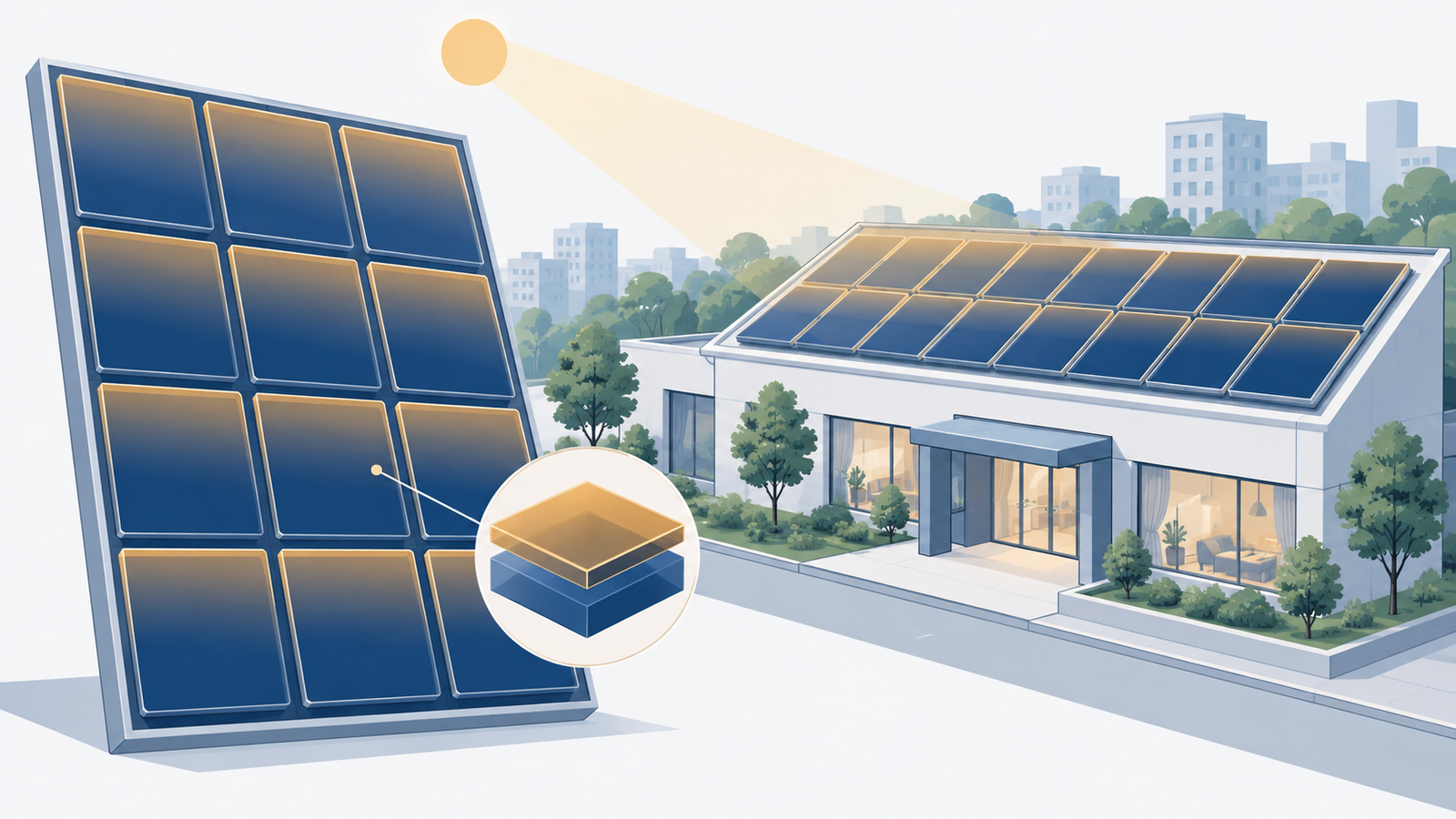
Trina Solar is one of China's major solar module makers. In perovskites it has built its record not on small research cells but on cells in the 210 mm production size and modules in the standard 3.1 m² size. In June 2026 one of those modules reached 907 W (29.2% full-area efficiency, company-reported as certified by TÜV SÜD), and in its 2026 interim report the company disclosed its first order and first shipment, to a high-end distributed-generation customer overseas. The budget for its "perovskite tandem" research project is disclosed at about CNY 913 million, making Trina one of the established makers whose scale of investment can actually be seen.
- Trina Solar in 30 seconds, and where it stands in perovskite solar cells
- The logo and how the name is written
- Where the company sits in the perovskite solar cell field
- Scale (the silicon business in brief)
- Resources committed to perovskites
- What it has done so far
- What comes next
- What the company is aiming for in perovskite solar cells
- Map of perovskite partnerships
- Technology, products and services
- The risks this company carries
- Glossary, references and claim-to-source audit
1. Trina Solar in 30 seconds, and where it stands in perovskite solar cells
688599A shares
(entering from silicon mass production)Not a perovskite specialist
with silicon210 mm cells, standard 3.1 m² modules
Companies working on perovskite solar cells fall into three broad types: established PV makers, perovskite start-ups, and materials and electronics firms coming in from other industries. Trina Solar is an established PV maker, but while its large peers LONGi and JinkoSolar mostly announce efficiency records on cells of about 1 cm², Trina publishes its numbers on cells in the 210 mm wafer size that runs on its production lines and on modules in the standard 3.1 m² size Sourced. Its 2026 interim report says the company has "completed the crucial leap from technological and product innovation to commercialisation", making Trina the first of the majors to disclose that it has actually sold tandems.
2. The logo and how the name is written

The logo is the company's trademark. Rather than recreate it with an image generator, this article uses the logo image in the header of the official website, saved as img/trina_solar_logo.png.
A note on names: the legal name is registered in Chinese, and the English name is Trina Solar Co., Ltd. The official website and press releases use the one-word brand Trinasolar. Japanese coverage usually writes the name phonetically; this article's headings use the English company name, Trina Solar.
Official site: https://www.trinasolar.com/en-glb/3. Where the company sits in the perovskite solar cell field
The product format is a two-terminal (monolithic) tandem with silicon: the annual report refers to "a world record for the power output of a large-area 2T (two-terminal) tandem module" Sourced. For the silicon bottom cell, the annual report draws a distinction: the record modules rest on a heterojunction (HJT) bottom cell, while processes and equipment for volume production are being developed around a TOPCon bottom cell. The company has not announced any plan to commercialise a film-type or glass-type single-junction product.
4. Scale (the silicon business in brief)
The solar business as a whole is not the subject of this article, so only its size is noted. Figures in CNY million Sourced.
| CNY million (years to December) | 2023 | 2024 | 2025 |
|---|---|---|---|
| Operating revenue | 113,473 | 80,314 | 66,975 |
| Net profit attributable to shareholders of the parent | 5,573 | −3,412 | −7,031 |
| R&D input (company definition, including pilot-scale costs) | – | – | 4,078 (6.32% of main business revenue) |
2023 and 2024 figures are the "restated" values in the 2025 annual report. Figures rounded to the nearest CNY million Our calculation.
| Item | Figure | As of |
|---|---|---|
| Employees (parent company and main subsidiaries) | 24,840 | End of December 2025 |
| R&D staff | 2,542 (10.23%) | End of December 2025. A year earlier: 2,928 |
| Module shipments | More than 67 GW | Full year 2025 |
| Operating revenue and net loss, first half of 2026 | CNY 31,985 million / CNY 270 million | The net loss narrowed by 90.75% year on year |
The figures above are for the company as a whole, almost all of which is silicon modules, energy storage and systems. No revenue or shipment figures for perovskite tandems have been disclosed Not yet confirmed. The project-level figures in the next section are the best measure of how seriously the company is pursuing perovskites.
5. Resources committed to perovskites
The table of "research projects in progress" in Trina Solar's annual report includes two items directly related to perovskites.
| Project (CNY) | Planned total investment | Spent in 2025 | Cumulative (end of 2025) | Spent in H1 2026 | Cumulative (end of June 2026) |
|---|---|---|---|---|---|
| Perovskite tandem | 913,487,500 | 121,454,934 | 627,930,613 | 135,376,912 | 763,307,525 |
| Bottom-cell technology for tandems | 1,403,678,000 | 113,218,664 | 414,093,339 | 60,671,795 | 474,765,135 |
Rounded to the nearest yuan. The "bottom-cell technology" project covers HJT and TOPCon bottom cells, not the perovskite layer itself.
Spending on the "perovskite tandem" project was about CNY 121 million for the whole of 2025, and about CNY 135 million in the first half of 2026 alone Our calculation. Six months exceeded the previous full year, so the pace of spending has roughly doubled. Cumulative spending has reached about 84% of the planned total. The two projects together took about CNY 235 million in 2025, about 5.8% of that year's R&D input of CNY 4,078 million. That is small next to the mainstay TOPCon and BC (THBC) work, but among the perovskite budgets that established makers disclose, it is on the large side.
| Type of resource | What it is | Category |
|---|---|---|
| People (organisation) | The State Key Laboratory of Photovoltaic Science and Technology sits at the core of its research set-up. The number of people dedicated to tandems is not disclosed. In releases the spokesperson is vice-president Dr Chen Yifeng | Sourced (headcount not disclosed) |
| Money (research) | The two projects above have a combined planned total investment of about CNY 2.32 billion, of which the perovskite tandem project accounts for about CNY 913 million | Sourced |
| Money (production line) | No location, capacity or investment has been disclosed for a tandem production line | Not confirmed |
| Intellectual property | 698 patent applications for tandem cells and modules (end of 2025), which the company describes as "number one in the world". The count was 331 in April 2025 | Sourced (the ranking is the company's claim) |
| Outside stakes and joint ventures | No investment in or joint venture with a perovskite company has been found in the disclosures | Not confirmed |
| Universities and research institutes | A 210 mm tandem cell co-developed with Huairou Laboratory in Beijing (December 2025). Cooperation on perovskites and other topics with Fudan University and Nanyang Technological University in Singapore (2025 annual report) | Sourced |
| Public funding | The 808 W release says the company has "led many national research projects in this field in cooperation with universities". Individual project names and amounts are not disclosed. In October 2025 it received a first prize in the 2024 Jiangsu Provincial Science and Technology Awards for "key technologies and applications of high-efficiency crystalline silicon and crystalline silicon-perovskite tandem cells and modules" | Sourced (amounts not disclosed) |
6. What it has done so far
What sets Trina's announcements apart is their large areas. The table separates cells (210 mm) from modules (1.52 m² and 3.1 m²).
| When | What happened | Area and certification |
|---|---|---|
| From about ten years ago | Research on perovskite tandems begins (the April 2025 release says "more than ten years") | Company-reported |
| 14 April 2025 | The world's first tandem module above 800 W in the standard 3.1 m² size (808 W), using 210 mm × 105 mm tandem cells | 3.1 m² / TÜV SÜD (company-reported) |
| 2025 | 27.2% on a 1.52 m² tandem module, which the company says was included in NREL's champion module efficiency chart | 1.52 m² / annual report (the company's statement) |
| October 2025 | First prize in the 2024 Jiangsu Provincial Science and Technology Awards for "key technologies and applications of high-efficiency crystalline silicon and crystalline silicon-perovskite tandem cells and modules" | Annual report |
| 24 December 2025 | 32.6% on a 210 mm half-cut tandem cell co-developed with Huairou Laboratory, and a module output of 865 W | Cell: Fraunhofer ISE CalLab / 3.1 m² module: TÜV SÜD (company-reported) |
| First half of 2026 | Module output of 886 W. 33.9% on a 210 mm large-area tandem cell, and 32.4% on a large-area tandem with a TOPCon bottom cell | Interim report (the company's statement; no measuring body named) |
| 9 June 2026 | 907 W and 29.2% full-area efficiency on a 3.1 m² tandem module, up about 100 W from 808 W in roughly a year | 3.1 m² / TÜV SÜD (company-reported) |
| First half of 2026 | First order from a high-end distributed-generation customer overseas, and first overseas shipment. The company says it has "closed the commercialisation loop" | Interim report. Volume and customer not disclosed |
In the "perovskite/silicon" series of NLR's (formerly NREL's) champion module efficiency chart, Trina's name appears as a past record holder Sourced. When this article checked, however, the holder of the latest record in that series (31.6%) was LONGi. The 907 W and 29.2% figures were company-reported as measured by TÜV SÜD, and they are efficiencies measured over the full area of a 3.1 m² module, the same size as a product. The cell efficiencies of about 35% that LONGi announces are for cells of about 1 cm², an area roughly 30,000 times smaller, so the two are not comparable Our calculation. The interim report also names no measuring body for 33.9%, 32.4% or 886 W, so this article treats them as the company's own statements.
7. What comes next
The June 2026 release says the company will "continue to increase investment in core perovskite tandem technologies" Sourced. At the same time, the industry overview in the interim report lists the challenges facing perovskite industrialisation as "heavy R&D investment with long cycles, insufficient stability and immature large-area manufacturing processes", and expects GW-scale demonstration in the middle to late part of the 15th Five-Year Plan (2026 to 2030), China's national planning period Not yet confirmed. A first order has come in, but it is clear that the company itself sees volume-scale commercialisation as several years away.
None of the following appears in the annual report, the interim report or the official releases Not yet confirmed.
The volume, value, customer and destination country of the first order; the location, capacity, investment and start date of a tandem production line; product model numbers and prices; IEC reliability test results for the 907 W module (reported in the press, but not found in the company's primary sources checked for this article); and long-term outdoor generation data.
8. What the company is aiming for in perovskite solar cells
This section goes beyond what the company says directly. It sets out inferences that can be drawn from primary sources, each with its basis.
| What can be read | Primary evidence behind it | Category |
|---|---|---|
| It aims to be the first major to bring tandems to market as a product | It keeps publishing records at production size (210 mm, 3.1 m²) and disclosed a first order and shipment in the first half of 2026. The annual report explicitly lists building a brand as "the leader in perovskite tandems" among its sales activities | Inference |
| The first market is distributed generation (rooftops), where higher prices can be accepted | The first customer is described as "high-end distributed". The same interim report positions THBC for the "premium monofacial rooftop market" | Inference |
| A two-track bottom cell: HJT for records, TOPCon for production | The annual report distinguishes between the HJT bottom cell behind the record modules and the TOPCon bottom cell being developed for volume production | Sourced (that the distinction is made) |
| It is securing first-mover status through research and patent volume | Tandem patent applications doubled from 331 to 698 in less than a year | Inference |
| Large-scale production is aimed at around 2030 | The interim report expects industry-wide GW-scale demonstration in the middle to late 15th Five-Year Plan | Inference |
The progress column for the "bottom-cell technology for tandems" project in the 2025 annual report says that "introducing a fine junction-treatment process into the HJT/perovskite bottom-cell technology supported the world record for the power output of a large-area 2T tandem module", and that "TOPCon bottom-cell technology is being developed systematically, from process to equipment, for volume production, with a best efficiency of 30% for large-area TOPCon tandems" Sourced (updated to 32.4% in the 2026 interim report). In other words, the bottom cell used to set records (HJT) is not the one the company wants to use in production (TOPCon). Trina's current mainstay product is TOPCon, and it owns a great deal of TOPCon capacity. This article reads the real aim as taking the records first with HJT while eventually making the existing TOPCon factories usable as the front end of tandem production Not yet confirmed. Whether efficiency on a TOPCon bottom cell can catch up with HJT is likely to decide when production goes ahead.
9. Map of perovskite partnerships
10. Technology, products and services
| Element | What the primary sources say |
|---|---|
| Product | A perovskite/crystalline silicon tandem module in the standard 3.1 m² size (210 mm cells). First order and shipment in the first half of 2026. Model number and price not disclosed |
| Structure | Two-terminal (monolithic). Bottom cells: HJT (record modules) and TOPCon (under development for volume production) |
| Perovskite layer | Better film uniformity, more advanced interface passivation and spectral matching of absorption within the tandem structure (907 W release). Bulk doping, interface engineering and composite-layer design (808 W release) |
| Bottom-cell side | A "fine junction treatment" and a "highly transparent electron transport layer" introduced on the HJT bottom cell (annual and interim reports) |
| Research set-up | The State Key Laboratory of Photovoltaic Science and Technology, with an approach of "one generation in research, one maturing, one in reserve" (annual report) |
A 3.1 m² module holds several dozen 210 mm tandem cells. Because the output of the whole module is dragged down by its weakest cell, the 907 W figure means the thickness and composition of the perovskite layer are uniform both within each wafer and from wafer to wafer. That is why the 907 W release puts "improved uniformity of the perovskite film" first Sourced.
The other obstacle is encapsulation. In a two-terminal tandem, the upper perovskite cell is vulnerable to moisture and heat, and it has to survive 25 to 30 years outdoors inside 3.1 m² of glass, encapsulant and frame. In the primary sources checked for this article, Trina has not shown reliability test results for the 907 W module Not yet confirmed. That the first order came from a limited, "high-end distributed" customer probably reflects a stage at which a product without a long track record is released first to customers who value what it adds. For the principles of encapsulation, see our explainer on encapsulation and barrier layers.
11. The risks this company carries
| Risk | Substance | Category |
|---|---|---|
| Losses in the core business | Net losses in 2024 and 2025 (CNY 7.03 billion in 2025). The loss narrowed to CNY 270 million in the first half of 2026 but remains a loss | Sourced |
| Fewer R&D staff | R&D staff fell from 2,928 to 2,542 (2025) | Sourced |
| Immature production processes | The company itself names insufficient stability and immature large-area manufacturing processes as industry challenges, and expects GW-scale demonstration in the middle to late 15th Five-Year Plan | Sourced |
| Unknown size of the first order | Volume, value and customer are undisclosed, so the reality of commercialisation cannot be assessed from outside | Not yet confirmed |
| Switching bottom cells | Unless the efficiency gap narrows between the HJT bottom cell behind the records and the TOPCon bottom cell it wants to use in production, the plan to make use of existing factories will not work | Inference |
| No long-term reliability record | No long-term outdoor generation data appears in the primary sources | Not yet confirmed |
12. Glossary
- Tandem solar cell
- Two cells that absorb different parts of the light spectrum, stacked on top of each other. Trina places perovskite on top of silicon.
- Two-terminal (2T)
- A structure in which the upper and lower cells are built as a single device with just one pair of electrodes. The currents of the two cells must be matched.
- Bottom cell
- The silicon cell at the bottom of a tandem. Trina is developing two types, HJT and TOPCon.
- Full-area efficiency
- Efficiency calculated over the whole area of a module, frame included. It is lower than a figure based on the cell area alone.
- 210 mm
- The side length of a silicon wafer, and one of today's standard sizes for large production cells.
- HJT
- Heterojunction. A cell combining crystalline and amorphous silicon. Its low-temperature processes suit tandems.
- TOPCon
- Tunnel oxide passivated contact. The N-type silicon cell that dominates volume production today.
- Research projects in progress
- Ongoing R&D projects that Chinese listed companies disclose in their reports, with each project's planned total investment and spending.
13. References
- Trina Solar Co., Ltd. Trina Solar Co., Ltd. 2025 Annual Report (in Chinese; disclosed on the Shanghai Stock Exchange, 30 April 2026). Corporate information, operating revenue, net profit and R&D input, employees and R&D staff, budget and spending for the research projects (perovskite tandem, bottom-cell technology), 32.6%, 27.2% on 1.52 m², 865 W and 886 W, 698 tandem patents, research partners and the Jiangsu Provincial Science and Technology Award. http://static.cninfo.com.cn/finalpage/2026-04-30/1225263857.PDF
- Trina Solar Co., Ltd. Trina Solar Co., Ltd. 2026 Interim Report (in Chinese; disclosed on the Shanghai Stock Exchange, 7 August 2026). First-half 2026 results, 33.9% on a 210 mm tandem cell, 907 W and 29.2%, the first order and first overseas shipment, updated research project figures, 32.4% on a large-area tandem with a TOPCon bottom cell, and industry challenges and the outlook for GW-scale demonstration. http://static.cninfo.com.cn/finalpage/2026-08-07/1225462504.PDF
- Trinasolar Press release, "Trinasolar achieves 907W power output for its tandem modules, setting a new world record" (9 June 2026). 907 W and 29.2% full-area efficiency (TÜV SÜD), technical elements, progress from 808 W, and the commitment to keep investing. https://www.trinasolar.com/en-glb/newsroom202606091645/
- Trinasolar Press release, "Trinasolar sets new tandem cell efficiency and module power output records" (24 December 2025). 32.6% on a 210 mm half-cut tandem cell co-developed with Huairou Laboratory (Fraunhofer ISE CalLab), 865 W on a 3.1 m² module (TÜV SÜD), and comments from vice-president Chen Yifeng. https://www.trinasolar.com/en-glb/newsroom202512240228/
- Trinasolar Press release, "Trinasolar Develops World's First 800W+ Tandem Module, Ushering in a New Era" (14 April 2025). 808 W on 3.1 m² (TÜV SÜD), 210 mm × 105 mm cells, more than ten years of research, leadership of national research projects, and 331 tandem patents. https://www.trinasolar.com/us/resources/newsroom/Worlds-First-800W-Tandem-Module/
- NLR (U.S. national laboratory, formerly NREL) Champion Module Efficiencies chart. Trina as a past record holder in the perovskite/silicon series, and LONGi as holder of the latest record of 31.6%. https://www.nlr.gov/docs/libraries/pv/champion-module-chart.pdf
- Trinasolar Official website (source of the company name style and the logo image). https://www.trinasolar.com/en-glb/
14. Claim-to-source audit
| Claim in the article | Category | Source |
|---|---|---|
| Legal name, registered address, STAR Market code 688599 | Sourced | Reference 1 http://static.cninfo.com.cn/finalpage/2026-04-30/1225263857.PDF |
| Founded in 1997; first-half 2026 results and the narrower loss | Sourced | Reference 2 http://static.cninfo.com.cn/finalpage/2026-08-07/1225462504.PDF |
| Operating revenue and net profit (2023 to 2025), R&D input of CNY 4,078 million (6.32%), 24,840 employees, 2,542 R&D staff (2,928 a year earlier), shipments above 67 GW | Sourced | Reference 1 http://static.cninfo.com.cn/finalpage/2026-04-30/1225263857.PDF |
| Budgets and spending (2025) for the "perovskite tandem" and "bottom-cell technology for tandems" research projects | Sourced | Reference 1 http://static.cninfo.com.cn/finalpage/2026-04-30/1225263857.PDF |
| First-half 2026 spending and cumulative totals for the same two projects | Sourced | Reference 2 http://static.cninfo.com.cn/finalpage/2026-08-07/1225462504.PDF |
| Spending pace roughly doubled, cumulative spending at about 84% of the planned total, and about 5.8% of R&D input | Our calculation | Our own division of the figures in references 1 and 2 |
| The 2T structure; the HJT bottom cell behind the record modules and the TOPCon bottom cell developed for production (30% on a large area) | Sourced | Reference 1 http://static.cninfo.com.cn/finalpage/2026-04-30/1225263857.PDF |
| 33.9% on a 210 mm large-area tandem cell, 32.4% on a large-area tandem with a TOPCon bottom cell, 886 W, the first order and first overseas shipment, and industry challenges and the GW-scale demonstration outlook | Sourced | Reference 2 http://static.cninfo.com.cn/finalpage/2026-08-07/1225462504.PDF |
| 27.2% on 1.52 m² and the statement that it was included in NREL's chart, 698 tandem patents, the State Key Laboratory, cooperation with Fudan University and Nanyang Technological University, and the first prize in the Jiangsu Provincial Science and Technology Awards | Sourced | Reference 1 http://static.cninfo.com.cn/finalpage/2026-04-30/1225263857.PDF |
| 907 W and 29.2% full-area efficiency (TÜV SÜD), technical elements, progress from 808 W, and the commitment to keep investing | Sourced | Reference 3 https://www.trinasolar.com/en-glb/newsroom202606091645/ |
| 32.6% (Fraunhofer ISE CalLab) from co-development with Huairou Laboratory, and 865 W (TÜV SÜD) | Sourced | Reference 4 https://www.trinasolar.com/en-glb/newsroom202512240228/ |
| 808 W (TÜV SÜD), more than ten years of research, leadership of national research projects, and 331 patents | Sourced | Reference 5 https://www.trinasolar.com/us/resources/newsroom/Worlds-First-800W-Tandem-Module/ |
| Trina appears in the perovskite/silicon series of NLR's chart, and the holder of the latest 31.6% record is LONGi | Sourced | Reference 6 https://www.nlr.gov/docs/libraries/pv/champion-module-chart.pdf |
| The three types of perovskite solar cell company | Our calculation | Our own classification. Companies shown are examples from those covered in this series |
| The area of 3.1 m² is about 30,000 times that of about 1 cm² | Our calculation | Our own rough calculation: 31,000 cm² ÷ 1 cm² |
| Volume, value and customer of the first order, the location, capacity and investment of a production line, product model numbers and prices, IEC test results for the 907 W module, and long-term outdoor data | Not yet confirmed | Not in references 1 to 5. Press reports are not used http://static.cninfo.com.cn/finalpage/2026-08-07/1225462504.PDF |
| The measuring body for 33.9%, 32.4% and 886 W | Not yet confirmed | Not in reference 2. Treated as the company's own statements http://static.cninfo.com.cn/finalpage/2026-08-07/1225462504.PDF |
| The reading that it aims to be the first major to bring tandems to market as a product | Inference | This article's interpretation of how references 1 to 3 are built |
| The reading that the first market is distributed generation, where higher prices are accepted | Inference | This article's interpretation of the customer category in reference 2 and the positioning of THBC |
| The reading that it is securing first-mover status through patent volume | Inference | This article's interpretation of the patent counts in references 1 and 5 |
| The reading that large-scale production is aimed at around 2030 | Inference | This article's interpretation of the industry outlook in reference 2 |
| The reading that the real aim is to use existing TOPCon factories as the front end of tandem production, and the risk in switching bottom cells | Inference | This article's interpretation of the distinction between bottom cells in reference 1 |
Last updated 25 September 2026 / Troy Technical
Every figure in this article comes from statutory filings Trina Solar has made with the Shanghai Stock Exchange, the company's official press releases and material published by NLR (formerly NREL). No research-firm estimates or press-based figures have been used. Passages marked "Inference" are this article's interpretation of primary sources, not statements made by the company.