COMPANY PROFILE / OPTICAL COMMUNICATIONS & PHOTONICS
Broadcom
A company that owns both the switch chip and the laser fab, now three generations into CPO
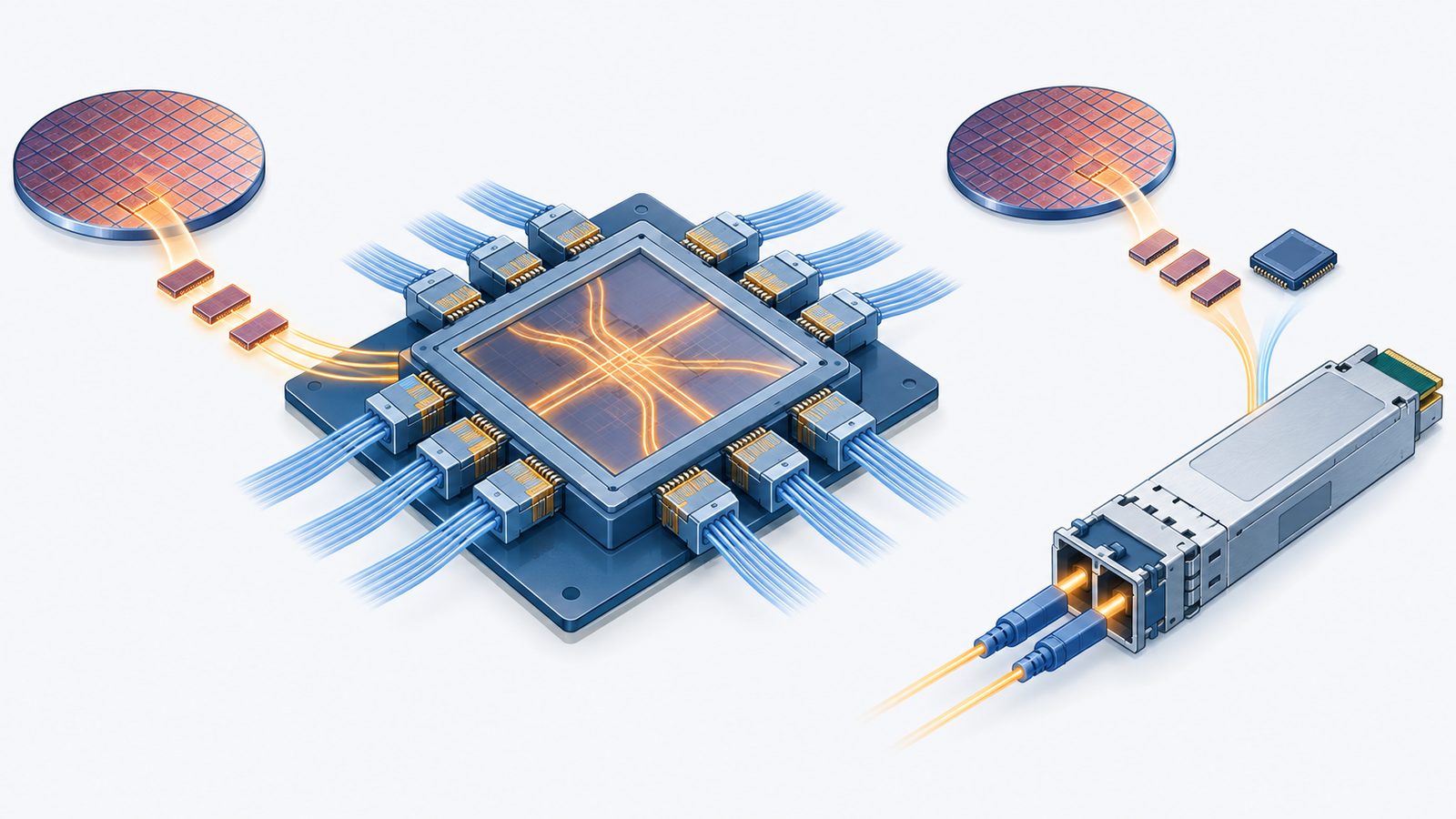
Broadcom is a chip company known for custom AI silicon and Ethernet switches, but in optical communications its name comes up as the company that has been shipping successive generations of CPO (co-packaged optics) since 2021. In October 2025 it announced its third generation, Tomahawk 6 – Davisson (102.4 Tb/s). Its other face is that of an optical component maker that builds lasers in its own fabs. Its annual report to the U.S. SEC names its own plant in Pennsylvania as the sole source of the InP (indium phosphide) wafers used in its fibre optics products. This profile keeps the company-wide figures, which include the software business, to a minimum and sets out what Broadcom has done in three areas: CPO, optical DSPs and lasers, using only the company's official releases and SEC filings.
- Broadcom in 30 seconds, and where it stands in optical communications and photonics
- The logo and how the name is written
- Where the company sits in optical communications and photonics
- Scale (in brief, since it includes the software business)
- Resources committed to optical communications and photonics
- Track record so far
- Plans ahead
- What the company is aiming for in optical communications and photonics
- Partnership map
- Technologies, products and services
- The risks this company carries
- Glossary, references and claim-to-source audit
1. Broadcom in 30 seconds, and where it stands in optical communications and photonics
California, U.S.3421 Hillview Ave
(with its own laser fabs)Its optical activity centres on optical interconnect inside the data centre
TH6-Davisson102.4 Tb/s, 200 Gb/s per channel. Announced October 2025
TH4-HumboldtThe company describes the second generation, TH5-Bailly, as the industry's first high-volume CPO
Pennsylvania, U.S.Sole source of InP wafers for its fibre optics products
(400 Gb/s per channel)Disclosed as in development in October 2025. Timing not disclosed
Companies involved in optical communications fall into three broad types: optical components & modules, chips & foundries, and network systems & carriers. Broadcom is a chip company, but unusually for this field it also has a foot in optical components Sourced. According to the 10-K, it outsources most of its manufacturing yet builds VCSELs (vertical-cavity surface-emitting lasers) and GaAs- and InP-based edge-emitting lasers for fibre optic communications in its own fabs. It therefore holds in one company the key components needed for both CPO and pluggable optical modules: the switch chip (Tomahawk), the DSPs that process optical signals, the optical engines and the lasers themselves. That is the decisive difference from NVIDIA, a fellow chip company that buys its lasers from outside.
2. The logo and how the name is written

The Broadcom logo is a trademark of the company. We have not recreated it with generated imagery;
the image is the logo used on Broadcom's official website, placed here as img/broadcom_logo.svg.
A note on names: the name in the statutory filings is Broadcom Inc. Its CPO product names combine the switch chip and the optical engine: Tomahawk 6 – Davisson, for example, pairs the Tomahawk 6 switch chip with the Davisson optical engine. The company itself abbreviates these as "TH6-Davisson" and "TH5-Bailly", and this article does the same.
Official site: https://www.broadcom.com/3. Where the company sits in optical communications and photonics
In terms of which part of optics it touches, the centre of gravity is optical interconnect inside the data centre Sourced. The 10-K, however, lists applications for its optical components that go beyond Ethernet networking, storage and access networks to include metro and long-haul networks, and the company also sells fibre optic components and optocouplers for industrial use. This article concentrates on the data centre side (CPO, optical DSPs and lasers), where the primary sources give concrete products and figures.
4. Scale (in brief, since it includes the software business)
Besides semiconductors, Broadcom owns software businesses such as VMware, so its company-wide figures are far removed from the scale of its optics activity. We note only its size Sourced.
| Measure (US$ million) | FY2024 | FY2025 |
|---|---|---|
| Revenue (company-wide) | 51,574 | 63,887 |
| of which semiconductor solutions | 30,096 | 36,858 |
| of which infrastructure software | 21,478 | 27,029 |
| R&D expense (company-wide) | 9,310 | 10,977 |
The fiscal year ends on the Sunday closest to 31 October (FY2025 ran to 2 November 2025). "FY2025" in the table refers to that year.
As of 2 November 2025 the company had about 33,000 employees, about 57% of them in research and development, and held about 19,000 patents Sourced. The 10-K attributes the growth in semiconductor revenue to "strong demand for our networking solutions, primarily custom AI accelerators and AI networking products".
The figures above are for the whole company and whole segments. Broadcom does not break out revenue for optical components, CPO or optical DSPs Not yet confirmed. The semiconductor solutions segment includes custom AI chips, Ethernet switches, wireless components, broadband, industrial products and more. Figures of the "Broadcom's optics business is worth US$X billion" kind come from research-firm estimates or press reports, and this article does not use them.
5. Resources committed to optical communications and photonics
Amounts and headcounts are not disclosed, but what the company has to work with can be read quite concretely from the 10-K and official releases.
| Resource | Details | Status |
|---|---|---|
| People (dedicated teams and staff) | Optical products are handled by the Optical Systems Division (from the job titles of spokespeople in releases). Headcount is not disclosed. Company-wide, about 57% of some 33,000 employees work in R&D | Organisation confirmed; headcount not disclosed |
| Money (R&D and facilities) | Company-wide R&D expense was US$10.977 billion in FY2025. Optics-related R&D and capital spending are not disclosed | Not disclosed |
| Own optical fab | The plant in Breinigsville, Pennsylvania, is the sole source of InP-based wafers for its fibre optics products. Most in-house III-V (compound semiconductor) wafer production takes place in the United States and Singapore. VCSELs and GaAs- and InP-based lasers are made in its own fabs; standard CMOS is outsourced | Confirmed |
| Equity investments and acquisitions | No optics-related investments or acquisitions were found in the primary sources reviewed for this article | Could not be confirmed |
| Manufacturing and product partners | TSMC (COUPE technology for the Davisson optical engine), Corning (fibre and connectors), Foxconn Interconnect Technology (CPO sockets and parts for the detachable laser source), Twinstar (fibre cables for CPO) and others | Confirmed |
| Customer and evaluation partners | Tencent (co-developed a CPO switch in 2022), Meta (CPO reliability testing), and Micas Networks, Delta Electronics, Celestica, HPE and Nexthop AI (building CPO switches into systems) | Confirmed |
| Standards work | Announced in March 2026 that it had co-founded the OCI MSA (Optical Compute Interconnect Multi-Source Agreement) with other companies | Confirmed |
| Universities, research institutes, public funding | The 10-K and releases say nothing about optics-related joint research with universities or awards of public funding such as the CHIPS Act | Could not be confirmed |
In the risk factors of the 10-K, the Breinigsville plant is named as the sole source of the InP-based wafers used in its fibre optics products Sourced. InP (indium phosphide) is the compound semiconductor used to make lasers at the wavelengths used in fibre optic communications, and unlike silicon it cannot be produced in volume on large-diameter wafers. From crystal growth and the stacking of epitaxial layers to facet processing and passivation coatings, this is a field in which the materials and process know-how stays locked inside the fab.
Broadcom outsources standard CMOS but has kept this one part in house. The 10-K explains that doing so lets it "protect our IP and accelerate time to market for our products". The flip side is that a problem at this single plant could halt the supply of lasers for its fibre optics products, and the company itself lists that as a risk. From the materials side, the picture is one in which having only one fab that can make these wafers is at once a strength and the greatest weakness Not yet confirmed.
6. Track record so far
| When | What happened | What it means |
|---|---|---|
| 2021 | Launches its first-generation CPO, TH4-Humboldt (as described in the May 2025 release), introducing high-density optical engines, edge coupling and detachable fibre connectors | Starts running fast learning cycles across the whole CPO supply chain |
| 22 August 2022 | Strategic partnership with Tencent. Supplies the 25.6 Tb/s Humboldt (Tomahawk 4 plus four 3.2 Tb/s optical engines); Ruijie Networks builds and tests the switches and delivers them to Tencent. Uses uncooled 1310 nm CW lasers | A major Chinese cloud provider becomes the first partner for real-world deployment |
| 14 March 2024 | Second generation, TH5-Bailly (51.2 Tb/s), ships to customers, with eight 6.4 Tb/s optical engines. The company claims a 70% cut in optical interconnect power and eight times better silicon area efficiency | Capacity doubles and the volume manufacturing process is refined |
| 15 May 2025 | Announces a third-generation (200 Gb/s per channel) CPO product line. Positions Bailly as the industry's first high-volume CPO and commits to a fourth generation (400 Gb/s). Corning, Delta, Foxconn Interconnect, Micas and Twinstar announce volume production or shipment milestones | Shows that the component and equipment supply chain is falling into place |
| 1 October 2025 | Announces that testing at Meta reached one million cumulative 400G-equivalent port hours with zero link flaps, and a 65% cut in optical power compared with pluggables | Answers the biggest question, "does it break?", with customer-side data |
| 8 October 2025 | Announces the third-generation TH6-Davisson (102.4 Tb/s): sixteen 6.4 Tb/s optical engines made with TSMC's COUPE, and lasers in replaceable ELSFP modules. Discloses that a fourth generation (400 Gb/s) is in development | Draws level with the largest CPO capacities on offer |
| 12 March 2026 | Ahead of OFC 2026, announces the Taurus 400 Gb/s-per-lane optical DSP and 400G EMLs and photodetectors. Also shows 200G VCSELs, EMLs and CW lasers and a 3.2T VCSEL-based NPO. Co-founds the OCI MSA with other companies | Moves parts for pluggables, not just CPO, to the next speed grade |
7. Plans ahead
scale-upThe product page says CPO will also be offered for links between XPUs (AI chips)
The May 2025 release describes the third-generation CPO as aimed at scale-up beyond 512 nodes, where copper-like reliability and power efficiency are required Sourced. In other words, the company has in its sights replacing with optics even the domain where GPUs and AI chips are now linked to each other by copper cables (scale-up).
None of the following appears in the primary sources reviewed for this article Not yet confirmed.
CPO unit shipments, revenue and prices / when volume shipments of TH6-Davisson begin (the October 2025 release says "shipping" in its headline but says in the body that samples are shipping to early-access customers) / availability of the fourth-generation CPO and of 3.2T optical modules / whether Meta or other test sites have actually deployed at scale / optics-related capital spending. The March 2024 release states that pluggable optical modules account for about 50% of switch system power and more than 50% of cost, but in the same release a research-firm analyst gives an outlook along the same lines, and since we cannot tell whether the figure is the company's own measurement or a market estimate, this article does not use it.
8. What the company is aiming for in optical communications and photonics
This section includes things the company does not say directly. We set them out as inferences within what the primary sources support, with the evidence for each.
| What the evidence suggests | Primary information it rests on | Category |
|---|---|---|
| It aims to win in both CPO and pluggables | It releases a CPO switch every generation, yet in March 2026 announced 400G-per-lane DSPs and EMLs for pluggable optical modules. The TH6-Davisson announcement also spells out interoperability with DR-type transceivers and LPO | Inference |
| It wants CPO to be an "open" technology that several companies can build | The founding of the OCI MSA, the explicit claim of IEEE 802.3 compliance, and announcements structured to showcase an outside supply chain of TSMC, Corning, Foxconn Interconnect and others | Inference |
| The next battleground is moving scale-up (links between AI chips) to optics | It describes the third generation as aimed at scale-up beyond 512 nodes, and its product page promotes "CPO for XPUs" | Sourced |
| It will keep making lasers in house | The 10-K explains that it makes lasers in its own fabs to protect its IP and speed time to market. It also announced its 400G EML as a first for the company | Inference |
| It sees proving reliability as the key to CPO adoption | In October 2025 it issued the Meta test results (zero link flaps) as a standalone release, and the TH6-Davisson announcement also lists link stability among the main benefits | Inference |
In its March 2026 release for OFC, what Broadcom gave top billing to was not CPO but the Taurus 400G-per-lane optical DSP and 400G EMLs, both for pluggable optical modules Sourced. The release says these will let module makers build low-power 1.6T optical modules and pave the way to 3.2T. If CPO spreads, pluggable modules ought to decline, so it looks contradictory for CPO's standard-bearer to strengthen its pluggable parts. We read it as a two-pronged strategy designed so that whichever approach becomes mainstream, revenue comes in from the switch chip, the DSP or the laser Not yet confirmed. It is a strategy open only to a company that makes its own lasers, but the company itself has not explained any such intention, so this remains our interpretation.
9. Partnership map
10. Technologies, products and services
| Product or technology | Published specifications | Stage |
|---|---|---|
| TH6-Davisson (BCM78919) | 102.4 Tb/s. Sixteen 6.4 Tb/s DR-type optical engines. 200 Gb/s per link. Replaceable ELSFP laser modules. Supports 512 XPUs in scale-up and more than 100,000 XPUs in a two-tier network. Claims IEEE 802.3 compliance | Sampling to early-access customers (as of October 2025) |
| TH5-Bailly | 51.2 Tb/s. Eight 6.4 Tb/s optical engines. 128 ports of 400G FR4. Uses the Broadcom Fiber Connector (BFC) and supports several field-replaceable remote laser modules | Described by the company as the industry's first high-volume CPO |
| TH4-Humboldt | 25.6 Tb/s. Four 3.2 Tb/s optical engines. Uncooled 1310 nm CW lasers | First generation (from 2021) |
| Taurus (optical DSP) | Optical DSP at 400 Gb/s per lane. Combined with 400G EMLs and photodetectors, it enables 1.6T optical modules and lays the groundwork for 3.2T | Unveiled in March 2026 |
| Lasers and photodetectors | 200G-per-lane VCSELs, EMLs and CW lasers; 400G EMLs. VCSELs and GaAs- and InP-based lasers are made in its own fabs | Offered as a product family (shipment status of individual parts not disclosed) |
| VCSEL-based NPO | 3.2T near-packaged optics (optical parts placed close to the chip) | Shown in March 2026 |
| Fibre optic components (conventional) | Optical components for Ethernet, storage, access networks, and metro and long-haul communications. Fibre optic components and optocouplers for industrial use | On sale (revenue not disclosed) |
On the power savings of CPO, Broadcom gives different figures in different documents: a 70% cut in optical interconnect power, or more than 3.5 times lower than pluggables (March 2024 and October 2025), and a 65% cut compared with pluggables in the Meta test data (October 2025) Sourced. The CPO overview page also claims a 40% reduction in optical cost per bit and bandwidth density above 1 Tb/s per millimetre, without stating the conditions of comparison. "Industry first" and "industry only" are likewise the company's own phrases. IEEE 802.3 compliance is a claim the company makes in the TH6-Davisson release; this article has not confirmed any certification by a standards body Not yet confirmed.
Broadcom has used edge coupling and detachable fibre connectors since its first generation, and with Bailly in 2024 it cited highly automated, high-density edge-coupled fibre attachment as the key to volume production Sourced. Edge coupling brings light from the fibre into the side (the facet) of the photonic chip. It makes low coupling loss easier to achieve, but facet polishing and protection, and the placement accuracy and long-term stability of the adhesive holding the fibre, become critical. NVIDIA, by contrast, explains in its technical blog that Spectrum-X Ethernet Photonics uses surface-normal I/O, bringing light in and out through the top surface of the chip (reference 11).
Either way, aligning the fibre with the silicon waveguide demands sub-micrometre accuracy, and whenever the adhesive expands and contracts through temperature cycles, light leaks out accordingly. "Zero link flaps" gets top billing in CPO reliability testing because optical connections are more sensitive than electrical ones to materials changing over time Not yet confirmed.
11. The risks this company carries
| Risk | Details | Category |
|---|---|---|
| A single laser fab | The 10-K and the 2026 10-Q both list as a risk that the Breinigsville plant is the sole source of InP-based wafers for its fibre optics products | Sourced |
| Most manufacturing outsourced | The 10-K describes "a primarily outsourced manufacturing business model". The Davisson optical engine also depends on TSMC technology | Sourced |
| Customer concentration | One customer accounted for 32% of revenue in FY2025, and the top five for about 40%. No breakdown for optical products alone is disclosed | Sourced |
| Hard-to-read shipment status | The TH6-Davisson release says "shipping" in its headline but "sampling" in the body, making it hard to judge the production stage from outside | Sourced |
| Whether CPO becomes mainstream is not settled | The company is itself strengthening its parts for pluggables, and even its own materials do not indicate whether CPO or pluggables will prevail | Inference |
| Competition | NVIDIA has also taken CPO switches into volume production, and names Broadcom as a networking competitor in its 10-K. Broadcom's 10-K does not name its competitors | Sourced |
12. Glossary
- CPO (co-packaged optics)
- Placing the optical transmit and receive functions in the same package as the switch chip, shortening the electrical path to save power.
- Optical DSP
- The digital signal processing chip inside an optical module that cleans up distorted signals. It draws a lot of power.
- EML
- Electro-absorption modulated laser. Combines a laser and a modulator on one chip to switch light on and off at high speed.
- VCSEL
- Vertical-cavity surface-emitting laser. Emits light perpendicular to the substrate. Inexpensive, and used with short-reach multimode fibre.
- InP (indium phosphide)
- The compound semiconductor used to make lasers at the wavelengths of fibre optic communications.
- Edge coupling
- Bringing light from an optical fibre into the side of a photonic chip.
- Link flap
- A connection dropping momentarily and then re-establishing itself. It can halt AI training runs.
- NPO (near-packaged optics)
- Placing optical parts on the board right next to the chip, rather than inside the same package.
- MSA
- Multi-Source Agreement. A common specification agreed by several companies so that they can build interchangeable products.
- Scale-up
- Linking AI chips tightly enough that they behave like one large computer. Today this mostly uses copper wiring.
13. References
- Broadcom Inc. Form 10-K for the fiscal year ended November 2, 2025 (filed with the U.S. SEC on 18 December 2025). Headquarters and history, business description (optical components, PHYs, AI products), own fabs (Breinigsville, Fort Collins, Singapore) and in-house laser production, revenue by segment, R&D expense, headcount, patent count, customer concentration and competition. https://www.sec.gov/Archives/edgar/data/1730168/000173016825000121/avgo-20251102.htm
- Broadcom Inc. Form 10-Q for the quarterly period ended August 2, 2026 (filed with the U.S. SEC on 10 September 2026). The risk disclosure that the Breinigsville plant is the sole source of InP wafers (still present in 2026) and the reasons for semiconductor segment growth. https://www.sec.gov/Archives/edgar/data/1730168/000173016826000080/avgo-20260802.htm
- Broadcom Inc. Press release, "Broadcom and Tencent Partner to Accelerate Commercialization of Co-Packaged Optics Network Switch" (22 August 2022). The Tencent partnership, the 25.6 Tb/s Humboldt, the role of Ruijie Networks and uncooled 1310 nm CW lasers. https://www.broadcom.com/company/news/product-releases/60461
- Broadcom Inc. Press release, "Broadcom Delivers Industry's First 51.2-Tbps Co-Packaged Optics Ethernet Switch Platform for Scalable AI Systems" (14 March 2024). Bailly shipments, eight optical engines, claimed 70% power cut and eightfold area efficiency, edge-coupled fibre attachment and product specifications. https://www.broadcom.com/company/news/product-releases/61946
- Broadcom Inc. Press release, "Broadcom Announces Third-Generation Co-Packaged Optics (CPO) Technology with 200G/lane Capability" (15 May 2025). History from the first to the third generation, the commitment to a fourth generation, partner milestones and the scale-up positioning. https://www.broadcom.com/company/news/product-releases/63126
- Broadcom Inc. Press release, "Broadcom Showcases Industry-Leading Quality and Reliability of Co-Packaged Optics" (1 October 2025). Testing at Meta (one million cumulative 400G-equivalent port hours with zero link flaps) and a 65% cut in optical power. https://www.broadcom.com/company/news/product-releases/63616
- Broadcom Inc. Press release, "Broadcom Announces Tomahawk® 6 – Davisson, the Industry's First 102.4-Tbps Ethernet Switch with Co-Packaged Optics" (8 October 2025). TH6-Davisson specifications, TSMC's COUPE, ELSFP, the claim of IEEE 802.3 compliance, sampling, fourth-generation development and partner comments. https://www.broadcom.com/company/news/product-releases/63626
- Broadcom Inc. Press release, "Broadcom Showcases Industry-Leading Solutions for Scaling AI Infrastructure at OFC 2026" (12 March 2026). The Taurus 400G-per-lane optical DSP, 400G EMLs and photodetectors, 200G VCSELs, EMLs and CW lasers, the 3.2T VCSEL NPO, the founding of the OCI MSA and the roadmap to 200T. https://www.broadcom.com/company/news/product-releases/64036
- Broadcom Inc. CPO overview page, "Here. Now. Leading the future of Co-Packaged Optics (CPO)" (accessed September 2026). Claimed benefits of CPO (more than 3.5x lower power, 40% lower cost per bit, bandwidth density above 1 Tb/s/mm) and CPO for switches and for XPUs. https://www.broadcom.com/info/optics/cpo
- Broadcom Inc. Official website (source of the company name style and the logo image). https://www.broadcom.com/
- NVIDIA Corporation Technical blog, "Scaling Power-Efficient AI Factories with NVIDIA Spectrum-X Ethernet Photonics" (6 January 2026). Consulted for comparison: the optical I/O approach of NVIDIA's CPO (surface-normal I/O). https://developer.nvidia.com/blog/scaling-power-efficient-ai-factories-with-nvidia-spectrum-x-ethernet-photonics/
- NVIDIA Corporation Form 10-K for the fiscal year ended January 25, 2026 (filed with the U.S. SEC on 25 February 2026). Consulted for comparison: NVIDIA's naming of Broadcom as a networking competitor. https://www.sec.gov/Archives/edgar/data/1045810/000104581026000021/nvda-20260125.htm
14. Claim-to-source audit
| Claim in the article | Category | Source |
|---|---|---|
| Legal name, headquarters address, history, fiscal year | Sourced | Reference 1 https://www.sec.gov/Archives/edgar/data/1730168/000173016825000121/avgo-20251102.htm |
| Revenue, segment revenue and R&D expense (FY2024 and FY2025); about 33,000 employees with about 57% in R&D; about 19,000 patents | Sourced | Reference 1 https://www.sec.gov/Archives/edgar/data/1730168/000173016825000121/avgo-20251102.htm |
| Applications of its optical components (Ethernet, storage, access, metro, long-haul) and industrial fibre optic components | Sourced | Reference 1 https://www.sec.gov/Archives/edgar/data/1730168/000173016825000121/avgo-20251102.htm |
| In-house production of VCSELs and GaAs- and InP-based lasers, III-V wafer production sites, Breinigsville as sole source | Sourced | References 1 and 2 https://www.sec.gov/Archives/edgar/data/1730168/000173016826000080/avgo-20260802.htm |
| Customer concentration (one customer 32%, top five about 40%) | Sourced | Reference 1 https://www.sec.gov/Archives/edgar/data/1730168/000173016825000121/avgo-20251102.htm |
| Tencent partnership (2022), Humboldt specifications, Ruijie's role | Sourced | Reference 3 https://www.broadcom.com/company/news/product-releases/60461 |
| Bailly shipments (March 2024), specifications, claimed 70% power cut and eightfold area efficiency, edge coupling | Sourced | Reference 4 https://www.broadcom.com/company/news/product-releases/61946 |
| History since the first generation (2021), the company's description of Bailly as the industry's first high-volume CPO, the aim of the third generation, partner milestones | Sourced | Reference 5 https://www.broadcom.com/company/news/product-releases/63126 |
| Test results at Meta (zero link flaps) and the 65% cut | Sourced | Reference 6 https://www.broadcom.com/company/news/product-releases/63616 |
| TH6-Davisson specifications, TSMC's COUPE, sampling, fourth-generation development, the claim of IEEE 802.3 compliance, partners | Sourced | Reference 7 https://www.broadcom.com/company/news/product-releases/63626 |
| Taurus, 400G EMLs and photodetectors, the 200G laser family, NPO, founding of the OCI MSA, roadmap to 200T | Sourced | Reference 8 https://www.broadcom.com/company/news/product-releases/64036 |
| Claimed benefits on the CPO overview page, CPO for XPUs | Sourced | Reference 9 https://www.broadcom.com/info/optics/cpo |
| The three types of optical communications company (optical components & modules / chips & foundries / network systems & carriers) | Our calculation | Our own classification. Example companies drawn from those covered in this series |
| Revenue from optical components, CPO and optical DSPs; optics-related R&D, capital spending and headcount | Not yet confirmed | None of these is disclosed. This article does not estimate them either https://www.sec.gov/Archives/edgar/data/1730168/000173016825000121/avgo-20251102.htm |
| Start of TH6-Davisson volume shipments, availability of the fourth generation and 3.2T, whether Meta has deployed at scale | Not yet confirmed | Not stated in references 3 to 9. Press-based information is not used https://www.broadcom.com/company/news/product-releases/63626 |
| The statement that pluggables account for about 50% of switch power and more than 50% of cost | Not yet confirmed | Appears in reference 4, but cannot be distinguished from a research firm's outlook, so this article does not use it https://www.broadcom.com/company/news/product-releases/61946 |
| Optics-related investments and acquisitions, joint research with universities, public funding | Not yet confirmed | Not stated in references 1 to 9. This article does not conclude that they do not exist either https://www.sec.gov/Archives/edgar/data/1730168/000173016825000121/avgo-20251102.htm |
| The reading of a two-pronged strategy to win in both CPO and pluggables | Inference | This article's interpretation of the product line-up in references 7 and 8. The company has not explained its intention |
| The reading that it wants CPO to be an open technology several companies can build | Inference | This article's interpretation of the OCI MSA, standards compliance and supply chain statements in references 7 and 8 |
| The reading that it will keep making lasers in house | Inference | This article's interpretation of the reasons for in-house production in reference 1 and the 400G EML in reference 8 |
| The reading that it sees proving reliability as the key to adoption | Inference | This article's interpretation of how the announcements in references 6 and 7 are structured |
| The reading that the InP fab is both a strength and a weakness; the explanation that optical connections are sensitive to materials changing over time | Inference | This article's commentary based on the statements in references 1, 2 and 4 |
| NVIDIA names Broadcom as a competitor; NVIDIA's CPO brings light in and out through the chip surface | Sourced | References 11 and 12 https://www.sec.gov/Archives/edgar/data/1045810/000104581026000021/nvda-20260125.htm |
Last updated 26 September 2026 / Troy Technical
Every figure in this article comes from the statutory filings Broadcom Inc. has made with the U.S. Securities and Exchange Commission (SEC) and from the company's official press releases and product pages. No research-firm estimates or press-based figures have been used. Performance figures are the company's claims and have not been independently verified. Passages marked "Inference" are this article's interpretation of the primary sources, not statements made by the company.