COMPANY PROFILE / OPTICAL COMMUNICATIONS & PHOTONICS
Hesai Group
Packing lasers and detectors into its own chips to mass-produce LiDAR at 1.6 million units a year
Hesai is a Chinese company that develops and manufactures LiDAR, sensors that measure the distance to their surroundings with laser light. It is not an optical communications company, but because it integrates semiconductor lasers (VCSELs), photodetectors and the circuits that drive them into chips of its own design, it is one of the leading examples of photonics in high-volume use. In 2025 it shipped about 1.62 million LiDAR units (about 3.2 times the year before), and revenue of CNY 3,027.6 million (Chinese yuan) brought its first full-year profit. At the same time, it has been placed on the U.S. Department of Defense's list of "Chinese military companies" and is contesting that in the U.S. courts. Using only its annual report to the U.S. SEC (Form 20-F) and its quarterly results disclosures, this profile sets out what the company is putting into optical technology, who it works with and where it is heading.
- Hesai in 30 seconds, and where it stands in optical communications and photonics
- The logo and how the name is written
- Where the company sits in optical communications and photonics
- Scale
- Resources committed to optical communications and photonics
- Track record so far
- Plans ahead
- What the company is aiming for in optical communications and photonics
- Partnership map
- Technologies, products and services
- The risks this company carries
- Glossary, references and claim-to-source audit
1. Hesai in 30 seconds, and where it stands in optical communications and photonics
Hong Kong 2525U.S. in February 2023, Hong Kong in September 2025
(LiDAR)Not optical communications but "measuring with light"
185 million shippedChips with AEC-Q certification and cumulative deliveries (end of 2025)
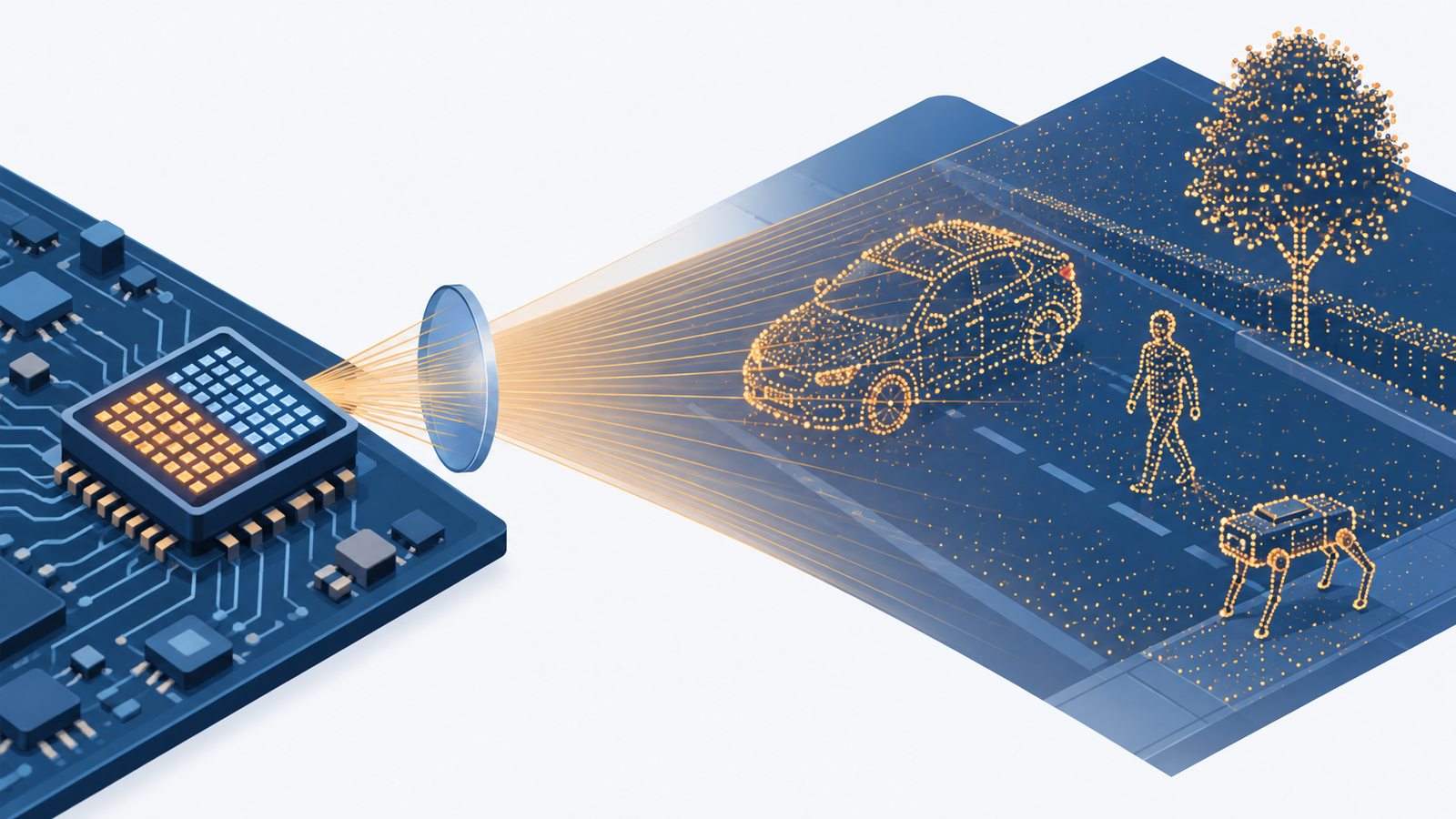
Companies in optical communications and photonics fall into three broad groups: optical components & modules, chips & foundries, and network systems & carriers. Hesai sits closest to optical components & modules, but what it makes is not a communications component; it is a finished sensor, the LiDAR Sourced. According to the 20-F, its fourth-generation ASICs "consolidate all seven key components into chips, namely, lasers, detectors, laser drivers, analog front-end, analog-to-digital converters, digital signal processors, and controllers". The company explains that by consolidating a LiDAR that used to be assembled from hundreds or thousands of discrete parts into a few chips and building it on automated lines, it has improved performance, quality and cost at the same time. In optical communications terms, this is the equivalent of "integrating the optical engine", and Hesai can be seen as a company that took that step into mass production first, in automotive sensors.
2. The logo and how the name is written

The Hesai logo is a trademark of the company. We have not recreated it with generated imagery;
the image is the one shown in the header of the official website (white on transparent, so it is shown on a dark background) and is placed here as img/hesai_logo.svg.
A note on names: the listed holding company's legal name is Hesai Group (incorporated in the Cayman Islands in April 2021). The Shanghai subsidiary that runs the business started out in October 2014 as Hesai Photonics Technology Co., Ltd. and is now called Hesai Technology Co., Ltd. (Shanghai Hesai). The 20-F refers to this subsidiary and its subsidiaries together as "Hesai Technology". The folder name for this company in our series follows the listed company's current English name, "Hesai Group". Japanese-language coverage sometimes writes the name with the Japanese reading of its Chinese characters; this English edition uses "Hesai" throughout.
Official site: https://www.hesaitech.com/3. Where the company sits in optical communications and photonics
Hesai's products belong not to communicating with light but to measuring distance with light (LiDAR). By application they break down as follows Sourced.
| Application | Main products (as described in the 20-F) | Position |
|---|---|---|
| ADAS (driver assistance) in passenger cars | AT series (ATX), ET series (ETX), FT series (FTX) | The AT series was 63.0% of revenue in 2025 |
| Autonomous vehicles (robotaxis and others) | Pandar series, OT series (OT128), QT series | 360-degree mechanical LiDAR |
| Robotics and industry | XT series, JT series (JT128) | Humanoid and quadruped robots, delivery and cleaning robots, agriculture and more |
| (For reference) new businesses | The "Kosmo" spatial intelligence platform and actuators for robots | Began contributing revenue in 2026. Partly outside optics |
4. Scale
| Item | 2023 | 2024 | 2025 | April to June 2026 |
|---|---|---|---|---|
| LiDAR shipments (units) | About 222,100 | About 501,900 | About 1,620,400 | 628,275 |
| Revenue (CNY million) | 1,877.0 | 2,077.2 | 3,027.6 | 860.8 |
| Gross margin | 35.2% | 42.6% | 41.8% | - |
| R&D expense (CNY million) | 790.5 | 855.6 | 796.9 | - |
| Net income (loss) (CNY million) | -476.0 | -102.4 | 435.9 | 70.6 |
| Capital expenditure (CNY million) | 406.7 | 270.4 | 342.2 | - |
| Employees | 1,122 | 1,142 | 1,118 | - |
Dividing revenue by units shipped gives about CNY 8,450 per unit in 2023, about CNY 4,140 in 2024 and about CNY 1,870 in 2025 Our calculation. Revenue includes non-LiDAR income such as engineering services, so this is not an exact unit price, but the picture of revenue growing on volume while unit prices fall sharply is clear. Gross margin nevertheless rose from 35.2% to 41.8%, which fits the company's explanation that its ASICs cut the parts count and automation lowered costs. The 20-F attributes the slight dip in margin in 2025 "primarily" to a "decrease in revenues from high-margin non-recurring engineering services" Sourced.
5. Resources committed to optical communications and photonics
For the four angles this series uses (people; money; outside investments, acquisitions and joint ventures; universities, research institutes and public funding), we separate what could be confirmed from what could not.
| Angle | Details | Category |
|---|---|---|
| People | 733 engineers (66.8% of all employees, end of 2025), 57.2% of them with a master's degree or above. R&D is organised into three departments: the Hesai Research Institute (research on fundamental components such as narrow-linewidth lasers, integrated optical packaging and scanners), the ASIC center and the R&D center | Sourced |
| Money (R&D) | R&D expense of CNY 796.9 million (2025, 26.3% of revenue), down 6.9% on the year before (lower payroll and materials costs) | Sourced |
| Money (capital expenditure) | CNY 342.2 million (2025). The company says it went on building the Hertz Center in Hangzhou, the Maxwell Center in Shanghai and the plant in Thailand, among other things | Sourced |
| Plants | Hertz Center (Hangzhou; main volume plant; operating since September 2023, phase II started production in August 2025), Maxwell Center (Jiading, Shanghai; R&D and low-volume production; trial operation December 2023) and Galileo Factory (Thailand; leased in May 2025, under renovation). The company states a 100% automation rate in its core production processes | Sourced |
| Fund-raising | Net proceeds of about US$174.5 million from the U.S. IPO (February 2023) and about US$614 million from the dual primary listing in Hong Kong (September 2025) | Sourced |
| Patents | 632 granted and 728 pending in China, and 157 granted and 554 pending elsewhere (the U.S., Europe and others) (end of 2025) | Sourced |
| Outside investments, acquisitions and JVs | Nothing on equity stakes, acquisitions or joint ventures in optics within the parts of the 20-F we checked | Could not be confirmed |
| Public funding | The 20-F says other operating income includes VAT exemptions, operating subsidies and subsidies for building production lines from local governments in China. We have not checked the breakdown of amounts | Existence sourced / amounts not checked |
| Universities and research institutes | No joint research with universities within the parts of the 20-F we checked | Could not be confirmed |
VCSELs (vertical-cavity surface-emitting lasers) can be made cheaply in two-dimensional arrays on a wafer, but each emitter's optical output is small, and they have been regarded as unsuited to long-range measurement (a general explanation). The 20-F lists using its proprietary high-power VCSELs in long-range automotive LiDAR among the "bold steps that others hesitated to pursue" Sourced. It also explains that it uses "one-dimensional electronic scanning", with vertical scanning done by electronic switching on the ASIC and horizontal scanning by a rotating mirror, which reduces power consumption and optical crosstalk.
Because a VCSEL emits from its top surface, it can be tested on the wafer, and it lends itself to arrays in which each pixel is switched on and off electrically (a general explanation). Designs that turn the light source and the receiver into semiconductor arrays and scan electronically benefit more from semiconductor economies of scale the fewer mechanical parts they have (a general explanation). We read the company's ability to hold its margin even as revenue per unit fell to about a fifth in two years as the payoff of this design philosophy Not yet confirmed. See also our explainers on LiDAR, semiconductor lasers and photodetectors.
6. Track record so far
| When | What happened | What it means |
|---|---|---|
| October 2014 | Started business in Shanghai as Hesai Photonics Technology (now Hesai Technology), initially with high-performance laser sensors for industries such as natural gas | Started out as a laser measurement company |
| 2016 | Shifted its main business to developing, making and selling LiDAR | Riding demand from autonomous driving |
| Early 2018 | Introduced technology that encrypts laser pulses to suppress interference from other LiDARs (the company claims it as one of the "industry's first" technologies) | Designed on the assumption that many cars will use LiDAR at once |
| September 2020 | Launched the XT32, its first product with an in-house ASIC, and the 128-channel Pandar128 | The start of the ASIC route |
| April 2021 | Holding company Hesai Group incorporated in the Cayman Islands | Preparing for an overseas listing |
| February 2023 | Listed on Nasdaq (HSAI). The Hertz Center in Hangzhou started operation in September | Volume production set-up established |
| January and October 2024 | Added to the U.S. Department of Defense's 1260H list (removed, then re-added in October) | A risk factor for its U.S. business |
| 2024 | Introduced its fourth-generation ASIC (512 channels on a single board, 24.6 billion samples per second). ATX announced in April, OT128 launched in September | Lower cost per unit |
| 2025 | ATX volume production started (January), FTX and JT128 announced (January), site for the Thai plant leased (May), Hertz Center phase II started production (August), dual primary listing in Hong Kong (September). About 1.62 million units shipped and a full-year profit | The year volume production moved up a level |
| July 2025 | A U.S. district court upheld the Department of Defense's designation. The company appealed (oral argument in March 2026) | Litigation ongoing |
| April to June 2026 | Shipments of 628,275 units, revenue of CNY 860.8 million and net income of CNY 70.6 million. ADAS shipments up 60% and robotics shipments up 193%. Design wins with Great Wall Motor (ETX), GAC Toyota (bZ7) and Volkswagen's China joint ventures, among others. The "Picasso" 6D SPAD-SoC became SOP-ready | The fifth consecutive profitable quarter |
7. Plans ahead
shipments by end-2026Expectation in the 20-F. Great Wall Motor's SOP is described as late 2026
300 million in 2026Company revenue guidance. About US$100 million expected in 2027
None of the following appears in the 20-F or the results release Not yet confirmed.
Revenue by named customer (only the combined share of the top five is disclosed) / the volumes and values of each design win / the capacity and start date of the Thai plant / the names of the main suppliers of lasers and photodetectors / the foundry that makes its ASICs / the amounts of public subsidies. The results release also quotes market shares from research firms (GGII and Gasgoo), but since those are not the company's own figures, this article does not use them.
8. What the company is aiming for in optical communications and photonics
This section includes things the company does not say directly. We set them out as inferences within what the primary sources support, with the evidence for each.
| What the evidence suggests | Primary information it rests on | Category |
|---|---|---|
| Turning LiDAR into a product of "optical semiconductor chips" | Its fourth-generation ASIC puts seven components, including lasers and detectors, on chips; 16 automotive-grade chips and 185 million cumulative deliveries; and its Research Institute works on narrow-linewidth lasers and integrated optical packaging | Sourced (the company's description) |
| Making the receiver side a SPAD SoC that captures colour and change over time as well as distance | It describes "Picasso" as "the full-color, ultra-sensitive 6D SPAD-SoC" and has announced that it is SOP-ready | Inference |
| After cars, extending the same optical sensors to robots | Robotics shipments up 193% and JT128 collaborations with more than 50 embodied AI companies. The CEO describes Hesai as "a full-stack infrastructure platform for Robotics and Physical AI" | Inference |
| Reducing reliance on the U.S. and growing in China and third countries | The share of revenue from outside China went from 47.2% (2023) to 22.2% (2025), and the share of its large U.S. customer from 28.4% to under 5%. It states the impact of the 1260H list as a risk and is preparing a plant in Thailand | Inference |
The August 2026 results release says that at GAC Toyota, "following the bZ3X model", Hesai "secured another design win for the bZ7 model, further expanding partnerships with Japanese automotive brands" Sourced. It also says it "secured a major global design win with Volkswagen, covering multiple vehicle models under its China joint ventures". The 20-F, meanwhile, records that the share of revenue from outside China fell from 47.2% in 2023 to 22.2% in 2025, and that listing on the U.S. Department of Defense's 1260H list may harm its business opportunities Sourced. From this we read that Hesai is using foreign carmakers' "made in China" vehicles as a foothold to build relationships with Japanese and European automakers Not yet confirmed. For a Chinese optical sensor company facing headwinds in the U.S. market, foreign brands' Chinese joint ventures are the easiest way in. Whether these wins will extend to vehicles built outside China, however, cannot be read from the primary sources.
9. Partnership map
10. Technologies, products and services
We set out the main products and technologies from the product descriptions in the 20-F. Performance figures are the company's published values, and we state whether each product is in volume production or not yet.
| Product or technology | What it is (as the company describes it) | Status |
|---|---|---|
| ATX | An ultra-compact, high-performance long-range ADAS LiDAR based on a one-dimensional scanning architecture. 7x optical zoom, maximum detection range of 300 m | Announced April 2024; volume production (SOP) from January 2025 |
| ETX | A long-range product for L3 and L4. Its proprietary optical vector chip "enables Class 1 eye safety while delivering up to 400 meters detection range at 10% reflectivity". Up to 2,160 channels, 11 W power consumption, 600 g and a window height of 32 mm | Volume production and shipments expected by the end of 2026 |
| FTX | Solid-state. Field of view 180° × 140° (the company claims the widest of any automotive solid-state LiDAR), 492,000 points per second | Announced January 2025 |
| OT128 / Pandar128 | 360° mechanical, 200 m at 10% reflectivity, 3.45 million points per second. The company says the OT128 reused its ADAS ASIC design in a mechanical LiDAR, sharply lowering the price | In volume production |
| JT128 | A compact product for robots. Field of view 360° × 189° (the company claims the widest in the world), 40 m at 10% reflectivity | Announced January 2025; in volume production |
| Fourth-generation ASIC | 512 channels on a single board, 24.6 billion samples per second. Integrates seven components including lasers and detectors | Introduced 2024 |
| Picasso | A "full-color, ultra-sensitive 6D SPAD-SoC" | SOP-ready. In ETX under customer validation (as of August 2026) |
| Interference rejection | Encrypts laser pulses to suppress interference from other LiDARs | Standard since 2018 |
Because a LiDAR sends light towards people's eyes, laser output has to stay within the eye-safety limit (Class 1) (a general explanation). Measuring further without raising output requires optics that concentrate light efficiently in the intended direction and photodetectors that can pick up even faint reflections. The 20-F explains that the ETX's "proprietary optical vector chip" enables Class 1 eye safety while detecting objects of 10% reflectivity at up to 400 m Sourced.
The 20-F does not say what the optical vector chip is made of or how it is built, but the name suggests a device that controls the direction of emitted light on a semiconductor chip Not yet confirmed. Taken together with "narrow-linewidth lasers" and "integrated optical packaging" among the Research Institute's topics, we read Hesai as moving towards controlling the light source and the light path in semiconductors too.
11. The risks this company carries
| Risk | Details | Category |
|---|---|---|
| The U.S. Department of Defense's 1260H list | Added in January 2024, removed, then re-added in October. In July 2025 a district court upheld the designation, and the company is appealing. The 20-F states that contracts with the Department of Defense are prohibited from 30 June 2026, and procurement through third parties from 30 June 2027 | Sourced |
| Customer concentration | The top five customers accounted for 55.8% of revenue (2025) | Sourced |
| Product concentration | The AT series accounted for 63.0% of revenue (2025) | Sourced |
| Falling prices | The 20-F says competition in the LiDAR market is intense, with pressure to cut prices. Revenue per unit fell to about a fifth between 2023 and 2025 (our calculation) | Sourced |
| Design wins that may not become orders | The 20-F states that under framework agreements with automakers, the customer decides whether and when to place orders | Sourced |
| Ramping new plants | The 20-F lists the risks that plant expansion may not go to plan and that equipment may sit idle in the early stages of operation | Sourced |
| Expansion beyond optics | It is directing resources to new businesses unrelated to optics, such as actuators | Inference |
12. Glossary
- LiDAR
- A sensor that shines laser light and measures distance from the time it takes to reflect back, capturing the surroundings as a three-dimensional cloud of points.
- ToF
- Time of flight. Measuring distance from the time between emitting light and its return.
- VCSEL
- Vertical-cavity surface-emitting laser. It emits light perpendicular to the substrate and is easy to make in two-dimensional arrays.
- SPAD
- Single-photon avalanche diode. A highly sensitive photodetector that can detect even a single photon.
- ASIC
- Application-specific integrated circuit. Hesai concentrates the main functions of its LiDAR in ASICs.
- ADAS
- Advanced driver-assistance systems, such as automatic braking and lane keeping.
- Design win
- An automaker's decision to adopt a part for a particular vehicle model. Production timing and volumes are decided separately.
- 1260H list
- The U.S. Department of Defense's published list of "Chinese military companies". Listed companies face restrictions on business with the Department.
13. References
- Hesai Group Form 20-F for the fiscal year ended December 31, 2025 (filed with the U.S. SEC on 24 April 2026). History, listings, products, ASIC technology, plants, R&D organisation and expense, employees, patents, customer and product concentration, share of revenue from outside China, capital expenditure, public subsidies, and the 1260H list and litigation. https://www.sec.gov/Archives/edgar/data/1861737/000110465926048025/hsai-20251231x20f.htm
- Hesai Group Results release, "Hesai Group Reports Second Quarter 2026 Unaudited Financial Results" (18 August 2026; Exhibit 99.1 to Form 6-K). Quarterly shipments, revenue and net income, design wins, Picasso, robotics adoption and the outlook for new businesses. https://www.sec.gov/Archives/edgar/data/1861737/000110465926098050/tm2623467d1_ex99-1.htm
- Hesai Group Official website (source of the company name style and the logo image). https://www.hesaitech.com/
14. Claim-to-source audit
| Claim in the article | Category | Source |
|---|---|---|
| Legal name, place of incorporation and location, start of business in 2014 and former name, the 2016 shift to LiDAR, the Nasdaq and Hong Kong listings, and amounts raised | Sourced | Reference 1 https://www.sec.gov/Archives/edgar/data/1861737/000110465926048025/hsai-20251231x20f.htm |
| LiDAR shipments, revenue, gross margin, R&D expense, net income (loss), capital expenditure and headcount (2023 to 2025) | Sourced | Reference 1 https://www.sec.gov/Archives/edgar/data/1861737/000110465926048025/hsai-20251231x20f.htm |
| ASIC generations and integrated components, 16 automotive-grade chips and 185 million cumulative deliveries, high-power VCSELs and one-dimensional electronic scanning | Sourced | Reference 1 https://www.sec.gov/Archives/edgar/data/1861737/000110465926048025/hsai-20251231x20f.htm |
| Product specifications and launch and production dates (ATX, ETX, FTX, OT128, Pandar128, JT128, XT32), and interference rejection technology | Sourced | Reference 1 https://www.sec.gov/Archives/edgar/data/1861737/000110465926048025/hsai-20251231x20f.htm |
| Plants (Hertz Center, Maxwell Center, Galileo Factory) and automation rate, R&D organisation and engineer numbers, and patent counts | Sourced | Reference 1 https://www.sec.gov/Archives/edgar/data/1861737/000110465926048025/hsai-20251231x20f.htm |
| Top-five customer share, trend in the large U.S. customer's share, share of revenue from outside China, AT series share, nature of framework agreements, and types of local government subsidy | Sourced | Reference 1 https://www.sec.gov/Archives/edgar/data/1861737/000110465926048025/hsai-20251231x20f.htm |
| Listing and re-listing on the 1260H list, the district court ruling, the appeal and oral argument, and the 2026 and 2027 business restrictions | Sourced | Reference 1 https://www.sec.gov/Archives/edgar/data/1861737/000110465926048025/hsai-20251231x20f.htm |
| Shipments, revenue and net income for April to June 2026, growth in ADAS and robotics shipments, and five consecutive profitable quarters | Sourced | Reference 2 https://www.sec.gov/Archives/edgar/data/1861737/000110465926098050/tm2623467d1_ex99-1.htm |
| Design wins with Great Wall Motor, Li Auto, GAC Toyota and Volkswagen's China joint ventures, collaborations with more than 50 robotics companies, Picasso's SOP readiness, and the revenue outlook for new businesses | Sourced | Reference 2 https://www.sec.gov/Archives/edgar/data/1861737/000110465926098050/tm2623467d1_ex99-1.htm |
| Revenue per unit (about CNY 8,450, then CNY 4,140, then CNY 1,870) | Our calculation | Revenue divided by units shipped, from reference 1. A rough figure that includes non-LiDAR income |
| The three types of company in optical communications and photonics | Our calculation | This article's own classification. Example companies drawn from those covered in this series |
| Revenue by customer, volumes and values of design wins, Thai plant capacity, names of main suppliers and the ASIC foundry, and subsidy amounts | Not yet confirmed | Not stated in references 1 and 2 (subsidy amounts not checked by this article). Figures from press reports are not used https://www.sec.gov/Archives/edgar/data/1861737/000110465926048025/hsai-20251231x20f.htm |
| Market shares from research firms (GGII, Gasgoo) | Not yet confirmed | Quoted in reference 2, but not used because they are not the company's own figures https://www.sec.gov/Archives/edgar/data/1861737/000110465926098050/tm2623467d1_ex99-1.htm |
| The readings that it is moving to multi-dimensional sensing with a SPAD SoC, extending to robots, reducing reliance on the U.S., and using foreign brands' Chinese joint ventures as a way in | Inference | This article's interpretation of references 1 and 2 |
| Technical readings on VCSELs, the optical vector chip and eye safety, and the risk of expanding beyond optics | Inference | This article's explanation based on general technical knowledge and references 1 and 2 |
Last updated 26 September 2026 / Troy Technical
Every figure in this article comes from the annual report (Form 20-F) Hesai Group has filed with the U.S. Securities and Exchange Commission (SEC) and the results release attached to its Form 6-K. "CNY" means Chinese yuan (renminbi). No research-firm estimates or press-based figures have been used. Passages marked "Inference" are this article's interpretation of the primary sources, not statements made by the company.