COMPANY PROFILE / OPTICAL COMMUNICATIONS & PHOTONICS
Huawei
A giant covering every layer of optics, from home fibre to the backbone, that publishes almost no optics numbers
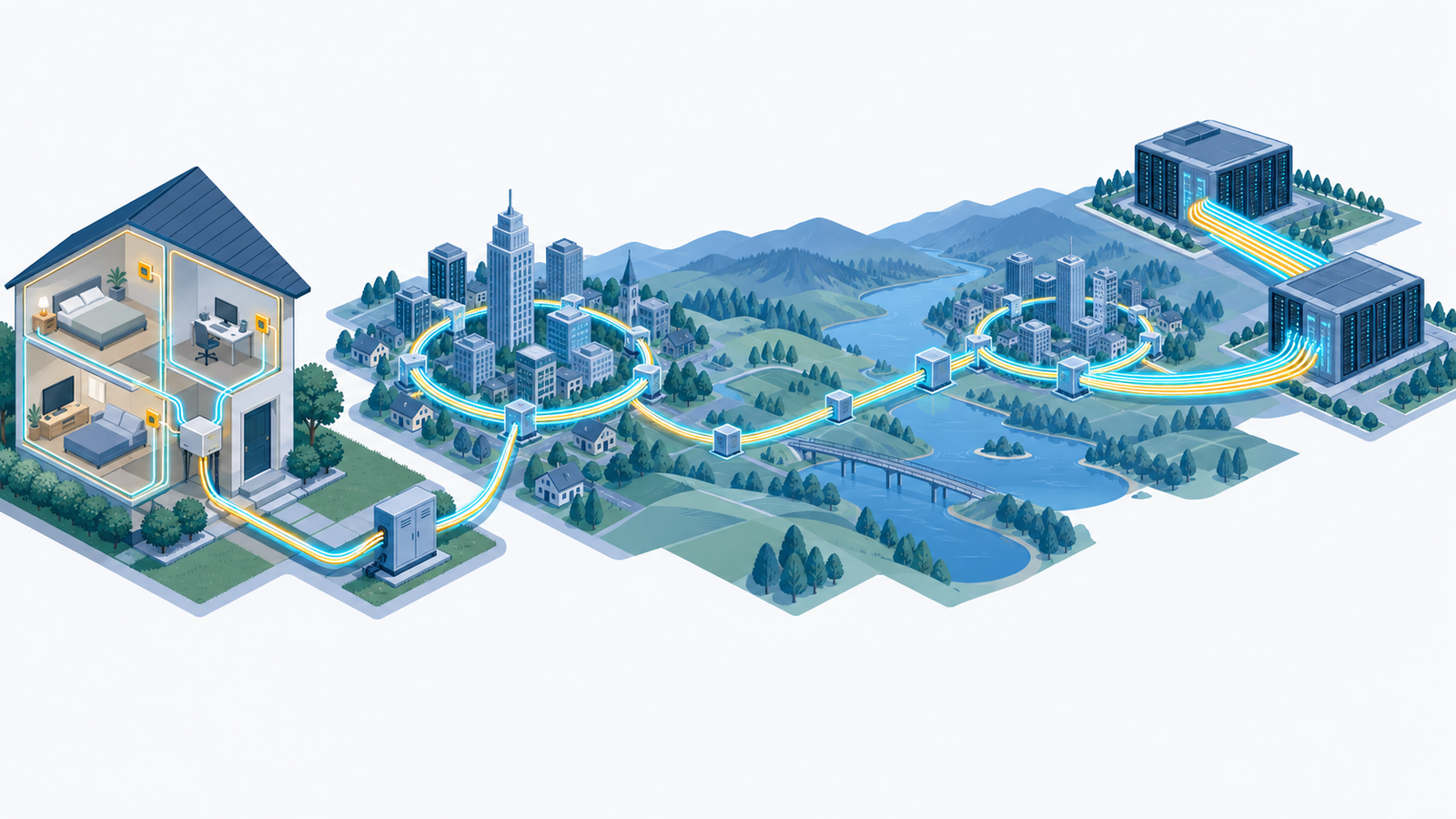
Huawei is a privately held company based in Shenzhen, China, that makes telecoms network equipment as well as smartphones and other devices. In optical communications it covers a wide range of equipment: optical access that brings fibre into the home, optical transport linking cities and whole countries, optical networks for enterprises, and links between data centres. According to its 2025 annual report, customers using its products had rolled out more than 240 400G and 800G commercial networks and built over 15,000 all-optical campus networks. It does not publish revenue, investment or headcount for its optics business, however. Using only Huawei's published annual report and official news, this profile separates what can be known from what cannot.
- Huawei in 30 seconds, and where it stands in optical communications and photonics
- The logo and how the name is written
- Where the company sits in optical communications and photonics
- Scale (the company as a whole, in brief)
- Resources committed to optical communications and photonics
- What it has done so far
- What comes next
- What the company is aiming for in optical communications and photonics
- Map of partnerships in optical communications and photonics
- Technologies, products and services
- The risks this company carries
- Glossary, references and claim-to-source audit
1. Huawei in 30 seconds, and where it stands in optical communications and photonics
Holding Co., Ltd.The holding company that issues the annual report
enterprise networks, DCIFrom home fibre to the backbone
This series sorts companies in optical communications and photonics into three types: optical components & modules, chips & foundries, and network systems & carriers. Huawei is a network systems maker, and optics is one field within it. The annual report describes the ICT infrastructure business as offering "wireless networks, cloud core networks, data communication, optical, computing, data storage as well as services and software", and optics revenue is included within ICT infrastructure (CNY 375,014 million in 2025) and not broken out Sourced. This article therefore looks at Huawei's optics business in terms of what it has delivered and where, rather than its size.
2. The logo and how the name is written

The Huawei logo is a trademark of the company. We have not recreated it with generated imagery;
the logo image used in the header of the official website (huawei.com) is placed here as img/huawei_logo.png.
A note on names: the annual report is issued by the holding company, Huawei Investment & Holding Co., Ltd., while the operating company for network equipment is Huawei Technologies Co., Ltd. Its optical products carry family names such as OptiXtrans (optical transport), OptiX OSN and OptiXaccess (optical access).
Official site: https://www.huawei.com/en/annual-report/20253. Where the company sits in optical communications and photonics
In terms of where it works with light, Huawei has products in almost every layer of the fibre network, from home fibre (optical access) through city and national backbones (optical transport) to enterprise campus networks and links between data centres Sourced. Compared with the other network systems makers in this series (Cisco, Nokia and Ciena), what stands out is the weight of optical access for homes and optical networks for enterprises. For inside the data centre, the data communication business mentions "StarryLink optical modules", but gives no specifications or scale. Its territory overlaps with our explainers on optical fibre, on coherent optical communication and DSPs, and on IOWN.
| Aspect | Where Huawei stands | Category |
|---|---|---|
| Type | Network systems maker (optics is part of the ICT infrastructure business) | Sourced |
| Optical access | PON that brings fibre into the home (OLT and ONT), FTTR that runs fibre to each room, and the optical distribution network (ODN) | Sourced |
| Optical transport | OTN (backbone and metro), optical cross-connects (OXC), data centre interconnect | Sourced |
| For enterprises | All-optical campus networks for factories, hospitals, power utilities and others; optical fibre sensing | Sourced |
| Inside the data centre | Mentions StarryLink optical modules (data communication business). Specifications and scale unknown | Sourced / details unknown |
| In-house production of optical components and chips | Not mentioned in the annual report or the news we checked | Not confirmed |
4. Scale (the company as a whole, in brief)
The company as a whole gets a single table. Amounts are in Chinese yuan (CNY) and have not been converted Sourced.
| Measure (CNY million) | Year to December 2024 | Year to December 2025 |
|---|---|---|
| Revenue | 862,072 | 880,941 |
| of which ICT infrastructure (includes optics) | 365,424 | 375,014 |
| Net profit | - | 68,036 |
| R&D expenses | - | About 192,300 (21.8% of revenue) |
| Employees (of which R&D) | - | About 213,000 (about 114,000) |
The figures above are for the company as a whole, or for the ICT infrastructure business as a whole. ICT infrastructure also includes wireless, data communication, computing, storage and more, and revenue, profit, R&D spending and headcount for optics alone are not published Not yet confirmed. It is reasonable to assume that most of the "CNY 192.3 billion in R&D" and "114,000 R&D staff" go to areas other than optics, so these figures cannot be used as a measure of the optics business.
5. Resources committed to optical communications and photonics
| Type of resource | What it is | Category |
|---|---|---|
| People (dedicated organisation and staff) | There is an Optical Business Product Line, whose president as of March 2026 was Bob Chen. Headcount is not published | Sourced / headcount not disclosed |
| Money (R&D spending and investment) | Company-wide R&D expenses were about CNY 192.3 billion (2025). No figure for optics alone is published. Among its research results in optical networking, the annual report lists breakthroughs in demarcating, suppressing and compensating for optical link impairments and a new FEC dynamic decoding architecture, which it says "enables highly-reliable and low-power optical interconnect between data centers" | Sourced / optics spending not disclosed |
| Outside investments, acquisitions and joint ventures | No optics-related acquisition, investment or joint venture appears in the annual report or the news we checked | Not confirmed |
| Universities, research institutes and public funding | No university research collaboration or public funding for optics is mentioned. On standards, it says its strategy revolves around ION-2030, the vision for next-generation optical networks defined by the ITU-T | Not confirmed (standards work is sourced) |
Among its 2025 research results in optical networking, alongside optical links between data centres, the annual report says Huawei "broke ground on a number of key technologies such as laser communication in space, diffraction-limited optical antennas, and high-precision acquisition, tracking, and pointing (ATP)" Sourced. These are technologies for linking satellites to each other by light, a direction separate from terrestrial fibre networks. No timing or scale for products has been given, however Not yet confirmed.
6. What it has done so far
Below, the deployment record as of the end of 2025 given in the annual report is set alongside official news from 2026. All figures are presented by the company as results achieved by customers using Huawei's products and solutions.
| When | What happened, or what was achieved | Why it matters |
|---|---|---|
| End of 2025 | Using Huawei's F5G-A all-optical network solutions, customers had acquired more than 70 million FTTR home users, rolled out more than 240 400G and 800G commercial networks and built over 15,000 all-optical campus networks | In volume production and deployment from optical access to the backbone |
| 2025 | Supported more than 230 carriers worldwide in building and upgrading fibre broadband networks. More than 50 carriers offered FTTR packages | The spread of fibre to the home |
| 2025 | 46 benchmark projects for 1 ms metro transport networks with Chinese carriers | Low-latency city networks |
| 2025 | Chinese carriers used its solutions to roll out 50G PON and launched multi-gigabit and 10-gigabit packages in 24 provinces | Next-generation home fibre |
| 2025 | In the Middle East, its 800G and "3D" backbone solutions built a new data centre interconnect network for a carrier | Data centre interconnect |
| 2025 | Offers an "All-Optical Lossless Data Center Interconnect Solution" that raises training efficiency even when data centres are more than 100 km apart | Data centre interconnect for AI |
| 2 March 2026 | Unveils Next Generation Optical Network products and solutions at MWC Barcelona (FTTR, OLT, ONT and ODN for optical access; Next Generation OTN for optical transport) | Promotes mutual reinforcement between AI and networks |
| 19 March 2026 | Announces nine awards in the Lightwave Innovation Reviews (DC908 Pro, E6600 OTN plus quantum key distribution, and others) | Awards from an industry publication, not independent performance verification |
7. What comes next
Convergence StrategyAs named in the annual report
metro 1 msThe "latency circles" set out in March 2026
At the March 2026 launch, the head of the optics business said Huawei advances its Next Generation Optical Network solutions "in two directions: AI for Networks and Networks for AI" Sourced. The first means using AI, for example to identify fibre risks in advance and pinpoint fault locations to within 10 metres, or to cut average energy consumption by 40%; the second means building latency circles of 5 ms, 3 ms and 1 ms for national, regional and metro networks, so that AI computing resources are always within quick reach.
None of the following appears in the annual report or the news we checked Not yet confirmed.
Revenue, profit, R&D spending and headcount for optics; whether it makes optical components or chips itself, and where; specifications and shipment volumes for the StarryLink optical modules used inside the data centre; any work on CPO; names of optical customers (described only as "carriers" in China, the Middle East and elsewhere); and the amount and timing of optics investment plans.
8. What the company is aiming for in optical communications and photonics
This section goes beyond what the company says directly. It sets out inferences that can be drawn from primary sources, each with its basis.
| What can be read | Primary evidence behind it | Category |
|---|---|---|
| It positions optics as the foundation of networks in the AI era | The annual report sets out an "Optical-Intelligence Convergence Strategy", and the March 2026 launch says "upgrading optical networks for the AI era is the right move" | Sourced |
| Where others concentrate on links between data centres, it sells every layer from the home to the backbone as one package | The annual report's results span FTTR, 50G PON, OTN, OXC, enterprise networks and DCI. The launch also promoted optical access and optical transport together | Inference |
| It uses AI-driven automation of operations to differentiate its optics | Half of the March 2026 announcement was devoted to "AI for Networks" (fault prediction, energy saving, automated operations) | Inference |
| Its main customer base is carriers in China and emerging markets | The specific examples in the annual report are concentrated on carriers in China, the Middle East, Latin America and Africa | Inference |
| It uses optical security (quantum key distribution) as a selling point for critical infrastructure such as power and government | The E6600, which integrates OTN and quantum key distribution (QKD) on one board, was presented for power, transport and government | Inference |
The disclosures of the Western network systems makers in this series (Cisco, Nokia and Ciena) have, since the start of 2026, concentrated on links between data centres for AI and the capacity to supply optical components. Huawei's annual report, by contrast, lays out its optics results across every layer of the network: home fibre (more than 70 million FTTR users, 50G PON), city networks (1 ms metro), the backbone (400G/800G), enterprise networks (more than 15,000 campus networks) and links between data centres (lossless DCI over more than 100 km) Sourced. We read this as a sign that Huawei's optics business is structured to deliver every layer as a package to large numbers of carriers and enterprises, rather than to a handful of large cloud providers Not yet confirmed. Because it does not disclose how much revenue each layer generates, however, this reading cannot be checked against figures.
9. Map of partnerships in optical communications and photonics
10. Technologies, products and services
All figures are the company's own and are not third-party measurements. We found no material expressing power consumption per bit (pJ/bit). Claims of "industry's first" are the company's own.
| Product or technology | What it does | What the company says | Stage |
|---|---|---|---|
| OptiXtrans DC908 Pro | Equipment for all-optical links between data centres | Up to 2 Tbps per wavelength and up to 96 Tbps per fibre. 1+2 optical line protection that survives two fibre cuts | Product (described in the awards announcement) |
| Next Generation OTN (mini OXC, OTN plus QKD) | Backbone and metro optical transport. Combines compact optical cross-connects with quantum key distribution | 46 benchmark 1 ms metro projects in China | Being deployed |
| OptiXtrans E6600 OTN & QKD | Integrates quantum key distribution into optical transport equipment on a single board | Described as delivering "quantum encryption against eavesdropping and tampering attacks with only one board, without requiring extra devices, network management systems, or optical fibers". For power, transport and government | Product |
| OptiX OSN 1800 I X | 1U integrated optical and electrical transport equipment | Integrates two 100G line ports and a bidirectional ROADM on the system control board. The company calls it "the industry's first 1 U 100G optical-electrical integrated device" | Product |
| FTTR, 50G PON, OLT / ONT | Optical access that brings fibre to the home or to each room | More than 70 million FTTR users (customers' results). 50G PON rolled out in 24 provinces in China | In volume production and being deployed |
| Optical fibre sensing | Using optical fibre to detect vibration and other activity around it | Pinpoints fault locations to within 10 metres. Says it helped one African customer reduce asset losses by about 80% | Being deployed |
| StarryLink optical modules | Optical modules for switches inside the data centre (data communication business) | Mentioned by name only; no specifications given | Details unknown |
Huawei's FTTR (Fiber to the Room) runs optical fibre to each room, not just to the front door, and the annual report says users now exceed 70 million Sourced. Running fibre inside a home demands fibre that leaks little light even when bent sharply around a corner, that is thin and unobtrusive, and that non-specialists can install. The annual report's European example, in which all-optical networks "are being deployed with zero wall damage, connecting century-old buildings to high-speed optical networks", reflects exactly these installation demands.
From a materials standpoint, what matters here is bend-insensitive fibre (a design with low bending loss) and its coatings, adhesives and transparent cabling materials Not yet confirmed. Backbone optical transport is a contest of "how far and how much", whereas home fibre is a contest of "how easily and how neatly it can be installed"; it is worth noting that, within the same field of optical communications, the performance demanded of materials is completely different. For more, see our explainers on optical fibre and on optical connectors and fibre attachment.
11. The risks this company carries
| Risk | Substance | Category |
|---|---|---|
| U.S. export controls | The notes to the financial statements in the annual report state that, following additions to the Entity List by the U.S. Commerce Department's BIS since 2019, "supplies of relevant items to the Group and sales of certain products of the Group are adversely affected" | Sourced |
| Geopolitics and technology sanctions | The annual report lists uncertainties arising from geopolitics, technical sanctions and trade barriers as compliance risks | Sourced |
| Optics business invisible from outside | Optics revenue, profit, investment and headcount are all undisclosed, so how the optics business is faring cannot be checked in figures | Sourced |
| Sourcing optical components | Given the effect of the Entity List and the absence of any disclosure about in-house production of optical components, sourcing leading-edge optical components may be a constraint | Inference |
| Regional skew in its customers | The examples in the annual report are concentrated in China, the Middle East, Latin America and Africa. Its structure may make it hard to benefit directly from AI investment by North American cloud providers | Inference |
12. Glossary
- OTN
- Optical Transport Network. An international standard transmission method for bundling many signals and carrying them over optical fibre.
- OXC
- Optical Cross-Connect. Equipment that switches the destination of optical signals while they remain light, without converting them to electrical signals.
- PON / 50G PON
- Passive Optical Network. A fibre access method in which several homes share one optical fibre. 50G PON is the next generation, at up to around 50 Gbps.
- FTTR
- Fiber to the Room. Running optical fibre to each room of a home.
- F5G-A
- A name used by Huawei and others for a generation of fixed (fibre) networks: an advanced version of the fifth-generation fixed network.
- QKD
- Quantum Key Distribution. A technique that uses the quantum properties of light to distribute encryption keys in a way that reveals eavesdropping.
- ION-2030
- The vision for next-generation optical networks set out by the ITU-T (the standardisation sector of the International Telecommunication Union).
- Entity List
- A list maintained by the U.S. Department of Commerce of companies and organisations to which exports require a licence.
13. References
- Huawei Investment & Holding Co., Ltd. 2025 Annual Report (annual report page on the official website). https://www.huawei.com/en/annual-report/2025
- Huawei Investment & Holding Co., Ltd. 2025 Annual Report (PDF). Company overview and headcount (PDF page 2), revenue by segment (page 23), support for fibre broadband (page 24), DCI in the Middle East and OXC in China (page 27), optics results (pages 47 to 48), research results in optical networking (page 72), R&D expenses and R&D staff (page 74), export control and sanctions risks (page 79), revenue and net profit (page 95), reporting entity and controlling party (page 104), effect of the Entity List (page 119), description of business segments (page 120). Page numbers are those of the PDF. https://www-file.huawei.com/dam/asset/view/dec782afd1544f558c32fc76e3141334.pdf
- Huawei News, "Huawei Launches Next Generation Optical Network Products and Solutions to Drive New Growth in the AI Era" (2 March 2026). The president of the Optical Business Product Line, AI for Networks / Networks for AI, latency circles, the product range. https://www.huawei.com/en/news/2026/3/next-generation-optical
- Huawei News, "Huawei Wins Nine Lightwave Innovation Reviews Awards, Retaining the Title of Most Honored Vendor" (19 March 2026). The award-winning products and their descriptions (DC908 Pro, E6600 OTN & QKD, OSN 1800 I X and others). https://www.huawei.com/en/news/2026/3/nine-lightwave-innovation-award
14. Claim-to-source audit
| Claim in the article | Category | Source |
|---|---|---|
| Reporting entity, headquarters (Shenzhen), founded in 1987, private, controlling party, about 213,000 employees | Sourced | Reference 2 https://www-file.huawei.com/dam/asset/view/dec782afd1544f558c32fc76e3141334.pdf |
| Revenue, ICT infrastructure revenue, net profit, R&D expenses and R&D staff | Sourced | Reference 2 https://www-file.huawei.com/dam/asset/view/dec782afd1544f558c32fc76e3141334.pdf |
| The business segment description showing optics within ICT infrastructure | Sourced | Reference 2 https://www-file.huawei.com/dam/asset/view/dec782afd1544f558c32fc76e3141334.pdf |
| More than 70 million FTTR users, more than 240 400G/800G commercial networks, over 15,000 all-optical campus networks, the Optical-Intelligence Convergence Strategy, ION-2030 | Sourced | Reference 2 https://www-file.huawei.com/dam/asset/view/dec782afd1544f558c32fc76e3141334.pdf |
| 46 projects for 1 ms metro networks, 50G PON in 24 provinces, all-optical lossless DCI (over 100 km), optical fibre sensing, StarryLink | Sourced | Reference 2 https://www-file.huawei.com/dam/asset/view/dec782afd1544f558c32fc76e3141334.pdf |
| Fibre broadband support for more than 230 carriers, 800G DCI in the Middle East, OXC in China, the European building installation example | Sourced | Reference 2 https://www-file.huawei.com/dam/asset/view/dec782afd1544f558c32fc76e3141334.pdf |
| Research results in optical networking (compensation for optical link impairments, FEC dynamic decoding, laser communication in space) | Sourced | Reference 2 https://www-file.huawei.com/dam/asset/view/dec782afd1544f558c32fc76e3141334.pdf |
| The effect of the Entity List; geopolitical and technology sanction risks | Sourced | Reference 2 https://www-file.huawei.com/dam/asset/view/dec782afd1544f558c32fc76e3141334.pdf |
| The Next Generation Optical Network launch, the head of the optics business, AI for Networks / Networks for AI, latency circles, the figures for fault location and energy saving | Sourced | Reference 3 https://www.huawei.com/en/news/2026/3/next-generation-optical |
| The nine awards and the descriptions of DC908 Pro, E6600 and OSN 1800 I X ("industry's first" is the company's claim) | Sourced | Reference 4 https://www.huawei.com/en/news/2026/3/nine-lightwave-innovation-award |
| The three types of company in optical communications and photonics | Our calculation | Our own classification. Companies shown are examples from those covered in this series |
| Optics revenue, profit, R&D spending and headcount; in-house production of optical components; StarryLink specifications; CPO; customer names; investment plans | Not yet confirmed | Not in references 1 to 4. Information from press reports is not used https://www.huawei.com/en/annual-report/2025 |
| Optics-related acquisitions, investments, university research collaboration and public funding | Not yet confirmed | Not in references 1 to 4. This article does not conclude that none exists https://www.huawei.com/en/annual-report/2025 |
| The readings on selling every layer as a package, differentiation through AI-driven automation, the main customer base, and how QKD is sold | Inference | This article's interpretation of references 2 to 4 |
| The view on the performance demanded of materials in home fibre | Inference | This article's commentary based on reference 2 |
| Risks of constraints on sourcing optical components and a regional skew in customers | Inference | This article's interpretation of reference 2 |
Last updated 26 September 2026 / Troy Technical
Every figure in this article comes from the 2025 annual report of Huawei Investment & Holding Co., Ltd. and from Huawei's official news. Amounts are shown in Chinese yuan as disclosed, with no currency conversion. Huawei is privately held and its annual report is not a statutory filing with the U.S. SEC or similar regulators, but it is the company's own publication and includes a summary of audited financial statements. No research-firm estimates or press-based figures have been used. Passages marked "Inference" are this article's interpretation of primary sources, not statements made by the company.