COMPANY PROFILE / OPTICAL COMMUNICATIONS & PHOTONICS
Lumentum
Using its volume in laser chips to claim the "optical heart" of the AI data centre
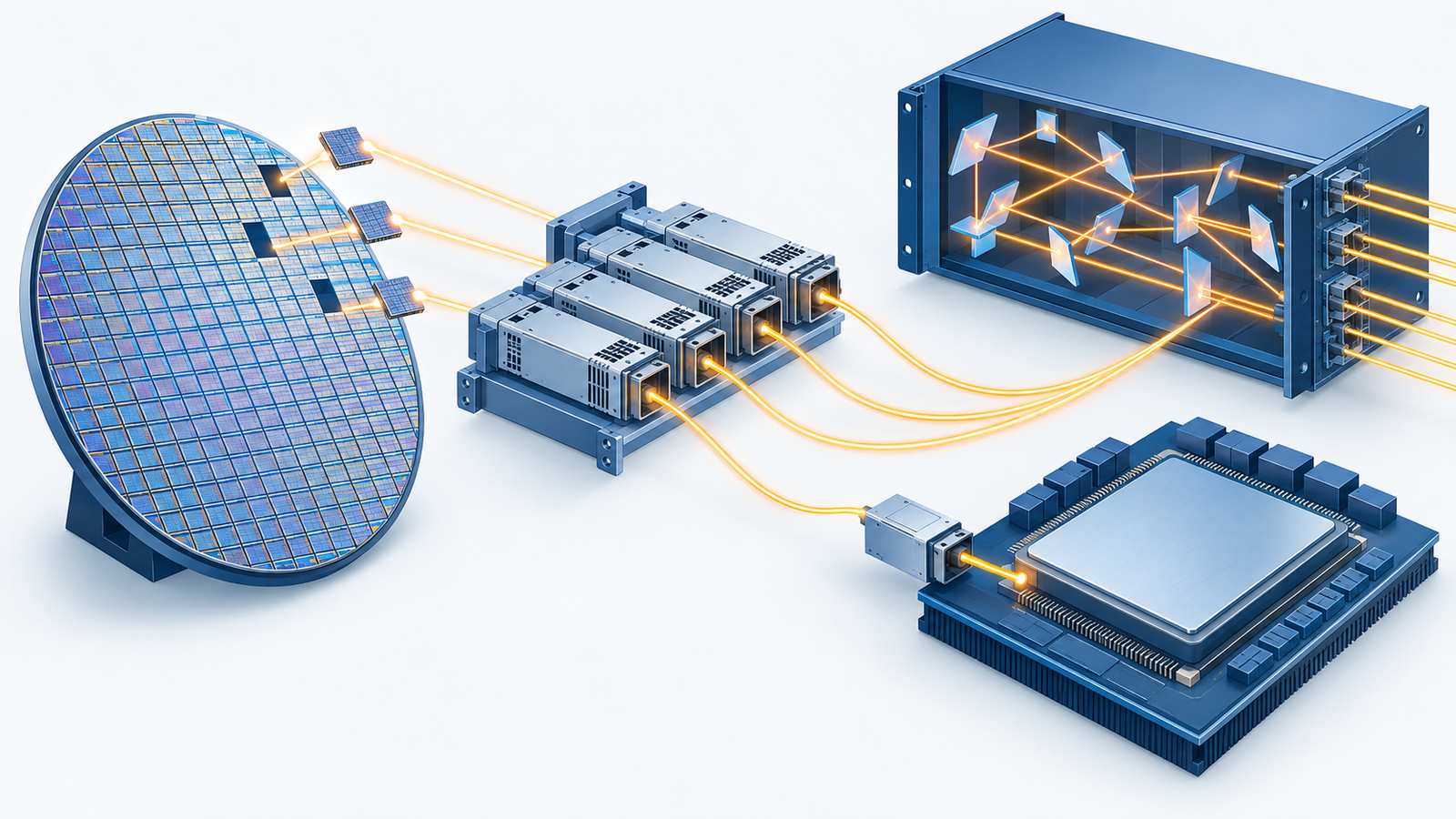
Lumentum is an optical components maker that builds, in house, everything from the semiconductor laser chips that generate light inside an optical transceiver, through the transceivers themselves, to optical circuit switches (OCS) for data centres. Revenue for its fiscal year to June 2026 was US$3,014 million, up 83.2% on the year before, and in March 2026 it received a US$2 billion investment from NVIDIA together with a multi-year purchase agreement. This profile sets out what the company is putting into optical communications and photonics, who it works with and where it is heading, using only its statutory filings with the U.S. SEC and its official releases.
- Lumentum in 30 seconds, and where it stands in optical communications and photonics
- The logo and how the name is written
- Where the company sits in optical communications and photonics
- Scale
- Resources committed to optical communications and photonics
- Track record so far
- Plans ahead
- What the company is aiming for in optical communications and photonics
- Partnership map
- Technologies, products and services
- The risks this company carries
- Glossary, references and claim-to-source audit
1. Lumentum in 30 seconds, and where it stands in optical communications and photonics
California, U.S.The headquarters buildings are company-owned
US$2 billionPrivate placement of convertible preferred stock, with a multi-year purchase agreement
Customer B 15.0%Share of revenue, year to June 2026. Names not disclosed
Companies in optical communications and photonics fall into three broad groups: optical components & modules, chips & foundries, and network systems & carriers. Lumentum belongs to the first, optical components & modules Sourced. What sets it apart within that group is that it makes the laser chips at the heart of an optical transceiver in its own wafer fabs. The 10-K splits revenue into "Components" and "Systems", and in the year to June 2026 Components accounted for 66.5%. The company says that 78% of the growth in Components came from higher shipments of laser chips and laser assemblies, and that the shift to 200G lane speeds for AI data centres also lifted average selling prices slightly. In other words, Lumentum is easier to understand as a company that supplies lasers to optical module makers than as a company that simply assembles and sells optical modules.
2. The logo and how the name is written

The Lumentum logo is a trademark of the company. We have not recreated it with generated imagery;
the image was taken from the official website and is placed here as img/lumentum_logo.svg.
A note on names: the name in the statutory filings is Lumentum Holdings Inc. The company was created in 2015 when the optical components and laser businesses of JDS Uniphase (JDSU) were separated; what remained of JDSU was renamed Viavi Solutions. Japanese-language coverage writes the name phonetically in katakana; this series uses the Latin-alphabet name throughout. In Japan the company has a wafer fabrication facility in Sagamihara, Kanagawa Prefecture, and the 10-K lists Japan among its main manufacturing locations.
Official site: https://www.lumentum.com/en3. Where the company sits in optical communications and photonics
Looked at by where in the optical landscape it operates, Lumentum spans four areas Sourced.
| Area | Main products (as described in the 10-K) | Position |
|---|---|---|
| Optical interconnect inside the data centre | High-speed laser chips, optical transceivers, optical circuit switches (OCS), high-power lasers for CPO | The fastest-growing area today |
| Data centre interconnect (DCI) | Coherent pluggable transceivers, and the narrow-linewidth lasers and coherent components that go inside them | Both its own products and component supply |
| Long-haul and telecom networks | ROADMs, optical amplifiers, tunable transceivers, pump lasers and products for undersea cables | The traditional business, selling to network equipment makers |
| Beyond optical communications | Industrial fibre lasers and ultrafast lasers, and VCSELs for 3D sensing in smartphones and other devices | Covered only briefly here |
4. Scale
Almost all of Lumentum's revenue comes from optical and photonic products, so the company-wide figures are effectively the size of its business in this field. They do include industrial lasers and 3D sensing, however, and the 10-K does not break those out separately from optical communications Sourced.
| Item (US$ million) | Year to June 2024 | Year to June 2025 | Year to June 2026 |
|---|---|---|---|
| Revenue | 1,359.2 | 1,645.0 | 3,014.0 |
| of which Components | 822.1 | 1,116.3 | 2,005.6 |
| of which Systems | 537.1 | 528.7 | 1,008.4 |
| Gross margin | 18.5% | 28.0% | 41.7% |
| R&D expense | 302.2 | 303.9 | 356.5 |
| Operating income (loss) | -434.0 | -180.1 | 524.8 |
| Net income (loss) | -546.5 | 25.9 | -6,935.1 |
| Capital expenditure (purchases of property, plant and equipment) | 133.0 | 231.0 | 451.3 |
The net loss of US$6,935.1 million for the year to June 2026 was not caused by weakness in the underlying business Sourced. Operating income for the same year was a profit of US$524.8 million. The loss comes from a US$7,756.6 million loss on debt extinguishment, booked in the fourth quarter when the company negotiated privately with some holders of its convertible notes and exchanged the notes for about 10.6 million shares of common stock. The company explains that this was a one-off, non-cash loss arising because the rise in its share price had pushed the conversion value of the notes far above their principal. When reading the revenue and profit trend, this one line needs to be set aside.
| Employees (27 June 2026) | Headcount | Revenue by region (year to June 2026, by ship-to location) | Share |
|---|---|---|---|
| Manufacturing | About 11,916 | United States | 20.8% |
| Research and development | About 1,085 | Thailand | 20.8% |
| Sales, general and administrative | About 756 | Hong Kong | 17.2% |
| Total (full-time) | About 13,757 | Mexico / China / Japan | 14.7% / 9.4% / 3.5% |
Regional revenue is assigned to the country where the product is initially shipped, not to where the customer is headquartered. The 10-K notes that the high shares for Thailand and Mexico reflect direct shipments to customers' contract manufacturers Sourced. Cash, cash equivalents and short-term investments at the end of June 2026 were about US$2.7 billion, up about US$1.9 billion in a year (results release).
5. Resources committed to optical communications and photonics
For the four angles this series uses (people; money; outside investments, acquisitions and joint ventures; universities, research institutes and public funding), we separate what could be confirmed from what could not.
| Angle | Details | Category |
|---|---|---|
| People | About 1,085 in research and development and about 11,916 in manufacturing (27 June 2026). No figure is disclosed for staff dedicated to optical communications alone | Sourced |
| Money (R&D) | R&D expense of US$356.5 million (year to June 2026, up 17.3%). The company attributes US$19.9 million of the increase to new R&D programmes. Priorities are high-speed and high-power laser chips for AI, high-speed optical transceivers, optical circuit switches, and high-capacity ROADMs and tunable lasers | Sourced |
| Money (capital expenditure) | Purchases of property, plant and equipment of US$451.3 million (about double the previous year's US$231.0 million). The 10-K says capacity is being added both internally and at contract manufacturers | Sourced |
| Money (outside funding) | NVIDIA subscribed US$2 billion of convertible preferred stock (2 March 2026). The joint release says the money will support R&D, future capacity and operations as the company builds out U.S.-based manufacturing in a new fab. Separately, convertible notes due 2032 raised net proceeds of US$1,254.7 million | Sourced |
| Plants and sites | Main manufacturing locations are in the United States, Thailand, China, the United Kingdom, Slovenia and Japan. In July 2024 it bought the land and building of its Sagamihara wafer fab for US$42.2 million, and in March 2026 it bought a plant in Greensboro, North Carolina, for US$38 million | Sourced |
| Outside investments, acquisitions and JVs | Acquisitions: Oclaro (2018), NeoPhotonics and IPG Photonics' telecom transmission product lines (2022), and Cloud Light (2023). The 10-K says nothing about equity stakes in other companies or joint ventures | Acquisitions sourced / stakes and JVs could not be confirmed |
| Size and location of the new fab | The joint release with NVIDIA says the company is "investing in a new fabrication facility", but the amount, location and start date have not been published | Not disclosed |
| Universities, research institutes and public funding | The only link the 10-K describes is partnering with universities for its internship programme. It mentions no joint research agreements and no public grants such as CHIPS Act funding or NEDO (Japan's state technology funding agency) awards | Could not be confirmed |
Among the costs of an optical transceiver, the light-emitting device (an EML or DFB laser) is the part that is hardest to substitute. Crystal growth of InP (indium phosphide), forming the diffraction grating, facet coating and, above all, the yield (how many good devices come off each wafer) directly determine both supply capacity and cost. Assembly can be sent out to contract manufacturers, but epitaxial growth and wafer processing cannot easily be outsourced.
Explaining why gross margin rose from 28.0% to 41.7% in the year to June 2026, the company says approximately 54% of the gross margin dollar increase was driven by lower manufacturing costs as a percentage of revenue, "primarily due to higher internal factory utilization" Sourced. Wafer fabs carry heavy fixed costs, so margins improve sharply as utilisation rises. The same structure works in reverse: if demand falls, margins drop just as fast. The 18.5% of the year to June 2024 is the flip side. The 10-K also names China's restrictions on exports of indium and gallium as a risk.
6. Track record so far
| When | What happened | What it means |
|---|---|---|
| February and August 2015 | Incorporated as a wholly owned subsidiary of JDSU (February); separated from JDSU and listed as an independent company (August) | Started life as a pure-play optical components and laser company |
| 2018 | Acquired Oclaro | The 10-K sums up its acquisitions as having "enhanced our product portfolio, broadened our revenue mix and strengthened our position to meet the evolving needs of our customers" |
| 2022 | Acquired NeoPhotonics and IPG Photonics' telecom transmission product lines | Broadened its line-up for telecom networks |
| November 2023 | Acquired Cloud Light Technology (US$75.8 million of the cash consideration placed in an indemnification escrow) | In November 2025 it settled indemnification claims with the former shareholders for US$27.5 million |
| July 2024 | Bought the land and building of the Sagamihara wafer fab for US$42.2 million (previously leased) | Its Japanese wafer site became company-owned |
| March 2025 | Sold the land and building of a manufacturing facility (about 250,000 sq ft) in Shenzhen, China | Site restructuring |
| 2 March 2026 | NVIDIA invests US$2 billion (2,876,415 shares of convertible preferred stock at US$695.31 a share). The multi-year, non-exclusive strategic agreement includes an NVIDIA multi-billion purchase commitment and future capacity access rights for advanced laser components | One of its largest customers is now tied to it through equity |
| 17 March 2026 | Bought a manufacturing facility in Greensboro, North Carolina, for US$38 million (including land, buildings, equipment and employees) | Adds a U.S. manufacturing site |
| Fourth quarter of the year to June 2026 | Exchanged part of its convertible notes for about 10.6 million shares of common stock and booked a US$7,756.6 million (non-cash) loss on debt extinguishment | Debt replaced with equity |
| Full year to June 2026 | Revenue of US$3,014 million (up 83.2%). Cloud transceivers grew more than 173%. Initial OCS shipments contributed more than US$90 million of revenue | Modules and OCS took off alongside laser chips |
| 11 August 2026 | In the results release the CEO pointed to "increasing demand for ultra-high-power CPO lasers, an initial order for ELS modules, as well as our breadth of NPO engagements" | The company's view that optics is starting to enter in-rack connections |
| 21 September 2026 | At ECOC 2026, announced an eight-wavelength DWDM ELSFP laser module and a joint demonstration with Qualcomm and Corning of die-to-die optical connectivity using 1060 nm VCSELs | Branching out into both external light sources for CPO/NPO and die-to-die optical links |
7. Plans ahead
in H1 2027Calendar year. The company's expectation
over coming quartersAs stated in the 10-K. Scale not disclosed
In the 10-K the company writes that demand "is outpacing our current supply which has required us to make decisions on supply allocation" Sourced. For now, then, its plans are weighted as much towards increasing how much it can make as towards launching new products. It also states that it is investing in manufacturing capacity both internally and with contract manufacturers.
None of the following appears in the 10-K, the 8-K or the official releases Not yet confirmed.
The location, investment amount and start date of the new U.S. fab / whether the Greensboro plant is that new fab / the exact amount and term of NVIDIA's purchase commitment (the release says only "multi-billion") / the names of customers A and B / capacity and revenue outlook for OCS and CPO lasers / market share by product. Figures of the "Lumentum has an X% share" kind are research-firm estimates, and this article does not use them.
8. What the company is aiming for in optical communications and photonics
This section includes things the company does not say directly. We set them out as inferences within what the primary sources support, with the evidence for each.
| What the evidence suggests | Primary information it rests on | Category |
|---|---|---|
| It wants to extend optics from outside the rack (scale-out) to inside the rack (scale-up) | In the results release the CEO called these "the first signs that optics are starting to penetrate in-rack connectivity", and at ECOC it announced external light sources for CPO/NPO and die-to-die optical links | Inference |
| It is going after the part that survives in the CPO era: the external light source | The ELSFP release presents the external laser source as something that "separates the laser from the highest-temperature environment" and can be "serviced, or replaced independently", and states that the UHP laser platform is "already in production" | Inference |
| The NVIDIA relationship is closer to a long-term supply guarantee than an ordinary customer-supplier relationship | Besides the equity investment, the agreement includes a "purchase commitment" and "future capacity access rights". The agreement is non-exclusive, however | Inference |
| It is moving towards more manufacturing in the United States | The uses of NVIDIA's money explicitly include U.S.-based manufacturing in a new fab, and the Greensboro plant was bought the same month | Inference |
| In transceivers, making its own lasers is its main point of differentiation | The 10-K lists "cost leadership and functional and vertical integration" in its strategy and says higher utilisation of its own fabs was the biggest driver of the margin improvement | Sourced |
| It wants the optical circuit switch to be its next pillar | The 10-K lists OCS among its R&D priorities, booked more than US$90 million of initial revenue in the year to June 2026 and states that manufacturing will expand | Inference |
CPO (co-packaged optics) places the optical engine right next to the switch or GPU package. Shorter electrical paths cut power consumption, but the optical transceiver disappears as a separate product, which is a threat to the companies that have made their living selling transceivers. Lasers, though, are sensitive to heat and have finite lifetimes, so designs that keep only the laser outside and make it replaceable are widely considered even for CPO. That is exactly what Lumentum stressed in its September 2026 release: an external laser source "separates the laser from the highest-temperature environment, while a pluggable ELSFP module can be accessed, serviced, or replaced independently of the compute or switching package" Sourced. Whatever shape the transceiver takes, demand for the light source remains. For a company that makes its own laser chips, we read this as the most natural ground to stake out Not yet confirmed. Our explainers on co-packaged optics and on NPO and LPO also discuss the role of the external light source.
9. Partnership map
10. Technologies, products and services
The 10-K describes its products in two segments, "Components" and "Systems". We focus on those relevant to optical communications. For performance figures, we state whether the product is in volume production or a demonstration.
| Segment | Product | What it is and its status |
|---|---|---|
| Components | High-speed laser chips and laser assemblies | The light-emitting devices inside optical transceivers. They accounted for 78% of Components revenue growth in the year to June 2026, and the shift to 200G-per-lane products also lifted average selling prices (in volume production) |
| Components | Ultra-high-power (UHP) lasers | Lasers for external light sources in CPO and NPO. The ELSFP release states that the platform is "already in production" |
| Components | Coherent components and narrow-linewidth lasers | For coherent transmission between data centres and over long distances. Supplied both to its own transceivers and to other companies (in volume production) |
| Components | Subsystems for telecom networks | Line subsystems for long-haul terrestrial networks and pump products for undersea cables (the 10-K's wording is "charge pump products"), among others (in volume production) |
| Systems | Optical transceivers for the cloud | Revenue up more than 173% in the year to June 2026. The CEO says the company is advancing adoption of 1.6T (in volume production) |
| Systems | Optical circuit switch (OCS) | Switches between optical fibres while keeping signals as light. Initial shipments brought in more than US$90 million in the year to June 2026. The "OCS R300" product was exhibited at ECOC |
| Systems | ROADMs, optical amplifiers, tunable transceivers | DWDM equipment for carriers and network equipment makers (in volume production) |
| In development | DWDM ELSFP laser module | Eight wavelengths (two four-channel bands centred near 1311 nm and 1331 nm). Wavelength accuracy of ±0.2 nm is a design target; up to 24 dBm (about 250 mW) per wavelength has been demonstrated; power consumption about 12 W. Initial availability expected in the first half of 2027 |
| Demonstration | Die-to-die optical links with 1060 nm VCSELs | A proof of concept combining Qualcomm's die-to-die interface and Corning's multimode fibre. 32 Gb/s NRZ per channel, an optical engine with about 10 Tb/s of aggregate transmit and receive capacity, and a design bandwidth density of about 1 Tb/s/mm |
What stands out in the 1060 nm VCSEL release is its explicit statement that the platform is "built on Lumentum's ultra-high-volume 3D sensing manufacturing base" Sourced. The VCSELs used for face recognition in smartphones are surface-emitting lasers: a single wafer yields huge numbers of devices, and they can be tested while still on the wafer. They are made in a fundamentally different way from edge-emitting EMLs and DFB lasers, and they lend themselves to two-dimensional arrays. In die-to-die optical links, what matters is less the speed of each lane than the number of lanes (the degree of parallelism) and the bandwidth per unit area, so this property pays off directly.
On the other hand, 1060 nm is neither of the wavelengths that dominate data centres today, 850 nm (multimode) and 1310 nm (single-mode). A new ecosystem has to be built, including the fibre, connectors and photodetectors that go with it, and we read that as the reason Corning's fibre and Qualcomm's interface were shown side by side in the same demonstration Not yet confirmed. Note that the demonstration is a proof of concept running at 32 Gb/s NRZ, and no date has been given for a product.
11. The risks this company carries
| Risk | Details | Category |
|---|---|---|
| Customer concentration | In the year to June 2026, customer A accounted for 26.6% of revenue and customer B for 15.0%, more than 40% between them. The 10-K states that it has no long-term volume commitments with many of its customers | Sourced |
| Not enough capacity | Demand is outpacing supply and the company is making supply allocation decisions. If capacity expansion falls behind, it will miss orders | Sourced |
| Export controls on critical minerals | The 10-K names China's restrictions on exports of indium, gallium, germanium and other materials as a risk | Sourced |
| Tariffs and export controls | Tariffs between the United States and China, Thailand and other countries. Its main manufacturing sites and contract manufacturers are in Thailand, China and elsewhere | Sourced |
| Volatile margins | Gross margin went from 18.5% (year to June 2024) to 41.7% (year to June 2026). It depends heavily on the utilisation of its own fabs and would move the other way if demand fell | Sourced |
| Equity ties with one customer | NVIDIA has invested through convertible preferred stock. The agreement is non-exclusive, but it could affect relationships with other customers | Inference |
| Product mix change driven by CPO | Once optical engines move into the package, demand for stand-alone transceivers may fall. Whether external light sources can make up the difference is unknown | Inference |
| Share dilution | About 10.6 million shares were issued to convert notes into equity, and NVIDIA's preferred stock can be converted into common stock one for one | Sourced |
12. Glossary
- Optical transceiver
- A part that converts electrical signals to light to send them, and turns received light back into electrical signals. It plugs into a port on a server or switch.
- Laser chip
- The semiconductor device that emits light inside an optical transceiver. Types include EMLs and DFB lasers.
- CPO
- Co-packaged optics. The optical engine is mounted right next to, and together with, the switch or GPU package.
- NPO
- Near-packaged optics. The optical engine sits on the board near the package; a halfway house between CPO and pluggables.
- ELSFP
- External Laser Small Form Factor Pluggable. An external light source for CPO/NPO packaged as a swappable module.
- Optical circuit switch (OCS)
- Equipment that switches the path of optical signals without converting them back to electricity, which saves power.
- DWDM
- Dense wavelength division multiplexing. Increases capacity by sending many different wavelengths down a single fibre.
- VCSEL
- Vertical-cavity surface-emitting laser. It emits light perpendicular to the substrate, can be mass-produced cheaply and is easy to make into arrays.
13. References
- Lumentum Holdings Inc. Form 10-K for the fiscal year ended June 27, 2026 (filed with the U.S. SEC on 17 August 2026). Business description, product segments, revenue and its breakdown, R&D expense, capital expenditure, headcount, major customer shares, manufacturing sites, the Sagamihara and Greensboro purchases, acquisition history, loss on debt extinguishment, preferred stock issued to NVIDIA and risk factors. https://www.sec.gov/Archives/edgar/data/1633978/000162828026057358/lite-20260627.htm
- Lumentum Holdings Inc. Form 8-K (filed with the U.S. SEC on 2 March 2026). Issue of 2,876,415 shares of Series A convertible preferred stock to NVIDIA (US$695.31 a share, US$2 billion in total) and the terms of the preferred stock. https://www.sec.gov/Archives/edgar/data/1633978/000119312526085412/d41019d8k.htm
- NVIDIA / Lumentum Joint release, "NVIDIA Announces Strategic Partnership with Lumentum to Develop State-of-the-Art Optics Technology" (2 March 2026; Exhibit 99.1 to the 8-K above). The multi-year, non-exclusive strategic agreement, purchase commitment, capacity access rights and the new U.S. fab. https://www.sec.gov/Archives/edgar/data/1633978/000119312526085412/d41019dex991.htm
- Lumentum Holdings Inc. Results release, "Lumentum Announces Fourth Quarter and Full Fiscal Year 2026 Results" (11 August 2026; Exhibit 99.1 to Form 8-K). Quarterly revenue, cash on hand, guidance for the first quarter of the year to June 2027 and the CEO's comments (OCS, 1.6T, CPO lasers, ELS modules, NPO). https://www.sec.gov/Archives/edgar/data/1633978/000162828026055726/lite_ex991xq4fy26.htm
- Lumentum Holdings Inc. Press release, "Lumentum to Demonstrate DWDM ELSFP Laser Module for OCI MSA Applications at ECOC 2026" (21 September 2026). ELSFP specifications, what is demonstrated and initial availability, UHP laser production and the OCS R300 exhibit. https://investor.lumentum.com/financial-news-releases/news-details/2026/Lumentum-to-Demonstrate-DWDM-ELSFP-Laser-Module-for-OCI-MSA-Applications-at-ECOC-2026/default.aspx
- Lumentum Holdings Inc. Press release, "Lumentum, Qualcomm, and Corning to Demonstrate High-Density 1060 nm VCSEL Optical D2D Connectivity for AI Scale-Up at ECOC 2026" (21 September 2026). Configuration and figures of the joint demonstration. https://investor.lumentum.com/financial-news-releases/news-details/2026/Lumentum-Qualcomm-and-Corning-to-Demonstrate-High-Density-1060-nm-VCSEL-Optical-D2D-Connectivity-for-AI-Scale-Up-at-ECOC-2026/default.aspx
- Lumentum Holdings Inc. Official website (source of the company name style and the logo image). https://www.lumentum.com/en
14. Claim-to-source audit
| Claim in the article | Category | Source |
|---|---|---|
| Legal name, headquarters, listing venue and the 2015 separation from JDSU | Sourced | Reference 1 https://www.sec.gov/Archives/edgar/data/1633978/000162828026057358/lite-20260627.htm |
| Revenue, Components/Systems revenue, gross margin, R&D expense, operating income (loss), net income (loss) and capital expenditure (years to June 2024 to 2026) | Sourced | Reference 1 https://www.sec.gov/Archives/edgar/data/1633978/000162828026057358/lite-20260627.htm |
| 78% of Components revenue growth came from laser chips and assemblies, and the shift to 200G-per-lane products lifted average selling prices | Sourced | Reference 1 https://www.sec.gov/Archives/edgar/data/1633978/000162828026057358/lite-20260627.htm |
| Cloud transceiver revenue up more than 173%, more than US$90 million of revenue from initial OCS shipments, and OCS manufacturing expansion | Sourced | Reference 1 https://www.sec.gov/Archives/edgar/data/1633978/000162828026057358/lite-20260627.htm |
| About 54% of the gross margin improvement came from higher utilisation of its own factories | Sourced | Reference 1 https://www.sec.gov/Archives/edgar/data/1633978/000162828026057358/lite-20260627.htm |
| Exchange of convertible notes for stock (about 10.6 million shares) and the US$7,756.6 million loss on debt extinguishment | Sourced | References 1 and 4 https://www.sec.gov/Archives/edgar/data/1633978/000162828026057358/lite-20260627.htm |
| About 13,757 employees and the breakdown by function, revenue shares by region, and the revenue shares of customers A and B | Sourced | Reference 1 https://www.sec.gov/Archives/edgar/data/1633978/000162828026057358/lite-20260627.htm |
| Countries of the main manufacturing sites, purchase of the Sagamihara wafer fab (July 2024, US$42.2 million), purchase of the Greensboro plant (17 March 2026, US$38 million) and sale of the Shenzhen facility | Sourced | Reference 1 https://www.sec.gov/Archives/edgar/data/1633978/000162828026057358/lite-20260627.htm |
| Acquisitions of Oclaro, NeoPhotonics, IPG's telecom transmission product lines and Cloud Light, and the settlement with Cloud Light's former shareholders | Sourced | Reference 1 https://www.sec.gov/Archives/edgar/data/1633978/000162828026057358/lite-20260627.htm |
| R&D priorities, and the fact that the only university link described is the internship programme | Sourced | Reference 1 https://www.sec.gov/Archives/edgar/data/1633978/000162828026057358/lite-20260627.htm |
| Issue of convertible preferred stock to NVIDIA (2,876,415 shares, US$695.31 a share, US$2 billion in total) | Sourced | Reference 2 https://www.sec.gov/Archives/edgar/data/1633978/000119312526085412/d41019d8k.htm |
| The NVIDIA agreement is multi-year and non-exclusive, and includes a purchase commitment, capacity access rights and investment in a new U.S. fab | Sourced | Reference 3 https://www.sec.gov/Archives/edgar/data/1633978/000119312526085412/d41019dex991.htm |
| Cash of about US$2.7 billion, revenue guidance for the first quarter of the year to June 2027, and the CEO's comments (CPO lasers, ELS modules, NPO, 1.6T) | Sourced | Reference 4 https://www.sec.gov/Archives/edgar/data/1633978/000162828026055726/lite_ex991xq4fy26.htm |
| ELSFP specifications (eight wavelengths, ±0.2 nm design target, 24 dBm, about 12 W), expected initial availability in the first half of 2027, UHP lasers already in production and the OCS R300 exhibit | Sourced | Reference 5 https://investor.lumentum.com/financial-news-releases/news-details/2026/Lumentum-to-Demonstrate-DWDM-ELSFP-Laser-Module-for-OCI-MSA-Applications-at-ECOC-2026/default.aspx |
| Joint demonstration of 1060 nm VCSEL die-to-die optical links with Qualcomm and Corning, and its figures (32 Gb/s NRZ, about 10 Tb/s, about 1 Tb/s/mm) | Sourced | Reference 6 https://investor.lumentum.com/financial-news-releases/news-details/2026/Lumentum-Qualcomm-and-Corning-to-Demonstrate-High-Density-1060-nm-VCSEL-Optical-D2D-Connectivity-for-AI-Scale-Up-at-ECOC-2026/default.aspx |
| The three types of company in optical communications and photonics (optical components & modules / chips & foundries / network systems & carriers) | Our calculation | This article's own classification. Example companies drawn from those covered in this series |
| Location, investment amount and start date of the new fab, its relationship to the Greensboro plant, and the exact amount of the purchase commitment | Not yet confirmed | Not stated in references 1 to 3. Figures from press reports are not used https://www.sec.gov/Archives/edgar/data/1633978/000119312526085412/d41019dex991.htm |
| Names of customers A and B, market share by product, and headcount dedicated to optical communications | Not yet confirmed | Not stated in reference 1. Research-firm estimates are not used https://www.sec.gov/Archives/edgar/data/1633978/000162828026057358/lite-20260627.htm |
| Equity stakes in other companies, joint ventures and public funding awards | Not yet confirmed | Not stated in reference 1. This article does not conclude that they do not exist either https://www.sec.gov/Archives/edgar/data/1633978/000162828026057358/lite-20260627.htm |
| The reading that it wants to extend optics into the rack, and that it is going after the external light source | Inference | This article's interpretation of the CEO's comments in reference 4 and the announcements in references 5 and 6 |
| The reading that the NVIDIA relationship is close to a long-term supply guarantee, and that it is moving towards more U.S. manufacturing | Inference | This article's interpretation of the agreement terms in references 1 to 3 and the timing of the plant purchase |
| The reading that it wants OCS to be its next pillar | Inference | This article's interpretation of the R&D priorities and revenue recognised in reference 1 |
| The reading that a new 1060 nm ecosystem needs to be built, and what reusing the VCSEL volume base means | Inference | This article's interpretation of the configuration in reference 6, plus a general explanation of VCSEL properties |
| The risks of equity ties with one customer and of a product mix change driven by CPO | Inference | This article's interpretation of references 1 to 5 |
Last updated 25 September 2026 / Troy Technical
Every figure in this article comes from the statutory filings Lumentum Holdings Inc. has made with the U.S. Securities and Exchange Commission (SEC) and from the company's official releases. No research-firm estimates or press-based figures have been used. Passages marked "Inference" are this article's interpretation of the primary sources, not statements made by the company.