COMPANY PROFILE / OPTICAL COMMUNICATIONS & PHOTONICS
Sumitomo Electric Industries
From substrates to lasers to submarine fibre: a plan to triple the optical division that brings in 6% of sales and a fifth of profit
Sumitomo Electric Industries is a large company with sales of more than ¥5 trillion, most of it from automotive wiring harnesses. Yet in the year to March 2026 its Infocommunications segment, only 6.4% of sales, earned 18.5% of operating profit. Demand for optical wiring products, optical cables and optical devices for data centres surged, and the segment's operating profit rose about 3.9-fold in a single year. In its new medium-term management plan of May 2026 the company renamed this field "Digital & AI" and set targets of ¥970 billion in sales and ¥240 billion in operating profit for FY2028. This profile keeps the automotive and other businesses to a minimum and concentrates on what the company is putting into optical communications, who it is working with and where it is heading.
- Sumitomo Electric in 30 seconds, and where it stands in optical communications and photonics
- The logo and how the name is written
- Where the company sits in the optical communications landscape
- Scale (the group in brief)
- Resources committed to optical communications and photonics
- What it has done so far
- What comes next
- What the company is aiming for in optical communications and photonics
- Map of partnerships in optical communications and photonics
- Technologies, products and services
- The risks this company carries
- Glossary, references and claim-to-source audit
1. Sumitomo Electric in 30 seconds, and where it stands in optical communications and photonics
(from materials to devices)Makes its own optical fibre, InP substrates and lasers
Operating profit ¥240 billionMid-Term Management Plan 2028
Optical access networksMass-produces multi-core fibre for submarine use
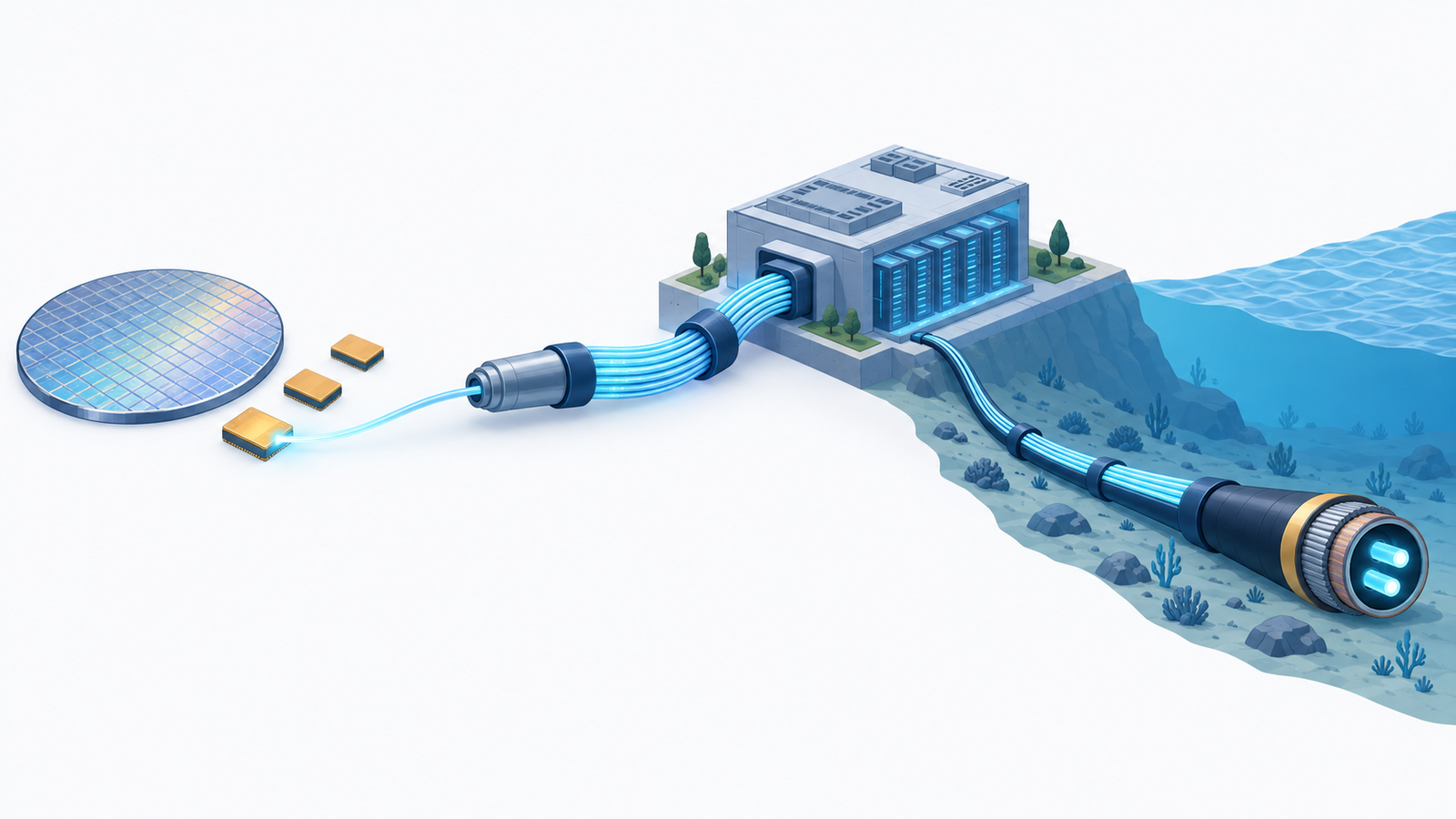
Companies involved in optical communications fall into three broad types: optical components & modules, chips & foundries, and network systems & carriers. Sumitomo Electric is on the optical components side, but what sets it apart from other cable makers is that it owns even the "materials" of the semiconductors that emit light Sourced. According to the Annual Securities Report, besides optical fibre, cable and optical connectors, the company develops and manufactures optical communication devices (products for short-reach links in data centres and devices for long-haul coherent transmission) and also the InP (indium phosphide) substrates and InP- and GaAs-based epitaxial wafers on which they are built. Mid-Term Management Plan 2028 lists "increasing production of modulator-integrated lasers, continuous-wave lasers and InP substrates for lasers" among its main initiatives. In other words, Sumitomo Electric covers optical communications from upstream to downstream in a single company: crystal substrate, then laser chip, then optical fibre, cable and connectors.
2. The logo and how the name is written

The Sumitomo Electric logo is a trademark of the company. We have not recreated it with generated imagery;
the image was taken from the official website and is placed here as img/sumitomo_electric_logo.svg.
A note on names: the legal entity is Sumitomo Electric Industries, Ltd., usually shortened to "Sumitomo Electric". Optical and electronic devices are handled by the Japanese subsidiary Sumitomo Electric Device Innovations, Inc. (formed in 2009), and the U.S. optical fibre and cable business by Sumitomo Electric Lightwave Corp. (founded in 1994). From FY2026 the medium-term plan refers to the "Infocommunications" field as "Digital & AI", but the segment in the Annual Securities Report is still called Infocommunications.
Official site: https://sumitomoelectric.com/jp3. Where the company sits in the optical communications landscape
In terms of where in the optical chain it operates, the company spans the inside of data centres (MT ferrules and high-density optical connector wiring, modulator-integrated lasers and continuous-wave lasers), links between data-centre buildings (ultra-high-fibre-count optical cable), intercontinental submarine links (ultra-low-loss fibre and multi-core fibre) and carriers' access networks (access network equipment such as GE-PON) Sourced. It is involved, through components or materials, in much of the ground covered by our explainers on semiconductor lasers, optical transceivers and IOWN.
4. Scale (the group in brief)
The size of the group as a whole is covered in a single table Sourced.
| Measure (¥ million) | Year to March 2024 | Year to March 2025 | Year to March 2026 |
|---|---|---|---|
| Consolidated net sales | 4,402,814 | 4,679,789 | 5,110,171 |
| Consolidated operating profit | - | 320,663 | 418,173 |
| Consolidated R&D expenses | - | - | 162,858 |
| Consolidated employees (people) | 293,266 | 288,145 | 302,972 |
Optical communications figures are disclosed in the Infocommunications segment. The segment also includes wireless devices such as GaN transistors for base stations, but as the company itself explains, sales rose because demand for optical wiring products, optical cables and optical devices for data centres increased, so light is at its core Sourced.
| Infocommunications (¥ million) | Year to March 2025 | Year to March 2026 |
|---|---|---|
| Net sales | 223,276 | 326,632 |
| Operating profit | 19,926 | 77,435 |
| Operating margin | 8.9% | 23.7% |
| Segment assets | 284,622 | 367,373 |
| R&D expenses | - | 22,233 |
| Capital expenditure (property, plant and equipment received) | - | 23,746 |
| Employees (people, 31 March 2026) | - | 9,240 (plus 1,427 temporary) |
Net sales, operating profit and assets for the year to March 2025 were back-calculated by us from the year-to-March-2026 values and the year-on-year changes given in the Annual Securities Report Our calculation
Infocommunications sales of ¥326.6 billion are 6.4% of consolidated net sales, but its operating profit of ¥77.4 billion is 18.5% of consolidated operating profit Our calculation. The segment receives 13.7% of R&D spending and 9.8% of capital expenditure. If the FY2028 targets in Mid-Term Management Plan 2028 are met (group operating profit of ¥600 billion, of which ¥240 billion from Infocommunications), the segment's share will rise to 40%. The company itself writes that it will expand the share of the Infocommunications segment and diversify its earnings structure Sourced.
5. Resources committed to optical communications and photonics
| Type of resource | What it is | Category |
|---|---|---|
| People (dedicated organisation and staff) | 9,240 employees in the Infocommunications segment (plus 1,427 temporary staff), of whom 1,537 are at the parent company. The main subsidiaries are Sumitomo Electric Device Innovations (Japan) and Sumitomo Electric Lightwave (U.S.). The R&D base for infocommunications is at Yokohama Works | Sourced |
| Money (R&D) | ¥22,233 million in the Infocommunications segment (year to March 2026), 13.7% of consolidated R&D expenses (the percentage is our calculation) | Sourced |
| Money (capital expenditure) | ¥23,746 million in the year to March 2026 (investment to expand and streamline production of optical and electronic devices and optical fibre and cable). For FY2026 to FY2028 the company plans capital expenditure in the Infocommunications segment of about four times the cumulative total for FY2023 to FY2025 (¥1 trillion over three years for the whole group; the amount for Infocommunications itself is not disclosed) | Sourced |
| R&D site | The Annual Securities Report states that a new R&D building has been completed at Yokohama Works and is due to start operating, to accelerate development of optical connectors and optical interconnect components for data centres | Sourced |
| Outside investment, acquisitions and joint ventures | No acquisitions of or investments in companies in optical communications appear in the Annual Securities Report for the year to March 2026 or in the releases we checked. The reorganisation of three Japanese optical equipment subsidiaries (October 2024) and the founding of the Australian sales company SEI Australia (founded June 2025, began operating October 2025) were internal group restructuring | Not confirmed |
| Joint research with public research institutes | With NICT (Japan's national institute for information and communications technology), demonstrated transmission of 1.02 petabits per second over 1,808 km on a 19-core optical fibre with a standard cladding diameter (April 2025). Using a silicon optical switch supplied by the National Institute of Advanced Industrial Science and Technology (AIST), demonstrated dynamic allocation of GPUs with optical switch control software (July 2025) | Sourced |
| Public funding (NEDO and others) | No selection of Sumitomo Electric itself for subsidies or commissioned projects in optical communications appears in the primary sources we checked. The August 2026 release on ITU-T standardisation states that the research commissioned under the NICT-administered fund was carried out by five other companies | Not confirmed |
| University collaboration | No joint research with universities on optical communications appears in the primary sources we checked | Not confirmed |
6. What it has done so far
| When | What happened | Why it matters |
|---|---|---|
| 1897 | The Sumitomo head office opens the Sumitomo Copper Rolling Works in Osaka (the company's founding) | A start in electric wire and copper products |
| 1970 | Begins manufacturing compound semiconductors | The origin of today's InP substrates and optical devices |
| 1974 | Begins manufacturing optical fibre and cable | The start of the optical communications business |
| 1994 | Sumitomo Electric Lightwave Corp. founded in the U.S. | A North American base for optical fibre and cable |
| 2009 | Sumitomo Electric Device Innovations formed through a reorganisation of the optical and electronic device businesses | The device businesses brought together |
| September 2023 | Succeeds in mass-producing "2C Z-PLUS Fiber® ULL", a two-core multi-core fibre for submarine use (described by the company as a world first) | Twice the capacity of earlier fibre (40 terabits per second per fibre) |
| October 2024 | Reorganises its Japanese optical equipment subsidiaries (Sumiden Opcom, Nihon Tsushin Denzai and Sumitomo Electric Optifrontier) | A stronger set-up for the optical equipment business |
| March 2025 | Signs an assembly agreement with 3M for optical connectors using expanded-beam optical interconnect technology (EBO technology). Named in the silicon photonics ecosystem announced by NVIDIA | Joins data-centre optical interconnect and the CPO ecosystem |
| April 2025 | With NICT, achieves transmission of 1.02 petabits per second over 1,808 km on a 19-core fibre with a standard cladding diameter (announced as a world record for standard-diameter fibre) | Long-haul, high-capacity technology at the research stage |
| July 2025 | Demonstrates, in a commercial data centre, dynamic allocation of GPUs to multiple servers using optical switch control software (over 2 m and 1 km) | A concept of separating GPUs from servers with light |
| November 2025 (announced) | Wins the "2025 Implementation of the Year" award at the IOWN Global Forum (for a joint PoC with Sony Group, Fujitsu, NEC and Keysight) | A service demonstration using the APN |
| Year to March 2026 | Infocommunications sales up 46.3%; operating profit up about 3.9-fold to ¥77.4 billion | The year data-centre demand showed up in the numbers |
| April 2026 | Begins working with AFL, Corning and TeraHop on the "SDM4 MCF MSA", a common specification for four-core MCF for data centres | Bringing multi-core fibre into the data centre |
| May 2026 | Publishes Mid-Term Management Plan 2028, renaming the "Infocommunications" field "Digital & AI" | Infocommunications set up as a pillar of profit |
| August 2026 | Seven Japanese companies get APN design guidelines standardised internationally as ITU-T Recommendation Y.3335 (Sumitomo Electric announced that it led the drafting) | An international standard for all-photonic networks |
| September 2026 | Collaboration with Meta and NEC to build "Petal", a transatlantic submarine optical cable. Sumitomo Electric supplies two-core MCF (operation scheduled to start in 2029) | Described by the company as the world's first commercial petabit-class cable |
7. What comes next
Operating profit ¥130 billionMay 2026 results briefing materials
Operating profit ¥240 billionAbout 3.0 times FY2025 sales
Mid-Term Management Plan 2028 lists three main initiatives for the Infocommunications segment Sourced: (1) for data centres, adding value to ultra-high-fibre-count optical cable and investing to raise its output, supplying MT ferrules and high-density optical connector wiring, and increasing production of modulator-integrated lasers, continuous-wave lasers and InP substrates for lasers; (2) for next-generation networks, expanding multi-core optical fibre for submarine and terrestrial use, developing a compact tunable light source, and developing next-generation network equipment for the APN; and (3) GaN devices for base stations, radar and satellites. As its priority market it states explicitly that it aims to raise its share of the North American hyperscale data-centre market.
None of the following appears in the primary sources Not yet confirmed.
The actual capital expenditure for the Infocommunications segment in FY2026 to FY2028 (only the multiple is disclosed); sales and production capacity by product for optical devices, InP substrates and optical cable; the customers and shipment volumes for modulator-integrated and continuous-wave lasers; and which components Sumitomo Electric supplies in NVIDIA's ecosystem (NVIDIA's release only lists company names). The medium-term plan describes the modulator-integrated and continuous-wave lasers as having "a world top-class share", but it cites no market data, so this article does not treat that as a figure.
8. What the company is aiming for in optical communications and photonics
This section goes beyond what the company says directly. It sets out inferences that can be drawn from primary sources, each with its basis.
| What can be read | Primary evidence behind it | Category |
|---|---|---|
| Infocommunications is to become a pillar of profit alongside automotive | Mid-Term Management Plan 2028 states that the company will expand the share of the Infocommunications segment and diversify its earnings structure. Infocommunications accounts for 40% of the FY2028 operating profit target | Sourced |
| Vertical integration from crystal substrate to laser is to be the source of competitiveness | The company develops and manufactures InP substrates, epitaxial wafers and optical devices in house, and the medium-term plan says it will increase production of lasers and InP substrates for lasers at the same time | Inference |
| In CPO and silicon photonics it is aiming to be a supplier of continuous-wave lasers (light sources) | "Continuous-wave lasers" are named as a product whose production will increase, and the company appears in NVIDIA's silicon photonics ecosystem. Which components it supplies has not been disclosed | Inference |
| In multi-core fibre it is positioning itself among those who write the specifications | It mass-produces two-core MCF for submarine use, is drafting an MSA for four-core MCF for data centres with other companies, and led ITU-T standardisation of the APN design guidelines | Inference |
| The main battleground is North American hyperscale data centres | Mid-Term Management Plan 2028 states explicitly that it aims to raise its share of the North American hyperscale data-centre market | Sourced |
Among its initiatives for optical communication products for data centres, Mid-Term Management Plan 2028 lists "increasing production of modulator-integrated lasers, continuous-wave lasers and InP substrates for lasers" in a single line Sourced. Any laser maker might write that it will make more lasers, but few companies put the substrate, the laser's raw material, in the same plan. InP substrates are the foundation of lasers and photodetectors for optical communications, and if substrate supply tightens, laser output stalls too. Sumitomo Electric has manufactured compound semiconductors since 1970 and is in a position not to depend on outsiders for the substrates it needs to make more lasers. Our reading is that, when demand surges, not being held up by materials becomes one of its strengths Not yet confirmed.
9. Map of partnerships in optical communications and photonics
10. Technologies, products and services
| Product | What the primary sources say | Stage |
|---|---|---|
| Ultra-high-fibre-count cable and optical connector wiring | Ultra-high-fibre-count optical cable linking data-centre buildings, MT ferrules, MMC optical connectors, 12- and 16-fibre connectorised cables using 3M's EBO technology, and optical patch panels | In volume production |
| Modulator-integrated and continuous-wave lasers | Optical communication devices fitted in data-centre equipment. Production to be increased under the medium-term plan | In volume production |
| Coherent transmission devices and compact tunable light source | For long-haul trunk equipment. A compact tunable light source that can transmit several wavelengths at once is under development | Partly in volume production; tunable source in development |
| InP substrates and epitaxial wafers | InP- and GaAs-based epitaxial wafers used in optical devices for high-speed communications and in wireless devices. Production of InP substrates for lasers is being increased | In volume production |
| Submarine optical fibre | Ultra-low-loss fibre. The two-core MCF "2C Z-PLUS Fiber® ULL" carries 40 terabits per second per fibre while keeping the same outer diameter as earlier fibre | In volume production (since September 2023) |
| Multi-core fibre for data centres | Four-core MCF for O-band transmission. Requirements for design, performance and interoperability are being drafted in an MSA | Specification stage |
| 19-core optical fibre | A coupled-core 19-core fibre with a standard cladding diameter. Transmission of 1.02 Pb/s over 1,808 km demonstrated with NICT | Research stage |
| Optical access equipment and fusion splicers | Access network equipment such as GE-PON, set-top boxes and CATV-related products, and optical fusion splicers | In volume production |
"World first" (mass production of two-core MCF and the petabit-class submarine cable) and "world record" (19-core transmission) are both the company's own wording. ITU-T Recommendation Y.3335 is a standard approved by the International Telecommunication Union under the title "Framework of low-latency and energy-efficient networks" Sourced.
Sending signals a long way over optical fibre needs lasers that emit light in the wavelength bands where fibre loss is low (the 1.3 µm and 1.55 µm bands). The materials that emit efficiently at these wavelengths are mainly compound semiconductors built up as crystal layers on an InP substrate; silicon by itself emits almost no light. So even as silicon photonics and CPO spread, the dominant design will bring in the light source alone as an external InP-based laser (see our explainer on silicon photonics).
InP substrates are brittle and hard to make in large diameters, and crystal defects feed straight into laser lifetime and yield. Because Sumitomo Electric makes substrates, epitaxial wafers and lasers within the same group, it is in a position to check internally whether a laser defect comes from the substrate or from the process. When demand surges, being able to control both the quantity and the quality of materials yourself translates directly into how fast you can ramp up. How many InP substrates the company sells to outside customers, and how many it uses for its own lasers, has not been disclosed Not yet confirmed.
11. The risks this company carries
| Risk | Substance | Category |
|---|---|---|
| Short product life cycles | The Annual Securities Report says that, besides swings in demand in each field, the company may be affected by product life cycles shortened by technological innovation. Optical devices change generation quickly | Sourced |
| Ambitious targets | The FY2028 Infocommunications sales target of ¥970 billion is about 3.0 times the FY2025 result. A slowdown in data-centre investment would leave it out of reach | Inference |
| Rapid growth in capital expenditure | The plan is to multiply capital expenditure in the Infocommunications segment about fourfold over three years. If demand weakens, only the fixed costs remain | Inference |
| Opacity on customers and products | Customer names for optical devices, sales by product and the company's role in NVIDIA's ecosystem are not disclosed, so concentration cannot be checked from outside | Not yet confirmed |
| Exchange rates and trade | The medium-term plan assumes ¥150 to the US dollar. The Annual Securities Report mentions changes in U.S. tariff policy and geopolitical risk | Sourced |
| Uneven profit within the segment | The 23.7% Infocommunications margin covers the whole segment, including GaN wireless devices and others. The margin on optical products alone is not disclosed | Sourced |
12. Glossary
- InP (indium phosphide)
- A compound semiconductor substrate material that forms the foundation of lasers and photodetectors for optical communications.
- Modulator-integrated laser
- A light source with a laser and an optical modulator integrated on one chip. Used in data-centre optical transceivers.
- Continuous-wave laser
- A laser that emits light of constant intensity continuously. Used as an external light source in silicon photonics and CPO.
- Multi-core fibre (MCF)
- A fibre with several cores inside one strand. Raises transmission capacity without changing the outer diameter.
- MSA
- Multi-Source Agreement. An arrangement in which several companies agree a common specification so that compatible products can be made.
- APN
- All-Photonics Network. A low-latency, low-power network that carries signals as light without converting them to electrical signals along the way.
- EBO technology
- 3M's expanded-beam optical interconnect technology. A lens spreads the light, so fibre end faces are connected without touching each other.
- MMC
- The name of a very small form factor (VSFF) multi-fibre optical connector for data centres, developed by US Conec.
13. References
- Sumitomo Electric Industries, Ltd. Annual Securities Report for the 156th fiscal period (1 April 2025 to 31 March 2026), filed 26 June 2026 (in Japanese). Key financial indicators, company history, lines of business, management policy, business risks, segment results, R&D activities, capital expenditure and headcount. https://sumitomoelectric.com/jp/sites/japan/files/2026-06/download_documents/yuuka156.pdf
- Sumitomo Electric Industries, Ltd. Mid-Term Management Plan 2028 (May 2026, in Japanese). FY2028 targets for the Infocommunications segment, main initiatives, the North American hyperscale data-centre market, the capital expenditure multiple and assumed exchange rates. https://sumitomoelectric.com/jp/sites/japan/files/2026-05/download_documents/28m.pdf
- Sumitomo Electric Industries, Ltd. FY2025 results briefing materials (22 May 2026, in Japanese). FY2026 forecasts by segment and Infocommunications initiatives. https://sumitomoelectric.com/jp/sites/japan/files/2026-05/download_documents/20260522ceo.pdf
- Sumitomo Electric Industries, Ltd. Press release: Meta, NEC and Sumitomo Electric collaborate to build "Petal", the world's first commercial petabit-class submarine optical cable system (September 2026, in Japanese). https://sumitomoelectric.com/jp/press/2026/09/prs105
- Sumitomo Electric Industries, Ltd. Press release: Receives the MM Research Institute Award 2026 Judges' Special Award for the world's first mass production of submarine multi-core optical fibre (August 2026, in Japanese). Specifications of 2C Z-PLUS Fiber® ULL and its mass production from September 2023. https://sumitomoelectric.com/jp/press/2026/08/prs097
- Sumitomo Electric Industries, Ltd. and others Press release: Collaboration begins on a common specification for multi-core optical fibre for AI data centres (April 2026, in Japanese). https://sumitomoelectric.com/jp/press/2026/04/prs038
- KDDI, NTT, 1FINITY, NEC, Rakuten Mobile, Oki Electric Industry and Sumitomo Electric Industries Press release: ITU-T Standardizes Framework of Low-Latency and Energy-Efficient Networks to Support the AI Era (21 August 2026; title of the English version issued by 1Finity, link to the Japanese release). https://sumitomoelectric.com/jp/press/2026/08/prs095
- Sumitomo Electric Industries, Ltd. and 3M Press release: Sumitomo Electric and 3M sign an assembly agreement on optical interconnect technology for data centres (March 2025, in Japanese). https://sumitomoelectric.com/jp/press/2025/03/prs037
- Sumitomo Electric Industries, Ltd. and NICT Press release: New world record: 1.02 petabits per second transmitted over 1,808 km on a 19-core optical fibre with a standard cladding diameter (24 April 2025, in Japanese). https://sumitomoelectric.com/jp/press/2025/04/prs056
- Sumitomo Electric Industries, Ltd. Press release: Successful demonstration of dynamic GPU allocation to multiple servers using optical switch control software developed by the company (30 July 2025, in Japanese). https://sumitomoelectric.com/jp/press/2025/07/prs106
- Sumitomo Electric Industries, Ltd. Press release: Sumitomo Electric Receives the "2025 Implementation of the Year Award" from the IOWN Global Forum™ (November 2025; title of the English version, link to the Japanese release). https://sumitomoelectric.com/jp/press/2025/11/prs150
- Sumitomo Electric Industries, Ltd. Press release: Reorganisation of Japanese subsidiaries in the optical equipment business (July 2024, in Japanese). https://sumitomoelectric.com/jp/press/2024/07/prs073
- Sumitomo Electric Industries, Ltd. Press release: Sales company established in Australia to expand the infocommunications business (14 October 2025, in Japanese). https://sumitomoelectric.com/jp/press/2025/10/prs129
- NVIDIA Press release "NVIDIA Announces Spectrum-X Photonics, Co-Packaged Optics Networking Switches to Scale AI Factories to Millions of GPUs" (18 March 2025). Sumitomo Electric Industries is listed in the silicon photonics ecosystem. https://nvidianews.nvidia.com/news/nvidia-spectrum-x-co-packaged-optics-networking-switches-ai-factories
- Sumitomo Electric Industries, Ltd. Official website (source of the company name and logo image). https://sumitomoelectric.com/jp
14. Claim-to-source audit
| Claim in the article | Category | Source |
|---|---|---|
| Legal name, English name, head office address, founding in 1897, listing in 1949, start of compound semiconductor production in 1970 and of optical fibre in 1974, founding of SEL in 1994, formation of SEDI in 2009 | Sourced | Reference 1 https://sumitomoelectric.com/jp/sites/japan/files/2026-06/download_documents/yuuka156.pdf |
| Consolidated net sales, operating profit, R&D expenses and headcount | Sourced | Reference 1 https://sumitomoelectric.com/jp/sites/japan/files/2026-06/download_documents/yuuka156.pdf |
| Infocommunications sales of ¥326.6 billion, operating profit of ¥77.4 billion, 23.7% margin and year-on-year changes, segment assets, R&D expenses, capital expenditure and headcount | Sourced | Reference 1 https://sumitomoelectric.com/jp/sites/japan/files/2026-06/download_documents/yuuka156.pdf |
| Main products and main subsidiaries, InP and GaAs epitaxial wafers, optical communication devices, the new R&D building in Yokohama | Sourced | Reference 1 https://sumitomoelectric.com/jp/sites/japan/files/2026-06/download_documents/yuuka156.pdf |
| Risk disclosures on shorter product life cycles and political conditions, mention of U.S. tariff policy | Sourced | Reference 1 https://sumitomoelectric.com/jp/sites/japan/files/2026-06/download_documents/yuuka156.pdf |
| FY2028 targets (Infocommunications ¥970 billion and ¥240 billion, group ¥600 billion), the renaming to "Digital & AI", main initiatives, North American hyperscale data centres, capex of about four times, assumed exchange rates | Sourced | Reference 2 https://sumitomoelectric.com/jp/sites/japan/files/2026-05/download_documents/28m.pdf |
| Infocommunications forecast for FY2026 (sales ¥500 billion, operating profit ¥130 billion) | Sourced | Reference 3 https://sumitomoelectric.com/jp/sites/japan/files/2026-05/download_documents/20260522ceo.pdf |
| Outline of Petal (about 7,000 km, operation scheduled from 2029, 24 fibre pairs, two-core MCF supplied by Sumitomo Electric) | Sourced | Reference 4 https://sumitomoelectric.com/jp/press/2026/09/prs105 |
| Mass production of 2C Z-PLUS Fiber® ULL from September 2023 and 40 terabits per second | Sourced | Reference 5 https://sumitomoelectric.com/jp/press/2026/08/prs097 |
| The SDM4 MCF MSA collaboration (AFL, Corning, TeraHop) and four-core MCF for the O band | Sourced | Reference 6 https://sumitomoelectric.com/jp/press/2026/04/prs038 |
| Adoption of ITU-T Recommendation Y.3335 (13 August 2026), the seven companies, and the five companies that carried out the research commissioned under the NICT fund | Sourced | Reference 7 https://sumitomoelectric.com/jp/press/2026/08/prs095 |
| The assembly agreement with 3M on EBO technology | Sourced | Reference 8 https://sumitomoelectric.com/jp/press/2025/03/prs037 |
| 19-core, 1.02 Pb/s, 1,808 km transmission with NICT | Sourced | Reference 9 https://sumitomoelectric.com/jp/press/2025/04/prs056 |
| Demonstration of dynamic GPU allocation by optical switch (AIST's silicon optical switch, 2 m and 1 km) | Sourced | Reference 10 https://sumitomoelectric.com/jp/press/2025/07/prs106 |
| The IOWN Global Forum award and the partners in the joint PoC | Sourced | Reference 11 https://sumitomoelectric.com/jp/press/2025/11/prs150 |
| Reorganisation of three Japanese optical equipment subsidiaries | Sourced | Reference 12 https://sumitomoelectric.com/jp/press/2024/07/prs073 |
| Founding and start of operations of SEI Australia | Sourced | Reference 13 https://sumitomoelectric.com/jp/press/2025/10/prs129 |
| That the company is listed in NVIDIA's silicon photonics ecosystem | Sourced | Reference 14 https://nvidianews.nvidia.com/news/nvidia-spectrum-x-co-packaged-optics-networking-switches-ai-factories |
| 6.4% of sales, 18.5% of operating profit, 13.7% of R&D, 9.8% of capex, 40% in FY2028, about 3.0 times, and the back-calculated values for the year to March 2025 | Our calculation | Calculated by this article from figures in references 1 to 3 |
| The three types of optical communications company | Our calculation | Our own classification. Companies shown are examples from those in this series |
| The actual Infocommunications capex, sales and capacity by product, laser customers and volumes, components supplied in NVIDIA's ecosystem, the share of InP substrates sold externally | Not yet confirmed | Not in references 1 to 3 or 14. Figures from press reports are not used https://sumitomoelectric.com/jp/sites/japan/files/2026-05/download_documents/28m.pdf |
| The company's description of a "world top-class share" | Not yet confirmed | Not used as a figure because no underlying market data is given https://sumitomoelectric.com/jp/sites/japan/files/2026-05/download_documents/28m.pdf |
| Acquisitions or investments in optical communications, public funding awarded to Sumitomo Electric itself, joint research with universities | Not yet confirmed | Not in the primary sources we checked. This article does not conclude that none exists https://sumitomoelectric.com/jp/sites/japan/files/2026-06/download_documents/yuuka156.pdf |
| The reading that vertical integration from crystal substrate to laser is the source of competitiveness | Inference | This article's interpretation of references 1 and 2 |
| The reading that it aims to supply continuous-wave lasers for CPO | Inference | This article's interpretation of references 2 and 14 |
| The reading that it is positioning itself among those who write the specifications for multi-core fibre | Inference | This article's interpretation of references 5 to 7 |
| The explanation of why InP-based lasers remain the light source, and of the advantage of owning substrates | Not yet confirmed | This article's explanation, based on general knowledge of optical semiconductors |
| The risks of ambitious targets and of rapidly growing capital expenditure | Inference | This article's interpretation of references 2 and 3 |
Last updated 26 September 2026 / Troy Technical
Every figure in this article comes from the Annual Securities Report, medium-term management plan, results briefing materials and press releases published by Sumitomo Electric Industries, Ltd., and from NVIDIA's official release. No research-firm estimates or press-based figures have been used. Passages marked "Inference" are this article's interpretation of primary sources, not statements made by the company.