COMPANY PROFILE / OPTICAL COMMUNICATIONS & PHOTONICS
Tower Semiconductor
An Israeli foundry that has locked in volume with photonic chips for pluggables and is multiplying its capacity in Japan
Tower Semiconductor is an Israel-headquartered foundry specialising in analogue semiconductors. In optical communications it is one of the few companies already making silicon photonics chips in large volumes for data centre optical transceivers, and it says its silicon photonics revenue (which it abbreviates as SiPho) reached an annualised US$680 million in the second quarter of 2026. In May 2026 it announced US$1.3 billion of customer contracts for 2027 and US$290 million in prepayments, and in July a large capacity expansion in Japan backed by the Japanese government. This profile confines the company-wide figures to a single table and sets out what Tower makes in optics and in what volume, whom it works with and where it is investing, using only the Form 20-F and Forms 6-K (reports that attach its official announcements) filed with the U.S. SEC.
- Tower Semiconductor in 30 seconds, and where it stands in optical communications and photonics
- The logo and how the name is written
- Where the company sits in optical communications and photonics
- Scale
- Resources committed to optical communications and photonics
- Track record so far
- Plans ahead
- What the company is aiming for in optical communications and photonics
- Partnership map
- Technologies, products and services
- The risks this company carries
- Glossary, references and claim-to-source audit
1. Tower Semiconductor in 30 seconds, and where it stands in optical communications and photonics
IsraelRamat Gavriel Industrial Park
inside the data centreAlso coherent optics between data centres, LiDAR, optical switching and quantum
annualisedSecond quarter of 2026, up from US$180 million a year earlier
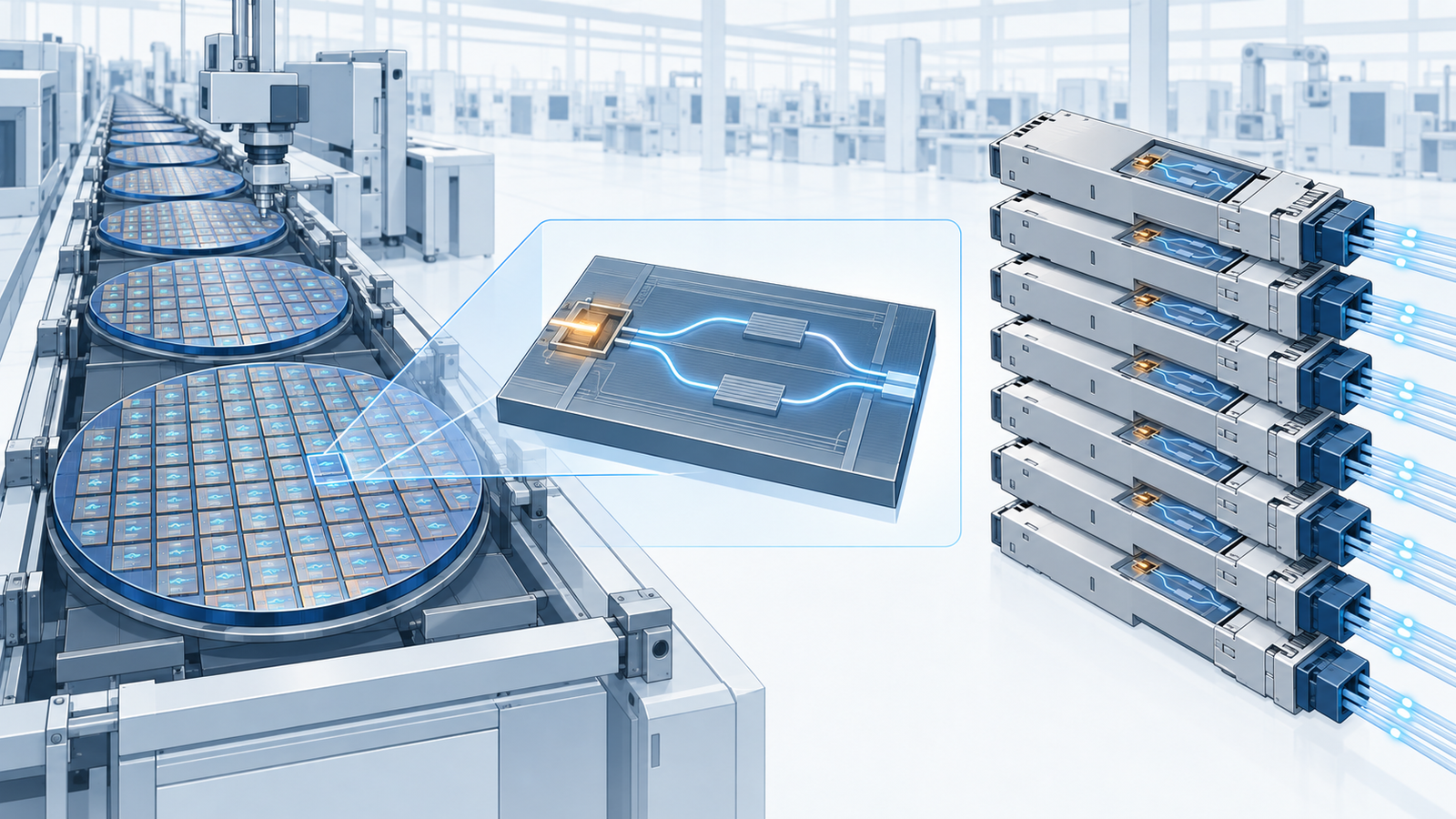
Companies involved in optical communications fall into three broad types: optical components & modules, chips & foundries, and network systems & carriers. Tower belongs to chips & foundries and manufactures, under contract, photonic chips designed by optical transceiver companies Sourced. According to the 20-F, the SiPho chips made in its fabs are used mainly in pluggable optical transceivers.
Where TSMC, a fellow foundry, talks mostly about CPO (co-packaged optics) as "the shape of things to come", Tower's defining feature is that it is making large volumes of the photonic chips for the pluggables selling today. In its fourth-quarter 2025 earnings release, the company said it is a primary provider for 1.6T (1.6 terabits per second) optical transceivers (a company claim).
2. The logo and how the name is written

The Tower Semiconductor logo is a trademark of the company. We have not recreated it with generated imagery;
the image is the logo published on the official website, placed here as img/tower_semiconductor_logo.png.
A note on names: the legal name is Tower Semiconductor Ltd. Its Japanese fabs, taken over from Panasonic, have been run as TPSCo (51% Tower, 49% on the Nuvoton side), but this is due to be restructured by around April 2027 (section 6). This article uses the short form Tower.
Official site: https://towersemi.com/3. Where the company sits in optical communications and photonics
The middle box in Fig. 1 says "owns the switches and GPUs", a trait of chip companies with their own products such as NVIDIA and Broadcom, which does not apply to Tower. Tower owns no end products; it takes manufacturing orders from optical transceiver and optical switch companies Not yet confirmed. How a pluggable optical transceiver is put together is covered in our explainers on optical transceivers and on silicon photonics.
4. Scale
Tower's revenue is relatively small and the weight of optics is rising fast, so we show both the company as a whole and SiPho Sourced.
| Measure | FY2023 | FY2024 | FY2025 |
|---|---|---|---|
| Revenue (US$ million) | 1,422.7 | 1,436.1 | 1,566.1 |
| R&D expense (US$ million) | 79.8 | 79.4 | 86.5 (5.5% of revenue) |
| Employees (31 December) | 5,215 | 5,359 | 5,316 |
| of whom process and product engineering, R&D and design | 887 | 882 | 852 |
| SiPho revenue (company announcements) | Q2 2025 | Q2 2026 | Q4 2026 (target) |
|---|---|---|---|
| Annualised revenue pace (run rate) | US$180 million | US$680 million | Over US$1 billion |
Company-wide revenue in the second quarter of 2026 was US$460 million Sourced. If the SiPho figure of "US$680 million annualised" is taken to mean quarterly revenue times four, quarterly SiPho revenue was about US$170 million, or about 37% of the company total Our calculation. The same calculation a year earlier gives about US$180 million / 4 = US$45 million, about 12% of company revenue in the second quarter of 2025 (about US$371 million, back-calculated from the stated 24% year-on-year growth) Our calculation. The company does not explain how it calculates its "annual run rate", however, so these ratios are only a guide. Either way, the company's own numbers show that within a year SiPho has become one of its main businesses.
5. Resources committed to optical communications and photonics
As a matter of method, we checked four things: people, money, external investment or acquisitions, and universities or public funding.
| Resource | Details | Category |
|---|---|---|
| People (dedicated teams and staff) | Dedicated optics headcount is not disclosed. In the announcement on coherent PICs for Marvell, the comment came from the vice president and general manager of the RF Business Unit, which suggests SiPho is run under the RF and high-performance analogue business unit. Process, R&D and design staff total 852 company-wide | Not disclosed (organisation partly confirmed) |
| Money (capital spending) | A US$920 million capital spending plan (US$650 million plus US$270 million added in February 2026), mainly to increase SiPho and SiGe capacity in Israel (Fab 2), the United States (Fabs 3 and 9) and Japan (Fab 7) | Sourced |
| Money (large investment in Japan) | With Japanese government support, it plans to convert the existing Arai fab (formerly Fab 6) to 300 mm SiPho and advanced packaging, and to build a new 300 mm fab next to Fab 7 in Uozu. It announced a Tower investment of about US$3 billion, net of US$1 billion in Japanese government grants | Sourced (new fab not yet contracted) |
| Money (R&D) | US$86.5 million company-wide (2025). No SiPho breakdown | Not disclosed |
| Money from customers | Received US$290 million in prepayments for capacity reserved for 2027. Prepayments for 2028 are due by January 2027 | Sourced |
| Investments, acquisitions and joint ventures | No investments in or acquisitions of optics-related companies appear in the materials reviewed. In Japan it plans to restructure the TPSCo joint venture and move the 300 mm Fab 7 into a wholly owned Tower subsidiary (targeted for completion on 1 April 2027) | Optics investments and acquisitions could not be confirmed |
| Securing materials | A multi-year supply agreement for InP epiwafers with IQE of the UK (with a minimum purchase commitment in the first year). At the same time, the two companies settled their litigation over porous silicon patents | Sourced |
| Universities, research institutes, public funding | Public funding is the Japanese government grant above. On universities, it says it will deepen ties with Japanese universities and research institutes, but names none | Public funding sourced; universities could not be confirmed |
6. Track record so far
| When | What happened | What it means |
|---|---|---|
| Up to 2025 | In volume production on two SiPho platforms, the 200 mm PH18 and the 300 mm PH45. The 20-F describes them as leading SiPho platforms for the 400 Gb/s to 1.6 Tb/s market | Builds a volume track record in pluggable transceivers |
| Full year 2025 | Revenue of US$1,566.1 million (up 9% year on year). The earnings release highlights very high adoption of SiPho and its strong incremental margins | Optics starts to drive profit growth |
| January 2026 | Collaboration with LightIC on FMCW LiDAR (for vehicles and robots) | Expansion beyond the data centre |
| 5 February 2026 | Announces SiPho for 1.6T optical modules designed for NVIDIA's networking protocols, with a comment from an NVIDIA senior vice president | Makes public its relationship with one of the largest outlets |
| 11 February 2026 | Adds US$270 million to capital spending, for US$920 million in total. Targets December 2026 SiPho capacity of more than five times the fourth-quarter 2025 run rate. More than 70% of SiPho capacity is reserved, or in the process of being reserved, through 2028 | Backs its bet on future demand with customer prepayments |
| February 2026 | Announces with Scintil Photonics the availability of light sources integrating DWDM lasers ("world's first" is the two companies' claim). Moves towards production readiness of optical circuit switches with Salience Labs. Expands its photonic quantum computing collaboration with Xanadu | Light sources for CPO, and expansion into optical switching and quantum |
| March 2026 | Collaboration with Oriole Networks on nanosecond optical circuit switching. With Coherent, demonstrates 400 Gb/s-per-lane transmission using a silicon modulator with no exotic materials (presented at OFC). Announces restructuring of TPSCo, its Japanese joint venture | Shows that silicon may still compete in the next, 3.2T, generation |
| 13 May 2026 | Signs US$1.3 billion of SiPho contracts for 2027 with its largest customers and receives US$290 million in prepayments, with even larger commitments for 2028. More than 50 SiPho customers | Secures demand two years out by contract |
| June 2026 | InP epiwafer supply agreement with IQE. More than 5 million coherent PICs shipped cumulatively for Marvell | Locks in InP material supply and shows a volume track record in optics between data centres too |
| 14 July 2026 | Announces a two-track expansion of 300 mm SiPho, SiGe and advanced optical packaging with Japanese government support. Raises its 2028 targets to US$3.6 billion of revenue and US$1.2 billion of net profit | Makes Japan its largest expansion base |
| August 2026 | Announces that OpenLight's design kit is now available in Cadence tools, making it easier to design for PH18DA, its InP-on-silicon platform. SiPho reaches US$680 million annualised in the second quarter | Puts in place a design environment for laser-integrated photonic chips |
| 17 September 2026 | Announces with NewPhotonics high-volume shipments of laser-integrated optical engine PICs (800G to 1.6T). A chipset for 6.4T NPO is scheduled for volume shipment in the first half of 2027 | Laser-integrated chips enter volume production |
7. Plans ahead
annualised in Q4 2026Company plan. It says 2027 will also grow strongly
US$1.2 billion net profitCompany targets raised in July 2026
On technology, the 20-F says that for the next 3.2T platform and future CPO it is developing and prototyping wafer-to-wafer bonding, lasers including DWDM, III-V modulators and TSVs for integration into SiPho chips Sourced. The May 2026 announcement explains that it is developing several next-generation modulation approaches in parallel with customers, including thin-film lithium niobate (TFLN), InP and organic modulators, micro-ring modulators, silicon electro-absorption modulators and micro-LEDs.
None of the following appears in Tower's 20-F or 6-K filings Not yet confirmed.
The names of the counterparties to the US$1.3 billion contracts / SiPho revenue by customer or application / dedicated SiPho headcount / when the second Japanese track (the new fab) will be completed and when its contract will be signed / when volume production for CPO begins / how the "run rate" is calculated. Market forecasts from research firms (Yole, Dell’Oro, LightCounting, 650 Group) quoted in various announcements are not the company's own figures, so this article does not use them.
8. What the company is aiming for in optical communications and photonics
This section includes things the company does not say directly. We set them out as inferences within what the primary sources support, with the evidence for each.
| What the evidence suggests | Primary information it rests on | Category |
|---|---|---|
| First to cement volume leadership in pluggable transceivers, then use those profits to move into NPO and CPO | The 20-F says its chips are mainly for pluggables and treats CPO as future. In the contract announcement the CEO said Tower is well positioned to support "today's high-volume pluggable optical transceivers as well as next-generation Near-Packaged Optics (NPO) and Co-Packaged Optics (CPO) solutions" | Inference |
| To push silicon as far as it will go in the next generation and reuse its equipment | In the Coherent demonstration announcement the CEO said the result "can extend the use of silicon for another generation of transceivers, re-utilizing the large multi-fab capacity investments we continue to make" | Sourced |
| Not to bet on one modulation approach but to be ready with a range | It says it is developing TFLN, InP, organic, micro-ring, electro-absorption and micro-LED approaches with customers in parallel | Inference |
| To bring the light source into its own platform | On PH18DA, which incorporates InP lasers, NewPhotonics' laser-integrated PICs have entered volume shipment, and Scintil's DWDM light source, OpenLight's design kit and IQE's InP material supply are all in place | Sourced |
| To make Japan its largest expansion base and spread its production geographically | The planned investment of about US$3 billion in Japan. The 20-F says that because of the conflict in the Middle East since February 2026 equipment vendors could not enter Israel, which could delay installation | Inference |
| To widen the uses of optics beyond the data centre | A string of collaborations announced on LiDAR (LightIC), optical circuit switches (Salience, Oriole) and photonic quantum (Xanadu) | Inference |
After 200 Gbps per lane comes 400 Gbps, a speed at which silicon modulators are generally said to be near their limit, and companies are researching a move to other materials such as TFLN and InP (see our explainers on optical modulation and modulation formats, and on thin-film lithium niobate). In March 2026, Tower and Coherent showed an open 420 Gb/s PAM4 eye using a silicon Mach-Zehnder modulator made in a production-ready SiPho process Sourced. This is a demonstration, not a product, and the light source was Coherent's InP laser. Even so, the CEO's added remark about re-utilising the large multi-fab capacity investments matters. The US$920 million of equipment and the Japan expansion are investments mainly in silicon processes. If the same equipment can serve the next generation, the payback period lengthens; if not, a separate process for different materials will have to be set up. We read Tower as hedging between extending silicon and building a range of new materials Not yet confirmed.
9. Partnership map
10. Technologies, products and services
| Item | What the official materials say | Volume production or demonstration |
|---|---|---|
| PH18 (200 mm) | 0.18 µm design rules. The 20-F says the SiPho chips contain waveguides, splitters, modulators and photodiodes for monitoring laser light | In volume production |
| PH45 (300 mm) | 65 to 45 nm design rules. For optical transceivers from 400 Gb/s to 1.6 Tb/s | In volume production. The latest 1.6T version is ramping to volume |
| PH18DA (InP on silicon) | Heterogeneously integrates InP components, putting lasers, optical amplifiers (SOAs), modulators and photodetectors on a single PIC | In volume production (shipping NewPhotonics' 800G to 1.6T PICs) |
| Silicon nitride waveguides | A platform with low-loss silicon nitride waveguides (TPS45PH), used for optical circuit switches | Pre-production (Salience Labs) |
| Coherent PICs | PICs that control the phase and polarisation of light as well. More than 5 million shipped cumulatively for Marvell | In volume production |
| 400G per lane | 420 Gb/s PAM4 with a silicon Mach-Zehnder modulator. Separately, the company says it has shown "400GHz/lane" modulator and detector performance with heterogeneously integrated InP/SiPho and with TFLN as well | Demonstration |
| DWDM lasers | DWDM laser light sources heterogeneously integrated on Tower's process using Scintil's SHIP technology (for CPO) | Announced as available; at the customer evaluation stage |
| SiGe BiCMOS | For the electrical side (EIC) of optical transceivers. Offered together with SiPho | In volume production |
| Elements in development | Wafer-to-wafer (hybrid) bonding, III-V modulators, TSVs (for 3.2T and CPO) | Development and prototyping |
"A primary provider for 1.6T" and "the world's first heterogeneously integrated DWDM lasers" are claims by the company (and its partners) Sourced. The statement that NewPhotonics' 6.4T chipset complies with the CPX MSA comes from the two companies' announcement; this article has not checked it with the standards body Not yet confirmed. For where heterogeneous integration and InP fit in, see our explainers on photonic integrated circuits and indium phosphide, on semiconductor lasers and on silicon nitride waveguides.
On an InP-on-silicon platform such as PH18DA, an epiwafer, an InP substrate with many layers such as the light-emitting layer grown on top, is prepared, bonded to the silicon wafer, and then made into lasers and optical amplifiers. Laser characteristics are largely fixed by the composition, thickness and defect density of these epitaxial layers, so the quality and supply of epiwafers directly cap the yield and shipments of the photonic chips Not yet confirmed. What Tower signed with IQE is a multi-year agreement with a minimum purchase commitment in the first year and minimum volume commitments thereafter Sourced. At the same time, the porous silicon patent litigation between the two was settled with a royalty-free licence to IQE. Silicon processing can be scaled up in its own fabs, but compound semiconductor materials depend on outside suppliers, and the more the light source is brought in house, the stronger that dependence becomes.
11. The risks this company carries
| Risk | Details | Category |
|---|---|---|
| Refunds of prepayments and penalties | The forward-looking statement caveats in the earnings release explicitly mention possible compensation, penalties and refunds of prepayments if the company cannot meet demand | Sourced |
| Delays in installing equipment | The 20-F states that because of the conflict in the Middle East since February 2026 equipment vendors could not enter Israel, which could delay execution of the US$920 million investment plan | Sourced |
| Non-performance on 300 mm capacity | The 20-F states that Intel has indicated it will not perform the agreement to manufacture 300 mm wafers at its New Mexico fab, and that the matter is in mediation | Sourced |
| Price and demand swings | The 20-F states that AI demand and wafer prices are volatile, and that a downturn could bring oversupply and price pressure in SiPho and SiGe | Sourced |
| Concentration on large customers | The US$1.3 billion contracts are with its "largest customers", with neither names nor number disclosed. Changes in a few customers' ordering plans would likely have a big impact | Inference |
| Dependence on pluggables | Today's SiPho is mainly for pluggables. If the shift to CPO moves control of packaging to large chip companies, the way foundries are chosen may change | Inference |
| Competition from other foundries | TSMC (COUPE), GlobalFoundries (the AMF acquisition and SCALE) and UMC, all covered in this series, have also officially put forward silicon photonics foundry services | Our calculation |
12. Glossary
- SiPho
- Tower's abbreviation for silicon photonics: building optical circuits onto silicon wafers.
- PIC / EIC
- A PIC is a chip of optical circuits, an EIC a chip of electrical circuits. Tower makes the former in SiPho and the latter in SiGe.
- Coherent PIC
- A PIC for sending information using not just the intensity of light but its phase and polarisation too. Used over longer distances such as between data centres.
- Heterogeneous integration
- Bonding a different material such as InP onto silicon so that devices of different materials share one chip.
- Mach-Zehnder modulator (MZM)
- A modulator that splits light into two paths, shifts their phase and recombines them to change the light's intensity.
- PAM4
- A modulation scheme that divides light intensity into four levels to send two bits at a time.
- Optical circuit switch (OCS)
- A switch that changes the path of light without converting it back into electricity.
- Run rate
- A revenue pace obtained by stretching one period's revenue to a full year. Its meaning depends on how the company calculates it.
13. References
- Tower Semiconductor Form 20-F for the fiscal year ended December 31, 2025 (filed with the U.S. SEC on 30 April 2026). SiPho description, PH18 and PH45, technologies in development, the US$920 million investment plan, capacity reservations and prepayments, fabs, revenue, R&D expense and headcount, and risks including the conflict and the Intel agreement. https://www.sec.gov/Archives/edgar/data/928876/000117891326002318/zk2635149.htm
- Tower Semiconductor Fourth-quarter and full-year 2025 earnings release (Form 6-K exhibit, 11 February 2026). The additional US$270 million investment, the target of more than five times capacity, over 70% of capacity reserved, and the description of Tower as a primary provider for 1.6T. https://www.sec.gov/Archives/edgar/data/928876/000117891326000404/exhibit_99-1.htm
- Tower Semiconductor Second-quarter 2026 earnings release (Form 6-K exhibit, 4 August 2026). Quarterly revenue, the SiPho annualised revenue, the 2028 targets and the caveat on refunds of prepayments. https://www.sec.gov/Archives/edgar/data/928876/000117891326003776/exhibit_99-1.htm
- Tower Semiconductor Official announcement, "Tower Semiconductor Signs Customer Contracts for $1.3 Billion Silicon Photonics Revenue for 2027" (Form 6-K, 13 May 2026). The US$1.3 billion contracts, US$290 million in prepayments, more than 50 customers, and development of next-generation modulators. https://www.sec.gov/Archives/edgar/data/928876/000117891326002609/zk2635309.htm
- Tower Semiconductor Official announcement, "Tower Semiconductor with METI Support Announces Strategic Capacity Expansion in Japan" (Form 6-K, 14 July 2026). The two-track expansion, an investment of about US$3 billion and US$1 billion in grants, and the raised 2028 targets. https://www.sec.gov/Archives/edgar/data/928876/000117891326003477/zk2635682.htm
- Tower Semiconductor Official announcement, "Tower Semiconductor Announces Plans to Expand 300mm Capacity in Japan to Support Strong Customer Demand" (Form 6-K, 25 March 2026). Restructuring of TPSCo and making Fab 7 a wholly owned subsidiary. https://www.sec.gov/Archives/edgar/data/928876/000117891326001695/zk2634949.htm
- Tower Semiconductor Official announcement, "Tower Semiconductor and Marvell Ship Over Five Million Coherent Photonic ICs" (Form 6-K, 18 June 2026). https://www.sec.gov/Archives/edgar/data/928876/000117891326003242/zk2635572.htm
- Tower Semiconductor Official announcement, "Tower Semiconductor Teams with NVIDIA to Advance AI Infrastructure with 1.6T Data Center Optical Modules" (Form 6-K, 5 February 2026). https://www.sec.gov/Archives/edgar/data/928876/000117891326000303/zk2634292.htm
- Tower Semiconductor Official announcement, "Tower Semiconductor and Coherent Demonstrate 400Gbps/lane Data Transmission with a Silicon Modulator in a Production-Ready Sipho Process" (Form 6-K, 23 March 2026). https://www.sec.gov/Archives/edgar/data/928876/000117891326001579/zk2634893.htm
- Tower Semiconductor / IQE Official announcement, "IQE and Tower Semiconductor Announce Multi-year InP epiwafer Supply Agreement" (Form 6-K, 15 June 2026). https://www.sec.gov/Archives/edgar/data/928876/000117891326003180/zk2635540.htm
- Tower Semiconductor Official announcement, "Tower Semiconductor and Scintil Photonics Announce Availability of World’s First Heterogeneously Integrated DWDM Lasers for AI Infrastructure" (Form 6-K, 17 February 2026). https://www.sec.gov/Archives/edgar/data/928876/000117891326000479/zk2634383.htm
- Tower Semiconductor Official announcement, "OpenLight and Tower Semiconductor Expand PH18DA Photonics Ecosystem to Accelerate Photonic IC Development" (Form 6-K, 11 August 2026). https://www.sec.gov/Archives/edgar/data/928876/000117891326004009/zk2635926.htm
- Tower Semiconductor Official announcement, "NewPhotonics and Tower Semiconductor Begin High-Volume Shipments of Laser-Integrated, Serviceable Optical Engine PICs" (Form 6-K, 17 September 2026). https://www.sec.gov/Archives/edgar/data/928876/000117891326004535/zk2636128.htm
- Tower Semiconductor Official announcement, "Tower Semiconductor Partners with LightIC to Expand Silicon Photonics Beyond AI Infrastructure into Physical AI and Automotive" (Form 6-K, 5 January 2026). https://www.sec.gov/Archives/edgar/data/928876/000117891326000026/zk2634181.htm
- Tower Semiconductor Official announcement, "Salience Labs and Tower Semiconductor Partner to Manufacture At-Scale Optical Circuit Switches for Next-Generation Data Centers" (Form 6-K, 25 February 2026). https://www.sec.gov/Archives/edgar/data/928876/000117891326000619/zk2634442.htm
- Tower Semiconductor Official announcement, "Tower Semiconductor Teams up with Oriole to Advance AI Infrastructure and Networking with Nanosecond Optical Circuit Switching" (Form 6-K, 16 March 2026). https://www.sec.gov/Archives/edgar/data/928876/000117891326000884/zk2634680.htm
- Tower Semiconductor Official announcement, "Xanadu and Tower Semiconductor Deepen Strategic Collaboration to Accelerate Photonic Quantum Hardware Innovation" (Form 6-K, 19 February 2026). https://www.sec.gov/Archives/edgar/data/928876/000117891326000565/zk2634409.htm
- Tower Semiconductor Official website (source of the company name style and the logo image). https://towersemi.com/
14. Claim-to-source audit
| Claim in the article | Category | Source |
|---|---|---|
| Legal name, Israeli company, headquarters address, revenue, R&D expense and headcount (2023 to 2025) | Sourced | Reference 1 https://www.sec.gov/Archives/edgar/data/928876/000117891326002318/zk2635149.htm |
| SiPho chips used mainly in pluggable transceivers; PH18 and PH45 in volume production; technologies in development for 3.2T and CPO | Sourced | Reference 1 https://www.sec.gov/Archives/edgar/data/928876/000117891326002318/zk2635149.htm |
| The US$920 million investment plan (mainly SiPho and SiGe at Fabs 2, 3, 7 and 9), capacity reservations through 2028 and prepayments | Sourced | References 1 and 2 https://www.sec.gov/Archives/edgar/data/928876/000117891326000404/exhibit_99-1.htm |
| The target of more than five times the fourth-quarter 2025 capacity, over 70% reserved, and the company's description of itself as a primary provider for 1.6T | Sourced | Reference 2 https://www.sec.gov/Archives/edgar/data/928876/000117891326000404/exhibit_99-1.htm |
| Second-quarter 2026 revenue of US$460 million (up 24%), SiPho at US$680 million annualised (US$180 million a year earlier), the plan for over US$1 billion in the fourth quarter, the 2028 targets | Sourced | Reference 3 https://www.sec.gov/Archives/edgar/data/928876/000117891326003776/exhibit_99-1.htm |
| Estimate that SiPho is about 37% of company revenue (about 12% a year earlier) | Our calculation | Calculated by this article from the figures in reference 3, assuming annualised = quarterly x 4 |
| US$1.3 billion of contracts for 2027, US$290 million in prepayments, 2028 commitments, more than 50 customers, development of next-generation modulators | Sourced | Reference 4 https://www.sec.gov/Archives/edgar/data/928876/000117891326002609/zk2635309.htm |
| The two-track expansion in Japan, an investment of about US$3 billion and US$1 billion in grants, production readiness in the fourth quarter of 2027, the raised 2028 targets | Sourced | Reference 5 https://www.sec.gov/Archives/edgar/data/928876/000117891326003477/zk2635682.htm |
| Restructuring of TPSCo and making Fab 7 a wholly owned subsidiary (targeted for 1 April 2027) | Sourced | Reference 6 https://www.sec.gov/Archives/edgar/data/928876/000117891326001695/zk2634949.htm |
| More than 5 million coherent PICs shipped cumulatively for Marvell; comment from the head of the RF business unit | Sourced | Reference 7 https://www.sec.gov/Archives/edgar/data/928876/000117891326003242/zk2635572.htm |
| SiPho supplied for 1.6T optical modules designed for NVIDIA's networking protocols | Sourced | Reference 8 https://www.sec.gov/Archives/edgar/data/928876/000117891326000303/zk2634292.htm |
| The 400 Gb/s-per-lane demonstration with Coherent (420 Gb/s PAM4, using Coherent's InP laser) and the CEO's remark on reusing equipment | Sourced | Reference 9 https://www.sec.gov/Archives/edgar/data/928876/000117891326001579/zk2634893.htm |
| The InP epiwafer supply agreement with IQE (minimum purchase commitment) and the settlement of the patent litigation | Sourced | Reference 10 https://www.sec.gov/Archives/edgar/data/928876/000117891326003180/zk2635540.htm |
| Availability of Scintil's DWDM lasers ("world's first" is the two companies' claim) | Sourced | Reference 11 https://www.sec.gov/Archives/edgar/data/928876/000117891326000479/zk2634383.htm |
| OpenLight's design kit and PH18DA (monolithic integration of lasers, modulators and amplifiers) | Sourced | Reference 12 https://www.sec.gov/Archives/edgar/data/928876/000117891326004009/zk2635926.htm |
| High-volume shipments of NewPhotonics' laser-integrated PICs (800G to 1.6T), and the 6.4T chipset scheduled for the first half of 2027 | Sourced | Reference 13 https://www.sec.gov/Archives/edgar/data/928876/000117891326004535/zk2636128.htm |
| Collaborations with LightIC (LiDAR), Salience Labs (optical circuit switches, pre-production, silicon nitride), Oriole (optical circuit switches) and Xanadu (photonic quantum) | Sourced | References 14 to 17 https://www.sec.gov/Archives/edgar/data/928876/000117891326000619/zk2634442.htm |
| Risks of delayed equipment installation due to the conflict, Intel's non-performance and mediation, and price and demand swings | Sourced | Reference 1 https://www.sec.gov/Archives/edgar/data/928876/000117891326002318/zk2635149.htm |
| The caveat on possible refunds of prepayments | Sourced | Reference 3 https://www.sec.gov/Archives/edgar/data/928876/000117891326003776/exhibit_99-1.htm |
| The three types of optical communications company | Our calculation | Our own classification. Example companies drawn from those covered in this series |
| Counterparties to the US$1.3 billion contracts, revenue by customer and application, dedicated SiPho headcount, completion of the new fab, CPO volume timing, how the run rate is calculated | Not yet confirmed | Not stated in references 1 to 17. This article does not estimate them https://www.sec.gov/Archives/edgar/data/928876/000117891326002609/zk2635309.htm |
| Research firms' market forecasts quoted in the announcements | Not yet confirmed | Not the company's own figures, so this article does not use them (our own judgement) |
| The readings that it will cement volume leadership in pluggables before moving to NPO and CPO, prepare with a range of modulation approaches, make Japan its largest expansion base, and widen the uses of optics | Inference | This article's interpretation of references 1, 4, 5, 9 and 14 to 17 |
| The reading that it is hedging between extending silicon and building a range of new materials | Inference | This article's interpretation of references 4 and 9 |
| The reading that epiwafer quality and supply cap yield and shipments | Inference | This article's commentary based on reference 10 and on the general properties of such devices |
| The risks of concentration on large customers and dependence on pluggables | Inference | This article's interpretation of references 1 and 4 |
| Other foundries also putting forward silicon photonics foundry services | Our calculation | Our own summary, based on the profiles of each company in this series |
Last updated 26 September 2026 / Troy Technical
Every figure in this article comes from the Form 20-F and Forms 6-K (including official announcements made jointly with partners) that Tower Semiconductor Ltd. has filed with the U.S. Securities and Exchange Commission (SEC). No research-firm estimates or press-based figures have been used. Passages marked "Inference" are this article's interpretation of the primary sources, not statements made by the company.