Key Findings
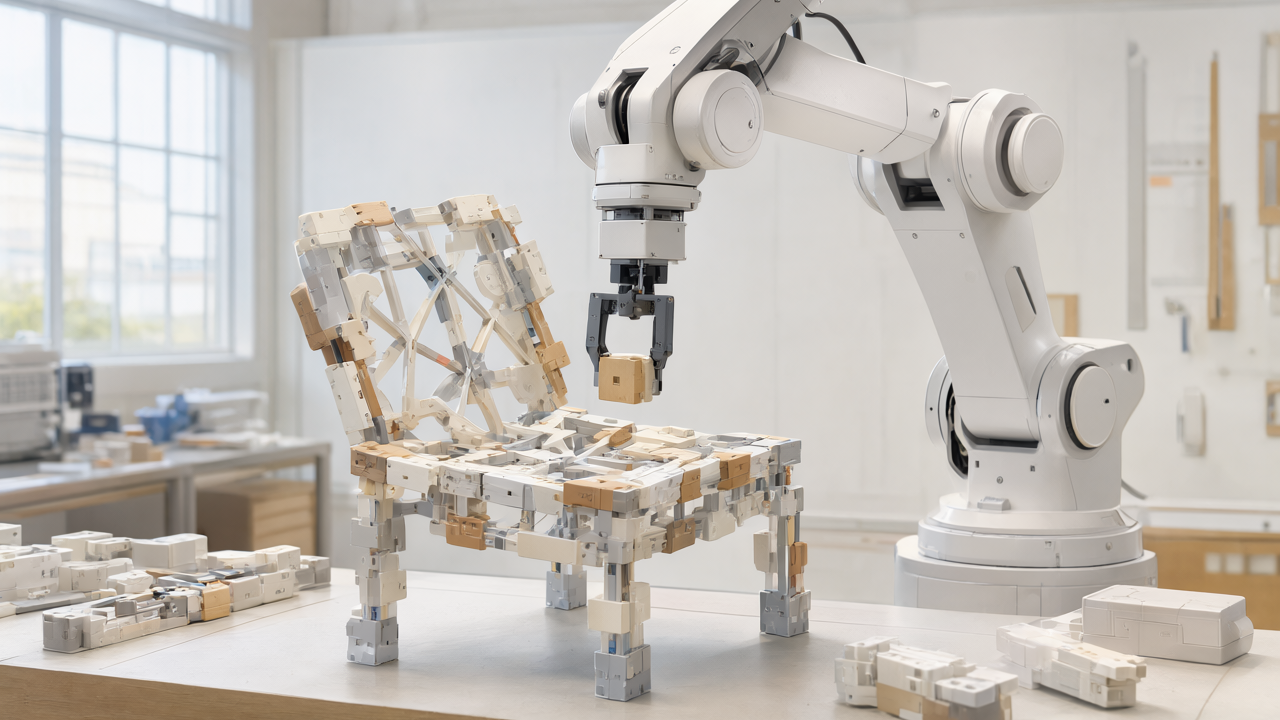
Alexander Htet Kyaw, a researcher at MIT, has presented a groundbreaking research pipeline that integrates 3D generative AI, vision-language models, and robotic assembly. This system is capable of autonomously generating multi-component physical objects from text prompts. Beyond mere visual appearance, it can also infer and incorporate physical properties into the design, such as where specific components should be stronger, lighter, stiffer, or more flexible. This demonstrates the potential for AI to go beyond simple shape generation and deeply engage with materials science and manufacturing processes.
Technical / Clinical Details
The pipeline achieves its capabilities by seamlessly coordinating the following key technologies:
- 3D Generative AI: The core technology responsible for creating complex three-dimensional geometries from textual input. It supports the design of objects composed of multiple distinct materials, not just monolithic structures.
- Vision-Language Models (VLMs): These models bridge textual instructions with image/3D data, enabling a deeper understanding of user intent. For example, for a prompt like ‘lightweight chair,’ the VLM would not only generate a shape but also infer structures and material placements conducive to weight reduction.
- Material-Informed Reasoning: For a generated shape, AI determines the optimal material selection, placement, and component structure based on mechanical properties (strength, stiffness, flexibility) and functional requirements (e.g., heat dissipation, electrical conductivity).
- Robotic Assembly: Robots physically assemble the multi-component objects designed by the AI. This step ensures the constructability of the design and serves as the final stage in producing the tangible physical object.
This system opens up possibilities for automatically designing and manufacturing functional objects from high-level instructions, without requiring humans to specify intricate physical properties or manufacturing constraints in detail.
Background & Context
Traditional product design and manufacturing processes have been multi-stage, time-consuming, and costly, involving designers conceiving concepts, engineers conducting structural analysis and material selection, and manufacturing personnel fabricating the actual product. Integrating materials science knowledge with manufacturing expertise has been particularly challenging, often leading to protracted design iteration cycles. This MIT research presents a new path where AI bridges these disparate expertises, optimizing the entire process from design to manufacturing in a cohesive manner. It realizes an AI-driven approach to ‘Design for Assembly’ (DfA), with the potential to significantly accelerate the prototyping and mass production of complex products.
Strategic Significance & Outlook
This AI-driven design and manufacturing system has the potential to revolutionize a wide range of industries requiring multi-component objects with advanced functionalities, including aerospace, automotive, medical devices, and consumer products. In the future, it will likely enable the rapid and efficient generation of objects with more complex functional requirements and material properties that can adapt to dynamic environmental changes. By allowing AI to understand and integrate physical constraints into design, this technology embodies a vision for ‘future manufacturing’ that produces unprecedentedly high-performance products. Furthermore, by generating constructible and reusable assemblies, it is expected to contribute to sustainable manufacturing practices.
Source: https://www.designforam.com/p/from-text-to-robotic-assembly-3d
Get our weekly technology intelligence — free
Receive an infographic that lets you judge at a glance whether each field’s analysis report is worth reading.
Subscribe Free — Weekly Tech Intelligence
By subscribing, you’ll receive Troy-Technical’s weekly technology intelligence newsletter.
- Your email and selected fields are used only to deliver the newsletter.
- We never share your information with third parties.
- You can unsubscribe anytime via the link in each email.
See our Privacy Policy for details.
Takes about a minute · Unsubscribe anytime









Comments