Key Findings
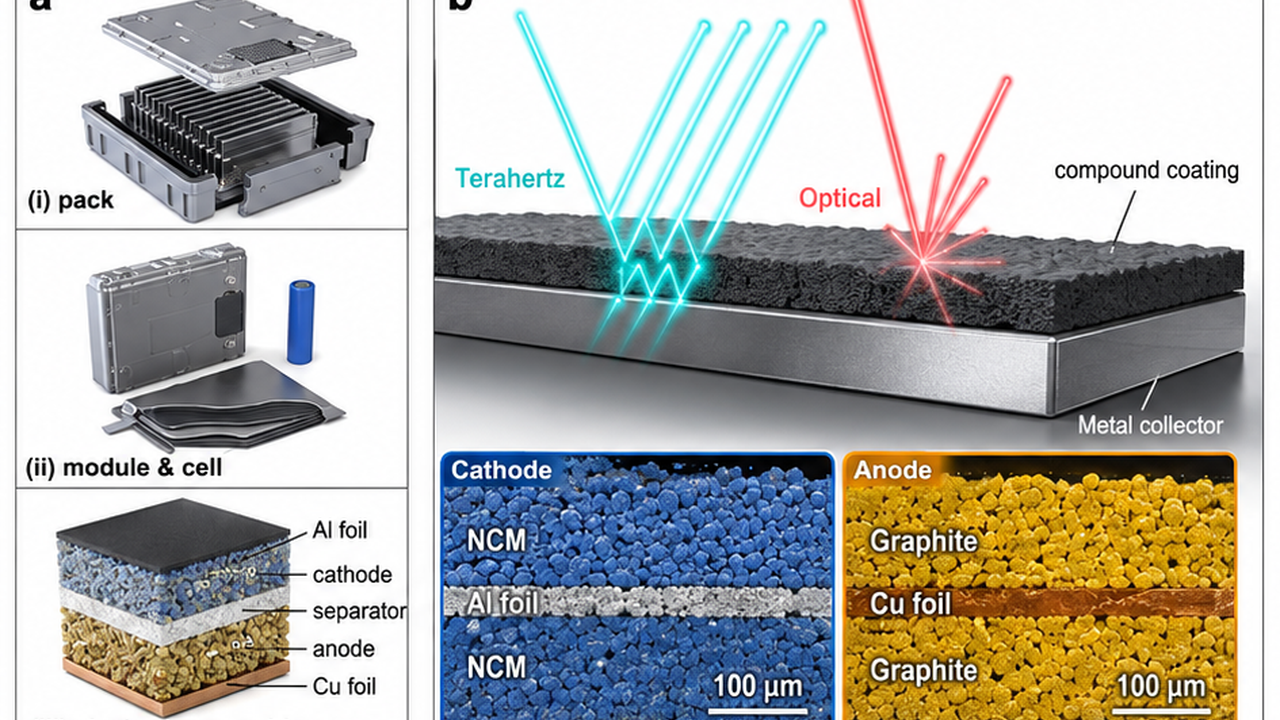
Latest research, published in Nature Communications, introduces a groundbreaking technique that combines nanometer-accurate terahertz interferometry with frequency combs for the precise metrology of battery electrodes. This advanced measurement methodology offers ultra-high precision essential for optimizing battery manufacturing processes and holds the potential to accelerate the development of high-performance batteries.
Technical / Clinical Details
Battery performance is heavily dependent on the uniformity of electrode material microstructure and thickness. However, accurately and non-destructively evaluating nanoscale inhomogeneities has been challenging with previous technologies. The terahertz interferometry method employed in this study utilizes the terahertz frequency band (between microwaves and infrared in the electromagnetic spectrum). Light in this band can penetrate many non-metallic materials, allowing for non-destructive analysis of the internal structure of battery electrode layers. Furthermore, combining this with frequency comb technology dramatically enhances the precision of terahertz measurements, enabling thickness measurements and material property evaluations at the nanometer scale. A frequency comb is an optical tool with a large number of discrete, precisely spaced laser frequency components, bringing ultra-high precision to distance measurement and spectroscopic analysis. This allows for detailed analysis of active material distribution, binder uniformity, and electrolyte penetration within battery electrodes, making it possible to identify and correct minute defects and variations in real-time during the manufacturing process.
Background & Context
With the widespread adoption of electric vehicles (EVs) and renewable energy storage systems (ESS), demands for battery energy density, safety, and durability are increasingly stringent. Improving these performances necessitates enhancing the manufacturing quality of battery cells, especially electrodes. Conventional quality control methods often rely on destructive testing, leading to increased manufacturing costs and reduced production efficiency. Moreover, nanoscale defects and inhomogeneities are often the root cause of premature battery degradation and safety issues, driving an urgent need for non-destructive, high-precision measurement techniques.
Strategic Significance & Outlook
This nanometer-accurate metrology technique is poised to revolutionize battery manufacturing processes and strongly bolster the development of next-generation high-performance batteries. By dramatically improving quality control during manufacturing, it will be possible to reduce battery defect rates and maximize energy density, cycle life, and safety. In the future, this technology is expected to be implemented as an in-line quality control system, contributing to the realization of a ‘digital twin’ in battery production. This breakthrough will accelerate technological innovation in sectors such as electric vehicles, drones, and smart grids, serving as a crucial foundation for a sustainable energy future.