TECHNOLOGY EXPLAINER
Chemical Recycling
— back to molecules, or just fuel? Reading both the technology and the "books"
Where mechanical recycling melts plastic and sets it again, chemical recycling breaks the molecular chains by chemical reaction and returns the plastic to raw materials. But "returning" covers very different things: depolymerisation back to monomers, pyrolysis into an oil that goes back to the petrochemical industry, and gasification into synthesis gas. What you get, and how much of it can be counted as "recycling", differ completely between them. This article sorts out, from the molecular structure up, which resins suit which route, then mass balance accounting and certification, the energy and life-cycle assessment (LCA) debate, and companies' actual plants, keeping the targets that companies state apart from the results we could confirm.
- What chemical recycling is (the short version)
- Three routes — depolymerisation, pyrolysis, gasification
- What "chemical recycling" means in Japanese statistics
- A materials engineer's view (1): molecular structure decides how a plastic can be returned
- Depolymerisation in practice — PET, nylon, polystyrene
- Pyrolysis and pyrolysis oil — an outlet for mixed plastics, and the quality wall
- Gasification — a Japanese example running for more than 20 years
- Mass balance and certification — ISCC PLUS and the EU calculation rules
- A materials engineer's view (2): "recycling on paper" versus the physical content
- Energy use and the LCA debate
- Companies' actual plants — targets, and the results we could confirm
- Open problems, and what we could not confirm
- Glossary / References / Claim-to-source audit
Sourced = content stated by a public body, statute, peer-reviewed paper or a company's own publication (link given)
Our calculation = a figure this article derived from stated assumptions
Not yet confirmed = a plan, target or planned certification with no confirmed outcome yet
General explanations and framings from chemistry are marked separately as Commentary. Company capacity figures are nameplate capacities, not utilisation rates or production results. No market estimates from research firms are used.
1. What chemical recycling is (the short version)
- Chemical recycling is the collective name for methods that cut the polymer chains of plastic by chemical reaction, return them to chemical raw materials such as monomers, oil and gas, and make them into materials again. It divides broadly into three according to how far back the material is taken (Section 2).
- Mechanical (material) recycling melts the plastic again with the chains intact; chemical recycling cuts the chains, so it can strip out additives and colour and may reach dirty or mixed waste plastic. In exchange it needs energy and equipment for the reaction.
- Where the output, like pyrolysis oil, is processed together with fossil feedstock, the "recycled share" in a product cannot be measured physically. That calls for a bookkeeping rule, mass balance, and how that rule is set is the biggest point of dispute in policy (Section 8).
How to read mechanical recycling figures was covered in our explainer on plastic recycling. This article continues from there and deals with the issues specific to chemical recycling. Polymer basics are in our explainer on polymer basics, PET in our explainer on polyesters and PET, and nylon in our explainer on polyamides.
2. Three routes — depolymerisation, pyrolysis, gasification
The review by Vollmer and co-authors sorts the options that go beyond mechanical recycling: dissolution and reprecipitation, solvolysis, pyrolysis and others. It concludes that each process available today suits particular waste plastic streams, and that only a combination of several technologies can meet the challengeSourced (the gist of the abstract; the original is in English). To match the categories used in Japanese statistics (Section 3), we set out three routes here, including gasification.
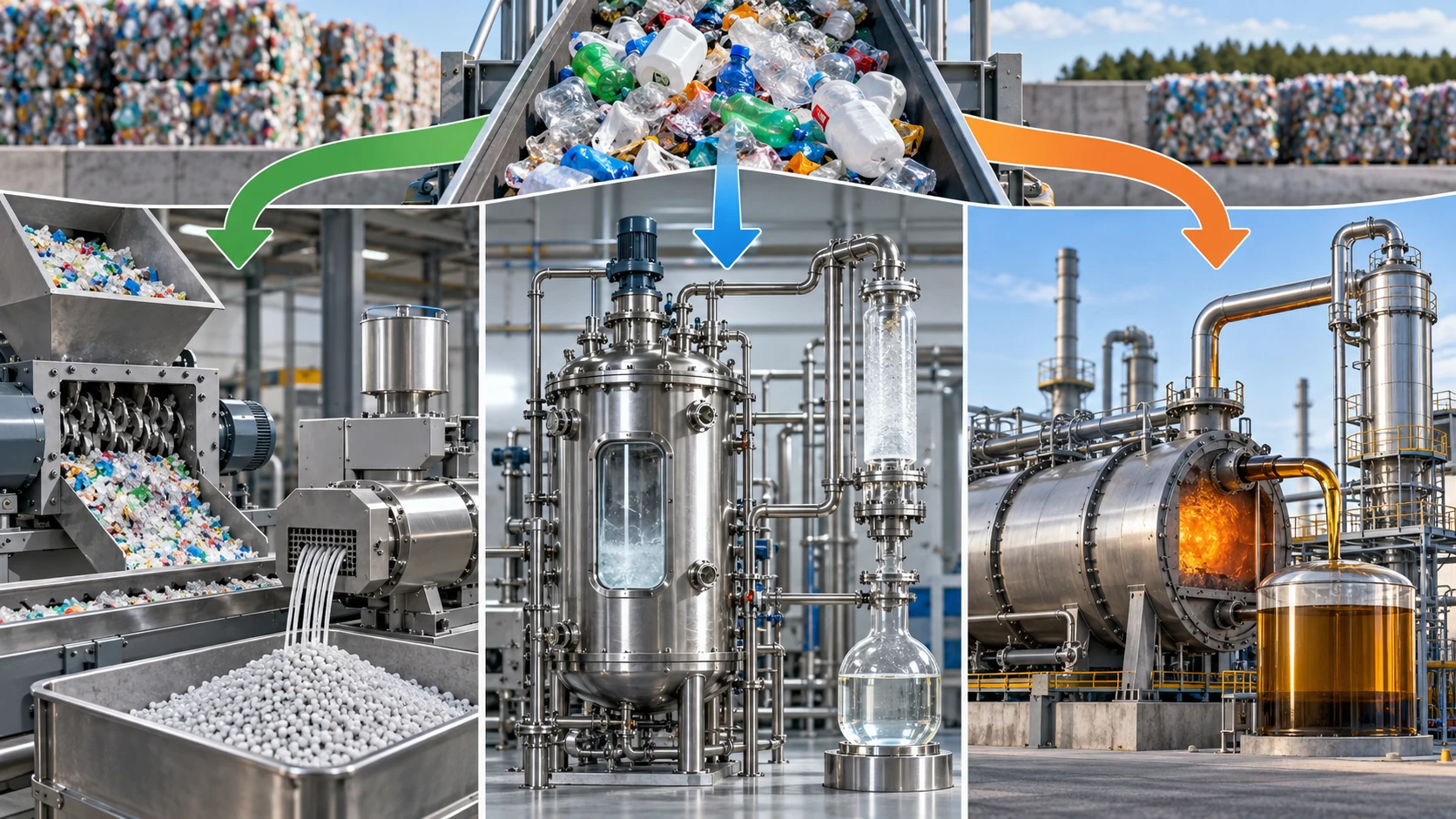
ImageGen conceptual illustration (not a real photograph or measurement). See the original diagram for exact values, names and structure.
Show original diagram with exact annotations and values
3. What "chemical recycling" means in Japanese statistics
Japan's Plastic Waste Management Institute (PWMI) divides the treatment of waste plastic into "material", "chemical" and "thermal". Chemical covers blast-furnace and coke-oven feedstock, gasification (chemical feedstock use) and oil recovery; a note says that gasification is split by end use, with chemical feedstock use counted as chemical and fuel use counted as thermalSourced. For 2023, chemical recycling was 0.26 million tonnes (Mt), 3% of the 7.69 Mt of waste plastic generatedSourced.
| Category (2023) | Quantity | Note |
|---|---|---|
| Chemical recycling (total) | 0.26 Mt (3%) | Blast-furnace / coke-oven feedstock; gasification (chemical feedstock use); oil recovery |
| of which blast-furnace / coke-oven feedstock (container and packaging flow) | 0.21 Mt | Breakdown in the material flow diagram for "expanded containers, packaging and so on" |
| of which gasification (chemical feedstock use) (same) | 0.04 Mt | The part of gasification used as chemical feedstock |
| of which oil recovery (same) | 0.00 Mt | Shown as "0" after rounding |
| For reference: mechanical recycling | 1.71 Mt (22%) | About 6.6 times chemical (171 / 26, our calculation) |
All Sourced (PWMI Material Flow Diagram 2023 [Reference 1]). The three sub-categories are values from the container and packaging flow diagram and do not add up to 0.26 Mt because of rounding.
Of the 0.26 Mt counted as chemical recycling in Japan, the container and packaging flow diagram shows blast-furnace and coke-oven feedstock at 0.21 Mt (about 80%), and oil recovery at 0 Mt after roundingSourced. In the global debate, "chemical recycling" usually brings to mind new pyrolysis and depolymerisation plants, but in Japanese statistics the lead role is played by existing large facilities, such as steelworks and gasifiers, that accept waste plastic (our reading). Once the oil recovery facilities of ENEOS and Mitsubishi Chemical (Section 11) are running, this breakdown may change.
The EU Waste Framework Directive defines recycling as a recovery operation that reprocesses waste into products or substances and says it does not include energy recovery or reprocessing into materials to be used as fuels (our paraphrase)Sourced. The part of pyrolysis oil that becomes fuel is therefore not counted as recycling in EU accounting. The "fuel-use excluded" method we meet in Section 8 follows from this definitionSourced. Japanese statistics allocate the "fuel use" of gasification to thermal, but the rules on how far "recycling" extends are not identical to the EU's.
4. A materials engineer's view (1): molecular structure decides how a plastic can be returned
How much of a plastic "returns to monomer" on pyrolysis differs by orders of magnitude between resins. Vollmer and co-authors tabulate, resin by resin, a guide to the maximum monomer recovery in single-stage pyrolysis (values rounded to the nearest 5%)Sourced.
| Resin | Maximum monomer recovery (guide) | Product with the largest yield |
|---|---|---|
| PMMA | Over 95 wt% (450 °C) | Methyl methacrylate |
| PS | 70-85 wt% (500 °C, short time; 85 under vacuum) | Styrene |
| HDPE | 40 wt% (780 °C, 1.3 s) | Pyrolysis oil (crude-oil-like) |
| LDPE | 40 wt% (860 °C, 0.6 s) | Pyrolysis oil (crude-oil-like) |
| PP | 30-45 wt% (650 °C) | Pyrolysis oil (crude-oil-like) |
| PET | Near 0 | Benzoic acid, CO, CO2, solid organics |
| PVC | Near 0 | Hydrogen chloride (HCl), benzene |
All Sourced (Vollmer et al., Table 2 [Reference 2]). The temperatures are the conditions in brackets; reactors and residence times differ between studies.
This table is a treasure trove of numbers that molecular structure can explain (what follows includes general polymer chemistry and is Commentary).
- PMMA and PS return easily: their structure favours chain scission that proceeds from the chain end and releases monomer one after another (an unzipping chain reaction). The low heat of polymerisation also plays a part: the thermodynamic penalty for going back to monomer is small.
- PE and PP return poorly: chain scission occurs at random along the chain, so the main product is not monomer (ethylene, propylene) but a mixture of hydrocarbons of differing carbon number (oil and wax). This is why the yields in the table stay at 30-45 wt%.
- PET and PVC do not return (in pyrolysis): PET has ester bonds in its backbone and breaks down on pyrolysis into benzoic acid, CO and CO2Sourced. PVC begins to release hydrogen chloride at about 270-290 °C (T5% 270 °C, TMAX 290 °C), a much lower temperature than the roughly 465 °C at which backbone scission occursSourced. The review states that this temperature gap makes it possible to remove the chlorine alone in a pre-treatment stepSourced.
Coates and Getzler (2020) call chemical recycling that returns a polymer to monomer, purifies it and repolymerises it "chemical recycling to monomer" (CRM) and state that material recycled this way shows no loss of performance (our paraphrase)Sourced (abstract; the original is in English). The paper argues that the energetics of polymerisation (how readily a polymer reverts to monomer) are the key to practical CRM, and cites the pyrolysis of polyolefins and the ring-closing depolymerisation of nylon 6 as attempts with existing resinsSourced. Vollmer and co-authors likewise say that the ability to design polymers that break down to monomers (or oligomers) under predefined conditions is an important step for plastics recycling (our paraphrase)Sourced. In other words, whether a plastic suits chemical recycling is decided not only by the recycling process but at the stage of polymer design (Commentary by this article).
5. Depolymerisation in practice — PET, nylon, polystyrene
Bonds such as esters and amides can be cut with reagents such as water and alcohols. Of this solvolysis, Vollmer and co-authors say that hydrolysis and alcoholysis (glycolysis, methanolysis) cleave ether, ester and acid-amide bonds and so are limited to resins that contain such bonds (our paraphrase), and point to the advantage that the monomers obtained can be purified to remove additives and colourants and repolymerised to virgin qualitySourced.
| Resin | Bond cut and route (as described in the review) | What is obtained | Examples (review as of 2020 / company announcements) |
|---|---|---|---|
| PET | Ester bonds. Hydrolysis, glycolysis, methanolysis | TPA, BHET, DMT. BHET and DMT can be used directly to polymerise PET; TPA must first be converted to BHET | Commercial plants for PET methanolysis and glycolysis are "few" (2020 review). Eastman achieved initial production at Kingsport in March 2024 (Section 11) |
| Nylon 6 | Amide bonds. Hydrolysis with steam | Caprolactam (recovered by condensing the steam) | The review describes Aquafil hydrolysing carpet-derived nylon 6 at a plant in Slovenia and returning the caprolactam obtained to carpet (2020 review) |
| PU | Urethane bonds. Glycolysis and others | Monomers and oligomers (products by route are laid out in Fig. 4 of the review) | The review says PU is especially promising because it "cannot be mechanically recycled" |
| PS | (Pyrolysis to styrene, not depolymerisation) | Styrene. Recovery guide 70-85 wt% (Table 2) | A method that removes the flame retardant (HBCD) by dissolution and reprecipitation is also described (PolyStyreneLoop, construction said to have begun in December 2019) |
All Sourced (Vollmer et al. [Reference 2]). This is a 2020 review and does not reflect current operating status. Eastman follows the company's announcement [Reference 5].
Vollmer and co-authors write that the BHET obtained by glycolysis of PET is not pure enough to make PET directly, and oligomers also form. On the other hand, with metal acetates or sodium carbonate as catalyst, high-purity BHET can be obtained, and with sodium carbonate they record a yield of about 80% in 1 hour at 196 °C (EG:PET molar ratio 7.6:1)Sourced. They also say that methanolysis and glycolysis were developed further than hydrolysis because of the energy demand that comes with the high operating temperature hydrolysis needsSourced. So even for the same PET, "which bond to cut with which reagent, and to what purity to purify" becomes a design problem for each route (Commentary by this article).
6. Pyrolysis and pyrolysis oil — an outlet for mixed plastics, and the quality wall
Vollmer and co-authors describe pyrolysis as thermal decomposition without oxygen that gives a mixture resembling the fractions of crude oil distillation (refinery gas, gasoline/naphtha, gas oil and residue) (our paraphrase)Sourced. The product can be used as fuel, or to make monomers by the same routes as crude-oil-derived feed, such as steam cracking. The same review records that the commercial pyrolysis plants of Plastic Energy, Petronas, Fuenix Ecogy and Nexus Fuel were then (2020) aimed at producing fuel, not monomersSourced.
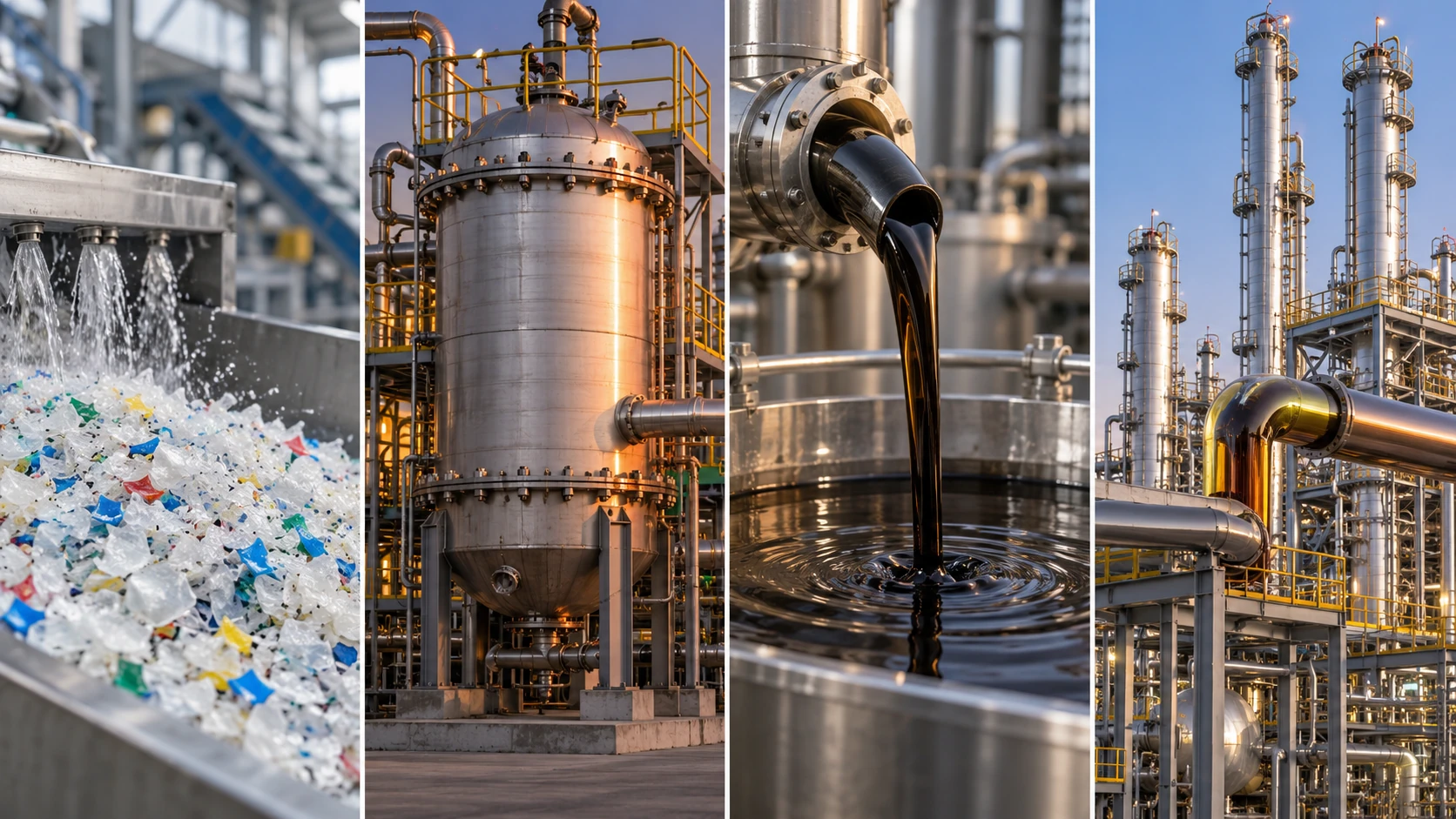
ImageGen conceptual illustration (not a real photograph or measurement). See the original diagram for exact values, names and structure.
Show original diagram with exact annotations and values
When pyrolysis oil is fed to a steam cracker to return it to ethylene and propylene, the oil must fall within the range the cracker can accept. The EU Implementing Decision (EU) 2026/1425 uses the concept of a "maximum allowable boiling point for each cracker" in its calculation, and specifies that the weight of the input oil that evaporates at or below that boiling point is to be determined by standard test methods that give the boiling range distribution of petroleum fractions by gas chromatography (EN 15199-3:2021, EN 15199-4:2021 and others)Sourced. In other words, the rule is that the heavy, high-boiling part cannot be counted as recycled content even if it is fed into the cracker (our reading).
There are other quality walls too. Vollmer and co-authors describe an example in which pyrolysing HDPE bags at 400 °C gave a gas-oil-range fraction of up to 47 wt%, but two properties, oxidation stability and density, did not meet the gas oil specifications (ASTM D975, EN 590)Sourced. Because pyrolysis oil is "similar to petroleum products but not identical", control of chlorine, nitrogen, metals and unsaturated components shapes the choice of downstream equipment (this general account is Commentary by this article; we have not confirmed individual values in our primary sources).
7. Gasification — a Japanese example running for more than 20 years
Resonac has run its Plastic Chemical Recycling (KPR) business at its Kawasaki Plant (Kawasaki, Kanagawa Prefecture) since 2003. According to the company, KPR is a facility that takes used plastic discharged as waste from households and businesses, gasifies it at high temperature, breaks it down to the molecular level and extracts hydrogen and CO2 (our paraphrase of the company's description). The hydrogen is used mainly as a raw material for ammonia, and the CO2 for dry ice and carbonated drinksSourced.
| Item | What the company published | Source |
|---|---|---|
| Start | Business promoted since 2003. The company describes it as the only gasification chemical plant in the world that has kept stable commercial operation over a long period | Resonac, 6 October 2025 [11] |
| Throughput | About 200 tonnes a day, about 60,000 tonnes a year. Cumulative 1 million tonnes reached in January 2022 | Resonac, 20 December 2022 [10] |
| Hydrogen split | As of 2022, ammonia was made with 50% hydrogen from used plastic and 50% from city gas. A plan to use hydrogen from used plastic only (announced October 2025) | [10] [11] |
| Certification | ISCC PLUS certification obtained in 2023 for three products: hydrogen, ammonia and acrylonitrile | [11] |
| Environmental performance | The company announced that a CO2 emissions reduction of just over 80% was confirmed for this ammonia (calculation conditions are in the company's materials) | [10] |
All Sourced (the company's own publications). The calculation conditions, comparison basis and scope of third-party verification behind the "just over 80% reduction" have not been verified in this article.
Our calculation The published material does not give the month the business started in 2003, so the period from the start to the cumulative figure in January 2022 ranges from a little over 18 years (if it started at the end of 2003) to about 19 years (if it started at the beginning of 2003). 1,000,000 t / (a little over 18 to 19 years) = about 53,000 to 55,000 t a year. The nameplate throughput of about 60,000 t a year is somewhat higher than this average but broadly consistent with it.
Premises and limits: the start-up period and year-to-year variation in throughput cannot be read from the published material. This is a simple average that treats "the start in 2003" as the start of the business, not a year-by-year record. The 60,000 t should also be treated only as an order-of-magnitude reference against Japan's chemical recycling total (0.26 Mt in 2023, Section 3), because the years and categories differ.
Gasification destroys the whole structure of the polymer and returns it to synthesis gas of hydrogen and carbon oxides. It is little affected by polymer structure, additives or dirt, but the value of the resin as a resin (its molecular structure) does not come back. In Resonac's case the destination is ammonia (and derivatives such as acrylonitrile), not resin, so it is a circulation as chemical raw material, not plastic-to-plasticSourced (the company explains that the derivatives of ammonia include acrylonitrile). Japanese statistics divide gasification by end use into chemical feedstock use and fuel use to keep this difference visible (Section 3; Commentary by this article).
8. Mass balance and certification — ISCC PLUS and the EU calculation rules
Pyrolysis oil goes into a steam cracker and is processed mixed with fossil-derived naphtha. How many "molecules derived from plastic waste" the resulting ethylene and propylene contain cannot be measured physically. So the quantity in and the quantity out are managed on paper, and that is the mass balance method. The EU implementing decision explains that mass balance ensures that the weight of input material derived from post-consumer waste equals the weight allocated to all outputs and lossesSourced (the gist of recital 8).
Private certification: ISCC PLUS
ISCC PLUS is a voluntary certification scheme that verifies the sustainability characteristics of alternative feedstocks (bio-based and recycled). For traceability it offers three chain-of-custody (CoC) options: physical segregation, controlled blending and mass balance. Each site in the supply chain must hold its own certificate (issued per site, valid for 12 months)Sourced.
In an April 2026 explainer, ISCC distinguishes mass balance (tracking certified input) from "attribution" (to which outputs those characteristics are assigned). Under one attribution method, "free attribution", the characteristics of the certified input can be assigned flexibly to one or several outputs, within defined guardrails. ISCC gives the following worked example using a steam crackerSourced.
Our calculation We apply the default procedure in Article 7(5) of the EU implementing decision to the example in Fig. 4.
- Step (a): allocate the 100 t of certified (eligible) input material so that the share of eligible material in each output equals its share in the input. The outputs, excluding losses, total 100 + 100 + 100 + 200 = 500 t, so 100 / 500 = 0.2 t is assigned per tonne.
- Step (c): multiply each output by a "dual-use factor": non-fuel = 1, fuel and losses = 0, dual-use output (liquid or gas) = the share that does not become fuel and stays in the recycling route (0 for solids).
- Result: product A = 100 x 0.2 = 20 t, product B = 20 t, fuel = 100 x 0.2 x 0 = 0 t, dual-use output = 200 x 0.2 x 0.5 = 20 t (0.5 is an assumption). The total is 60 t, and the remaining 40 t is counted as going to the fuel side and is not included in recycled content.
Premises and limits: the implementing decision confines its scope to calculating the recycled content of single-use plastic beverage bottles; it is not a rule for all products. The calculation above applies the rule's default allocation to a simple example. It does not include the reallocation that Article 7(6) allows (subject to conditions such as proof that a feasible chemical process exists), or the adjustment by boiling range at the cracker in Article 7(4). The "100 t to product A" in ISCC's example is one illustration that the number changes if the rule and method differ; it does not show which is correct.
EU: Implementing Decision (EU) 2026/1425 (dated 30 June 2026)
On 30 June 2026 the European Commission adopted Implementing Decision (EU) 2026/1425, the rules for calculating, verifying and reporting recycled plastic content (for beverage bottles) under the Single-Use Plastics Directive (published in the Official Journal on 3 July 2026, entering into force 20 days after publication). It replaces the earlier Decision (EU) 2023/2683 and for the first time includes rules on chemical recycling and the mass balance methodSourced. The main contents are as followsSourced.
- The "fuel-use excluded" method: recital 24 says that at each calculation point, eligible material that went to fuel or to losses is deducted from the recycled content, and explains this as being in order to comply with Article 3(17) of the Waste Framework Directive. Solid dual-use outputs (such as char) are excluded from the calculation entirely.
- Recital 5: it says that chemical recycling can treat waste plastic that is hard to handle mechanically and may provide recycled products of higher quality and performance, and that where mechanical recycling can deliver sufficient quality and performance, mechanical recycling is generally preferable environmentally and chemical recycling should complement it (our paraphrase).
- Running the books: the calculation period is at most three months; a positive balance may be carried forward but a negative balance is not allowed. Calculation is per site, and transfers between sites or companies are not permitted (Article 7(7) and (8)).
- Once mass balance is used, it is used at every later stage too (recital 10). On the other hand, once the share is known at the polymer stage (after repolymerisation), with both input and output at the polymer stage, no further reallocation is allowed (recital 11).
- Material recycled in third countries: from 21 November 2027, material recycled in countries to which an OECD decision applies and the like is also included, subject to conditions (Article 1, point 1, definitions).
- Review: the European Commission is to review the decision by 1 January 2030 (Article 10).
For packaging in general (the PPWR), Article 7(8) and (9) provide that by 31 December 2026 an implementing act on how to calculate and verify recycled content, and a delegated act on sustainability criteria for recycling technologies, are to be adoptedSourced. In doing so the European Commission says it will assess technologies including their environmental performance, such as quality, availability of waste, energy required and greenhouse gas emissionsSourced. We could not confirm the implementing act and delegated act for the PPWR at the time of our researchNot yet confirmed.
9. A materials engineer's view (2): "recycling on paper" versus the physical content
Of its "ChemCycling" process, in which pyrolysis oil is fed to a steam cracker, BASF explains that under the mass balance method the share of recycled feedstock can be assigned arithmetically to the final certified products, and customers can choose the share of recycled material assigned (our paraphrase)Sourced. On another page the company says mass balance products are drop-in (processable in the same way as conventional products)Sourced.
From the materials side this has two meanings (Commentary by this article).
- The advantage: as molecules they are indistinguishable from fossil-derived material, so grade, properties and specification are maintained as they are. The customer does not have to take on the "variation" of mechanical recycling. It is also easier to enter demanding uses of recycled material, such as food packaging.
- The caution: analysing the product cannot verify "whether it is recycled-derived". The basis for the claim is not analysis but the books and the audit. So the rules themselves, "to which output it is allocated" and "how the part that went to fuel is treated", decide how credible the claim is.
The EU implementing decision's adoption of the "fuel-use excluded" method, its books kept per site and per three months, and its ban on negative balances are there to bind by rule the part that cannot be measured (our reading). For a materials engineer, the first step in procurement or environmental claims is to check "under which rule was this figure calculated" rather than whether there is a certificate.
10. Energy use and the LCA debate
Because chemical recycling cuts chains, it needs energy for the reaction. Whether that is justified by the value of the material obtained is assessed by life cycle assessment (LCA). Here we set out the results of peer-reviewed papers together with their premises.
From their LCA comparison, Vollmer and co-authors conclude that the less the polymer structure and bonds are broken and the higher the quality of the recycled product, the better the environmental performance (our paraphrase)Sourced. In that review, the CO2 reduction is largest for dissolution and reprecipitation, at 65-75 wt% (no bonds are cut and no reforming is needed); solvolysis of clean PET and the like is similar; where pyrolysis products replace fuel oil or natural gas, it is about 30 wt% of the CO2 emitted by incineration; mechanical recycling of mixed plastics containing additives is about 25 wt%; and energy recovery is 30-45 wt%Sourced. The review also says that recycled products need remanufacturing and transport, and that reuse is more favourable than all the recycling routesSourced.
Jeswani et al. (2021) compared the pyrolysis of mixed plastic waste with mechanical recycling, energy recovery and virgin resin production by LCA, and showed the following resultsSourced.
- Pyrolysis has a climate change impact and energy use about 50% lower than energy recovery.
- Pyrolysis and mechanical recycling are similar in climate change impact and energy use once the quality of the recycled product is taken into account.
- The climate change impact of mixed plastic recycled by pyrolysis is -0.45 t CO2 eq./t, significantly lower than the fossil-based equivalent (1.89 t CO2 eq./t).
- On the other hand, the other environmental impacts are significantly larger for pyrolysis than for mechanical recycling, energy recovery or virgin resin production.
- The results are sensitive to assumptions such as the region and its energy mix, the carbon conversion efficiency of pyrolysis, and the quality of the recycled product.
These results cannot be summed up in a single line as "chemical is good" or "chemical is bad". The conclusion changes with what it is compared against (burning, mechanical, virgin), which kind of impact is assessed (climate change or the others), and how decarbonised the electricity is. Recital 5 of the EU implementing decision, which says mechanical recycling is generally preferable environmentally where it can deliver sufficient quality, can be read as reflecting this state of affairs (Commentary by this article). The thinking behind LCA itself is covered in our explainer on microplastics and life cycle assessment.
What is established: solvolysis (depolymerisation) can return resins with cleavable bonds (PET, PA and others) to high-purity monomer. Pyrolysis of PE and PP gives mainly a mixture of hydrocarbons rather than monomer. The part of pyrolysis oil that becomes fuel is not counted as recycling under the EU definitionSourced.
What is still debated: the allocation rules for mass balance (free attribution or fuel exclusion), quality specifications for pyrolysis oil, the conclusions of LCA (which depend on the comparison and the premises), and how far "recycling" should be counted. This article recommends no particular position and sticks to what public documents and peer-reviewed papers state.
11. Companies' actual plants — targets, and the results we could confirm
Chemical recycling facilities often take a long time from announcement of a plan to operation, and targets frequently slip. Here, using only the companies' own publications, we set out nameplate capacity, announced targets and the status we could confirm separately. Capacity figures are nameplate values for the facility, not utilisation or actual throughput.
| Company / plant | Method | Nameplate capacity | Announced targets and plans | What we could confirm |
|---|---|---|---|---|
| Eastman Kingsport (Tennessee, US) | Molecular recycling (polyester returned to monomer; the 2020 review describes the methanolysis technology) | 110,000 t/yr (company) | — | Initial production achieved in March 2024. The company page says both "operating at scale" and "started up toward operating at scale". Utilisation unconfirmed |
| ENEOS / Mitsubishi Chemical Ibaraki (Kamisu City) | Oil recovery by supercritical hydrothermal processing (technology of Mura Technology, UK), as feed for refinery units and naphtha crackers | 20,000 t/yr (announced 2021) | July 2021: aim to start oil recovery in fiscal 2023 | Completion ceremony on 2 July 2025. ISCC PLUS certification is "planned". We could not confirm any operating record for oil recovery |
| ExxonMobil Baytown (Texas, US) | "Advanced recycling" (Exxtend technology) | 2022: over 80 million lb/yr 2024: 500 million lb/yr in total after additions (company-wide) | December 2022: 1 billion lb a year worldwide by the end of 2026 → November 2024: by 2027 | Baytown began operating in 2022 and had processed over 70 million lb in total as of October 2024. Additional units are planned for 2026 |
| Resonac Kawasaki Plant (KPR) | Gasification (to hydrogen and ammonia) | About 60,000 t/yr (about 200 t/day) | Plan to make ammonia from used-plastic hydrogen only (October 2025) | Operating since 2003; cumulative 1 million t in January 2022. ISCC PLUS certification obtained in 2023 |
| Aquafil Slovenia | Hydrolysis of nylon 6 (to caprolactam) | Not confirmed | — | The 2020 review describes it as processing carpet-derived nylon 6. Current operating status not confirmed |
All Sourced (company announcements [References 5 to 11], Vollmer et al. [2]). ExxonMobil's "total after additions" is as the announcement states: adding 350 million lb for a total of 500 million lb, which implies 150 million lb before the addition (Our calculation). The additional capacity due in 2026 is Not yet confirmed.
Our calculation We convert the figures in the announcements (1 lb = 0.4536 kg).
- Cumulative processing of 70 million lb = about 32,000 t (December 2022 to October 2024, about 22 months)
- 2022 nameplate capacity of 80 million lb a year = about 36,000 t a year. Over 22 months this comes to about 147 million lb
- The cumulative amount is about 48% of what 22 months at the 2022 nameplate capacity would give (7,000 / 14,700)
- Capacity before the addition, backed out from the November 2024 announcement: 500 - 350 = 150 million lb a year (about 68,000 t a year)
Premises and limits: after Baytown began operating in 2022, units were added (over 80 million lb in the 2022 announcement, 150 million lb when backed out of the 2024 announcement), so capacity differs by period. A low utilisation rate during ramp-up is normal, and the 48% above is a reference for orders of magnitude in the published figures, not an assessment of utilisation. The cumulative figure is also given only as a lower bound, "over 70 million lb". Together with the move of the target year for the capacity expansion from the end of 2026 to 2027, it shows that "nameplate capacity" and "amount actually processed" are different numbers.
Keeping three gaps in mind helps you read companies' announcements calmly (Commentary by this article).
- The gap between capacity and operation: nameplate capacity is a design value. Ramp-up, securing feedstock and scheduled maintenance change the actual throughput.
- The gap between throughput and product: not all the waste plastic put in becomes resin feedstock. Pyrolysis splits it into oil, gas and residue (char), and under the EU rules the part that went to fuel or losses is deducted from recycled content (Section 8).
- The gap between target and result: ENEOS and Mitsubishi Chemical announced an aim to start in fiscal 2023, and the completion ceremony was in July 2025. ExxonMobil moved the target year for 1 billion lb from the end of 2026 to 2027. Planned figures are outlooks, not results.
12. Open problems, and what we could not confirm
(1) Securing feedstock and pre-treatment
Vollmer and co-authors say that research should focus on more realistic, dirtier and mixed waste plastic streams, and that collection and sorting infrastructure needs to be improved through stricter regulation (our paraphrase)Sourced. Including the removal of chlorine from PVC (Section 6), how much effort to put into pre-treatment affects both economics and environmental performance.
(2) The parts of the rules not yet settled
The EU Implementing Decision (EU) 2026/1425 sets rules for beverage bottles, but for packaging in general (the PPWR), the method of calculating recycled content and the sustainability criteria for recycling technologies are at the stage where adoption is scheduled by 31 December 2026Not yet confirmed. On how mass balance is treated within Japan (the standing of certification, treatment in statistics), we have not been able to confirm primary sources.
(3) What we could not confirm
- Utilisation and actual annual throughput of each facility: for the facilities of Eastman Kingsport, ENEOS / Mitsubishi Chemical and ExxonMobil, we found nameplate capacity and dates, but no full-year operating record.
- The current status of Eastman's planned new facility in Texas, Mura Technology's UK plant and similar: not given, because we could not confirm them in official materials.
- Quality specifications and actual composition of pyrolysis oil (permitted levels of chlorine, nitrogen, metals and so on): we have not confirmed the values in our primary sources.
- Verification of the calculation conditions for Resonac's "CO2 emissions cut by just over 80%": we limit ourselves to quoting the company's announcement.
- The treatment of mass balance in Japanese regulation and guidelines: outside the scope of our research.
- Chemical recycling is the collective name for methods that "cut the chain"; depolymerisation (monomer), pyrolysis (oil) and gasification (synthesis gas) differ completely in what they yield and in how much of it is counted as "recycling".
- How readily a plastic returns to monomer is decided by molecular structure. The guide to monomer recovery in pyrolysis is over 95 for PMMA, 70-85 for PS, 40 for PE, 30-45 for PP, and near 0 for PET and PVC (wt%)Sourced.
- Chemical recycling in Japanese statistics is 0.26 Mt (3%); in the container and packaging flow, blast-furnace and coke-oven feedstock accounts for 0.21 Mt, and oil recovery is shown as 0Sourced.
- Mass balance is a book of accounts that "binds by rule what cannot be measured". The EU uses a fuel-use-excluded method, and even for the same worked example the certified quantity changes with the ruleOur calculation.
- Environmental performance depends on the premises of the LCA: pyrolysis is reported to be lower than energy recovery in climate impact but larger in other impactsSourced.
- Each company's "capacity", "target" and "result" are different numbers. Against ENEOS and Mitsubishi Chemical's target of starting oil recovery in fiscal 2023, the completion ceremony was in July 2025. ExxonMobil moved its target year for 1 billion lb back by a yearSourced.
13. Glossary
- Chemical recycling
- The collective name for methods that cut polymers by chemical reaction, return them to raw materials and make them into materials again.
- Depolymerisation (solvolysis)
- Cutting bonds with reagents such as water or alcohols to return the polymer to monomer.
- Pyrolysis
- Heating without oxygen to decompose the plastic into oil, gas and residue.
- Gasification
- Decomposing the plastic at high temperature to the molecular level to give synthesis gas (hydrogen, carbon monoxide and so on).
- Pyrolysis oil
- A liquid mixture, similar to crude oil fractions, obtained from the pyrolysis of waste plastic.
- Steam cracker
- Petrochemical equipment that cracks naphtha and similar feeds at about 850 °C to make ethylene and propylene.
- Monomer recovery
- The weight of monomer recovered as a share of the weight of waste resin (wt%).
- BHET / DMT / TPA
- Compounds that are raw materials for PET: bis(2-hydroxyethyl) terephthalate, dimethyl terephthalate and terephthalic acid.
- Mass balance
- A method of managing quantities in and out on paper and assigning the recycled-derived share to products.
- ISCC PLUS
- A voluntary international scheme that certifies bio-based and recycled-derived feedstocks.
- Fuel-use excluded
- A calculation method that deducts the part that went to fuel or losses from recycled content (adopted by the EU implementing decision).
- Dual-use output
- An output that can become either fuel or a non-fuel product. A term from the EU implementing decision.
14. References
- Plastic Waste Management Institute (PWMI) "Production, disposal, recycling and treatment of plastic products in Japan: Material Flow Diagram 2023", published December 2024 (PDF, in Japanese) — pwmi.or.jp
- Vollmer et al. “Beyond Mechanical Recycling: Giving New Life to Plastic Waste”, Angewandte Chemie International Edition 59, 15402–15423 (2020). DOI 10.1002/anie.201915651 — pmc.ncbi.nlm.nih.gov
- Coates, Getzler “Chemical recycling to monomer for an ideal, circular polymer economy”, Nature Reviews Materials 5, 501–516 (2020). DOI 10.1038/s41578-020-0190-4 — nature.com
- Jeswani et al. “Life cycle environmental impacts of chemical recycling via pyrolysis of mixed plastic waste in comparison with mechanical recycling and energy recovery”, Science of the Total Environment 769, 144483 (2021). DOI 10.1016/j.scitotenv.2020.144483 — doi.org
- Eastman "Tennessee site (Kingsport)" — eastman.com
- ENEOS / Mitsubishi Chemical "On the joint plastic oil recovery business of ENEOS and Mitsubishi Chemical", 20 July 2021 (PDF, in Japanese) — eneos.co.jp
- ENEOS / Mitsubishi Chemical "ENEOS and Mitsubishi Chemical complete the chemical recycling facility toward the start of plastic oil recovery", 3 July 2025 (PDF, in Japanese) — mcgc.com
- ExxonMobil "ExxonMobil starts operations at large-scale advanced recycling facility", 14 December 2022 — corporate.exxonmobil.com
- ExxonMobil "ExxonMobil to expand advanced recycling capacity", 21 November 2024 — corporate.exxonmobil.com
- Resonac "CO2 emissions confirmed cut by over 80%: low-carbon ammonia made from used plastics", 20 December 2022 (in Japanese) — resonac.com
- Resonac "Decision to expand the low-carbon ammonia business based on chemical recycling of plastics", 6 October 2025 (in Japanese) — resonac.com
- ISCC "ISCC PLUS certification" — iscc-system.org
- ISCC "Certified Free Attribution for Scaling-up the Circular Economy", 1 April 2026 — iscc-system.org
- European Commission Implementing Decision (EU) 2026/1425 on the calculation, verification and reporting of data on recycled plastic content in single-use plastic beverage bottles, 30 June 2026 — eur-lex.europa.eu
- European Parliament and Council Directive 2008/98/EC (Waste Framework Directive) — eur-lex.europa.eu
- European Parliament and Council Regulation (EU) 2025/40 on packaging and packaging waste — eur-lex.europa.eu
- BASF "BASF for the first time makes products with chemically recycled plastics", December 2018 — basf.com
- BASF "ChemCycling® as a feedstock for raw materials" — myindustryworld.basf.com
15. Claim-to-source audit
| Claim in the text | Basis | Label |
|---|---|---|
| Japan's 2023 chemical recycling of 0.26 Mt (3%), total waste plastic generated 7.69 Mt, mechanical 1.71 Mt (22%). The categories being "blast-furnace / coke-oven feedstock, gasification (chemical feedstock use), oil recovery", with gasification split by end use into chemical (chemical feedstock use) and thermal (fuel use). The breakdown in the container and packaging flow diagram (blast-furnace / coke-oven feedstock 0.21 Mt, gasification (chemical feedstock use) 0.04 Mt, oil recovery 0.00 Mt). The note on rounding. Published December 2024 | PWMI Material Flow Diagram 2023, Reference 1https://www.pwmi.or.jp/flow_pdf/flow2023.pdf | Sourced |
| The review's abstract (each process suits particular waste plastic streams / a combination of technologies is needed / focus on dirtier, mixed waste). That solvolysis cleaves ester, ether and acid-amide bonds and that the monomers can be purified to remove additives and colourants and repolymerised to virgin quality. The PET products (TPA, BHET, DMT), the purity of BHET and oligomers, and a yield of about 80% in 1 hour at 196 °C with sodium carbonate catalyst (EG:PET molar ratio 7.6:1). That methanolysis and glycolysis advanced further than hydrolysis because of the energy demand of hydrolysis's high operating temperature. That a few commercial plants exist for PET methanolysis and for PET and PU glycolysis. That PU cannot be mechanically recycled. Aquafil's steam hydrolysis of nylon 6 (caprolactam) in Slovenia. The description of pyrolysis (a mixture resembling crude oil fractions), HDPE bags at 400 °C, up to 47 wt% gas oil, and oxidation stability and density missing the gas oil specifications. That commercial pyrolysis plants were aimed at fuel. Table 2 (PMMA over 95, PS 70/85, HDPE 40, LDPE 40, PP 30/45, PET and PVC near 0; PVC T5% 270 °C, TMAX 290 °C, 465 °C; the products from PET). That HCl removal is possible in PVC pre-treatment. 36 wt% ethylene and 18 wt% propylene in a pilot. The LCA statements (dissolution and reprecipitation 65-75 wt%, solvolysis similar, pyrolysis products replacing fuel about 30 wt%, mechanical recycling of mixed plastic about 25 wt%, energy recovery 30-45 wt%, the advantage of reuse, "the less the structure is broken, the better the environmental performance"). That the ability to design polymers that degrade under predefined conditions is an important step. The start of construction of PolyStyreneLoop at 3,300 t/yr (December 2019) | Vollmer et al. (2020), Reference 2https://pmc.ncbi.nlm.nih.gov/articles/PMC7497176/ | Sourced |
| That chemical recycling that returns a polymer to monomer, purifies it and repolymerises it is called "CRM". The view that material recycled this way shows no loss of performance. That the paper examines the energetics of polymerisation and cites the pyrolysis of polyolefins and the ring-closing depolymerisation of nylon 6 as attempts with existing resins | Coates and Getzler (2020), abstract, Reference 3https://www.nature.com/articles/s41578-020-0190-4 | Sourced |
| LCA of pyrolysis: climate change impact and energy use about 50% lower than energy recovery. Similar to mechanical recycling once quality is considered. Climate change impact -0.45 vs 1.89 t CO2 eq./t. Other impacts significantly larger for pyrolysis. Sensitivity to region, energy mix, carbon conversion efficiency and recycled-product quality | Jeswani et al. (2021), abstract, Reference 4https://doi.org/10.1016/j.scitotenv.2020.144483 | Sourced |
| Eastman Kingsport's nameplate capacity of 110,000 metric tons a year. Initial production achieved in March 2024, the statement that start-up toward operating at scale began, and the statement "operating at scale". The technology that returns polyester to monomer | Eastman official page, Reference 5https://www.eastman.com/en/sustainability/environmental/circularity/site-locations/tennessee-site | Sourced |
| The announcement of 20 July 2021 that a chemical recycling facility with a throughput of 20,000 t a year would be built at the ENEOS / Mitsubishi Chemical Ibaraki site, aiming to start oil recovery in fiscal 2023. Mura Technology's supercritical water technology. The use of the oil produced as feed for refinery units and naphtha crackers | ENEOS / Mitsubishi Chemical, 20 July 2021, Reference 6https://www.ENEOS.co.jp/newsrelease/20210720_01_01_2006437.pdf | Sourced |
| That a completion ceremony was held on 2 July 2025. That ISCC PLUS certification is "planned". The use of the recycled oil as feed for existing refinery units and naphtha crackers | ENEOS / Mitsubishi Chemical, 3 July 2025, Reference 7https://www.mcgc.com/news_release/pdf/02376/02642.pdf | Sourced |
| ExxonMobil Baytown began operating in December 2022, with a throughput capacity of over 80 million lb a year and a plan for 1 billion lb a year worldwide by the end of 2026. About 15 million lb processed since pilot operation | ExxonMobil, 14 December 2022, Reference 8https://corporate.exxonmobil.com/news/news-releases/2022/1214_exxonmobil-starts-operations-at-large-scale-advanced-recycling-facility | Sourced |
| An investment of over US$200 million adding 350 million lb a year at Baytown and Beaumont for a total of 500 million lb a year, due to operate in 2026. A target of 1 billion lb a year worldwide by 2027. Cumulative processing at Baytown of over 70 million lb as of October 2024 | ExxonMobil, 21 November 2024, Reference 9https://corporate.exxonmobil.com/news/news-releases/2024/1121_exxonmobil-invests-200m-to-expand-advanced-recycling-in-texas | Sourced |
| The method of Resonac's KPR (gasification at high temperature to extract hydrogen and CO2), the use of hydrogen as an ammonia raw material, throughput of "about 200 tonnes a day, about 60,000 tonnes a year", cumulative 1 million tonnes in January 2022, 50% of the hydrogen from used plastic, and the announcement of a "CO2 emissions cut of just over 80%" | Resonac, 20 December 2022, Reference 10https://www.resonac.com/jp/news/2022/12/20/2263.html | Sourced |
| The KPR business since 2003, ISCC PLUS certification in 2023 (hydrogen, ammonia, acrylonitrile), the plan to make ammonia from used-plastic hydrogen only, acrylonitrile being a derivative of ammonia, and over 1 million tonnes cumulative in 2022 | Resonac, 6 October 2025, Reference 11https://www.resonac.com/jp/news/2025/10/06/3631.html | Sourced |
| That ISCC PLUS is a voluntary scheme verifying the sustainability characteristics of alternative feedstocks. The three chain-of-custody options (physical segregation, controlled blending, mass balance). That each site needs certification, issued per site and valid for 12 months | ISCC PLUS certification scheme page, Reference 12https://iscc-system.org/certification/certification-schemes/iscc-plus/ | Sourced |
| The distinction between mass balance and attribution. The explanation of free attribution. The steam cracker worked example (fuel 100 t, product A 100 t, product B 100 t, dual-use output 200 t, with 100 t of certified input remaining after loss deduction), and examples such as allocating all of it to product A. That the balance of input and output is maintained. 1 April 2026 | ISCC explainer, Reference 13https://iscc-system.org/certified-free-attribution-for-scaling-up-the-circular-economy/ | Sourced |
| The dates of Implementing Decision (EU) 2026/1425 (dated 30 June 2026, Official Journal 3 July 2026, in force 20 days after publication) and its replacement of the earlier Decision (EU) 2023/2683. Recitals 3, 5, 8, 10, 11 and 24. Article 1 (definitions: eligible material, output categories, maximum allowable boiling point, third countries from 21 November 2027), Articles 5 to 7 (mass balance, default pro rata allocation and dual-use factor, the boiling range at the steam cracker stage and the examples EN 15199-3:2021 and EN 15199-4:2021, conditions for reallocation, a three-month period, no negative balances, per site), Article 10 (review by 1 January 2030) | Commission Implementing Decision (EU) 2026/1425, Reference 14https://eur-lex.europa.eu/eli/dec_impl/2026/1425/oj/eng | Sourced |
| The definition of "recycling" (which does not include energy recovery or reprocessing into materials to be used as fuels). Article 3(17) | Waste Framework Directive 2008/98/EC, Reference 15https://eur-lex.europa.eu/eli/dir/2008/98/oj/eng | Sourced |
| PPWR Article 7(8) and (9) (adoption by 31 December 2026 of an implementing act on calculation and verification and a delegated act on sustainability criteria for recycling technologies, with technologies assessed including environmental performance) | Regulation (EU) 2025/40, Reference 16https://eur-lex.europa.eu/eli/reg/2025/40/oj/eng | Sourced |
| BASF's ChemCycling, in which pyrolysis oil is fed to a steam cracker, the share of recycled feedstock is assigned arithmetically to certified products by the mass balance method, and customers can choose the share. December 2018 | BASF news release, Reference 17https://www.basf.com/fi/en/media/news-releases/2018/12/p-18-385 | Sourced |
| BASF describing mass balance products as "drop-in", processable in the same way as conventional products | BASF ChemCycling page, Reference 18https://myindustryworld.basf.com/emea/en/sustainable-solutions/chemcycling | Sourced |
| Start of oil recovery at ENEOS / Mitsubishi Chemical (target: start in fiscal 2023), ExxonMobil's 1 billion lb target (end of 2026 to 2027), additional units operating in 2026, Resonac's move to 100% used-plastic hydrogen, planned ISCC PLUS certification, the PPWR implementing and delegated acts (adoption scheduled by 31 December 2026), the inclusion of third-country material under Implementing Decision (EU) 2026/1425 (21 November 2027), and that decision's review by 2030 | Plans, targets and schedules of companies and the EU, not resultshttps://www.mcgc.com/news_release/pdf/02376/02642.pdf (Reference 7) | Not yet confirmed |
| 171 / 26 = about 6.6 times. 1 million t over a little over 18 to 19 years = about 53,000 to 55,000 t a year. ExxonMobil's conversions (70 million lb = about 32,000 t, 80 million lb a year = about 36,000 t a year, about 147 million lb over 22 months, 7,000 / 14,700 = about 48%, 500 - 350 = 150 million lb a year = about 68,000 t a year). The pro rata allocation in Fig. 4 (0.2 t per t; A 20 t, B 20 t, fuel 0 t, dual-use 20 t, total 60 t) and the assumption of a 50% share for the dual-use output | Our calculation. All are conversions or simple calculations from published values; 1 lb = 0.4536 kg, a little over 18 to 19 years from 2003 to January 2022 (a range, because the start month is not known) and the 50% share for the dual-use output are assumptions made by this article. The "EU default pro rata" column of Fig. 4 is a simple application of the rule's default procedure and does not include reallocation (Article 7(6)) | Our calculation |
| That PMMA and PS readily release monomer in a chain reaction and PE and PP give mixed hydrocarbons by random scission, and the relation to the energetics of polymerisation. That gasification is a route that "breaks the molecular structure and returns to the elements" and the value as a resin does not return. The items to control in pyrolysis oil (chlorine, nitrogen, metals, unsaturated components). That mass balance products cannot be verified by analysis and the basis for the claim is the books and audit. The suggestion to check which rule applies rather than whether there is certification. The three gaps (nameplate capacity vs actual throughput; target vs result). The reading that blast-furnace / coke-oven feedstock is the lead role in Japan's "chemical" | General explanation of polymer chemistry and processing, and this article's framing and commentary based on published content. Not views stated by the bodies or companies concerned | Commentary |
| The utilisation and annual throughput of each facility, the current status of Eastman's Texas plan and Mura Technology's UK plant, quality specifications and permitted compositions for pyrolysis oil, verification of the calculation conditions behind Resonac's "just over 80% reduction", the treatment of mass balance within Japan, and the adoption status of the PPWR implementing and delegated acts | Not given because they could not be confirmed from published primary sources within the scope of this article, or are out of scope | Commentary |
| That Figs. 1, 2, 3, 4, 5 and 6 are explanatory drawings rather than original plant drawings or measured data, and that the hero image and Fig. 7 are AI-generated images | Our note | Commentary |
Last updated 2 October 2026. Sources are limited to primary material (public bodies, legislation and implementing decisions, industry association statistics, peer-reviewed papers, companies' own publications and an explainer from a certification body). No market estimates from research firms are used. Each company's capacity figures are nameplate capacities, not utilisation or results. General explanations of chemistry and processing are marked as Commentary and kept separate from sourced fact. Operating records of each facility, Eastman's Texas plan and the status of Mura Technology, numerical quality specifications for pyrolysis oil, verification of the calculation conditions behind Resonac's reduction rate, and the adoption status of the PPWR implementing and delegated acts are not stated here because they could not be confirmed. Figs. 1 to 6 are vector drawings; the hero image and Fig. 7 are AI-generated images. None of them shows a real plant, product or analytical data.