TECHNOLOGY EXPLAINER
Polyesters and PET
— the last 1% of the reaction, and the step called solid-state polymerisation, run all the way through to bottle-to-bottle recycling
PET (polyethylene terephthalate) is the most familiar polyester, in beverage bottles, fibres and films. But to grow PET to a molecular weight that can be made into a bottle, small molecules must keep being removed in the region where the reaction exceeds 99.5%, and a process called solid-state polymerisation is used for this. The same process is also the key to decontamination and recovery of molecular weight in bottle-to-bottle recycling, which turns used bottles back into food-grade material. This article, written from a materials engineer's standpoint, sets out how PET, PBT and PEN, polymerisation and solid-state polymerisation, mechanical recycling and depolymerisation relate to one another.
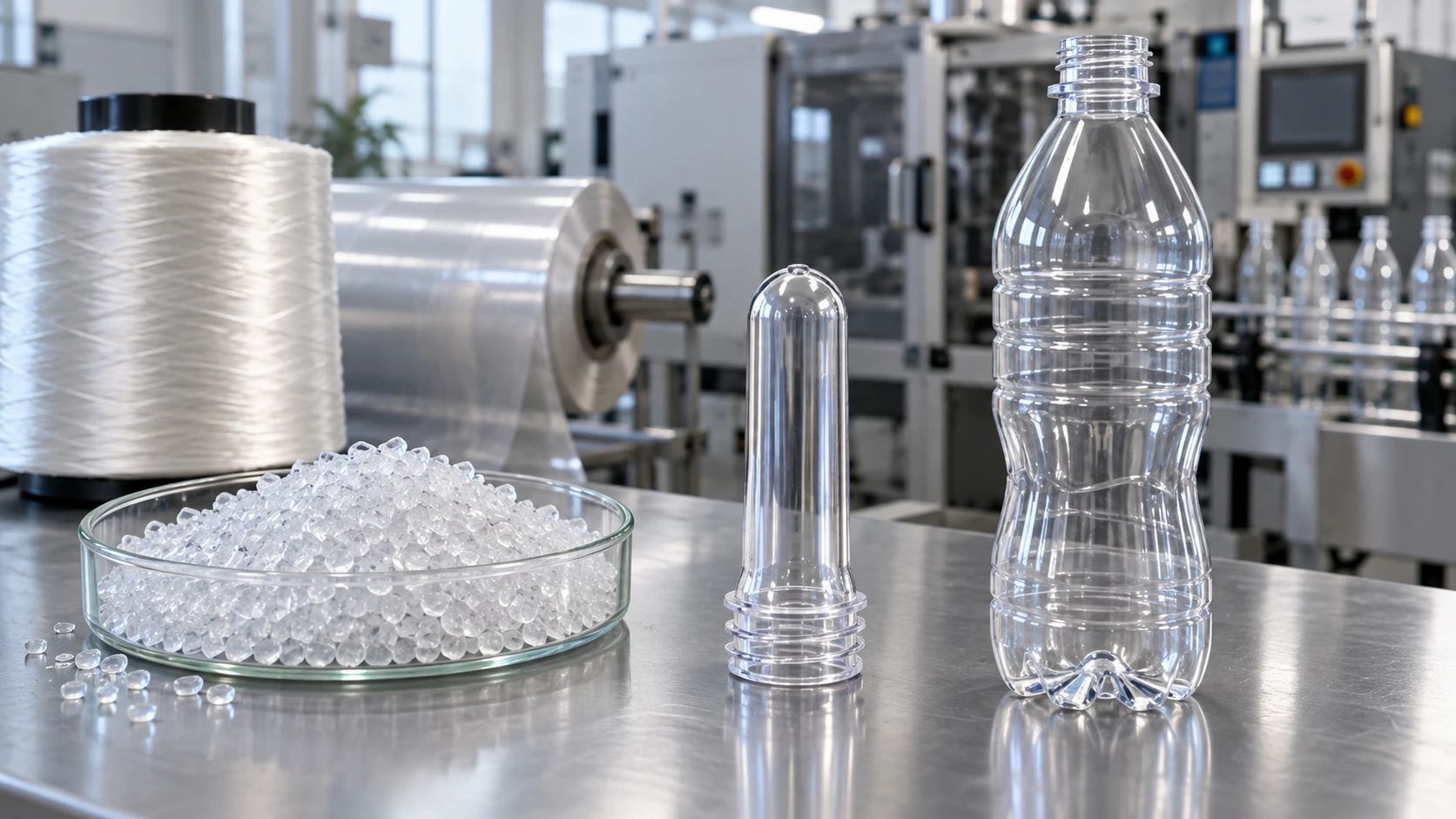
- What polyesters and PET are (the short version)
- PET, PBT and PEN — differences in composition, and how to read viscosity
- How PET is made — polymerisation in three stages
- Our calculation: the mass balance for making 1 kg of PET
- A materials engineer's view (1): in the melt, the chains cannot be grown all the way
- Solid-state polymerisation — growing chains as chips, below the melting point
- A materials engineer's view (2): solid-state polymerisation both "raises molecular weight" and "removes contaminants"
- Bottle-to-bottle — the conditions for returning to food use
- Our calculation: how small is the permitted concentration for food contact?
- A materials engineer's view (3): mechanical recycling and depolymerisation return to different places
- Fibres, films, bottles — how applications link to structure
- Open issues, and what this article could not confirm
- Glossary / References / Claim-to-source audit
Sourced = content stated in published material, peer-reviewed papers, standards, legislation or assessments by public bodies (link given)
Our calculation = a value this article derived from explicitly stated assumptions
Not yet confirmed = a plan, target or outlook with no confirmed track record
Textbook-style summaries of polymer science and readings for materials design are marked separately as Commentary.
1. What polyesters and PET are (the short version)
- What they are: polyester is the general name for polymers with ester bonds in the main chain. PET is the representative one. The annex to the EU recycled plastics regulation (2022/1616) defines PET as a polymer made by polycondensation of ethylene glycol with terephthalic acid or dimethyl terephthalate, which may contain up to 10 w/w% of other comonomers (isophthalic acid, diethylene glycol and so on) in the main chainSourced
- How much: of the 430.9 Mt of world plastics production in 2024 reported by Plastics Europe, PET is 6.2%Sourced. But these statistics do not include PET fibre, PBT fibre or PA fibreSourced. The total amount of PET including fibre must be larger than the 6.2% share suggests (Commentary)
- What is hard: polycondensation is an equilibrium reaction that proceeds while small molecules are removed. The molecular weight needed for a bottle cannot be reached in the melt alone. So solid-state polymerisation is used, and the same step is also used for decontamination in recycling (Sections 6 to 8) (Commentary)
Recycling PET is a problem of solving "how to recover molecular weight" and "how to remove contaminants" at the same time. The annex to the EU regulation describes mechanical recycling as a technology in which, after sorting, grinding, washing and similar steps, the plastic is held under heat and under vacuum or gas flow for at least a minimum time, so that "decontamination", which removes accidental contamination to a level of no health concern, is the decisive step. It says this technology preserves the polymer chain and may even increase molecular weight, and also that a small unintended decrease in molecular weight may occurSourced. The most interesting thing in this field is that solid-state polymerisation, which makes PET high in molecular weight, and decontamination, which makes PET fit for food use again, are tied together by the same equipment and the same operating conditions (temperature, reduced pressure, time) (our commentary).
2. PET, PBT and PEN — differences in composition, and how to read viscosity
A polyester joins an acid part and a diol part through ester bonds. What is combined changes the speed of crystallisation, the heat resistance and the barrier properties (Commentary).
| Polymer | Composition | Tendency in main applications (Commentary) |
|---|---|---|
| PET | Terephthalic acid (or DMT) + ethylene glycol | Beverage bottles, fibres, film, sheet |
| PBT | Terephthalic acid (or DMT) + 1,4-butanediol | Injection-moulded functional parts such as electrical and electronic components and automotive parts (read it in contrast with the series articles on polycarbonate and ABS resin and on PEEK and super engineering plastics) |
| PEN | Naphthalenedicarboxylic acid + ethylene glycol | Films and similar uses requiring heat resistance and barrier properties |
The summary of applications is a general tendency (Commentary). Because no source could be found that gives Tg, melting point and similar values for PET, PBT and PEN together with the test method, this article does not give them (Section 12).
"Intrinsic viscosity (IV)" as an index of molecular weight
In practice the molecular weight of PET is expressed not as molecular weight itself but as intrinsic viscosity (IV) or viscosity number, found from the viscosity of a dilute solution.
- ASTM D4603-18: specifies a method for finding the inherent viscosity of PET with a glass capillary viscometer, in a 60/40 phenol / 1,1,2,2-tetrachloroethane solution at a concentration of 0.50%. Highly crystalline PET needs a different procedure and is outside its scopeSourced
- ISO 1628-5: specifies the measurement of dilute-solution viscosity with capillary viscometers for thermoplastic polyester homopolymers and copolymersSourced
- ISO 20028-1:2019: a designation system for moulding and extrusion materials of thermoplastic polyesters (homopolymers and copolymers such as PET, PBT, PCT, PEN and PBN), in which viscosity number and tensile modulus are the specifying indicators. It cautions that materials with the same designation do not necessarily show the same performanceSourced
IV is a relative index with the solvent, temperature and concentration fixed (Section 4 of the series article on polymer basics). A value is read together with its measurement method. When comparing IV values alone, for example, a different solvent gives a different value (Commentary).
3. How PET is made — polymerisation in three stages
The polymerisation of PET can be understood in three broad stages (Fig. 2). The content is the standard account in polymer chemistry [Reference 2] (Commentary).
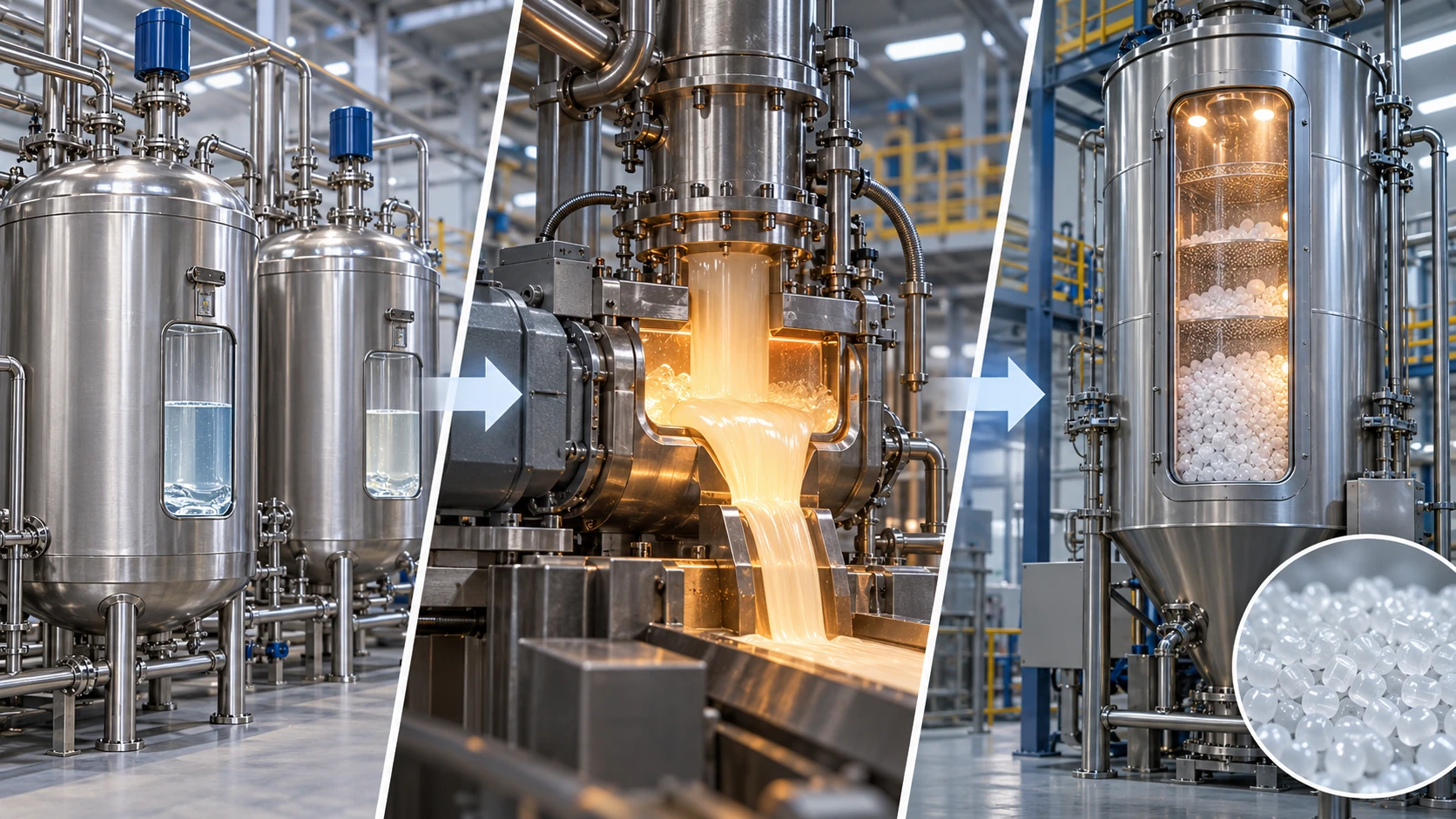
ImageGen conceptual illustration (not a real photograph or measurement). See the original diagram for exact values, names and structure.
Show original diagram with exact annotations and values
| Stage | What happens | What is removed | If stopped at this stage |
|---|---|---|---|
| (1) Esterification / transesterification | Terephthalic acid (TPA) and ethylene glycol (EG), or dimethyl terephthalate (DMT) and EG, react to give bis(2-hydroxyethyl) terephthalate (BHET) and low-molecular-weight oligomers | Water for TPA, methanol for DMT | Low-molecular-weight oligomers. Neither fibre nor bottle can be made |
| (2) Melt polycondensation | Oligomer chain ends react with one another and the chain grows. EG is formed as a by-product | Ethylene glycol (vaporised at high temperature and high vacuum) | Prepolymer. For some applications the process ends here (for example fibre) |
| (3) Solid-state polymerisation | The prepolymer, crystallised and kept as chips, grows further at a temperature below the melting point, under vacuum or in an inert gas stream | Ethylene glycol, water and so on | High-molecular-weight chips of the kind needed for bottles |
A textbook summary (Commentary; the subject of Scheirs and Long, Modern Polyesters [Reference 2]). The correspondences "for some applications the process ends at (2)" and "(3) is for bottles" are general explanations and do not apply to every plant. The EU regulation names TPA or DMT and EG as raw materialsSourced [Reference 3].
4. Our calculation: the mass balance for making 1 kg of PET
In polycondensation, part of the raw material leaves as small molecules. How much leaves can be calculated from atomic weights (Fig. 3).
The mass balance per repeat unit of PETOur calculation.
- Formula weights: PET repeat unit C₁₀H₈O₄ = 192.17, TPA (C₈H₆O₄) = 166.13, EG (C₂H₆O₂) = 62.07, DMT (C₁₀H₁₀O₄) = 194.19, water = 18.02, methanol = 32.04 (atomic weights C 12.011, H 1.008, O 15.999)
- Direct esterification route: TPA + EG → repeat unit + 2H₂O. Per 1 kg of PET, about 0.86 kg of TPA and about 0.32 kg of EG (net) are used, and about 0.19 kg of water is released
- Transesterification route: DMT + 2EG → BHET + 2CH₃OH, then BHET → repeat unit + EG. Net: DMT + EG → repeat unit + 2CH₃OH. Per 1 kg of PET, about 1.01 kg of DMT and about 0.32 kg of EG (net) are used, and about 0.33 kg of methanol is released
- Link to conversion: in the calculation of Section 3 of the series article on polymer basics, taking Mn = 20,000 as a provisional target, the required conversion is about 99.5%. The small molecules to be removed keep coming off even during the last 0.5% of the reaction
Assumptions and limits: these are theoretical values for complete reaction and 100% yield. In real plants EG is charged in excess and recovered for reuse, and side reactions also form diethylene glycol and other products. The numbers are not plant results.
For every 1 kg of PET, about 0.19 kg of water (or about 0.33 kg of methanol) must be removed, and in polycondensation about 0.32 kg worth of EG leaves the system as the reaction proceeds (our commentary).
- Reactor design: to get small molecules out of a highly viscous melt efficiently, equipment that spreads the melt thin to gain surface area (thin-film and disc-type reactors and the like) is used
- Degree of reduced pressure: the lower the partial pressure of EG, the further the equilibrium moves. The vacuum level directly sets the upper limit of molecular weight
- Quality: a long residence time at high temperature changes the end groups and causes colouring through side reactions. Here the limit of working in the melt alone appears (Section 5)
5. A materials engineer's view (1): in the melt, the chains cannot be grown all the way
In Fig. 2 of the series article on polymer basics, we calculated that in step-growth polymerisation the degree of polymerisation is only 100 even at 99% conversion. At the molecular weight PET needs for bottles, conversion lies in the region beyond 99.5%. Three constraints then act at once (our commentary).
- The equilibrium constraint: if much EG remains, the reverse reaction (chain scission) proceeds. To raise molecular weight, EG must be removed thoroughly
- The viscosity constraint: the longer the chains, the more sharply the melt viscosity rises (Fig. 4 of the polymer basics article: molecular weight to the power of about 3.4). When viscosity is high, EG cannot diffuse out from inside the melt
- The thermal degradation constraint: raising temperature to lower viscosity increases side reactions such as thermal decomposition and colouring
When the three constraints overlap, it becomes hard to push molecular weight up in the melt alone. So another route is used: at a temperature below the melting point, keep the material as solid chips and let EG diffuse out while gaining surface area. This is solid-state polymerisation. The idea is similar to the diffusion heat treatment of metals, which evens out composition in the solid phase rather than the liquid phase.
6. Solid-state polymerisation — growing chains as chips, below the melting point
In the Journal of Applied Polymer Science (2001), Duh reported a kinetic model of the solid-state polymerisation (SSP) of PET. The main points are as followsSourced.
- There are two kinds of end group, those that can react and those that cannot, and the solid-state polycondensation reaction is second order in the concentration of the reactive end groups
- The unreactive end groups include, besides chemically deactivated end groups, end groups fixed in the crystal structure and unable to move. The concentration of unreactive end groups sets the limiting intrinsic viscosity (molecular weight) that solid-state polymerisation can reach
- For verification, data were used from ground PET prepolymer of IV 0.20 to 0.35 dL/g held at 200 to 230 °C in a fluidised-bed reactor
- Under these conditions, the activation energy is about 23.6 kcal/mol and the mean SSP rate roughly doubles for each 10 °C rise
From the activation energy, how the rate changes with temperatureOur calculation.
- Conversion: 23.6 kcal/mol = 23.6 × 4.184 = 98.7 kJ/mol. Ea/R = 98,742 ÷ 8.314 = about 11,900 K
- Ratio of rate constants (Arrhenius): k(T) / k(200 °C) = exp[(Ea/R)(1/473.15 − 1/T)]. At 210 °C about 1.7 times, at 220 °C about 2.8 times, at 230 °C about 4.5 times
- The reported mean-rate relation: if the rate doubles every 10 °C, then at 230 °C it is 2³ = 8 times
Interpretation: that the ratio of the reported mean rates (about 8 times) is larger than the ratio of rate constants calculated from Ea alone (about 4.5 times) can be read, as the paper states, as arising because the higher the temperature, the lower the concentration of immobile end groups, and the higher the rate constant and the limiting IVSourced (the paper's statement). Assumptions and limits: this calculation is a simplification of the paper's statements and is not the experimental curve itself. The experiments were small-scale with ground prepolymer, and with industrial chips the effect of particle size (diffusion) is added.
In a 2006 paper, Duh re-examined, under correct experimental conditions, the long-held assumption that "solid-state polymerisation slows as crystallinity rises". The result showed that for powders and pellets the rate of solid-state polymerisation increases as crystallinity rises. The reaction takes place in the amorphous phase; as crystallinity rises, the end-group concentration in the amorphous phase goes up, and fewer unreactive end groups are trapped inside the crystals. Above a particle size of about 7 mm the trend reverses, because diffusion resistance to the by-product takes over, but this size is said to be larger than commercial resin pelletsSourced.
The chapter by Wadekar et al., "Recent Developments in Solid State Polymerization of Poly(ethylene terephthalate)" (2009), has sections on conventional solid-state polymerisation processes, new solid-state polymerisation processes, recycling of PET flakes using solid-state polymerisation, particle-formation technology, alternatives to solid-state polymerisation, and PET for liquid packaging, among othersSourced (the section structure of the chapter; the text was not checked). It shows that solid-state polymerisation and recycling have long been discussed together on the engineering side too.
7. A materials engineer's view (2): solid-state polymerisation both "raises molecular weight" and "removes contaminants"
Solid-state polymerisation was originally a step for raising the molecular weight of new PET. But EFSA (the European Food Safety Authority), in its assessment opinion on the PET recycling process "PETUK SSP", evaluates the following mechanismSourced.
- Washed and dried PET flakes are dried, extruded into pellets, and then put into a solid-state polymerisation reactor, where high temperature, a long residence time and vacuum are applied
- From the results of a challenge test (a test with known contaminants deliberately added), the EFSA panel concluded that solid-state polymerisation is the critical step that determines decontamination efficiency
- The operating parameters that control the performance of the process are temperature, pressure and residence time
- If operated under these conditions, it assessed that foreseeable accidental contamination can be reduced to a level where migration into food, by a conservative model, is below 0.1 μg/kg food (on condition that the operating conditions are at least as severe as in the challenge test and that the input is washed and dried flakes made from material produced in compliance with food-contact legislation)
In other words, solid-state polymerisation is both a device for "recovering molecular weight" and a decontamination device that drives low-molecular-weight contaminants out of the solid (our commentary). Both are phenomena of small molecules diffusing out through a solid. The rate at which EG leaves and the rate at which contaminants leave are governed by the same "temperature, reduced pressure and time".
For a materials engineer, this has the following implications.
- Operating conditions become "quality assurance": temperature, pressure and residence time are, in EFSA's assessment, the very conditions of approval. Relaxing them is not only a molecular weight problem but also a departure on food safety
- The shape and size of the chip matter: the exit for small molecules is the surface. The larger the particle, the longer the diffusion distance (the effect of particle size is also discussed in Duh's paper)
- The history of the input is a precondition: EFSA's assessment makes it a condition that the input comes from material made in compliance with food-contact legislation. Decontamination is not a universal purification
8. Bottle-to-bottle — the conditions for returning to food use
In the EU, the use of recycled plastics in food contact is governed by Regulation (EU) 2022/1616 (15 September 2022, repealing the earlier 2008 regulation). The regulation says that it provides for the placing on the market of recycled plastic materials and articles, the development and operation of recycling technologies, processes and installations, and their use in food contactSourced.
- The recycling technology used must be either a "suitable recycling technology" listed in Annex I of the regulation or a "novel technology" developed in accordance with Chapter IV. Where a suitable recycling technology is used, authorisation of the recycling process is required where applicable, and the general requirements of Articles 6 to 8 and the technology-specific requirements of Annex I must be metSourced
- The recitals of the regulation record EFSA's judgement that for contaminants in post-consumer PET, what will be mixed into the input cannot be predicted, and absence of genotoxicity cannot be confirmed, and say that this thinking can be extended to other plastic wasteSourced
In a 2011 scientific opinion, EFSA set out criteria for the safety evaluation of mechanical recycling processes for PET. The main points are as followsSourced.
- The principle is to apply the cleaning efficiency obtained in a challenge test (a test using surrogate contaminants) to a reference contamination level of 3 mg/kg PET for post-consumer PET (a value conservatively assuming contaminants that could enter through misuse), and so find the concentration remaining in the recycled PET (Cres)
- Cres is compared with the concentration calculated by a generally accepted conservative migration model (Cmod). Cmod corresponds to a migration that does not exceed the exposure threshold of 0.0025 μg/kg body weight per day for chemicals with structural alerts for genotoxicity
- The default scenario is an infant of 5 kg body weight drinking 0.75 L per day of water from bottles made of 100% recycled PET, from which the permitted concentration in food is derived as 0.017 μg/kg food
9. Our calculation: how small is the permitted concentration for food contact?
Checking the figures in the EFSA opinion by arithmeticOur calculation.
- Reproducing the permitted concentration: 0.0025 μg/kg body weight/day × 5 kg = 0.0125 μg/day. Dividing by 0.75 L of water (taken as about 0.75 kg) gives 0.0125 ÷ 0.75 = about 0.0167 μg/kg food. This agrees with the value in the opinion (0.017 μg/kg food)
- A feel for the orders of magnitude: the reference contamination level of 3 mg/kg PET = 3,000 μg/kg PET. Its ratio to the permitted concentration of 0.017 μg/kg food is 3,000 ÷ 0.017 = about 1.8×10⁵
Assumptions and limits: this ratio is not the "required cleaning efficiency". The required cleaning efficiency is set for each substance by the diffusion and migration model (Cmod). The calculation here only confirms that there is a gap of five orders of magnitude or more between the contaminant concentration (of the order of mg/kg) and the permitted migration (below a tenth of μg/kg).
The Packaging and Packaging Waste Regulation (EU) 2025/40 (PPWR) sets minimum recycled content at 30% in 2030 and 50% in 2040 for contact-sensitive packaging made of PET, and 30% in 2030 and 65% in 2040 for single-use plastic beverage bottles (applying from 12 August 2026)Sourced. For this reason the technology of the step that returns used PET to food use (including decontamination) is placed at the centre of regulatory compliance (Commentary). Collection and recycling rates for PET bottles are covered in the series article on plastic recycling.
10. A materials engineer's view (3): mechanical recycling and depolymerisation return to different places
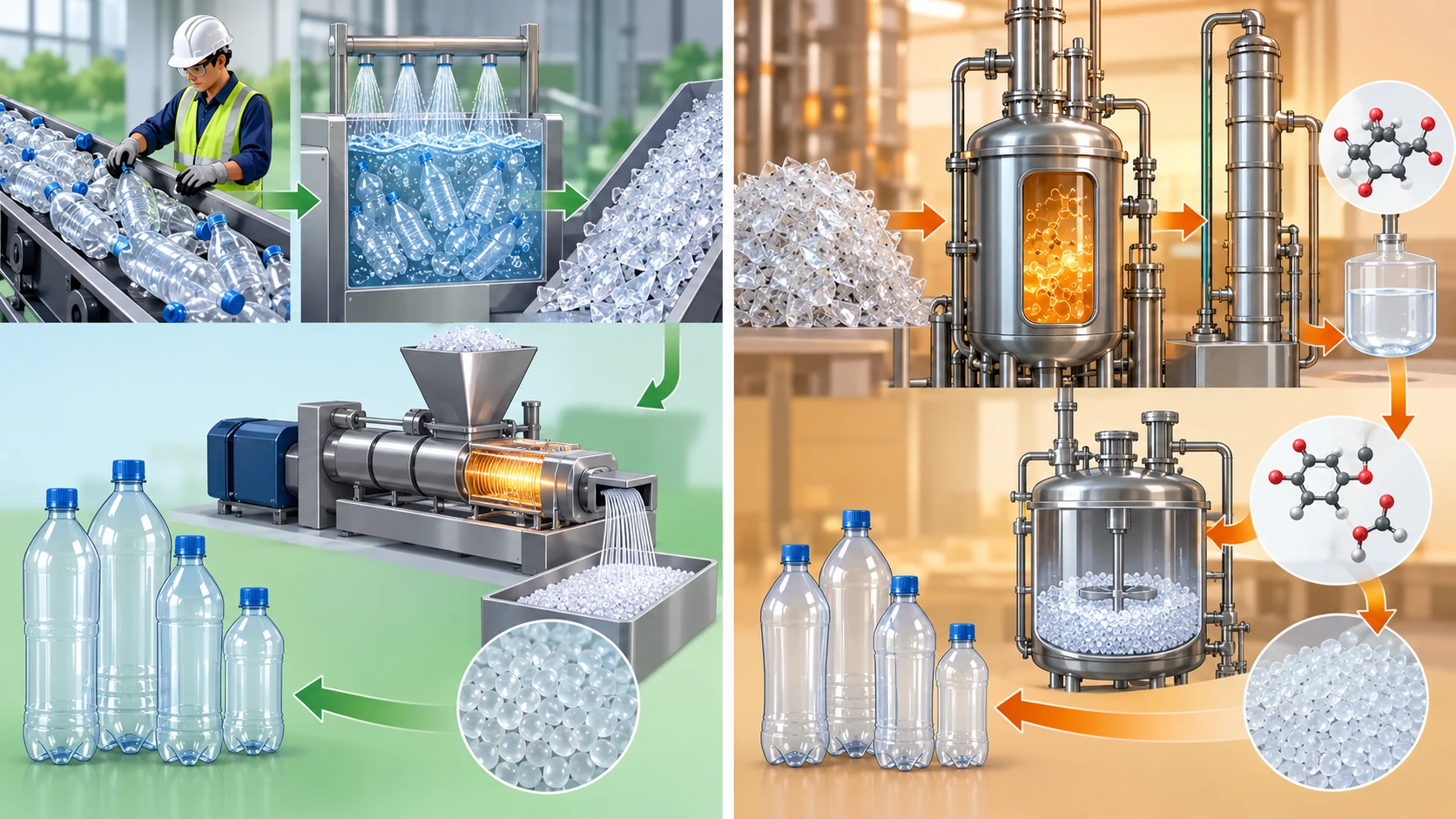
ImageGen conceptual illustration (not a real photograph or measurement). See the original diagram for exact values, names and structure.
Show original diagram with exact annotations and values
- Mechanical recycling (the mainstream of bottle-to-bottle): it keeps the chain and returns to the last step of manufacture (solid-state polymerisation). The EU regulation says this technology preserves the polymer chain and may increase molecular weightSourced. Its strength is that, because polymerisation is not redone from the start, there is less energy and fewer steps. Its weakness is that pigments and foreign matter in the input, mixed polymers and the history of degradation may be carried over as they are (Commentary)
- Depolymerisation (glycolysis, methanolysis and so on): it cuts the ester bonds to return the material to BHET, DMT and the like, and goes back to the first step of manufacture (esterification). It can be purified and repolymerised to virgin quality. Its weakness is more steps, and the energy and equipment needed (Commentary; routes, examples and scale are in the series article on chemical recycling)
- How they are used: there is a tendency to divide the work, with washed flakes whose molecular weight has been kept going to mechanical recycling, and used material that is strongly coloured or dirty, or in a different form such as fibre, going to depolymerisation (Commentary)
Ester bonds are cut by water and alcohols. This property was a constraint in polycondensation: "the reverse reaction occurs, so small molecules must be removed". In depolymerisation, the same property becomes the advantage that "it can be cut and returned". The same property of a chemical bond is a constraint in manufacture and an advantage in recycling, and that is what makes polyesters interesting (our commentary).
ISO 12418-1:2012 also sets out a designation system and the basis for specifications for recyclate (bottle flakes and the like) derived from post-consumer PET bottlesSourced. It is a framework for specifying the quality of recyclate by numbers.
11. Fibres, films, bottles — how applications link to structure
With the same chemical formula, PET is given a different chain orientation and a different way of forming crystals for each application (Commentary).
| Application | How the structure is made (Commentary) | What is controlled |
|---|---|---|
| Fibre | Molten resin is extruded through fine holes and spun, drawn to orient the chains along the axis, and heat-treated to set the crystals | Degree of orientation, crystallinity |
| Film | Sheet is drawn in both directions (biaxial drawing) to orient it, then heat-set | Biaxial orientation, crystallinity, heat shrinkage |
| Bottle | An injection-moulded preform is heated and stretched biaxially by blow moulding (injection stretch blow moulding). Crystals form during the stretching (strain-induced crystallisation) | Stretch ratio, strain-induced crystallisation, IV |
| Engineering resin (PBT) | PBT, which crystallises quickly, is crystallised in the mould during injection moulding | Crystallisation rate, reinforcement |
The summary of processing methods is general content (Commentary). On strain-induced crystallisation, Billon published a paper in the journal Polymer (2023) treating strain-induced crystallisation of PET under biaxial conditions from laboratory tests through to injection stretch blow moulding (only the title was checked; the text was not).
Statistics on the Japanese fibre side show how large the change has been. In domestic production of chemical fibres published by the Japan Chemical Fibers Association, based on statistics from the Ministry of Economy, Trade and Industry, the combined total of polyester filament and staple was about 347,000 t in 2010 (188,451 t + 158,351 t) and about 137,000 t in 2024 (79,827 t + 56,873 t)Sourced. That is a fall of about 61%Our calculation (136,700 ÷ 346,802 = 0.394). This concerns domestic production, not world demand or domestic consumption including imports.
PET needs a different molecular weight and structure for each application (our commentary).
- Fibre: needs both the flowability to spin thin and uniform fibre and the strength from drawing. The evenness of orientation sets the properties
- Bottle: needs toughness to withstand drops and internal pressure, retention of gas (carbonation), and transparency. Here high molecular weight matters. The orientation and crystals created by drawing raise barrier properties and strength
- Where recycled material goes: whether recycled bottle material goes back into bottles or cascades down to fibre or sheet is decided by how far IV (molecular weight) is recovered, and by colour and cleanliness
How to measure oxygen and water vapour permeation, which bear on barrier properties, is covered in the series article on barrier properties and coatings.
12. Open issues, and what this article could not confirm
(1) Property values of PET, PBT and PEN
Values such as the glass transition temperature, melting point and barrier properties of PET, PBT and PEN are not given, because within the scope of this article no published source could be found that gives them together with test method, conditions and grade. Please check property values in each company's data sheet, together with the test method (ISO or ASTM).
(2) Details of the polymerisation process
The three-stage summary in Section 3 is textbook content, and the relevant pages of the book by Scheirs and Long [Reference 2] were not checked directly. The catalyst (antimony-based and so on) and process conditions such as temperature and vacuum level are not given in this article.
(3) Industrial conditions for solid-state polymerisation
Duh's experiments were small-scale, at 200 to 230 °C, in a fluidised bed, with ground prepolymer. How the solid-state polymerisation conditions for industrial chips (temperature, time, particle size) relate to the rates in Fig. 4 was not checked in this article. Nor does this article quote numerical operating conditions for individual processes from EFSA's assessment opinions.
(4) Figures for PET bottles in Japan
The collection and recycling rates of PET bottles in Japan are left to the series article on plastic recycling, and the figures are not repeated here. The operating status of real chemical recycling plants is likewise left to the article on chemical recycling.
(5) Scope of the fibre statistics
The figures in Section 11 are domestic production of chemical fibres in Japan (Ministry of Economy, Trade and Industry statistics, the Japan Chemical Fibers Association's tables). They are not world demand, domestic consumption including imports, or a breakdown of fibre by application. The world volume of PET used in fibre was not checked in this article.
- PET is 6.2% of world plastics production (2024). But these statistics do not include fibreSourced
- Every 1 kg of PET made requires removing about 0.19 kg of water (or about 0.33 kg of methanol). In the melt alone, the last 1% of the reaction cannot be driven to completionOur calculation
- Solid-state polymerisation grows the chain by removing EG from chips, below the melting point. In Duh's experiments the activation energy was about 23.6 kcal/mol and the mean rate roughly doubled for each 10 °CSourced
- Solid-state polymerisation can also be the decisive decontamination step. In its assessment of PETUK SSP, EFSA names temperature, pressure and residence time as the parameters to be controlledSourced
- The permitted concentration for food contact is extremely small. EFSA's infant scenario yields 0.017 μg/kg foodSourced. It can be reproduced by arithmeticOur calculation
- Mechanical recycling keeps the chain and returns to the last step of manufacture; depolymerisation cuts the chain and returns to the first. The property of the ester bond is a constraint in manufacture and an advantage in recycling (Commentary)
13. Glossary
- Polyester
- A polymer with ester bonds in the main chain. PET, PBT, PEN and others.
- Terephthalic acid (TPA) / dimethyl terephthalate (DMT)
- Raw materials for the acid component of PET.
- Ethylene glycol (EG)
- The raw material for the diol component of PET. It is formed as a by-product in polycondensation and removed.
- BHET
- Bis(2-hydroxyethyl) terephthalate. A low-molecular-weight precursor of PET.
- Esterification / transesterification
- The reaction of TPA with EG (water is released) / of DMT with EG (methanol is released).
- Melt polycondensation
- Polymerisation in which the chain grows in the melt while small molecules are removed.
- Solid-state polymerisation (SSP)
- Polymerisation in which the chain grows in solid chips at a temperature below the melting point.
- Intrinsic viscosity (IV)
- An index of molecular weight found from the viscosity of a dilute solution. The value changes with solvent and temperature.
- PBT
- Polybutylene terephthalate. Crystallises quickly and suits injection moulding.
- PEN
- Polyethylene naphthalate. Has a naphthalene ring and tends toward higher heat resistance and barrier properties.
- Preform
- The test-tube-shaped intermediate made by injection moulding before blow moulding a bottle.
- Strain-induced crystallisation
- The phenomenon in which drawing orients the chains and crystals form.
- Challenge test
- A test in which surrogate contaminants are deliberately added to measure the decontamination efficiency of a recycling process.
- Mechanical recycling / depolymerisation
- Recycling that keeps the chain / recycling that cuts the chain to return to raw materials (monomers, oligomers).
- EFSA
- The European Food Safety Authority. It scientifically assesses the safety of food-contact materials.
14. References (primary sources)
- Plastics Europe "Plastics the Fast Facts 2025", October 2025 (provisional figures for 2024, PDF) — https://plasticseurope.org/wp-content/uploads/2025/09/PE_TheFacts_25_digital-1pager-scrollable.pdf
- Book J. Scheirs, T. E. Long (eds.), Modern Polyesters: Chemistry and Technology of Polyesters and Copolyesters, Wiley, 2003 — https://doi.org/10.1002/0470090685
- European Commission Commission Regulation (EU) 2022/1616 on recycled plastic materials and articles intended to come into contact with foods (15 September 2022) — https://eur-lex.europa.eu/legal-content/EN/TXT/HTML/?uri=CELEX:32022R1616
- EFSA "Scientific Opinion on the criteria to be used for safety evaluation of a mechanical recycling process to produce recycled PET intended to be used for manufacture of materials and articles in contact with food", EFSA Journal 2011;9(7):2184 — https://doi.org/10.2903/j.efsa.2011.2184
- EFSA "Scientific Opinion on the safety evaluation of the process “PETUK SSP” for production of recycled post-consumer PET for use in food contact materials", EFSA Journal 2012;10(8):2826 — https://doi.org/10.2903/j.efsa.2012.2826
- B. Duh "Reaction kinetics for solid-state polymerization of poly(ethylene terephthalate)", J. Appl. Polym. Sci. 81, 1748–1761 (2001) — https://doi.org/10.1002/app.1607
- B. Duh "Effects of crystallinity on solid-state polymerization of poly(ethylene terephthalate)", J. Appl. Polym. Sci. 102, 623–632 (2006) — https://doi.org/10.1002/app.24406
- Wadekar, Agarwal, Boon "Recent developments in solid state polymerization of poly(ethylene terephthalate)", in Solid State Polymerization, Wiley, 2009, Chapter 8 — https://doi.org/10.1002/9780470451830.ch8
- European Union Regulation (EU) 2025/40 on packaging and packaging waste (19 December 2024) — https://eur-lex.europa.eu/legal-content/EN/TXT/HTML/?uri=OJ:L_202500040
- Japan Chemical Fibers Association "Chemical fibre production and stock, monthly data" (source: Ministry of Economy, Trade and Industry; in Japanese, XLS) — https://www.jcfa.gr.jp/home/wp-content/uploads/2026/09/%E7%94%9F%E7%94%A3%E3%83%BB%E5%9C%A8%E5%BA%AB%EF%BC%88%E3%83%97%E3%83%AC%E3%82%B9%E3%83%AA%E3%83%AA%E3%83%BC%E3%82%B9%EF%BC%89.xls
- ISO ISO 20028-1:2019 "Plastics — Thermoplastic polyester (TP) moulding and extrusion materials — Part 1: Designation system and basis for specification" — https://www.iso.org/standard/76396.html
- ISO ISO 1628-5:1998 "Plastics — Determination of the viscosity of polymers in dilute solution using capillary viscometers — Part 5: Thermoplastic polyester (TP) homopolymers and copolymers" — https://www.iso.org/standard/25183.html
- ASTM International ASTM D4603-18 "Standard Test Method for Determining Inherent Viscosity of Poly(Ethylene Terephthalate) (PET) by Glass Capillary Viscometer" — https://store.astm.org/d4603-18.html
- ISO ISO 12418-1:2012 "Plastics — Post-consumer poly(ethylene terephthalate) (PET) bottle recyclates — Part 1: Designation system and basis for specifications" — https://www.iso.org/standard/51421.html
- J.-M. Billon "Strain induced crystallization of PET under biaxial conditions. From laboratory tests to injection stretch-blow molding", Polymer (2023) — https://doi.org/10.1016/j.polymer.2023.125953
15. Claim-to-source audit
| Claim in the text | Basis | Type |
|---|---|---|
| PET's share of 6.2% of world plastics production of 430.9 Mt (2024). That PET, PBT and PA fibres are not in the scope of the statistics | Plastics Europe, "Plastics the Fast Facts 2025"Reference 1 https://plasticseurope.org/wp-content/uploads/2025/09/PE_TheFacts_25_digital-1pager-scrollable.pdf | Sourced |
| That PET polymerisation is polycondensation of ethylene glycol with TPA or DMT. The definition of PET as possibly containing up to 10 w/w% of other comonomers (isophthalic acid, diethylene glycol and so on) in the main chain. The definition of mechanical recycling (decontamination as the decisive step, heat and vacuum or gas flow, the chain preserved and molecular weight possibly raised, a small unintended decrease also possible). EFSA's judgement on the unpredictability of contaminants in post-consumer PET. That recycling technologies are suitable technologies in Annex I or novel technologies, authorisation, Articles 6 to 8. The title and date of the regulation and the repeal of the earlier regulation | Text of Commission Regulation (EU) 2022/1616 (recitals, Articles 1, 2 and 4, the table in Annex I), checked by opening it in a browserReference 3 https://eur-lex.europa.eu/legal-content/EN/TXT/HTML/?uri=CELEX:32022R1616 | Sourced |
| EFSA's criteria for the safety evaluation of mechanical recycling of PET: challenge test, reference contamination level of 3 mg/kg PET, Cres against Cmod, exposure threshold of 0.0025 μg/kg body weight per day, an infant of 5 kg drinking 0.75 L of water daily, permitted concentration of 0.017 μg/kg food | Abstract of the EFSA scientific opinionReference 4 https://doi.org/10.2903/j.efsa.2011.2184 | Sourced |
| The PETUK SSP process (washed and dried flakes → extruded pellets → solid-state polymerisation reactor, high temperature, long residence time, vacuum). That solid-state polymerisation is the critical step determining decontamination efficiency. That the control parameters are temperature, pressure and residence time. That migration is below 0.1 μg/kg food by a conservative model (with conditions) | Abstract of the EFSA scientific opinionReference 5 https://doi.org/10.2903/j.efsa.2012.2826 | Sourced |
| The kinetic model of PET solid-state polymerisation (second order in reactive end groups; unreactive end groups set the limiting IV). Ground prepolymer of IV 0.20 to 0.35 dL/g, fluidised bed, 200 to 230 °C. Activation energy of about 23.6 kcal/mol; mean rate about doubling per 10 °C. That higher temperature raises the rate constant and reduces unreactive end groups | Abstract of Duh (2001)Reference 6 https://doi.org/10.1002/app.1607 | Sourced |
| That for powders and pellets the solid-state polymerisation rate rises with crystallinity. That the reaction takes place in the amorphous phase. That above a particle size of about 7 mm the trend reverses, but this is larger than commercial pellets | Abstract of Duh (2006)Reference 7 https://doi.org/10.1002/app.24406 | Sourced |
| The section structure of the chapter by Wadekar et al. (conventional solid-state polymerisation, new solid-state polymerisation, recycling of PET flakes using solid-state polymerisation, particle-formation technology, alternatives to solid-state polymerisation, PET for liquid packaging and so on) | Table of contents of the chapter (text not checked)Reference 8 https://doi.org/10.1002/9780470451830.ch8 | Sourced |
| PPWR Article 7: contact-sensitive packaging made of PET 30% in 2030 and 50% in 2040; single-use plastic beverage bottles 30% in 2030 and 65% in 2040. Applies from 12 August 2026 | Text of the regulation on EUR-Lex (Articles 7 and 71), checked by opening it in a browserReference 9 https://eur-lex.europa.eu/legal-content/EN/TXT/HTML/?uri=OJ:L_202500040 | Sourced |
| Japanese domestic production of polyester filament and staple: 2010 188,451 t + 158,351 t, 2024 79,827 t + 56,873 t (Ministry of Economy, Trade and Industry statistics, the Japan Chemical Fibers Association's tables) | Annual totals in the Japan Chemical Fibers Association's "Chemical fibre production and stock, monthly data"Reference 10 https://www.jcfa.gr.jp/home/wp-content/uploads/2026/09/%E7%94%9F%E7%94%A3%E3%83%BB%E5%9C%A8%E5%BA%AB%EF%BC%88%E3%83%97%E3%83%AC%E3%82%B9%E3%83%AA%E3%83%AA%E3%83%BC%E3%82%B9%EF%BC%89.xls | Sourced |
| That ISO 20028-1:2019 is a designation system for thermoplastic polyesters such as PET, PBT, PCT, PEN and PBN, with viscosity number and tensile modulus as indicators. That the same designation does not necessarily mean the same performance | Title and scopeReference 11 https://www.iso.org/standard/76396.html | Sourced |
| That ISO 1628-5 specifies the measurement of dilute-solution viscosity of thermoplastic polyesters | TitleReference 12 https://www.iso.org/standard/25183.html | Sourced |
| That ASTM D4603-18 finds the inherent viscosity of PET in 60/40 phenol / tetrachloroethane at 0.50% with a glass capillary viscometer. That highly crystalline PET is outside its scope | Title and scopeReference 13 https://store.astm.org/d4603-18.html | Sourced |
| That ISO 12418-1:2012 sets out a designation system for post-consumer PET bottle recyclate | TitleReference 14 https://www.iso.org/standard/51421.html | Sourced |
| That Billon's paper treats strain-induced crystallisation of PET under biaxial conditions from laboratory tests through to injection stretch blow moulding | Title of the paper (abstract and text not checked)Reference 15 https://doi.org/10.1016/j.polymer.2023.125953 | Sourced |
| The summary that divides PET polymerisation into three stages (esterification / transesterification, melt polycondensation, solid-state polymerisation) | A textbook summary of polymer chemistry, the subject of the book by Scheirs and Long. The relevant pages were not checked directlyReference 2 https://doi.org/10.1002/0470090685 | Sourced |
| The mass balance per 1 kg of PET (TPA about 0.86 kg, DMT about 1.01 kg, EG about 0.32 kg, water about 0.19 kg, methanol about 0.33 kg). Relative rates of solid-state polymerisation (about 1.7 times at 210 °C, about 2.8 times at 220 °C, about 4.5 times at 230 °C; 8 times at 230 °C by the reported mean-rate relation). Reproduction of the permitted concentration (about 0.0167 μg/kg food) and its ratio to 3,000 μg/kg PET (about 1.8×10⁵). The fall of about 61% in domestic polyester fibre | Our calculation. Assumptions: complete reaction and 100% yield (mass balance); Arrhenius using Ea only (rate); 0.75 L of water = about 0.75 kg (permitted concentration). Atomic weights C 12.011, H 1.008, O 15.999 | Our calculation |
| The differences in composition of PET, PBT and PEN and the tendencies in crystallisation, heat resistance and barrier properties; the summary that the property of the ester bond is a constraint in manufacture and an advantage in recycling; the reading that solid-state polymerisation bears both molecular weight recovery and decontamination; the difference in where mechanical recycling and depolymerisation return to; how structure is made in fibre, film and bottle; and how recycled material is directed to applications | Our commentary, based on the general summary of polymer science and on published values. These are not views expressed by any institution | Commentary |
| Tg, melting point and similar values of PET, PBT and PEN. Industrial solid-state polymerisation conditions for chips. World volume of PET used in fibre | No source with test method and conditions could be confirmed within the scope of this article | Not yet confirmed |
| That Figs. 1 to 5 are explanatory drawings or our own calculations, and that the hero image is an AI-generated image | Our note | Commentary |
Last updated 2 October 2026. Sources are limited to primary material (the text of EU regulation, abstracts of EFSA scientific opinions, bibliographic details and abstracts of peer-reviewed papers, statistics from Plastics Europe and the Japan Chemical Fibers Association, and the titles and scopes of ISO and ASTM standards). Because the article includes structural readings and materials-design interpretations, those are marked as Commentary and kept separate from sourced fact. Property values of PET, PBT and PEN, industrial conditions for solid-state polymerisation, and the world volume of fibre use could not be confirmed and are therefore not stated. The mass balance and rates in the figures are theoretical or calculated values based on assumptions. All figures are explanatory concept graphics or our own calculations. Figs. 1 to 5 are vector drawings and the hero image is AI-generated; none of them shows a real plant, measured data or a physical product.