TECHNOLOGY EXPLAINER
MHC and Universal Donors
— how “cells for everyone” handle the immune system's markers
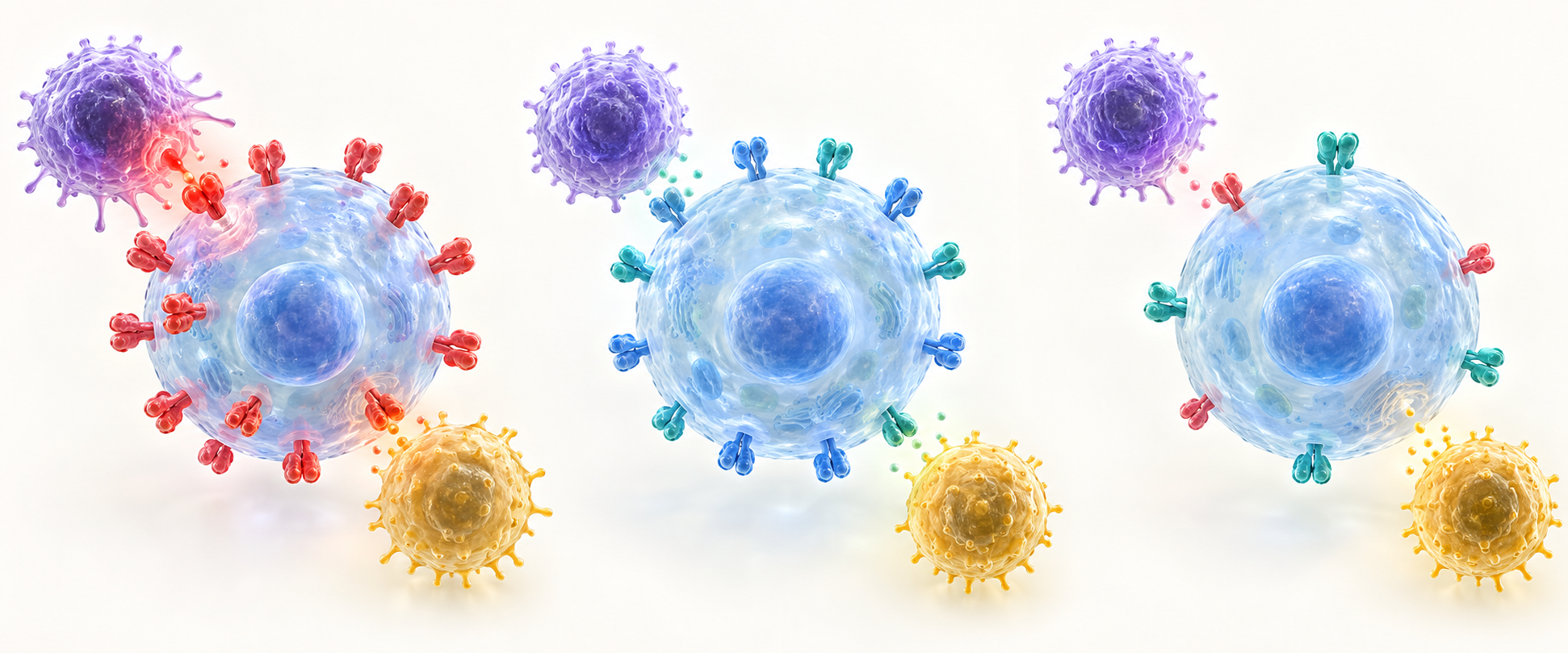
When another person's cells are transplanted, the immune system tells them apart by differences in the markers on the cell surface (HLA in humans, MHC in animals) and rejects them. Two opposite designs are being pursued against this barrier: matching the type, and deleting or hiding the marker. For the first, a stock from the CiRA Foundation (Kyoto University iPS Cell Research Foundation) built from 7 donors and 27 lines matches about 40% of Japanese people and has been used in more than 10 clinical trials. For the second, the Foundation offers clinical-grade HLA-edited lines, and abroad one patient has been followed for 14 months after a transplant without immunosuppression. This article sorts out the mechanisms, the numbers and the points of contact with materials and manufacturing, from primary sources.
- What HLA (MHC) is (the short version)
- How rejection works — three T cell pathways, and NK cells
- Method 1: matching HLA — homozygous donors and iPS cell stocks
- A materials engineer's view (1): a stock is a raw material with regulatory documents
- Method 2: editing HLA — universal donor cells
- A materials engineer's view (2): editing becomes part of the manufacturing process
- What “off the shelf” contains — sorting out autologous versus allogeneic
- Milestones and open questions
- Glossary / Primary sources / Claim-to-source audit
Sourced = content stated in published material, papers, reviews or announcements from the Foundation and companies (link given)
Our calculation = a figure this article derived from stated assumptions
Not yet confirmed = a product in development, a plan or a result not yet available, with no confirmed track record
Readings from the standpoint of materials and process are marked separately as Commentary.
This article is a technical explainer from the standpoint of manufacturing, materials and regulation. It does not recommend any treatment, does not rank products or treatments by efficacy, and is not medical advice. Clinical figures are quoted only as stated in papers and official material, together with the trial name, population and time point.
1. What HLA (MHC) is (the short version)
HLA is a marker on the cell surface that tells self from non-self. It is a product of the MHC (major histocompatibility complex); the human MHC is called HLA (human leukocyte antigen).
- What it is: the CiRA Foundation describes HLA as a collective name for proteins that serve as markers for telling self from non-self in human cells. They are present on many kinds of cell besides white blood cells, and there are tens of thousands of possible combinations. HLA divides broadly into class I and class II, and in particular class I HLA-A, HLA-B and HLA-C are said to have a large effect on rejection when cells are transplantedSourced
- Who reads it: a review explains that class I-peptide complexes appear on most nucleated cells and are recognised by CD8-positive cytotoxic T cells, while class II appears mainly on antigen-presenting cells and is recognised by CD4-positive helper T cells; it says rejection is mainly a T cell response to this highly polymorphic MHCSourced
- Invisible is dangerous: NK cells attack cells that do not display the self class I (the missing-self hypothesis)Sourced. So it is not enough simply to delete the marker
“Cells for everyone” can be made in two opposite ways. One is to prepare several lines from donors with matched types and choose the one that fits the patient. The other is to edit genes so that the marker itself is deleted or hidden. The former has a record of use in more than 10 clinical trials, but even the product approved in Japan (Amchepry) is used with an immunosuppressant (tacrolimus)Sourced [Reference 27]. The latter could allow immunosuppression to be dropped, but the clinical transplant without immunosuppression reported so far involves one patientSourced (within the scope of this article's survey).
2. How rejection works — three T cell pathways, and NK cells
There are at least two pathways by which T cells recognise another person's MHC. According to the review by Siu et al., the direct pathway is one in which T cells directly see the intact MHC of another person on the surface of donor cells, and the indirect pathway is one in which donor proteins are broken down and presented as peptides on the recipient's own MHC. A semi-direct pathway, in which donor MHC moves onto the recipient's dendritic cells and is presented intact, has also been shownSourced.
It has traditionally been thought that the direct pathway gives a strong but short response involved in acute rejection, while the indirect pathway gives a long-lasting response involved in chronic rejection. The same review, however, says this view rests on surprisingly little experimental evidence and may be oversimplified in light of the discovery of the semi-direct pathwaySourced.
Antibodies and “sensitisation”
T cells and NK cells are not the only ones involved in rejection. The LANTIDRA package insert states that patients whose T-cell and B-cell crossmatch between recipient serum and donor lymphocytes is positive may be at higher risk of graft rejection, and that administration of the product may raise panel reactive antibodies (PRA), which could put the patient at a disadvantage as a later kidney transplant candidateSourced. In other words, cells made from another person can affect later, separate transplants too (our commentary).
The brain is said to be “immune-privileged”, but…
Morizane and colleagues allografted dopaminergic neurons made from iPS cells of MHC-homozygous cynomolgus monkeys into the brain. The brain is considered a tissue with weak immune responses, but with MHC-mismatched grafts neuroinflammation was detected by PET, and when MHC was matched, the accumulation of microglia and lymphocytes was reduced and survival of the transplanted dopaminergic (TH-positive) neurons increased, they reported. The effect of the immunosuppressant tacrolimus was also confirmed in the same experimental systemSourced.
3. Method 1: matching HLA — homozygous donors and iPS cell stocks
HLA genes are inherited one set from each parent. A donor who is “homozygous”, with the same type at a locus from both parents, displays only one type from that locus on the cells. For a patient who carries that type on one chromosome, every marker on the donor cells is “familiar” (our commentary). The Foundation provides stocks of iPS cells made from such donors to universities and companies, as derived from “donors with HLA types that are unlikely to provoke immune rejection in many Japanese people”Sourced.
Track record of the stock
| Item | Content |
|---|---|
| Start of the project | Begun in 2013 by the Center for iPS Cell Research and Application (CiRA), Kyoto University, as part of the Network Program for Realization of Regenerative Medicine. Handed to the Foundation in April 2020. Provision began in 2015 |
| Composition (the Med paper) | 27 lines selected from peripheral blood or cord blood of 7 donors homozygous at the HLA-A, -B and -DR loci, covering the top four HLA types by frequency in Japanese people. Matches about 40% of Japanese people |
| Use | Used in more than 10 clinical trials. No adverse event attributed to the transplanted cells had been reported at the time of the paper. Provided to more than 60 universities and companies in Japan and abroad |
| Donor recruitment | About 90 people consented, and blood was received from 37 homozygous donors in total covering the 20 most frequent HLA types in Japan. That number covers about 60% of Japanese people. Recruitment ended in February 2025 |
| Next generation | Research and development continues on an “HLA genome-edited iPS cell stock” with the HLA types edited, and on “My iPS cells” made from the patient's own cells |
All Sourced (Foundation announcements [References 3 and 4], Yoshida et al., Med 2023 [Reference 7]).
The Foundation's page gives the frequencies of the top four HLA types (A-B-DRB1) from which the provided lines were derivedSourced.
| Rank | A | B | DRB1 | Frequency |
|---|---|---|---|---|
| 1 | *24:02 | *52:01 | *15:02 | 8.437% |
| 2 | *33:03 | *44:03 | *13:02 | 4.448% |
| 3 | *24:02 | *07:02 | *01:01 | 3.843% |
| 4 | *24:02 | *54:01 | *04:05 | 2.722% |
All Sourced (the Foundation's “HLA-homozygous iPS cell stock” page [Reference 5]).
A quick check from the frequencies aboveOur calculation.
- Assumptions: cells from a homozygous donor count as “matched” in type if the recipient carries that type on at least one chromosome. Types are assumed to combine at random in the population (Hardy-Weinberg equilibrium)
- The top type: 1 − (1 − 0.08437)² = about 16.2%
- The top four combined: 0.08437 + 0.04448 + 0.03843 + 0.02722 = 0.1945. 1 − (1 − 0.1945)² = about 35.1%
Assumptions and limits: the simple value of 16.2% for the top type is close to the “matches 17% of Japanese people” (six-locus haplotype) given in the Nature paperSourced. The simple value of 35.1% for the top four, on the other hand, does not agree with the published “about 40%”. The reasons for the gap (definition of loci, treatment of linkage, criteria for matching and so on) could not be confirmed from the material this article consulted. This calculation is a check of the idea and does not reproduce the basis of the Foundation's matching rate.
Why are “140 lines” needed?
A 2012 paper by Taylor et al. modelled that a bank made from 150 homozygous volunteers with existing HLA typing data could match 93% of the UK population with minimal immunosuppressionSourced [Reference 25]. The review reports estimates that 150 lines in the UK and 140 lines in Japan could adequately match 93% and 90% of the respective populationsSourced. The actual stock stands at about 60% with 37 donors (Foundation announcement). It can be read that coverage rises only slowly towards the end (our commentary; the number of donors and the number of lines are not the same, so this is not a strict comparison).
“Even when matched, immunosuppression remains”
| Example | Cells and HLA | Immunosuppression described |
|---|---|---|
| Parkinson's disease (Nature 2025) | Dopaminergic progenitor cells derived from an HLA-homozygous iPS cell line (matching 17% of Japanese people) | Tacrolimus (halved at 12 months, stopped at 15 months) |
| Age-related macular degeneration (Sugita et al. 2020) | RPE derived from HLA-homozygous iPS cells transplanted into 5 HLA-matched patients | Topical steroids without systemic immunosuppressants. Immune reaction suspected in 1 patient and handled with topical steroids |
| Monkey brain transplant (Morizane et al. 2017) | Dopaminergic neurons derived from MHC-homozygous iPS cells | Reaction reduced with MHC matching. Effect of tacrolimus also confirmed |
All Sourced (Sawamoto et al. [Reference 21], Sugita et al. [Reference 24], Morizane et al. [Reference 10]). The review lists, as limits of HLA matching, that minor antigens (antigens other than HLA) cannot be matched and that immunosuppression may still be needed [Reference 1].
This is the same point seen in our explainer on autologous versus allogeneic cells: matching HLA does not make immunosuppression unnecessary.
4. A materials engineer's view (1): a stock is a raw material with regulatory documents
From the Foundation's pages and announcements, it can be seen how the stock is prepared as a “raw material”Sourced.
- Three tiers: research lines, which are clinical lines expanded in the laboratory; clinical lines; and the master cell bank, made by expanding a clinical line and subjecting it to quality control tests under the GMP ministerial ordinance (ICH Q5A tested). As a rule, one vial of each cell line is provided per institution
- Reasons lines were excluded in quality evaluation: the main reasons lines were not selected were residual episomal vector used to establish the iPS cells, mutations in cancer-related genes (SNV/indel), copy number changes and structural abnormalities (such as a structural variation of chromosome 11), undifferentiated markers, and karyotype abnormalities. No line was excluded by contamination testing, including sterility testing
- Process improvement: because residual vector was the most prominent reason for exclusion, single-cell cloning was introduced (Method 2) and reduced residual vector was confirmed, and fewer colony-picking steps were then used to shorten manufacturing time and passage number (Method 3)
- International alignment of donor eligibility: because of differences between Japanese and FDA rules (questionnaire, some tests, use of FDA-approved kits and so on), the FDA strongly recommended re-interviewing, re-sampling and re-testing the donor. As a result of the response by the Foundation and Sumitomo Pharma, a reply dated 29 April 2022 stated that for the Parkinson's disease clinical trial, iPS cells derived from the QHJI donor meet the donor eligibility the FDA requires
- US Drug Master File: two of the HLA-homozygous stock lines are registered in an FDA Drug Master File (DMF)
Read through the eyes of materials, the following points emerge (our commentary).
- The stock is less “the cells themselves” than a raw material that comes as a set with donor eligibility, virus and sterility tests, genome analysis and manufacturing records. It is close to a chemical “raw material with a certificate of analysis”
- That the top reason for exclusion was residual episomal vector shows that the materials used to establish iPS cells can affect the quality of the final product to the very end
- Because donor eligibility standards differ by country, even the same line needs additional testing to be used abroad. Even “off the shelf” creates extra work when it crosses a border
The thinking on GMP is covered in our explainer on GMP, and cell bank management in our explainer on cell manufacturing and cell banks.
5. Method 2: editing HLA — universal donor cells
The weaknesses of matching are donor recruitment and the number of lines. Xu and colleagues named the need to collect rare donors as a problem, and showed two ways of improving immune compatibility by gene editingSourced.
| Strategy | Aim | What was reported | Problems noted in the report |
|---|---|---|---|
| B2M deletion (removes all of class I) | Avoid the CD8 T cell response | Riolobos et al. (2013): in B2M-deleted ES cells, the mixed lymphocyte reaction and CD8 T cell response were reduced. They suggested the cells could serve as universal donors for uses where class II is not displayed | NK cells can react (missing self) |
| Introducing HLA-E (B2M fusion) at the B2M locus | Prevent lysis by NK cells | Gornalusse et al. (2017): cells did not display HLA-A, -B or -C, were not recognised as allogeneic by CD8 T cells, did not bind anti-HLA antibodies and resisted NK cell lysis. Introduced with AAV | Limited to uses of differentiated cells that lack class II |
| Deleting HLA-A and -B and keeping C (plus class II deletion) | Restrain NK cells while keeping antigen presentation | Xu et al. (2019): evaded T cells and NK cells in vitro and in vivo. 12 HLA-C-retaining lines plus class II deletion estimated to match more than 90% of the world population | (The estimate is a model based on population frequencies) |
| Inactivating MHC class I and II plus CD47 overexpression | Engraft in MHC-mismatched allogeneic hosts without immunosuppression | Deuse et al. (2019): vascular endothelium, smooth muscle and cardiomyocytes derived from mouse and human iPS cells survived long term in fully MHC-mismatched immunocompetent recipients (animal experiments) | (The experiments were in animal models) |
| Application of the same edits | Applied to islet cells | Hu et al. (2024): B2M−/−, CIITA−/−, CD47+ primate islets (pseudo-islets) achieved insulin independence without immunosuppression (in primates) | (The experiments were in animal models) |
All Sourced (Riolobos et al. [Reference 11], Gornalusse et al. [Reference 12], Xu et al. [Reference 13], Deuse et al. [Reference 14], Hu et al. [Reference 15]). Setting the five strategies side by side is this article's own arrangement and does not show which is better.
Clinical-grade genome-edited lines in Japan
The Foundation has made iPS cells in which HLA-A, HLA-B and CIITA are deleted by CRISPR-Cas9 editing of the HLA-homozygous stock, and stores and provides them after quality evaluation. It explains that keeping HLA-C, HLA-E and others can be expected to reduce the risk of rejection mediated not only by killer T cells and helper T cells but also by NK cellsSourced. The clinical lines comprise five clones in total from two donors (QHJI and YZWJ)Sourced. The Foundation also names as problems the possibility that not all rejection can be avoided and the fact that there is no domestic precedent for clinical use of genome editing, so safety and quality need to be confirmedSourced.
What has been confirmed clinically
- UP421 (gene-edited allogeneic donor islets): a 2025 NEJM paper reported a case in which allogeneic islets, edited with CRISPR-Cas12b and lentiviral gene transfer to evade rejection, were transplanted into the forearm muscle of one man who had had type 1 diabetes for many years. Without immunosuppressants, there was no immune response to the edited cells at 12 weeks, and C-peptide was stably detected and responded to blood glucoseSourced. In July 2026 a 14-month follow-up was published in NEJM as a Letter, and according to Sana's announcement C-peptide was still detected at 14 months and no safety problem was identifiedSourced. On ClinicalTrials.gov it is Early Phase 1 (an estimated 2 patients, recruiting)Sourced
- VX-017 (Vertex): a stem cell-derived islet cell therapy designed to be able to treat all eligible patients regardless of blood group, for which the FDA has accepted the IND (investigational new drug application). The start of a Phase 1/2 trial is described as “soon”Sourced
- iPS cell-derived platelets lacking HLA-I (preclinical): Suzuki and colleagues reported that platelets lacking HLA-I did not provoke NK cell cytotoxicity and circulated in mice carrying human NK cells. They suggest this may be because platelets have no ligand that activates NK cellsSourced. It is an example of how for some cell types, NK cells do not react even when HLA-I is removed
In practice these are cells designed to avoid particular immune pathways, and not cells confirmed to avoid every immune reaction. The review names as problems of gene-edited cells off-target effects and the failure to recognise malignant or infected cellsSourced. Xu and colleagues also state that B2M deletion can lead to NK cell activation and a lack of antigen presentationSourced. Evaluation of off-target effects is covered in our explainer on off-target effects and safety assessment.
6. A materials engineer's view (2): editing becomes part of the manufacturing process
HLA-edited cells mean building the step of editing into manufacturing. The editing methods reported are not a single oneSourced.
- Gene targeting with AAV: Riolobos et al. state that they targeted genes efficiently with an AAV vector, without using nucleases that may be genotoxic. Gornalusse et al. also introduced HLA-E with AAV
- CRISPR-Cas9: the Foundation's clinical genome-edited lines, and the work of Xu et al.
- CRISPR-Cas12b and lentivirus: UP421
Read through the eyes of materials and manufacturing, the following points emerge (our commentary).
- The editing enzyme, guide RNA and vector become “raw materials”: whichever method is chosen, the enzyme (or its gene), nucleic acids and viral vectors become manufacturing supplies. For viral vectors see our explainer on viral vectors; the synthesis and delivery of nucleic acids share knowledge with our explainers on mRNA and lipid nanoparticles
- Clone selection as a process step: that the Foundation's edited lines are managed clone by clone, as in “QHJI14s04/AB II-KO-03”, “-11” and “-12”Sourced, shows that clones expanded from single cells after editing are selected, quality-evaluated and then stored. Each line needs its own quality tests
- “Living reagents” used for evaluation: the immunogenicity assays named in the review (NK cell cytotoxicity, T cell proliferation against peripheral blood mononuclear cells, measurement of anti-HLA antibodies and so on)Sourced use primary human cells and serum. The reproducibility of the assay system also becomes part of product quality
- The edited line itself is a master-cell-bank unit: each edited line needs bank management, characterisation and safety evaluation
The review also sorts “shielding”, in which cells are wrapped in materials (alginate beads, functionalised hydrogels and so on), as one more way of dealing with immunity, and names as its problems immune-compatible materials, vascularisation and function of the cells, and permeability to the soluble factors neededSourced. This direction is covered in our explainers on cell therapy for diabetes and on hydrogels.
7. What “off the shelf” contains — sorting out autologous versus allogeneic
Our explainer on autologous versus allogeneic cells sorted off-the-shelf as a state in which manufacturing and quality testing are done in advance and stock is held, ready for immediate use when needed, and saw that even among allogeneic products, immunosuppression is used with the two approved iPS cell-derived products, and some products are made for each operation. Here we re-arrange three paths along one axis only, how the immune markers are handled (our own arrangement).
| Path | Immune markers | What is prepared in advance | What published material confirms |
|---|---|---|---|
| Autologous | The patient's own | Nothing (made for each patient) | A report of dopaminergic progenitors derived from a patient's own iPS cells transplanted into one patient without immunosuppressionSourced [Reference 26] |
| Allogeneic: match HLA | Another person's, with matched type | Lines from homozygous donors (27 lines from 7 donors for about 40%) | Used in more than 10 clinical trials. In Parkinson's disease used with immunosuppression (tacrolimus)Sourced |
| Allogeneic: edit HLA | Another person's, with markers deleted or hidden | Edited lines (the Foundation's clinical lines are 5 clones) | One patient with islets, 14 months without immunosuppressionSourced. No domestic precedent for clinical useSourced |
The autologous example is Schweitzer et al. (NEJM 2020) [Reference 26]; the others follow the sources in the text. It does not show which of the three paths is better.
What can be seen from this is that what is needed to make something “off the shelf” differs by path (our commentary). For the matching path, the issue is “covering the donors” (how many lines of how many types are held), and for the editing path, it is “proving the safety of the edit” (how far the added risk from editing can be shown).
8. Milestones and open questions
(1) Long-term safety of edited cells
The follow-up of UP421 is 14 months in one patientSourced. Questions such as long-term engraftment, tumour formation and missed infection will be answered by future follow-up and trialsNot yet confirmed.
(2) Results in many patients with HLA-edited cells
Results of clinical trials using HLA-edited cells in many patients could not be found as of this survey (October 2026)Not yet confirmed. Sana says it intends to file an IND and start a Phase 1/2 trial of a similar stem cell-derived product (SC451) as early as 2026Not yet confirmed.
(3) What this article could not confirm
- The reason for the gap between the Foundation's “about 40%” and this article's simple calculation (about 35%)
- Plans for and conduct of clinical trials using the Foundation's HLA genome-edited lines
- The exact make-up of the genes edited in UP421 (within the published paper and announcements, nothing could be confirmed beyond the fact that gene editing and lentiviral gene transfer were performed)
- The regulatory requirements for approving HLA genome-edited cells in Japan
- HLA is the marker for “self or other”, read by T cells (class I and II) and NK cells (missing self). Because NK cells can react when the marker is simply deleted, the design is not simpleSourced
- The matching path: about 40% of Japanese people with 7 donors and 27 lines, about 60% with 37 donors. Used in more than 10 clinical trials, but immunosuppressants are used even with the approved productSourced
- The editing path: the Foundation provides clinical lines with HLA-A, -B and CIITA deleted and C retained. A transplant without immunosuppression has been reported for one patient with islets, followed for 14 monthsSourced
- In the simple calculation, about 16.2% for the top type and about 35.1% for the top four (not in agreement with the published about 40%)Our calculation
- On the materials side, both the stock and the edited lines are “raw materials with regulatory documents”, and the tools and assay systems for editing become new supplies and tests (our commentary)
9. Glossary
- MHC / HLA
- Major histocompatibility complex. In humans it is called HLA (human leukocyte antigen). A marker for telling self from non-self.
- HLA class I
- A, B, C and others. Displayed on almost all nucleated cells and recognised by CD8-positive T cells.
- HLA class II
- DR, DQ, DP and others. Displayed mainly on antigen-presenting cells and recognised by CD4-positive T cells.
- Homozygote
- A state in which the same type was inherited from both parents. Fewer kinds of marker are displayed.
- Haplotype
- A combination of HLA types inherited together on one chromosome.
- Hardy-Weinberg equilibrium
- The relation between type frequencies when types are assumed to combine at random in a population.
- Direct / indirect / semi-direct pathway
- Three pathways by which T cells recognise another person's MHC.
- Missing self
- NK cells attacking cells that do not display their own HLA class I.
- NK cell
- Natural killer cell. An innate immune cell that senses the absence of HLA class I.
- PRA (panel reactive antibody)
- An index of how many anti-HLA antibodies a person has. When high, it is harder to find a matching graft.
- B2M
- Beta-2 microglobulin. A component needed for class I to appear on the cell surface.
- CIITA
- A factor that controls expression of class II genes. When deleted, class II is no longer displayed.
- HLA-E / CD47
- Molecules that send signals restraining attack by NK cells and others. Designs that supply them by editing have been tried.
- Hypoimmune
- Describes cells edited so that the immune system is less likely to detect them.
- Master cell bank
- A bank of cells whose quality has been confirmed, frozen and stored as the source for manufacturing.
- Drug Master File (DMF)
- A system for registering manufacturing and quality information on raw materials and the like with a regulator.
10. Primary sources
- Petrus-Reurer S, et al. "Immunological considerations and challenges for regenerative cellular therapies", Commun Biol 4:798, 2021 — doi.org
- Siu JHY, et al. "T cell Allorecognition Pathways in Solid Organ Transplantation", Front Immunol 9:2548, 2018 — doi.org
- CiRA Foundation (Kyoto University iPS Cell Research Foundation) "Publication of a 10-year summary paper on the iPS cell stock project", 17 November 2022 (Japanese-language page) — cira-foundation.or.jp
- CiRA Foundation (Kyoto University iPS Cell Research Foundation) "Medical-use iPS cell stock project: end of recruitment of HLA-homozygous donors", 3 February 2025 (Japanese-language page) — cira-foundation.or.jp
- CiRA Foundation (Kyoto University iPS Cell Research Foundation) "HLA-homozygous iPS cell stock" (provision page, in Japanese) — cira-foundation.or.jp
- CiRA Foundation (Kyoto University iPS Cell Research Foundation) "HLA genome-edited iPS cell stock (genome-edited lines)" (provision page, in Japanese) — cira-foundation.or.jp
- Yoshida S, et al. "A clinical-grade HLA haplobank of human induced pluripotent stem cells matching approximately 40% of the Japanese population", Med 4(1):51-66.e10, 2023 — doi.org
- Taylor CJ, et al. "Banking on human embryonic stem cells: estimating the number of donor cell lines needed for HLA matching", Lancet 366:2019-2025, 2005 — doi.org
- Nakatsuji N, et al. "HLA-haplotype banking and iPS cells", Nat Biotechnol 26:739-740, 2008 — doi.org
- Morizane A, et al. "MHC matching improves engraftment of iPSC-derived neurons in non-human primates", Nat Commun 8:385, 2017 — doi.org
- Riolobos L, et al. "HLA Engineering of Human Pluripotent Stem Cells", Mol Ther 21(6):1232-1241, 2013 — doi.org
- Gornalusse GG, et al. "HLA-E-expressing pluripotent stem cells escape allogeneic responses and lysis by NK cells", Nat Biotechnol 35:765-772, 2017 — doi.org
- Xu H, et al. "Targeted Disruption of HLA Genes via CRISPR-Cas9 Generates iPSCs with Enhanced Immune Compatibility", Cell Stem Cell 24(4):566-578, 2019 — doi.org
- Deuse T, et al. "Hypoimmunogenic derivatives of induced pluripotent stem cells evade immune rejection in fully immunocompetent allogeneic recipients", Nat Biotechnol 37:252-258, 2019 — doi.org
- Hu X, et al. "Hypoimmune islets achieve insulin independence after allogeneic transplantation in a fully immunocompetent non-human primate", Cell Stem Cell 31:334-340, 2024 — doi.org
- Carlsson PO, et al. "Survival of Transplanted Allogeneic Beta Cells with No Immunosuppression", N Engl J Med 393(9):887-894, 2025 — doi.org
- Carlsson PO, et al. "Long-Term Survival of Hypoimmune Allogeneic Islets without Immunosuppression", N Engl J Med 395:825-827, 2026 (Letter to the Editor) — doi.org
- Sana Biotechnology "Sana Biotechnology Announces Follow-On Publication in The New England Journal of Medicine (NEJM) Highlighting Groundbreaking Long-Term Data and Durability of Hypoimmune-Modified Islet Cell Transplantation Without Immunosuppression in Type 1 Diabetes", 13 July 2026 — ir.sana.com
- Vertex Pharmaceuticals "Vertex Reports Second Quarter 2026 Financial Results", 3 August 2026 — news.vrtx.com
- Suzuki D, et al. "iPSC-Derived Platelets Depleted of HLA Class I Are Inert to Anti-HLA Class I and Natural Killer Cell Immunity", Stem Cell Reports 14:49-59, 2020 — doi.org
- Sawamoto N, et al. "Phase I/II trial of iPS-cell-derived dopaminergic cells for Parkinson’s disease", Nature 641:971-977, 2025 — doi.org
- U.S. FDA "LANTIDRA (donislecel-jujn) Package Insert", Revised 06/2023 (PDF) — fda.gov
- ClinicalTrials.gov NCT06239636 "First-in-human Safety Study of Hypoimmune Pancreatic Islet Transplantation in Adult Subjects With Type 1 Diabetes" — clinicaltrials.gov
- Sugita S, et al. "HLA-Matched Allogeneic iPS Cells-Derived RPE Transplantation for Macular Degeneration", J Clin Med 9(7):2217, 2020 — doi.org
- Taylor CJ, et al. "Generating an iPSC bank for HLA-matched tissue transplantation based on known donor and recipient HLA types", Cell Stem Cell 11(2):147-152, 2012 — doi.org
- Schweitzer JS, et al. "Personalized iPSC-Derived Dopamine Progenitor Cells for Parkinson’s Disease", N Engl J Med 382:1926-1932, 2020 — doi.org
- Ministry of Health, Labour and Welfare, Central Social Insurance Medical Council (Chuikyo) "Handling of regenerative medicine products (Amchepry)", Sou-11-4, 8 April 2026 (PDF, in Japanese) — mhlw.go.jp
11. Claim-to-source audit
| Claim in the text | Basis | Label |
|---|---|---|
| The roles of class I and II (CD8 T cells / CD4 T cells); that rejection arises from T cell responses to the highly polymorphic MHC; NK cell missing self; suppression by HLA-E and CD47; deletion of B2M and CIITA; the limits of HLA matching (minor antigens, and immunosuppression may still be needed); the estimates of 93% and 90% for 150 lines in the UK and 140 lines in Japan; the problems of gene editing (off-target effects, failure to recognise malignant or infected cells); the problems of shielding (alginate, functionalised hydrogels); and the immunogenicity assays | Reference 1 https://doi.org/10.1038/s42003-021-02237-4 | Sourced |
| The definitions of the direct, indirect and semi-direct pathways; the traditional view (direct: strong, short-lived, acute rejection; indirect: long-lasting, chronic rejection) and the thinness of its basis | Reference 2 https://doi.org/10.3389/fimmu.2018.02548 | Sourced |
| 7 donors, 27 lines, about 40%; the top four HLA types; more than 10 clinical trials; no adverse events reported; more than 60 recipients; start in 2013, handover to the Foundation in April 2020, provision from 2015; reasons for exclusion; Methods 2 and 3; 47 donors, 28 types, about 60% (end of 2021) | Reference 3 https://www.cira-foundation.or.jp/j/news/2022/11/17-000302.html | Sourced |
| End of donor recruitment (February 2025); about 90 consenting; the top 20 types, 37 donors in total, about 60%; coverage of about 40%; more than 10 clinical studies and trials; the start of a US trial in 2023; and research and development of the HLA genome-edited stock and My iPS cells | Reference 4 https://www.cira-foundation.or.jp/j/news/2025/02/03-001045.html | Sourced |
| The forms in which the HLA-homozygous iPS cell stock is provided (research, clinical, MCB, ICH Q5A, one vial each); the response on FDA donor eligibility (reply dated 29 April 2022); DMF registration (2 lines); and the frequencies of the top four HLA types (8.437%, 4.448%, 3.843%, 2.722%) | Reference 5 https://www.cira-foundation.or.jp/j/provision-of-ips-cells/homozygous/ | Sourced |
| The explanation of HLA (a marker of self or non-self, tens of thousands of combinations, class I and II, HLA-A, -B and -C); the HLA genome-edited lines (HLA-A, -B and CIITA deleted by CRISPR-Cas9, C and E kept, expected reduction of rejection risk including through NK cells); the problems (not all rejection may be avoided, no domestic precedent for clinical use); and the clinical clones (3 from QHJI, 2 from YZWJ) | Reference 6 https://www.cira-foundation.or.jp/j/provision-of-ips-cells/genome-edited/ | Sourced |
| The HLA haplobank of 27 lines from 7 donors matching about 40%, GMP, more than 10 clinical trials, and reasons for exclusion | Reference 7 https://doi.org/10.1016/j.medj.2022.10.003 | Sourced |
| The estimate of the number of homozygous banks needed (2005) | Reference 8 https://doi.org/10.1016/S0140-6736(05)67813-0 | Sourced |
| HLA haplotype banking and iPS cells (2008) | Reference 9 https://doi.org/10.1038/nbt0708-739 | Sourced |
| Allogeneic brain transplantation of dopaminergic neurons derived from iPS cells of MHC-homozygous cynomolgus monkeys; reduced microglia and lymphocytes and increased survival of TH-positive neurons with MHC matching; and the effect of tacrolimus | Reference 10 https://doi.org/10.1038/s41467-017-00926-5 | Sourced |
| Reduced mixed lymphocyte reaction and CD8 T cell response in B2M-deleted ES cells, gene targeting with AAV, and HLA-homozygous ES cell subclones | Reference 11 https://doi.org/10.1038/mt.2013.59 | Sourced |
| Introduction of HLA-E (B2M fusion) at the B2M locus (AAV); no display of HLA-A, -B or -C; not recognised as allogeneic by CD8 T cells; no binding of anti-HLA antibodies; resistance to NK cell lysis; limited to differentiated cells lacking class II | Reference 12 https://doi.org/10.1038/nbt.3860 | Sourced |
| HLA pseudo-homozygous and HLA-C-retaining iPS cells; evasion of T cells and NK cells; 12 lines plus class II deletion for over 90% of the world population; and NK cell activation and lack of antigen presentation with B2M deletion | Reference 13 https://doi.org/10.1016/j.stem.2019.02.005 | Sourced |
| Inactivation of MHC class I and II with CD47 overexpression; long-term survival in fully MHC-mismatched allogeneic recipients (animal models) | Reference 14 https://doi.org/10.1038/s41587-019-0016-3 | Sourced |
| B2M−/−, CIITA−/−, CD47+ primate islets (pseudo-islets), insulin independence without immunosuppression | Reference 15 https://doi.org/10.1016/j.stem.2024.02.001 | Sourced |
| UP421 (allogeneic islets edited with CRISPR-Cas12b and lentivirus, forearm muscle, no immunosuppression, no immune response at 12 weeks, C-peptide, 4 adverse events) | Reference 16 https://doi.org/10.1056/NEJMoa2503822 | Sourced |
| The 14-month follow-up Letter on UP421 (NEJM 2026) | Reference 17 https://doi.org/10.1056/NEJMc2604408 | Sourced |
| Sana's announcement of 13 July 2026 (C-peptide at 14 months, no safety issues, IND and Phase 1/2 of SC451 as early as this year) | Reference 18 https://ir.sana.com/news-releases/news-release-details/sana-biotechnology-announces-follow-publication-new-england | Sourced |
| Vertex's announcement of 3 August 2026 (VX-017: designed to treat all eligible patients regardless of blood group, FDA accepted the IND, Phase 1/2 to start soon) | Reference 19 https://news.vrtx.com/news-releases/news-release-details/vertex-reports-second-quarter-2026-financial-results | Sourced |
| iPS cell-derived platelets lacking HLA-I (no NK cell cytotoxicity, circulation in mice with human NK cells, the lack of an NK-activating ligand as a possible reason) | Reference 20 https://doi.org/10.1016/j.stemcr.2019.11.011 | Sourced |
| The HLA type of the cell line in the Parkinson's disease trial (matching 17% of Japanese people) and tacrolimus dosing (halved at 12 months, stopped at 15 months) | Reference 21 https://doi.org/10.1038/s41586-025-08700-0 | Sourced |
| That the directions for Amchepry include tacrolimus hydrate (taper over 12 weeks after about one year, then stop) | Reference 27 https://www.mhlw.go.jp/content/10808000/001687606.pdf | Sourced |
| The rejection risk with a positive crossmatch and the rise in PRA in the LANTIDRA package insert | Reference 22 https://www.fda.gov/media/169920/download?attachment | Sourced |
| NCT06239636 (Early Phase 1, estimated 2 patients, transplant into forearm muscle, recruiting) | Reference 23 https://clinicaltrials.gov/study/NCT06239636 | Sourced |
| HLA-homozygous iPS cell-derived RPE transplanted into 5 HLA-matched patients, topical steroids, immune reaction suspected in 1 patient and handled with topical steroids | Reference 24 https://doi.org/10.3390/jcm9072217 | Sourced |
| The model in which a bank made from 150 homozygous volunteers with existing HLA typing data could match 93% of the UK population | Reference 25 https://doi.org/10.1016/j.stem.2012.07.014 | Sourced |
| A report of dopaminergic progenitors derived from a patient's own iPS cells transplanted into one patient without immunosuppression | Reference 26 https://doi.org/10.1056/NEJMoa1915872 | Sourced |
| The simple values (top type about 16.2%, top four about 35.1%) | Our calculation. A simple calculation that assumes the recipient carries the type on at least one chromosome and Hardy-Weinberg equilibrium; it does not agree with the published about 40% (the reason for the gap is unconfirmed) | Our calculation |
| The reason for the gap between the Foundation's about 40% and this article's simple value, plans for clinical trials with the HLA genome-edited lines, the exact make-up of the genes edited in UP421, the requirements for approving HLA genome-edited cells in Japan, long-term safety of edited cells, and results in many patients | Not described in published material as of this article's survey (October 2026), or results are not yet available | Not yet confirmed |
| The reading that a stock is close to a raw material with a certificate of analysis; that the top reason for exclusion is a material used to establish the cells (the vector); the differences in donor eligibility by country; the framing of editing tools as raw materials; clone selection; reproducibility of the assay system; and the arrangement of three paths (matching: covering donors; editing: proving safety) | This article's own summary and commentary based on published content. Not views expressed by any company or institution | Commentary |
| That Figs. 1 to 5 are explanatory drawings rather than real cell surfaces, design drawings or statistical charts, and that the hero image is an AI-generated image | Our note in this article | Commentary |
Last updated 1 October 2026. Sources are limited to primary material (announcements and provision pages of the CiRA Foundation; peer-reviewed papers in Med, Cell Stem Cell, Nature Biotechnology, NEJM and elsewhere; reviews; the FDA package insert; company announcements; and ClinicalTrials.gov). Because the article includes readings from the standpoint of materials and process, those are marked as Commentary and kept separate from sourced fact. The reason for the gap between the Foundation's about 40% and this article's simple value, plans for clinical trials with the HLA genome-edited lines, the exact make-up of the genes edited in UP421, and the requirements for approving HLA genome-edited cells in Japan are not stated, because they could not be confirmed in published primary sources. This article is a technical explainer from the standpoint of manufacturing, materials and regulation, and is not medical advice. All figures are explanatory concept graphics.