TECHNOLOGY EXPLAINER
Semiconductor Encapsulants
— Most of the weight is powder; the resin binds it and sets
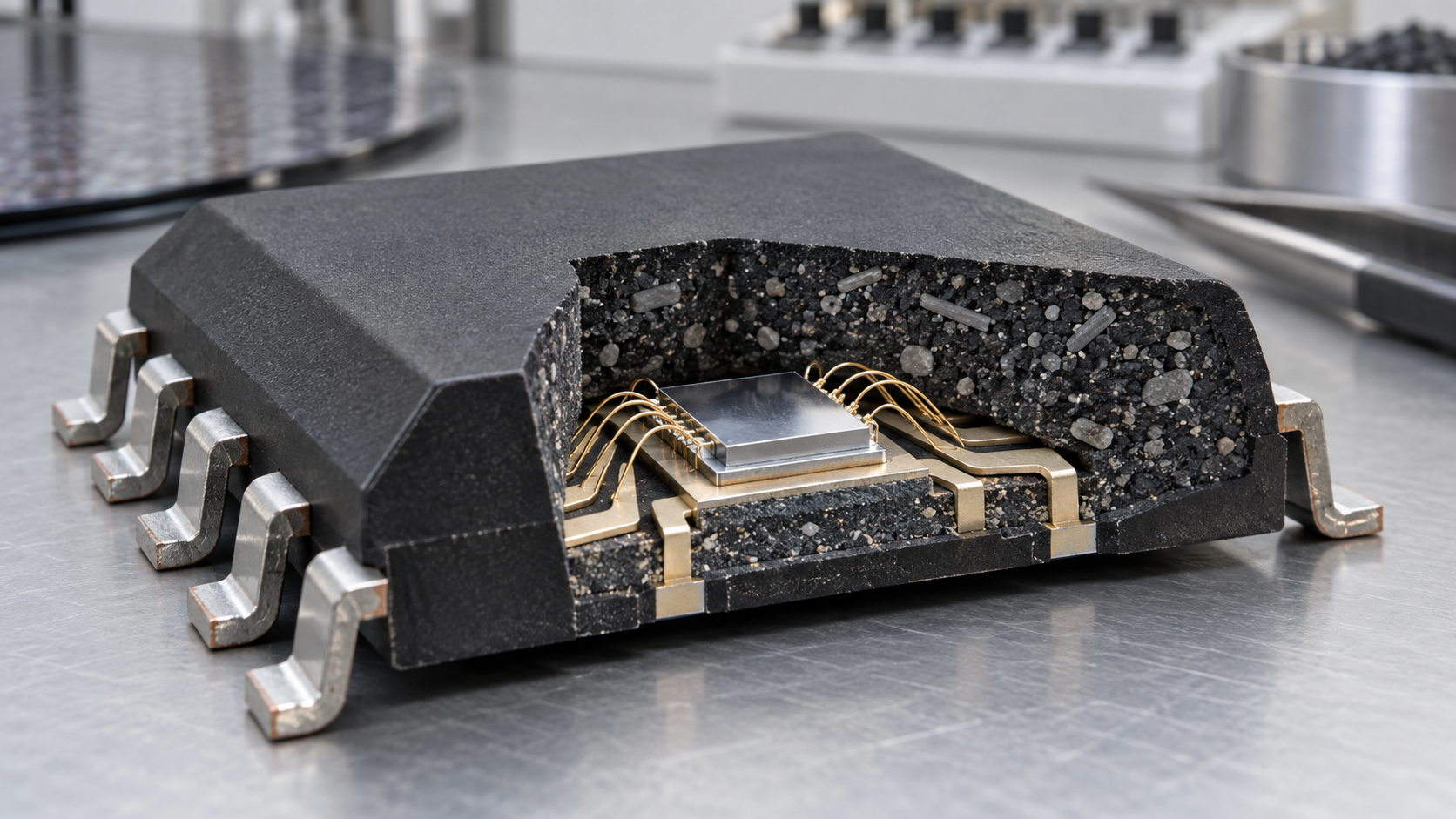
The dark resin that wraps and protects a chip (EMC, epoxy molding compound) is, in the example in a patent publication, a composite in which inorganic powder (filler) makes up roughly 60 to 95% of the weight. Epoxy resin, hardener, powder and small amounts of additives are mixed and set, and supplied as powder, granules, liquid or film. While it is being molded it has to flow; afterwards it has to resist warping, resist absorbing water, and carry heat away. This article sets out its composition, the forms it is supplied in, how to read the evaluation figures, and how it diversifies by application, using official material.
- What a semiconductor encapsulant is (the short version)
- Composition — a powder-and-resin composite
- A materials engineer's view (1): the worst enemy is water, and the hydroxyl trade-off in the hardener
- How it is supplied and molded — tablets, granules, liquid, film
- Evaluation — what is measured, and where comparison breaks down
- Our calculation: does swapping silica for alumina raise thermal conductivity?
- Grades diversify by application — advanced packages and power semiconductors
- A materials engineer's view (2): vitrification during cure, and which properties drive warpage depends on the process step
- What could not be confirmed / summary
- Glossary / Primary sources / Claim-to-source audit
Sourced = stated in an official page, a patent publication or a paper (link given). Where the original is in English or Japanese, the text here is this article's paraphrase, not a verbatim quotation
Our calculation = a figure this article derived, with the assumptions spelled out
Not yet confirmed = a plan, trial supply or similar, with no confirmed production record
Materials-design interpretations are marked separately as Commentary.
Figures on manufacturers' product pages are manufacturer's stated values (typical); where test conditions are not shown, this article does not set them against other companies' products or other grades to rank them.
1. What a semiconductor encapsulant is (the short version)
An encapsulant (EMC: epoxy molding compound) is the material that wraps a chip and its surroundings in resin to protect them from moisture, shock and heat. Its roles (protecting the chip, insulating from the outside environment, spreading heat, and handling during mounting) are as Sumitomo Bakelite lists them on its product pageSourced. The behaviour of gap-filling resin and the link between filler particle size and CTE and Tg are in our explainer on underfill, the transfer and compression molding processes are in our explainer on molding, and the resin itself is in our explainer on epoxy resins. This article is limited to what an encapsulant is made of as a material (composition, forms, evaluation).
- What it is made of: Sumitomo Bakelite describes it as a composite in which inorganic filler such as silica, epoxy resin and hardener are uniformly kneaded and dispersedSourced. In the example in a patent publication, silica powder is 60 to 95% by weight of the composition (preferably 70 to 92%)Sourced.
- How it is used: the same company's FAQ gives a typical cure condition of about 60 seconds at 175 °C and a transfer-molding pressure of about 10 MPaSourced. It is supplied as powder, granules, liquid or film to suit the molding step.
- What is hard: during molding it has to flow into narrow gaps and set at the intended moment. Afterwards, thermal expansion, elastic modulus, moisture uptake, heat conduction, flame resistance and reliability are all demanded at once (our commentary).
An encapsulant is not an “epoxy resin product”; it is a “composite product in which powder is the main character”. Much of its performance is set not by resin chemistry but by which powder, of what size, how much, with what surface treatment. The resin binds that powder, flows during molding, and sets afterwards (our commentary).
2. Composition — a powder-and-resin composite
Companies do not disclose their formulations in detail. Here the components are sorted from a published patent publication (US Patent 5,756,564, published 26 May 1998) and from what Sumitomo Bakelite's and Resonac's product pages and FAQ confirm. The publication is one example and does not show the formulation of any current productSourced. We do not interpret claim scope.
| Component | Role (commentary) | Examples confirmed in public material |
|---|---|---|
| Epoxy resin | The skeleton. It melts during molding, lowering viscosity so it flows between filler particles. When it sets it becomes a network | The publication lists epoxy resins made from various phenols and epihalohydrin and favours crystalline epoxy resins (melting point 40 to 170 °C) that are crystalline solids at ordinary temperature but become low-viscosity liquids on melting for molding, especially those from biphenol and tetramethylbiphenol. Its examples also use an ortho-cresol novolac typeSourced |
| Hardener | Reacts with the epoxy groups to build the network. Affects moisture uptake, cure speed and Tg | The publication says the combination of cresol novolac epoxy and phenol novolac hardener was mainly used at the time and was not yet sufficient in low moisture absorptionSourced (next chapter) |
| Cure accelerator | Sets cure speed and storage stability | The publication lists phosphine compounds, phosphonium salts, imidazoles, diazabicyclo compounds and their salts, and prefers phosphines, imidazoles and diazabicyclo compoundsSourced |
| Inorganic filler | Lowers CTE, raises strength, conducts heat. Raises viscosity sharply | The publication gives fused or crystalline silica, crushed or spherical, at 60 to 95% by weight of the composition (preferably 70 to 92%)Sourced. Sumitomo Bakelite says that for high thermal conductivity grades it changes the filler from silica to alumina or introduces filler surface modificationSourced |
| Coupling agent | Ties the inorganic powder to the organic resin at the interface. Affects flow and strength | The publication's examples use epoxy silane as the filler surface-treatment agentSourced. A paper shows that treating the filler with different silane coupling agents changes spiral flow, torque during kneading and tensile strength [Source 16]Sourced |
| Release agent | Makes the part come away from the mold | The publication's examples use carnauba wax as the release agentSourced |
| Flame retardant (aids) | Suppresses flame spread | The publication lists partial use of brominated epoxy resin together with flame-retardant aids such as antimony trioxide or phosphoric acidSourced. Today, Sumitomo Bakelite says it achieved UL 94 V-0 without bromine- or antimony-based flame retardantsSourced, and Resonac's product table sorts flame-retardant systems into “flame-retardant-free”, “organophosphorus” and “metal-based”Sourced |
Table 1 Components of an encapsulant and examples confirmed in public material. The right-hand column follows [Sources 1, 2, 3, 4, 12 and 16]. The publication's formulation is one example, not the formulation of a current product.
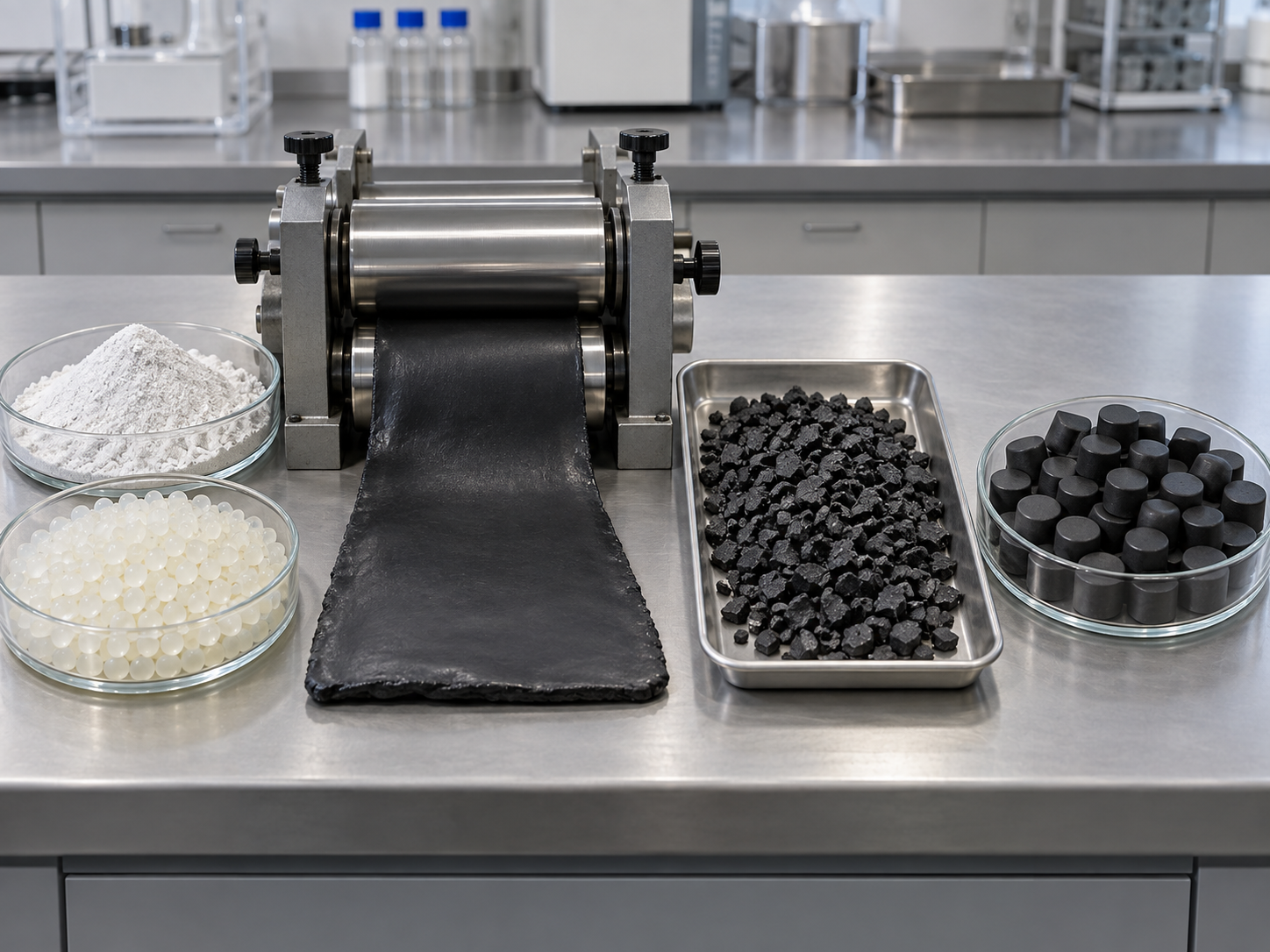
The method of making it is also described in the publication's examples. The components are melt-mixed on a mixing roll at 70 to 130 °C for 5 minutes, taken out as a sheet, and crushed to give the molding materialSourced [Source 12]. In other words, an encapsulant is a material in which powder is dispersed uniformly in the resin with the reaction barely advanced, and then turned into a solid for storage (our commentary).
3. A materials engineer's view (1): the worst enemy is water, and the hydroxyl trade-off in the hardener
The publication explains why low moisture absorption is demanded of an encapsulant in terms of surface mountingSourced [Source 12]. When a semiconductor is soldered to a board, the whole package is exposed to high temperature. At that point, the moisture it had absorbed expands, puts large stress on the whole package, and cracks the encapsulant, as the publication explains.
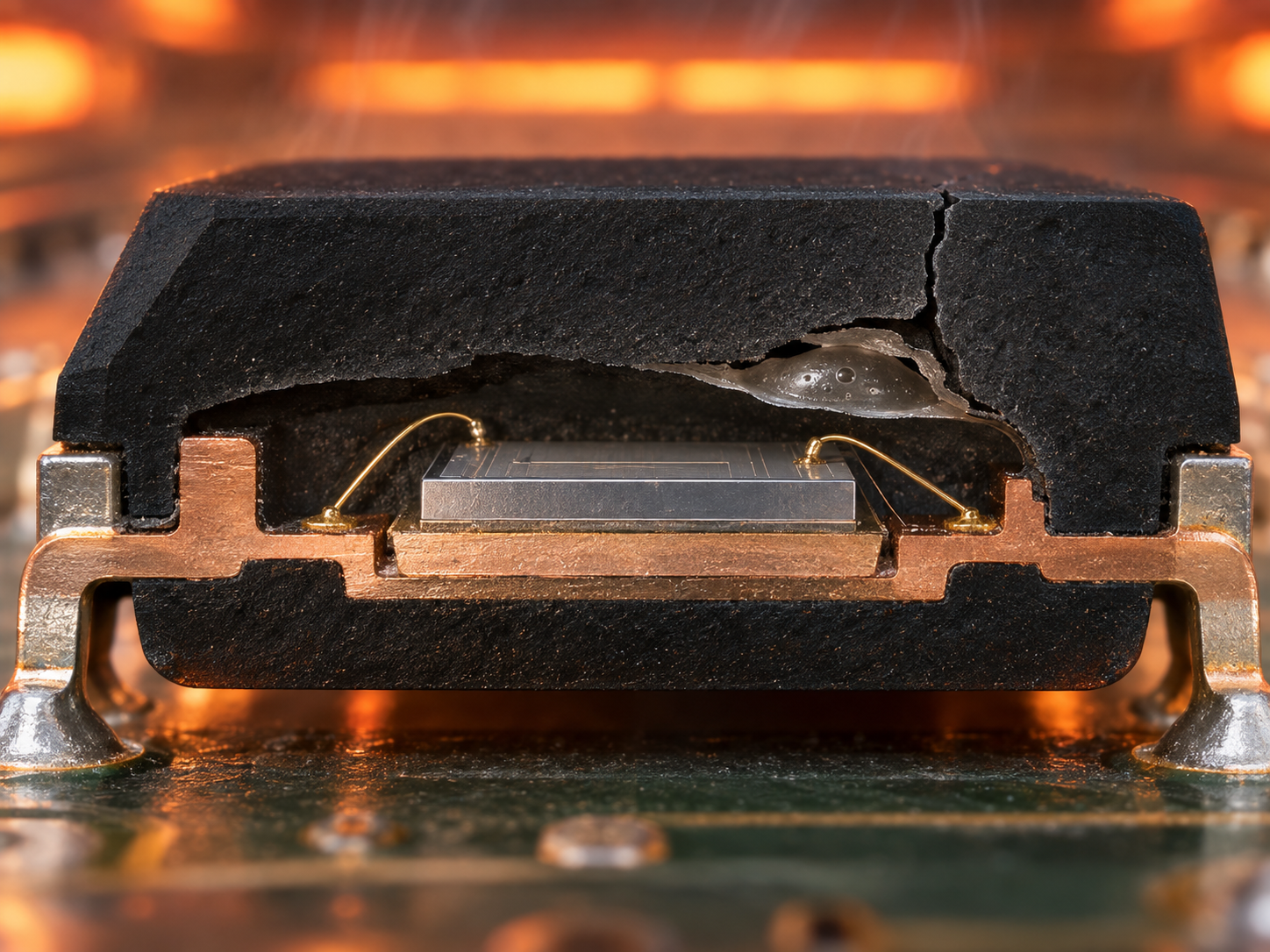
View the original SVG schematic and source notes
The publication is written on the premise that the phenolic hydroxyl groups of a common phenolic hardener are a cause of moisture absorption. Its explanation is that when an epoxy group reacts with a phenolic hydroxyl to build the network, a new hydroxyl group forms, and that hydroxyl increases moisture uptake furtherSourced [Source 12].
The countermeasure the publication takes up is to replace part of the hardener's hydroxyl groups with aromatic esters. With fewer hydroxyls, moisture uptake falls. But the reaction between ester and epoxy group is slow, so the demand for rapid cure is hard to meet. The publication's idea is therefore to deliberately leave an appropriate amount of hydroxyl to secure speedSourced.
The demand to shorten molding time (productivity) and the demand for a network that resists water sit at opposite ends of one and the same knob, the amount of hydroxyl. This structural design of the hardener is the other design territory of an encapsulant, alongside the powder design of the previous chapter (our commentary). The hardener structures of current products could not be confirmed in the public material we checked.
4. How it is supplied and molded — tablets, granules, liquid, film
The form in which an encapsulant is supplied differs with the molding method. A different form means different demands on the material.
| Form | Molding method | What official material confirms | Material-side caution (commentary) |
|---|---|---|---|
| Crushed molding material (tablets, etc.) | Transfer molding | In the patent publication's examples the mixed sheet is crushed to give the molding material [Source 12]. In Sumitomo Bakelite's FAQ the molding method is transfer molding, the pressure about 10 MPa and the cure condition about 60 seconds at 175 °C [Source 2]Sourced | It melts in the pot and passes through runner and gate. The longer the flow distance, the more viscosity and cure progress matter |
| Granules | Compression molding | Hitachi Chemical's report: the powder-type material is supplied straight into the mold cavity and molded under reduced pressure. The granule size distribution was controlled to 0.4 to 1.2 mm to cut fine powder, and a de-foaming technique suppressed resin leakage from foaming under reduced pressure [Source 7]. Sumitomo Bakelite says it offers granule grades with excellent pot life and filling of narrow gaps [Source 2]Sourced | The more uniform the granules, the steadier the amount spread in the mold and the more even the package thickness. Volatiles and air between particles cause foaming under reduced pressure |
| Liquid | Pouring or dispensing (including uses that merge under-mold and over-mold) | Sumitomo Bakelite says liquid resins, whose low viscosity allows small-particle filler, have been used for the narrow gaps of 3DS-TSV, but had issues of larger package warpage, productivity and cost [Source 8]. From April 2026 it began trial supply of a liquid encapsulant for advanced packages (EME-L series) and aims for qualified adoption in 2027 [Source 10]SourcedNot yet confirmed | Gaining flowability tends to cost you in warpage and shrinkage. The finer the powder and the more of it, the harder a liquid flows |
| Film | Lamination and cure | Resonac says its film EMC (EB series) keeps the encapsulation layer uniform in thickness, eliminates local strain from thickness variation, can cure at low temperature, and can encapsulate large panels and thin packages in one step [Sources 5 and 6]Sourced | The form itself is part of the performance. Thickness uniformity bears directly on warpage and downstream accuracy |
Table 2 Forms of encapsulant and molding methods. Each company's product description is that company's own claim. The “Material-side caution” column is this article's commentary.
5. Evaluation — what is measured, and where comparison breaks down
A datasheet for an encapsulant lists many numbers. But numbers whose test conditions are not given cannot be compared with other sources. First, the items of evaluation and what official material confirms.
| Item | What it tells you (commentary) | Standards and what official material confirms | Caution when comparing |
|---|---|---|---|
| Spiral flow | How far the compound flows and sets in a spiral groove in a mold (cm). A guide to flowability | ASTM D3123 is a test method for spiral flow of low-pressure thermosetting molding compounds; it is a measure of the combined characteristics of fusion under pressure, melt viscosity and gelation rate, and is useful for quality control and as an acceptance criterion. The standard is intended for a transfer pressure of 6.9 MPa and a mold temperature of 150 ± 3 °C [Source 13]Sourced. Resonac's product table gives values in cm [Source 3] | We found no test conditions stated on the Sumitomo Bakelite or Resonac product pages. The standard's condition (150 °C) differs from a molding condition (175 °C). Values can be compared only under the same conditions |
| Gel time | Time from heating until the compound stops flowing (seconds). A guide to usable molding time | Sumitomo Bakelite's product table gives seconds for each grade [Source 1]Sourced | The measurement temperature is not stated that we could find |
| Tg, CTE (α1, α2), flexural modulus, mold shrinkage | The four basics that govern warpage, stress and heat resistance | Both companies' product tables give values [Sources 1, 3 and 4]Sourced. A paper evaluates encapsulants by torque during kneading, spiral flow (EMMI method), DSC and TMA, among others [Source 16] | The product pages do not state measurement methods (TMA heating rate, flexural test conditions). Manufacturer's stated values (typical) |
| Thermal conductivity | How readily heat passes (W/m·K) | Sumitomo Bakelite's standard BGA/CSP grade is 0.8 and its high thermal conductivity grades 3.0 [Source 1]. Resonac's granular EMC for advanced packages is also 3.0 W/(m·K) [Source 5]Sourced | No measurement method stated. With a different filler, the value changes greatly even at the same loading (Chapter 6) |
| Flame resistance | How hard it is for flame to spread | UL 94 is a small-flame test of the flammability of plastic materials for parts in devices and appliances, with ratings such as V-0, V-1 and V-2 [Source 15]Sourced. Sumitomo Bakelite says it achieved UL 94 V-0 without bromine- or antimony-based flame retardants [Source 1]Sourced | A rating can depend on specimen thickness. The product pages do not state a thickness that we could find |
| Tracking resistance and dielectric properties | Insulation reliability at high voltage; loss at high frequency | Sumitomo Bakelite's product table gives tracking resistance (in volts) for power-module grades and, for antenna-in-package grades, a relative permittivity of 3.9 and a dissipation factor of 0.003 (1 MHz) [Source 1]Sourced | These are 1 MHz values; values at high-frequency bands need separate confirmation |
| Solder-heat resistance after moisture uptake (reflow resistance) | Whether it survives soldering heat after absorbing water | IPC/JEDEC J-STD-020F is the standard for moisture/reflow sensitivity classification of non-hermetic surface-mount devices; its table of contents includes humidity chambers, solder reflow equipment, acoustic microscopy and absorption/desorption curves [Source 14]Sourced | The standard's text is paid, so this article stays within the title and contents |
Table 3 Evaluation items for encapsulants and what official material confirms. The right-hand column and the “What it tells you” column are this article's commentary.
As ASTM D3123 puts it, spiral flow is one number that mixes three things: fusion under pressure, melt viscosity and gelation rateSourced. So two materials with the same spiral flow do not necessarily have the same viscosity. A material with low viscosity that sets quickly will not flow far. A material with higher viscosity that sets slowly can reach farther.
That is why encapsulant development has to look side by side, under the same conditions, not only at spiral flow but at how viscosity changes with temperature, gel time and the progress of cure. How far a compound actually gets into a narrow gap in a real mold is set by the combination of these (our commentary). A datasheet's spiral flow is a valid quality-control index, but it is not a number for ranking against another company's product.
6. Our calculation: does swapping silica for alumina raise thermal conductivity?
Sumitomo Bakelite says that for high thermal conductivity grades it changes the filler from silica to aluminaSourced [Source 2]. Its standard BGA/CSP grade has a thermal conductivity of 0.8 W/m·K and its high thermal conductivity grades 3.0 W/m·KSourced [Source 1]. Does changing the filler alone make it 3.75 times higher? A simple model lets us check.
We estimate the thermal conductivity of a composite of spherically dispersed powder in resin with the Maxwell-Eucken equationOur calculation. It is a model in which the resin is the continuous phase and the powder is scattered as isolated spheres.
k = km × [2km + kf + 2φ(kf − km)] ÷ [2km + kf − φ(kf − km)]
- Our assumptions (general values put in provisionally; not product values): resin thermal conductivity km = 0.2, silica kf = 1.4, alumina kf = 30 (all in W/m·K). Densities: resin 1.2, silica 2.2, alumina 3.9 g/cm³
- At a filler volume fraction φ = 0.70: silica gives about 0.73 W/m·K, alumina about 1.5 W/m·K
- Silica volume fraction that gives the published 0.8 W/m·K: φ ≈ 0.75 (about 85% by weight), which falls inside the range the publication gives for silica (60 to 95% by weight)
- Alumina volume fraction that reaches the published 3.0 W/m·K: φ ≈ 0.84 (about 94 to 95% by weight). Silica cannot reach 3.0 however much is added (about 1.1 W/m·K even at φ = 0.9)
Assumptions and limits: when particles touch and form a heat-conducting network, the value is higher than this model gives. Real products include undisclosed designs such as particle size distribution, surface treatment and filler blends. This calculation is to show orders of magnitude and trends, not to infer the formulation of any particular product.
This calculation shows that reaching 3.0 W/m·K with alumina takes, in a simple dispersion, about 84% by volume and about 94 to 95% by weight, a very high loading. There is almost no resin left between particles. With that much powder, molten resin hardly flows. Real high thermal conductivity grades are thought to aim at high values with less loading through measures such as making particles touch to form heat paths and blending particle sizes to pack them (our commentary).
That Resonac says of its granular EMC for advanced packages that it has not only a thermal conductivity of 3.0 W/(m·K) but also high resin flowability that reaches fine gaps and suppresses voidsSourced [Source 5] is to put on the label exactly how hard this “heat and flow together” is. The relation between filler particle size and flow is covered in our explainer on underfill.
7. Grades diversify by application — advanced packages and power semiconductors
Sumitomo Bakelite's product page divides its encapsulant lineup by which package it is for and attaches the “required features” to eachSourced [Source 1]. Even if all of them are “epoxy plus powder”, the feature at the front differs by destination.
The same page also gives numbers for several representative grades. They are manufacturer's stated values (typical); the page does not give test conditions, so they are not used to rank grades against each other.
| Application / feature | Grade | Molding | Filler cut (µm) | Spiral flow | Gel time (s) | Tg (°C) | CTE α1/α2 (ppm/°C) | Flexural modulus (GPa) | Thermal cond. (W/m·K) |
|---|---|---|---|---|---|---|---|---|---|
| BGA/CSP, low warpage | G750 Type L-B | Transfer | not stated | 125 | 35 | 145 | 8/34 | 24.5 | 0.8 |
| BGA/CSP, high thermal conductivity | A730E | Transfer | not stated | 145 | 50 | 145 | 10/38 | 31.0 | 3.0 |
| FCCSP/SiP, narrow-gap fill | G311L | Transfer | 12 | 185 | 60 | not stated | not stated | not stated | 0.8 |
| FCCSP/SiP, narrow-gap fill, high thermal conductivity | A382 Type B | Transfer | 20 | 145 | 50 | not stated | not stated | not stated | 2.0 |
| WLP/PLP, low warpage | G730 Ver. GR | Compression | 55 | 105 | 40 | 175 | 8/24 | 24.5 | not stated |
| WLP/PLP, low warpage, narrow-gap fill | G380 Ver. GR | Compression | 12 | 105 | 60 | 205 | 6/25 | 12.0 | not stated |
| Power modules, ultra-high Tg | G785A | Transfer | not stated | 80 | 35 | 230 | 10 (α1 only) | 13.5 | not stated |
Table 4 Representative grades of Sumitomo Bakelite's SUMIKON EME (manufacturer's stated values, typical; [Source 1]). The page does not state the unit of spiral flow, the test conditions or the grade revision. G785A's tracking resistance is given as “at least 600 (V)”.
(1) Advanced packages: from liquid to granules to film, and back to liquid
In 2024 Sumitomo Bakelite announced a compression-molding granule material for 3DS-TSV (with a 5 µm-cut filler)Sourced [Source 8] and the volume sale of a granule material for PLPSourced [Source 9]. Both are positioned as replacing the liquid resins used until then, to raise productivity and reduce warpage. In May 2026, on the other hand, the company announced that it began trial supply, from April 2026, of a low-warpage, high-reliability liquid encapsulant (EME-L series) aimed at 2.xD/3D and chiplet packages that are getting larger and more complexSourced [Source 10]. It says it combined the formulation know-how built up with solid encapsulants and process technology for liquid products, also offers grades that merge the under-mold and over-mold steps into one, and aims for qualified adoption in 2027Not yet confirmed.
That the easy-flowing liquid is coming back reads as a result of the package side's requirements changing (larger sizes, merged steps) (our commentary). Solid or liquid is not the “right answer”; the form is being chosen afresh by the conditions of the application.
(2) Power semiconductors: raise Tg and it gets stiffer and cracks
On 1 June 2026 Sumitomo Bakelite announced the start of volume production of a solid epoxy encapsulant with a Tg of 230 °C for SiC power modules (EME-G785 series)Sourced [Source 11]. The company calls it an “industry first”, but this is a claim based on its own survey (April 2026). The announcement says that trying to raise the Tg of epoxy above 200 °C raised crosslink density and so elastic modulus, making delamination and cracking more likely under heat cycling, a trade-off; it says the Tg was raised by stiffening the main-chain skeleton and optimising crosslink density, while a stress-reduction technique held back the rise in modulusSourced. For the comparison in detail, see Chapter 7 of our explainer on underfill.
8. A materials engineer's view (2): vitrification during cure, and which properties drive warpage depends on the process step
(1) A material whose Tg is above the molding temperature does not finish curing in the mold
One paper cured a commercial epoxy-phenolic encapsulant with a Tg above 195 °C under isothermal conditions of 165 to 185 °C, close to molding, and followed the progress of the reaction by measuring dielectric properties (ion viscosity) in place during the cureSourced [Source 18]. It reports that, near the end of the reaction, the analysis differed markedly from the one based on DSC, that the difference was due to vitrification, and that it measured the Tg of the molded parts by TMA to confirm the effect of vitrificationSourced.
As cure proceeds, Tg rises. When Tg climbs above the molding temperature, the network can no longer move (vitrification) and the reaction stops part-way. If a material with a Tg above 195 °C is molded at 165 to 185 °C, the reaction may not have gone to completion when molding ends. This reads as one background to the practice of heating the part again after molding to finish the cure (post-mold cure), but the post-mold-cure conditions could not be confirmed in the public material we checked (our commentary). Raising Tg also affects how easily the material molds and cures.
(2) The properties that drive warpage swap places depending on “warpage at which temperature range”
In our explainer on underfill we calculated that once Tg is exceeded the expansion behaviour changes, which bears on warpage at reflow temperature. Another paper examined, by simulation, how the material properties of the encapsulant affect wafer warpage in fan-out wafer-level packaging (FOWLP)Sourced [Source 17]. For wafer warpage in the step where the carrier is removed, the Young's modulus below Tg (25 to 35 °C) and α1 are the decisive factors; α1 matters more, and the Young's modulus above Tg, α2, Tg and the temperature range have little influence. With optimised properties, the maximum wafer warpage fell from 7.34 mm to 0.545 mm in the X direction and from 7.189 mm to 0.45 mm in the Y direction, about 93 to 94% (computed values).
If you look at warpage at reflow temperature, Tg and α2 matter. If you look at wafer warpage at room temperature after the carrier comes off, what matters is room-temperature modulus and α1. For the same material, the properties that matter swap places depending on which step's warpage is the problem. Which numbers in an encapsulant's property table to improve first depends on the package type and where in the process the problem appears (our commentary). The paper is a simulation, with conditions limited to a particular package structure. It does not guarantee results in real products.
(3) The kind of powder splits which properties are affected
Another paper compares aluminium nitride, aluminium oxide, barium sulfate, fused silica and hexagonal boron nitride at the same content in a bio-based epoxy matrixSourced [Source 19]. It reports that thermal conductivity, CTE and relative permittivity depend on the filler's own properties, that viscosity and Tg depend mainly on the filler size, and that barium sulfate had poor compatibility with the matrix, a weak interface, and lost performance. The matrix is not a production EMC, so the numbers do not apply directly to products, but the paper supports the framing that “what powder” and “what size of powder” act on different properties (our commentary).
9. What could not be confirmed / summary
What could not be confirmed in official material
- Formulations of current products: the type of epoxy resin, the structure of the hardener, the type, particle size distribution and amount of filler, the surface treatment and the flame-retardant formulation could not be confirmed in public material. The formulation in Chapter 2 is from a 1990s patent publication
- Colourants and the like: the components used to colour the compound black could not be confirmed in the official material and publication we checked
- Test conditions: the measurement conditions for spiral flow, gel time, TMA, flexural tests and thermal conductivity were not found on the product pages. We do not rank figures
- Flame rating of flame-retardant-free grades: Resonac's product table states the flame-retardant system but we could not confirm a UL 94 rating
- Post-mold-cure conditions: could not be confirmed
- Property values and adoption record of the liquid encapsulant (EME-L): could not be confirmed (qualified adoption in 2027 is the target)
- Standards for temperature cycling, high-temperature high-humidity tests and the like: we could not retrieve JEDEC's official pages automatically, so this article gives no standard numbers for them. The standards we could confirm are ASTM D3123, IPC/JEDEC J-STD-020F and UL 94
- Market share and adoption record: estimates by research firms and press-report figures are not used
- An encapsulant is a composite in which powder is the main character. In the publication's example silica powder is 60 to 95% of the weightSourced
- Water is the worst enemy. Absorbed moisture expands at soldering temperature and cracks the part, so there is a tug-of-war over the hardener's hydroxyl groups between low moisture uptake and fast cureSourced
- The form of supply follows the molding method. There are crushed molding material, granules, liquid and film, and in advanced packages the liquid form is returningSourced
- Datasheet numbers cannot be compared unless conditions are given. Spiral flow is not viscosity but one number mixing fusion, viscosity and gelationSourced
- The more heat, the more flow is sacrificed. In a simple dispersion model, reaching 3.0 W/m·K with alumina needs about 84% filler by volumeOur calculation
- The properties that drive warpage swap places with the process step. For room-temperature warpage, α1 and room-temperature modulus; for warpage at reflow temperature, Tg and α2Sourced
10. Glossary
- EMC
- Epoxy molding compound. A semiconductor encapsulant based on epoxy resin and powder.
- Filler
- Inorganic powder mixed into resin, such as silica or alumina. It lowers CTE, raises strength and conducts heat.
- Fused silica
- Glassy silica made by melting and re-solidifying quartz. It has lower CTE than crystalline silica and can be made spherical.
- Coupling agent
- A chemical that ties inorganic powder to organic resin at the interface. Silanes are typical.
- Hardener
- The component that reacts with epoxy groups to build the network. Phenolic ones are usual in EMC.
- Cure accelerator
- A component that speeds up the curing reaction, such as phosphines and imidazoles.
- Crystalline epoxy
- An epoxy resin that is a crystalline solid at ordinary temperature and becomes a low-viscosity liquid when it melts during molding.
- Spiral flow
- The length a compound flows along a spiral groove in a mold. A guide to flowability.
- Gel time
- Time from heating until the compound stops flowing.
- Tg
- Glass transition temperature. Elastic modulus and CTE change greatly across it.
- CTE (α1, α2)
- Coefficient of thermal expansion. α1 is below Tg, α2 above it.
- Vitrification
- During cure, the network's Tg reaches the molding temperature, molecules can no longer move and the reaction stops.
- Post-mold cure
- A step that heats the part again after molding to finish curing.
- Granules
- Encapsulant in granular form, spread directly into the mold for compression molding.
- Transfer molding
- Molding in which melted material is pushed by a plunger into the mold cavity.
- Compression molding
- Molding in which material placed in a mold recess is pressed on under reduced pressure.
- UL 94
- A test of the flammability of plastic materials with a small flame. It has ratings such as V-0.
- J-STD-020
- A standard classifying the sensitivity of non-hermetic surface-mount devices to moisture and reflow.
- Maxwell-Eucken equation
- An equation estimating the thermal conductivity of a composite in which isolated particles are dispersed in a matrix.
11. References
- Sumitomo Bakelite "Epoxy resin molding compounds for semiconductor encapsulation, SUMIKON® EME" product page (in Japanese) — sumibe.co.jp
- Sumitomo Bakelite "FAQ about Products, IT Materials Division" — sumibe.co.jp
- Resonac "Epoxy molding compound for organic substrates (CEL series)" (in Japanese) — resonac.com
- Resonac "Epoxy molding compound for lead frames (CEL series)" (in Japanese) — resonac.com
- Resonac "Materials contributing to thermal management of advanced semiconductor packages (1)", 25 February 2026 (in Japanese) — resonac.com
- Resonac "Materials contributing to warpage suppression and stress relief in advanced semiconductor packages (2)", 20 May 2026 (in Japanese) — resonac.com
- Hitachi Chemical (now Resonac) "Granule-Type Encapsulating Compound for Compression Molding", Hitachi Chemical Technical Report No.61 (PDF) — resonac.com
- Sumitomo Bakelite "Compression-molding encapsulating resin (granules) for 3DS-TSV now on sale", 31 May 2024 (in Japanese) — sumibe.co.jp
- Sumitomo Bakelite "Compression-molding encapsulating resin (granules) for advanced-semiconductor panel level packages now in volume production", 19 November 2024 (in Japanese) — sumibe.co.jp
- Sumitomo Bakelite "Notice of trial supply start of liquid encapsulant for advanced packages", 18 May 2026 (in Japanese) — sumibe.co.jp
- Sumitomo Bakelite "Volume production of the G785 series, a solid epoxy encapsulant with a Tg of 230 °C for SiC power modules", 1 June 2026 (in Japanese) — sumibe.co.jp
- Murata et al. US 5,756,564 A, "Epoxy resin composition for encapsulation of semiconductors" (priority 28 February 1996, published 26 May 1998) — patents.google.com
- ASTM International "D3123 Standard Test Method for Spiral Flow of Low-Pressure Thermosetting Molding Compounds" — store.astm.org
- IPC / JEDEC "J-STD-020F: Moisture/Reflow Sensitivity Classification for Non-Hermetic Surface Mount Devices (SMDs)" (table of contents PDF) — ipc.org
- UL Solutions "Combustion (Fire) Tests for Plastics" (page on UL 94) — ul.com
- Šinkovec and Mušič "Effect of Organosilane Coupling Agents on Thermal, Rheological and Mechanical Properties of Silicate-Filled Epoxy Molding Compound", Materials 13(1), 2020 (DOI: 10.3390/ma13010177) — doi.org
- Chuang et al. "Exploring the Influence of Material Properties of Epoxy Molding Compound on Wafer Warpage in Fan-Out Wafer-Level Packaging", Materials 16(9), 2023 (DOI: 10.3390/ma16093482) — doi.org
- Franieck et al. "Cure Kinetics Modeling of a High Glass Transition Temperature Epoxy Molding Compound (EMC) Based on Inline Dielectric Analysis", Polymers 13(11), 2021 (DOI: 10.3390/polym13111734) — doi.org
- Lee et al. "Epoxy Molding Compound for Electronic Packaging: Impact of Inorganic Filler Type and Geometry", Journal of Electronic Packaging, 2026 (DOI: 10.1115/1.4071141) — doi.org
12. Claim-to-source audit
| Claim in the text | Basis | Label |
|---|---|---|
| The roles of an encapsulant (chip protection, insulation from the outside environment, heat spreading, handling during mounting); that it supports transfer and compression molding; that UL 94 V-0 was achieved without bromine- or antimony-based flame retardants; the lineup and features by application (standard, high thermal conductivity, low stress, low warpage, high flow, narrow-gap fill, low dielectric, high Tg and so on); the representative grade values: G750 Type L-B (spiral flow 125, gel time 35, Tg 145, CTE 8/34, flexural modulus 24.5, thermal conductivity 0.8), A730E (145, 50, 145, 10/38, 31.0, 3.0), G311L (filler cut 12, 185, 60, 0.8), A382 Type B (20, 145, 50, 2.0), G730 Ver. GR (55, 105, 40, 175, 8/24, 24.5), G380 Ver. GR (12, 105, 60, 205, 6/25, 12.0), G785A (80, 35, Tg 230, CTE 10, 13.5, tracking resistance at least 600); relative permittivity 3.9 and dissipation factor 0.003 (1 MHz) for AiP grade G314 | Sumitomo Bakelite SUMIKON EME product page[Source 1] https://www.sumibe.co.jp/product/it-materials/epoxy/sumikon-eme/ | Sourced |
| That an encapsulant is a composite in which inorganic filler such as silica, epoxy resin and hardener are uniformly kneaded and dispersed; that the cure condition is about 60 seconds at 175 °C, the molding method transfer molding and the transfer pressure about 10 MPa; that high thermal conductivity grades change the filler from silica to alumina or introduce filler surface modification; that granule grades have excellent pot life and narrow-gap filling | Sumitomo Bakelite FAQ[Source 2] https://www.sumibe.co.jp/english/question/product/it-materials/ | Sourced |
| That the product table for organic-substrate EMC (CEL series) lists spiral flow (in cm), Tg, CTE, flexural modulus, mold shrinkage, thermal conductivity and flame-retardant systems (flame-retardant-free, organophosphorus, metal-based) | Resonac, epoxy molding compound for organic substrates[Source 3] https://www.resonac.com/jp/products/semi-backend-process/76/012.html | Sourced |
| That the lead-frame EMC (CEL series) product table also lists flame-retardant systems (flame-retardant-free, organophosphorus), spiral flow, Tg and CTE | Resonac, epoxy molding compound for lead frames[Source 4] https://www.resonac.com/jp/products/semi-backend-process/76/011.html | Sourced |
| That the granular EMC for advanced packages has a thermal conductivity of 3.0 W/(m·K) and high flowability that reaches fine gaps and suppresses voids; that film EMC can encapsulate large panels just by laminating and curing and helps make packages thinner | Resonac column (25 February 2026)[Source 5] https://www.resonac.com/jp/solution/column/005.html | Sourced |
| That film EMC (EB series) keeps the encapsulation layer uniform in thickness, eliminates local strain from thickness variation and can cure at low temperature | Resonac column (20 May 2026)[Source 6] https://www.resonac.com/jp/solution/column/008.html | Sourced |
| That in compression molding powder-type material is supplied straight into the mold cavity and molded under reduced pressure; that the granule size distribution was controlled to 0.4 to 1.2 mm to cut fine powder; that resin leakage from foaming under reduced pressure was suppressed by a de-foaming technique | Hitachi Chemical Technical Report No.61[Source 7] https://www.resonac.com/sites/default/files/2022-12/en_pdf-rd-report-061-61_tr03.pdf | Sourced |
| That a granule material for 3DS-TSV (5 µm-cut filler) was announced on 31 May 2024; that liquid resins filled narrow gaps well but tended to warp more and had productivity and cost issues | Sumitomo Bakelite news release (31 May 2024)[Source 8] https://www.sumibe.co.jp/topics/2024/it-materials/0522_02/index.html | Sourced |
| That a compression-molding granule material for PLP went into volume production, announced on 19 November 2024; that compared with liquid encapsulating resin it spreads better and gives less panel warpage | Sumitomo Bakelite news release (19 November 2024)[Source 9] https://www.sumibe.co.jp/topics/2024/it-materials/1118_01/ | Sourced |
| That trial supply of a liquid encapsulant for advanced packages (EME-L series) began in April 2026 (announced 18 May 2026); that it applies solid-encapsulant formulation technology and liquid-product process technology to combine low warpage with processability; that grades merging under-mold and over-mold are also offered | Sumitomo Bakelite news release (18 May 2026)[Source 10] https://www.sumibe.co.jp/topics/2026/it-materials/0514_01/index.html | Sourced |
| The target of qualified adoption of the EME-L series in 2027 | A plan stated by Sumitomo Bakelite, not a result[Source 10] https://www.sumibe.co.jp/topics/2026/it-materials/0514_01/index.html | Not yet confirmed |
| Start of volume production of the G785 series (Tg 230 °C, for SiC power modules) on 1 June 2026; that “industry first” is from the company's own survey (April 2026); the trade-off that raising the Tg of epoxy above 200 °C raises crosslink density and modulus and makes delamination and cracking under heat cycling more likely; that stiffening the main chain and optimising crosslink density raised Tg and a stress-reduction technique held back the rise in modulus | Sumitomo Bakelite news release (1 June 2026)[Source 11] https://www.sumibe.co.jp/topics/2026/it-materials/0428_01/index.html | Sourced |
| US 5,756,564: that epoxy resin, hardener, silica powder and cure accelerator are the essential components; that the silica powder is fused or crystalline silica, crushed or spherical, at 60 to 95% by weight (preferably 70 to 92%); that crystalline epoxy resins (melting point 40 to 170 °C) are preferred; accelerator examples (phosphines, imidazoles and others); flame-retardant aids (antimony trioxide and others) and brominated epoxy; in the examples epoxy silane (filler surface treatment) and carnauba wax (release agent); mixing on a mixing roll at 70 to 130 °C for 5 minutes, then forming a sheet and crushing; that in surface mounting absorbed moisture expands and cracks the encapsulant; that phenolic hardeners were common and low moisture uptake was insufficient; that esterifying part of the hardener's hydroxyl groups lowers moisture uptake but slows the reaction, so an appropriate amount of hydroxyl is left to secure speed | US Patent US 5,756,564 A (Google Patents)[Source 12] https://patents.google.com/patent/US5756564 | Sourced |
| That spiral flow is a measure of the combined characteristics of fusion under pressure, melt viscosity and gelation rate, used for quality control and as an acceptance criterion; that the standard is intended for 6.9 MPa and 150 ± 3 °C | ASTM D3123 (ASTM International)[Source 13] https://store.astm.org/d3123-09r17.html | Sourced |
| That J-STD-020F is a standard classifying moisture/reflow sensitivity of non-hermetic surface-mount devices; that its table of contents includes humidity chambers, solder reflow equipment, acoustic microscopy and absorption/desorption curves | IPC/JEDEC J-STD-020F (table of contents PDF)[Source 14] https://www.ipc.org/TOC/J-STD-020F_TOC.pdf | Sourced |
| That UL 94 is a small-flame test of the flammability of plastic materials for parts in devices and appliances, with ratings such as V-0, V-1 and V-2 | UL Solutions, Combustion (Fire) Tests for Plastics[Source 15] https://www.ul.com/services/combustion-fire-tests-plastics | Sourced |
| That changing the silane coupling agent used to treat the filler changes spiral flow (EMMI method), torque during kneading and tensile strength; that thermal behaviour was examined by DSC and TMA | Šinkovec and Mušič, Materials (2020)[Source 16] https://doi.org/10.3390/ma13010177 | Sourced |
| That in FOWLP, for wafer warpage in the carrier-removal step, the Young's modulus below Tg and α1 are the decisive factors, α1 matters more, and the other factors (Young's modulus above Tg, α2, Tg, temperature range) have little influence; that optimisation cut the maximum warpage from 7.34 mm to 0.545 mm (X) and from 7.189 mm to 0.45 mm (Y) (simulation) | Chuang et al., Materials (2023)[Source 17] https://doi.org/10.3390/ma16093482 | Sourced |
| That a commercial epoxy-phenolic encapsulant with Tg above 195 °C was cured at 165 to 185 °C and followed by ion viscosity; that the difference from the DSC-based analysis arose in parameters tied to vitrification near the end of the reaction; that the Tg of the molded parts was measured by TMA to confirm the effect of vitrification | Franieck et al., Polymers (2021)[Source 18] https://doi.org/10.3390/polym13111734 | Sourced |
| That with AlN, Al2O3, BaSO4, fused silica and hBN at the same content in a bio-based epoxy, thermal conductivity, CTE and relative permittivity depend on the filler's own properties and viscosity and Tg mainly on filler size; that BaSO4 has poor compatibility with the matrix | Lee et al., Journal of Electronic Packaging (2026)[Source 19] https://doi.org/10.1115/1.4071141 | Sourced |
| Chapter 6 calculation: Maxwell-Eucken equation with assumed values (resin 0.2, silica 1.4, alumina 30 W/m·K; densities 1.2, 2.2, 3.9 g/cm³); at volume fraction 0.70, silica about 0.73 and alumina about 1.5 W/m·K; silica volume fraction for 0.8 W/m·K about 0.75 (about 85 wt%); alumina volume fraction for 3.0 W/m·K about 0.84 (about 94 to 95 wt%); silica about 1.1 W/m·K even at 0.9. Not an inference of any product's formulation | Our calculation. The thermal conductivity and density values are general values put in provisionally as our assumptions, not product values. 0.8 and 3.0 are Sumitomo Bakelite's typical values [Source 1] | Our calculation |
| The framing of an encapsulant as a composite in which powder is the main character; that current formulations may differ from the publication's example; the reading that the amount of hydroxyl in the hardener sits at both ends of low moisture uptake and fast cure; the points that spiral flow is not viscosity and is not a number for ranking against other companies; the reading that the return of liquid forms is due to changed package-side requirements; the reading that a material with a Tg above the molding temperature may be left with unreacted groups after molding; the framing that the properties driving warpage swap with the process step; the commentary columns of Tables 1, 2 and 3 | This article's own summary and commentary based on the published material. Not views expressed by the companies or institutions | Commentary |
| Formulations of current products, colourants, test conditions, flame ratings of flame-retardant-free grades, post-mold-cure conditions, property values and adoption record of EME-L, JEDEC JESD22 standard numbers, and market share or adoption record | Not confirmed in official material, so not stated. Research-firm estimates and press-report figures are not used | Commentary |
| That Figs. 1, 2, 3, 5 and 6 are explanatory drawings rather than real structures or products, and that the hero image and Fig. 4 are AI-generated images | Our note | Commentary |
Last updated 3 October 2026. Sources are limited to primary material (official material from Sumitomo Bakelite and Resonac, a patent publication, official pages for standards, and academic papers). Where the originals are in English or Japanese, the text is this article's paraphrase, not verbatim quotation. Figures on manufacturers' product pages are manufacturer's stated values (typical); because test conditions are not shown, no ranking is made between grades or against other companies' products. Because the article includes structural readings and materials-design interpretations, those are marked as Commentary and kept separate from sourced fact. Current formulations, test conditions, post-mold-cure conditions, property values and adoption record of the liquid encapsulant, and JEDEC JESD22 standard numbers are not stated here because they could not be confirmed in official material. All figures are explanatory concept graphics. Figs. 1, 2, 3, 5 and 6 are vector drawings; Fig. 4 and the hero image are AI-generated images, and none of them shows a real cross-section, micrograph or physical product.