INSTITUTION PROFILE / ADHESIVES & ENCAPSULANTS
Fraunhofer-Gesellschaft
Germany's applied research organisation, and a training ground for adhesive bonders and chip encapsulation
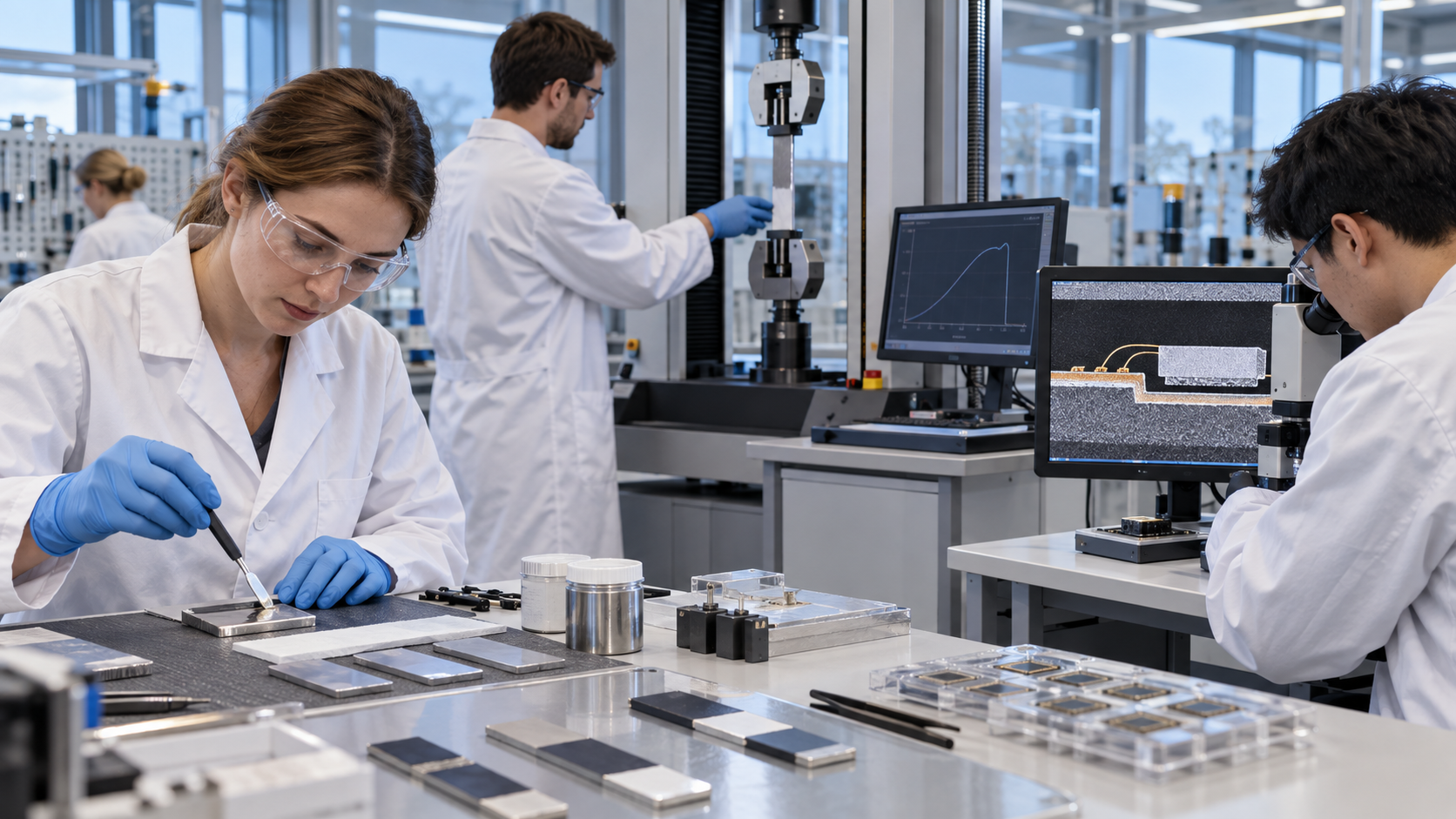
The Fraunhofer-Gesellschaft is a non-profit applied research organisation based in Germany. It does not write rules or standards. It influences the industry by carrying out research, prototyping and testing on commission from companies, and by training people. In adhesives and encapsulants, Fraunhofer IFAM in Bremen runs adhesive-bonder training (EAB, EAS, EAE) and verifies bonding processes, while Fraunhofer IZM in Berlin works on mold encapsulation of semiconductor packages and reliability testing. This profile looks at one question: how much influence Fraunhofer actually has over adhesives and encapsulants.
- Fraunhofer in 30 seconds
- What kind of body it is: the four types of influence
- What it does for adhesives and encapsulants
- How far its influence reaches (powers and geography)
- Who it works with
- Outlook
- Glossary, references and claim-to-source audit
1. Fraunhofer in 30 seconds
Fraunhofer's influence comes not from deciding things but from showing how and teaching people. In adhesive bonding, IFAM's training courses are presented as meeting the process requirements of ISO 21368 and EN 17460, and more than 18,000 people have completed them Sourced. In semiconductor encapsulation, IZM runs a mold encapsulation lab with production-grade equipment where companies can build prototypes before volume production Sourced. What Fraunhofer does not have is any power to set test standards for adhesives or encapsulants, to regulate chemicals, or to certify products Our calculation.
2. What kind of body it is: the four types of influence
Unlike the companies in this series, the institutions that appear in adhesives and encapsulants coverage do not sell adhesives or encapsulants. What separates them is the route by which they influence the industry, and that gives four types. Fraunhofer sits at the right-hand end, in the "Convening" type: it provides a place where companies can test things together with researchers, and where people get trained.
Fraunhofer's funding model is built so that institutional funding covers no more than one-third of its contract research budget; at least two-thirds must be won from industry contracts and public project funding Sourced. Because it only survives if companies use it, its research stays close to what companies actually need.
3. What it does for adhesives and encapsulants
Of Fraunhofer's 74 institutes and independent research units, these are the ones that touch adhesives and encapsulants directly Sourced.
| Institute | Location and size | Relevance to adhesives and encapsulants |
|---|---|---|
| IFAM (Fraunhofer Institute for Manufacturing Technology and Advanced Materials IFAM) | Bremen (seven sites in total) About 700 staff; over 200 in the adhesive bonding divisions | Adhesive selection and characterisation, design and validation of bonded joints, dispensing and application processes, quality assurance, failure analysis, adhesive formulation and surface pretreatment. IFAM describes its solutions as supplier-independent. It also trains adhesive bonders and verifies that industrial bonding processes comply with the relevant standards |
| IZM (Fraunhofer Institute for Reliability and Microintegration IZM) | Berlin (also Dresden and Cottbus) More than 463 staff; 2025 turnover €47.1 million | Semiconductor packaging and system integration. A mold encapsulation lab (compression molding at module and wafer level, transfer molding, film molding and more), plus thermo-mechanical reliability assessment and research on moisture-driven failures such as corrosion and electrochemical migration |
| ISC (Fraunhofer Institute for Silicate Research ISC) | Würzburg and other sites About 330 staff (facts-and-figures page) | ORMOCER® (inorganic-organic hybrid) coatings, hydrogen and oxygen barrier layers, silicone elastomers. This is on the barrier and protection materials side rather than adhesives or encapsulants as such |
| LBF (Fraunhofer Institute for Structural Durability and System Reliability LBF) | Darmstadt About 350 staff, including a joint research group with TU Darmstadt | Lifetime prediction, reliability assessment and polymer characterisation. We could not confirm a unit dedicated to adhesives or encapsulants (a 2017 press release describes an analytical method for polyolefin coupling agents) |
* ISC's headcount is given as about 330 (2025) on its facts-and-figures page and as about 380 on its profile page. We show the first and flag the discrepancy.
Training and qualification of adhesive bonders (IFAM)
| Item | What IFAM states |
|---|---|
| Courses | European Adhesive Bonder (EAB), European Adhesive Specialist (EAS), European Adhesive Engineer (EAE), Adhesive Bonding Technologist (ABT), refresher courses, in-company courses and special seminars |
| Scale | The adhesive bonding training centre has existed for more than 30 years; over 18,000 participants have completed courses |
| EAB (adhesive bonder) | One week, 40 hours including the examination. Covers fundamentals, adhesives, surface treatment, testing bonded joints, manufacturing technology and workplace safety, and ends with practical, written and oral exams. Recognised under the DVS®/EWF 3305 and EWF 515 guidelines |
| Link to standards | Courses are said to meet DIN EN ISO 21368 (formerly DIN 2304-1) for all industries and DIN EN 17460 (formerly DIN 6701) for rail vehicles. IFAM also provides auditors approved for both standards |
| How it is delivered | Partners in other countries run the courses in the local language, following IFAM's technical and teaching specifications. For company-level certification, IFAM points to its cooperation partner TBBcert |
IFAM explains that under ISO 9001 bonding is a "special process", one whose results cannot be fully checked by non-destructive testing. So even an adhesive with an excellent datasheet will not deliver its strength if the person applying it, or the process, is poor. That is why Fraunhofer stands on the "how it is used" side rather than competing with materials suppliers. For a materials supplier, more people who can use its product correctly means more confidence from customers. The test standards that define datasheet values (ISO, ASTM and the like) are, however, not Fraunhofer's to set.
How companies work with Fraunhofer
| Form | What it involves | Source of the description |
|---|---|---|
| Individual commission | A company brings a problem and gets an assessment of possible solutions, the best form of cooperation and the effort involved. Prototypes and shared use of laboratory facilities are also offered | IZM's "collaborating" page |
| Publicly funded consortium | Joint research with several companies and research bodies, supported by public funding | IZM's "collaborating" page. Public project revenue in 2025: €1,254 million |
| Training and in-house courses | Courses for company staff, including courses held at the company | IFAM training centre |
| Patents and licences | In 2025, 538 priority patent applications were filed; about 7,000 active patent families; revenue from licensing and sale of IP of about €200 million | Fraunhofer-wide technology transfer page |
4. How far its influence reaches (powers and geography)
| Aspect | What Fraunhofer has | What it does not have |
|---|---|---|
| Powers | Contract research, prototyping and testing for companies. IFAM's training courses (under DVS®/EWF guidelines) and its verification and auditing of processes against ISO 21368 and EN 17460 | Power to make laws or rules, to write test or international standards, or to register or authorise chemicals. No role as a certification body for placing products on the market |
| Geography | Institutes in Germany, plus €217 million of industry revenue from abroad (€88 million from the EU, €148 million from outside it). The largest markets were the US (€40 million), Switzerland (€32 million) and Japan (€21 million). IFAM courses are delivered by partners in other countries in the local language | Direct power over other countries' policy or regulation. The qualification framework itself belongs to DVS and EWF guidelines; IFAM is a provider of the courses |
| Funding structure | At least two-thirds of contract research income comes from industry and public projects. Institutional funding is shared 90:10 between the federal government and the states, and is at most one-third of the contract research budget | Any power to oblige companies to buy or adopt anything |
| Scale | 30,898 staff and a €3.6 billion budget (all fields combined) | No figure is published for spending on adhesives and encapsulants alone |
The €3.6 billion and the 30,898 staff cover all of Fraunhofer, including information technology, defence, health and energy. Even adding together the institutes that matter most here (IFAM about 700, IZM more than 463), they are a small fraction of the total Our calculation. No budget or project count for adhesives and encapsulants alone has been published Not yet confirmed.
5. Who it works with
These are the relationships we could confirm from the institutions' own websites.
| Counterpart | Relationship | Source |
|---|---|---|
| IFAM Board of Trustees | Chaired by the CEO of the German Adhesives Association (Industrieverband Klebstoffe). Members include Evonik, Chemetall, Tesa, Plasmatreat, Airbus and DECHEMA (as of September 2026). The board advises the institute on strategy and technology | IFAM Board of Trustees page |
| BMW | An IFAM researcher and a BMW engineer jointly presented work on car-body bonding, showing that spacing between joining points could be increased from 50 mm to over 150 mm | IFAM adhesive bonding page |
| APECS pilot line (EU Chips Act) | IZM takes part through high-precision integration technology, substrate prototyping and research on modular chiplet architectures. The €730 million total is co-financed by the Chips Joint Undertaking and eight European countries | IZM APECS page; Fraunhofer finance page |
| Kumamoto University and Yamagata University | IZM, Fraunhofer EMFT and the two universities signed a memorandum of understanding on research, education and workforce development (signed in Kumamoto on 15 September 2026, announced on 28 September; focus on semiconductor packaging, integration and printed electronics) | IZM news item |
* We could not confirm, from primary sources, a direct relationship with the companies profiled in this series (Henkel, Resonac, Sumitomo Bakelite and others).
6. Outlook
| What can be read from the sources | Primary evidence | Type |
|---|---|---|
| In advanced packaging, IZM is likely to be used more often as a place to try out encapsulation and assembly materials | IZM is a key node in the APECS pilot line, works on substrates and chiplets, and has its own mold encapsulation lab | Inference |
| Demand for adhesive-bonder qualifications will depend on whether customers make process standards (ISO 21368, EN 17460) a purchasing condition | IFAM says its courses meet these standards. Adopting the standards is voluntary (our reading) | Inference |
| German-Japanese cooperation between IZM and the two Japanese universities may deepen | Memorandum signed on 15 September 2026 (semiconductor packaging, integration and printed electronics). No specific joint projects have been published | Inference |
7. Glossary
- Applied research
- Research aimed at practical use in industry rather than basic discovery. Fraunhofer does this jointly with, or on commission from, companies.
- Institutional funding
- Basic operating funds from the German federal government and the states (shared 90:10). Limited to at most one-third of the contract research budget.
- DVS and EWF
- DVS is the German association for welding and allied processes (Deutscher Verband für Schweißen und verwandte Verfahren); EWF is the European Welding Federation. Guidelines for adhesive-bonder courses are issued under the DVS®/EWF name.
- EAB, EAS, EAE
- European Adhesive Bonder, Specialist and Engineer: the three levels of European adhesive bonding qualification.
- Special process
- A process whose results cannot be fully verified by non-destructive inspection. IFAM says bonding counts as one under ISO 9001 and needs additional process-specific controls.
- Mold encapsulation
- Enclosing semiconductor chips in moulded resin, for example by compression or transfer molding.
8. References
- Fraunhofer-Gesellschaft Profile/Structure (30,000+ staff, 74 institutes, founded 1949, €3.6 billion budget, €3.2 billion contract research, €966 million industrial revenue, cap on institutional funding; updated April 2026). https://www.fraunhofer.de/en/about-fraunhofer/profile-structure.html
- Fraunhofer-Gesellschaft Employees (30,898 staff as of 31 December 2025). https://www.fraunhofer.de/en/about-fraunhofer/profile-structure/facts-and-figures/employees.html
- Fraunhofer-Gesellschaft Finances (2025 results, 90:10 institutional funding split, public project revenue, breakdown of international revenue, €730 million APECS total). https://www.fraunhofer.de/en/about-fraunhofer/profile-structure/facts-and-figures/finances.html
- Fraunhofer-Gesellschaft Technology Transfer (538 priority patent applications in 2025, about 7,000 active patent families, about €200 million from licensing and IP sales). https://www.fraunhofer.de/en/about-fraunhofer/profile-structure/facts-and-figures/transfer.html
- Fraunhofer IFAM About us (founded 1968, joined Fraunhofer 1974, about 700 staff, seven sites, training overview). https://www.ifam.fraunhofer.de/en/Aboutus/profile.html
- Fraunhofer IFAM Adhesive Bonding (200+ staff in the divisions, services offered, auditors for ISO 21368 and EN 17460, joint presentation with BMW). https://www.ifam.fraunhofer.de/en/Competencies/Adhesive_Bonding.html
- Fraunhofer IFAM Quality assurance and further training in adhesive bonding technology (ISO 9001 special process, training centre, DVS®/EWF courses, TBBcert). https://www.ifam.fraunhofer.de/en/Competencies/Adhesive_Bonding/quality-assurance-further-training-adhesive-bonding-technology.html
- Fraunhofer IFAM training centre Adhesive Bonding Technology (course portfolio, more than 18,000 participants, relationship to ISO 21368 and EN 17460). https://www.weiterbildung.ifam.fraunhofer.de/en/adhesive-bonding-technology.html
- Fraunhofer IFAM training centre European Adhesive Bonder (40 hours, examinations, DVS®/EWF 3305 and EWF 515, delivery in other languages). https://www.weiterbildung.ifam.fraunhofer.de/en/adhesive-bonding-technology/european-adhesive-bonder.html
- Fraunhofer IFAM Board of Trustees (membership as of September 2026). https://www.ifam.fraunhofer.de/en/Aboutus/profile/board-of-trustees.html
- Fraunhofer IZM The Institute (more than 463 staff, 2025 turnover of €47.1 million, sites). https://www.izm.fraunhofer.de/en/institut.html
- Fraunhofer IZM Mold Encapsulation Lab (compression, transfer and film molding, among others). https://www.izm.fraunhofer.de/en/abteilungen/system_integrationinterconnectiontechnologies/ausstattung/labor_zur_moldverkapselung.html
- Fraunhofer IZM Key research areas of Environmental & Reliability Engineering (thermo-mechanical reliability, moisture-driven corrosion and migration). https://www.izm.fraunhofer.de/en/abteilungen/environmental_reliabilityengineering/key_research_areas.html
- Fraunhofer IZM APECS pilot line (part of the EU Chips Act; IZM's role). https://www.izm.fraunhofer.de/en/institut/ausstattung/apecs-pilot-line.html
- Fraunhofer IZM Collaborating with Fraunhofer IZM (individual commissions, industry services, consortia). https://www.izm.fraunhofer.de/en/institut/wege_der_zusammenarbeit.html
- Fraunhofer IZM News item "Fraunhofer IZM strengthens research bridge with Japan" (28 September 2026; memorandum signed in Kumamoto on 15 September 2026). https://www.izm.fraunhofer.de/en/news/japanbridge.html
- Fraunhofer ISC Facts and Figures (2025 operating budget revenue of €33.0 million, about 330 staff). https://www.isc.fraunhofer.de/en/about-fraunhofer-isc/facts-and-figures.html
- Fraunhofer ISC Profile (about 380 staff, research fields). https://www.isc.fraunhofer.de/en/about-fraunhofer-isc/profile.html
- Fraunhofer ISC Polymers / ORMOCER® (coatings, hydrogen and oxygen barrier layers, silicone elastomers). https://www.isc.fraunhofer.de/en/fields-of-activity/materials/polymers-ormocers.html
- Fraunhofer LBF About us (about 350 staff, joint research group with TU Darmstadt). https://www.lbf.fraunhofer.de/en/profile.html
- Fraunhofer LBF Press release "How effective are bonding agents? Fraunhofer LBF uses liquid chromatography for characterization for the first time" (24 October 2017). https://www.lbf.fraunhofer.de/en/press-releases/liquidchromatography-characterization-bonding-agents.html
- DVS Website (confirms the name Deutscher Verband für Schweißen und verwandte Verfahren e.V.). https://www.dvs-ev.de/
- EWF Website (confirms the name European Welding Federation). https://www.ewf.be/
9. Claim-to-source audit
| Claim in the text | Type | Source |
|---|---|---|
| Staff of 30,898 (31 December 2025) | Sourced | Reference 2 https://www.fraunhofer.de/en/about-fraunhofer/profile-structure/facts-and-figures/employees.html |
| 74 institutes and units, founded 1949, €3.6 billion budget, €3.2 billion contract research, €966 million industrial revenue, institutional funding at most one-third of contract research | Sourced | Reference 1 https://www.fraunhofer.de/en/about-fraunhofer/profile-structure.html |
| 90:10 institutional funding split, €1,254 million public project revenue, €217 million international industry revenue and its breakdown (Japan €21 million) | Sourced | Reference 3 https://www.fraunhofer.de/en/about-fraunhofer/profile-structure/facts-and-figures/finances.html |
| 538 patent applications, about 7,000 active patent families, about €200 million from licensing and IP sales | Sourced | Reference 4 https://www.fraunhofer.de/en/about-fraunhofer/profile-structure/facts-and-figures/transfer.html |
| IFAM's founding year, about 700 staff, seven sites, training overview | Sourced | Reference 5 https://www.ifam.fraunhofer.de/en/Aboutus/profile.html |
| IFAM's 200+ staff in adhesive bonding, services, supplier-independent description, approved auditors for ISO 21368 and EN 17460, joint presentation with BMW (50 mm to over 150 mm) | Sourced | Reference 6 https://www.ifam.fraunhofer.de/en/Competencies/Adhesive_Bonding.html |
| ISO 9001 special-process explanation, DVS®/EWF courses, TBBcert as the company-certification contact | Sourced | Reference 7 https://www.ifam.fraunhofer.de/en/Competencies/Adhesive_Bonding/quality-assurance-further-training-adhesive-bonding-technology.html |
| Course types, more than 18,000 participants, courses meeting ISO 21368 (formerly DIN 2304-1) and EN 17460 (formerly DIN 6701) | Sourced | Reference 8 https://www.weiterbildung.ifam.fraunhofer.de/en/adhesive-bonding-technology.html |
| EAB: 40 hours, examinations, DVS®/EWF 3305 and EWF 515, delivery in other languages | Sourced | Reference 9 https://www.weiterbildung.ifam.fraunhofer.de/en/adhesive-bonding-technology/european-adhesive-bonder.html |
| IFAM Board of Trustees chair and member affiliations (September 2026) | Sourced | Reference 10 https://www.ifam.fraunhofer.de/en/Aboutus/profile/board-of-trustees.html |
| IZM: more than 463 staff, €47.1 million turnover, sites, forms of commissioned work | Sourced | Reference 11 https://www.izm.fraunhofer.de/en/institut.html Reference 15 https://www.izm.fraunhofer.de/en/institut/wege_der_zusammenarbeit.html |
| IZM mold encapsulation lab equipment; reliability and moisture-failure research | Sourced | Reference 12 https://www.izm.fraunhofer.de/en/abteilungen/system_integrationinterconnectiontechnologies/ausstattung/labor_zur_moldverkapselung.html Reference 13 https://www.izm.fraunhofer.de/en/abteilungen/environmental_reliabilityengineering/key_research_areas.html |
| IZM's role in APECS; €730 million total; Chips JU and eight countries | Sourced | Reference 14 https://www.izm.fraunhofer.de/en/institut/ausstattung/apecs-pilot-line.html Reference 3 https://www.fraunhofer.de/en/about-fraunhofer/profile-structure/facts-and-figures/finances.html |
| Memorandum between IZM, EMFT, Kumamoto University and Yamagata University (signed 15 September 2026, announced 28 September) | Sourced | Reference 16 https://www.izm.fraunhofer.de/en/news/japanbridge.html |
| ISC headcount (about 330 and about 380 in two places); ORMOCER® coatings and barrier layers | Sourced | Reference 17 https://www.isc.fraunhofer.de/en/about-fraunhofer-isc/facts-and-figures.html Reference 18 https://www.isc.fraunhofer.de/en/about-fraunhofer-isc/profile.html Reference 19 https://www.isc.fraunhofer.de/en/fields-of-activity/materials/polymers-ormocers.html |
| LBF: about 350 staff, lifetime and reliability assessment, 2017 analytical method for polyolefin coupling agents | Sourced | Reference 20 https://www.lbf.fraunhofer.de/en/profile.html Reference 21 https://www.lbf.fraunhofer.de/en/press-releases/liquidchromatography-characterization-bonding-agents.html |
| The names DVS and EWF | Sourced | Reference 22 https://www.dvs-ev.de/ Reference 23 https://www.ewf.be/ |
| The four-type classification of institutions, and placing Fraunhofer in "Convening" | Our calculation | Our own classification (this article) |
| Fraunhofer has no authority to set standards or rules or to act as a certification body | Our calculation | Our own reading of References 1, 7 and 8 (a non-profit applied research organisation that provides courses and audits) |
| The institutes most relevant here are a small fraction of Fraunhofer's total staff | Our calculation | Our own arithmetic from References 2, 5 and 11 (IFAM about 700, IZM 463+, total 30,898) |
| Budget or project count for adhesives and encapsulants alone | Not yet confirmed | Not stated in References 1 to 21; we do not estimate it (this article) |
| Whether LBF has a unit dedicated to adhesives or encapsulants | Not yet confirmed | We could not confirm it from References 20 and 21 (this article) |
| Content of specific joint projects with Kumamoto and Yamagata universities | Not yet confirmed | Not stated in Reference 16; we do not estimate it (this article) |
| The three outlook items in Chapter 6 | Inference | Our own interpretation of References 8, 12, 14 and 16 |
Last updated: 3 October 2026 / Troy Technical
Figures in this article come from the websites of the Fraunhofer-Gesellschaft, its institutes and the IFAM training centre. Items marked "Inference" are our own reading of the primary sources.