INSTITUTION PROFILE / ADHESIVES & ENCAPSULANTS
UL Solutions
The U.S. certifier whose flammability and materials ratings act as a gate to market
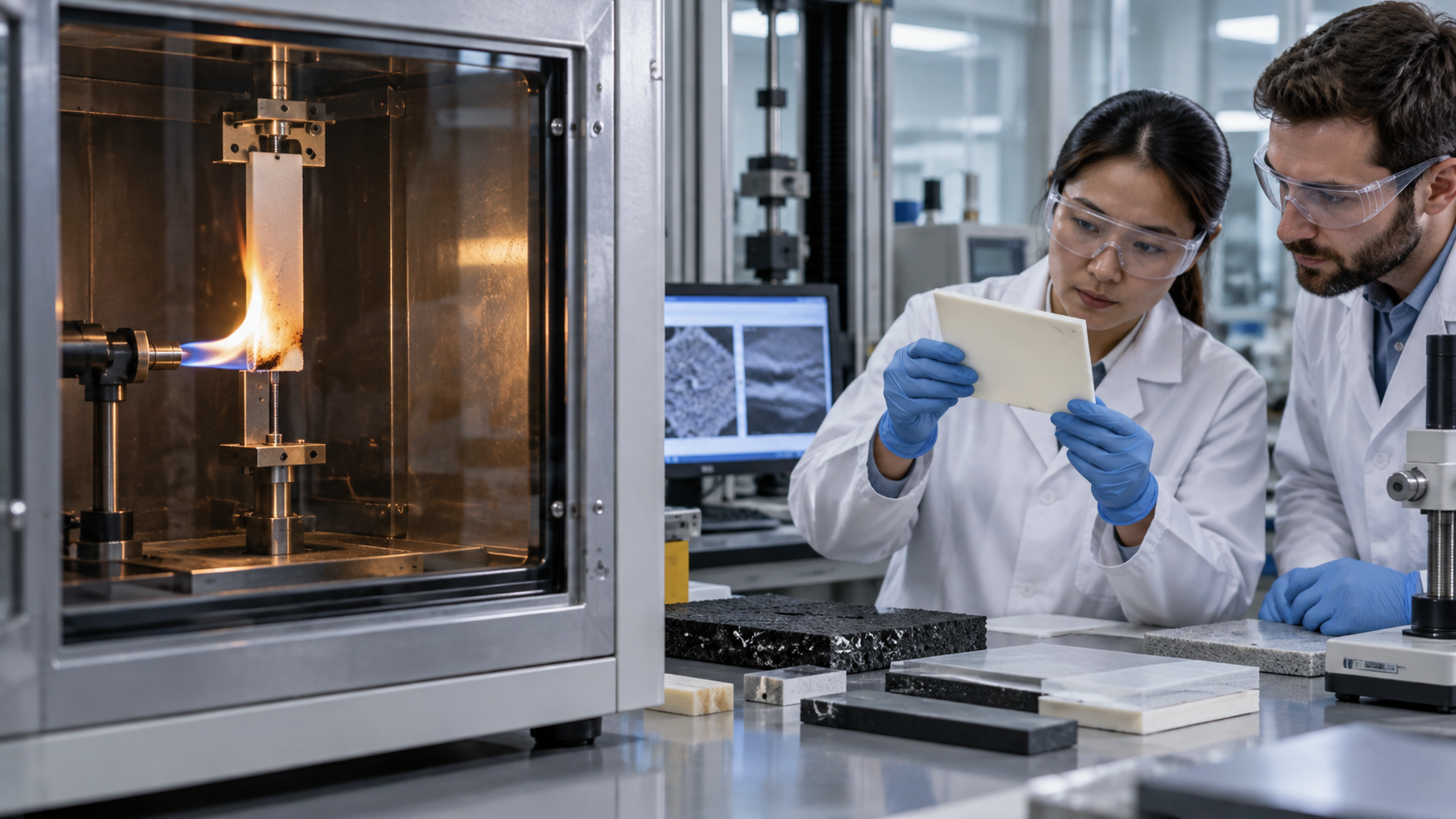
UL Solutions is a U.S. company, headquartered in Illinois, that tests, inspects and certifies products. It was listed on the New York Stock Exchange in April 2024. It does not make adhesives or encapsulants. Its link to the field is that it tests how readily a material burns (UL 94) and how polymer materials hold up in electrical products (UL 746), and issues a certification record, the Yellow Card, for materials that pass. Because makers of electrical equipment require UL 94-rated materials in their factories, the rating can become a practical gate for a material supplier trying to win business. This profile covers the kind of influence UL Solutions has and how far it reaches, limited to what could be confirmed in official documents.
- UL Solutions in 30 seconds
- What kind of institution: the type of influence
- What UL Solutions does for adhesives and encapsulants
- Scope of influence: authority and geography
- Related bodies and how certification flows
- Outlook
- Glossary / References / Claim-to-source audit
1. UL Solutions in 30 seconds
UL Solutions is not a standards body like ISO. It is a business that tests to standards, attests to a pass and charges for the service. The standards themselves, such as UL 94, are written by a different organisation, the nonprofit UL Standards & Engagement, which controls UL Solutions. The annual report treats the two separately Sourced. According to a UL explainer, the main customers for UL 94-rated materials are end-use manufacturers of electrical equipment, and those manufacturers are required to use UL 94-rated materials in their factory production. That is why, for a material supplier, the rating becomes in practice a credential worth having Sourced.
2. What kind of institution: the type of influence
The institutions in our adhesives profiles do not make products themselves. They can be sorted into four types according to the route by which they influence the industry. UL Solutions is a for-profit company, but it influences the market through certification against standards, so it fits mainly the "standards" type.
3. What UL Solutions does for adhesives and encapsulants
UL Solutions says on its website that it has been testing plastics since 1941 Sourced. Three mechanisms connect it to adhesives and encapsulants.
| Mechanism | What it is (as described by UL Solutions) | Link to adhesives and encapsulants |
|---|---|---|
| UL 94 (flammability) | UL 94 is the "Tests for Flammability of Plastic Materials for Parts in Devices and Appliances". A small-scale test of how readily polymeric materials burn under a small flame or radiant heat source in controlled laboratory conditions. It is harmonised with IEC 60695-11-10, ISO 9772/9773 and others | Ratings (HB, V-0, V-1, V-2 and so on) for resin materials used in electrical parts. Whether the scope covers encapsulants or adhesives is not stated in the documents checked |
| UL 746 series (evaluation of polymeric materials) | UL 746A (short-term properties), 746B (long-term properties and thermal ageing), 746C (use in electrical equipment), 746D (fabricated parts), 746E (industrial laminates, printed-wiring board materials and more), 746F (dielectric films for flexible circuits), 746G (non-fluorine and non-PFAS materials) and others | Printed-wiring board materials (746E), films such as polyimide for flexible circuits (746F), and evaluation of PFAS-free materials (746G) overlap with electronics assembly materials |
| Yellow Card (plastics recognition) | When a polymeric material earns the UL Recognized Component Mark, UL Solutions automatically issues a Yellow Card: an information card listing safety and performance properties. It is listed in the UL Product iQ and UL Prospector databases | Material makers can use the recognition in marketing. Users can skip repeat testing and, in some cases, shorten the path to certifying their own product (UL Solutions' description) |
UL 94 looks at how a specimen of a defined size burns under a small flame. A UL explainer says that most UL 94 results do not apply to materials thicker than 13.0 mm or with a surface area above 1 square metre. It also says that U.S. model building and fire codes do not recognise small-scale UL 94 ratings, and that there is no technical basis for accepting a UL 94 rating in place of the other fire ratings the codes specify (the document is a reprint of a 2007 newsletter and notes that things may have changed since) Sourced. When you evaluate the flame resistance of an encapsulant (such as an epoxy) or a potting compound, a UL 94 rating is a way to compare materials with one another, but the safety of the finished product is verified by other standards and tests. For flame resistance in this field, see also our explainers on semiconductor encapsulants and on silicones and encapsulants for vehicles.
4. Scope of influence: authority and geography
| Aspect | What UL Solutions has | What UL Solutions does not have |
|---|---|---|
| Authority | The ability to test, certify and authorise use of its marks against standards. After certification, continued inspection and monitoring are required to keep using the mark | The power to make law, or to make certification generally compulsory. The writing of standards such as UL 94 sits with a separate nonprofit |
| Geography | Customers in more than 110 countries and over 80,000 customers. 87 testing and certification sites in 27 countries (end of December 2025). The UL Recognized Component Mark can also indicate compliance with ISO and IEC requirements | Status as a legally designated certifier differs by country; this article did not check country by country |
| Scope in adhesives and sealing | Testing and certification of flammability, electrical properties and ageing of polymer materials (UL 94, UL 746). It also covers printed-wiring board materials and evaluation of PFAS-free materials | Standards for bond strength or for the reliability of semiconductor encapsulants (such as temperature cycling). No adhesive-specific certification scheme appeared in the documents checked |
| Size | 14,587 full-time employees and revenue of US$3.053 billion in 2025. The Industrial segment, which includes plastics and wire and cable, brought in US$1.341 billion, 44% of revenue | Revenue or test volumes for adhesives and encapsulants alone are not published |
UL Solutions' annual report says that new certification testing accounted for about 28% of 2025 revenue, and ongoing certification services, such as the inspections needed to keep using the mark, about 33% Sourced. In other words, certification is not a one-time event: inspection and monitoring continue for as long as the mark is used. Whether a given law requires certification varies by country and application, and this article did not check it country by country. That international standards are voluntary is covered in our ISO profile in this series.
5. Related bodies and how certification flows
According to UL Solutions' annual report, UL Research Institutes is a nonprofit that studies threats to human safety and is the sole member of UL Standards & Engagement. UL Standards & Engagement is also a nonprofit, and turns research insights into practical outcomes such as safety standards. UL Standards & Engagement holds 61.6% of the shares and 94.1% of the voting power of UL Solutions, a listed company (as of 31 December 2025) Sourced.
Which UL certifications individual adhesive and encapsulant makers in our company profiles hold could not be determined from the official documents we checked, so this article does not say. Certification data on individual materials can be searched in UL Prospector and UL Product iQ, but this article did not check individual materials.
6. Outlook
| What can be read | Primary information behind it | Status |
|---|---|---|
| UL 746G is a framework for evaluating non-fluorine materials (50 ppm fluorine or less) and non-PFAS materials (under 25 ppb for each listed PFAS and 250 ppb or less in total). It responds to market demand for PFAS-free materials | UL Solutions' "Understanding the UL 746 Series" page | Sourced |
| This framework may be used more often to show that adhesives and encapsulants are PFAS-free | The page's reference to "ongoing market demand for non-PFAS materials". Application to adhesives and encapsulants has not been confirmed | Inference |
| From the first quarter of 2026, UL Solutions reorganised its business segments. The content of the new segments was not confirmed | Form 10-K for fiscal 2025 (it points to Note 22, Subsequent Events, for details) | Not yet confirmed |
7. Glossary
- TIC
- Testing, inspection and certification: the business of checking products against standards and attesting to the result.
- UL 94
- A standard that tests how readily plastic materials burn under a small flame. Results are expressed as classes such as HB, V-0, V-1 and V-2.
- UL 746
- A family of standards for evaluating polymeric materials used in electrical equipment. It is divided into several parts, A to H and more.
- Yellow Card
- An information card on a polymer material that has earned the UL Recognized Component Mark, issued by UL Solutions.
- PFAS
- Per- and polyfluoroalkyl substances, a large family of organofluorine compounds. UL 746G defines how to evaluate materials that do not contain them.
8. References
- UL Solutions Inc. Form 10-K for the year ended December 2025 (filed with the U.S. SEC on 19 February 2026). Headcount, revenue, customers, sites, listing date, UL Standards & Engagement's shareholding and voting power, service-category mix, segment reorganisation. https://www.sec.gov/Archives/edgar/data/1901440/000190144026000005/uls-20251231.htm
- UL Solutions Understanding the UL 746 Series of Standards (UL 94, the contents of UL 746A to 746G, PFAS evaluation criteria). https://www.ul.com/services/understanding-ul-746-series-standards
- UL Solutions UL Solutions Yellow Card Plastics Recognition Program (plastics testing since 1941, Recognized Component Mark, Product iQ and Prospector listing, skipping repeat testing). https://www.ul.com/services/ul-solutions-yellow-card-plastics-recognition-program
- UL Solutions How to Read the UL Solutions Yellow Card (issued automatically with the Recognized Component Mark; relationship to the White Card). https://www.ul.com/resources/how-read-ul-yellow-card
- UL (The Code Authority, issue 3, 2007, reprinted) Understanding UL 94 Certifications and Limitations (UL 94 is a small-scale test; not accepted under building model codes; customers are electrical equipment makers). https://code-authorities.ul.com/wp-content/uploads/2014/04/ul_UL94CertificationsAndLimitations.pdf
- UL Solutions About (more than 130 years of history, customers in more than 110 countries). https://www.ul.com/about
9. Claim-to-source audit
| Claim in the text | Status | Source |
|---|---|---|
| Headquarters location, origins in 1894, listing on 16 April 2024, 14,587 full-time and 264 part-time employees, revenue of US$3.053 billion, Industrial segment US$1.341 billion (44%) | Sourced | Reference 1 https://www.sec.gov/Archives/edgar/data/1901440/000190144026000005/uls-20251231.htm |
| More than 80,000 customers in 110+ countries, 87 sites in 27 countries, service mix of about 28% certification testing and about 33% ongoing certification, continued inspection needed to use the mark | Sourced | Reference 1 https://www.sec.gov/Archives/edgar/data/1901440/000190144026000005/uls-20251231.htm |
| UL Standards & Engagement holds 61.6% of shares and 94.1% of votes and is responsible for developing safety standards; UL Research Institutes is its sole member | Sourced | Reference 1 https://www.sec.gov/Archives/edgar/data/1901440/000190144026000005/uls-20251231.htm |
| UL 94 title and harmonisation with IEC and ISO, contents of UL 746A to 746G, non-fluorine and non-PFAS thresholds | Sourced | Reference 2 https://www.ul.com/services/understanding-ul-746-series-standards |
| Plastics testing since 1941, Recognized Component Mark, skipping repeat testing | Sourced | Reference 3 https://www.ul.com/services/ul-solutions-yellow-card-plastics-recognition-program |
| The Yellow Card is issued automatically with the Recognized Component Mark and listed in Product iQ and Prospector | Sourced | Reference 4 https://www.ul.com/resources/how-read-ul-yellow-card |
| UL 94 is a small-scale test; 13.0 mm and 1 square metre limits; not accepted under building model codes; customers are electrical equipment makers | Sourced | Reference 5 https://code-authorities.ul.com/wp-content/uploads/2014/04/ul_UL94CertificationsAndLimitations.pdf |
| The four types of institution and the arrangement of Fig. 2 | Our calculation | Classification by this article |
| Whether UL 94 and UL 746 cover encapsulants or adhesives, individual manufacturers' certifications, whether an adhesive-specific scheme exists | Not yet confirmed | Not stated in the official documents checked. This article does not estimate them |
| Content of the segment reorganisation from 2026 | Not yet confirmed | Reference 1 only points to Note 22. This article did not check the content |
| Growing demand for proof of PFAS-free status (Section 6) | Inference | This article's reading of Reference 2 |
Last updated 3 October 2026 / Troy Technical
Figures come from UL Solutions' annual report (Form 10-K), its official website and UL's published documents. Items marked "Inference" are this article's reading of the primary information.