COMPANY PROFILE / ADHESIVES & ENCAPSULANTS
Dow
— Inside a broad chemicals group, specialty silicones are being built up to protect, cool and bond electronics
Dow Inc. is a chemicals group with about US$40 billion in sales in 2025, but what matters for adhesives and encapsulants is its silicones business (DOWSIL brand), a little over a tenth of group sales. Dow's annual report on Form 10-K for 2025 says this business makes "adhesives and sealants" and "encapsulants for solar photovoltaic applications", among other products, and that its growth investment is aimed at thermal management for high-performance computing and AI, electric-vehicle electronics, and silicone and hybrid materials to replace fluorinated ones. This profile is separate from our Dow profile in the polymers and resins series. It looks at Dow through silicones, adhesives, encapsulants, thermal interface materials and electronic materials: what it has committed, who it works with, and what it appears to be aiming for.
- Dow in 30 seconds, and where it stands in adhesives and encapsulants
- The logo and how the name is written
- Where the company sits in adhesives and encapsulants
- Scale (the group in brief, the silicones business in focus)
- Resources committed to adhesives and encapsulants
- What it has done so far
- What comes next
- What the company is aiming for in adhesives and encapsulants
- Map of partnerships in adhesives and encapsulants
- Technologies, products and services
- The risks this company carries
- Glossary / References / Claim-to-source audit
1. Dow in 30 seconds, and where it stands in adhesives and encapsulants
NYSE: DOWFiles Form 10-K with the U.S. SEC
Semiconductor & electronic materials (secondary)Enters electronics through silicones. Epoxy molding compound (EMC) not confirmed
(DOWSIL)Adhesives and sealants, encapsulating gels, thermal gels, hot melts
(through end of 2027)Specialty silicones plants and labs; announced 23 June 2026
Companies in adhesives and encapsulants fall into three broad types: general adhesives & chemicals makers, semiconductor & electronic materials makers, and UV-curing & specialty makers. Dow is a general chemicals group at the company level, and its core material in this field is silicone. The 10-K says the silicones business (Performance Silicones & Specialty Materials) serves consumer and electronics, infrastructure, mobility and other markets, and lists "adhesives and sealants", "encapsulants for solar photovoltaic applications", "DOWSIL silicone products" and "SILASTIC silicone elastomers" among its products Sourced. Dow is not a company whose core business is epoxy molding compound (EMC) or epoxy underfill for semiconductors. None of the primary sources we reviewed mentions such products Not yet confirmed. That puts it on a different axis from Resonac or Sumitomo Bakelite, the "seal the chip in epoxy" companies covered elsewhere in this series. What distinguishes Dow is that it sells a soft, heat-resistant, low-stress, electrically insulating silicone in three roles: encapsulating, cooling and bonding.
Decision to write this profile: we judged that it should be written. Dow's own primary sources on adhesives, encapsulants and electronic materials number well over three: the 10-K, the 10-Q, an 8-K exhibit filed in 2019, six official press releases, and several product and technology pages.
2. The logo and how the name is written
A note on naming: in this article "Dow" means Dow Inc. (the holding company) and its subsidiaries together. The 10-K explains that Dow Inc. runs all of its businesses through The Dow Chemical Company (TDCC), and that the silicones business sits in a subsidiary, Dow Silicones Corporation (formerly Dow Corning Corporation; renamed on 1 February 2018) Sourced. The product brands DOWSIL, SILASTIC and SYL-OFF are Dow trademarks (listed in the 10-K).
Until 2016, Dow Corning was a 50:50 joint venture between Dow and Corning Incorporated (the glass and ceramics maker). We could not obtain the logo image from Dow's official site, so the company name is shown as a wordmark instead.
Official website: https://corporate.dow.com/en-us.html3. Where the company sits in adhesives and encapsulants
Dow's adhesives and encapsulants are easiest to read as three roles. Silicone is the lead material in all three, and they relate to our explainers on silicones, thermal interface materials (TIM), automotive silicones and encapsulants, and semiconductor encapsulants.
| Role | Products and uses named in Dow's materials | Typical use |
|---|---|---|
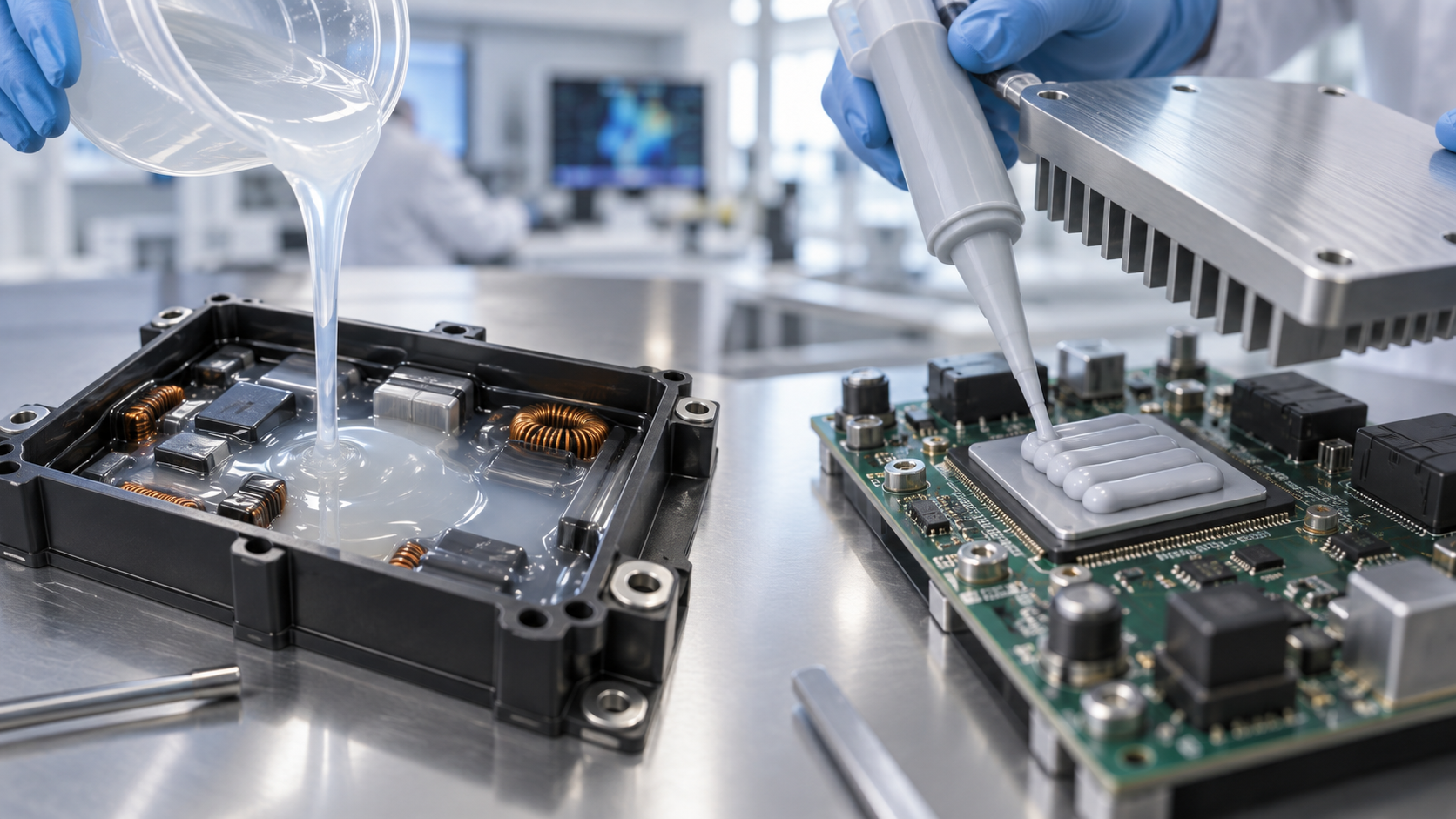
| Encapsulate (protect) | Thermally conductive encapsulant (DOWSIL TC-6040), silicone gel (DOWSIL EG-4175), potting gels, glob-top and wire encapsulants | EV on-board chargers and DC/DC converters, inverters, sensors |
| Cool (move heat away) | Thermal gel (DOWSIL TC-3120), thermally conductive compounds, gap fillers, TIM 1 (between die and lid), carbon-nanotube TIM made with Carbice (joint development) | Optical transceivers, data-center servers, chip packages |
| Bond and fix | Silicone adhesives and sealants, die-attach and lid-attach adhesives, fiber-bonding adhesives, silicone hot melts, silicone pressure-sensitive adhesives (PSAs, such as DOWSIL 2110) | Electronics assembly, semiconductor packages, optical parts, industrial tapes |
4. Scale (the group in brief, the silicones business in focus)
The group figures are kept short here; the numbers closest to adhesives and encapsulants come first Sourced. Dow's 10-K for 2025 reports three operating segments. The one that matters here is Performance Materials & Coatings, which has two businesses: coating materials, and Consumer Solutions, which handles silicones.
| Measure (US$ million) | 2023 | 2024 | 2025 |
|---|---|---|---|
| Group net sales | 44,622 | 42,964 | 39,968 |
| Group R&D expenses | 829 | 810 | 752 |
| Group capital expenditures | 2,356 | 2,940 | 2,479 |
| Performance Materials & Coatings net sales | 8,497 | 8,574 | 8,134 |
| of which Consumer Solutions (silicones) net sales | 5,160 | 5,082 | 4,919 |
| of which Coatings & Performance Monomers net sales | 3,337 | 3,492 | 3,215 |
| Performance Materials & Coatings operating EBIT | 219 | 318 | 306 |
| Performance Materials & Coatings capital expenditures | 422 | 316 | 217 |
| Item | Detail |
|---|---|
| Employees (31 December 2025) | About 34,600 full-time (whole group; headcount for silicones alone not disclosed) |
| Manufacturing | Sites in 29 countries. The 10-K lists major Performance Materials & Coatings sites including Barry (UK), Carrollton (Kentucky), Midland (Michigan) and Zhangjiagang (China) |
| Patents | About 3,900 active U.S. patents and 25,800 active foreign patents across the group (31 December 2025; no count for adhesives and encapsulants alone) |
| First half of 2026 (to 30 June) | Group net sales US$21,886 million (US$20,535 million a year earlier). Consumer Solutions US$2,586 million (US$2,491 million; up about 3.8%, our calculation) |
Consumer Solutions was about 12.3% of group sales in 2025 (4,919 / 39,968) Our calculation. Its sales fell about 3.2% from the previous year (5,082 to 4,919) Our calculation. The 10-K attributes the decline to lower local prices in every region, lower volumes of upstream siloxanes (the basic raw material) and weaker building and construction demand, and says demand in consumer and electronics increased.
The operating EBIT of US$306 million belongs to the whole Performance Materials & Coatings segment, which includes coating materials. Profit, R&D spending and capital expenditure for Consumer Solutions (silicones) alone are not disclosed Not yet confirmed. Nor are all silicone sales adhesives or encapsulants; the business also serves personal care, consumer goods and release coatings. Sales of adhesives and encapsulants alone are not disclosed, and this article does not estimate them.
5. Resources committed to adhesives and encapsulants
The table covers four points (people, money, external deals, and public or academic links) and separates what we could confirm from what we could not. An explicit "no mention" is a finding in its own right.
| Type of resource | Confirmed | Not confirmed | Status |
|---|---|---|---|
| People and sites | Joint-evaluation sites for thermal management, "Cooling Science Studios", in Shanghai and Auburn, Michigan. The first studio opened in Shanghai on 4 November 2025. "Cooling Science Labs" were expanded in Shanghai (earlier in 2026) and Midland (June 2026) | R&D headcount for silicones or adhesives (whole-group headcount is about 34,600) | Sourced / not disclosed |
| Money | Projects totaling about US$100 million (through the end of 2027) for specialty silicones plants and labs. Performance Materials & Coatings capital expenditure was US$217 million in 2025 (US$316 million in 2024). The 10-K cites investment to add capacity and efficiency, particularly in consumer and electronics for data center and mobility applications | R&D spending and capital expenditure for silicones alone (the segment's combined selling, general, administrative and R&D expenses were US$608 million in 2025, with no breakdown) | Sourced / not disclosed |
| Investments, acquisitions, joint ventures, divestments | Became sole owner of Dow Corning (the former joint venture) in 2016. Sold its flexible-packaging laminating adhesives business to Arkema on 2 December 2024 (US$115 million in cash; five sites in the U.S., Italy and Mexico). Partnered with Carbice on thermal interface materials in October 2024 | Any new acquisition, investment or joint venture in silicones or electronic materials (none in the 10-K or 10-Q) | Sourced / not confirmed |
| Universities, research institutes, public funding | (None confirmed) | Neither the 10-K, the 10-Q, nor the official releases and product pages we reviewed mention joint research with universities or institutes, or government grants or funds, in silicones or adhesives | Not confirmed |
The 10-K names the key raw materials of the silicones business as methanol, platinum, silica and silicon metal. It splits the business into Performance Silicones & Specialty Materials (differentiated products) and Silicone Feedstocks & Intermediates (silicon metal, siloxanes and intermediates) Sourced. In other words, Dow has the upstream that turns silicon metal into basic siloxanes and the downstream that turns them into adhesives, encapsulating gels and thermal materials. In adhesive and encapsulant formulations, performance is set by the molecular-weight distribution of the silicone polymer, the number of crosslink sites, and the surface treatment between filler (thermally conductive particles) and polymer. Keeping polymer design, formulation and testing under one roof could shorten the cycle for improving a material Not yet confirmed. Dow describes its "Cooling Science Labs", expanded in June 2026, as a place to evaluate the package structure and process conditions together with the material.
6. What it has done so far
| When | What happened | Why it matters |
|---|---|---|
| 1 June 2016 | Dow Corning (now Dow Silicones Corporation) went from a 50:50 joint venture with Corning to a wholly owned Dow subsidiary | Start of the structure in which Dow owns 100% of the silicones business |
| 1 February 2018 | Dow Corning Corporation was renamed Dow Silicones Corporation | The Dow Corning name disappears from the corporate entity |
| 8 October 2024 | Partnership with Carbice on thermal interface materials announced (at The Battery Show North America). It combines Dow's silicones with Carbice's carbon-nanotube technology; two products (one with silicone wax, one with silicone adhesive) were planned for 2025 | Dow's silicone paired with another company's nanomaterial. We did not confirm that the products were actually launched |
| 2 December 2024 | Sold the flexible-packaging laminating adhesives business to Arkema (US$115 million in cash; five sites in the U.S., Italy and Mexico) | Exit from a non-silicone adhesives business. It reads as narrowing adhesives to silicones (an inference; see Chapter 8) |
| 4 September 2025 | Announced DOWSIL EG-4175 silicone gel for 800 V electric vehicles (withstands up to 180 °C, self-healing, primerless adhesion) | A product for encapsulating high-voltage power electronics |
| 4 November 2025 | Opened the Cooling Science Studio in Shanghai | Described by Dow as its first collaborative R&D environment dedicated to thermal management |
| 2025 (full year) | Won "SEAL" Business Sustainability Awards (Sustainability, Environmental Achievement and Leadership). DOWSIL TC-6040 (thermally conductive encapsulant) and DOWSIL 2102 and 2110 (adhesives) each received a Sustainable Product Award | Stated in the 10-K, which gives no further detail on the awards |
| 28 May 2026 | Announced DOWSIL TC-3120 thermal gel (about 12 W/m·K; for optical transceivers and similar uses) | A cooling material for faster optical links (800G and 1.6T) |
| 6 June 2026 | EU restriction on D4, D5 and D6 (cyclic siloxanes) began to apply (Regulation (EU) 2024/1328). It allows silicone-polymer residues of up to 1% in mixtures for adhesion, sealing, gluing and casting | A rule common to all silicone makers. Details in Chapter 11 |
| 2026 (by mid-year) | Closed the basic siloxanes plant in Barry, UK (the 10-K announced closure "by mid-year 2026"; the 10-Q for the period to 30 June 2026 cites fixed costs affected by the closure) | A pull-back from upstream basic raw materials |
| 23 June 2026 | Announced about US$100 million of specialty silicones plants and labs, through the end of 2027 | Completes the silicones projects first outlined at Dow's 2024 Investor Day |
| 2 September 2026 | At SEMICON Taiwan 2026 (2-4 September), showed silicone materials for AI and advanced packaging: TIM 1, silicones for MEMS formulated without intentionally added PFAS, optical-interconnect materials, and hot melts for panel-level packaging | A push into semiconductor packaging |
7. What comes next
through end of 202723 June 2026 release. Timing updated to reflect demand and affordability
According to the 23 June 2026 release, the spending covers three things: more liquid silicone rubber capacity (Carrollton, Zhangjiagang); more capacity for engineered silicone materials for electronics (power electronics, semiconductor packaging, thermal and electrical protection; Songjiang, Fukui, Auburn, Zhangjiagang); and expanded Cooling Science Labs (Shanghai, Midland) Sourced. The company says demand for specialty silicones continues to grow faster than GDP, but that is the company's own outlook Not yet confirmed.
None of the following appears in the primary sources we reviewed Not yet confirmed.
The added capacity (in tons) at each electronics-silicone site; the investment amount for each site; sales volumes or revenue for individual products such as TC-3120; whether the two Carbice products were actually launched (we saw only the announcement that they were planned for 2025); and any sales target for electronics silicones. Market-size estimates by research firms are not used here because they do not come from the company itself.
8. What the company is aiming for in adhesives and encapsulants
This chapter includes points the company does not state directly. They are inferences from primary sources, set out with their grounds.
| What can be read | Primary-source basis | Status |
|---|---|---|
| Dow is shifting weight from basic commodity raw materials to higher-value electronics and thermal-management products | Closure of the Barry basic siloxanes plant (the 10-K says it will "reduce merchant sales exposure"), alongside about US$100 million for electronics-grade specialty silicones | Inference |
| The growth pillars are thermal management for AI and data centers, and electronics for electric vehicles and industrial power | The 10-K lists thermal management for high-performance computing and AI, industrial power systems and EV electronics as investment priorities. The 2026 releases lead with TC-3120 for optical transceivers and materials for advanced packaging | Sourced |
| Dow has let go of non-silicone adhesives and is concentrating on silicone-based ones | Sale of the flexible-packaging laminating adhesives business to Arkema in 2024, while silicone adhesives and sealants remain in the 10-K product list | Inference |
| Dow wants to move from selling single materials to co-developing from the start of package design | The September 2026 release describes Cooling Science as evaluating material, package structure and process conditions in one development framework, and says Dow is "bringing materials science into design and validation earlier" | Sourced (the company's description) |
| Dow sees silicones as a replacement for fluorinated materials as a regulatory tailwind | The 10-K names "silicone and hybrid chemistry materials to replace fluorinated materials" as an investment focus. At SEMICON Taiwan it presented MEMS and sensor silicones "formulated without intentionally added PFAS" | Inference |
The first inference rests on the Barry closure and the electronics expansion appearing in the same 10-K. The 10-K describes the Barry closure as right-sizing regional capacity, reducing merchant sales exposure, and removing higher-cost, energy-intensive parts of the portfolio, and says it will improve the company's ability to supply profitable derivative demand and optimize margins Sourced. Basic siloxanes can be sold to other companies, but they are a commodity exposed to price competition. Reducing them and directing more output to Dow's own adhesives, encapsulants and thermal materials is a reasonable reading. But Dow has set no target for how much of its sales adhesives and encapsulants should represent, so this is our interpretation Not yet confirmed.
9. Map of partnerships in adhesives and encapsulants
10. Technologies, products and services
Dow's electronics adhesives and encapsulants read best through manufacturer's stated values. The table below gives values from Dow's own product pages and releases. Because the grades differ, do not read a larger or smaller number as one product being better than another. Test methods and conditions are given only where the page states them; otherwise we say "not confirmed".
| Product (DOWSIL) | Type | Manufacturer's stated values | Method / conditions | Source and date |
|---|---|---|---|---|
| TC-6040 | Two-part thermally conductive encapsulant (pink) | Thermal conductivity 4.0 W/m·K; hardness 32 Shore A; tensile strength 0.3 MPa; specific gravity 3.1; mix ratio 1:1 by weight; high-temperature stability up to 175 °C; UL 94 V0; meets ASTM E595 outgassing requirements; low-molecular volatiles (D4-D10) below 200 ppm | Cure: 24 h at 25 °C, or 60 min at 100 °C. Thermal-conductivity test method not confirmed | Dow product page (checked October 2026; revision date not confirmed) |
| TC-3120 | One-part thermal gel (reworkable) | Thermal conductivity about 12 W/m·K (the highest among Dow's commercially available silicone gels); minimum bond-line thickness 200 µm once pressed; reduced oil bleeding and condensed outgassing | Thermal-conductivity test method not confirmed | Dow release (28 May 2026) |
| EG-4175 | Silicone gel (for higher-voltage power electronics) | Withstands up to 180 °C; self-healing; primerless adhesion; low silicone-oil bleed; room-temperature cure (optional heat acceleration) | Numerical properties not confirmed | Dow release (4 September 2025) |
| 2110 | Solventless, platinum-catalyzed silicone pressure-sensitive adhesive (PSA) | Uses: screen-protection tape, shipment-protection tape, die-cutting and carrier tape, among others. "Stable adhesion", "fast cure", "low migration" | Numerical properties not confirmed | Dow product page (checked October 2026) |
Dow's page on adhesives and sealants also lists acrylic pressure-sensitive adhesives, hot-melt adhesives and polyurethane-based products (including VORAMER) as product categories. The values we could verify, however, are for silicones.
For semiconductor packaging, Dow's own page lists die-attach and lid-attach adhesives, TIM 1 (the layer carrying heat from the die to the lid), glob-top and wire encapsulants and potting gels. For co-packaged optics (CPO), it lists PIC/EIC attach adhesives, low-modulus fiber-bonding adhesives, optical encapsulants and silicone hot-melt sheet for panel-level packaging Sourced. Dow's September 2026 release describes its silicone hot melt as supporting lamination and molding processes, warpage control, stress dissipation and bonding strength.
(1) Thermal conductivity is bought with filler, and the price shows up in viscosity and at the interface. TC-6040's specific gravity of 3.1, set against the roughly 1 typical of silicone polymer itself, suggests a formulation heavily loaded with thermally conductive particles Inference (the sources we reviewed state neither the filler type nor the loading). Packing in more particles carries more heat, but it raises viscosity so the material flows less easily, and poor surface treatment between particle and polymer lets oil seep out. The emphasis TC-3120 puts on low oil bleeding reads as a response to this problem Not yet confirmed. It helps to read this alongside our explainers on thermal interface materials and on thermally conductive pastes and gap fillers.
(2) Low hardness means stress relief. At 32 Shore A and 0.3 MPa tensile strength, TC-6040 is a rubber-soft encapsulant. Unlike an epoxy molding compound, its selling point is that it puts little force on components during thermal cycling. In exchange it gives up some of epoxy's mechanical protection and dimensional stability, so the two are chosen by application.
(3) Managing low-molecular siloxanes. TC-6040 is stated to contain under 200 ppm of low-molecular volatiles (D4-D10). With the EU restriction on cyclic siloxanes (D4, D5, D6) now in force, controlling residual levels has become more important for silicone products (Chapter 11). It is also generally known that volatilized low-molecular siloxanes can deposit on electrical contacts and similar surfaces.
(4) Platinum-catalyzed addition cure. DOWSIL 2110 is stated to be "platinum catalyzed". Addition cure produces few by-products, but it is generally known that nitrogen-, sulfur- and tin-based compounds can inhibit the cure Not yet confirmed (this is our own note, not a statement in Dow's materials).
11. The risks this company carries
| Risk | Detail | Status |
|---|---|---|
| Weak group results | In 2025 Dow reported a loss before income taxes of US$2,511 million, including US$2,220 million of significant items such as a goodwill impairment. How much it can invest in adhesives and encapsulants depends on group results | Sourced |
| Falling prices | Local prices in Consumer Solutions fell in every region in 2025. According to the 10-Q, upstream siloxane prices kept falling in the first half of 2026 | Sourced |
| Concentrated demand | Dow places its growth outlook on AI and data centers, electric vehicles and consumer electronics. The company gives no numbers on the effect if demand in those markets weakens | Inference |
| Cyclic-siloxane regulation | Under Regulation (EU) 2024/1328, substances and mixtures containing 0.1% or more by weight of D4, D5 or D6 may not be placed on the EU market after 6 June 2026. There are exceptions, including industrial uses (such as monomer for silicone polymer, or production of articles) and, for mixtures used in adhesion, sealing, gluing and casting, residues from silicone polymers of up to 1% by weight | Sourced |
| Outlook for PFAS rules | The 10-K lists "silicone and hybrid chemistry materials to replace fluorinated materials" as an investment focus. We could not open the regulator's (ECHA) pages, so we did not confirm the latest steps in the proposed EU-wide PFAS restriction | Not yet confirmed |
| Environmental compliance | On 14 October 2025 the U.S. EPA demanded US$329,000 in stipulated penalties from Dow Silicones Corporation under a 2020 consent decree (for self-reported violations). The 10-K says paying it resolves the violations and is a necessary step before the decree is terminated | Sourced |
| Competition and comparability | The 10-K names Elkem, Momentive, Shin-Etsu and Wacker Chemie as competitors of the silicones business. This article does not judge product superiority. Manufacturer's stated values cannot be compared when test methods and conditions differ | Sourced |
| Schedule changes | The company says the timing of the June 2026 projects was updated from the plan outlined at its 2024 Investor Day to reflect market demand and affordability | Sourced |
12. Glossary
- Silicone
- A polymer with a silicon-oxygen (Si-O) backbone carrying organic groups. Resistant to heat and UV, soft, and electrically insulating.
- DOWSIL
- Dow's brand name for silicone products (a Dow trademark), covering adhesives, encapsulants, gels and thermally conductive materials.
- Encapsulant
- A material that wraps an electronic part to protect it from moisture, dirt and shock, and to carry heat away.
- Potting
- Pouring a liquid material into a housing that holds the parts, then curing it solid.
- TIM (thermal interface material) / TIM 1
- A material that fills the gap between a heat-generating part and a heat-dissipating part to carry heat across. TIM 1 sits between the die and the lid.
- Thermal conductivity (W/m·K)
- The heat flow per second through 1 m of material for a 1 K temperature difference. Higher means heat passes more easily, but the value depends on the test method.
- PSA (pressure-sensitive adhesive)
- An adhesive that bonds with light pressure alone. Used for tapes and protective films.
- Hot melt
- A material applied molten that sets as it cools. Dow's silicone hot melts are proposed for encapsulation in panel-level packaging.
- D4, D5, D6
- Cyclic siloxanes with four, five and six silicon units, present as raw materials or residues in silicones. In the EU they may not be placed on the market at 0.1% by weight or more (with exceptions).
- PFAS
- A broad group of organofluorine compounds, used for heat resistance and water repellency, now facing wider regulation.
- LSR
- Liquid silicone rubber, shaped by injection into a mold.
- Form 10-K / 10-Q
- The annual and quarterly reports that U.S.-listed companies file with the SEC.
13. References
- Dow Inc. Annual Report on Form 10-K for the fiscal year ended 31 December 2025 (filed with the U.S. SEC on 3 February 2026). Business overview; segment sales, operating EBIT and capital expenditure; R&D; employees; patents; major sites; silicones product lines and investment direction; Barry plant closure; sale of laminating adhesives; SEAL awards; EPA penalty; goodwill. https://www.sec.gov/Archives/edgar/data/1751788/000175178826000018/dow-20251231.htm
- Dow Inc. Quarterly Report on Form 10-Q for the quarter ended 30 June 2026 (filed 24 July 2026). First-half 2026 sales; Consumer Solutions sales, volume and price; the Barry closure. https://www.sec.gov/Archives/edgar/data/1751788/000175178826000147/dow-20260630.htm
- Dow Inc. Form 8-K, Exhibit 99.1 (recast Form 10-K for 2018, filed 2019). Dow Corning becoming wholly owned on 1 June 2016, and the renaming on 1 February 2018. https://www.sec.gov/Archives/edgar/data/1751788/000175178819000025/dow201810kex991recast.htm
- Dow Press release "Dow expands product and innovation capabilities to support continued growth in specialty silicones markets" (23 June 2026). Breakdown and timing of the about-US$100 million specialty silicones investment. https://corporate.dow.com/en-us/news/press-releases/dow-expands-product-and-innovation-capabilities.html
- Dow Press release "Dow to showcase chip-to-system materials innovation for AI and advanced packaging at SEMICON Taiwan 2026" (2 September 2026). TIM 1, MEMS silicones formulated without intentionally added PFAS, optical interconnects, hot melts, Cooling Science Studios. https://corporate.dow.com/en-us/news/press-releases/dow-to-showcase-chip-to-system-materials-innovation-at-semicon-taiwan-2026.html
- Dow Press release "Dow launches DOWSIL TC-3120 Thermal Gel" (28 May 2026). Thermal conductivity about 12 W/m·K; minimum bond-line thickness 200 µm. https://corporate.dow.com/en-us/news/press-releases/dow-launches-dowsil-tc-3120-thermal-gel.html
- Dow Press release "Dow launches DOWSIL EG-4175 Silicone Gel" (4 September 2025). Silicone gel for 800 V electric vehicles. https://corporate.dow.com/en-us/news/press-releases/dow-launches-dowsil-eg-4175-silicone-gel.html
- Dow Press release "Dow and Carbice partner to advance thermal interface materials" (8 October 2024). The partnership with Carbice. https://corporate.dow.com/en-us/news/press-releases/dow-and-carbice-partner-to-advance-thermal-interface-materials.html
- Dow Press release "Dow Opens First Cooling Science Studio in Shanghai" (4 November 2025). A collaborative R&D environment for thermal management. https://corporate.dow.com/en-us/news/press-releases/dow-opens-first-cooling-science-studio-shanghai.html
- Dow Product page "DOWSIL TC-6040 Thermal Conductive Encapsulant". Manufacturer's stated properties. https://www.dow.com/en-us/pdp.dowsil-tc-6040-thermal-conductive-encapsulant.522453z.html
- Dow Product page "DOWSIL 2110 Adhesive". A solventless, platinum-catalyzed silicone pressure-sensitive adhesive. https://www.dow.com/en-us/pdp.dowsil-2110-adhesive.512284z.html
- Dow Technology page "Semiconductor Packaging & MEMS Materials". Die-attach and lid-attach adhesives, TIM 1, glob top, potting gels, materials for CPO. https://www.dow.com/en-us/market/mkt-electronics/sub-elec-mems-sensors-actuators.html
- Dow Technology page "Adhesives and Sealants". Product categories (silicone, acrylic, hot melt, polyurethane) and markets. https://www.dow.com/en-us/product-technology/pt-adhesives-sealants.html
- European Commission Commission Regulation (EU) 2024/1328 of 16 May 2024 amending Annex XVII to Regulation (EC) No 1907/2006 (REACH) as regards D4, D5 and D6 (Official Journal, 17 May 2024). https://eur-lex.europa.eu/legal-content/EN/TXT/HTML/?uri=OJ:L_202401328
- Dow Official website (to confirm the company overview). https://corporate.dow.com/en-us.html
14. Claim-to-source audit
| Claim in the text | Status | Source |
|---|---|---|
| Legal name, headquarters, the holding-company/operating-company structure, about 34,600 employees | Sourced | Reference 1 https://www.sec.gov/Archives/edgar/data/1751788/000175178826000018/dow-20251231.htm |
| Group sales, R&D and capital expenditure (2023-2025); Performance Materials & Coatings and Consumer Solutions sales; segment operating EBIT and capital expenditure | Sourced | Reference 1 https://www.sec.gov/Archives/edgar/data/1751788/000175178826000018/dow-20251231.htm |
| First-half 2026 group and Consumer Solutions sales; volume and price trends | Sourced | Reference 2 https://www.sec.gov/Archives/edgar/data/1751788/000175178826000147/dow-20260630.htm |
| Silicones product lines (adhesives and sealants, solar PV encapsulants, DOWSIL, SILASTIC), key raw materials (methanol, platinum, silica, silicon metal), competitors | Sourced | Reference 1 https://www.sec.gov/Archives/edgar/data/1751788/000175178826000018/dow-20251231.htm |
| Investment priorities (thermal management for HPC and AI, EV electronics, silicones to replace fluorinated materials) | Sourced | Reference 1 https://www.sec.gov/Archives/edgar/data/1751788/000175178826000018/dow-20251231.htm |
| Dow Corning becoming wholly owned on 1 June 2016, and the renaming on 1 February 2018 | Sourced | Reference 3 https://www.sec.gov/Archives/edgar/data/1751788/000175178819000025/dow201810kex991recast.htm |
| Sale of the flexible-packaging laminating adhesives business to Arkema (2 December 2024, US$115 million, five sites) | Sourced | Reference 1 https://www.sec.gov/Archives/edgar/data/1751788/000175178826000018/dow-20251231.htm |
| Closure of the Barry basic siloxanes plant and the company's rationale | Sourced | Reference 1 https://www.sec.gov/Archives/edgar/data/1751788/000175178826000018/dow-20251231.htm |
| Barry closure affecting fixed costs in Q2 2026; falling upstream siloxane prices | Sourced | Reference 2 https://www.sec.gov/Archives/edgar/data/1751788/000175178826000147/dow-20260630.htm |
| Breakdown and timing of the about-US$100 million specialty silicones investment (LSR, electronics silicones, Cooling Science Labs) | Sourced | Reference 4 https://corporate.dow.com/en-us/news/press-releases/dow-expands-product-and-innovation-capabilities.html |
| SEMICON Taiwan 2026 showcase (TIM 1, MEMS silicones without intentionally added PFAS, optical interconnects, hot melts) and the Cooling Science approach | Sourced | Reference 5 https://corporate.dow.com/en-us/news/press-releases/dow-to-showcase-chip-to-system-materials-innovation-at-semicon-taiwan-2026.html |
| DOWSIL TC-3120 thermal conductivity (about 12 W/m·K), minimum bond-line thickness (200 µm) and announcement date | Sourced | Reference 6 https://corporate.dow.com/en-us/news/press-releases/dow-launches-dowsil-tc-3120-thermal-gel.html |
| DOWSIL EG-4175 features (up to 180 °C, self-healing, primerless adhesion) and announcement date | Sourced | Reference 7 https://corporate.dow.com/en-us/news/press-releases/dow-launches-dowsil-eg-4175-silicone-gel.html |
| Partnership with Carbice (8 October 2024) and two products planned for 2025 | Sourced | Reference 8 https://corporate.dow.com/en-us/news/press-releases/dow-and-carbice-partner-to-advance-thermal-interface-materials.html |
| Opening of the Shanghai Cooling Science Studio (4 November 2025) | Sourced | Reference 9 https://corporate.dow.com/en-us/news/press-releases/dow-opens-first-cooling-science-studio-shanghai.html |
| DOWSIL TC-6040 properties (4.0 W/m·K, 32 Shore A, specific gravity 3.1, UL 94 V0, D4-D10 below 200 ppm, etc.) | Sourced | Reference 10 https://www.dow.com/en-us/pdp.dowsil-tc-6040-thermal-conductive-encapsulant.522453z.html |
| DOWSIL 2110 being a solventless, platinum-catalyzed silicone PSA | Sourced | Reference 11 https://www.dow.com/en-us/pdp.dowsil-2110-adhesive.512284z.html |
| Die-attach and lid-attach adhesives, TIM 1, glob top, potting gels; PIC/EIC attach and fiber-bonding adhesives and hot-melt sheet for CPO | Sourced | Reference 12 https://www.dow.com/en-us/market/mkt-electronics/sub-elec-mems-sensors-actuators.html |
| Dow's adhesive and sealant categories (silicone, acrylic, hot melt, polyurethane) and markets | Sourced | Reference 13 https://www.dow.com/en-us/product-technology/pt-adhesives-sealants.html |
| 2025 SEAL awards (DOWSIL TC-6040, 2102, 2110), the EPA stipulated penalty of US$329,000, loss before income taxes of US$2,511 million | Sourced | Reference 1 https://www.sec.gov/Archives/edgar/data/1751788/000175178826000018/dow-20251231.htm |
| The 0.1% by weight restriction on D4, D5 and D6 (after 6 June 2026), and the up-to-1% derogation for adhesion, sealing, gluing and casting | Sourced | Reference 14 https://eur-lex.europa.eu/legal-content/EN/TXT/HTML/?uri=OJ:L_202401328 |
| Consumer Solutions at about 12.3% of group sales; down about 3.2% in 2025; up about 3.8% in the first half of 2026 | Our calculation | Our calculation from the figures in References 1 and 2 |
| Dow's position among the three types (general adhesives & chemicals primary, semiconductor & electronic materials secondary) | Our calculation | Our own classification; company names are examples from this series |
| Sales, profit, R&D, capital expenditure and headcount for silicones, adhesives and encapsulants alone | Not yet confirmed | None disclosed. This article does not estimate them |
| Added capacity (tons) and investment amount per site, an electronics-silicones sales target, and launch results for the Carbice products | Not yet confirmed | Not stated in the primary sources we reviewed. Press and research-firm figures are not used in this article |
| Test methods for thermal conductivity and other values for TC-6040, TC-3120, EG-4175 and 2110, and per-product revision dates | Not yet confirmed | Not stated on the product pages or releases. This article does not guess (the values are manufacturer's stated, not specified in a standard) |
| Joint research with universities or institutes, or government grants, in silicones and adhesives | Not yet confirmed | Not stated in the 10-K, 10-Q or official releases. This article does not assert that none exist |
| Latest steps in the proposed EU-wide PFAS restriction | Not yet confirmed | We could not open the regulator's (ECHA) pages, so this article does not confirm them |
| The reading that Dow is shifting from commodity raw materials to electronics and thermal management | Inference | This article's interpretation of the Barry closure alongside the electronics expansion (References 1 and 4) |
| The reading that Dow is concentrating its adhesives on silicones | Inference | This article's interpretation of the laminating-adhesives sale and the silicone adhesives that remain |
| The reading that replacing fluorinated materials is a regulatory tailwind for silicones | Inference | This article's interpretation of the 10-K investment focus and the SEMICON Taiwan showcase |
| The risk of demand concentrated in AI, data centers, EVs and consumer electronics | Inference | This article's interpretation of the 10-K investment priorities |
| The reading that TC-6040's specific gravity of 3.1 points to a heavily filled formulation | Inference | This article's commentary, based on comparison with the typical specific gravity of silicone polymer |
| The note that platinum addition cure can be inhibited by some compounds | Not yet confirmed | Commentary: general chemical knowledge, not a statement in Dow's materials |
Last updated 3 October 2026 / Troy Technical
Figures in this article come from Dow Inc.'s statutory filings with the U.S. Securities and Exchange Commission, Dow's official releases and product pages, and the Official Journal of the European Union. No research-firm estimates or press-based figures have been used. Product performance values are the manufacturer's stated values and cannot be compared across different test methods and conditions. Passages marked "Inference" are this article's interpretation of primary sources, not statements made by the company.