COMPANY PROFILE / ADHESIVES & ENCAPSULANTS
Sika
A construction-chemicals group that has made adhesives and sealants a pillar of growth, and has bought Turkey's Akkim
Sika AG is a large Swiss maker of construction chemicals and industrial materials. Alongside concrete admixtures, waterproofing, roofing and flooring, it has a business in adhesives and sealants. Its products range from joint sealing and elastic bonding on building sites to windscreen bonding and structural bonding in cars, and the company says it entered the automotive field in the 1980s with Sikaflex. In February 2026 it announced the acquisition of the Turkish adhesives and sealants group Akkim, and the deal closed on 3 September. This profile draws on what the company itself publishes: its annual and half-year reports, news releases and a product data sheet. It sets out what Sika makes in adhesives and encapsulants, what it puts into the business, and whom it works with. Sales of adhesives and encapsulants on their own are not disclosed.
- Sika in 30 seconds, and where it stands in adhesives and encapsulants
- The logo and how the name is written
- Where the company sits in the adhesives and encapsulants field
- Company size
- Resources committed to adhesives and encapsulants
- Track record so far
- Plans ahead
- What the company seems to be aiming for
- Partnership map for adhesives and encapsulants
- Technologies, products and services
- Risks the company faces
- Glossary / References / Claim-to-source audit
1. Sika in 30 seconds, and where it stands in adhesives and encapsulants
(canton of Zug)The annual report gives the location as Baar
(Zurich)160,479,293 registered shares
Structural bonding, automotivePU, SMP, epoxy, silicone and others
3 September 2026An adhesives and sealants group with net sales of about CHF 220 million in 2025
Adhesive companies fall into three broad types: general adhesives and chemicals, semiconductor and electronic materials, and UV-curing and specialty applications. Sika's main identity is that of a general adhesives and chemicals company Our calculation. Unlike Henkel or H.B. Fuller, however, it is not a company with adhesives at its centre. It is a construction-chemicals group (concrete admixtures, waterproofing, roofing, finishing materials, flooring, repair) that has adhesives and sealants within it Sourced. The company names eight "target markets"; adhesives and sealants run across "Sealing & Bonding" (construction) and "Industry" (automotive and industrial), but sales for these alone are not disclosed Not yet confirmed. This article therefore keeps the company-wide figures apart from the facts that bear on adhesives and encapsulants (acquisitions, R&D, product brands and stated values).
2. The logo and how the name is written
A note on names: the parent is Sika AG, a Swiss company, and in Japan the business is run by Sika Japan Ltd. The logo image is the one used in the header of the company's own website, and has been placed here as obtained from it. The company's history page says it was founded in 1910 by Kaspar Winkler, who invented the waterproofing admixture "Sika-1". Product names such as Sikaflex, SikaBond, SikaPower and Sikasil are trademarks and appear in this article as brand names.
Official site: https://www.sika.com/en/3. Where the company sits in the adhesives and encapsulants field
Sika describes itself as a company of bonding, sealing, damping, reinforcing and protecting technologies for the building sector and the motor vehicle industry Sourced. Its own materials disagree on the number of target markets: the group page says eight, while the industrial-solutions site says Industry is "one out of seven". The annual report names eight (Concrete, Waterproofing, Roofing, Building Finishing, Flooring, Sealing & Bonding, Engineered Refurbishment and Industry), and places automotive within Industry.
4. Company size
Because Sika is a large group, this part shows the company-wide revenue and headcount briefly, then the figures nearest to adhesives and encapsulants Sourced. The financial year is the calendar year (January to December).
| Indicator (CHF million) | 2024 | 2025 | January to June 2026 |
|---|---|---|---|
| Revenue | 11,763.1 | 11,201.3 | 5,589.8 |
| Change on previous year (local currencies) | not checked in this article | +0.6% | +4.0% |
| EBITDA | 2,269.5 | 2,064.7 | 1,063.0 |
| EBITDA margin | about 19.3% (our calculation) | 18.4% | 19.0% |
| Net profit | 1,247.6 | 1,045.3 | 552.1 |
| R&D spending (share of revenue) | 278.1 (2.4%) | 280.8 (2.5%) | not given for the half-year |
| Capital expenditure (tangible and intangible) | 359 | 375 (3.4%) | 192.4 (3.4%) |
| Employees (year-end or period-end) | 34,476 | 33,707 | 33,856 |
| Revenue breakdown for 2025 (CHF million) | Amount | Change (local currencies) |
|---|---|---|
| Products for the construction industry | 9,555.0 | +0.5% |
| Products for industrial manufacturing (automotive, commercial vehicles, renewable energy, appliances, windows, facades and more) | 1,646.3 | +1.4% |
| EMEA | 5,028.9 | +2.2% |
| The Americas | 3,878.8 | +2.2% |
| Asia/Pacific | 2,293.6 | -5.3% |
The figures above are for the whole company. Revenue and profit for adhesives and sealants alone (Sealing & Bonding in construction, and the automotive and industrial side) are not disclosed Not yet confirmed. The annual report also contains market-size figures (such as a market for construction chemicals and industry of more than CHF 110 billion), but these draw on a research firm's data, so this article does not use them. In 2025 revenue fell in Swiss francs because of currency (-5.4% because of the Swiss franc's strength) and a double-digit fall in Chinese construction, among other things. When reading changes in revenue, keep Swiss-franc and local-currency figures apart.
5. Resources committed to adhesives and encapsulants
The table covers people, money, outside investment and links with universities and public bodies, separating company-wide figures from concrete examples in adhesives and encapsulants.
| Type of resource | What we found | Category |
|---|---|---|
| People (R&D) | 1,841 R&D employees, 16 Global Technology Centers and more than 100 local laboratories worldwide (the 2025 report and the R&D page). The headcount for adhesives and encapsulants alone is not disclosed | Sourced (adhesives share not disclosed) |
| Money (R&D) | R&D spending was CHF 280.8 million, 2.5% of revenue (2025, whole company). The amount for adhesives and encapsulants alone is not disclosed | Sourced |
| Money (capital expenditure) | CHF 375 million invested in 2025 (3.4% of revenue). The breakdown was 41% for expansion of capacity, 28% for maintenance and upgrades, 24% for rationalisation, efficiency and digitalisation, and 7% for environmental protection, health and safety, and quality control. In the first half of 2026, investment went into seven new plants. An adhesives example: in June 2025 the existing Suzhou site was extended to specialise in high-viscosity polyurethane products for bonding and sealing in automotive, construction and industrial uses | Sourced (adhesives amounts not disclosed) |
| Outside investments, acquisitions, joint ventures, divestments | Akkim, an adhesives and sealants group in Turkey: agreement on 13 February 2026, closed on 3 September, with net sales of about CHF 220 million in 2025. The purchase price is not stated in the published material. Other deals: MBCC (construction chemicals) in May 2023; Elmich, Cromar, HPS North America, GAF, Marlon and Gulf Seal in 2025; and Finja (mortars, purchase price about CHF 130 million) in February 2026. Of the deals listed here, only Akkim is mainly adhesives and sealants | Sourced |
| Universities, research institutes and public funding | Sika has been involved for more than 25 years in the Joint Committee on Adhesive Bonding (GAK) in Germany, and since 2019 in research projects at the Laboratory for Material and Joining Technology (LWF), University of Paderborn (EV battery cases, off-road machinery, basic research), in which Sika adhesives and sealants were tested. It is also a funding partner of ETH Zurich's "Living Lab HIL" (2026 to 2028) and cooperates with Innosuisse, the Swiss innovation agency (both in construction). The annual report records government support of CHF 6.8 million (whole company) | Sourced |
Sika's R&D ratio (2.5%) looks an order of magnitude lower than a specialist's (DELO, in this series, is at about 15%). But most of Sika's revenue comes from construction materials such as concrete admixtures, waterproofing and mortars, which are products that deliver on-site performance through small amounts of specialised formulation, so the ratio alone cannot show the depth of development Not yet confirmed. What the figures do show is the scale of research: 1,841 R&D staff, 1,572 patent families and 5,430 national patents, and the company's statement that adhesives have been a core business for decades and that it is a technology leader in elastic and structural adhesives and sealants Sourced.
6. Track record so far
| When | What happened | Meaning |
|---|---|---|
| 1910 | Kaspar Winkler invented Sika-1, a waterproofing admixture for cement, and founded the company. It was used to waterproof the Gotthard railway tunnels | Construction chemicals are the origin |
| 1980s | Entered the automotive industry with the adhesive Sikaflex. A photo caption on the history page refers to the windscreen of a late-1980s BMW 7 series | The first major field outside construction chemicals |
| 2000 | Bonding, sealing, damping, reinforcing and protecting set out as five core competencies | The "from basement to roof" approach |
| May 2023 | Completed the MBCC acquisition, the largest in its history | Expansion in construction chemicals. Integration was still under way in 2025 |
| 2025 | Launched the efficiency and investment programme "Fast Forward". Six acquisitions (none mainly adhesives). Extended the Suzhou high-viscosity PU site | Streamlining the organisation, and more capacity for bonding and sealing products |
| February 2026 | Acquired Finja, a Swedish mortar maker. Agreed on 13 February to buy Akkim | Towards a wider range and more capacity in adhesives and sealants |
| 3 September 2026 | Closed the Akkim acquisition | Geographic expansion of the adhesives and sealants business |
7. Plans ahead
(above the market)In local currencies. Targets an EBITDA margin of 20 to 23%
a year in benefitFull effect in 2028; about CHF 80 million in 2026
EBITDA margin of 19.0 to 19.5%Raised in the half-year report for 2026
for adhesives and sealantsTwo plants in Turkey and Romania; another large site planned in Turkey
All of these are company targets and outlooks, not results already achieved Not yet confirmed. Strategy 2028 rests on four pillars (market penetration, innovation and sustainability, acquisitions, and people and culture), and acquisitions are described as a way to add complementary technologies, market access and distribution reach. The Akkim announcement says Strategy 2028 puts a key focus on expanding the adhesives and sealants business and strengthening distribution in that segment.
None of the following appears in the public material Not yet confirmed.
Revenue and profit for adhesives and sealants alone; Akkim's purchase price and its contribution to revenue after the acquisition; a medium-term revenue target for adhesives and encapsulants; the share of adhesives in automotive revenue; and the names of, and revenue shares for, major customers (no automaker is named, apart from the BMW in a history-page photo caption).
8. What the company seems to be aiming for
This part includes points the company has not stated directly. It sets out inferences from what the primary sources say, together with the evidence.
| What can be read from the material | Primary evidence | Category |
|---|---|---|
| It is widening adhesives and sealants into products sold through distribution channels (distributors, retail, e-commerce) | The Akkim announcement speaks of a production and export hub for distribution-focused adhesives and sealants, and of developing its distribution, retail and e-commerce business. The 2026 half-year report notes that DIY and online channels did well in EMEA | Sourced (the direction is an inference) |
| It sees Eastern Europe, Central Asia, the Middle East and North Africa as the next growth region for adhesives | The company says Akkim's distribution is concentrated in those regions | Sourced |
| It uses acquisitions to add range and production capacity in adhesives faster than it could by developing them itself | It describes Akkim as having proprietary formulations from a strong R&D team and two large plants. Strategy 2028 makes acquisitions a pillar | Inference |
| In construction, demand for refurbishment gives bonding and sealing a stable base | The annual report says about 55% of construction-related sales come from refurbishment (about 70% in mature markets). The construction adhesives page says elastic adhesives spread load more evenly than mechanical fixing and are faster and safer to apply | Sourced (the stability of demand is an inference) |
| In automotive, it centres on adhesives suited to lightweighting and low-energy processes | The annual report cites low-bake curing adhesives, water-based activators and structural inserts, and says adhesives that can be debonded help separation and recycling | Sourced (the strategic positioning is an inference) |
Akkim's net sales of about CHF 220 million in 2025 are around 2% of Sika's total (CHF 11,201.3 million) Our calculation. It is a small deal in money terms, but the company's explanation stresses distribution reach and a production and export hub rather than the amount Sourced. Sika's adhesives have, we think, tended to be sold by offering technical proposals to site professionals and industrial manufacturers, whereas Akkim sells a wide range of construction adhesives and sealants through a distribution network. From this, this article reads Sika as widening how it sells adhesives, from project-based sales to professionals towards product-based sales through distribution, retail and e-commerce Not yet confirmed. Sika's revenue by sales channel is not published, so how far it will shift the weight is unknown.
9. Partnership map for adhesives and encapsulants
10. Technologies, products and services
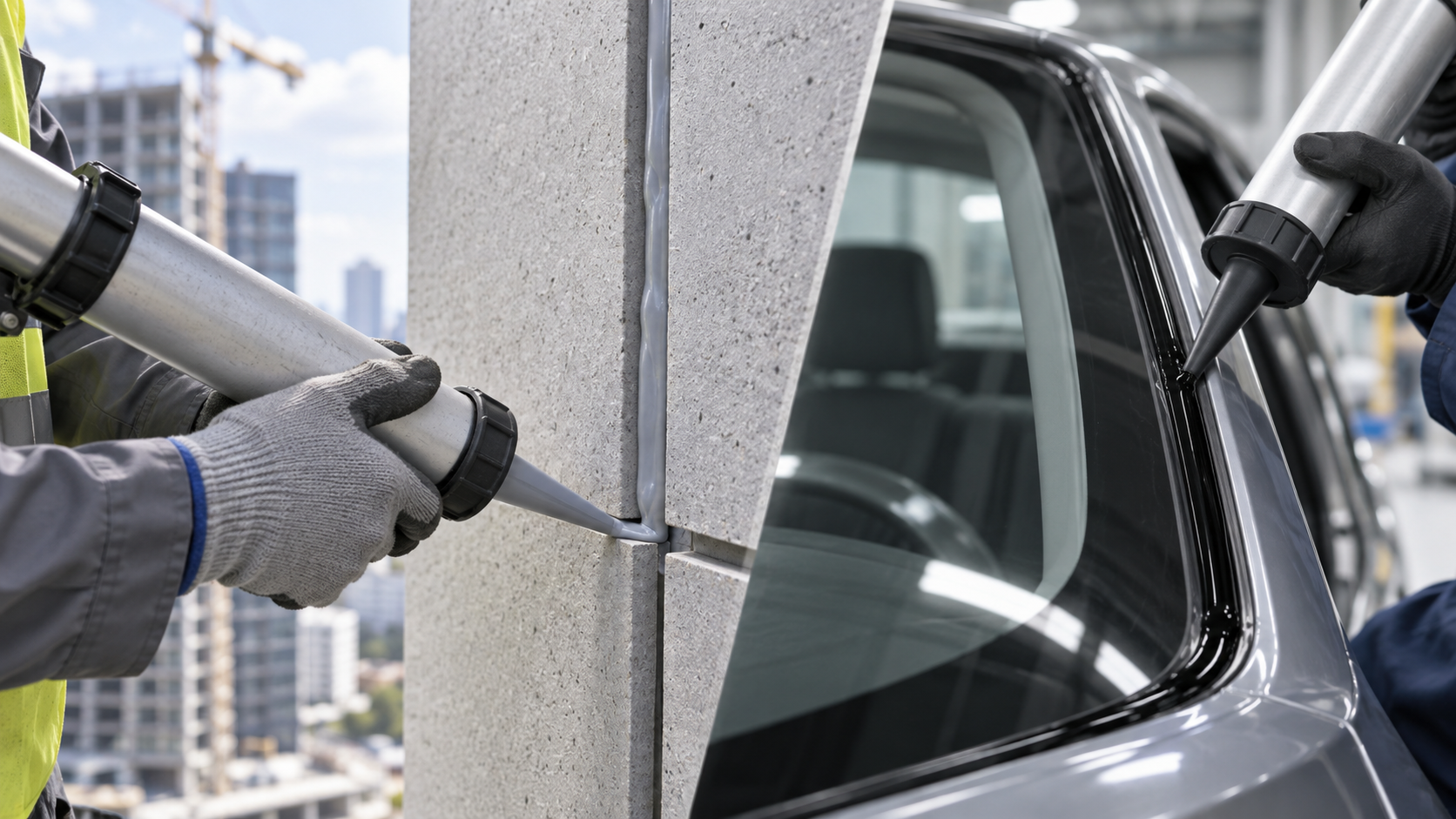
Sika's industrial bonding and sealing products are split into brands by chemical family Sourced. The company treats bonding, sealing, damping, reinforcing and protecting as its five core technologies, and says bonding can replace welding, screws, bolts and nails while adding functions such as sealing, damping and compensation for surface irregularities.
| Brand | Company description (summary) |
|---|---|
| Sikaflex | One-component polyurethane and silane-terminated polymer (SMP) adhesives and sealants, for glass bonding, sealing, adhesive bonding, bedding and caulking. Mechanical properties can be adapted to the application |
| SikaTack | One-component polyurethane adhesives, for automotive glass replacement, direct glazing and panel bonding in facades |
| Sikasil | One- and two-component silicone adhesives, bonding to glass, coated metals, plastics and wood, for automated processes that need high UV resistance and temperature stability |
| SikaPower | Epoxy adhesives for bonding metals and composites, where high static load capacity and resistance to shock and fatigue are needed |
| SikaForce / SikaFast | Two-component polyurethane adhesives (panels, composites, vehicles) / fast-curing acrylate structural adhesives |
| SikaMelt / SikaLastomer / SikaSeal | Hot-melt adhesives (industrial lamination) / butyl tapes and sealants / mastics and anti-flutter adhesives for vehicle assembly |
| SikaBiresin RE | Polyurethane and epoxy resins for potting and encapsulating electronic parts, able to withstand lead-free soldering temperatures. The company says it encapsulates "more than 10 million airbag sensors a year" and protects "more than 100 million automotive connectors a year" (the company's statements, which we have not verified) |
In construction it offers elastic bonding (applied in beads or dots to form a thick layer that spreads stress), rigid bonding (applied over the surface for a firm fix) and joint sealing (allowing movement while staying tight against water, air, heat and vapour). For joint sealants, the company notes that VOCs, phthalates, tin catalysts and isocyanates can become an issue depending on local regulations or green-building requirements.
As a representative example, here are the manufacturer's stated values from the March 2026 product data sheet for Sikaflex-221, a general-purpose one-component polyurethane adhesive sealant.
| Item | Manufacturer's stated value (Sikaflex-221) | Test method and conditions |
|---|---|---|
| Chemistry and cure | One-component polyurethane, moisture-curing | None |
| Skin time | 60 minutes | CQP019-1, 23°C / 50% r.h. |
| Shore A hardness | 40 | CQP023-1 / ISO 48-4 |
| Tensile strength | 1.8 MPa | CQP036-1 / ISO 527 |
| Elongation at break | 500% | CQP036-1 / ISO 527 |
| Tear propagation resistance | 7 N/mm | CQP045-1 / ISO 34 |
| Service temperature | -50 to 90°C (continuous), 120°C (24 hours), 140°C (1 hour) | CQP513-1 |
| Shelf life | 12 months | CQP016-1, stored below 25°C |
The stated values for Sikaflex-221 are modest, with a Shore A hardness of 40 and a tensile strength of 1.8 MPa compared with a hard structural adhesive, but it has a large elongation at break of 500% Sourced. In buildings and vehicles, where different materials expand and contract differently with temperature and humidity, an adhesive layer that stretches softly can relieve the stress and so make the joint less likely to fail (a general explanation). The company's construction adhesives page likewise says elastic adhesives spread load more evenly over a wide area, and that a thick bond layer helps compensate for and transfer stress. A moisture-curing polyurethane sets by reacting with water in the air, so the data sheet notes that at low temperatures the air holds less water and curing proceeds somewhat slower, and asks users to test adhesion and material compatibility on the actual substrates. Against polyurethanes, which use isocyanate chemistry, the company also offers silane-terminated polymer (SMP) technology under the same Sikaflex brand; the choice between them depends on strength, cure speed, regulation (the handling of isocyanates) and surface preparation (a general explanation). This article does not rank products. Please read each value together with the test method and conditions under which it was obtained. See also our explainers on adhesives, polyurethanes and elastomers, silicones, adhesive strength testing, and automotive silicones and encapsulants.
11. Risks the company faces
| Risk | What it means | Category |
|---|---|---|
| Construction cycle and China | Construction is about 85% of revenue Our calculation. In 2025 Chinese construction fell by a double-digit percentage, and Asia/Pacific revenue fell 5.3% in local currencies. The company says weak Chinese housing continued into the first half of 2026 | Sourced |
| Currency | Swiss-franc revenue was reduced by currency effects of -5.4% in 2025 and -5.5% in the first half of 2026 | Sourced |
| Raw materials and sourcing | Some raw materials (polymers, resins and others) are derived from crude oil, so purchasing costs move. Material expenses were CHF 5,048 million in 2025 | Sourced |
| Chemical regulation | In 2025, products containing PFAS were 0.4% of sales, and products containing substances on the EU SVHC Candidate List above 0.1% by weight were 5.7%. The assessment of MBCC's portfolio is continuing. Several reformulations to PFAS-free versions are reported to be under way | Sourced |
| Integrating acquisitions | The integration of MBCC was still continuing in 2025, and the EBITDA margin and ROCE targets of Strategy 2028 are conditional on MBCC's synergies having materialised. Akkim's integration is still to come | Sourced (the outcome of integration is not yet confirmed) |
| Transparency in adhesives and encapsulants | Revenue and profit for adhesives and sealants alone are not disclosed, so the effect of acquisitions is hard to check from outside. Akkim's purchase price is not stated in the published material either | Sourced |
| Inconsistent statements | The number of Global Technology Centers is 16 on the R&D page and 21 on the history page. The number of target markets differs between eight and seven | Sourced |
12. Glossary
- Elastic bonding
- Bonding in which beads or dots form a thick adhesive layer that spreads load and relieves stress.
- Rigid (structural) bonding
- Bonding in which adhesive is applied over the surface for a firm fix. Strong against static load and shock.
- Sealant
- A material that fills joints and gaps and keeps out water, air and heat. Elastic adhesives also have some sealant properties.
- One-component polyurethane
- An adhesive that sets by reacting with moisture in the air. It needs no mixing.
- SMP (silane-terminated polymer)
- A moisture-curing polymer that does not use isocyanates. It is used in some Sikaflex systems.
- Shore A hardness
- A guide to the hardness of rubber. The higher the number, the harder.
- Debonding
- Designing a bonded joint so that the parts can be separated afterwards, which helps recycling and repair.
- EBITDA
- Earnings before interest, tax, depreciation and amortisation, a measure of a business's earning power.
- Growth in local currencies
- The change in revenue with currency effects removed.
- PFAS
- A broad family of fluorinated chemicals whose regulation is being debated in many countries.
- SVHC
- Substances of very high concern, which are on the candidate list under the EU REACH regulation.
- MBCC
- A construction-chemicals group that Sika bought in May 2023.
13. References
- Sika AG Annual Report 2025 (PDF). Revenue, EBITDA and net profit, sales by region and business, R&D spending, headcount, patents, capital expenditure, Strategy 2028, Fast Forward, acquisitions, disclosure on PFAS and SVHC, debonding adhesives and more. https://www.sika.com/dam/dms/corporate/media/glo-ar-25-annual-report.pdf
- Sika AG Half-Year Report 2026 (PDF). Revenue, EBITDA, net profit, headcount and capital expenditure for January to June 2026, acquisitions and new plants, and the 2026 outlook. https://www.sika.com/dam/dms/corporate/media/glo-hyr-26-half-year-report.pdf
- Sika AG Media release, "Sika to acquire Akkim: Marking a major step in accelerating global expansion in adhesives and sealants" (13 February 2026). https://www.sika.com/en/media/media-releases/2026/sika-to-acquire-akkim.html
- Sika AG Media release, "Sika closes acquisition of Akkim – Accelerating global expansion in adhesives and sealants" (3 September 2026). https://www.sika.com/en/media/media-releases/2026/sika-closes-acquisition-of-akkim.html
- Sika AG "Research & Development" page (16 Global Technology Centers, 1,841 R&D employees, patents, the place of adhesives and sealants, and the statement on use in vehicles). https://www.sika.com/en/sustainability/innovation/research-development.html
- Sika AG "Universities" page (collaboration with universities and institutes; funding of ETH Zurich's "Living Lab HIL"). https://www.sika.com/en/sustainability/innovation/research-development/partnerships/universities.html
- Sika AG "Joining Technologies" page (the Joint Committee on Adhesive Bonding GAK, and research projects with the Laboratory for Material and Joining Technology (LWF) at the University of Paderborn). https://www.sika.com/en/sustainability/innovation/research-development/partnerships/joining-technologies.html
- Sika Industry "Technologies and Brands" page of Sika Industry (Sikaflex, SikaTack, Sikasil, SikaMelt, SikaFast, SikaForce, SikaSeal, SikaPower and other industrial brands). https://industry.sika.com/en/home/about-industry/technologies-brand.html
- Sika Industry "Core Competencies" page of Sika Industry (the five core technologies of bonding, sealing, damping, reinforcing and protecting, and the Industry markets). https://industry.sika.com/en/home/about-industry/core-competencies.html
- Sika Industry "Electronic Potting and Casting" page of Sika Industry (SikaBiresin RE potting and encapsulation resins for electronic parts). https://industry.sika.com/en/home/advanced-resins/electronic-pottingandcasting.html
- Sika Industry Home page of Sika Industry (self-description as technology leader for industrial adhesives, sealants and acoustic solutions; list of markets served). https://industry.sika.com/en/home.html
- Sika AG "Target Markets" page (the target markets across construction and the vehicle industry). https://www.sika.com/en/about-us/organization/target-markets.html
- Sika AG "Construction Adhesives" page (elastic and rigid adhesives, compared with mechanical fixing). https://www.sika.com/en/construction/construction-adhesives.html
- Sika AG "Joint Sealing" page (uses of joint sealing, and remarks on VOCs, phthalates, tin catalysts and isocyanates). https://www.sika.com/en/construction/joint-sealing.html
- Sika AG "History" page (founded 1910, start of the automotive business with Sikaflex in the 1980s, the MBCC acquisition in May 2023). https://www.sika.com/en/about-us/who-we-are/history.html
- Sika AG "Key Data on Sika Shares and Shareholders" (listing on SIX Swiss Exchange, number of shares). https://www.sika.com/en/investors/shares/key-data-on-sika-shares.html
- Sika AG Product Data Sheet, Sikaflex-221, Version 05.01 (March 2026, en_GB). Manufacturer's stated values for a one-component polyurethane adhesive sealant. https://gbr.sika.com/dam/dms/gb01/4/sikaflex-221.pdf
- Sika Japan Sika Japan's media-release page (to confirm the name of the Japanese subsidiary). https://jpn.sika.com/ja/media/media-releases/2026.html
14. Claim-to-source audit
| Claim in the article | Category | Source |
|---|---|---|
| Legal name, location (Baar), listing venue, number of shares, name of the Japanese subsidiary | Sourced | References 1, 16 and 18 https://www.sika.com/dam/dms/corporate/media/glo-ar-25-annual-report.pdf https://www.sika.com/en/investors/shares/key-data-on-sika-shares.html https://jpn.sika.com/ja/media/media-releases/2026.html |
| Revenue, EBITDA, net profit, R&D spending, investment, headcount, and revenue by region and business for 2024 and 2025 | Sourced | Reference 1 https://www.sika.com/dam/dms/corporate/media/glo-ar-25-annual-report.pdf |
| Revenue, EBITDA, net profit, headcount, capital expenditure, new plants and the outlook for January to June 2026 | Sourced | Reference 2 https://www.sika.com/dam/dms/corporate/media/glo-hyr-26-half-year-report.pdf |
| The agreement to buy Akkim (13 February 2026) and the closing (3 September 2026), and Akkim's sales, plants and distribution | Sourced | References 3 and 4 https://www.sika.com/en/media/media-releases/2026/sika-to-acquire-akkim.html https://www.sika.com/en/media/media-releases/2026/sika-closes-acquisition-of-akkim.html |
| Targets of Strategy 2028, the benefit of Fast Forward, the refurbishment share (about 55%), shares of PFAS and SVHC products, and debonding adhesives | Sourced | Reference 1 https://www.sika.com/dam/dms/corporate/media/glo-ar-25-annual-report.pdf |
| 1,841 R&D employees, 16 Technology Centers, patent figures, and the statement on use in vehicles | Sourced | References 5 and 1 https://www.sika.com/en/sustainability/innovation/research-development.html https://www.sika.com/dam/dms/corporate/media/glo-ar-25-annual-report.pdf |
| Collaboration with the University of Paderborn's LWF, GAK, ETH Zurich and other universities and institutes | Sourced | References 7 and 6 https://www.sika.com/en/sustainability/innovation/research-development/partnerships/joining-technologies.html https://www.sika.com/en/sustainability/innovation/research-development/partnerships/universities.html |
| Industrial bonding and sealing brands and their descriptions, the core technologies and SikaBiresin RE | Sourced | References 8, 9, 10 and 11 https://industry.sika.com/en/home/about-industry/technologies-brand.html https://industry.sika.com/en/home/about-industry/core-competencies.html https://industry.sika.com/en/home/advanced-resins/electronic-pottingandcasting.html https://industry.sika.com/en/home.html |
| The description of target markets (eight or seven), and of construction adhesives and joint sealing | Sourced | References 12, 13, 14 and 11 https://www.sika.com/en/about-us/organization/target-markets.html https://www.sika.com/en/construction/construction-adhesives.html https://www.sika.com/en/construction/joint-sealing.html https://industry.sika.com/en/home.html |
| Founded 1910, start of the automotive business in the 1980s, the BMW photo caption, the MBCC acquisition in May 2023, and 21 Technology Centers | Sourced | Reference 15 https://www.sika.com/en/about-us/who-we-are/history.html |
| Stated values for Sikaflex-221 (hardness, tensile strength, elongation, service temperature and others) | Sourced | Reference 17 https://gbr.sika.com/dam/dms/gb01/4/sikaflex-221.pdf |
| Sika's placement among the three types (general adhesives & chemicals primary) | Our calculation | This article's own classification. Companies named are examples from this series |
| Construction about 85% and industrial manufacturing about 15% (9,555.0 / 11,201.3 and 1,646.3 / 11,201.3) | Our calculation | This article's calculation. Not the share for adhesives and encapsulants https://www.sika.com/dam/dms/corporate/media/glo-ar-25-annual-report.pdf |
| Akkim's sales at about 2% of the group (220 / 11,201.3), and the 2024 EBITDA margin of about 19.3% | Our calculation | This article's calculation |
| Revenue and profit for adhesives and sealants alone, Akkim's purchase price, a medium-term target, and revenue by sales channel | Not yet confirmed | Not stated in the public material. This article makes no estimate https://www.sika.com/dam/dms/corporate/media/glo-ar-25-annual-report.pdf |
| Targets of Strategy 2028, the benefit of Fast Forward, and the 2026 outlook | Not yet confirmed | Company targets and outlooks, not results achieved https://www.sika.com/dam/dms/corporate/media/glo-hyr-26-half-year-report.pdf |
| The reading that Sika is widening how it sells adhesives towards distribution, retail and e-commerce | Inference | This article's interpretation of the Akkim announcement and the 2026 half-year report https://www.sika.com/en/media/media-releases/2026/sika-to-acquire-akkim.html |
| The reading that acquisitions add range and capacity faster than in-house development | Inference | This article's interpretation of the Akkim announcement and Strategy 2028 https://www.sika.com/en/media/media-releases/2026/sika-closes-acquisition-of-akkim.html |
| The reading that refurbishment demand gives bonding and sealing a stable base | Inference | This article's interpretation of the refurbishment share https://www.sika.com/dam/dms/corporate/media/glo-ar-25-annual-report.pdf |
| The reading that in automotive it centres on adhesives for lightweighting and low-energy processes | Inference | This article's interpretation of the annual report https://www.sika.com/dam/dms/corporate/media/glo-ar-25-annual-report.pdf |
Last updated 3 October 2026 / Troy Technical
Every figure in this article comes from Sika AG's Annual Report 2025 and Half-Year Report 2026, pages of its website, 2026 news releases and a product data sheet. The market-size figures in the annual report draw on a research firm's data and are not used here, and no research-firm estimates or press-based figures have been used. Product performance values are those published by the company (manufacturer's stated values). Passages marked "Inference" are this article's interpretation of primary sources, not statements made by the company.