COMPANY PROFILE / ADHESIVES & ENCAPSULANTS
Sumitomo Bakelite
A thermoset-resin company that began with phenolic resin and has built semiconductor encapsulants (EME) into its earnings engine
Sumitomo Bakelite is a name that comes up often when people talk about semiconductor-package encapsulants, known as epoxy molding compounds (EME). According to its securities report for the year to March 2026, the Semiconductor Materials segment had sales revenue of ¥106.4 billion (up 16.5%) and business profit of ¥20.7 billion. The company calls its encapsulants the "world's top share" in its own words, but that is its self-assessment and we have not checked it against third-party figures. In January 2026 it also agreed to buy the company that will take over Kyocera's semiconductor encapsulant and related chemical business (¥30.0 billion), with completion planned for October 2026. This profile sets out, from primary sources only, what the company puts into adhesives and encapsulants, who it works with, and how much it discloses.
- Sumitomo Bakelite in 30 seconds, and where it stands in adhesives and encapsulants
- The logo and how the name is written
- Where the company sits in the field
- Scale
- Resources committed to adhesives and encapsulants
- What it has done so far
- What comes next
- What the company is aiming for in adhesives and encapsulants
- Map of partnerships in adhesives and encapsulants
- Technologies, products and services
- The risks this company carries
- Glossary, references and claim-to-source audit
1. Sumitomo Bakelite in 30 seconds, and where it stands in adhesives and encapsulants
(secondary: functional resins)High-performance plastics such as phenolic resins are also a core business
bonding pastesAlso photosensitive materials and package-substrate materials
due in October 2026Purchase price ¥30.0 billion. The company's plan
Sumitomo Bakelite is not a dedicated semiconductor-materials company but a broad thermoset-resin maker built on phenolic resin, and semiconductor materials are one of its three pillars. The contribution to profit, though, is large. In the year to March 2026, the segment's business profit of ¥20.7 billion was about 52% of the combined business profit of the three reporting segments (about ¥39.8 billion) Our calculation. It is about a third of consolidated sales, which means this is a higher-margin business Sourced. In adhesives and encapsulants, the solid epoxy molding compound (EME) is the main line, while the liquid encapsulant only began customer evaluation in April 2026.
2. The logo and how the name is written

A note on names: the legal entity is Sumitomo Bakelite Co., Ltd. (the securities report gives the English name as Sumitomo Bakelite Company Limited). According to the history in the securities report, the company was founded in 1932 as Nippon Bakelite, taking over a phenolic synthetic-resin business from Sankyo, and took its present name in 1955 by merging with Sumitomo Kakozai Kogyo. The encapsulant product brand is SUMIKON. The company's website domain uses the short form "sumibe". The logo image was taken from the header of the company's official website.
Official site: https://www.sumibe.co.jp/english/3. Where the company sits in the field
4. Scale
The Group has three reporting segments. Adhesives and encapsulants belong to Semiconductor Materials, so the company as a whole is covered briefly Sourced.
| Indicator (¥ million, IFRS) | Year to Mar 2025 | Year to Mar 2026 | Change |
|---|---|---|---|
| Consolidated sales revenue | 304,773 | 319,867 | +5.0% |
| Consolidated business profit | 30,837 | 34,490 | +11.8% |
| Semiconductor Materials sales revenue | 91,336 | 106,396 | +16.5% |
| Semiconductor Materials business profit | 17,988 | 20,714 | +15.2% |
| Consolidated employees (year end) | 7,981 | 7,524 | n/a |
"Business profit" is the company's own measure: sales revenue minus cost of sales and selling, general and administrative expenses. Semiconductor Materials had 1,158 employees at the end of March 2026 (plus 135 temporary staff), about 15% of the consolidated total (our calculation). In the April to June 2026 quarter, the segment's sales revenue was ¥34.2 billion (up 40.0% year on year) and business profit was ¥8.0 billion (up 66.3%). The company says demand related to AI data centres led the way, with especially strong growth in power-device applications Sourced.
Within Semiconductor Materials, sales for encapsulants (EME) alone are not disclosed. The securities report describes the movement of encapsulants, photosensitive materials, bonding pastes and package-substrate materials in words, with no amount per product. This article does not estimate sales by product Not yet confirmed.
5. Resources committed to adhesives and encapsulants
Amounts and headcounts can be read at the level of "Semiconductor Materials". There are no figures for encapsulants and adhesives alone.
| Resource | What primary sources confirm | Category |
|---|---|---|
| People | Semiconductor Materials had 1,158 employees (end of March 2026). Group R&D spending was ¥13.3 billion, of which Semiconductor Materials accounted for ¥4.36 billion (about 33%; our calculation). R&D headcount is not disclosed. R&D bases with open-lab functions exist overseas in China, Taiwan, Singapore, the U.S. and Belgium | Sourced / partly undisclosed |
| Money (capital expenditure) | Capital expenditure in the year to March 2026 was ¥19.28 billion for the Group, of which Semiconductor Materials accounted for ¥5.16 billion (including added encapsulant production equipment at Suzhou and Singapore). In Suzhou, China, a new line due to start around December 2028 will raise production capacity in China by about 30% (amount not disclosed). The investment budget in the medium-term plan (FY2024 to FY2026) is ¥50 billion for capital expenditure, ¥50 billion for strategic investment and ¥20 billion for growth investment | Sourced / plan |
| Acquisitions and investments | Acquisition of the shares of a new company that will take over part of Kyocera's chemical business (semiconductor EME, bonding pastes and resins for industrial use) for ¥30.0 billion, planned for October 2026. The business had sales of ¥23,223 million in the year to March 2025. In 2001 the company bought the electronic-materials research unit of Goodrich of the U.S. (now Promerus) | Sourced / planned |
| Universities, institutes, public funding | In January 2025 it set up a joint research institute with Tohoku University for materials and processes for next-generation semiconductors, and it does joint research with Georgia Institute of Technology on low-dielectric materials for glass packages. No amount of public funding (such as grants) could be confirmed | Sourced / amount not confirmed |
| Places for development and evaluation | It says it runs open labs in Japan, Asia, Europe and the U.S., where customers can try actual molding and examine structures and processes. It also describes collaboration with equipment makers, raw-material makers, universities and consortia | Sourced (company description) |
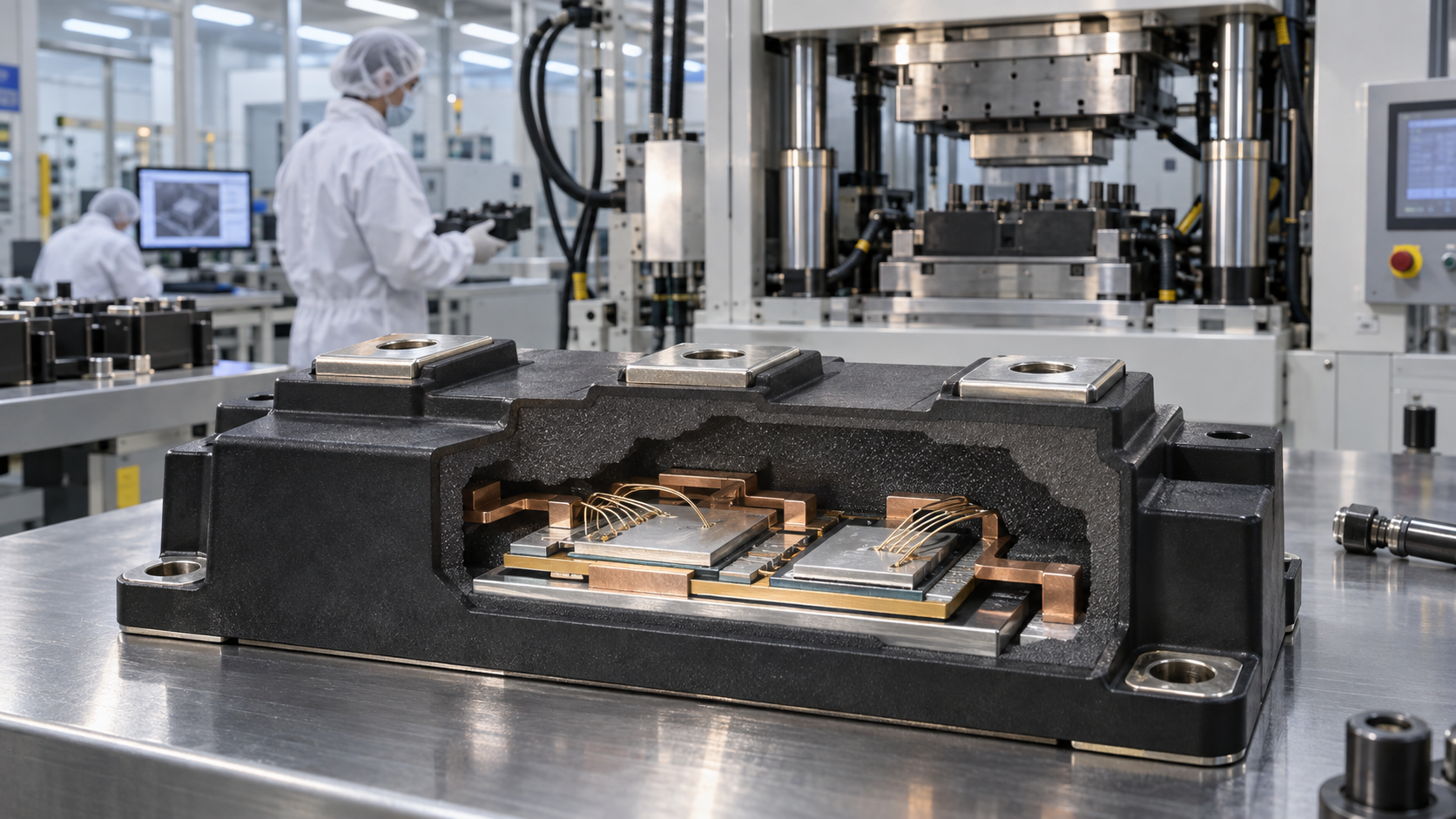
A solid epoxy encapsulant is a mixture of epoxy resin, hardener, highly loaded fillers such as silica, and additives such as release agents, flame retardants and coupling agents, ground and pressed into tablets or granules, so performance is set by formulation and processing know-how. The company says it applied "the formulation and prescription technologies cultivated over many years in solid encapsulants" when it developed its liquid encapsulant Sourced. The product page states that flame retardancy of UL-94 V-0 is achieved without bromine or antimony flame retardants (manufacturer's stated value). Even among "encapsulants", the priority given to flow, warpage, thermal conductivity, heat resistance and dielectric properties differs by package type, which is why the products are split into series (see our explainers on semiconductor encapsulants and molding).
6. What it has done so far
| When | What happened | Why it matters |
|---|---|---|
| 1932 | Founded as Nippon Bakelite, taking over a phenolic synthetic-resin business from Sankyo | The starting point as a thermoset-resin company |
| 1995 to 1997 | Established Sumitomo Bakelite (Suzhou) in China (1995). Began producing semiconductor encapsulants in China (1997) | About 30 years of encapsulant production in China |
| 2001 | Acquired the electronic-materials research unit of Goodrich of the U.S. (now Promerus, LLC) | A base for advanced semiconductor-materials research |
| 2022 to 2025 | Added a line at Suzhou (March 2022). A new plant was completed in 2024 and began operating in 2025 | Responding to growth in Chinese demand |
| January 2025 | Set up a joint research institute with Tohoku University for materials and processes for next-generation semiconductors | A framework for joint research with a university |
| 22 January 2026 | Resolved to acquire the shares of a new company that will take over part of Kyocera's chemical business, and signed the agreement | Brings in the scale of the encapsulant and bonding-paste businesses, plus Kyocera's high-thermal-conductivity technology |
| April to May 2026 | Began trial supply (customer evaluation) of the liquid encapsulant "EME-L series" for large packages such as those for AI (started in April, announced 18 May). Presented 3 joint-research results at ECTC 2026 | Extends from solid to liquid |
| June 2026 | Began volume production of the solid encapsulant "EME-G785 series" for SiC power modules (announced 1 June). Announced about 30% more encapsulant capacity at Suzhou (25 June). Told customers it will raise EME selling prices by about 10% to 20% (announced 14 May, from shipments on 1 June) | Serving both power semiconductors and AI. A response to higher raw-material costs |
| August 2026 | Developed, with Tohoku University, a 3D SiC power module using a resin insulating substrate and encapsulating resin (announced 18 August) | The materials maker joined from the concept stage of module design |
7. What comes next
business profit ¥23.5 billionForecast announced in May 2026; unchanged in August
(closing planned for end of month)The company says the antitrust review was cleared on 17 June
The primary sources also describe the following plans Not yet confirmed.
- For the final year of the medium-term plan (FY2024 to FY2026, year to March 2027), the targets are consolidated business profit of ¥40.0 billion and a business-profit margin of 11.5% (the Group forecast for the year to March 2027 is ¥38.0 billion). The longer-term "Vision 2030" is business profit of ¥55.0 billion, a margin of 13.0% and ROE of 10.0%
- In semiconductor materials the company focuses on three areas, AI, power and mobility, widening encapsulants for AI servers (MUF and granular) and high-thermal-conductivity materials. It plans to cover Southeast Asian demand from two sites, in Taiwan and Singapore
- Through integration (PMI) of the Kyocera business, it aims to combine Kyocera's high-thermal-conductivity technology with its own and raise its presence in AI data-centre applications
- With MUF and granular encapsulants and automotive materials growing, it is considering extra investment that uses its global production capacity (amount and timing not disclosed)
Sales of EME alone and by country; third-party backing for its global encapsulant share; the investment amount for the Suzhou expansion; the results of integrating the Kyocera business after the acquisition; whether and when the liquid encapsulant is adopted (2027 is the company's target); and R&D headcount. None of these appears in the securities report, the results summary or the briefing, or they remain company targets.
8. What the company is aiming for in adhesives and encapsulants
This section separates what the company writes from what we read into it. Inference marks our interpretation of primary sources.
| What can be read | Primary evidence | Category |
|---|---|---|
| It aims at "niche and top share" and is willing to swap businesses | The management policy in the securities report says it aims for "niche and top share". The investor briefing of September 2026 sorts businesses into core, earnings, growth and "to be assessed", shifts resources to growth businesses and directs strategic investment to M&A | Sourced |
| In semiconductor materials it focuses on AI, power and mobility | The R&D section of the securities report states that it concentrates on "three reinforcement areas: AI, power and mobility". The five products launched in the year include a PDMS-free encapsulant for AI and a high-thermal-conductivity encapsulant for power semiconductors | Sourced |
| It builds on its solid-encapsulant strength and extends to liquid encapsulants and MUF (molded underfill) | The release on the EME-L series says it applied the formulation know-how built up in solid encapsulants, and promotes integrating under-mold and over-mold steps. The briefing also mentions "MUF and granular" and the start of customer evaluation of a liquid encapsulant for AI semiconductors | Sourced (development) / Inference (intent) |
| It takes in capacity and technology in one step through M&A | It decided to acquire the company taking over part of Kyocera's chemical business, and says that combining it with "Kyocera's proprietary high-thermal-conductivity technology" will raise its presence in AI data centres. The medium-term plan sets a ¥50 billion strategic investment budget | Sourced |
| It gets into next-generation specifications through joint research with universities and package companies, not only customers | It presented joint research with Tohoku University's joint institute, Georgia Tech and SPIL / MediaTek at ECTC 2026 | Sourced (activity) / Inference (aim) |
The reading that the company is extending to liquid encapsulants and MUF rests on its own reference to changing customer demands. The release on the EME-L series says that, as generative AI spreads and 2.xD/3D and chiplet structures advance, packages themselves are getting larger, so liquid encapsulants also need lower warpage and better processability, and that development began "in response to strong requests from customers" Sourced. The company's mainstay is the solid encapsulant, and the liquid product only entered trial supply in April 2026. It looks as though the company sees a risk of losing customers with large packages if it defends its core and does not reach into liquids as well. But qualification in 2027 is a company target, and adoption is not assured Not yet confirmed.
9. Map of partnerships in adhesives and encapsulants
The partners in joint research that official materials name are universities (Tohoku University and Georgia Tech) and package or chip companies (SPIL and MediaTek) Sourced. By contrast, we could not find any named customer among the semiconductor makers that actually use the encapsulants. The results briefing contains phrases such as "long-term contract with a major U.S. aerospace company", but without a company name, so it remains the company's own description Not yet confirmed.
10. Technologies, products and services
The items below are drawn from the official product pages of the IT Materials Division and the securities report, organised around adhesives and encapsulants. No performance figures are given, because manufacturer's stated values must be read with the grade and test conditions matched Sourced.
| Area | Items listed in official materials | Note |
|---|---|---|
| Encapsulants (solid, EME) | Epoxy molding compounds for semiconductor encapsulation, "SUMIKON EME", for transfer and compression molding. Series by package: standard (for DIP and QFP), for BGA and CSP (low warpage, high flow, high thermal conductivity), for FCCSP and SiP (narrow-gap filling), for AiP (low dielectric), for WLP and PLP (low warpage), for power modules (high Tg), for fixing motor rotor magnets, and others | See our explainers on semiconductor encapsulants and molding |
| Encapsulants (for SiC power) | EME-G785 series. The company announced (June 2026) a glass transition temperature (Tg) of 230°C, which it says is an industry first for a solid epoxy encapsulant, with low-stress technology holding the rise in modulus in check | Manufacturer's stated value. The older series are listed at 195°C in the company's comparison table |
| Encapsulants (liquid) | EME-L series. A low-warpage, high-reliability liquid encapsulant, with some grades capable of molded underfill. Trial supply from April 2026, with qualification targeted for 2027 | See our explainer on underfill |
| Die bonding | "SUMIRESIN EXCEL CRM" die bonding paste, used for chip bonding and heat spreading. The securities report mentions rising demand for bonding pastes in China, Southeast Asia, power devices and automotive | See our explainers on die attach and pastes |
| Photosensitive and substrate materials | "SUMIRESIN EXCEL CRC" photosensitive material for wafer coating (front end), "SUMILITE LαZ" package-substrate material, build-up materials, solder-resist substitutes and low-modulus build-up materials for glass substrates | Not adhesives, but used in the same customers' processes |
| Related materials and processes | "SUMILITE FSL" dicing film and cover tape for carrying parts. Encapsulants for fixing motor magnets and for batch-encapsulating ECUs and sensors | Proposes the whole semiconductor process |
Encapsulants for SiC power modules must stay rigid at high temperature (high Tg). The company's release explains, however, that raising the Tg of an epoxy above 200°C raises the crosslink density and so the modulus (stiffness), making delamination and cracking in heat cycles more likely, a trade-off Sourced. The company says it stiffened the main-chain backbone of the resin and optimised the crosslink density, and used low-stress technology to hold the rise in modulus in check (manufacturer's stated value; the value for each product must be checked on its technical data sheet under stated conditions). In large packages for AI, a different problem, warpage, comes to the fore. Because warpage arises from the difference between the cure shrinkage of the encapsulant and the thermal expansion of chip and substrate, the design of a low-warpage encapsulant (filler loading, resin backbone, stress-relief agents) is the centre of the work Not yet confirmed.
11. The risks this company carries
| Risk | Detail | Category |
|---|---|---|
| Integrating Kyocera's business | Closing is planned for October 2026 and the antitrust review is said to be cleared. Whether the company can absorb a business with sales of ¥23.2 billion (year to March 2025) and create synergies has yet to be seen | Sourced (plan) / Inference (difficulty of integration) |
| Raw materials and passing on prices | The securities report rates supply problems and price swings in raw materials at "4" (highest) for likelihood. In 2026 the company told customers it would raise EME prices by about 10% to 20%. Whether customers accept is a separate matter | Sourced |
| China and geopolitics | Suzhou benefits from rising Chinese demand, but the securities report says US-China trade friction and tighter economic-security policies could affect exports, imports and transactions (impact rated "4", the largest). The end-2028 expansion adds to its exposure to China | Sourced / Inference |
| Concentration on AI and power demand | The company says the April to June 2026 growth was led by AI data-centre applications and power devices. A change in that demand would have a large effect | Sourced (driver) / Inference (effect) |
| Uncertain adoption of liquid encapsulants | Qualification in 2027 is a company target. Customer evaluation results could change both the timing and whether it is adopted | Sourced (target) |
| Product quality | The securities report lists product quality as one of its main risks. Even a slight defect in a semiconductor encapsulant affects the customer's yield | Sourced (statement) / Inference (effect) |
| Hard to verify from outside | Encapsulant sales alone, the investment amount for the expansion and any third-party backing for global share are all missing, so "world top share" can only be read as the company's own assessment | Not yet confirmed |
12. Glossary
- Business profit
- A measure Sumitomo Bakelite uses: sales revenue minus cost of sales and selling, general and administrative expenses.
- EME (epoxy molding compound)
- An epoxy-based molding material that encloses and protects a semiconductor chip. Solid powder or granules are heated and molded.
- MUF (molded underfill)
- A method that fills the gap under the chip and encapsulates the whole chip with one material in one step.
- Transfer / compression molding
- Transfer molding pushes the encapsulant into a closed mold; compression molding presses it into the mold from above. The latter is used for large-area packages.
- Glass transition temperature (Tg)
- The temperature at which a resin changes from hard to soft. For encapsulants it is a guide to how well they hold their shape at high temperature.
- Power devices (SiC)
- Semiconductors used for power conversion in electric vehicles and data centres. SiC (silicon carbide) withstands high temperature and high voltage.
- AiP
- Antenna in Package: a structure with the antenna built into the package, which calls for an encapsulant with a low dielectric constant.
- PMI
- Post-merger integration: the work of combining a business after an acquisition.
13. References
- Sumitomo Bakelite Securities report for the 135th fiscal period, the year to March 2026, filed 22 June 2026 (in Japanese). History, business description, employee numbers, results, R&D, capital expenditure, business risks and the Kyocera business takeover (additional information). https://www.sumibe.co.jp/ir/library/report/files/135.pdf
- Sumitomo Bakelite Summary of Consolidated Business Results for the Three Months Ended June 30, 2026 [IFRS] (3 August 2026). Results for April to June 2026 and the situation by segment. https://www.sumibe.co.jp/english/ir/library/result/files/2026/0803_01.pdf
- Sumitomo Bakelite Financial Results for 1st Quarter of FY2026 (3 August 2026). Full-year forecast by segment for the year to March 2027. https://www.sumibe.co.jp/english/ir/library/presentation/files/2026/0803_02.pdf
- Sumitomo Bakelite Investor business briefing presentation (8 September 2026; in Japanese). Outlook and initiatives for semiconductor materials, the Suzhou expansion, progress on the Kyocera business, and investment under the medium-term plan. https://www.sumibe.co.jp/ir/library/presentation/files/2026/0908.pdf
- Sumitomo Bakelite Notice of acquisition of the shares of a new company succeeding part of Kyocera's chemical business (22 January 2026). https://www.sumibe.co.jp/english/topics/2026/pdf/0122_01.pdf
- Sumitomo Bakelite "Expansion of Production Capacity for Semiconductor Encapsulation Materials at Sumitomo Bakelite (Suzhou) Co., Ltd." (25 June 2026). https://www.sumibe.co.jp/english/topics/2026/it-materials/0619_01/index.html
- Sumitomo Bakelite "Announcement of Trial Launch of Liquid Encapsulant for Advanced Packages" (18 May 2026). https://www.sumibe.co.jp/english/topics/2026/it-materials/0514_01/index.html
- Sumitomo Bakelite "Development of High-Tg Epoxy Molding Compounds for Next-Generation SiC Power Modules" (1 June 2026). Manufacturer's stated values. https://www.sumibe.co.jp/english/topics/2026/it-materials/0428_01/index.html
- Sumitomo Bakelite "Price Revision of Epoxy Resin Molding Compounds for Encapsulation of Semiconductor Devices SUMIKON EME" (14 May 2026). https://www.sumibe.co.jp/english/topics/2026/it-materials/0509_01/index.html
- Sumitomo Bakelite "Participation in ECTC 2026" (15 May 2026). https://www.sumibe.co.jp/english/topics/2026/it-materials/0511_01/index.html
- Sumitomo Bakelite "Development of a Next-Generation 3D Power Module with Ultra-Compact Size and High Power Density" (18 August 2026). https://www.sumibe.co.jp/english/topics/2026/it-materials/0804_01/index.html
- Sumitomo Bakelite IT Materials Division (official product page). https://www.sumibe.co.jp/english/product/it-materials/index.html
- Sumitomo Bakelite Epoxy Resin Molding Compounds for Encapsulation of Semiconductor Devices, SUMIKON EME (official product page). https://www.sumibe.co.jp/english/product/it-materials/epoxy/sumikon-eme/index.html
- Sumitomo Bakelite Official website (source of the logo image). https://www.sumibe.co.jp/english/
14. Claim-to-source audit
| Claim in the article | Category | Source |
|---|---|---|
| Legal name, head office, listing and securities code, history (1932 founding, 1955 merger, 1995 Suzhou company, 2001 Promerus acquisition) | Sourced | Reference 1 https://www.sumibe.co.jp/ir/library/report/files/135.pdf |
| Consolidated sales revenue and business profit, Semiconductor Materials sales revenue of ¥106.4 billion and business profit of ¥20.7 billion (year to March 2026) with the prior year, employee numbers | Sourced | Reference 1 https://www.sumibe.co.jp/ir/library/report/files/135.pdf |
| Segment shares (about 33% of consolidated sales, about 52% of combined segment profit, about 15% of employees, about 33% of R&D spending) and the 19.5% business-profit margin | Our calculation | Our own division of figures in Reference 1 |
| Main Semiconductor Materials products (EME, photosensitive materials, bonding pastes, LαZ substrate materials) and how they moved in the year to March 2026 | Sourced | Reference 1 https://www.sumibe.co.jp/ir/library/report/files/135.pdf |
| R&D spending (Group ¥13.3 billion, Semiconductor Materials ¥4.36 billion), capital expenditure (Group ¥19.28 billion, Semiconductor Materials ¥5.16 billion), the five products launched | Sourced | Reference 1 https://www.sumibe.co.jp/ir/library/report/files/135.pdf |
| April to June 2026 Semiconductor Materials sales of ¥34.2 billion (+40.0%) and business profit of ¥8.0 billion (+66.3%), and the explanation that AI data-centre and power-device demand led | Sourced | Reference 2 https://www.sumibe.co.jp/english/ir/library/result/files/2026/0803_01.pdf |
| Outlook for the year to March 2027 (Semiconductor Materials sales of ¥117.5 billion and business profit of ¥23.5 billion; Group sales of ¥337.0 billion and business profit of ¥38.0 billion) | Not yet confirmed | Reference 3 https://www.sumibe.co.jp/english/ir/library/presentation/files/2026/0803_02.pdf |
| Acquisition of the new company taking over part of Kyocera's chemical business (¥30.0 billion, sales of ¥23,223 million in the year to March 2025, October 2026 planned, business relationship) | Sourced | Reference 5 https://www.sumibe.co.jp/english/topics/2026/pdf/0122_01.pdf |
| Progress on the Kyocera business (antitrust clearance, closing planned for end of October), the business-swap and M&A policy, medium-term investment budget, Vision 2030, AI / power / mobility initiatives | Not yet confirmed | Reference 4 https://www.sumibe.co.jp/ir/library/presentation/files/2026/0908.pdf |
| Medium-term plan targets (FY2026 business profit of ¥40.0 billion) and investment budget (capital expenditure ¥50 billion, strategic ¥50 billion, growth ¥20 billion) | Not yet confirmed | Reference 1 https://www.sumibe.co.jp/ir/library/report/files/135.pdf Reference 4 https://www.sumibe.co.jp/ir/library/presentation/files/2026/0908.pdf |
| About 30% more encapsulant capacity at Suzhou (operation around December 2028) and the history of encapsulant production in China (from 1997, 2022 line, new plant) | Sourced | Reference 6 https://www.sumibe.co.jp/english/topics/2026/it-materials/0619_01/index.html Reference 4 https://www.sumibe.co.jp/ir/library/presentation/files/2026/0908.pdf |
| Trial supply of the EME-L liquid encapsulant (April 2026), the 2027 qualification target, and the "top share" self-assessment | Sourced | Reference 7 https://www.sumibe.co.jp/english/topics/2026/it-materials/0514_01/index.html |
| Volume production of the EME-G785 series (Tg of 230°C is the company's own survey, comparison with older series, explanation of the Tg and low-stress trade-off) | Sourced | Reference 8 https://www.sumibe.co.jp/english/topics/2026/it-materials/0428_01/index.html |
| Notice of a roughly 10% to 20% EME price rise (from shipments on 1 June 2026) and higher raw-material costs from the Middle East situation | Sourced | Reference 9 https://www.sumibe.co.jp/english/topics/2026/it-materials/0509_01/index.html |
| Three joint-research presentations at ECTC 2026 (Tohoku University, Georgia Tech, SPIL / MediaTek) | Sourced | Reference 10 https://www.sumibe.co.jp/english/topics/2026/it-materials/0511_01/index.html |
| Joint research institute with Tohoku University (January 2025) and the 3D SiC power module | Sourced | Reference 11 https://www.sumibe.co.jp/english/topics/2026/it-materials/0804_01/index.html |
| SUMIKON EME series line-up, molding methods, halogen-free and antimony-free flame retardancy meeting UL-94 V-0 | Sourced | Reference 13 https://www.sumibe.co.jp/english/product/it-materials/epoxy/sumikon-eme/index.html |
| Die bonding paste, photosensitive materials, package-substrate materials, dicing film, cover tape, open labs and collaboration | Sourced | Reference 12 https://www.sumibe.co.jp/english/product/it-materials/index.html |
| Business risks (raw-material supply and price swings, geopolitics, product quality) | Sourced | Reference 1 https://www.sumibe.co.jp/ir/library/report/files/135.pdf |
| R&D headcount, EME-only sales, the investment amount for the Suzhou expansion, third-party backing for global share, amounts of public funding | Not yet confirmed | Not stated in References 1 to 4. Not confirmed; this article does not estimate them Reference 1 https://www.sumibe.co.jp/ir/library/report/files/135.pdf Reference 2 https://www.sumibe.co.jp/english/ir/library/result/files/2026/0803_01.pdf Reference 3 https://www.sumibe.co.jp/english/ir/library/presentation/files/2026/0803_02.pdf Reference 4 https://www.sumibe.co.jp/ir/library/presentation/files/2026/0908.pdf |
| Named semiconductor-maker customers for the encapsulants and the transaction values | Not yet confirmed | Not stated in References 1 to 4 (only phrases without company names). Not confirmed Reference 4 https://www.sumibe.co.jp/ir/library/presentation/files/2026/0908.pdf |
| The three-type classification (general adhesives & chemicals; semiconductor & electronic materials; UV-curing & specialty), the example companies, and the framing as a broad thermoset-resin maker rather than a dedicated semiconductor-materials company | Our calculation | Our own classification. Company names are examples from those covered in this series |
| The reading that it is extending to liquid encapsulants and MUF | Inference | Our own interpretation of the EME-L release (Reference 7) and the briefing (Reference 4) |
| The reading that it gets into next-generation specifications through joint research with universities and package companies | Inference | Our own interpretation of the joint-research announcements (References 10 and 11) |
| The readings of integration difficulty for the Kyocera business and of concentration on China and AI demand as risks | Inference | Our own interpretation of References 1 to 5 |
Last updated 3 October 2026 / Troy Technical
Every figure in this article comes from Sumitomo Bakelite's securities report, results summaries and briefings, and official news releases. No research-firm estimates or press-based figures have been used. Passages marked "Inference" are this article's interpretation of primary sources, not statements made by the company.