TECHNOLOGY EXPLAINER
Point-of-Care Testing (POCT)
— what materials and design must carry when a test is handed to the person using it
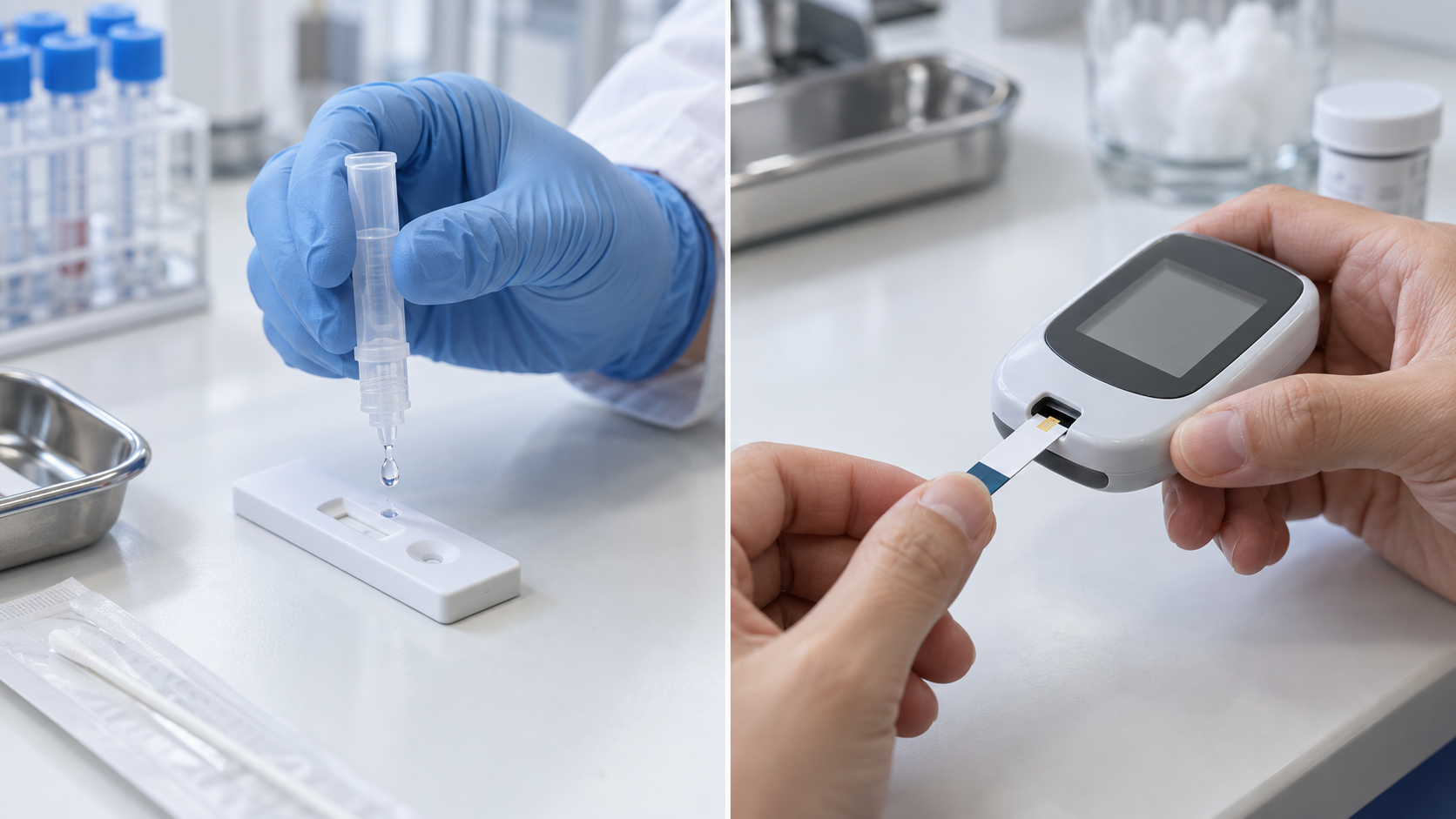
POCT is testing done outside the laboratory, beside the patient, with a result on the spot. Pregnancy tests (lateral flow), blood glucose meters (electrochemical strips) and rapid COVID-19 antigen tests are typical examples. Their shared difficulty is giving results that do not drift far when the user is not a testing professional. In the United States that is why the design of the test strip itself is expected to withstand user error. This article walks through the materials and structure of each format, how user error is estimated, the CLIA waiver (an FDA category), the move from ISO 22870 to ISO 15189, and the place of rapid COVID-19 tests, drawing on regulators' documents, standards bodies' official pages and peer-reviewed papers.
- What POCT is (the short version)
- Two representative formats: lateral flow and electrochemical strips
- Structure and materials of lateral flow
- A materials engineer's view 1: flow through paper is a problem of material combinations
- Electrochemical strips: enzyme, mediator and electrode
- A materials engineer's view 2: enzyme selectivity sets the direction of error
- User error: designed out, estimated by study
- The CLIA waiver: a category by where a test is used (FDA)
- Rapid COVID-19 tests: emergency use authorization and ordinary review
- Our calculation: predictive value and permitted counts in a clinical study
- Related standards: the withdrawal of ISO 22870 and ISO 15189:2022
- A materials engineer's view 3: "simple" is a performance that design creates
- Open issues and what could not be confirmed / Glossary / References / Claim-to-source audit
Sourced = a statement in published material (link given)
Our calculation = a figure this article derived, with the assumptions spelled out
Not yet confirmed = a plan or target with no confirmed record
Structural readings and materials-design interpretations are marked separately as Commentary.
It explains the materials, structure, evaluation and regulation of tests. It does not recommend any test kit or meter, and it does not say how to read a result or what to do after one. For interpreting results and for what to do after a positive or negative result, follow each product's labeling and the explanation of a healthcare professional. Performance numbers are given together with what was tested, on what, and under what conditions (subjects, conditions, source), and figures from different studies are never lined up to rank products.
1. What POCT is (the short version)
POCT (point-of-care testing) is testing done outside the laboratory, close to the patient (our own working definition). According to the standards body's official page, ISO 22870:2016 set requirements for POCT carried out in a hospital, clinic or healthcare organization providing ambulatory care. It could be applied to transcutaneous measurements, analysis of expired air and in vivo monitoring of physiological parameters, and excluded patient self-testing in a home or community setting, though elements of it could apply Sourced.
- "Where" is part of the definition: the same test principle needs a different design and a different regulatory treatment depending on whether a laboratory specialist, a clinic nurse or the person at home runs it (chapter 8)
- Representative formats: the review by Koczula and Gallotta describes lateral flow assays (LFAs) as the technology behind low-cost, simple, rapid and portable detection devices, and says the most commonly used LFA is the pregnancy test Sourced. A blood glucose meter is a combination of a disposable electrochemical strip and a small meter (chapter 5)
- The ideal: for diagnostics in low- and middle-income settings, ASSURED (affordable, sensitive, specific, user-friendly, rapid, equipment-free, delivered) was coined more than ten years ago, and Land and colleagues extended it to REASSURED by adding digital elements and more Sourced
The performance of POCT is set not only by the reagent but by the user. For home-use glucose meters, FDA asks that the study subjects take their own sample and test using only the labeling (the instructions), and for the CLIA waiver it asks for accuracy in the hands of operators with no laboratory training Sourced. The structure and materials of a test strip are designed so that results do not stray far even when it is used wrongly.
2. Two representative formats: lateral flow and electrochemical strips
3. Structure and materials of lateral flow
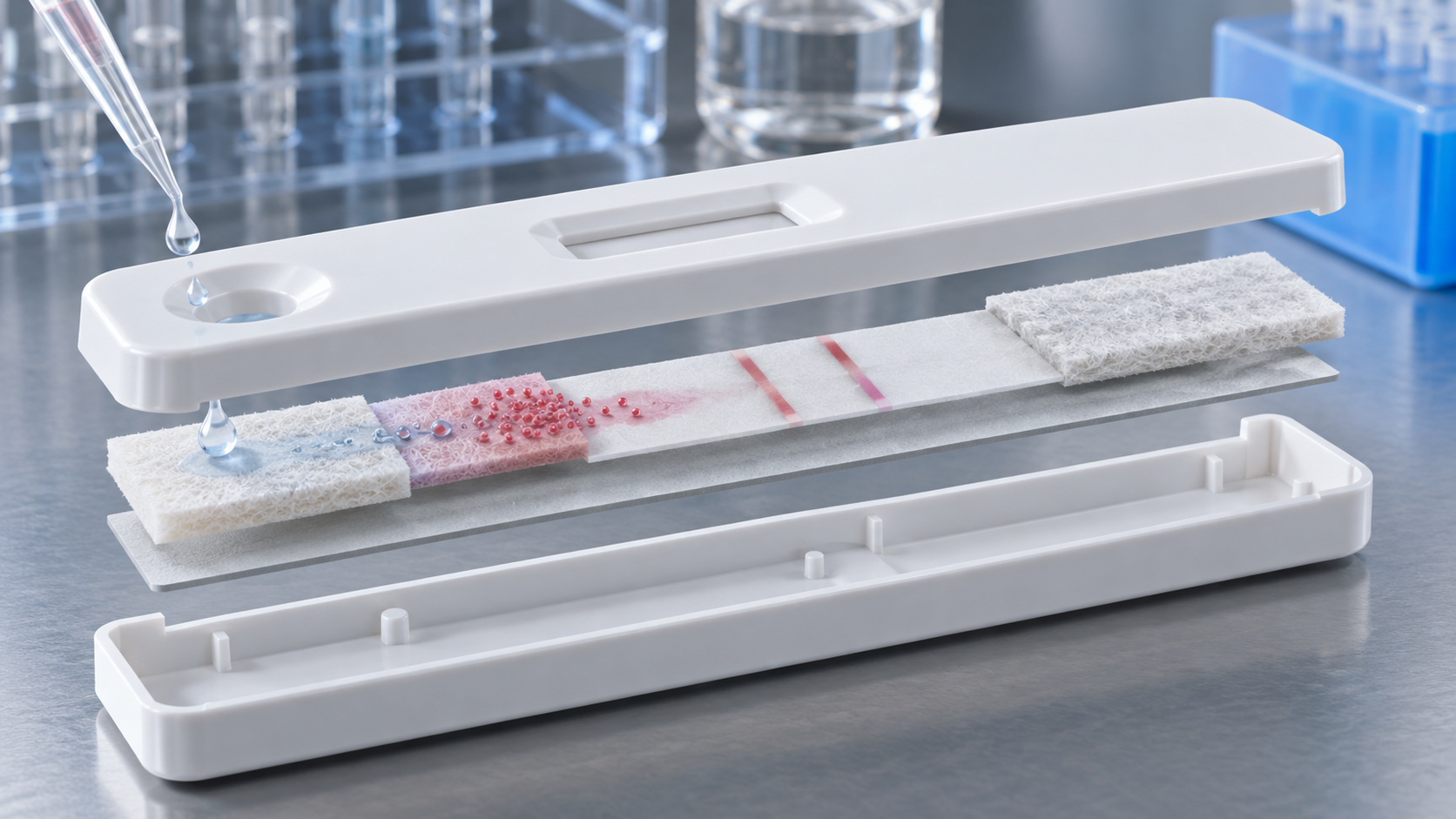
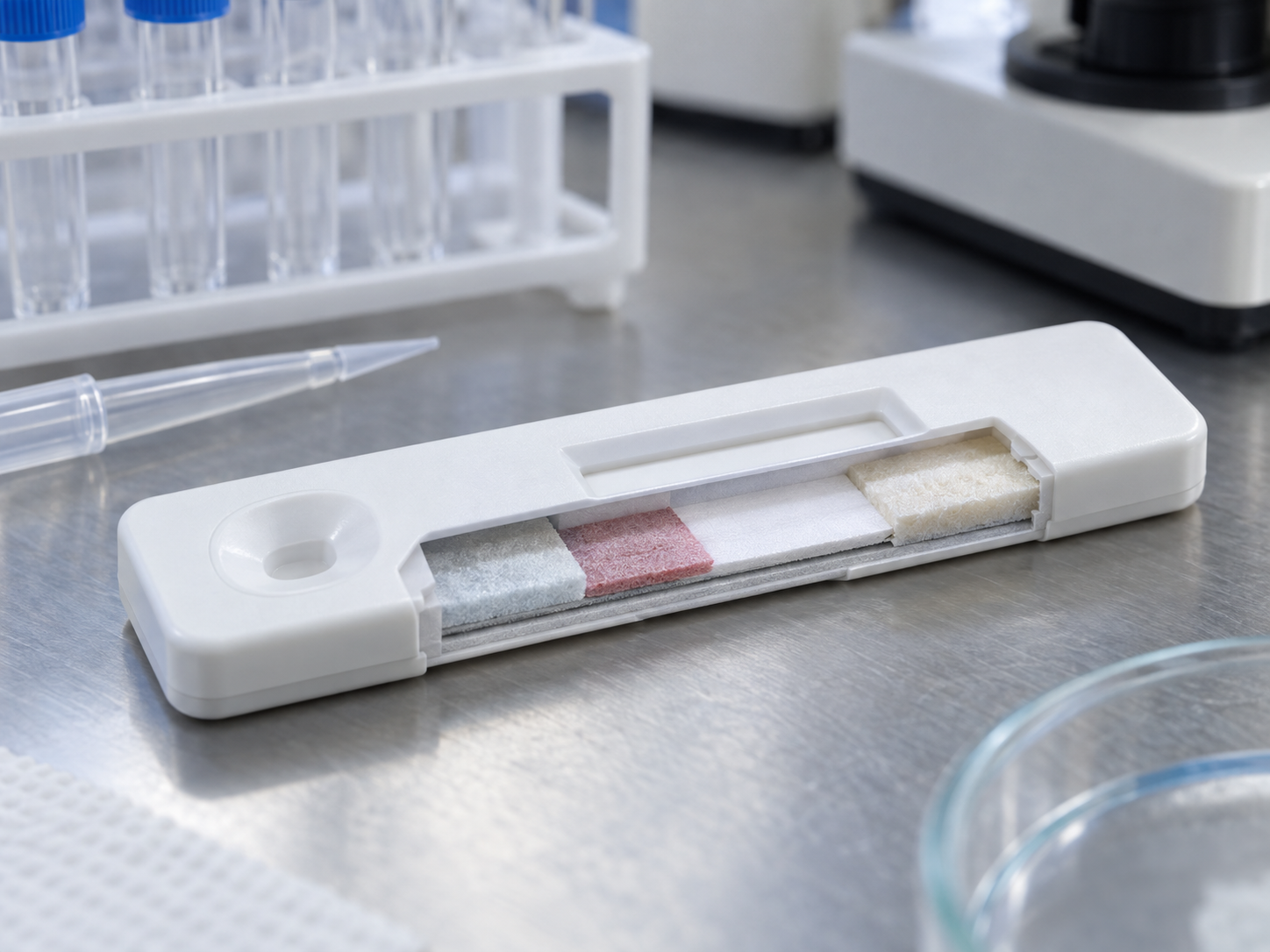
Koczula and Gallotta's review (2016, open access) describes the LFA as a paper-based platform that gives results within 5-30 minutes of placing the sample Sourced. The liquid sample moves by capillary action, without external force, through zones of polymeric strips on which molecules that can interact with the analyte are attached. A typical strip consists of overlapping membranes mounted on a backing card for stability, and comprises four elements.
View the original SVG schematic, source notes and numerical details
| Element | Role and materials (as described by Koczula and Gallotta) |
|---|---|
| Sample pad | Distributes the sample evenly and directs it to the conjugate pad. Impregnated with buffer salts, proteins and surfactants to control flow rate and make the sample suitable for the detection system. The pores can also act as a filter, for example for red blood cells |
| Conjugate pad | Holds antibodies conjugated to detector particles (colloidal gold is the most widely used; latex microspheres are another) and keeps them functionally stable until the test is run. The conjugate buffer contains carbohydrates such as sucrose, which form a layer around the dried particles to stabilize their biological structure and dissolve rapidly when sample arrives, carrying the particles into the stream. Release must be consistent from strip to strip |
| Nitrocellulose membrane | The most critical element. Important properties are capillary force and the ease of binding and immobilizing proteins. Pore sizes range from 0.05 to 12 µm, but because pores are not uniformly distributed, capillary flow time (the time for liquid to travel to and completely fill the membrane strip) should be used as the selection parameter |
| Absorbent pad | Wicks fluid through the membrane and collects processed liquid. Most are cellulose filters. It allows larger sample volumes, which raises sensitivity |
| Backing card, cover tape | An inert backing fixes the elements. The review says the most common difficulties in manufacturing LFAs come from the "hidden complexity" of the device: material incompatibility, flaws in the connection of overlapping elements and imperfect material characteristics can all cause problems. Attention is needed even to the backing card, adhesive strip and cover tape |
All Sourced (Koczula and Gallotta 2016 [Reference 15]). The pore size range (0.05-12 µm) is the review's statement and not a product specification.
Detection comes in two formats. In the direct (sandwich) format the analyte is captured between two antibodies; it is used for large molecules and for analytes with multiple antigenic sites, such as hCG in pregnancy tests. A positive result shows a test line, and the control line indicates proper flow. The competitive format is used for small molecules that cannot bind two antibodies at once; the analyte blocks the binding sites of the antibodies on the test line, so a positive result is shown by the absence of a line Sourced.
4. A materials engineer's view 1: flow through paper is a problem of material combinations
Talk about LFAs tends to gather around antibodies and labels. Koczula and Gallotta note that development has focused on the best detection method or the best antigen or antibody, but that a consistent, high-quality product also requires attention to all elements, including the backing card, adhesive strip and cover tape Sourced. From a materials standpoint, these points stand out (Commentary).
- Select the membrane by flow time, not pore size: because pore distribution is non-uniform, the time for liquid to fill the membrane is a better performance indicator than the nominal pore size. Lot-to-lot differences in flow time translate directly into differences in reaction time, and so in results
- Sugar protects during drying: drying the labeled antibody together with sugar protects antibody structure through drying and storage, and lets it dissolve quickly into the stream when sample arrives. The amount of sugar and the drying conditions affect both storage stability and uniformity of release
- The pad is also a container for reagents: the sample pad is treated with buffer salts, surfactants and proteins to condition flow and sample. Its material and impregnation determine how far it can absorb the differences between samples
- The joints between overlapping parts: the width of overlap and the pressure of lamination set the liquid path. An imperfect overlap stops or skews the flow
This bonding and lamination problem is of the same type as the wetting and joining discussed in this series' articles on adhesives and tapes. For the properties of labeling particles such as gold colloid, see the article on nanoparticles and nanozymes. The review also notes that regulatory bodies often require confirmation of results by an independent method, so LFAs are suited to primary screening Sourced.
5. Electrochemical strips: enzyme, mediator and electrode
The disposable strip of a blood glucose meter is an electrochemical biosensor. FDA's 510(k) decision summaries state the principle as follows Sourced.
- A home-use blood glucose system (K173658): it uses a glucose-oxidizing enzyme, flavin adenine dinucleotide-glucose dehydrogenase (FAD-GDH), together with a redox mediator on a disposable test strip (an electrochemical embedded sensor), and a hand-held device measures the current generated. The current is proportional to glucose concentration, and the meter's software converts it to a concentration (mg/dL). 21 CFR 862.1345 (glucose test system), Class II, product code NBW (over-the-counter blood glucose system)
- Another home-use system (K181527): a reagent system containing FAD-GDH and a mediator reacts with glucose in whole blood from the fingertip, forearm or palm to produce a current, measured by amperometry. The meter shows a value calibrated to plasma reference
The "conditions for error" in the decision summaries
Even within one format, the conditions under which error arises differ by product. Here are the limitations on use from two FDA decision summaries Sourced.
| Decision summary | Hematocrit limitation (as written in the labeling) | Other limitations |
|---|---|---|
| K173658 (FAD-GDH, home use) | A hematocrit above 55% or below 30% can cause false results | Fresh capillary whole blood from the fingertip only. Wrong results possible above 10,000 ft. Not for critically ill patients, or those dehydrated, hypotensive, in shock or in a hyperglycemic hyperosmolar state |
| K181527 (FAD-GDH, home use) | A hematocrit above 70% or below 10% can cause false results | (as far as we confirmed in the decision summary) |
All Sourced (FDA 510(k) decision summaries [References 12, 13]). The limits in the two products are values set under each product's own test conditions and do not rank the technology.
What FDA's guidance for home-use glucose systems (29 September 2020) asks to be evaluated
- Interferents: it gives a table of known or potential interferents that form the minimal list to test, including acetaminophen (20 mg/dL), ascorbic acid (6 mg/dL), bilirubin, cholesterol, galactose (60 mg/dL), maltose (480 mg/dL), xylose, mannitol, salicylic acid and ibuprofen, with testing at glucose values of about 50-70, 110-130 and 225-270 mg/dL
- Hematocrit: because the majority of intended users may be expected to have hematocrit between 20% and 60%, it recommends claiming that range. Because lay users have no way to determine their hematocrit, a system should measure adequately across 30-55%; if it cannot, it may not be found substantially equivalent. Testing is in 5% steps, over five glucose levels and at least three strip lots
- Strip stability: two studies, closed-vial (shelf life) and open-vial stability, across combinations of temperature and humidity
These are statements in guidance (nonbinding recommendations) and do not show the performance of any individual product Sourced.
6. A materials engineer's view 2: enzyme selectivity sets the direction of error
A strip uses an enzyme that reacts with glucose in blood. If the enzyme also reacts with other sugars, error results. A case where this became a real safety problem is the boxed warning in the US label (2016 version) of the peritoneal dialysis solution EXTRANEAL (icodextrin) Sourced.
- Meters and strips that react with maltose, a metabolite of icodextrin, display glucose falsely elevated. The label records that this has led to withholding treatment of hypoglycemia or inappropriate insulin dosing, to unrecognized hypoglycemia, and to loss of consciousness, coma, permanent neurological damage and death
- Non-glucose-specific systems (GDH-PQQ, glucose-dye-oxidoreductase (GDO) and some GDH-FAD-based ones) must not be used, the label states. The false elevation can persist for up to two weeks after stopping the drug
- The label also tells users to contact the manufacturers of the monitor and strips to find out whether icodextrin or maltose affects them
In other words, the choice of enzyme (its selectivity), a materials decision, determines which drugs and substances push a result, and in which direction. That is why FDA's home-use glucose guidance includes maltose (480 mg/dL) and galactose in its interferent table (Commentary). The above introduces a label warning and is not advice to any individual. How to choose a meter for someone on treatment is something to confirm with a healthcare professional and each product's labeling.
7. User error: designed out, estimated by study
The performance of POCT is decided not by laboratory specialists but by people who read the instructions and use the test for the first time. FDA treats this "user error" from both the design side and the study side.
Estimated by study: the user evaluation for home-use glucose systems
FDA's guidance (29 September 2020) asks for a user evaluation as part of the 510(k) and recommends this design Sourced.
- Subjects: at least 350. At least 10% of participants should be naive to glucose meters (non-diabetic subjects may be included)
- With the instructions only: subjects are given the draft labeling and take their own fingertip sample and test with no other training or prompting, and without help from a technician or healthcare provider. They are sequestered so they cannot observe others' technique
- Language and readability: the instructions are in English only, and for home use the reading level should be 8th grade or lower, assessed for example by Flesch-Kincaid
- Strips: at least 10 vials or packages covering at least 3 lots, having been through typical shipping and handling
- The target: 95% of all results within ±15% of the comparator and 99% within ±20%. FDA notes that most 510(k) studies are done in idealized conditions that may overestimate total accuracy in the hands of users, and asks for a design that reflects expected conditions of use
- Relation to ISO 15197: FDA says many manufacturers design their studies on ISO 15197 but that it believes the standard's criteria are not sufficient to protect lay users, because for example it does not adequately address the hypoglycemic range or performance across strip lots
Designed out: the CLIA waiver guidance (26 February 2020)
FDA's CLIA waiver guidance asks that a test eligible for waiver be shown to be designed so that results do not stray far despite user error Sourced.
- Risk analysis and flex studies: identify all known sources of error, such as operator error, specimen handling and reagent condition, and test the system under stress conditions beyond its normal operating limits to verify that it is insensitive to environmental and usage variation
- Examples of error sources (from the guidance's list): incorrect specimen type, incorrect application or volume, incorrect handling of reagents, placing the device on a non-level surface, wrong placement of strips or other reagent-bearing components, wrong order, amount or timing of reagents, misreading results, misreading due to color blindness, errors in specimen collection, clotted specimens, bubbles, interfering substances, and improperly stored or expired reagents
- Fail-safe and failure alert mechanisms: most risk controls should be mechanisms that give no result when something is wrong (a lock-out) or that alert the operator. Examples include guides or channels that prevent improper strip placement and messages such as "out of range high" or "out of range low"
8. The CLIA waiver: a category by where a test is used (FDA)
The US CLIA (Clinical Laboratory Improvement Amendments of 1988) sorts tests by complexity and sets laboratory requirements accordingly. FDA places in vitro diagnostic tests in one of three categories: waived, moderate complexity and high complexity Sourced.
- The statutory definition of waived: the CLIA statute (42 U.S.C. § 263a(d)(3)), as quoted on FDA's page, describes waived tests as those approved by FDA for home use, or those that the Secretary determines are simple laboratory examinations and procedures that have an insignificant risk of an erroneous result, including those that "employ methodologies that are so simple and accurate as to render the likelihood of erroneous results by the user negligible," or that "pose no unreasonable risk of harm to the patient if performed incorrectly" Sourced
- When a test is automatically waived: tests waived by regulation under 42 CFR 493.15(c), or cleared or approved for home use or over-the-counter use, are categorized as waived after clearance or approval. Otherwise FDA reads the package insert's instructions and uses a seven-criterion "scorecard" (1 to 3 points each), categorizing 12 points or fewer as moderate and above 12 as high complexity. A test that has not been categorized is treated as high complexity until it is Sourced
- CLIA Waiver by Application (CW): a manufacturer of a test categorized as moderate may ask FDA through a CW for waived status. A waived test can be run by laboratories with a Certificate of Waiver (CoW) and others. FDA's review goals are 150 FDA days for a CW alone (320 if an advisory panel is needed) and 180 FDA days for a dual 510(k) and CW Sourced
- CW study design (guidance of 26 February 2020): untrained operators (people in waived settings with limited or no laboratory training or experience) at at least three sites, with 1-3 operators per site and at least nine in total. The operators should be people who do the testing as part of daily work, multitasking with other duties Sourced
"Waived" is a category meaning the laboratory requirements for performing the test are lighter. FDA's account is that the manufacturer has shown the risk of an erroneous result to be insignificant. It does not mean there is no error under any conditions, and it does not guarantee use beyond the intended use, population, operators and specimens. The category is also a US system and separate from Japanese or EU categories (not checked here).
9. Rapid COVID-19 tests: emergency use authorization and ordinary review
Rapid COVID-19 antigen tests are among the most widely used POCT. What matters here is by which route they reached the market. According to FDA's antigen test page (content current as of 1 September 2026), most COVID-19 tests were issued emergency use authorizations (EUAs). An EUA is a procedure under section 564 of the Federal Food, Drug, and Cosmetic Act and is separate from ordinary 510(k) clearance or PMA approval. The page also says that, besides EUA tests, there are antigen tests authorized through traditional premarket review pathways Sourced.
- 26 August 2020: FDA's listing records Abbott Diagnostics Scarborough's "BinaxNOW COVID-19 Ag Card" as an antigen test with an EUA of 26 August, as lateral flow, visual read, single target. The same company's home version (OTC, telehealth proctor supervised) is dated 16 December Sourced
- 15 December 2020: FDA issued an EUA for Ellume's rapid lateral flow antigen test as the first OTC, fully at-home COVID-19 diagnostic test (ages two and over, including those not showing symptoms). FDA's CDRH director said that "this test, like other antigen tests, is less sensitive and less specific than typical molecular tests run in a lab" Sourced
- 11 May and 6 June 2023: the public health emergency expired. On 6 June FDA granted marketing authorization to the Cue COVID-19 Molecular Test (a molecular nucleic acid amplification test) as the first at-home OTC COVID-19 test through a traditional premarket review pathway. Existing EUAs, however, remained in effect under section 564 Sourced
- 29 June to 26 December 2026: FDA's page says the HHS Secretary determined that circumstances no longer exist justifying emergency use of COVID-19 diagnostics, personal respiratory protective devices and medical devices, and that these declarations will be terminated effective 26 December 2026. On that date the EUAs listed on the page will no longer be in effect. FDA encourages manufacturers to review the transition plan Not yet confirmed
Performance: averages from a systematic review
The Cochrane review by Dinnes and colleagues (2022; literature to March 2021) pooled 152 evaluations of single test applications (100,462 samples) of rapid antigen tests Sourced.
- Sensitivity (average): 73.0% in symptomatic people (95% CI 69.3-76.4%) and 54.7% in asymptomatic people (47.7-61.6%). It was 80.9% in the first week after symptom onset and 53.8% in the second, and fell as viral load fell
- Specificity (average): 99.1% in symptomatic and 99.7% in asymptomatic people
- Differences between brands: used according to manufacturer instructions, average sensitivity by brand ranged from 34.3% to 91.3% in symptomatic participants (20 assays) and from 28.6% to 77.8% in asymptomatic participants (12 assays). Seven assays reached 80% or more, the WHO acceptable criterion
- The authors' conclusion: sensitivity varies between tests and a negative result may still be an infection, so the tests are more suitable as triage to RT-PCR. Many commercial tests have not been evaluated in independent studies
These are averages from literature up to March 2021. They do not show the performance against later variants, or the present performance of any individual product.
10. Our calculation: predictive value and permitted counts in a clinical study
These calculations, from published numbers, are meant to give a sense of scale Our calculation.
- Positive predictive value (PPV): PPV = sensitivity × prevalence ÷ (sensitivity × prevalence + (1 − specificity) × (1 − prevalence)).
1. Symptomatic people (sensitivity 73.0%, specificity 99.1%), assuming prevalence of 5%: 0.730 × 0.05 = 0.0365 and 0.009 × 0.95 = 0.00855, so PPV = 0.0365 ÷ 0.04505 = about 81%.
2. Asymptomatic people (sensitivity 54.7%, specificity 99.7%), assuming prevalence of 0.5%: 0.547 × 0.005 = 0.002735 and 0.003 × 0.995 = 0.002985, so PPV = 0.002735 ÷ 0.00572 = about 48%. - Share missed: 1 − sensitivity. In case 1 about 27%, and in case 2 about 45%, of infected people would test negative.
- Permitted counts in the 350-person user evaluation for home-use glucose systems: 95% within ±15% means 350 × 0.95 = 332.5, so 333 or more inside the range, that is at most 17 outside. 99% within ±20% means 350 × 0.99 = 346.5, so 347 or more inside, that is at most 3 outside.
- Minimum operators for a CW: 3 sites × up to 3 operators = up to 9. The guidance says "at least nine across all sites," so three at each site is the minimum configuration.
- CLIA scorecard: 7 criteria × 1 to 3 points each = a total of 7 to 21. 12 or fewer is moderate and above 12 is high complexity.
Assumptions and limits: the prevalences (5% and 0.5%) are assumptions chosen to match the examples in the Cochrane review and are not actual prevalences. The average sensitivity and specificity pool literature up to March 2021 and need not apply to current products. Nothing here is a guide to reading a test result or what to do after one. The permitted counts for 350 people are FDA's recommended study design translated into numbers of people and are not a pass/fail rule for a 510(k) (the guidance says that a device may be found substantially equivalent even if it does not meet the criteria).
11. Related standards: the withdrawal of ISO 22870 and ISO 15189:2022
The international standards on POCT have changed considerably in recent years. Here is what we could confirm on the official pages of the standards body EVS (the Estonian Centre for Standardisation and Accreditation) Sourced.
| Standard (status) | Title and scope (as on the EVS page) |
|---|---|
| ISO 22870:2016 Withdrawn (6 December 2022) | Point-of-care testing (POCT) — Requirements for quality and competence. Specific requirements for POCT, to be used together with ISO 15189. Applies when POCT is carried out in a hospital, clinic or ambulatory care organization. Can be applied to transcutaneous measurements, analysis of expired air and in vivo monitoring of physiological parameters. Patient self-testing at home or in the community is excluded, though elements can apply. The history lists ISO 15189:2022 |
| ISO 15189:2022 Valid (from 6 December 2022) | Medical laboratories — Requirements for quality and competence. Quality and competence requirements for medical laboratories. The scope states that this document is also applicable to point-of-care testing (POCT). Previous editions: ISO 15189:2012 and ISO 22870:2016 |
| ISO 15197:2013 Valid | In vitro diagnostic test systems — Requirements for blood-glucose monitoring systems for self-testing in managing diabetes mellitus. Requirements for in vitro systems measuring glucose in capillary blood, for design verification procedures and for validation of performance by the intended users. For self-measurement by lay persons |
| ISO 18113-1:2022 Valid | IVD medical devices — Information supplied by the manufacturer (labelling) — Part 1: Terms, definitions and general requirements. General requirements for information supplied by IVD manufacturers |
| ISO 23640:2011 Valid | IVD medical devices — Evaluation of stability of in vitro diagnostic reagents. Stability evaluation of reagents, calibrators, control materials, diluents, buffers and kits (real-time and accelerated) |
| ISO 20916:2019 Valid | IVD medical devices — Clinical performance studies using specimens from human subjects — Good study practice. Good study practice for planning, conduct and reporting of clinical performance studies of IVDs |
| ISO 14971:2019 Valid | Medical devices — Application of risk management to medical devices. Risk management of medical devices, including IVD medical devices |
All Sourced (EVS standard pages [References 1-6, 22]. The ISO site itself could not be fetched automatically, so the pages of an ISO member body were used. The text of the standards is paid and was not checked).
The relationship between ISO 15197 and FDA also matters. FDA's home-use glucose guidance (2020) says many manufacturers design studies on ISO 15197 but that the standard does not adequately address the hypoglycemic range or performance across strip lots, and that FDA believes it is not sufficient to protect lay users. FDA's 2016 explanatory slides state "FDA does not recognize ISO 15197:2013" and describe the studies in its guidance as "compatible with ISO 15197:2013, but not identical" Sourced (2016 material; the present recognition status was not checked). For glucose testing by professionals (prescription POCT), a separate guidance sets goals of 95% within ±12% (above 75 mg/dL) or ±12 mg/dL (below 75 mg/dL), and 98% within ±15% or ±15 mg/dL Sourced. Even for the same glucose measurement, the standard changes with who uses it (the home or a professional).
12. A materials engineer's view 3: "simple" is a performance that design creates
The CLIA scorecard grades the complexity of a test on seven criteria. Under "reagents and materials preparation," for instance, the lowest (simplest) score applies when reagents and materials are generally stable and reliable, and are prepackaged or premeasured and need no special handling or storage Sourced. The design of a strip's materials and packaging thus feeds directly into the regulatory score for "simplicity" (Commentary).
- Shape prevents error: guides or channels that stop a strip being inserted wrongly, and a capillary channel that draws a fixed volume (preventing volume errors), are designs that prevent user error through geometry. FDA's guidance cites them as examples of fail-safe measures
- Chemistry creates insensitivity: FDA asks home-use glucose systems to measure across 30-55% hematocrit because users do not know their own. The design of electrode, enzyme, mediator and flow path creates that insensitivity
- Materials create storage stability: the sugar-protected dry antibody of an LFA and the open-vial stability of a strip are materials designs that reduce the error source of poor storage. FDA asks for testing even of open-vial stability
- Selectivity decides interactions: an enzyme's selectivity decides whether it interacts with a drug (maltose) (chapter 6)
Being "easy for anyone to use" is not the user's effort but something the design takes on. The specifications a materials engineer sets (membrane flow time, sugar amount, electrode layers, channel shape) become the grounds for waived or OTC status (Commentary).
13. Open issues and what could not be confirmed
(1) Japanese and EU systems were not checked
The regulatory statements here rest on US sources (FDA, CMS). We did not check Japan's in vitro diagnostic reagents under the Pharmaceuticals and Medical Devices Act, or the self-test and near-patient-test classes of the EU's IVDR (Regulation (EU) 2017/746). The latter is covered in this series' article on medical device categories and home use.
(2) The text of standards was not checked
The text of ISO 22870, ISO 15189, ISO 15197 and others is paid. We confirmed only titles and scope on the standards body's pages, and did not check the accuracy criteria of ISO 15197:2013 or the concrete POCT requirements of ISO 15189:2022.
(3) Actual error rates in the home could not be confirmed
FDA's guidance shows the design of user studies and a pass target, but we found in the sources consulted no primary source giving the frequency of mistakes in real home use.
(4) The performance of COVID-19 tests is given only as averages
The Cochrane review pools literature up to March 2021. We did not check performance against later variants, the current performance of individual products, or the handling after 26 December 2026. For an individual product, one must refer to the conditioned values in its EUA documents and labeling.
(5) Other POCT formats are not covered
Small analyzers (cartridge immunoassays, blood gas), nucleic acid amplification POCT and smartphone readers are not covered here.
(6) The EXTRANEAL label is the 2016 version
The label warning cited in chapter 6 is from the 2016 version published by FDA. We did not check the current version.
- The performance of POCT is set by the user as well as the reagent. FDA asks for a study of at least 350 people working from the instructions alone for home glucose systems, and of at least nine untrained operators for a waiver Sourced
- Lateral flow is a materials system of paper, sugar and joints, and the membrane is chosen by flow time rather than pore size Sourced
- In electrochemical strips, enzyme selectivity sets the direction of error. Systems that react with maltose can show glucose falsely elevated Sourced
- ISO 22870:2016 was withdrawn in 2022, and POCT now falls within the scope of ISO 15189:2022 Sourced
- Most rapid COVID-19 tests came through EUAs. The declarations behind them are scheduled to end on 26 December 2026 Not yet confirmed
14. Glossary
- POCT
- Testing done outside the laboratory, near the patient, with a result on the spot (our working definition).
- Lateral flow assay (LFA)
- A paper-based test in which the sample flows by capillary action along a strip and the result is shown by a line.
- Nitrocellulose membrane
- The porous membrane forming the detection zone of an LFA, on which antibodies are immobilized as lines.
- Colloidal gold
- The most widely used label particle in LFAs; it appears as a red line.
- Capillary flow time
- The time for liquid to fill a membrane; used as a selection parameter.
- FAD-GDH
- FAD-dependent glucose dehydrogenase, one of the enzymes used in glucose strips.
- Mediator
- A substance that carries electrons from the enzyme to the electrode.
- Amperometry
- A measurement that applies a voltage to an electrode and finds concentration from the current.
- Hematocrit
- The share of blood occupied by red cells; a possible source of error in glucose strips.
- CLIA
- The US Clinical Laboratory Improvement Amendments of 1988; it classifies tests by complexity and sets laboratory requirements.
- CoW
- Certificate of Waiver, held by laboratories that perform only waived tests.
- CW (CLIA Waiver by Application)
- A manufacturer's application asking FDA to categorize a test as waived.
- Flex study
- A study that stresses a system beyond its operating limits to confirm insensitivity to variation.
- EUA (emergency use authorization)
- An FDA mechanism that permits use in an emergency before ordinary approval or clearance.
- Positive predictive value (PPV)
- The share of positive results that are true infections; it depends strongly on prevalence.
15. References
- EVS (Estonian Centre for Standardisation and Accreditation) ISO 22870:2016 Point-of-care testing (POCT) — Requirements for quality and competence (withdrawn 6 December 2022) — evs.ee
- EVS ISO 15189:2022 Medical laboratories — Requirements for quality and competence — evs.ee
- EVS ISO 15197:2013 In vitro diagnostic test systems — Requirements for blood-glucose monitoring systems for self-testing in managing diabetes mellitus — evs.ee
- EVS ISO 18113-1:2022 In vitro diagnostic medical devices — Information supplied by the manufacturer (labelling) — Part 1 — evs.ee
- EVS ISO 23640:2011 In vitro diagnostic medical devices — Evaluation of stability of in vitro diagnostic reagents — evs.ee
- EVS ISO 20916:2019 In vitro diagnostic medical devices — Clinical performance studies using specimens from human subjects — Good study practice — evs.ee
- U.S. Food and Drug Administration (FDA) "CLIA Waiver by Application" (CLIA categories, statutory text, review times, dual submission) — fda.gov
- FDA "CLIA Categorizations" (categorization criteria, scorecard, uncategorized tests default to high complexity; content current as of 17 July 2023) — fda.gov
- FDA Guidance "Recommendations for Clinical Laboratory Improvement Amendments of 1988 (CLIA) Waiver Applications for Manufacturers of In Vitro Diagnostic Devices," 26 February 2020 (nonbinding recommendations) — fda.gov
- FDA Guidance "Self-Monitoring Blood Glucose Test Systems for Over-the-Counter Use," 29 September 2020 (nonbinding recommendations) — fda.gov
- FDA (CDRH) Webinar slides on the final blood glucose guidances (OTC and prescription POC), 21 November 2016 — fda.gov
- FDA 510(k) decision summary K173658, Confidence Blood Glucose Monitoring System (Applied Biomedical LLC) — accessdata.fda.gov
- FDA 510(k) decision summary K181527, On Call Sure / On Call Sure Sync Blood Glucose Monitoring Systems — accessdata.fda.gov
- FDA (Drugs@FDA) EXTRANEAL (icodextrin) peritoneal dialysis solution, prescribing information (2016 version, NDA 021321) — accessdata.fda.gov
- Koczula KM, Gallotta A Lateral flow assays. Essays Biochem 60(1): 111-120 (2016). DOI 10.1042/EBC20150012 (open access, PMC4986465) — doi.org
- Posthuma-Trumpie GA et al. Lateral flow (immuno)assay: its strengths, weaknesses, opportunities and threats. A literature survey. Anal Bioanal Chem 393(2): 569-582 (2009). DOI 10.1007/s00216-008-2287-2 (abstract only checked, PMID 18696055) — doi.org
- Land KJ et al. REASSURED diagnostics to inform disease control strategies, strengthen health systems and improve patient outcomes. Nat Microbiol 4(1): 46-54 (2019). DOI 10.1038/s41564-018-0295-3 (abstract checked on PubMed, PMID 30546093) — doi.org
- FDA "In Vitro Diagnostics EUAs - Antigen Diagnostic Tests for SARS-CoV-2" (content current as of 1 September 2026) — fda.gov
- FDA Press release "Coronavirus (COVID-19) Update: FDA Authorizes Antigen Test as First Over-the-Counter Fully At-Home Diagnostic Test for COVID-19," 15 December 2020 — fda.gov
- FDA Press release "FDA Permits Marketing of First COVID-19 At-Home Test Using Traditional Premarket Review Process," 6 June 2023 — fda.gov
- Dinnes J et al. Rapid, point-of-care antigen tests for diagnosis of SARS-CoV-2 infection. Cochrane Database Syst Rev 7: CD013705 (2022). DOI 10.1002/14651858.CD013705.pub3 (abstract checked on PubMed, PMID 35866452) — doi.org
- EVS ISO 14971:2019 Medical devices — Application of risk management to medical devices — evs.ee
16. Claim-to-source audit
| Claim in the text | Basis | Type |
|---|---|---|
| The scope of ISO 22870:2016 (POCT in hospital, clinic or ambulatory care; transcutaneous measurement, expired air, in vivo monitoring; self-testing excluded) and its withdrawal on 6 December 2022 | EVS standard page Reference 1 https://www.evs.ee/en/iso-22870-2016 | Sourced |
| ISO 15189:2022 in force from 6 December 2022, applicable also to POCT, and its previous editions | EVS standard page Reference 2 https://www.evs.ee/en/iso-15189-2022 | Sourced |
| Title and scope of ISO 15197:2013 (capillary blood, design verification, validation by intended users, self-measurement); valid | EVS standard page Reference 3 https://www.evs.ee/en/iso-15197-2013 | Sourced |
| Title and scope of ISO 18113-1:2022 | EVS standard page Reference 4 https://www.evs.ee/en/iso-18113-1-2022 | Sourced |
| Title and scope of ISO 23640:2011 | EVS standard page Reference 5 https://www.evs.ee/en/iso-23640-2011 | Sourced |
| Title and scope of ISO 20916:2019 | EVS standard page Reference 6 https://www.evs.ee/en/iso-20916-2019 | Sourced |
| Title and scope of ISO 14971:2019 (including IVD medical devices) | EVS standard page Reference 22 https://www.evs.ee/en/iso-14971-2019 | Sourced |
| FDA's three categories (waived, moderate, high). Tests cleared or approved for home use are automatically waived. The statutory text (42 U.S.C. § 263a(d)(3)) as quoted. CW and the Certificate of Waiver. Review times (150 / 320 / 180 FDA days). Dual submission | FDA's CLIA Waiver by Application page Reference 7 https://www.fda.gov/medical-devices/ivd-regulatory-assistance/clia-waiver-application | Sourced |
| The categorization criteria (seven-criterion scorecard, 1-3 points each, 12 or fewer moderate and above 12 high), uncategorized tests default to high complexity, and the wording of the criterion (lowest score for reagents and materials preparation) | FDA's CLIA Categorizations page Reference 8 https://www.fda.gov/medical-devices/ivd-regulatory-assistance/clia-categorizations | Sourced |
| CW study design (untrained operators, at least three sites, 1-3 operators per site and at least nine in total). Flex studies, risk analysis, examples of error sources, the idea of fail-safe and failure-alert mechanisms. Issued 26 February 2020 | FDA's CLIA waiver guidance (nonbinding recommendations) Reference 9 https://www.fda.gov/media/109582/download | Sourced |
| The user evaluation for home-use glucose systems (at least 350 subjects, 10% naive, labeling only, 8th-grade readability, at least 3 lots and 10 vials, 95% within ±15% and 99% within ±20%). FDA's view that ISO 15197 is not sufficient to protect lay users. The interferent table (concentrations), hematocrit (claimed range 20-60%, adequate measurement over 30-55%), stability (closed and open vial). Issued 29 September 2020 | FDA's home-use glucose guidance Reference 10 https://www.fda.gov/media/87721/download | Sourced |
| The goals in the final guidance for prescription POC glucose systems (95% within ±12% / ±12 mg/dL, 98% within ±15% / ±15 mg/dL). FDA does not recognize ISO 15197:2013 (2016 material) | FDA (CDRH) webinar slides Reference 11 https://www.fda.gov/media/101886/download | Sourced |
| The principle of an electrochemical strip using FAD-GDH and a redox mediator. 21 CFR 862.1345, Class II, product code NBW. Hematocrit above 55% or below 30% gives false results; altitude above 10,000 ft | FDA 510(k) decision summary K173658 Reference 12 https://www.accessdata.fda.gov/cdrh_docs/reviews/K173658.pdf | Sourced |
| Amperometry with a reagent system containing FAD-GDH and a mediator; calibrated to plasma. Hematocrit above 70% or below 10% gives false results | FDA 510(k) decision summary K181527 Reference 13 https://www.accessdata.fda.gov/cdrh_docs/reviews/K181527.pdf | Sourced |
| The boxed warning of EXTRANEAL (icodextrin): systems that react with maltose display glucose falsely elevated; GDH-PQQ, GDO and some GDH-FAD must not be used; up to two weeks | FDA (Drugs@FDA) prescribing information, 2016 version Reference 14 https://www.accessdata.fda.gov/drugsatfda_docs/label/2016/021321s034lbl.pdf | Sourced |
| The structure and materials of the LFA (sample pad, conjugate pad, nitrocellulose membrane, absorbent pad, backing card), colloidal gold, sugar, pore size 0.05-12 µm, capillary flow time, direct and competitive formats, the pregnancy test as the most common LFA, the frequent requirement of confirmation by an independent method | Koczula and Gallotta 2016 (open access) Reference 15 https://doi.org/10.1042/EBC20150012 | Sourced |
| The title and abstract scope of the LFA literature survey | Posthuma-Trumpie et al. 2009 Reference 16 https://doi.org/10.1007/s00216-008-2287-2 | Sourced |
| ASSURED coined more than ten years earlier and extended to REASSURED | Abstract of Land et al. 2019 Reference 17 https://doi.org/10.1038/s41564-018-0295-3 | Sourced |
| The basis of EUAs (section 564), the expiry of the PHE (11 May 2023), the HHS Secretary's determination (29 June 2026) and the scheduled end of the declarations (26 December 2026), the EUA dates for BinaxNOW, the existence of antigen tests authorized by traditional review, the revision for serial testing of asymptomatic people. Content current as of 1 September 2026 | FDA's antigen test EUA page Reference 18 https://www.fda.gov/medical-devices/covid-19-emergency-use-authorizations-medical-devices/in-vitro-diagnostics-euas-antigen-diagnostic-tests-sars-cov-2 | Sourced |
| EUA for the first OTC fully at-home COVID-19 diagnostic test (15 December 2020), and the CDRH director's statement that antigen tests are less sensitive and less specific than molecular tests | FDA press release Reference 19 https://www.fda.gov/news-events/press-announcements/coronavirus-covid-19-update-fda-authorizes-antigen-test-first-over-counter-fully-home-diagnostic | Sourced |
| The first at-home OTC COVID-19 test authorized through a traditional premarket review pathway (6 June 2023, a molecular test) | FDA press release Reference 20 https://www.fda.gov/news-events/press-announcements/fda-permits-marketing-first-covid-19-home-test-using-traditional-premarket-review-process | Sourced |
| Sensitivity and specificity of rapid antigen tests (symptomatic and asymptomatic, by week of symptoms), differences between brands, the number of assays meeting the WHO criterion, the authors' conclusion | Abstract of the Cochrane review by Dinnes et al. 2022 Reference 21 https://doi.org/10.1002/14651858.CD013705.pub3 | Sourced |
| PPV (about 81% for symptomatic people at 5% prevalence, about 48% for asymptomatic people at 0.5%), the shares missed (about 27% and 45%), the permitted counts in a 350-person study (at most 17 outside ±15%, at most 3 outside ±20%), the minimum of nine CW operators, and the range of the scorecard total (7-21) | Our calculation. Assumptions: sensitivity and specificity are the Cochrane averages, prevalence is an assumption, and 350, ±15%, ±20%, 9 and the seven criteria are numbers in FDA documents | Our calculation |
| The readings of LFA materials (select the membrane by flow time, sugar protects during drying, the pad as a reagent container, the joints between overlapping parts). The reading that enzyme selectivity sets the direction of error. The matching of user-error sources with countermeasures (Fig. 5). The framing of "simple" as a performance that design creates. The framing of what waived means | Commentary by this article, built on the sourced facts above | Commentary |
| Japanese and EU systems, the text of the ISO standards (the numbers of ISO 15197:2013), actual home error rates, the current performance of COVID-19 tests, other POCT formats, and the current EXTRANEAL label | Could not be confirmed in the public official sources consulted for this article, and so are not stated | Commentary |
| That 26 December 2026 is a scheduled end of the declarations | FDA's page (Reference 18). It is a scheduled date, a plan and not a record, and this article treats it so | Not yet confirmed |
| That Figs. 1, 2 and 4 to 7 are explanatory drawings, and that the hero image and Fig. 3 are AI-generated images that do not show real products, strips or procedures | Note by this article | Commentary |
Last updated 4 October 2026. Sources are limited to primary material (FDA guidance, decision summaries, press releases and EUA listings, official pages of standards bodies, peer-reviewed papers, a Cochrane review, and prescribing information published by FDA). Because the article includes structural readings and materials-design interpretations, those are marked as Commentary and kept separate from sourced fact. Japanese and EU systems, the text of ISO standards, actual home error rates, the current performance of COVID-19 tests, and other POCT formats are not stated, because no published primary source could be confirmed or they are outside this article. The end of the declarations on 26 December 2026 is a date scheduled on FDA's page. All figures are explanatory concept graphics. Figs. 1, 2 and 4 to 7 are vector drawings, Fig. 8 is a drawing that includes our calculation, and the hero image and Fig. 3 are AI-generated images; none of them shows a real product, strip or procedure. This article explains the materials, evaluation and regulation of tests and is not medical advice.