TECHNOLOGY EXPLAINER
Regulatory Pathways for Medical Devices and Home Use
— the same sensor can take a different road depending on who uses it
The US FDA sorts devices into three classes and three pathways: 510(k) (clearance), De Novo (new classification) and PMA (approval). Japan uses notification, certification and approval, and the EU uses CE marking and notified bodies. For devices used at home, even when the materials and hardware are the same, a change in intended use and intended user changes both the category and the tests asked for. This article lays out how this works, and the standards that matter for home use, from primary sources.
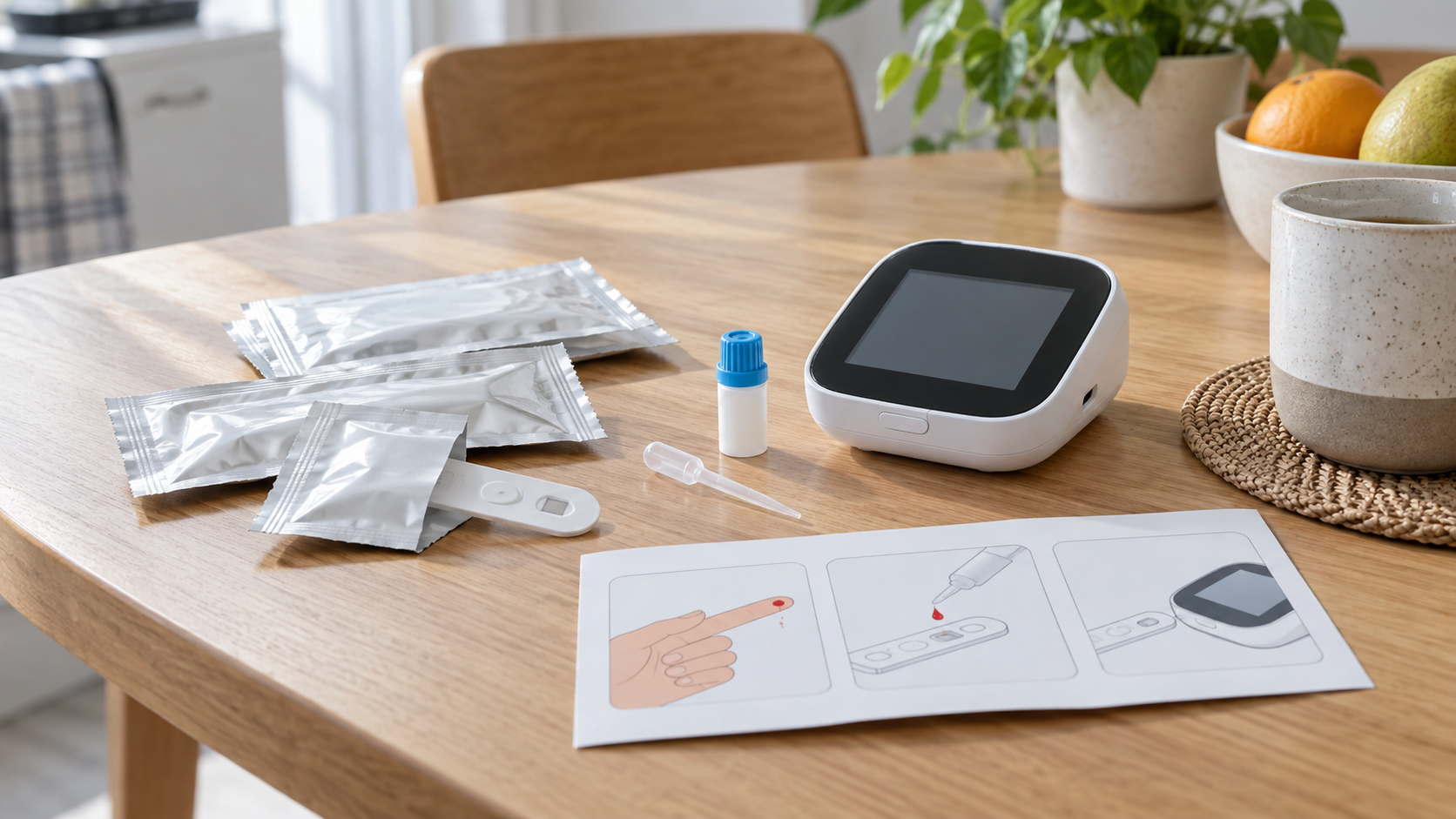
- What device approval categories and home use mean (the short version)
- United States: three classes and three pathways
- United States: in vitro diagnostics, prescription versus home use, CLIA
- A worked example: how glucose-related devices travelled the pathways
- Where general wellness products end and medical devices begin
- Japan: notification, certification, approval
- EU: MDR, IVDR and notified bodies
- Standards for home use, and FDA's home-use device guidance
- A materials engineer's view: same material, different category; change the material, trigger a procedure
- Cautions about overstated claims
- What is still open, and what we could not confirm
- Glossary / References / Claim-to-source audit
This article explains how regulation of medical devices and in vitro diagnostic devices works. It does not evaluate or recommend any product or company, and it is not medical advice on whether to use a device, how to read a measured value, or on diagnosis, treatment or medication. A clearance or approval is a judgment about a specific intended use and does not mean "safe and accurate however it is used". Our explainer on approval applications and real-world data focuses on drug approval, so this article covers devices and in vitro diagnostics and does not go into drug approval. Please consult a health professional about decisions concerning your health or your readings.
Sourced = stated in published material (link given)
Our calculation = a figure this article derived or tallied from stated assumptions
Not yet confirmed = items that can change, such as transition deadlines
Our arrangement of categories and our readings of the materials side are marked separately as Commentary. FDA's clearance, authorization (a De Novo grant) and approval are written as the official documents name them.
1. What device approval categories and home use mean (the short version)
- United States: FDA has classified about 1,700 types of device into 16 panels and assigned each to Class I, II or IIISourced. The premarket procedure depends on the class, and FDA itself distinguishes a device that went through 510(k) as "cleared" from one that went through PMA as "approved". De Novo is the route that classifies a novel low-to-moderate risk device into Class I or IISourced.
- Home use is decided by intended use and intended user: the decision summary of an over-the-counter (OTC) continuous glucose monitoring system that FDA cleared in 2024 says it shares "identical hardware, material, chemical composition, principle of operation and energy source" with its prescription predicateSourced. What changed was the intended use (OTC, adults not on insulin) and a usability test of whether users can tell from the pre-purchase labelling that the device is for them.
- Japan and the EU: Japan applies notification, certification or approval according to its classes of general, controlled and specially controlled devices, and treats in vitro diagnostics as medicines in Classes I to III. In the EU, devices fall under the MDR (Classes I, IIa, IIb, III) and in vitro diagnostic devices under the IVDR (Classes A to D); apart from classes that can self-declare (Class A and most of Class I), a notified body is generally involvedSourced.
"FDA-approved", "CE marked" and "approved" do not mean the same thing. An FDA 510(k) is a clearance, PMA is an approval, and De Novo is an authorization of a new type of device. Even for a device of the same name, the judgment was made under conditions: the intended use, the intended user (prescription or home), age, and the way it is used. What to check is not the title but which category, for which intended use, and who made the judgment.
2. United States: three classes and three pathways
FDA's "Classify Your Medical Device" page (as displayed on 26 August 2026) says that FDA has classified about 1,700 generic types of device, grouped them into 16 panels, and assigned each to one of three classes according to riskSourced. 21 CFR 860.3 defines the classes as followsSourced.
- Class I: devices for which general controls are sufficient to provide reasonable assurance of safety and effectiveness, among others.
- Class II: devices for which general controls alone are insufficient but for which there is enough information to establish special controls. These include performance standards, postmarket surveillance, patient registries and guidelines.
- Class III: devices for which neither general nor special controls give sufficient assurance and which are life-supporting or life-sustaining, of substantial importance in preventing impairment of human health, or present a potential unreasonable risk of illness or injury. Premarket approval (PMA) is required.
(1) 510(k): compare with a predicate
FDA describes the 510(k) as a premarket submission demonstrating that the device to be marketed is substantially equivalent to a legally marketed device (the predicate). When FDA's order finds substantial equivalence, that order "clears" the device for commercial distributionSourced. 21 CFR 807.100 sets out the basis on which substantial equivalence is judgedSourced.
- The device has the same intended use as the predicate.
- It has the same technological characteristics, or different technological characteristics (for example, a significant change in materials, design or energy source) where the submitted data show it is as safe and effective as the predicate and it does not raise different questions of safety and effectiveness.
The FDA page says the substantial equivalence determination is usually made within 90 days. The applicant cannot market the device until the order is receivedSourced.
(2) De Novo: new classification when there is no predicate
De Novo is a route to classify into Class I or II a device for which there is no legally marketed predicate and for which general controls, or general and special controls, give reasonable assurance of safety and effectiveness. It can be requested in two ways: after a 510(k) has received a not-substantially-equivalent determination, or directly when the requester determines there is no predicateSourced. 21 CFR 860.240 provides that FDA will review within 120 days of acceptance and send an order granting or declining the request. If a request is granted, FDA publishes a notice of the classification order, including special controls, in the Federal Register within 30 days (860.260)Sourced. A device classified through De Novo can be used as a predicate for later 510(k)sSourced.
(3) PMA: approval of Class III
PMA is FDA's process of scientific and regulatory review to evaluate the safety and effectiveness of Class III devices, and it is the most stringent kind of device marketing application. The applicant must receive FDA approval before marketing, and approval rests on FDA's determination that the PMA contains sufficient valid scientific evidence to assure that the device is safe and effective for its intended usesSourced. A Class III device that fails to meet PMA requirements is considered adulterated under section 501(f) of the FD&C Act and may not be marketed.
From openFDA public records we tallied the number of decisions per decision year for 2015 to 2025Our calculation. For 510(k) we counted decisions coded "substantially equivalent"; for PMA, original approvals excluding supplements.
For 2015 to 2025 the totals are 33,491 for 510(k) and 320 for original PMAs, about 105 to 1. The structure of two pathways that differ by orders of magnitude in the weight of the file and the time to review shows up in the counts too (our observation; the ratio does not rank the systems).
3. United States: in vitro diagnostics, prescription versus home use, CLIA
In 21 CFR 809.3(a), in vitro diagnostic (IVD) products are reagents, instruments and systems intended for use in diagnosing disease or other conditions, in the collection, preparation and examination of specimens taken from the human body, and they are devicesSourced. Glucose measurement falls under the "glucose test system" in 21 CFR 862.1345 (Class II, special controls), defined as a device that measures glucose quantitatively in blood and other body fluidsSourced.
(1) Prescription and over-the-counter (OTC)
21 CFR 801.109 sets conditions for prescription devices, those that, because of potential harmful effect, method of use or collateral measures necessary to use, are not safe except under the supervision of a licensed practitioner. The label of a prescription device must carry "Rx only" or an equivalent statementSourced. Everything else sits on the over-the-counter side (our summary). For blood glucose, FDA has issued two separate guidancesSourced.
- Home self-monitoring (OTC): "Self-Monitoring Blood Glucose Test Systems for Over-the-Counter Use" (29 September 2020; product code NBW). It covers blood glucose systems that lay users use at home, including home-use systems obtained with a prescription.
- Prescription point-of-care use (healthcare facilities): "Blood Glucose Monitoring Test Systems for Prescription Point-of-Care Use", for hospitals, physician offices and long-term care facilities.
The OTC guidance excludes continuous glucose sensors, and clinical chemistry analyzers used to screen and diagnose diabetes. FDA believes the ISO 15197 criteria are not sufficient to protect lay users, because they do not adequately address performance in the hypoglycemic range or across test strip lots, and so recommends the followingSourced.
| Item | Recommendation in the OTC blood glucose system guidance (2020) |
|---|---|
| Test with users | A user evaluation with at least 350 different subjects, of whom at least 10% are naive to self-monitoring (may include non-diabetic people) |
| Conditions | Subjects use only the draft labeling, with no other training or prompting and no help from a technician or healthcare provider. Instructions in English only |
| Readability | For a home-use product, a reading level of 8th grade or less; the assessment and results go in the submission |
| Lots | Strips from at least 10 vials covering at least 3 manufacturing lots, put through typical shipping and handling. Lot release criteria are typically tighter than the total-error criteria in the studies |
| Accuracy target | Against the comparator method, 95% of results within ±15% and 99% within ±20% across the claimed measuring range. The guidance adds that meters may still be found substantially equivalent when they do not meet these, depending on other features |
| Environment, interference | Temperature, humidity, altitude and so on are assessed in flex studies (studies that stress the operating boundaries). Glucose should be measurable across 30 to 55% hematocrit, tested in 5% steps |
All Sourced (FDA "Self-Monitoring Blood Glucose Test Systems for Over-the-Counter Use", 29 September 2020; PDF text checked) [Ref. 15].
(2) CLIA categorization: waived, moderate, high
CLIA is the US regulation of clinical laboratories. FDA categorizes tests by complexity, from least to most complex: waived, moderate and highSourced. Tests cleared or approved for home use are categorized as waived. For others, FDA reviews the package insert instructions and scores seven criteria (knowledge; training and experience; reagents and materials preparation; characteristics of operational steps; calibration, quality control and proficiency testing materials; troubleshooting and maintenance; interpretation and judgment) from 1 to 3. A total of 12 or less is moderate; above 12 is high. A test that has not been categorized defaults to high complexity. The maker of a test categorized as moderate may later request waived status through a CLIA Waiver by ApplicationSourced.
42 CFR 493.15(b) gives the criteria for waived tests: (1) cleared by FDA for home use, (2) employing methodologies so simple and accurate as to render the likelihood of erroneous results negligible, or (3) posing no reasonable risk of harm to the patient if performed incorrectly. Among the listed waived tests is blood glucose by glucose monitoring devices cleared by the FDA specifically for home useSourced.
Seven criteria scored 1 to 3 give a total of at least 7 (all 1) and at most 21 (all 3). With the boundary of "12 or less is moderate, above 12 is high", this followsOur calculation.
- If every criterion is scored the intermediate 2, the total is 14, which is in the high category.
- To stay moderate, the total must be kept within 12 (for example, five criteria at 1 and two at 3 give 11).
Premise: the points and boundary come from the FDA page, and this is simple addition. Actual categorization is decided by FDA for each device from its instructions.
4. A worked example: how glucose-related devices travelled the pathways
Blood glucose measurement, and the software that uses its data, are divided finely within the same 21 CFR 862 by function and user. Pulling the first decision for each product code from FDA's public records (openFDA) shows the road a new kind of device takes firstOur calculation (no product names are given).
- First entries: for invasive glucose sensors (product code MDS, Class III) the first PMA approval was in June 1999. In March 2018 an integrated CGM (iCGM, factory calibrated) was classified into Class II through De Novo. Later 510(k)s have used this as a predicate (18 records for QBJ through 2026).
- Product codes by user within the same 21 CFR 862.1355: under the iCGM rule there are codes for professional retrospective use (QDL), professionally directed use (QII), factory-calibrated devices not used with automated insulin dosing systems (QLG), non-intensive diabetes management (QDK) and over-the-counter use (SAF, SBH). So within one regulation, categories split by user and intended use.
| Product code | Name (FDA product classification) | First decision (openFDA) | Records |
|---|---|---|---|
| QBJ | Integrated CGM, factory calibrated | 2018-03-27 De Novo (DEN170088) | 18 |
| QDL | Integrated CGM for professional retrospective use | 2018-11-02 510(k) | 1 |
| QDK | Integrated CGM for non-intensive diabetes management | 2018-10-26 510(k) | 4 |
| QII | Integrated CGM for professional-directed retrospective or real-time use | 2019-10-07 510(k) | 1 |
| QLG | Integrated CGM, factory calibrated, not for use with automated insulin delivery systems | 2020-06-12 510(k) | 9 |
| SAF | Integrated CGM for non-intensive glucose monitoring, over-the-counter | 2024-03-05 510(k) (K234070) | 4 |
| SBH | Integrated CGM for non-intensive glucose management, over-the-counter | 2024-06-07 510(k) | 3 |
All under 21 CFR 862.1355 (Class II). Names are Sourced (FDA product classification); dates and counts are Our calculation (openFDA queried in October 2026) [Ref. 19].
The decision summary for FDA 510(k) K234070 (product code SAF, decided on 5 March 2024) cleared an over-the-counter (OTC) integrated continuous glucose monitoring system for "people 18 years and older not on insulin". The intended use also says "the user is not intended to take medical action based on the device output without consultation with a qualified healthcare professional"Sourced.
- Hardware and materials the same as the predicate: the summary says the system shares "identical hardware, material, chemical composition, principle of operation and energy source" with the predicate and that the design differences do not constitute a new intended use. Many nonclinical tests are stated to be applicable from testing of the predicate (biocompatibility, chemical/material characterization, sterilization validation, electrical and mechanical performance, operating environmental conditions, wireless coexistence, electrical safety and EMC and so on).
- Newly performed testing: a human factors study tested whether users can identify from the pre-purchase labeling whether they are an appropriate user and whether the intended user population can use the system safely under representative conditions. It was conducted in accordance with FDA's home-use device guidance (24 November 2014) and IEC 62366-1, among others.
- Clinical performance: against reference venous plasma measurements (YSI) across the measuring range over a 15-day wear with a 12-hour grace period, the system is stated to meet the iCGM special controls for clinical performance (21 CFR 862.1355). The study participants were adults with diabetes.
What we read from this (commentary): with the same materials and hardware, a change of intended use and intended user changes the regulatory category and the centre of gravity of the testing. For home use, on top of evaluating the materials, whether the user can use it correctly and can tell whether it is for them becomes part of what is reviewed. From the materials side, this means that it is not "same material, same treatment": the conditions of use and users set the premises for evaluating the material.
After the first OTC iCGM was cleared in 2024, the first clearance under another product code (SBH) followed in June 2024. For the CGM technology itself, see our explainer on continuous glucose monitoring.
5. Where general wellness products end and medical devices begin
The current version of FDA's "General Wellness: Policy for Low Risk Devices" is dated 6 January 2026 and supersedes the version of 27 September 2019Sourced. The background is that the 21st Century Cures Act, in section 520(o)(1)(B) of the FD&C Act, removed from the device definition software "for maintaining or encouraging a healthy lifestyle and unrelated to the diagnosis, cure, mitigation, prevention, or treatment of a disease or condition". The policy is that for products that are intended only for general wellness use and are low risk, FDA does not intend to examine whether they are devices or to apply premarket review and similar requirementsSourced.
(1) What counts as a general wellness use
- First category: uses that sustain or improve a general state of health without reference to diseases (weight management, physical fitness, relaxation or stress management, mental acuity, self-esteem, sleep management, sexual function).
- Second category: uses that refer to diseases but rest on the generally accepted relation that healthy lifestyle choices may reduce the risk of, or help living well with, chronic disease (examples: heart disease, high blood pressure, type 2 diabetes). Peer-reviewed publications or official statements of healthcare professional organizations are the benchmark.
(2) The 2026 text on non-invasive sensing of physiologic values
The 2026 version says FDA may consider products that use non-invasive sensing (for example optical) to estimate, infer or output physiologic parameters such as blood pressure, oxygen saturation, blood glucose or heart rate variability to be general wellness products, when the outputs are intended solely for wellness uses and all six of these conditions are metSourced.
- They are non-invasive and not implanted.
- They do not involve an intervention or technology that could pose a risk to the safety of users or others without specific regulatory controls.
- They are not intended for the diagnosis, cure, mitigation, prevention or treatment of a disease or condition.
- They are not intended to substitute for an FDA-authorized, cleared or approved device.
- They do not include claims, functionality or outputs that prompt or guide specific clinical action or medical management.
- They do not include values that mimic those used clinically unless validated (for example by manufacturer testing or peer-reviewed clinical literature) to reflect those values.
Products meeting these may display values, ranges, trends, baselines or longitudinal summaries and may put them in the context of sleep, activity, stress, recovery and similar wellness domains. On the other hand, the guidance states that products intended to measure, estimate or report physiologic values for medical or clinical purposes (screening, diagnosis, monitoring, alerting or management of a disease or condition) are not general wellness products, naming blood pressure monitors, fingerstick blood glucose meters, continuous glucose monitoring systems, ECG recording and analysis devices, and any product that provides outputs used for treatment decisions (such as medication dosing)Sourced.
| Items that, if present in labeling, advertising, interface or function, take a product out of general wellness (2026 version) |
|---|
| 1. References to specific diseases, clinical conditions or diagnostic thresholds |
| 2. Alerts, alarms or prompts that recommend or require specific clinical action or medical management |
| 3. Treatment guidance intended to inform or direct medical management |
| 4. Claims of clinical equivalence, clinical accuracy, "medical grade", or substitution for an FDA-authorized, cleared or approved device |
| 5. Intended-use statements that explicitly target diagnosis, screening, monitoring or management of a disease or condition |
All Sourced (FDA "General Wellness: Policy for Low Risk Devices", 6 January 2026; PDF text checked) [Ref. 17].
There are also conditions on notifications. A notification that evaluation by a healthcare professional may be helpful when values fall outside a range appropriate for general wellness use is allowed if it does not name a specific disease, does not characterize the output as abnormal, pathological or diagnostic, does not include clinical thresholds, diagnoses or treatment recommendations, and does not provide ongoing alerts or monitoring intended to manage a diseaseSourced.
- Falling under the policy does not establish that a product has been shown to be safe or effective. The guidance says so itselfSourced.
- The test of low risk asks whether the product is invasive (penetrates or pierces the skin or mucous membranes), whether it is implanted, and whether it involves a technology that could pose a safety risk without regulatory controls. If the answer to any is yes, the product is outside the policySourced.
- So a sensor that pierces the skin (a microneedle or a subcutaneous filament) is not covered by this policy even if its glucose values are called "wellness" (our reading from the invasiveness question).
- FDA expects labeling, advertising and the user interface to be consistent with, and not exceed, the stated intended use.
6. Japan: notification, certification, approval
The PMDA document "Medical device classification and review departments" (in Japanese) sorts medical devices by the size of the risk to the living body as followsSourced.
- General medical devices (Class I): devices considered to pose an extremely low risk to the human body even if they fail. They can be marketed by notification to the PMDA (self-certification), with no PMDA review.
- Controlled medical devices (Class II): devices considered to pose a comparatively low risk. Those with a certification standard are certified by a third-party (registered certification body). Those outside the standard need ministerial approval (PMDA review).
- Specially controlled medical devices (Class III and IV): devices with a comparatively high risk, or highly invasive and potentially life-threatening. They need approval by the Minister of Health, Labour and Welfare, with the PMDA conducting the review. Since 25 November 2014, Class III devices that have a certification standard can also be certified by a third party.
An older Ministry of Health, Labour and Welfare document, "Key points of the revised Pharmaceutical Affairs Law" (no creation year stated in the document), explains that devices are classified into Classes I to IV by generic name, using the classification rules under discussion at the GHTFSourced [Ref. 34]. The class is decided by generic name, not by individual product.
(1) In vitro diagnostics follow a separate system
According to a document from the PMDA's IVD review office (5 March 2019), in vitro diagnostics are regulated as medicines and fall into Classes I to IIISourced.
- Class I: diagnostic information risk is comparatively small and a calibration reference exists and self-checking is easy (excluding OTC tests). If it meets the standard, a marketing notification (self-certification); otherwise approval.
- Class II: comparatively small diagnostic information risk, and OTC tests. If it meets the standard, marketing certification (third party); if not, or if new, approval.
- Class III: comparatively large diagnostic information risk and a large effect of the accuracy of the information on life support (examples: bacterial and viral antigens, DNA and RNA, human genetic tests, cancer-related biomarkers, companion diagnostics). Marketing approval.
So the legal footing differs: an IVD is a device in the US (21 CFR 809.3), a medicine in Japan, and a device under the IVDR in the EU (our arrangement).
(2) Individual classes in Japan, and what we could not confirm
We could not confirm from primary sources the class of individual generic names such as blood glucose meters, continuous glucose monitoring systems and patch-type sensors, or any additional rules for home use. Classes in Japan are fixed per generic name, and need to be checked in PMDA's package insert information or the generic name notifications. For the qualification of software as a medical device, see our explainer on smartphone connectivity and digital twins; the change-plan confirmation (IDATEN) is touched on in our explainer on AI and machine learning analysis.
7. EU: MDR, IVDR and notified bodies
In the EU, devices are regulated by Regulation (EU) 2017/745 (MDR) and in vitro diagnostic devices by Regulation (EU) 2017/746 (IVDR). Before placing a device on the market the manufacturer carries out conformity assessment and affixes the CE marking. A notified body is a conformity assessment body designated under these regulationsSourced.
(1) MDR classes and procedures (Article 52)
- Class I: the manufacturer issues an EU declaration of conformity. For devices placed on the market sterile, with a measuring function, or reusable surgical instruments, the notified body is involved in a limited way.
- Class IIa: Annex IX quality management system and technical documentation assessment (technical documentation of one representative device per category), or an alternative under Annex XI.
- Class IIb: quality management system and technical documentation assessment (one representative device per generic device group; for implantable IIb devices, every device apart from listed exceptions).
- Class III: Annex IX, or type examination (Annex X) combined with product conformity verification (Annex XI).
Classification is decided by the rules in Annex VIII. Some relevant examplesSourced: Rule 4 covers non-invasive devices in contact with injured skin or mucous membrane. Rules 6 and 7 classify surgically invasive devices for transient or short-term use as Class IIa in general. Short term is 60 minutes to 30 days; long term is more than 30 days. Rule 8 classifies implantable and long-term surgically invasive devices as Class IIb in general, with Class III for contact with the heart, central circulatory system or central nervous system, a biological effect, chemical change, administration of medicinal products, active implantables and so on. Rule 10 covers active devices for diagnosis and monitoring and makes them Class IIb when they monitor vital physiological parameters whose variations could result in immediate danger. Rule 11 covers software (see our explainer on smartphone connectivity and digital twins), and Rule 22 makes active therapeutic devices with an integrated diagnostic function that significantly determines patient management, such as closed loop systems, Class III. We do not state which class an individual device, for example a continuous glucose monitoring system, falls into.
(2) IVDR classes and procedures (Article 48, Annex VIII)
- Class A: the manufacturer issues the EU declaration of conformity. If placed on the market sterile, the notified body is involved only in establishing and maintaining sterile conditions.
- Class B: quality management system and technical documentation assessment (one representative device per category).
- Class C: quality management system and technical documentation assessment (one representative device per generic device group).
- Class D: the strictest procedure. Where EU reference laboratories are designated for the device, the notified body requests laboratory verification of the claimed performance. Where no common specifications exist and it is the first certification, the notified body consults expert panels.
- Self-testing and near-patient testing: for classes B, C and D, an additional technical documentation assessment (Annex IX, Section 5.1) applies.
Rule 4, which matters for home use, classifies devices intended for self-testing as Class C, with exceptions classed as B only for the detection of pregnancy, fertility testing, determining cholesterol level, and the detection of glucose, erythrocytes, leucocytes and bacteria in urine. Near-patient testing devices are classified in their own rightSourced. Self-testing of glucose in blood is not in this list of exceptions (detection of glucose in urine is). From the wording of Rule 4(a) it would therefore be Class C in general (our reading; other rules also apply to a given device, so we do not assert a classification).
Regulation (EU) 2024/1860 of 13 June 2024 (Official Journal, 9 July 2024) allows devices for which a declaration of conformity was drawn up under the former directive (98/79/EC) and for which the IVDR requires notified body involvement to be placed on the market or put into service, under conditions, until the following datesSourced.
- Class D: 31 December 2027
- Class C: 31 December 2028
- Class B, and Class A placed on the market sterile: 31 December 2029
These are conditional transition deadlines and are treated as Not yet confirmed. We could not confirm whether they were amended again after this regulation, as of October 2026.
8. Standards for home use, and FDA's home-use device guidance
(1) What "home" means
FDA's "Design Considerations for Devices Intended for Home Use" (24 November 2014) defines a home use device as a medical device labeled for use in any environment outside a professional healthcare facility, which includes outdoor environments, offices, schools, vehicles, emergency shelters and independent-living retirement homesSourced. A user is a lay person, such as a patient, caregiver or family member, who directly operates or handles the device or assists the patient, without relevant specialized training. IEC 60601-1-11:2015+A1:2020 describes the "home healthcare environment" as the dwelling place in which a patient lives and other places where patients are present both indoors and outdoors, excluding professional healthcare facilities where operators with medical training are continually availableSourced.
(2) Risks and environments specific to the home
The FDA guidance says home use devices carry unique risks arising from the interaction of the user (often a layperson), the use environment and the deviceSourced. Environmental conditions it asks designers to consider include location; contaminants (vermin, pets, tobacco smoke and household chemicals, to be reduced by designs that minimize the ingress of fluids, solids and airborne particles); water; temperature, humidity and atmospheric pressure changes (mountains and air travel); air flow; and travel and international use. It also says managing risk by device design is preferable to managing it through labeling.

(3) Main standards related to home use
The table lists standards whose title, edition and year we could confirm on official standards information. The full texts are mostly paid, so this article stays with titles and scopeSourced.
| Standard | Title | Relevance to home use |
|---|---|---|
| IEC 60601-1-11:2015+A1:2020 (edition 2.1) | Medical electrical equipment — Part 1-11: General requirements for basic safety and essential performance — Collateral Standard: Requirements for medical electrical equipment and medical electrical systems used in the home healthcare environment | Basic safety and essential performance of medical electrical equipment in the home healthcare environment, for lay operators or trained personnel. The FDA guidance cites the US counterpart ANSI/AAMI HA60601-1-11:2011 for mechanical strength (pushing, dropping, rough handling, free fall, vibration, impact) |
| ISO 15197:2013 (edition 2; revision in progress) | In vitro diagnostic test systems — Requirements for blood-glucose monitoring systems for self-testing in managing diabetes mellitus | Requirements for systems measuring glucose in capillary blood by lay persons, with design verification and validation of performance by intended users. FDA's OTC guidance supplements points it considers insufficient |
| IEC 62366-1:2015+A1:2020 (edition 1.1) | Medical devices — Part 1: Application of usability engineering to medical devices | A usability engineering process related to safety, assessing and mitigating the risk of correct use and use errors. Cited in the K234070 decision summary |
| IEC 61010-2-101:2018 (edition 3.0) | Safety requirements for electrical equipment for measurement, control, and laboratory use — Part 2-101: Particular requirements for in vitro diagnostic (IVD) medical equipment | Electrical safety of IVD equipment, including self-test IVD medical purposes |
| ISO 14971:2019 | Medical devices — Application of risk management to medical devices | Risk management; the framework for risk assessment of the home environment at design |
| ISO 13485:2016 | Medical devices — Quality management systems — Requirements for regulatory purposes | Quality management system; referenced by FDA's QMSR (effective 2 February 2026) |
| ISO 10993-1:2025 | Biological evaluation of medical devices — Part 1: Requirements and general principles for the evaluation of biological safety within a risk management process | Biological safety; for skin-worn sensors, evaluation by contact site and duration |
| IEC 81001-5-1:2021 | Health software and health IT systems safety, effectiveness and security — Part 5-1: Security — Activities in the product life cycle | Cybersecurity of connected home devices (our explainer on smartphone connectivity and digital twins) |
Titles, editions and dates follow each standards body's official page [Refs. 21, 28 to 33]. The third column is a summary of scope and our arrangement (commentary), not a full list of requirements. The relation between ISO 13485 and the QMSR follows the opening note of the FDA guidance (QMSR; final rule of 2 February 2024; effective 2 February 2026) [Ref. 15].
We could not confirm whether Japan has corresponding JIS standards for these (for example JIS T 0601-1-11 corresponding to IEC 60601-1-11) or which editions.
9. A materials engineer's view: same material, different category; change the material, trigger a procedure
The K234070 decision summary in Section 4 is a case in which an OTC continuous glucose monitoring system shares identical hardware, material, chemical composition, principle of operation and energy source with its prescription predicate, yet the category and intended use changedSourced. From the materials side, the regulatory "category" is tied not to the composition of the material itself but to who uses it, where, and for what (commentary). For home use, alongside the evaluation of the material, tests of whether the user can use it correctly and can tell whether it is for them join the centre of the review.
21 CFR 807.81(a)(3) says a new 510(k) is needed when a device already marketed is about to be significantly changed or modified in design, components, method of manufacture or intended use. Its examples of changes that require one include "a change or modification in the device that could significantly affect the safety or effectiveness of the device, e.g., a significant change or modification in design, material, chemical composition, energy source, or manufacturing process"Sourced. And 807.100(b)(2)(ii)(A) lists "a significant change in the materials, design, energy source, or other features" as an example of technological characteristics different from the predicate; the data must then show equivalent safety and effectiveness without raising different questionsSourced.
- Exception: a change consistent with a PCCP (predetermined change control plan) that FDA has cleared needs no new 510(k) (807.81(b)(1)(ii))Sourced. The PCCP is covered in our explainer on AI and machine learning analysis.
- Commentary (our reading): whether a change to an adhesive, electrode material, enzyme immobilization material, membrane, encapsulant or substrate counts is judged by the size of the effect on safety and effectiveness. FDA has a guidance for this decision, "Deciding When to Submit a 510(k) for a Change to an Existing Device" (October 2017) [Ref. 35]. We do not go into its decision flow here.
- Reading K234070: its decision summary says that nonclinical testing, such as biocompatibility and chemical/material characterization, rests on reuse of the predicate's results. If the material were changed, this reuse might no longer hold (commentary).
Annex VIII of the MDR defines duration of use as transient (under 60 minutes), short term (60 minutes to 30 days) and long term (over 30 days)Sourced. A surgically invasive device that penetrates the body surface is Class IIa in general for short term under Rule 7 and Class IIb in general for long term under Rule 8 (exceptions include contact with the heart, central circulatory system or central nervous system)Sourced. So a design change that extends the intended wear period of a penetrating sensor from 30 days or less to more than 30 days would move the duration category from "short term" to "long term" under these rules, and could move the default class (commentary; we do not assert the class of any individual device). The durability of the material and its biocompatibility evaluation can bear directly on the class.
Materials that touch the skin: the biocompatibility framework
FDA's guidance "Use of International Standard ISO 10993-1" (September 2023) sets out how to evaluate the component materials of devices that contact the body directly or indirectly for the potential for an unacceptable adverse biological response, and includes risk-based approaches to deciding whether testing is needed, chemical assessment recommendations, how to prepare test articles for devices with submicron or nanotechnology components or made from in situ polymerizing materials, and recommendations when certain materials contact only intact skinSourced. ISO 10993-1 now has a 2025 edition ("Biological evaluation of medical devices — Part 1: Requirements and general principles for the evaluation of biological safety within a risk management process")Sourced. Biocompatibility of adhesive patch sensors is covered in our explainer on patch-type sensors and skin adhesion.
What the home environment asks of materials and design
| Home condition (items named in the FDA guidance) | Concerns for materials and design (commentary) |
|---|---|
| Temperature and humidity swings, carrying, travel | Storage stability of strip enzymes and reagents, electrodes and adhesives. The OTC glucose guidance assesses environmental conditions in flex studies and notes that lay users' devices are more exposed to varied storage and handling |
| Ingress of fluids, solids and airborne particles; pets, tobacco smoke, household chemicals | Design and materials of housings, seals and contacts, on the premise of a non-sterile environment |
| Atmospheric pressure changes (mountains, aircraft) | Deformation and performance of sealed containers, barrier films and materials that outgas |
| Drops, impacts, rough handling, transport | Mechanical strength of substrates and joints. FDA refers to standards in the IEC 60601-1-11 family and to ASTM D4169 (performance testing of shipping containers and systems) |
| Cleaning and disinfection with readily available supplies and simple methods | Chemical resistance and surface materials, on the premise that special sterilizing supplies are not available |
The left column follows items in FDA "Design Considerations for Devices Intended for Home Use" [Ref. 16]; the right column is our commentary. It also draws on the OTC glucose guidance [Ref. 15].
10. Cautions about overstated claims
The table below sorts out what to check when reading public material. It does not judge any product and is not advice to any individual reader.
| Typical wording | What to check (how to read the material) | Public documents that help |
|---|---|---|
| "FDA-approved" | Is it a 510(k) clearance, a De Novo authorization or a PMA approval? What is the intended use (age, prescription or OTC, devices it is used with)? | FDA writes 510(k) as "clears" and PMA as "approval"Sourced |
| "Medical grade" | A claim under which category? A general wellness product using this phrase falls outside the policy | FDA wellness policy (2026): a "medical grade" claim is one of the items that take a product outSourced |
| "CE marked" | Which MDR or IVDR class? Was a notified body involved? Does it fall under the transition deadlines for legacy-directive devices? | MDR Article 52, IVDR Article 48, Regulation (EU) 2024/1860Sourced |
| "Made for use at home" | OTC, or home use obtained by prescription? Was a study with users done (number, no training, reading level)? Are there tests for environmental conditions? | OTC glucose guidance; FDA home-use guidanceSourced |
| "A wearable that shows blood glucose" | Does it pierce the skin? Does it show values resembling clinical ones without validation? Is its purpose medical or wellness? | The six conditions of the wellness policy; CGMs and glucose meters are outside itSourced |
| "CLIA-waived, so accurate" | Waived is a category of test complexity and is separate from a guarantee of accuracy. A home-use clearance is categorized as waived | FDA CLIA categorizations, 42 CFR 493.15Sourced |
- FDA's three classes and three pathways: 510(k) is clearance (substantial equivalence), De Novo is new classification of a device with no predicate, and PMA is approval of Class III. The review target is 120 days after acceptance for De Novo, and a 510(k) decision usually comes within 90 daysSourced
- From 2015 to 2025, there were 33,491 510(k) decisions and 320 original PMAs (about 105 to 1)Our calculation
- Home use is decided by intended use and user. For OTC blood glucose systems FDA recommends a user evaluation of at least 350 subjects, three lots and a reading-level checkSourced
- CLIA waiver: tests cleared for home use are categorized as waived. Scoring every criterion 2 gives 14 and so high complexitySourcedOur calculation
- The first OTC iCGM had hardware and materials identical to its predicate. What changed was the intended use and the usability testingSourced
- The wellness line: devices that pierce the skin, CGMs and glucose meters, and outputs that prompt clinical action are not general wellness products (FDA, January 2026)Sourced
- Japan uses notification, certification and approval; the EU uses the MDR, IVDR and notified bodies. The IVDR transition deadlines are conditional and are treated as Not yet confirmed
11. What is still open, and what we could not confirm
(1) Classes of individual devices in Japan, and Japanese home-use rules
We could not confirm from primary sources the classes of individual generic names such as blood glucose meters, continuous glucose monitoring systems and patch-type sensors. Nor could we confirm any home-use-specific Japanese rules, or whether JIS standards corresponding to IEC 60601-1-11 exist and which edition applies.
(2) The latest EU amendments
We confirmed the transition deadlines in Regulation (EU) 2024/1860 (Official Journal of 9 July 2024). As of October 2026 we could not confirm whether the MDR or IVDR, or these deadlines, have been amended againNot yet confirmed.
(3) Guidance on prescription point-of-care testing
The existence of FDA's "Blood Glucose Monitoring Test Systems for Prescription Point-of-Care Use" was confirmed from the OTC guidance, but we have not read its text. A comparison of prescription point-of-care requirements is not made here.
(4) De Novo and the counts for each pathway
Fig. 2 tallies only 510(k) and PMA. Annual De Novo counts are not tallied. openFDA records include unvalidated parts, and the tally is for trends.
(5) How to check an individual product
This article organizes the regulatory framework; it did not investigate which category, and for which intended use, an individual product is cleared, authorized or approved. This has to be checked, including the intended use, in official databases such as FDA's 510(k), De Novo and PMA databases, PMDA's medical device information and EUDAMED.
12. Glossary
- 510(k)
- Premarket notification. Shows substantial equivalence to a predicate. FDA's order "clears" the device.
- De Novo
- A route that classifies a novel low-to-moderate risk device with no predicate into Class I or II.
- PMA
- Premarket approval. For Class III devices; FDA's most stringent review.
- General / special controls
- Baseline controls for every device / the added controls for Class II, such as performance standards and postmarket surveillance.
- Predicate
- The legally marketed device a 510(k) compares against.
- Substantial equivalence (SE)
- Same intended use, with technological characteristics that are the same or that, if different, are as safe and effective and raise no different questions.
- In vitro diagnostic (IVD)
- Reagents, instruments and systems that examine specimens from the body for diagnosis. In Japan regulated as medicines.
- OTC / Rx
- Available over the counter / requires a prescription (the direction of a licensed practitioner).
- CLIA
- The US regulation of clinical laboratories. It categorizes tests as waived, moderate or high complexity.
- General wellness product
- A low-risk product intended only for general health maintenance or improvement. FDA does not examine it as a device.
- Notification / certification / approval (Japan)
- Class I self-certification / certification by a third-party body / approval by the Minister (reviewed by PMDA).
- MDR / IVDR
- The EU Medical Device Regulation (2017/745) and In Vitro Diagnostic Regulation (2017/746).
- Notified body
- A conformity assessment body designated under the EU regulations.
- Home healthcare environment
- In IEC 60601-1-11, the dwelling where a patient lives and other places where patients are present indoors and outdoors, excluding professional facilities with medical staff always present.
- Flex study
- A study that stresses the operating boundaries of a device to confirm robustness to performance variation.
13. References
- FDA "Classify Your Medical Device" (as displayed on 26 August 2026) — fda.gov
- eCFR "21 CFR Part 860 Medical device classification procedures" (860.3 definitions; 860.200 to 860.260 De Novo) — ecfr.gov
- FDA "Premarket Notification 510(k)" — fda.gov
- eCFR "21 CFR 807.81 When a premarket notification submission is required" — ecfr.gov
- eCFR "21 CFR 807.100 FDA action on a premarket notification" — ecfr.gov
- FDA "De Novo Classification Request" — fda.gov
- FDA "Premarket Approval (PMA)" — fda.gov
- eCFR "21 CFR 814.1 Scope (Premarket approval of medical devices)" — ecfr.gov
- FDA "CLIA Categorizations" — fda.gov
- eCFR "42 CFR 493.15 Laboratories performing waived tests" — ecfr.gov
- eCFR "21 CFR 801.109 Prescription devices" — ecfr.gov
- eCFR "21 CFR 809.3 Definitions (in vitro diagnostic products)" — ecfr.gov
- eCFR "21 CFR 862.1345 Glucose test system" — ecfr.gov
- eCFR "21 CFR 862.1355 Integrated continuous glucose monitoring system" — ecfr.gov
- FDA "Self-Monitoring Blood Glucose Test Systems for Over-the-Counter Use", 29 September 2020 (PDF text checked) — fda.gov
- FDA "Design Considerations for Devices Intended for Home Use", 24 November 2014 (PDF text checked), guidance page — fda.gov
- FDA "General Wellness: Policy for Low Risk Devices", 6 January 2026 (PDF text checked), guidance page — fda.gov
- FDA "510(k) K234070 decision summary" (SE letter; cleared 5 March 2024) — accessdata.fda.gov
- openFDA "Device APIs" (records of product classification, 510(k) and PMA, tallied by us) — open.fda.gov
- FDA "Use of International Standard ISO 10993-1", September 2023, guidance page — fda.gov
- ISO "ISO 10993-1:2025" — iso.org
- PMDA "Medical device classification and review departments" (PMDA Medical Device Unit; in Japanese) — pmda.go.jp
- PMDA "Medical devices" (page on classification and review procedures; in Japanese) — pmda.go.jp
- PMDA IVD Review Office "Development, approval application and review of in vitro diagnostic medicines", 5 March 2019 (in Japanese) — pmda.go.jp
- EUR-Lex "Regulation (EU) 2017/745 (MDR)" — eur-lex.europa.eu
- EUR-Lex "Regulation (EU) 2017/746 (IVDR)" — eur-lex.europa.eu
- EUR-Lex "Regulation (EU) 2024/1860" (13 June 2024; Official Journal 9 July 2024) — eur-lex.europa.eu
- IEC "IEC 60601-1-11:2015+AMD1:2020 CSV" — webstore.iec.ch
- ISO "ISO 15197:2013" — iso.org
- IEC "IEC 62366-1:2015+AMD1:2020 CSV" — webstore.iec.ch
- IEC "IEC 61010-2-101:2018" — webstore.iec.ch
- ISO "ISO 14971:2019" — iso.org
- ISO "ISO 13485:2016" — iso.org
- Ministry of Health, Labour and Welfare "Key points of the revised Pharmaceutical Affairs Law: approval and certification system and sales regulation" (older material hosted by PMDA; in Japanese; no creation year stated) — pmda.go.jp
- FDA "Deciding When to Submit a 510(k) for a Change to an Existing Device", October 2017, guidance page — fda.gov
14. Claim-to-source audit
| Claim in the text | Basis | Label |
|---|---|---|
| That FDA has classified about 1,700 generic device types in 16 panels and three classes; the outline of the class definitions; that about 74% (572) of Class I devices are exempt from 510(k); the exceptions for preamendments Class III devices | FDA "Classify Your Medical Device"[Reference 1] https://www.fda.gov/medical-devices/overview-device-regulation/classify-your-medical-device | Sourced |
| Definitions of Classes I, II and III (860.3). The definition of a De Novo request, its purpose and the two ways to submit (860.200), review within 120 days of acceptance (860.240), the granting order and the Federal Register notice within 30 days (860.260) | 21 CFR Part 860[Reference 2] https://www.ecfr.gov/current/title-21/chapter-I/subchapter-H/part-860 | Sourced |
| That a 510(k) is a finding of substantial equivalence and the order "clears" the device; that the decision is usually within 90 days; that the applicant cannot market before the order; the idea of a predicate; that a De Novo-classified device can be a predicate | FDA "Premarket Notification 510(k)"[Reference 3] https://www.fda.gov/medical-devices/premarket-submissions-selecting-and-preparing-correct-submission/premarket-notification-510k | Sourced |
| Changes that require a new 510(k) (significant change in design, material, chemical composition, energy source, manufacturing process; major change in intended use); no new 510(k) for a change consistent with a cleared PCCP | 21 CFR 807.81[Reference 4] https://www.ecfr.gov/current/title-21/chapter-I/subchapter-H/part-807/subpart-E/section-807.81 | Sourced |
| The basis for substantial equivalence (same intended use; technological characteristics, including significant material changes, without raising different questions); the kinds of FDA action | 21 CFR 807.100[Reference 5] https://www.ecfr.gov/current/title-21/chapter-I/subchapter-H/part-807/subpart-E/section-807.100 | Sourced |
| The two ways to request De Novo, that it classifies into Class I or II, that it can become a later predicate | FDA "De Novo Classification Request"[Reference 6] https://www.fda.gov/medical-devices/premarket-submissions-selecting-and-preparing-correct-submission/de-novo-classification-request | Sourced |
| That PMA is FDA's most stringent process for Class III, that approval is needed before marketing, and that a Class III device not meeting PMA requirements is adulterated | FDA "Premarket Approval (PMA)"[Reference 7] https://www.fda.gov/medical-devices/premarket-submissions-selecting-and-preparing-correct-submission/premarket-approval-pma | Sourced |
| The scope of 21 CFR 814 (Class III and so on) | 21 CFR 814.1[Reference 8] https://www.ecfr.gov/current/title-21/chapter-I/subchapter-H/part-814/subpart-A/section-814.1 | Sourced |
| CLIA's waived, moderate and high categories; the seven scorecard criteria and the boundary of 12; that tests cleared or approved for home use are waived; that uncategorized tests default to high; Waiver by Application | FDA "CLIA Categorizations"[Reference 9] https://www.fda.gov/medical-devices/ivd-regulatory-assistance/clia-categorizations | Sourced |
| The three criteria for waived tests and blood glucose by monitoring devices cleared specifically for home use | 42 CFR 493.15[Reference 10] https://www.ecfr.gov/current/title-42/chapter-IV/subchapter-G/part-493/subpart-A/section-493.15 | Sourced |
| Conditions for prescription devices and the "Rx only" statement | 21 CFR 801.109[Reference 11] https://www.ecfr.gov/current/title-21/chapter-I/subchapter-H/part-801/subpart-D/section-801.109 | Sourced |
| The definition of in vitro diagnostic products | 21 CFR 809.3[Reference 12] https://www.ecfr.gov/current/title-21/chapter-I/subchapter-H/part-809/subpart-A/section-809.3 | Sourced |
| The definition and Class II status of the glucose test system | 21 CFR 862.1345[Reference 13] https://www.ecfr.gov/current/title-21/chapter-I/subchapter-H/part-862/subpart-B/section-862.1345 | Sourced |
| The iCGM rule (862.1355) and its special controls for clinical performance | 21 CFR 862.1355[Reference 14] https://www.ecfr.gov/current/title-21/chapter-I/subchapter-H/part-862/subpart-B/section-862.1355 | Sourced |
| The OTC blood glucose guidance: scope (NBW; separate OTC and prescription guidances), exclusions (CGMs and others), the ISO 15197 shortfall, at least 350 users, at least 10% naive users, draft labeling only and no training, 8th-grade reading level, 10 vials and 3 lots, lot release criteria, 95% within 15% and 99% within 20%, flex studies, hematocrit 30 to 55%; 29 September 2020; the opening note on the QMSR | FDA OTC blood glucose guidance (PDF text checked)[Reference 15] https://www.fda.gov/media/87721/download | Sourced |
| Definitions of a home use device and a user; environmental conditions (contaminants, temperature, humidity, pressure); design preferred over labeling for risk management; reference standards for mechanical strength; ASTM D4169; 24 November 2014 | FDA home-use guidance (PDF text checked)[Reference 16] https://www.fda.gov/regulatory-information/search-fda-guidance-documents/design-considerations-devices-intended-home-use | Sourced |
| The wellness policy: the 6 January 2026 version, Cures Act 520(o)(1)(B), the two categories, the six conditions for non-invasive sensing, CGMs and glucose meters outside the policy, the five items that take a product out, the notification conditions, the three low-risk questions, that inclusion does not establish safety or effectiveness | FDA wellness policy (PDF text checked)[Reference 17] https://www.fda.gov/regulatory-information/search-fda-guidance-documents/general-wellness-policy-low-risk-devices | Sourced |
| K234070: intended use, identity of hardware and materials with the predicate, reuse of nonclinical testing, human factors testing, the 15-day clinical study, decision date (5 March 2024) | FDA 510(k) decision summary (PDF text checked)[Reference 18] https://www.accessdata.fda.gov/cdrh_docs/reviews/K234070.pdf | Sourced |
| The names, classes and regulation numbers of product codes; the date and kind of the first decision for each code; the numbers of records; the annual counts of 510(k) (substantially equivalent) and PMA (original approvals) | Our tally of openFDA product classification, 510(k) and PMA records (queried October 2026); public data that includes unvalidated parts[Reference 19] https://open.fda.gov/apis/device/ | Our calculation |
| Content of the FDA ISO 10993-1 guidance (September 2023): risk-based decisions on testing, chemical assessment, recommendations for materials contacting only intact skin | FDA guidance page[Reference 20] https://www.fda.gov/regulatory-information/search-fda-guidance-documents/use-international-standard-iso-10993-1-biological-evaluation-medical-devices-part-1-evaluation-and | Sourced |
| The title of ISO 10993-1:2025 | ISO page[Reference 21] https://www.iso.org/standard/84512.html | Sourced |
| Japan's device categories: general (Class I) notification (self-certification, no PMDA review); controlled (Class II) third-party certification with ministerial approval outside the standard; specially controlled (Class III and IV) ministerial approval | PMDA device classification material[Reference 22] https://www.pmda.go.jp/files/000273968.pdf | Sourced |
| That Class III devices with a certification standard can be certified by a third party from 25 November 2014; the division of review bodies | PMDA page[Reference 23] https://www.pmda.go.jp/review-services/drug-reviews/about-reviews/devices/0028.html | Sourced |
| The thinking and procedures for in vitro diagnostic medicines in Classes I to III, with OTC tests in Class II; the material of 5 March 2019 | PMDA IVD review office material (PDF text checked)[Reference 24] https://www.pmda.go.jp/files/000228749.pdf | Sourced |
| The conformity assessment of MDR Classes I, IIa, IIb and III (Article 52); the Annex VIII duration definitions and Rules 4, 6, 7, 8, 10 and 22; the definition of a notified body | Regulation (EU) 2017/745[Reference 25] https://eur-lex.europa.eu/legal-content/EN/TXT/HTML/?uri=CELEX:32017R0745 | Sourced |
| The procedures for IVDR Classes A to D (Article 48); Rules 3, 4 and 5; the additional assessment for self-testing and near-patient testing; EU reference laboratories and expert panels | Regulation (EU) 2017/746[Reference 26] https://eur-lex.europa.eu/legal-content/EN/TXT/HTML/?uri=CELEX:32017R0746 | Sourced |
| Transition deadlines for legacy-directive devices (Class D 31 December 2027; C 31 December 2028; B and sterile A 31 December 2029); the dates of Regulation 2024/1860 | Regulation (EU) 2024/1860[Reference 27] https://eur-lex.europa.eu/legal-content/EN/TXT/HTML/?uri=CELEX:32024R1860 | Not yet confirmed |
| The title, edition, date and definition of the home healthcare environment of IEC 60601-1-11:2015+A1:2020 | IEC Webstore[Reference 28] https://webstore.iec.ch/publication/67384 | Sourced |
| The title and scope of ISO 15197:2013 and that it is under revision | ISO page[Reference 29] https://www.iso.org/standard/54976.html | Sourced |
| The title of IEC 62366-1:2015+A1:2020 | IEC Webstore[Reference 30] https://webstore.iec.ch/en/publication/67220 | Sourced |
| The title of IEC 61010-2-101:2018 and its scope including self-test IVD | IEC Webstore[Reference 31] https://webstore.iec.ch/en/publication/60197 | Sourced |
| The title of ISO 14971:2019 | ISO page[Reference 32] https://www.iso.org/standard/72704.html | Sourced |
| The title of ISO 13485:2016 | ISO page[Reference 33] https://www.iso.org/standard/59752.html | Sourced |
| That classes in Japan are set by generic name, as an older document explains | Older MHLW material (hosted by PMDA)[Reference 34] https://www.pmda.go.jp/files/000160413.pdf | Sourced |
| The existence of FDA's guidance on when to submit a 510(k) for a change (October 2017) | FDA guidance page[Reference 35] https://www.fda.gov/regulatory-information/search-fda-guidance-documents/deciding-when-submit-510k-change-existing-device | Sourced |
| The range of CLIA scorecard totals (7 to 21), that all-2 scores give 14 and so high complexity, an example of staying within 12 | Our calculation. Simple addition from the seven criteria, scores of 1 to 3 and the boundary of 12 stated on the FDA page | Our calculation |
| Totals for 2015 to 2025 (33,491 510(k) decisions, 320 PMAs, ratio about 105 to 1) | Our calculation. Tallied by openFDA decision date and decision code; De Novo not included. The ratio does not rank the systems | Our calculation |
| The arrangement of the three pathways. The reading that home use is decided by intended use and user. The reading of how material changes relate to 510(k) and PCCP. The reading of how wear duration relates to the MDR class. The reading from IVDR Rule 4 that blood glucose is not among the exceptions. The arrangement of the legal footing of IVDs across Japan, the US and the EU. The table for checking overstated claims | Commentary and organization by this article, based on the published material. Not views stated by the companies or agencies | Commentary |
| The classes of individual devices in Japan and home-use rules, corresponding JIS standards, the latest EU amendments, the text of the prescription point-of-care guidance, and De Novo counts | Not confirmed within the scope of this investigation, so not stated | Commentary |
| That Figs. 1, 3, 5 and 6 are explanatory drawings, that Figs. 2 and 4 are drawings including our tally, and that the hero image and Fig. 7 are AI-generated concepts | Note by this article | Commentary |
Last updated October 2026. Sources are limited to primary material (publications of FDA, MHLW, PMDA and EUR-Lex, 21 CFR and 42 CFR, and standards-body pages). Because the article includes arrangements of categories and readings of the materials side, those are marked as commentary and kept separate from sourced fact. The classes of individual devices and the home-use rules in Japan, corresponding JIS standards, the latest amendments to the EU MDR and IVDR, the text of the prescription point-of-care guidance, and De Novo counts could not be confirmed and are therefore not stated. The counts in Figs. 2 and 4 are our tally of openFDA public records and include unvalidated parts.