COMPANY PROFILE / BIOSENSORS
Dexcom
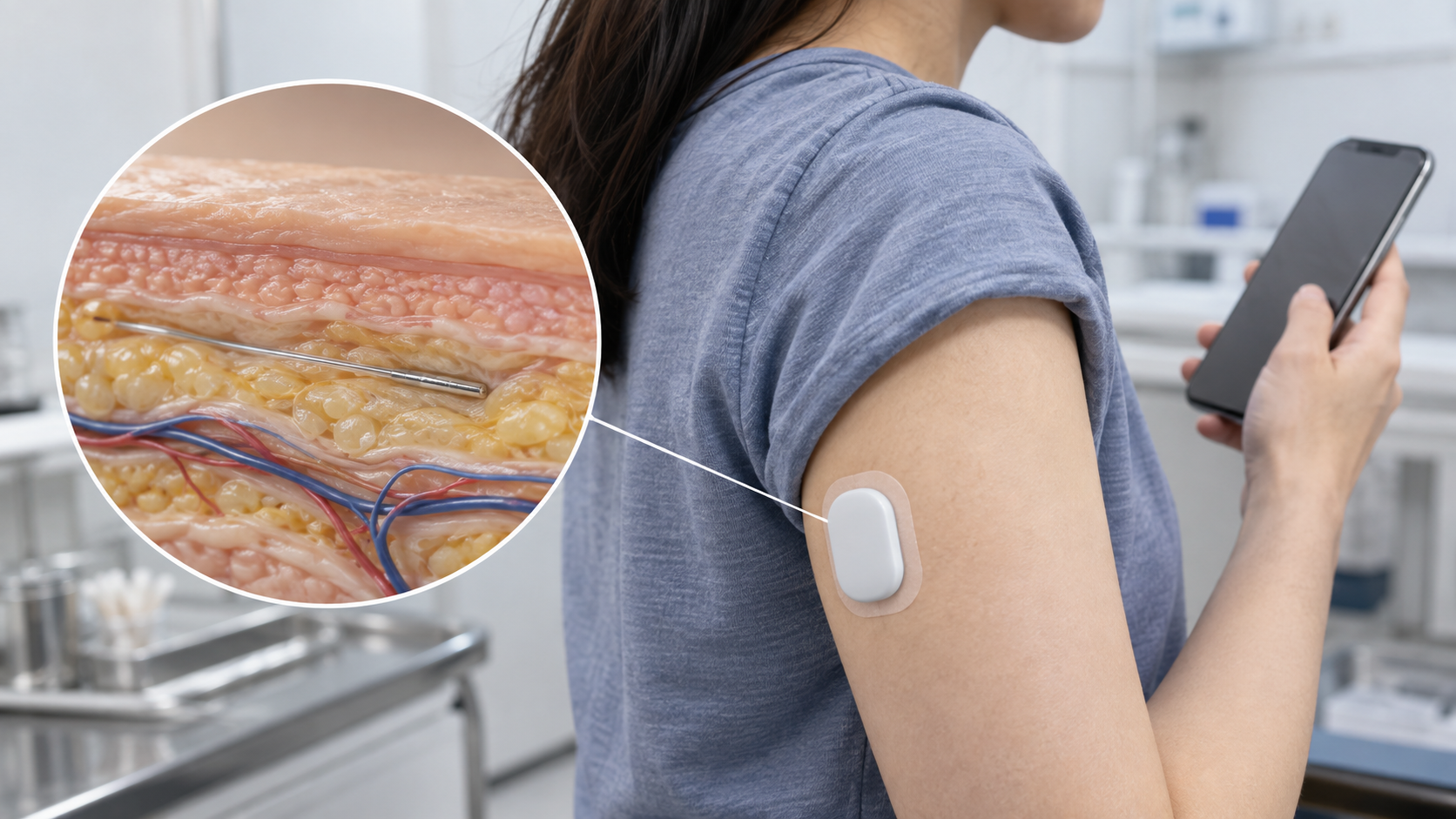
A dedicated maker of continuous glucose monitors built on a thin wire sensor under the skin, now extending from prescription G7 to the over-the-counter Stelo
Dexcom comes up in any discussion of biosensors because it is one of the few listed companies that centers its entire business on continuous glucose monitoring (CGM). In 2025 it reported revenue of US$4,662.0 million, research and development spending of US$599.1 million and about 11,100 employees (all from its Form 10-K). Its main G7-family systems require a prescription. Stelo, launched in 2024 for adults who do not use insulin, is sold over the counter (OTC) and has received 510(k) clearance from the U.S. Food and Drug Administration (FDA). This profile sets out, from primary sources only, what the company makes, what it invests in, who it works with and what challenges it faces. It is not a recommendation to use any product.
- Dexcom in 30 seconds, and where it stands in biosensors
- The logo and how the name is written
- Where the company sits in the field
- Scale
- Resources committed to biosensors
- What it has done so far
- What comes next
- What the company is aiming for in biosensors
- Map of partnerships in biosensors
- Technologies, products and services
- The risks this company carries
- Glossary, references and claim-to-source audit
1. Dexcom in 30 seconds, and where it stands in biosensors
Wearables & consumer devices (secondary)Core business is CGM. Stelo (OTC) is the consumer-facing entry point
(thin wire sensor under the skin)FDA documents: amperometric measurement using glucose oxidase
Dexcom is a specialist that carries both the sensor manufacturing and the clinical, regulatory and reimbursement framework around it, and about 85% of its revenue comes through distributors such as wholesalers and pharmacies Our calculation (2025: US$3,959.0 million via distributors divided by US$4,662.0 million total revenue). According to the 10-K, three unnamed customers each accounted for 10% or more of 2025 revenue Sourced. In other words, not only measurement technology but also FDA documents, public and private reimbursement, and the behavior of a few large channel customers shape the business. Manufacturing details such as yields, defect rates and material suppliers are not disclosed Not yet confirmed.
2. The logo and how the name is written

A note on names: the legal name in the 10-K is DexCom, Inc. (capital C), while the brand is written Dexcom. This article uses Dexcom in titles and in brand contexts. G7, G7 15 Day, Stelo and Dexcom ONE+ are product names, not companies. The logo was taken from the company's official website (dexcom.com) and is shown in a single color (black).
Official site: https://www.dexcom.com/3. Where the company sits in the field
4. Scale
Dexcom is a single-business company (CGM), so company-wide figures are the biosensor figures. Everything below comes from the 10-K Sourced.
| Indicator (US$ million) | 2023 | 2024 | 2025 | Change in 2025 |
|---|---|---|---|---|
| Revenue | 3,622.3 | 4,033.0 | 4,662.0 | +15.6% (our calculation) |
| Gross profit | 2,288.9 | 2,438.2 | 2,801.9 | Gross margin 60.1% (60.5% in 2024) |
| R&D expense | 505.8 | 552.4 | 599.1 | +8% (10-K ratio) |
| Operating income | 597.7 | 600.0 | 911.8 | +52% (10-K ratio) |
| Net income | 541.5 | 576.2 | 836.3 | +45% (10-K ratio) |
| 2025 revenue breakdown (US$ million) | U.S. | Outside U.S. | Total |
|---|---|---|---|
| Through distributors | 3,195.7 | 763.3 | 3,959.0 |
| Direct sales | 139.2 | 563.8 | 703.0 |
| Total | 3,334.9 | 1,327.1 | 4,662.0 |
About 71.5% of revenue came from the U.S. and about 28.5% from outside it Our calculation. For the second quarter of 2026 (April to June), revenue was US$1,308.4 million (up 13% year on year), operating income US$318.3 million and net income US$249.1 million (Form 10-Q) Sourced. The company had about 11,100 employees, 5,300 of them in the U.S. and 5,800 elsewhere (31 December 2025, 10-K).
The 10-K shows the share of revenue for customers A, B and C that each account for 10% or more (A = 55%, B = 35%, C = 46%), but the three add up to more than 100%. A footnote explains that the combined figure can exceed 100% because of how rebates are treated. The customers' names and the revenue line each belongs to are not disclosed. This article makes no estimates based on them Not yet confirmed.
5. Resources committed to biosensors
Because the whole company is a biosensor business, company-wide figures for people and money apply directly. However, the number of R&D staff, sensor manufacturing cost and yields are not disclosed.
| Resource | What primary sources confirm | Status |
|---|---|---|
| People | About 11,100 employees (31 December 2025): 5,300 in the U.S. and 5,800 elsewhere. The 10-K's site table lists San Diego as headquarters, R&D and manufacturing; Mesa and Penang as manufacturing; Athenry (under construction) as manufacturing. R&D-only headcount is not disclosed | Sourced / partly undisclosed |
| Money (R&D) | US$505.8 million in 2023, US$552.4 million in 2024, US$599.1 million in 2025. In April to June 2026: US$153.0 million (12% of revenue). The 10-K describes the spending as engineering and research on sensing technology, clinical trials, regulatory work, quality assurance, compensation and outsourced services | Sourced |
| Money (capital expenditure) | Purchases of property and equipment: US$236.6 million in 2023, US$358.8 million in 2024, US$363.5 million in 2025, and US$161.3 million in the first half of 2026. Construction in progress stood at US$614.4 million at 30 June 2026 | Sourced |
| Production sites | Mainly Mesa, Arizona and Penang, Malaysia. A new plant in Athenry, Ireland is under construction and, per the 10-K, is expected to add substantial capacity (no completion date found). The Malaysian site began commercial manufacturing in 2023 after its first construction phase | Sourced / completion date not confirmed |
| Acquisitions, investments, joint ventures | (1) US$75 million invested in Oura in November 2024 (Series D; company announcement). (2) Non-marketable equity securities of US$209.5 million at 30 June 2026 (investee names not disclosed). (3) An unnamed entity was acquired in April to June 2026 (10-Q): US$48.7 million of intangible assets, mainly acquired technology, and US$41.2 million cash paid, net of cash acquired; the name is not disclosed. (4) A collaboration and license agreement with Verily Life Sciences, amended and restated on 20 November 2018. The 10-K's tax discussion mentions a 2024 Verily milestone payment (amount not confirmed here) | Sourced / some names undisclosed |
| Universities, research institutes, public funding | ClinicalTrials.gov lists 171 studies in which Dexcom is sponsor or collaborator (searched 3 October 2026). In the CONNECT study (NCT06601166), Dexcom is the sponsor, with the Jaeb Center for Health Research, the Scripps Research Digital Trial Center and Precision Data Health as collaborators. No NIH or other public grant funding is confirmed in the 10-K | Sourced / public funding not confirmed |
Regulatory standing (confirmed in FDA's official documents)
| Product | Use (as written in FDA documents) | Category and number | Date |
|---|---|---|---|
| Dexcom G6 | Management of diabetes, ages 2 and older; prescription. Intended to replace fingerstick testing for treatment decisions | De Novo authorization DEN170088 (21 CFR 862.1355, Class II, product code QBJ) | 27 March 2018 |
| Dexcom G7 | Management of diabetes, ages 2 and older; prescription. Also intended to communicate with other devices such as automated insulin dosing systems | 510(k) clearance K213919 (product code QBJ) | 7 December 2022 |
| Dexcom G7 15 Day | Management of diabetes, ages 18 and older; prescription. Wear period of 15.5 days (10-K) | 510(k) clearance K243214 (QBJ) | 9 April 2025 |
| Stelo (first) | Over-the-counter (OTC) continuous glucose monitor for people 18 and older who are not on insulin | 510(k) clearance K234070 (product code SAF) | 5 March 2024 |
| Stelo (expanded ages) | OTC, for people not on insulin, ages 2 and older (FDA document: caregiver supervision required under 18) | 510(k) clearance K260935 (product code SBH) | 12 June 2026 |
| Dexcom Smart Basal | Insulin dose calculator software for adults 18 and older with type 2 diabetes who use long-acting insulin (prescription required) | 510(k) clearance K252818 (QRX) | 18 November 2025 |
The 10-K sometimes uses the word "approval" for these products, but in FDA terms the G7, G7 15 Day and Stelo are 510(k) clearances and the G6 is a De Novo authorization. None is a PMA approval. In Europe, the 10-K says the G7 received a CE mark in March 2022 and Dexcom ONE+ in November 2023. The status of approvals or certifications in Japan was not checked for this article Not yet confirmed.
Stelo's first 510(k) (K234070) uses the G7 as its predicate and states that it has "identical hardware, material, chemical composition, principle of operation and energy source" Sourced. In other words, the sensor's materials and structure stay the same, and only the intended use (who uses it, and where) changes, so it can be filed in a different category. On the materials side, once a design of "wire sensor + adhesive patch + transmitter" has been built, its biocompatibility, sterilization and shelf-life data can be reused across several products, which looks like a strength Not yet confirmed. How far reuse is accepted, however, is decided by the FDA, not by the company.
6. What it has done so far
| When | Event | Meaning |
|---|---|---|
| 1999 | Founded (per the company) | The company describes more than 25 years in glucose biosensing |
| 2006 | First product received FDA authorization and was commercialized (as worded in the 10-K; the exact category was not checked here) | Starting point of commercial CGM |
| 27 March 2018 | G6 received De Novo authorization (DEN170088). The 10-K describes it as the first CGM permitted for use as part of an integrated system with other devices | The 10-K says that, since then, products of this type can use the 510(k) pathway |
| 20 November 2018 | Collaboration and license agreement with Verily Life Sciences amended and restated (10-K exhibit list) | Verily was formerly Google Life Sciences (10-K). Contract details are not public |
| 7 December 2022 | G7 received 510(k) clearance (K213919); launched in 2023 | Sensor and transmitter in one unit. CE mark obtained in March 2022 |
| 5 March 2024 | Stelo received 510(k) clearance (K234070); launched in August 2024 | The 10-K calls it, in the company's words, the first OTC glucose biosensor in the U.S. |
| 19 November 2024 | US$75 million invested in Oura (Series D); app integration and cross-selling announced | A link to a consumer wearable |
| 20 December 2024 | Confidential settlement and patent license agreement signed with Abbott Diabetes Care (10-K exhibit list) | Resolves a dispute with a rival. Contents not public |
| 4 March 2025 | Received an FDA warning letter after inspections of San Diego (October to November 2024) and Mesa (June 2024), citing manufacturing processes and the quality system | The company said in its 8-K that the letter does not restrict production, marketing or distribution and does not require a recall |
| 9 April 2025 | G7 15 Day received 510(k) clearance (K243214); launched in late 2025 | Wear period extended to 15.5 days; adults 18 and older |
| 18 November 2025 | Smart Basal (insulin dose calculator software) received 510(k) clearance (K252818) | Extends the scope from sensors to software that uses sensor data |
| 14 May 2026 | Investor day in Mesa, Arizona; long-range targets through 2030 announced | Company targets, not results |
| 26 to 27 May 2026 | Issued a correction notification saying two lots of G7 sensors had been stolen and distributed; listed in FDA's recall database with a start date of 27 May 2026 | See the risk section for the facts only |
| 12 June 2026 | 510(k) clearance extending Stelo to ages 2 and older (K260935) | Wider OTC population |
| April to June 2026 | Acquired an entity (name not disclosed; US$48.7 million of intangible assets) | As stated in the 10-Q |
7. What comes next
The primary sources also describe the following plans and intentions Not yet confirmed.
- Retiring older generations: G6 users are to move to the G7 and G7 15 Day by the end of 2026, and the older Dexcom ONE is expected to be phased out by then. In April to June 2026 the company recorded inventory reserve charges that reflect, among other reasons, the planned discontinuation of G6 manufacturing (US$84.2 million for the first half).
- Strengthening Stelo: a redesigned app (AI-driven insights and better food logging) began rolling out in April to June 2026.
- Exploring new uses: the 10-Q says the company is exploring people with prediabetes, obesity, pregnancy and in hospital, and that it may eventually apply its expertise beyond glucose monitoring (exploration, not a plan).
- Clinical study: the primary assessment period of the CONNECT study (adults with type 2 diabetes not on insulin, 26 weeks) ended on 13 May 2026 (actual date on ClinicalTrials.gov). In its April to June 2026 results the company announced results showing a significant improvement in glucose control compared with routine care (company statement; figures not confirmed here). Overall completion is estimated for December 2026.
- Changes to public reimbursement (outside the company): U.S. Medicare will add CGMs to competitive bidding from the 2027 contracting round, with payment changes from 1 January 2028; the 10-K says CMS expects to award ten contracts for CGMs.
The start-up date and total investment of the Athenry plant / sensor yields and defect rates / the names of material and component suppliers / whether the warning letter has been resolved (the February 2026 10-K says the company is responding; no relevant passage was found in the July 2026 10-Q) / the number of R&D staff / the status of approvals or certifications in Japan. None appears in the primary sources checked for this article.
8. What the company is aiming for in biosensors
This section separates what the company says it is aiming for from what this article reads into the record. An Inference is our interpretation of primary sources, not a statement by the company.
| What can be read | Supporting primary information | Category |
|---|---|---|
| Broadening continuous glucose measurement from insulin users to non-users and general health-minded consumers | The 10-Q's "New Opportunities" lists prediabetes, obesity, pregnancy and hospital settings. Stelo (OTC) launched, its ages were widened in 2026, an investment was made in Oura, and the CONNECT study covers type 2 diabetes without insulin | Sourced (company description) / Inference (how strong the push is) |
| Meeting demand growth through supply capacity | Capital expenditure of about US$360 million a year; commercial production started in Malaysia; a new plant in Ireland. The 10-K says capacity must increase by a significant factor over the current level | Sourced / Inference |
| Extending beyond the sensor to software that uses glucose data (dose calculation, AI analysis) | Smart Basal clearance; the 10-Q's references to future generations enabling "intelligent insulin administration" and to machine learning for predictive insights | Sourced (statements) / Inference (emphasis) |
| Keeping a web of connections to other makers' automated insulin delivery systems | The 10-K refers to multiple integration agreements with insulin delivery companies but names none. 510(k) documents describe a use intended to communicate with other devices | Sourced (the connections exist) / names not confirmed |
| Ending older generations (G6, Dexcom ONE) and consolidating on the G7 family | G6 manufacturing wind-down plan; users to be moved by the end of 2026 | Sourced (company plan) |
The reading that the company is "widening to consumers" rests on the fact that it is adding categories without changing the product design. Stelo received 510(k) clearance in 2024 with the G7 as its predicate, citing "identical hardware, material, chemical composition and principle of operation," and in 2026 its age range was widened from 18-and-over to 2-and-over Sourced. The same sensor is sold through two doors: prescription (G7) and over the counter (Stelo). The 10-K also cites, as a competitive issue, FDA guidance of 6 January 2026 that broadens what counts as a "general wellness device," potentially extending to wearables that show vital signs including blood glucose Sourced. However, Stelo's revenue and user numbers are not reported separately in the 10-K, so the size of the consumer business cannot be verified Not yet confirmed.
9. Map of partnerships in biosensors
The only named contracts in the 10-K's exhibit list are Verily (collaboration and license) and Abbott (settlement and patent license). The Oura investment and integration were announced by the company in 2024 Sourced. On insulin pumps and pens, the 10-K says only that "multiple integration agreements" exist and names no partners. This article does not fill in names from other sources; which devices actually work together should be checked in each company's own documents.
10. Technologies, products and services
Dexcom's products combine a sensor and transmitter worn on the body, a smartphone app (or dedicated receiver), cloud reporting software (Dexcom Clarity) and features for sharing data with family and others (Dexcom Share and Follow) Sourced. Performance figures below are marked as either manufacturer's stated values or FDA review documents. No ranking is made across products or tests.
| Product | What the official documents say | Note |
|---|---|---|
| Dexcom G7 | FDA document (K213919): measures glucose in interstitial fluid as a current through a glucose oxidase reaction (amperometry). Measuring range 40 to 400 mg/dL; warm-up within 30 minutes (27 minutes); wear up to 10 days plus a 12-hour grace period; a value every 5 minutes. Sterilized with ethylene oxide (EO). Wear sites: upper arm (ages 2 and older) and upper buttocks (ages 2 to 6). The transmitter is built into the sensor and single-use (10.5 days) | Prescription. A small, flexible wire is inserted under the skin |
| Dexcom G7 15 Day | FDA document (K243214): a clinical study in adults, using venous plasma YSI measurements as the reference across a 15-day wear, showed that it meets the iCGM special controls. Wear period 15.5 days and 60-minute warm-up (10-K). Company statement (10-K): MARD 8.0%, with 94.2% of values within 20% of the comparator (comparison conditions are not given in the 10-K) | Figures are the company's. The FDA summary does not print a MARD value |
| Dexcom ONE+ | CE mark in Europe (November 2023). Ages 2 and older, including pregnancy. The 10-K describes features close to the G7 | The U.S. 510(k) documents were not checked here |
| Stelo | FDA documents (K234070, K260935): an OTC continuous glucose monitor for people not on insulin, meant to help detect normal and low or high glucose levels and to help users understand how diet and exercise relate to glucose excursions. Not for people on dialysis, with problematic hypoglycemia, who modify medication without consulting a health care professional, or with a history of eating disorders (K260935) | K234070 said the user is not intended to take medical action on the output without consulting a qualified health care professional; K260935 removes that statement |
| Dexcom Smart Basal | FDA document (K252818): dose-calculation software for adults with type 2 diabetes using long-acting insulin. Requires a prescription and initial configuration by a health care provider | Software that uses glucose readings |
| Apps and cloud | Dexcom Clarity (cloud reports), Dexcom Share and Follow (up to 10 people), display on Apple Watch and similar, and integration with other digital health apps | As stated in the 10-K. Individual partner apps are not named |
FDA review documents describe both the G6 and the G7 as measuring glucose in interstitial fluid by an enzymatic electrochemical reaction using glucose oxidase Sourced. In this approach, the electrode surface that holds the enzyme, the membrane that limits interference from blood components, and the materials that touch the body determine performance and life. The 10-K says the core sensor wire is made in-house and the remaining parts are bought in, and that the integrated circuits (ASICs), the seals used in the applicator and certain polymers used to synthesize the sensor's polymeric membranes come from single sources Sourced. A single source for the membrane polymer means the specification is hard to change and, if supply stops, qualifying a substitute takes time; this is a materials-side risk Not yet confirmed.
FDA documents state that interfering substances (hydroxyurea, and acetaminophen at high doses) can affect readings. The 10-K lists, as a G7 feature, reduced susceptibility to common medications at typical doses, but that is a company description and its conditions were not checked here. The sterilization method changed from electron beam (G6) to EO (G7); the reason for that design decision is not published (Inference: it likely relates to managing enzyme and membrane stability). For the 15-day wear, the FDA summary lists device-related adverse events including local infection, skin irritation (edema), and pain or discomfort, and says a new sensor patch was tested in a further clinical study with the aim of improving the sensor "survival rate" (the summary does not define the term; reading it as the share of sensors that stay on is an Inference). In long wear, the combination of skin and adhesive largely decides the product's success.
11. The risks this company carries
| Risk | Detail | Category |
|---|---|---|
| FDA warning letter | Received on 4 March 2025, citing manufacturing processes and the quality system at San Diego and Mesa. The company says it does not restrict manufacturing or sales and does not require a recall, but adds that "additional legal or regulatory action may be taken" until resolved. The February 2026 10-K says it is responding. Whether it has been resolved could not be confirmed here | Sourced / resolution not confirmed |
| Recalls and correction notices | FDA's recall database lists several entries in 2025 and 2026. Examples: 24 July 2025 (apps not issuing a "Sensor Failed" alert), 14 April 2026 (app display delay), and started 27 May 2026: two lots of G7 sensors designated as scrap and intended for destruction were stolen during destruction and sold to pharmacies and distributors; one lot had been designated for destruction because of inadequate sterilization, the other because of an increased risk of no sensor readings or inaccuracy. Responses for individual users are set out in each notice; this article gives no advice to users | Sourced (as recorded by FDA) |
| Litigation | (1) Securities class actions (U.S. District Courts for the Southern District of California and the Southern District of New York) concerning statements about 2024 revenue expectations; in California, part of the case was dismissed with leave to amend in January 2026 and the company has moved to dismiss the second amended complaint (10-Q). (2) Several shareholder derivative suits, stayed pending the securities case. (3) Consumer class actions by G6 and G7 users (six, filed between September 2025 and January 2026), in which plaintiffs allege, among other things, that devices did not perform as advertised (these are plaintiffs' allegations; the company says it will defend vigorously). The 10-Q says it cannot estimate the outcomes | Sourced (10-Q) |
| Changes in public reimbursement | Medicare adds CGMs to competitive bidding from the 2027 contracting round, with payment changes from 1 January 2028; ten CGM contracts expected. Medical-device sales depend heavily on reimbursement terms | Sourced (10-K) / effect is an Inference |
| Concentration in large channel customers | Three unnamed customers each account for more than 10% of revenue; about 85% of revenue is via distributors | Sourced / Our calculation |
| Competition and a changing market definition | The 10-K names Abbott, MiniMed (Medtronic's diabetes business), Roche and new entrants in China as competitors, and says Stelo competes with Abbott. The January 2026 FDA guidance broadening "general wellness devices" may also favor wearables that display blood glucose | Sourced |
| Difficulty of scaling manufacturing | Starting up new plants, equipment, yields, quality control and single-source materials. The 10-K says insufficient capacity could limit growth | Sourced (company's own risk statement) |
| Cost of retiring older generations | Inventory reserve charges of US$84.2 million in the first half of 2026 (US$37.0 million a year earlier), reflecting among other things the planned end of G6 manufacturing | Sourced |
| Verifying the consumer business | Stelo's revenue and user numbers are not reported separately, so it is hard to see from outside how much the consumer business contributes | Not yet confirmed |
12. Glossary
- CGM (continuous glucose monitoring)
- A method that automatically measures glucose in interstitial fluid under the skin every few minutes. It is distinct from fingerstick blood glucose testing.
- iCGM
- An FDA category of CGM, defined by special controls (21 CFR 862.1355), designed to be connected safely to other devices such as automated insulin dosing systems.
- MARD (mean absolute relative difference)
- The average size of the gap between CGM values and reference values. It cannot be compared across studies that use different references, populations or conditions.
- 510(k) clearance
- FDA's finding that a device is substantially equivalent to a legally marketed predicate device. It is separate from PMA approval.
- De Novo authorization
- An FDA pathway that classifies a new type of low-to-moderate-risk device that has no predicate.
- OTC (over the counter)
- Available without a prescription. The intended population and exclusions are as written in the FDA document.
- Glucose oxidase
- An enzyme that oxidizes glucose and produces hydrogen peroxide; the resulting current is used to determine glucose concentration.
- Warning letter
- An FDA notice of apparent violations after an inspection, issued for example when responses to a Form 483 (inspection observations) are judged inadequate.
- DMEPOS competitive bidding
- The U.S. Medicare program that selects durable medical equipment suppliers by bidding. CGMs enter the program from the 2027 contracting round.
- Non-GAAP
- A company-defined measure that excludes certain costs from GAAP figures; its definition must be checked before comparing.
13. References
- Dexcom Form 10-K for the year ended 31 December 2025 (filed 12 February 2026). Business overview, products, regulatory standing, revenue and costs, employees, manufacturing, competition, risks, litigation and exhibit list. https://www.sec.gov/Archives/edgar/data/1093557/000109355726000027/dxcm-20251231.htm
- Dexcom Form 10-Q for the quarter ended 30 June 2026 (filed 30 July 2026). Results for April to June 2026, future development plans, the acquisition and inventory charges. https://www.sec.gov/Archives/edgar/data/1093557/000109355726000143/dxcm-20260630.htm
- Dexcom Form 8-K Exhibit 99.1, "Dexcom Reports Second Quarter 2026 Financial Results" (30 July 2026). 2026 outlook, the new Stelo app and the CONNECT announcement. https://www.sec.gov/Archives/edgar/data/1093557/000109355726000142/dxcm06302026-exhibit991.htm
- Dexcom Form 8-K (14 May 2026, 2026 Investor Day). Long-range targets through 2030. https://www.sec.gov/Archives/edgar/data/1093557/000109355726000085/dxcm-20260514.htm
- Dexcom Form 8-K (4 March 2025). Receipt of the FDA warning letter and the company's statement. https://www.sec.gov/Archives/edgar/data/1093557/000109355725000047/dxcm-20250304.htm
- U.S. Food and Drug Administration 510(k) clearance letter and summary K213919 (Dexcom G7, 7 December 2022). Intended use, principle of operation and specifications. https://www.accessdata.fda.gov/cdrh_docs/pdf21/K213919.pdf
- U.S. Food and Drug Administration 510(k) clearance letter and summary K243214 (Dexcom G7 15 Day, 9 April 2025). https://www.accessdata.fda.gov/cdrh_docs/pdf24/K243214.pdf
- U.S. Food and Drug Administration 510(k) clearance letter and summary K234070 (Stelo, cleared 5 March 2024). https://www.accessdata.fda.gov/cdrh_docs/pdf23/K234070.pdf
- U.S. Food and Drug Administration 510(k) clearance letter and summary K260935 (Stelo, 12 June 2026). https://www.accessdata.fda.gov/cdrh_docs/pdf26/K260935.pdf
- U.S. Food and Drug Administration 510(k) clearance letter and summary K252818 (Dexcom Smart Basal, 18 November 2025). https://www.accessdata.fda.gov/cdrh_docs/pdf25/K252818.pdf
- U.S. Food and Drug Administration De Novo Decision Summary DEN170088 (Dexcom G6). Intended use and principle of operation. https://www.accessdata.fda.gov/cdrh_docs/reviews/DEN170088.pdf
- U.S. Food and Drug Administration (openFDA) Record showing the DEN170088 decision date (27 March 2018). https://api.fda.gov/device/510k.json?search=k_number:DEN170088
- U.S. Food and Drug Administration (openFDA) Recall record, event 98968 (two lots of G7 sensors, started 27 May 2026). https://api.fda.gov/device/recall.json?search=res_event_number:98968
- U.S. Food and Drug Administration (openFDA) Recall record, event 98639 (G7 apps, started 14 April 2026). https://api.fda.gov/device/recall.json?search=res_event_number:98639
- U.S. Food and Drug Administration (openFDA) Recall record, event 97262 (G7 and ONE+ apps, started 24 July 2025). https://api.fda.gov/device/recall.json?search=res_event_number:97262
- ClinicalTrials.gov NCT06601166 (the CONNECT study; sponsor DexCom, Inc.; collaborators include the Jaeb Center for Health Research). https://clinicaltrials.gov/study/NCT06601166
- ClinicalTrials.gov Count of studies registered with "Dexcom" as sponsor or collaborator (API; total of 171 confirmed on 3 October 2026). https://clinicaltrials.gov/api/v2/studies?query.spons=Dexcom&countTotal=true&pageSize=1&fields=NCTId
- Dexcom Investor news, "Dexcom and ŌURA Announce Strategic Partnership" (19 November 2024). https://investors.dexcom.com/news/news-details/2024/Dexcom-and-URA-Announce-Strategic-Partnership/default.aspx
- Dexcom Official website (source of the logo image). https://www.dexcom.com/
14. Claim-to-source audit
| Claim in the article | Category | Source |
|---|---|---|
| Legal name DexCom, Inc., headquarters, Nasdaq listing, founding year 1999, about 11,100 employees (5,300 U.S., 5,800 elsewhere) | Sourced | Reference 1 https://www.sec.gov/Archives/edgar/data/1093557/000109355726000027/dxcm-20251231.htm Reference 3 https://www.sec.gov/Archives/edgar/data/1093557/000109355726000142/dxcm06302026-exhibit991.htm |
| Revenue for 2023 to 2025 (US$3,622.3 / 4,033.0 / 4,662.0 million), gross profit, R&D expense, operating income, net income | Sourced | Reference 1 https://www.sec.gov/Archives/edgar/data/1093557/000109355726000027/dxcm-20251231.htm |
| 2025 revenue breakdown (distributors US$3,959.0 million, direct US$703.0 million, U.S. US$3,334.9 million, outside U.S. US$1,327.1 million) | Sourced | Reference 1 https://www.sec.gov/Archives/edgar/data/1093557/000109355726000027/dxcm-20251231.htm |
| Revenue growth of +15.6%, about 85% via distributors, about 71.5% from the U.S. | Our calculation | Our own division of figures in Reference 1. Reference 1 https://www.sec.gov/Archives/edgar/data/1093557/000109355726000027/dxcm-20251231.htm |
| Customers A = 55%, B = 35%, C = 46% of revenue (total over 100%) and the footnote | Sourced | Reference 1 https://www.sec.gov/Archives/edgar/data/1093557/000109355726000027/dxcm-20251231.htm |
| April to June 2026 revenue US$1,308.4 million, operating income US$318.3 million, net income US$249.1 million, R&D US$153.0 million | Sourced | Reference 2 https://www.sec.gov/Archives/edgar/data/1093557/000109355726000143/dxcm-20260630.htm Reference 3 https://www.sec.gov/Archives/edgar/data/1093557/000109355726000142/dxcm06302026-exhibit991.htm |
| Capital expenditure (US$236.6 / 358.8 / 363.5 million), US$161.3 million in the first half of 2026, construction in progress US$614.4 million | Sourced | Reference 1 https://www.sec.gov/Archives/edgar/data/1093557/000109355726000027/dxcm-20251231.htm Reference 2 https://www.sec.gov/Archives/edgar/data/1093557/000109355726000143/dxcm-20260630.htm |
| Production sites (San Diego, Mesa, Penang, Athenry under construction); commercial manufacturing in Malaysia from 2023 | Sourced | Reference 1 https://www.sec.gov/Archives/edgar/data/1093557/000109355726000027/dxcm-20251231.htm |
| The sensor wire is made in-house; ASICs, applicator seals and sensor-membrane polymers come from single sources | Sourced | Reference 1 https://www.sec.gov/Archives/edgar/data/1093557/000109355726000027/dxcm-20251231.htm |
| Non-marketable equity securities of US$209.5 million; the April to June 2026 acquisition (US$48.7 million of intangibles, US$41.2 million cash) | Sourced | Reference 2 https://www.sec.gov/Archives/edgar/data/1093557/000109355726000143/dxcm-20260630.htm |
| US$75 million invested in Oura (Series D); app integration and cross-selling announced | Sourced | Reference 18 https://investors.dexcom.com/news/news-details/2024/Dexcom-and-URA-Announce-Strategic-Partnership/default.aspx |
| Amended and restated Verily agreement (20 November 2018); confidential settlement and patent license with Abbott Diabetes Care (20 December 2024) | Sourced | Reference 1 https://www.sec.gov/Archives/edgar/data/1093557/000109355726000027/dxcm-20251231.htm |
| 171 registered studies; CONNECT study (sponsor, three collaborators, 283 participants, 26 weeks, primary period ended 13 May 2026, completion estimated December 2026) | Sourced | Reference 16 https://clinicaltrials.gov/study/NCT06601166 Reference 17 https://clinicaltrials.gov/api/v2/studies?query.spons=Dexcom&countTotal=true&pageSize=1&fields=NCTId |
| Company announcement of CONNECT results showing a significant improvement over routine care | Sourced | Reference 3 https://www.sec.gov/Archives/edgar/data/1093557/000109355726000142/dxcm06302026-exhibit991.htm |
| NIH or other public funding, R&D headcount, yields, Stelo revenue and users, Athenry start-up date | Not yet confirmed | Not found in References 1 to 3. We make no estimate. Reference 1 https://www.sec.gov/Archives/edgar/data/1093557/000109355726000027/dxcm-20251231.htm |
| G6: De Novo authorization DEN170088 (27 March 2018), 21 CFR 862.1355, Class II, intended use, glucose oxidase principle | Sourced | Reference 11 https://www.accessdata.fda.gov/cdrh_docs/reviews/DEN170088.pdf Reference 12 https://api.fda.gov/device/510k.json?search=k_number:DEN170088 |
| G7: 510(k) clearance K213919 (7 December 2022), ages 2 and older, prescription, measuring range 40 to 400 mg/dL, warm-up, EO sterilization, wear sites, single-use transmitter | Sourced | Reference 6 https://www.accessdata.fda.gov/cdrh_docs/pdf21/K213919.pdf |
| G7 15 Day: 510(k) clearance K243214 (9 April 2025), ages 18 and older, prescription, YSI-referenced clinical study meeting special controls, adverse event types, new sensor patch study | Sourced | Reference 7 https://www.accessdata.fda.gov/cdrh_docs/pdf24/K243214.pdf |
| G7 15 Day wear period of 15.5 days, MARD 8.0% and 94.2% within 20% (company statement), 60-minute warm-up | Sourced | Reference 1 https://www.sec.gov/Archives/edgar/data/1093557/000109355726000027/dxcm-20251231.htm |
| Stelo: 510(k) clearance K234070 (5 March 2024; the notice corrects a date typo), OTC, ages 18 and older not on insulin, identical hardware, material and chemical composition to the G7 | Sourced | Reference 8 https://www.accessdata.fda.gov/cdrh_docs/pdf23/K234070.pdf |
| Stelo: 510(k) clearance K260935 (12 June 2026), ages 2 and older, exclusions, removal of the consult-a-professional wording | Sourced | Reference 9 https://www.accessdata.fda.gov/cdrh_docs/pdf26/K260935.pdf |
| Dexcom Smart Basal: 510(k) clearance K252818 (18 November 2025), prescription, long-acting insulin dose calculator | Sourced | Reference 10 https://www.accessdata.fda.gov/cdrh_docs/pdf25/K252818.pdf |
| CE marks (G7 in March 2022, Dexcom ONE+ in November 2023, G6 in June 2018) | Sourced | Reference 1 https://www.sec.gov/Archives/edgar/data/1093557/000109355726000027/dxcm-20251231.htm |
| The 10-K's use of "approval" versus FDA's 510(k) clearance category | Our calculation | Our own reading, based on the categories in the FDA documents (References 6 to 11). Reference 6 https://www.accessdata.fda.gov/cdrh_docs/pdf21/K213919.pdf |
| FDA warning letter (4 March 2025), inspection dates and the company's statement | Sourced | Reference 5 https://www.sec.gov/Archives/edgar/data/1093557/000109355725000047/dxcm-20250304.htm Reference 1 https://www.sec.gov/Archives/edgar/data/1093557/000109355726000027/dxcm-20251231.htm |
| Recall records: started 27 May 2026 (two G7 sensor lots), 14 April 2026 (G7 apps), 24 July 2025 (apps) | Sourced | Reference 13 https://api.fda.gov/device/recall.json?search=res_event_number:98968 Reference 14 https://api.fda.gov/device/recall.json?search=res_event_number:98639 Reference 15 https://api.fda.gov/device/recall.json?search=res_event_number:97262 |
| Litigation (securities class actions, derivative suits, consumer class actions by G6 and G7 users) | Sourced | Reference 2 https://www.sec.gov/Archives/edgar/data/1093557/000109355726000143/dxcm-20260630.htm |
| Medicare competitive bidding (2027 contracting round, payment changes from 1 January 2028, ten contracts expected) | Sourced | Reference 1 https://www.sec.gov/Archives/edgar/data/1093557/000109355726000027/dxcm-20251231.htm |
| Competitors (Abbott, MiniMed, Roche, new entrants in China) and the FDA guidance of 6 January 2026 | Sourced | Reference 1 https://www.sec.gov/Archives/edgar/data/1093557/000109355726000027/dxcm-20251231.htm |
| 2026 revenue outlook of US$5.18 to 5.25 billion; non-GAAP operating margin of about 23.5 to 24% | Not yet confirmed | Company outlook (outlook, not a result). Reference 3 https://www.sec.gov/Archives/edgar/data/1093557/000109355726000142/dxcm06302026-exhibit991.htm |
| Long-range targets through 2030 (organic growth 10%+, gross margin 67 to 69%, operating margin 29 to 30%) | Not yet confirmed | Company targets (outlook, not results). Reference 4 https://www.sec.gov/Archives/edgar/data/1093557/000109355726000085/dxcm-20260514.htm |
| End of G6 and Dexcom ONE, inventory charges (US$84.2 million in the first half), new Stelo app, exploration of new uses, possible uses beyond glucose | Not yet confirmed | Reference 1 https://www.sec.gov/Archives/edgar/data/1093557/000109355726000027/dxcm-20251231.htm Reference 2 https://www.sec.gov/Archives/edgar/data/1093557/000109355726000143/dxcm-20260630.htm Reference 3 https://www.sec.gov/Archives/edgar/data/1093557/000109355726000142/dxcm06302026-exhibit991.htm |
| G7 integrates sensor and transmitter; reduced susceptibility to common medications (company description) | Sourced | Reference 1 https://www.sec.gov/Archives/edgar/data/1093557/000109355726000027/dxcm-20251231.htm |
| Treating Stelo as the consumer entry point; the four-type classification | Our calculation | Our own classification, based on FDA documents describing Stelo as OTC (References 8 and 9). Reference 8 https://www.accessdata.fda.gov/cdrh_docs/pdf23/K234070.pdf |
| Readings of a consumer push, manufacturing-capacity focus, software extension and a web of connections | Inference | Our interpretation of References 1, 2, 8, 9, 10 and 18. Reference 1 https://www.sec.gov/Archives/edgar/data/1093557/000109355726000027/dxcm-20251231.htm |
| Reasons for the shift to EO sterilization, the effect of single-sourced membrane polymer, and the meaning of "survival rate" | Inference | Our interpretation of References 1, 6 and 7. Reference 6 https://www.accessdata.fda.gov/cdrh_docs/pdf21/K213919.pdf |
| Strength from reusable design (materials engineer's view) | Inference | Our interpretation of Reference 8. Reference 8 https://www.accessdata.fda.gov/cdrh_docs/pdf23/K234070.pdf |
Last updated 4 October 2026 / Troy Technical
Every figure in this article comes from Dexcom's statutory filings (SEC filings), U.S. FDA public documents, ClinicalTrials.gov and the company's official announcements. No research-firm estimates or press-based figures have been used. Passages marked "Inference" are this article's interpretation of primary sources, not statements made by the company. Nothing here recommends using a product or makes a medical judgment.