COMPANY PROFILE / BIOSENSORS
Insulet
The company behind the Omnipod patch pump makes no glucose sensor itself: it is the "system side" of biosensing, using continuous glucose monitor readings from other companies
Insulet comes up in any discussion of biosensors not because it makes sensors, but because it is a company that receives and acts on sensor readings. Omnipod delivers insulin automatically from a small disposable body (the Pod) worn on the skin for up to three days, and it takes its glucose values from continuous glucose monitors (CGMs) made by other companies such as Dexcom and Abbott, which are sold separately. According to its 2025 Form 10-K, revenue was US$2,708.1 million (up 30.7%), and the estimated number of active Omnipod users exceeded 600,000. This profile sets out, from SEC filings and FDA public documents, what the company needs from sensors, how it connects to them, and what it invests in.
- Insulet in 30 seconds, and where it stands in biosensors
- The logo and how the name is written
- Where the company sits in the field
- Scale
- Resources committed to biosensors
- What it has done so far
- What comes next
- What the company is aiming for in biosensors
- Map of partnerships in biosensors
- Technologies, products and services
- The risks this company carries
- Glossary, references and claim-to-source audit
1. Insulet in 30 seconds, and where it stands in biosensors
(the insulin-delivery side)Makes no sensor; connects to other companies' CGMs
from CGM readingsThe Pod (worn up to 3 days), the algorithm, and a smartphone app
Insulet does not make a glucose sensor. The 10-K says Omnipod 5 integrates with third-party CGMs, and that the CGM is sold separately by third parties. The sensors it works with are Dexcom's G6 and G7 and Abbott's FreeStyle Libre 2 Plus (varying by country), and the 10-Q says that in June 2026 it expanded compatibility with Libre 3 Plus in the U.S. Sourced. In biosensors, then, Insulet's position is that of a user whose product's behavior depends on a sensor's accuracy, communication and wear time Our calculation. This profile covers the conditions of that connection (the FDA's "iCGM" category, contracts, and how the algorithm behaves) and the Pod's own materials and quality.
2. The logo and how the name is written

A note on names: the legal entity is Insulet Corporation. Omnipod is the name of the product family: the current Omnipod 5 (an automated insulin delivery system), the earlier Omnipod DASH, and the original Classic Omnipod (being phased out). The Pod is the name of the small disposable body worn on the skin. The logo image is the purple version used on the company's official website (insulet.com).
Official site: https://www.insulet.com/3. Where the company sits in the field
4. Scale
Insulet is close to a single-product company. Almost all revenue is Omnipod products, with a small amount from products for Amgen (Pods for the Neulasta Onpro kit) Sourced.
| Measure (US$ million) | 2024 | 2025 | Change |
|---|---|---|---|
| Total revenue | 2,071.6 | 2,708.1 | +30.7% (+29.5% at constant currency) |
| Of which Omnipod products in the U.S. | 1,509.3 | 1,919.8 | +27.2% |
| Of which Omnipod products outside the U.S. | 523.4 | 754.3 | +44.1% |
| Of which Drug Delivery (Amgen and others) | 38.9 | 34.1 | -12.3% |
| R&D expense | 219.6 | 301.1 | +37.1% |
| Gross margin | 69.8% | 71.6% | +1.8 points |
| Net income | 418.3 | 247.1 | See the note below |
Net income for 2025 includes a US$123.9 million loss on the repurchase of convertible notes. Net income for 2024 includes a tax benefit that arose because a valuation allowance on deferred tax assets was no longer needed (per the 10-K) Sourced. The estimated number of active Omnipod users was more than 600,000 at the end of 2025, products were sold in 25 countries (Omnipod 5 in 19), and 86% of global sales went through intermediaries such as wholesalers and distributors; three intermediaries accounted for 27%, 26% and 25% of revenue (2025).
In the first half of 2026 (January to June), revenue was US$1,563.4 million (up 28.4% year on year) and R&D expense was US$177.8 million (11.4% of revenue) Sourced.
The 10-K says CGMs are sold separately by third parties, which reads as meaning that CGM sales are not included in Insulet's revenue (our reading). Revenue and cost attributable to biosensors (the CGM sensor) therefore cannot be separated from Insulet's disclosures. R&D includes the development of CGM integration, but the amount is not disclosed Not yet confirmed.
5. Resources committed to biosensors
Insulet reports for the whole company (in effect one business). There are no headcount or cost figures limited to sensor integration. The table shows what could be confirmed.
| Resource | What primary sources confirm | Status |
|---|---|---|
| People | About 5,400 full-time employees at the end of 2025 (up 38%); about 60% in the U.S. and the rest in 17 other countries. R&D headcount is not disclosed (the 10-K cites added headcount as a reason for higher R&D). Manufacturing is at two company plants, Acton, Massachusetts and Johor, Malaysia, plus lines at a facility in China run by a contract manufacturer | Sourced / partly undisclosed |
| Money (R&D) | US$301.1 million in 2025 (11.1% of revenue). The 10-K cites fully closed loop for type 2 diabetes, Libre 3 integration with Omnipod 5 and the next-generation Omnipod 6 as reasons for the rise. First half of 2026: US$177.8 million (11.4% of revenue) | Sourced |
| Money (capital spending) | Capital expenditure in 2025 was US$191.6 million (US$124.9 million in 2024), mainly for a third plant in Costa Rica and equipment at the Malaysia plant. First half of 2026: US$56.8 million, with 2026 expected to exceed 2025. The Costa Rica plant is a build-and-purchase arrangement, and in April 2026 the company agreed to guarantee up to US$97 million of the seller's construction loan | Sourced / Not yet confirmed (expectation) |
| Acquisitions, investments, partnerships | Agreements with CGM makers: with Dexcom, a development agreement (7 December 2016), a commercialization agreement (21 November 2019, amended 5 January 2026) and a data agreement (7 May 2020); with Abbott, an amended and restated development and commercialization agreement (13 September 2021, amended eight times through 15 December 2025). Also a patent assignment and license agreement with Bigfoot Biomedical (9 February 2023) and a data-management partnership with Glooko (the agreement expires in December 2026). Strategic investments in private companies exist but are not named (for example a US$12.0 million equity stake in 2024). Parts and equipment contracts: NXP (from 12 October 2017), Sanmina (materials supply, 14 November 2025) and ATS | Sourced |
| Universities, research institutes, public funding | The 10-K and 10-Q give no name or amount for any university or public grant (such as NIH). ClinicalTrials.gov lists many Insulet-led clinical studies (for example Omnipod 6 versus Omnipod 5, the fully closed loop EVOLVE study, and a post-market registry), including studies with investigators in France and other countries | Not found (clinical studies confirmed) |
Regulatory status (as far as could be confirmed)
| Product | Intended use | Category | Date | Source |
|---|---|---|---|---|
| Omnipod 5 ACE Pump (Pod) | Subcutaneous delivery of insulin at set and variable rates. Can communicate securely with compatible digitally connected devices, including automated insulin dosing software, to receive, execute and confirm commands. Single-patient home use, prescription | FDA 510(k) clearance (K203768; product code QFG) | 27 January 2022 (revised version K231826: 18 October 2023) | References 3, 8 |
| SmartAdjust technology (Omnipod 5 algorithm) | Used with a compatible iCGM and ACE pump to automatically increase, decrease and pause insulin delivery based on current and predicted glucose values. Initially type 1 diabetes, age 6 and older | FDA 510(k) clearance (K203774; product code QJI, interoperable automated glycemic controller) | 27 January 2022 | Reference 4 |
| SmartAdjust Technology (expanded use) | Type 1 diabetes age 2 and older, and type 2 diabetes age 18 and older | FDA 510(k) clearance (K241777) | 26 August 2024 | Reference 5 |
| Omnipod 5 algorithm | Same. A change adding 100 mg/dL as a target glucose value | FDA 510(k) clearance (K251779) | 3 December 2025 | Reference 6 |
| Omnipod 6 algorithm | Same intended use as the Omnipod 5 algorithm, with a modification that personalizes to the user's bolus behavior | FDA 510(k) clearance (K261461) | 29 June 2026 | Reference 7 |
| Omnipod 5 (EU) | - | CE mark under the EU Medical Device Regulation (MDR); the 10-K says it was obtained in 2022 | 2022 | Reference 1 |
| Status in Japan | - | Japan is not among the 25 countries in the 10-K's list of markets. Approval or certification by the PMDA could not be confirmed | - | Reference 1 |
An FDA "510(k) clearance" recognizes substantial equivalence to a device already on the market. It is different from "De Novo authorization" and "PMA approval". The CGMs Insulet connects to fall under the FDA's "iCGM" category (Class II, special controls) in 21 CFR 862.1355.
The CGM is a part that comes from outside, but the Pod itself is a mass of materials that stay in contact with a drug (insulin) and with subcutaneous tissue. The comparison table in FDA document K203768 lists the Pod's fluid-path materials as fluorinated ethylene propylene (FEP), a fluoroalkyl-modified siloxane, stainless steel, polydimethylsiloxane (PDMS), polypropylene, cyclic olefin copolymer (COC) and polyethylene. It gives sterilization by ethylene oxide (EO), a shelf life of 18 months and an operating temperature of 5 to 40 °C Sourced. The 2026 corrective actions (Chapter 11) are attributed to damage to the soft cannula (the thin tube) during manufacturing, which suggests that quality here depends less on the material itself than on controlling the process so that it does not damage the material Not yet confirmed. Chapter 10 goes into more detail.
6. What it has done so far
| When | What happened | Why it matters |
|---|---|---|
| 7 December 2016 | Development agreement with Dexcom (date of the agreement, per the 10-K exhibit list) | The start of using CGM readings in the pump-side algorithm |
| 21 November 2019 / 7 May 2020 | Commercialization agreement and data agreement with Dexcom | The exhibit list does not state the terms, such as amounts |
| 13 September 2021 | Development and commercialization agreement with Abbott Diabetes Care (amended eight times through 15 December 2025) | Connection to Libre-family sensors |
| 27 January 2022 | FDA 510(k) clearance of the Omnipod 5 pump (K203768) and algorithm (K203774). CE mark (MDR) in the EU the same year | Market entry of an automated insulin delivery system used with a compatible iCGM |
| 9 February 2023 | Patent assignment and license agreement with Bigfoot Biomedical | Intellectual property on the system and algorithm side |
| 2023-2024 | Omnipod 5 launched in the United Kingdom and Germany (2023), and the Netherlands and France (2024) | Expansion outside the U.S. |
| 26 August 2024 | Expanded use to type 2 diabetes (age 18 and older) cleared (K241777). On this basis the company decided not to commercialize the basal-only "Omnipod GO" and recorded a US$13.5 million charge in 2024 | Expanding the market on the premise of pairing with a CGM |
| 2025 | Launched the iPhone Omnipod 5 app with Dexcom G7 in the U.S. Extended Dexcom G7 integration to five European countries and Libre 2 Plus integration to Australia. Launched Omnipod 5 in nine more countries. FDA 510(k) clearance for a change to the algorithm's target glucose settings (K251779, 3 December). Completed the STRIVE study for the next generation. On 24 April 2025 a federal district court entered final judgment for Insulet in its trade-secret case against EOFlow and others | A year of widening the choice of sensors and smartphones |
| March and May 2026 | Two voluntary corrective actions (medical device corrections, MDCs) for manufacturing issues that damaged the Pod's soft cannula (the thin tube). The FDA database also holds recall records (Chapter 11) | A charge of US$41.0 million in the first half of 2026 |
| June 2026 | Expanded compatibility with Abbott's FreeStyle Libre 3 Plus in the U.S. and rolled out algorithm enhancements including a 100 mg/dL target glucose value. On 29 June the Omnipod 6 algorithm received FDA 510(k) clearance (K261461) | The 10-Q says Omnipod 6 is "in development"; no launch date is given |
| February and July 2026 | Launched Omnipod 5 in five Middle East countries (February) and Spain (July) | As stated in the 10-Q |
7. What comes next
Everything below is a company plan or target, not something already achieved. It is based on the August 2026 10-Q, the February 2026 10-K, and the dates planned in ClinicalTrials.gov Not yet confirmed.
- Cost of corrective actions: The company estimates the total cost of the two 2026 corrective actions at US$60 million to US$70 million, most in 2026 and the rest in 2027 (extra manual inspection until automated inspection systems are in place).
- Data management: The 10-K says the Glooko agreement expires in December 2026 and that, if it is not renewed, the company would need another data-management arrangement or its own. In 2026 it launched the analytics platform Omnipod Discover.
- Litigation: In the EOFlow case, a jury in December 2024 awarded US$452 million and a federal court entered an injunction in April 2025. The defendants appealed, and oral argument was held on 5 January 2026. The damages are not recorded in the accounts.
The launch timing of Omnipod 6; the FDA status of the fully closed loop system (Omnipod M; a submission is planned for 2027); the amounts, terms and exclusivity of the Dexcom and Abbott agreements (the agreements are partly redacted); user numbers by connected CGM; status in Japan (PMDA); Insulet's own accuracy requirements for CGM sensors; when the Costa Rica plant will operate; and the share of R&D spent on sensor integration.
8. What the company is aiming for in biosensors
This chapter separates what the company says directly from what we have read into its materials. Inference marks our interpretation of primary sources.
| What can be read | Primary evidence | Status |
|---|---|---|
| It connects to several CGMs rather than being tied to one sensor | The 10-K makes "choice of CGM and smartphone" a development theme and integrates with Dexcom's G6 and G7 and Abbott's Libre 2 Plus and 3 Plus. It has separate contracts with both companies | Sourced (integration, contracts) / Inference (purpose) |
| As sensors become standardized, it competes on the algorithm and the Pod | The FDA limits the connected sensor to the "iCGM" category (K203774 and others). The 10-K says its more than 1,000 patents cover the drive system, cannula insertion and the algorithm | Inference |
| It is extending to type 2 diabetes | Expanded use for type 2 in 2024; the EVOLVE study of a fully closed loop system for type 2 started in 2026; "Omnipod GO" was dropped | Sourced |
| It is adding countries with more CGM connections | Nine new countries in 2025; five Middle East countries and Spain in 2026. Dexcom G7 integration extended to five European countries and Libre 2 Plus to Australia | Sourced |
| It is acutely aware that CGM data quality can constrain delivery | The algorithm enters "Limited" mode when CGM data have not arrived for 20 minutes or longer, or during sensor warm-up (FDA documents) | Sourced (behavior) / Inference (degree of awareness) |
The reading "as sensors become standardized, the contest shifts to the algorithm and the Pod" rests on the structure of the FDA documents. The intended use of every Insulet algorithm (SmartAdjust, the Omnipod 5 algorithm, the Omnipod 6 algorithm) is stated as use "with a compatible iCGM and an ACE pump". 21 CFR 862.1355 defines iCGM as a category of CGM that reliably and securely transmits glucose data to automated insulin dosing systems, with special controls that include accuracy criteria in adults Sourced. If the sensor-side requirements are fixed by regulation, Insulet can use sensors from several companies that meet the rule without building one in-house. But which sensor it uses also depends on contracts and commercial terms, and those terms are not disclosed Not yet confirmed.
9. Map of partnerships in biosensors
The relationships in the 10-K where the counterparty can be named are the two CGM companies (Dexcom and Abbott), the data-management company Glooko, parts suppliers (NXP, Sanmina) and the equipment supplier ATS Sourced. The Dexcom and Abbott agreements were filed with amounts and terms redacted, so whether they are exclusive and how long they run could not be confirmed here Not yet confirmed.
10. Technologies, products and services
Insulet's Omnipod consists of the Pod (a small disposable pump worn on the skin), an algorithm, and a smartphone app or dedicated controller; the CGM is a separately sold product from a third party. The figures here come from FDA documents and the 10-K; they are not measurement-accuracy figures, and values from different studies cannot be lined up to rank products.
| Category | What the official materials say | Note |
|---|---|---|
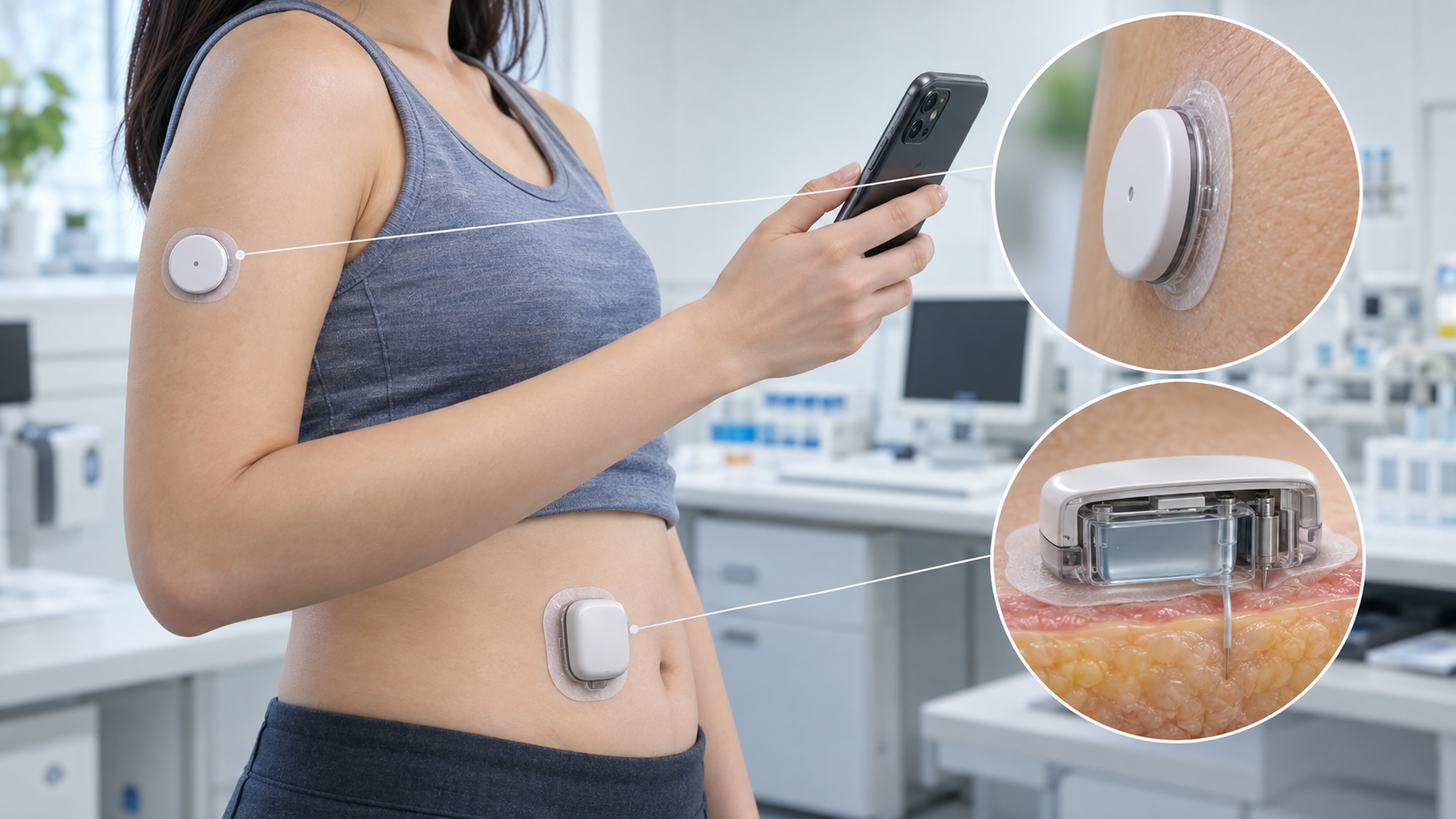
| The Pod (Omnipod 5, DASH) | A disposable, tubeless body held on the skin by an adhesive pad, worn for up to three days. Waterproof to IP28 (25 feet, about 7.6 m, for 60 minutes). Cannula (thin tube) insertion is automatic. Can be worn on the abdomen, hip, back of the upper arm, upper thigh or lower back | From the 10-K. A delivery-side device, separate from the continuous-measurement sensor |
| Algorithm (SmartAdjust, Omnipod 5 algorithm, Omnipod 6 algorithm) | Receives a CGM value every five minutes, predicts glucose ahead, and automatically increases, decreases or pauses insulin delivery every five minutes (the Omnipod 6 FDA document gives a 60-minute prediction horizon). The user-set target glucose range is 100 to 150 mg/dL (Omnipod 6 FDA document). If CGM data are missing for 20 minutes or longer, or during warm-up, it runs in "Limited" mode, with delivery restricted to basal amounts | The FDA category is "interoperable automated glycemic controller (iAGC)" |
| Connected CGMs | Dexcom G6 and G7, Abbott FreeStyle Libre 2 Plus, and from June 2026 Libre 3 Plus in the U.S. as well (10-K and 10-Q). Communication is by Bluetooth Low Energy (FDA documents) | Which CGMs can be used differs by country and over time |
| Apps and data | A smartphone app (iOS and Android in the U.S.) and a dedicated controller, uploading to the cloud by SIM card or Wi-Fi. Connection to Glooko, and Omnipod Discover from 2026 | The side that displays data, separate from measurement itself |
| Drug delivery (for Amgen) | Manufacture of Pods for the Neulasta Onpro kit. Revenue of US$34.1 million in 2025 | A different use from diabetes |
Because the Pod is a device that changes delivery in response to CGM values, properties of the sensor side directly constrain what it does. According to the FDA documents, when CGM values have not arrived for 20 minutes or longer, or while the sensor is warming up, the system stops automatic increases and decreases and limits delivery to basal amounts Sourced. In other words, a sensor that peels off, drops its connection or is slow to start up feeds straight through to the delivery side (our commentary).
On the Pod's own materials, the FDA documents and the 10-K support the following Sourced.
- The fluid path that touches the drug: a combination of FEP, a fluoroalkyl-modified siloxane, stainless steel, PDMS, polypropylene, COC and polyethylene. It must avoid adsorbing or degrading insulin and last for about three days of use (our commentary; no reason is given).
- The cannula under the skin: a thin, soft tube. The FDA records attribute the 2026 corrective actions to damage during manufacturing (an internal tear and external damage). Beyond material choice, inspection that finds damage (the introduction of automated inspection) is the key to quality.
- Adhesive pad and waterproofing: up to three days of wear and IP28. A CGM sensor is also worn on the skin, so the placement and adhesive compatibility of the two are design issues (see our explainer on patch sensors and skin adhesion).
- Sterilization and storage: EO sterilization, an 18-month shelf life and an operating temperature of 5 to 40 °C (K203768).
However, the cannula material, the adhesive pad material and measures against electrical interference with the sensor are not stated in the materials we reviewed. This article does not fill the gap by guessing.
11. The risks this company carries
| Risk | Detail | Status |
|---|---|---|
| Manufacturing defects and corrective actions | Two voluntary corrective actions in March and May 2026 concerned damage to the Pod's soft cannula. The 10-Q gives a first-half 2026 charge of US$41.0 million and a total estimate of US$60 million to US$70 million. In the FDA records, the action initiated on 12 March (Z-1797-2026) concerns an internal cannula tear in 49 lots (about 1.24 million units), and the action initiated on 20 May (Z-2603-2026 and others) concerns external cannula damage (units per record from about 0.29 million to about 4.94 million); both give possible under-delivery of insulin due to leakage as the reason. The unit counts are those in the records and may overlap | Sourced |
| Earlier software corrections | In 2025 there were also two corrective actions on iOS app input (a decimal separator not recognized, and a digit duplicating when the display is magnified; Z-2016-2025 and Z-0132-2026), both as recorded by the FDA | Sourced |
| Dependence on agreements with sensor companies | The 10-K lists, as a risk, that its commercial agreements with Dexcom and Abbott are what allow it to sell with their CGMs, and that losing those rights could materially affect functionality and sales. The agreements were filed with parts redacted | Sourced |
| Data-management agreement | The Glooko agreement expires in December 2026. The 10-K says failure to renew without an alternative could have a material adverse impact | Sourced |
| Concentrated manufacturing and tariffs | Manufacturing is in the U.S., Malaysia and at a contract manufacturer in China. U.S. inventory is held at a single site. The 10-K says that if the current tariff exemption for certain medical devices ended, tariffs could materially affect results in future years | Sourced |
| Competition | It names tubed-pump makers (Medtronic Diabetes, which is to be spun out as a listed company, and Tandem), emerging patch-pump companies (such as Beta Bionics), multiple daily injection therapy including smart pens, and growing use of GLP-1 products in type 2 diabetes | Sourced |
| Intellectual-property litigation | In the EOFlow trade-secret case, a jury in December 2024 found misappropriation and awarded US$452 million, and a federal court entered an injunction in April 2025. The defendants appealed, with oral argument on 5 January 2026. The damages are not recorded | Sourced |
| Geographic limits | Japan is not among the 25 countries in the 10-K's market list. Its regulatory status in Japan could not be confirmed | Sourced / Not yet confirmed |
| Indirect dependence on sensor performance and supply | Instability in a CGM's accuracy, communication or supply could affect Omnipod's automated delivery and the user experience. Insulet does not disclose its own accuracy requirements for sensors | Inference |
12. Glossary
- Pod
- The disposable body of Omnipod worn on the skin. It holds the insulin reservoir and the cannula insertion mechanism.
- AID (automated insulin delivery)
- A system in which an algorithm adjusts insulin doses automatically based on CGM values.
- ACE pump
- An alternate controller enabled pump: the FDA category for an insulin pump that acts on commands from compatible digital devices.
- iAGC
- Interoperable automated glycemic controller. The FDA category (product code QJI) for algorithms such as Insulet's SmartAdjust.
- iCGM
- Integrated continuous glucose monitoring system. An FDA Class II (special controls) category for CGMs that can transmit glucose data safely to automated insulin dosing systems.
- 510(k) clearance
- An FDA category recognizing substantial equivalence to a device already on the market. Different from De Novo authorization and PMA approval.
- MDI
- Multiple daily injections of insulin by syringe or pen.
- MDC
- Medical device correction: the term for a voluntary corrective action by a manufacturer.
- Cannula
- The thin, soft tube that delivers insulin under the skin.
13. References
- Insulet Form 10-K for the year ended 31 December 2025 (filed 18 February 2026). Business overview, Omnipod configuration, CGM integration, regulation, manufacturing sites, headcount, revenue, R&D and capital spending, risk factors and exhibit list. https://www.sec.gov/Archives/edgar/data/1145197/000114519726000028/podd-20251231.htm
- Insulet Form 10-Q for the quarter ended 30 June 2026 (filed 5 August 2026). First-half 2026 revenue, R&D and capital spending; Libre 3 Plus compatibility; Omnipod 6; EVOLVE; medical device corrections. https://www.sec.gov/Archives/edgar/data/1145197/000114519726000169/podd-20260630.htm
- FDA 510(k) K203768, Omnipod 5 ACE Pump (Pod) (27 January 2022). Intended use of the pump (Pod), and notes on drug-contacting and patient-contacting materials. https://www.accessdata.fda.gov/cdrh_docs/pdf20/K203768.pdf
- FDA 510(k) K203774, SmartAdjust technology (27 January 2022). Intended use and operation of the algorithm used with a compatible iCGM. https://www.accessdata.fda.gov/cdrh_docs/pdf20/K203774.pdf
- FDA 510(k) K241777, SmartAdjust Technology (26 August 2024). Expansion to type 2 diabetes (age 18 and older). https://www.accessdata.fda.gov/cdrh_docs/pdf24/K241777.pdf
- FDA 510(k) K251779, Omnipod 5 algorithm (3 December 2025). Addition of a 100 mg/dL target glucose value. https://www.accessdata.fda.gov/cdrh_docs/pdf25/K251779.pdf
- FDA 510(k) K261461, Omnipod 6 algorithm (29 June 2026). https://www.accessdata.fda.gov/cdrh_docs/pdf26/K261461.pdf
- FDA 510(k) K231826, Omnipod 5 ACE Pump (18 October 2023). https://www.accessdata.fda.gov/cdrh_docs/pdf23/K231826.pdf
- eCFR 21 CFR 862.1355, Integrated continuous glucose monitoring system (definition of iCGM and special controls). https://www.ecfr.gov/current/title-21/chapter-I/subchapter-H/part-862/subpart-B/section-862.1355
- FDA Medical Device Recalls: Z-1797-2026 (Omnipod 5 Pods, initiated 12 March 2026). https://www.accessdata.fda.gov/scripts/cdrh/cfdocs/cfres/res.cfm?id=219130
- FDA (openFDA) Medical Device Recalls: record for Z-2603-2026 (Omnipod 5 Pods, initiated 20 May 2026). https://api.fda.gov/device/recall.json?search=product_res_number:%22Z-2603-2026%22
- FDA (openFDA) Device Recall database, Insulet records from 2024 onward (search result). https://api.fda.gov/device/recall.json?search=recalling_firm:%22Insulet%22&limit=30
- FDA (openFDA) 510(k) database, Insulet records (search result). https://api.fda.gov/device/510k.json?search=applicant:%22Insulet%22&limit=30
- ClinicalTrials.gov NCT07579702: Omnipod 6 compared with Omnipod 5 (led by Insulet; recruiting). https://clinicaltrials.gov/study/NCT07579702
- ClinicalTrials.gov NCT07521475: EVOLVE, fully closed loop Omnipod M in type 2 diabetes (led by Insulet; recruiting). https://clinicaltrials.gov/study/NCT07521475
- ClinicalTrials.gov NCT06144554: Post-market registry for the Omnipod 5 System in type 1 diabetes (led by Insulet). https://clinicaltrials.gov/study/NCT06144554
- ClinicalTrials.gov NCT05923827: Omnipod 5 with Libre 2 compared with multiple daily injections (completed). https://clinicaltrials.gov/study/NCT05923827
- Insulet Official website (source of the logo image). https://www.insulet.com/
14. Claim-to-source audit
| Claim in the text | Status | Source |
|---|---|---|
| Legal name, headquarters, Nasdaq listing, about 5,400 employees (up 38%), about 60% in the U.S. | Sourced | Reference 1 https://www.sec.gov/Archives/edgar/data/1145197/000114519726000028/podd-20251231.htm |
| Revenue of US$2,708.1 million (up 30.7%); U.S. US$1,919.8 million, outside the U.S. US$754.3 million, Drug Delivery US$34.1 million | Sourced | Reference 1 https://www.sec.gov/Archives/edgar/data/1145197/000114519726000028/podd-20251231.htm |
| Gross margin of 71.6%, R&D of US$301.1 million, net income of US$247.1 million and the US$123.9 million loss on repurchase of notes | Sourced | Reference 1 https://www.sec.gov/Archives/edgar/data/1145197/000114519726000028/podd-20251231.htm |
| More than 600,000 estimated active users, 25 countries, Omnipod 5 in 19, 86% of sales through intermediaries, and the share of three intermediaries | Sourced | Reference 1 https://www.sec.gov/Archives/edgar/data/1145197/000114519726000028/podd-20251231.htm |
| First-half 2026 revenue of US$1,563.4 million, R&D of US$177.8 million, capital spending of US$56.8 million | Sourced | Reference 2 https://www.sec.gov/Archives/edgar/data/1145197/000114519726000169/podd-20260630.htm |
| Capital spending of US$191.6 million (Costa Rica and Malaysia plants), expected increase in 2026, and the guarantee of up to US$97 million for the Costa Rica plant | Sourced | Reference 1 https://www.sec.gov/Archives/edgar/data/1145197/000114519726000028/podd-20251231.htm Reference 2 https://www.sec.gov/Archives/edgar/data/1145197/000114519726000169/podd-20260630.htm |
| Manufacturing sites (Acton, Johor, a contract manufacturer in China) and the third plant in Costa Rica | Sourced | Reference 1 https://www.sec.gov/Archives/edgar/data/1145197/000114519726000028/podd-20251231.htm |
| CGMs sold separately by third parties; integration with Dexcom G6 and G7 and Abbott Libre 2 Plus; expansion to Libre 3 Plus in June 2026 | Sourced | Reference 1 https://www.sec.gov/Archives/edgar/data/1145197/000114519726000028/podd-20251231.htm Reference 2 https://www.sec.gov/Archives/edgar/data/1145197/000114519726000169/podd-20260630.htm |
| Agreements with Dexcom (7 Dec 2016, 21 Nov 2019, 7 May 2020, amended 5 Jan 2026) and Abbott (13 Sep 2021 through the eighth amendment), Glooko, Bigfoot Biomedical, NXP, Sanmina and ATS | Sourced | Reference 1 https://www.sec.gov/Archives/edgar/data/1145197/000114519726000028/podd-20251231.htm |
| Strategic investments in private companies (names not given) | Sourced | Reference 1 https://www.sec.gov/Archives/edgar/data/1145197/000114519726000028/podd-20251231.htm |
| Omnipod 5 ACE Pump (K203768, 27 January 2022): intended use, fluid-path materials, EO sterilization, 18-month shelf life | Sourced | Reference 3 https://www.accessdata.fda.gov/cdrh_docs/pdf20/K203768.pdf Reference 8 https://www.accessdata.fda.gov/cdrh_docs/pdf23/K231826.pdf |
| SmartAdjust technology (K203774): intended use and behavior (every 5 minutes; Limited mode when data are missing for 20 minutes or longer) | Sourced | Reference 4 https://www.accessdata.fda.gov/cdrh_docs/pdf20/K203774.pdf |
| Expansion of SmartAdjust Technology to type 2 diabetes (K241777, 26 August 2024) | Sourced | Reference 5 https://www.accessdata.fda.gov/cdrh_docs/pdf24/K241777.pdf |
| Omnipod 5 algorithm (K251779, 3 December 2025) and Omnipod 6 algorithm (K261461, 29 June 2026): intended use and changes | Sourced | Reference 6 https://www.accessdata.fda.gov/cdrh_docs/pdf25/K251779.pdf Reference 7 https://www.accessdata.fda.gov/cdrh_docs/pdf26/K261461.pdf |
| Definition of iCGM, Class II and special controls (21 CFR 862.1355) | Sourced | Reference 9 https://www.ecfr.gov/current/title-21/chapter-I/subchapter-H/part-862/subpart-B/section-862.1355 |
| CE mark for Omnipod 5 under the MDR (2022); Japan is not among the countries in the market list | Sourced | Reference 1 https://www.sec.gov/Archives/edgar/data/1145197/000114519726000028/podd-20251231.htm |
| Two voluntary corrective actions in March and May 2026 (cannula damage), estimated cost of US$60 million to US$70 million, first-half 2026 charge of US$41.0 million | Sourced | Reference 2 https://www.sec.gov/Archives/edgar/data/1145197/000114519726000169/podd-20260630.htm |
| FDA records: Z-1797-2026 (initiated 12 March 2026, internal cannula tear) and Z-2603-2026 and others (initiated 20 May 2026, external cannula damage) | Sourced | Reference 10 https://www.accessdata.fda.gov/scripts/cdrh/cfdocs/cfres/res.cfm?id=219130 Reference 11 https://api.fda.gov/device/recall.json?search=product_res_number:%22Z-2603-2026%22 Reference 12 https://api.fda.gov/device/recall.json?search=recalling_firm:%22Insulet%22&limit=30 |
| Two 2025 corrective actions on the iOS app (Z-2016-2025, Z-0132-2026) | Sourced | Reference 12 https://api.fda.gov/device/recall.json?search=recalling_firm:%22Insulet%22&limit=30 |
| Litigation against EOFlow and others (judgment of 24 April 2025, US$452 million awarded, appeal pending) | Sourced | Reference 1 https://www.sec.gov/Archives/edgar/data/1145197/000114519726000028/podd-20251231.htm |
| Competitors (tubed pumps, patch pumps, MDI, GLP-1), tariff risk and concentration of manufacturing sites | Sourced | Reference 1 https://www.sec.gov/Archives/edgar/data/1145197/000114519726000028/podd-20251231.htm |
| Planned clinical studies for Omnipod 6 and EVOLVE (Omnipod M): planned enrollment and expected completion dates | Not yet confirmed | Reference 14 https://clinicaltrials.gov/study/NCT07579702 Reference 15 https://clinicaltrials.gov/study/NCT07521475 |
| 510(k) submission for the type 2 fully closed loop system planned for 2027 | Not yet confirmed | Reference 2 https://www.sec.gov/Archives/edgar/data/1145197/000114519726000169/podd-20260630.htm |
| Omnipod 5 post-market registry; clinical study of Omnipod 5 with Libre 2 versus MDI | Sourced | Reference 16 https://clinicaltrials.gov/study/NCT06144554 Reference 17 https://clinicaltrials.gov/study/NCT05923827 |
| Amounts, terms and exclusivity of the Dexcom and Abbott agreements, launch timing of Omnipod 6, status with the PMDA, and the sensor-integration share of R&D | Not yet confirmed | Not stated in the 10-K or 10-Q, or redacted in the filed agreements. Not confirmed; we do not claim they do not exist. Reference 1 https://www.sec.gov/Archives/edgar/data/1145197/000114519726000028/podd-20251231.htm Reference 2 https://www.sec.gov/Archives/edgar/data/1145197/000114519726000169/podd-20260630.htm |
| The four-type classification and the example company names | Our calculation | Our own grouping; company names are examples from the companies covered in this series |
| Framing of Insulet as a user whose behavior depends on the sensor, rather than a sensor maker | Our calculation | Our own framing, interpreting the statements in Reference 1 |
| CGM sales are not included in Insulet's revenue (our reading) | Our calculation | Our own reading of Reference 1 (the CGM is sold separately by third parties) |
| The reading that standardized sensors shift the contest to the algorithm and the Pod | Inference | Our interpretation of References 4, 5, 6, 7 and 9 - this article's own reading |
| The purpose of connecting to several CGMs rather than one | Inference | Our interpretation of the agreements and integrations in Reference 1 - this article's own reading |
| Sensor adhesion, communication and slow start-up feeding through to delivery, and reasons for the choice of fluid-path materials | Commentary | Commentary in this article (A materials engineer's view), organizing the facts in References 3 and 4 from a materials viewpoint |
Last updated: 3 October 2026 / Troy Technical
The figures in this article come from Insulet's Form 10-K and 10-Q, FDA public documents, the eCFR and ClinicalTrials.gov. Market-research estimates and press-report figures are not used (the estimated number of active users is the company's own estimate and is flagged as such). Passages marked "Inference" are our own readings of primary sources and are not statements by the company. This article does not recommend any product, and it is not guidance on treatment or on reading measurements.