COMPANY PROFILE / BIOSENSORS
Oura
A consumer smart-ring company that measures sleep and biosignals with optical sensors. It holds no FDA authorization or clearance, and its hypertension-related feature is at the study stage
Oura appears in a biosensor series because it is a leading consumer wearable company: its smart ring carries optical pulse-wave, temperature and accelerometer sensors that measure sleep, heart rate, temperature and more in daily life. At the same time, we found no 510(k), De Novo or PMA record under the applicant name "Oura" in the FDA databases. In its filings with the U.S. Securities and Exchange Commission (SEC), the company says it markets most of its current products and features as "general wellness" products and not as medical devices. In Europe, its feature that predicts fertile days is registered as self-certified Class I medical device software under the EU Medical Device Regulation (MDR). In September 2026 it made a Form S-1 for a proposed initial public offering (IPO) public, disclosing its finances, headcount, regulatory position and validation studies in detail. This profile sets out, from primary sources only, what the company puts into this area, which features sit in which category, and how much it discloses.
- Oura in 30 seconds, and where it stands in biosensors
- The logo and how the name is written
- Where the company sits in the field
- Scale
- Resources committed to biosensors (including the regulatory position)
- What it has done so far
- What comes next
- What the company is aiming for in biosensors
- Map of partnerships in biosensors
- Technologies, products and services
- The risks this company carries
- Glossary, references and claim-to-source audit
1. Oura in 30 seconds, and where it stands in biosensors
(a user of sensors)Not a dedicated maker of sensor parts. Manufacturing is outsourced
temperature, accelerometerSleep, heart rate, heart rate variability, blood oxygen, temperature trends
Oura is not a company that sells FDA-authorized or cleared features. It extends features within the "general wellness" category, and for functions that amount to a medical device it either takes in a partner's authorized product or goes through a validation study and then seeks a regulator's decision Our calculation. The S-1 says the company "believes" most current products and features are low-risk wellness products under the FDA's "General Wellness: Policy for Low Risk Devices", revised in January 2026, and lists as a risk that the FDA may not accept this view and may decide differently Sourced. Blood glucose comes from Dexcom's FDA-cleared Stelo, and the feature that suggests hypertension is at the "investigational" study stage.
This article is an explainer on companies and regulation. It is not diagnosis, treatment or advice on how to read any measurement for an individual reader, and it does not recommend using any product. Please ask a healthcare professional what a notification or measurement means and whether to seek care. Accuracy, sensitivity and similar figures shown by the company come from the company's own studies and are meaningful only together with their conditions.
2. The logo and how the name is written
A note on naming: the entity applying to list is Oura Inc. (U.S.), and its financial statements carry forward the history of the Finnish operating company Oura Health Oy (a result of a reorganization). The brand is written "ŌURA" (with a macron over the O). Oura Ring is a product name, Oura App is the app, and Oura Membership is the paid membership service; none is a corporate name. The logo image is the one that ouraring.com specifies as its "logo" in the site's structured data; only the surrounding white margin has been trimmed.
Official website: https://ouraring.com/3. Where the company sits in the field
Oura's type is wearables & consumer devices. It is not a company that makes sensors from raw materials; it is a company that puts optical, temperature and motion sensors in a ring and earns revenue from the software and membership service that analyze the data. The S-1 describes a "hardware plus software subscription" model in which membership fees give recurring revenue on top of hardware sales Sourced. We assign no secondary category: Oura has no continuous glucose monitor or in vitro diagnostic instrument of its own, and takes in partners' products and services, such as Dexcom's device for glucose and Quest for blood tests Our calculation. As our explainers on wearable biosensors and on regulatory categories for medical devices and home use describe, the regulatory burden depends on what is measured and what is claimed. Oura keeps its claims on the wellness side.
4. Scale
Oura is not listed, but discloses its finances in the S-1/A for its IPO. The fiscal year ends on 30 September (fiscal 2025 is the year to September 2025). Amounts are in US$ thousand.
| Indicator (US$ thousand) | Fiscal 2024 | Fiscal 2025 | Nine months, fiscal 2025 (to 30 June) | Nine months, fiscal 2026 (to 30 June) |
|---|---|---|---|---|
| Revenue | 406,751 | 907,856 | 697,569 | 1,214,506 |
| of which hardware | 331,203 | 749,393 | 588,726 | 973,980 |
| of which membership fees | 75,548 | 158,463 | 108,843 | 240,526 |
| Gross profit | 264,094 | 471,012 | 356,025 | 662,167 |
| R&D expense | 90,596 | 141,957 | 101,078 | 206,800 |
| Net income | 3,649 | 12 | 1,573 | 60,768 |
| Rings sold | 1.0 million | 2.3 million | 1.8 million | 3.1 million |
| Paid Members | 1.3 million | 2.9 million | 2.5 million | 5.0 million |
Revenue in fiscal 2025 was up 123% on the prior year (our calculation), and up 74% for the nine months of fiscal 2026 over the same period a year earlier Sourced. The company had about 1,350 full-time employees in 11 countries on 30 June 2026, more than 350 of them in hardware and operations roles. It says Paid Members wore the ring for a median of about 23 hours a day in the third quarter of fiscal 2026. The S-1 also says rings are about 2% of global wearable shipments, but this uses research-firm IDC figures presented by the company, so we do not adopt it.
Company-wide figures and biosensor figures overlap heavily at Oura, but sales and users by feature are not disclosed. Figures in the S-1 such as "about 99% accuracy for heart rate" are the company's "research-grade accuracy" from its own data; the summary section we read does not state the reference method, subjects or conditions, so this article does not adopt them Not yet confirmed.
5. Resources committed to biosensors (including the regulatory position)
The table below shows, for four viewpoints, what primary sources confirm and what they do not ("not stated" is itself a finding).
| Resource | What primary sources confirm | Category |
|---|---|---|
| People | About 1,350 full-time employees (30 June 2026). The in-house science organization includes more than 50 PhDs and five MDs, plus a Medical Advisory Board. More than 350 are in hardware and operations roles. Headcount for R&D alone is not disclosed | Sourced / partly undisclosed |
| Money (R&D and investment) | R&D expense was US$141.96 million in fiscal 2025 (16% of revenue) and US$206.8 million for the nine months of fiscal 2026 (up 105% year on year). The company cites more hardware and supply-chain staff, outside professional fees and materials for new product development. On funding, it issued about 16.9 million Series E preferred shares at US$53.57 in September 2025, for gross proceeds of about US$908 million | Sourced |
| Outside investments, acquisitions, joint ventures and divestments | Acquisitions: the S-1 notes list an acquisition on 13 September 2024 to further metabolic health (aggregate consideration US$9.7 million), one on 31 October 2024 to enhance technology and capabilities (US$9.3 million), and, in another note, the acquisition of Human Engineering Health Oy (30 September 2024, US$8.6 million, paid in equity). Only the last carries a company name. As an investee, Dexcom made a US$75 million strategic investment in the Series D in 2024 (Dexcom's announcement) | Sourced / some names not given |
| Universities, research institutions and public funding | The S-1 says collaborators including Harvard Medical School, UCSF, UC San Diego, Stanford University, the University of Tokyo, Scripps Research, the University of Michigan and the University of Oulu contributed to more than 175 peer-reviewed publications. ClinicalTrials.gov lists two studies with Ouraring Inc. as lead sponsor (the blood pressure profile study and a reproductive sensor study). Public funding: research loan facilities from Business Finland, a Finnish public agency (facilities of US$0.3-1.1 million each, 2014-2020, with possible partial forgiveness). We could not confirm any grants in the parts we read | Sourced |
Regulatory position (as far as regulators' databases and the company's filings confirm)
We found no FDA 510(k) clearance, De Novo authorization or PMA approval for any Oura feature (openFDA searches; no match for PMA or recalls either). The table below gives the position as described in the company's filings and official materials. Authorized products of partners (Dexcom, Natural Cycles) are not Oura authorizations Sourced.
| Feature or product | Company description / regulator's document (summary) | Pathway | Date | Source |
|---|---|---|---|---|
| The ring in general, and most app features (sleep, heart rate, HRV, temperature trends, blood oxygen and so on) | The S-1 says the company believes these are general wellness products, either outside the definition of a device or subject to FDA enforcement discretion as low-risk products. It lists the risk that the FDA may not accept this view and may decide otherwise | Wellness (company's view). No FDA authorization or clearance record | 21 September 2026 (S-1/A) | References 1, 2 |
| Fertile Window (fertile-day prediction) | The S-1/A says that in Europe it is registered as self-certified Class I software under the EU MDR, and that it is regulated as a medical device in certain jurisdictions. We found no FDA record | EU MDR Class I (self-certified) | 21 September 2026 (S-1/A) | Reference 1 |
| Blood Pressure Profile (signs of hypertension) | An observational study of an "investigational" algorithm, registered as a non-significant-risk device study; completed 12 August 2026 with 382,200 registered participants. The S-1 says that if fully developed and cleared or approved by the FDA and marketed it would be regulated as a medical device, and that the study data "may support potential regulatory submissions" | Not authorized (study stage) | 17 December 2025 to 12 August 2026 | References 1, 3 |
| Blood Pressure Signals (trend notice on blood-pressure-related patterns) | The company describes an app feature that tracks 30-day trends in nighttime PPG data for blood-pressure-related patterns (S-1 glossary). It does not describe it as producing blood pressure values | Wellness (company's view) | 2026 | Reference 1 |
| Glucose feature | Imports data from Dexcom's Stelo (an over-the-counter FDA 510(k) product, K234070 and others) into the Oura App. Oura's support page says it is "U.S. only because of regulatory clearance" and that sensors other than Stelo are not supported | Dexcom's (partner's) 510(k). Not Oura's authorization | Stelo clearance: 5 March 2024 | References 4, 5, 6 |
| Natural Cycles (a women's health partner) | The S-1 says features of collaborators such as Natural Cycles and Dexcom are regulated as medical devices (the partner holds the needed authorization) | Partner's authorization. Not Oura's | - | Reference 1 |
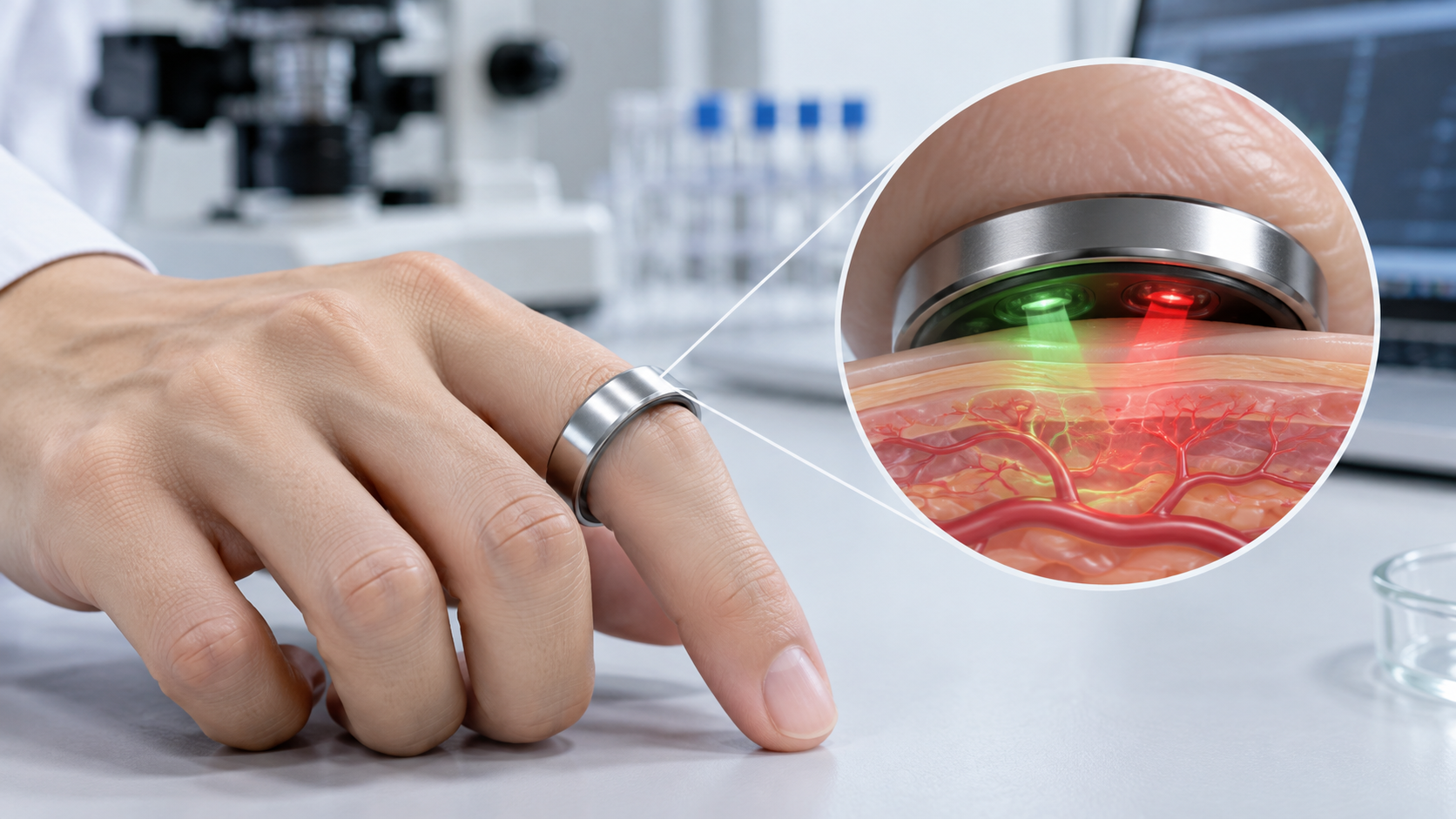
Oura describes the Oura Ring 5 sensor set as two triple LEDs (red, green, infrared), two photodetectors, a digital temperature sensor and an accelerometer. The exterior is fully titanium with a scratch-resistant physical vapor deposition (PVD) coating, and the inner shell is titanium, which the company calls "non-allergenic" Sourced. Because the body is 40% smaller than the Oura Ring 4, light paths became shorter, and the company says it "pushed the LEDs and PDs closer to the skin's surface and through the metallic layer". The height of the sensor dome rose from 0.3 mm to 0.7 mm Sourced. The company claims a pulse signal from the finger up to 100 times stronger than at the wrist, but we could not confirm the conditions for that ratio. The ring's challenges are thus passing light through a metal exterior, optimizing paths for different skin tones and finger sizes, and keeping a small battery long-lived, which are materials and packaging problems. Without FDA documents, we also could not find external regulatory review backing the performance Not yet confirmed.
6. What it has done so far
| When | What happened | Why it matters |
|---|---|---|
| More than a decade ago | Began in Finland and developed the smart ring (S-1: "more than a decade ago in Finland"). Research loan agreements with the public agency Business Finland date from 13 September 2014 | Started from measuring sleep and recovery with a ring |
| 2024 | Started Oura Labs (a venue for experimental member features) and made acquisitions (13 September for metabolic health, 30 September Human Engineering Health Oy, 31 October for technology). Oura's news list carries a September 2024 headline about acquiring "Veri" | Brought in people and technology in metabolic health (glucose and diet) |
| October 2024 | Launched the Oura Ring 4. The S-1 describes an "expanded sensor array and fully titanium construction" | A generational change in sensors and materials |
| 19 November 2024 | Dexcom made a US$75 million strategic investment in the Series D and a partnership on data links with its glucose biosensor. The announcement says the Oura Ring is "not a medical device and is not intended to diagnose, treat, cure, monitor or prevent" medical conditions (Dexcom) | For glucose, the ring takes in a partner's authorized product |
| 2025 | Raised about US$908 million of Series E in September 2025 (S-1). The Glucose feature in the Oura App (Stelo link, U.S. only) is offered (we could not confirm its start date) | Expanded the Dexcom link in the U.S. and financing |
| 20 October 2025 | Announced recruitment for the Blood Pressure Profile Study in Oura Labs (reports say it was run in consultation with the FDA, but we could not retrieve the announcement text) | Start of a validation study of an algorithm that indicates signs of hypertension |
| 17 December 2025 to 12 August 2026 | Blood Pressure Profile Study (ClinicalTrials.gov NCT07267871, a non-significant-risk device study). 382,200 participants | The S-1 says the study may support regulatory submissions |
| 6 January 2026 | The FDA revised "General Wellness: Policy for Low Risk Devices" (mentioned in the S-1 and Oura's blog) | The scope of wellness was clarified, including for estimating blood pressure and glucose. We did not verify the content against the FDA's own text |
| 28 May / 4 June 2026 | Announced the Oura Ring 5 (28 May) and launched it (4 June in the S-1). 40% smaller, fully titanium, PVD coating | An update to size, materials and optical design |
| 19 May to 21 September 2026 | Confidential draft submitted for the IPO (May), public S-1 (3 September), S-1/A (21 September). Reported postponed on 29 September | The S-1 is the main primary source for this article |
| 12 August 2026 | Enrollment in the Blood Pressure Profile Study ended. The company's blog published results (sensitivity 62%, specificity 91%) | The company's own analysis, not values reviewed by a regulator |
7. What comes next
Primary sources also contain the following Not yet confirmed.
- The S-1 says the company expects additional features it introduces to be regulated by the FDA and others as medical devices.
- The S-1 says some features under development could be Class IIa or higher under the EU MDR, requiring a notified body.
- The S-1 lists as risks that the FDA can later change its judgment on the wellness scope, and that the EU has no formal enforcement-discretion policy, so decisions are made country by country.
Whether and when a Blood Pressure Profile submission was made to the FDA; verification by regulator documents of individual features (sleep staging, temperature, blood oxygen); details of third-party certification for the Oura Ring 5 device itself; a breakdown of R&D by sensor and health area; sales and users by feature; the text of the 20 October 2025 announcement (Business Wire could not be retrieved); and the text of the IPO postponement announcement.
8. What the company is aiming for in biosensors
We separate what the company says directly from what we read into it. Inference marks our interpretation of primary sources; it is not something the company has said.
| What can be read | Primary evidence | Category |
|---|---|---|
| It keeps claims within "wellness" to add features faster | The S-1 treats most features as general wellness products and relies on the FDA's January 2026 revision. The CEO proposed a third category, "digital health screeners", in the Wall Street Journal (Oura's blog) | Sourced (the treatment) / Inference (the intent) |
| For features that amount to a medical device, it takes in a partner's authorized product or builds a body of validation first and then seeks a regulator's decision | Glucose comes from Dexcom Stelo. For blood pressure it ran an observational study of more than 380,000 people, and the S-1 says the data may support submissions | Sourced / Inference (what follows) |
| It layers health features on a hardware-plus-subscription revenue structure | In the nine months of fiscal 2026, membership fees were about 20% of revenue (US$240.5 million) | Sourced (about 20% is our calculation) |
| It also connects to hospital, insurance and drug pathways | The S-1 lists partnerships with LillyDirect (GLP-1), Resmed (sleep), Quest (blood tests) and Counsel Health (care) | Sourced (the partnerships) / Inference (the direction) |
| It does not offer diagnosis-like measurement of glucose or blood pressure as its own feature | The Glucose feature imports Stelo (Dexcom) data. The blood pressure profile is at study stage. On 21 February 2024 the FDA warned against smart rings and smartwatches that claim to measure blood glucose (no brand names given) | Sourced (the specification) / Inference (the policy) |
The reading that "for features that amount to a medical device, it takes in a partner's authorized product" rests on how the S-1 and Oura's support page are worded. The S-1 says that features of Dexcom and Natural Cycles are regulated as medical devices, and places them as features of collaborators offered on the Oura platform. Oura's support page says the Glucose feature is U.S. only, gives the reason as "regulatory clearance" for Stelo, and says sensors other than Stelo are not supported Sourced. The measurement of glucose itself is thus carried by Dexcom's FDA-cleared product, and Oura's role is to show the result alongside sleep, activity and stress Not yet confirmed.
9. Map of partnerships in biosensors
The partnerships and investments that Oura makes public are limited to those in the S-1/A, Dexcom's announcement and Oura's support pages. For manufacturing and components, the S-1 says only that Oura relies on a limited number of contract manufacturers and suppliers and sources semiconductors, sensors, batteries, flexible printed circuits, titanium and other parts from third parties, without naming them Sourced. We therefore cannot draw a material or component supply chain.
10. Technologies, products and services
We set out the configuration as described in company materials. Because conditions are not stated, we give no performance figures (except the company's published validation results, with their conditions).
| Element | What official materials list | Note |
|---|---|---|
| Optical sensors | Oura Ring 5: two triple LEDs (red, green, infrared) and two photodetectors. Green and infrared LEDs alternate to measure heart rate, heart rate variability and respiration; red and infrared LEDs measure blood oxygen (Oura's product page). The Ring 4 has three photodetectors (support page) | The company says the smaller size shortened light paths |
| Temperature and motion | A digital temperature sensor (body temperature trends) and an accelerometer (movement and activity) | Temperature is a trend, not an absolute value |
| Materials and form | Fully titanium, PVD coating. Width 6.09 mm, thickness 2.28 mm, sensor dome height 0.7 mm (Ring 4: 7.9 mm, about 2.88 mm, 0.3 mm). Waterproof to 100 m, IP68. Sizes 6-13. Weight from about 2 grams | The company calls the inner titanium shell "non-allergenic" |
| App and services | Oura App (paid membership): sleep, activity, readiness, stress, heart health, metabolic and women's health in more than 50 metrics. Health Radar (Symptom Radar, Blood Pressure Signals, Nighttime Breathing), Cardiovascular Age, Fertile Window, Glucose, and import of blood tests | Fertile Window is Class I medical device software in the EU |
| Validation results published by the company (with conditions) | Signs of hypertension: an algorithm developed from Blood Pressure Profile Study data showed sensitivity of 62% and specificity of 91%, with hypertension defined as a self-reported diagnosis plus average cuff readings in the hypertensive range (company article; more than 300,000 participants as of June 2026). Sleep apnea: in 339 participants (56 with diagnosed moderate-to-severe sleep apnea), against Type 1 attended polysomnography, sensitivity 76% and specificity 89%. Nocturnal blood pressure dipping: in 134 participants against 48-hour ambulatory monitoring, sensitivity 84% and specificity 69% | Values from the company's articles, not reviewed by a regulator. Whether they were peer reviewed could not be confirmed |
These values come from different studies with different references and populations, and they do not show which feature is better than another company's. Because wellness-category features have not undergone FDA premarket review, independent confirmation of their performance is limited Sourced.
An optical sensor emits light into the skin and receives what returns, so a metal exterior needs a light-transmitting window or a structure that passes through the metal layer. For the Ring 5, Oura says it moved the LEDs and photodetectors closer to the skin and through the metallic layer, and rotated the LEDs 180 degrees to shorten the paths Sourced. The skin-contact surfaces are the titanium inner shell (called non-allergenic by the company) and the sensor domes. The company says its "12 signal pathways" give accuracy "across a variety of fingers and skin tones", but we could not find data on performance by skin tone in the materials we read (unlike Apple and Samsung, whose FDA documents report results by skin tone) Not yet confirmed. The company says the battery was redesigned "chemically and mechanically" for the smaller size. The S-1 also records that battery performance issues in certain shipment cohorts of the Oura Ring 4 raised warranty reserves.
11. The risks this company carries
| Risk | Detail | Category |
|---|---|---|
| Risk that the wellness position changes | The S-1 notes that if current products or features are judged to be medical devices, FDA premarket review or EU CE marking could be required, and that FDA guidance is non-binding and may be revised | Sourced |
| Uncertainty of validation studies | Whether the blood pressure profile algorithm will obtain FDA clearance or approval is not settled. The S-1 says clinical studies are costly and time-consuming and their results uncertain | Sourced / Not yet confirmed |
| Dependence on manufacturing and parts | A limited number of contract manufacturers and suppliers, some single or limited source. It also cites the effect of tariffs on titanium and other metals | Sourced |
| Product quality and warranty | The S-1 records that warranty expense in fiscal 2025 rose by US$84.4 million from the prior year because of battery performance issues in certain cohorts of the Oura Ring 4 | Sourced (company disclosure, not a regulatory recall) |
| Intellectual property disputes | The S-1 cites a US$48.3 million increase in outside professional fees related to intellectual property litigation as the main driver of higher general and administrative expense in the nine months of fiscal 2026. Oura's news list carries a headline that the U.S. International Trade Commission ruled in Oura's favor in September 2025 | Sourced (details of the disputes not examined) |
| Difficulty of external verification | Most performance figures are the company's own data, not reviewed by a regulator or peer reviewers. With the IPO postponed, continuing public-company disclosure has not begun | Not yet confirmed |
| Recalls and safety communications | The openFDA medical device recall search showed no record for "Oura" (a different spelling could cause a miss) | Could not be confirmed |
12. Glossary
- General wellness product
- A low-risk product intended for general health or healthy habits that the FDA, under its policy, does not intend to examine as a medical device.
- 510(k) clearance / De Novo / PMA
- Three separate FDA pathways: substantial equivalence to an existing device; classification of a new type of low-to-moderate-risk device; and approval of high-risk devices.
- EU MDR Class I (self-certified)
- The lowest-risk class of the EU Medical Device Regulation, for which the manufacturer itself declares conformity without a notified body.
- Non-significant-risk device study
- A study of a device that does not present a significant risk to human health, run under abbreviated investigational-device requirements.
- PPG (photoplethysmography)
- A method that measures changes in blood volume from how light shone into the skin returns.
- PVD (physical vapor deposition)
- A coating process in which a thin hard film is deposited on a surface in vacuum; used here for scratch resistance.
- Sensitivity and specificity
- The share of people with a condition who are correctly flagged (sensitivity), and the share of people without it who are correctly not flagged (specificity).
- Form S-1
- The registration statement a company files with the SEC for an initial public offering; it discloses finances, risks and business in detail.
- Paid Members
- The company's own metric for members with an active paid membership.
13. References
- Oura Inc. Form S-1/A (SEC, 21 September 2026). Company profile, finances, employees, regulatory position, Blood Pressure Profile Study, partnerships, risks, manufacturing, acquisitions, public loans. https://www.sec.gov/Archives/edgar/data/2133022/000119312526396051/d119865ds1a.htm
- Oura How New FDA Guidance Unlocks Innovation at Oura (The Pulse Blog). The company's account of the FDA's 6 January 2026 revision of its general wellness policy. https://ouraring.com/blog/new-fda-guidance/
- ClinicalTrials.gov NCT07267871 Oura Blood Pressure Profile Study (lead sponsor Ouraring Inc.; non-significant-risk device observational study; 382,200 participants; 17 December 2025 to 12 August 2026). https://clinicaltrials.gov/study/NCT07267871
- Dexcom Dexcom and ŌURA Announce Strategic Partnership (19 November 2024). US$75 million strategic investment in the Series D, data link, statement that the ring is not a medical device. https://investors.dexcom.com/news/news-details/2024/Dexcom-and-URA-Announce-Strategic-Partnership/default.aspx
- Oura Stelo by Dexcom Integration (Oura Member Care, updated 1 October 2026). Glucose feature U.S. only; sensors other than Stelo not supported. https://support.ouraring.com/hc/en-us/articles/41171836791443-Stelo-by-Dexcom-Integration
- U.S. Food and Drug Administration (FDA) openFDA 510(k) API (search on device name "Stelo"; K234070, 5 March 2024, and others; applicant Dexcom, Inc.). https://api.fda.gov/device/510k.json?search=device_name:%22stelo%22&limit=5
- U.S. Food and Drug Administration (FDA) openFDA 510(k) API (search on applicant name "Oura" returned no match). https://api.fda.gov/device/510k.json?search=applicant:%22Oura%22&limit=20
- U.S. Food and Drug Administration (FDA) openFDA PMA API (no match for applicant "Oura"). https://api.fda.gov/device/pma.json?search=applicant:%22Oura%22&limit=3
- U.S. Food and Drug Administration (FDA) openFDA device recall API (no match for "Oura"). https://api.fda.gov/device/recall.json?search=recalling_firm:%22Oura%22&limit=3
- Oura Discover Oura Ring 5 (Oura Member Care). Sensor set, materials, dimensions, comparison with the Ring 4. https://support.ouraring.com/hc/en-us/articles/50997181300243-Discover-Oura-Ring-5
- Oura Meet Oura Ring 5 (product page). LED-based measurement, titanium, weight, Natural Cycles link. https://ouraring.com/store/rings/oura-ring-5
- Oura Inside the Ring: Building Oura Ring 5 (The Pulse Blog, 28 May 2026). Sensor design, titanium, PVD coating. https://ouraring.com/blog/inside-the-ring-oura-ring-5/
- Oura What PPG Can Reveal: New Cardiovascular and Respiratory Research Findings (The Pulse Blog). Validation results published by the company for hypertension, nocturnal blood pressure and sleep-disordered breathing. https://ouraring.com/blog/what-ppg-can-reveal-new-cardiovascular-and-respiratory-research-findings/
- Oura Blood Pressure Profile Study Now Available in Oura Labs (The Pulse Blog). https://ouraring.com/blog/new-blood-pressure-profile-study/
- ClinicalTrials.gov NCT06142097 Sensor Technology Assessments of Reproductive Target Study (lead sponsor Ouraring Inc.; 119 participants). https://clinicaltrials.gov/study/NCT06142097
- Oura Newsroom (the company's list of announcements). Headlines on the 2024 acquisition and 2025-2026 announcements. https://ouraring.com/newsroom
- Oura Official website ouraring.com (source of the logo image, specified as the logo in structured data). https://ouraring.com/
14. Claim-to-source audit
| Claim in the article | Category | Source |
|---|---|---|
| Legal name, headquarters, Nasdaq listing application, fiscal year, finances (revenue, gross profit, R&D, net income), rings sold, Paid Members, employees, patents, Series E | Sourced | Reference 1 https://www.sec.gov/Archives/edgar/data/2133022/000119312526396051/d119865ds1a.htm |
| S-1: view that most features are general wellness products, the risk that the FDA decides otherwise, Fertile Window's EU MDR Class I registration, expectation that future features will be regulated | Sourced | Reference 1 https://www.sec.gov/Archives/edgar/data/2133022/000119312526396051/d119865ds1a.htm |
| The company's account of the FDA's 6 January 2026 policy revision (treatment of blood pressure and glucose estimation) | Sourced | Reference 2 https://ouraring.com/blog/new-fda-guidance/ |
| Blood Pressure Profile Study (ClinicalTrials.gov; non-significant-risk device; 382,200 participants; 17 December 2025 to 12 August 2026) | Sourced | Reference 3 https://clinicaltrials.gov/study/NCT07267871 |
| Dexcom's US$75 million strategic investment in the Series D (19 November 2024), the data link, and the statement that the ring is not a medical device | Sourced | Reference 4 https://investors.dexcom.com/news/news-details/2024/Dexcom-and-URA-Announce-Strategic-Partnership/default.aspx |
| Glucose feature is U.S. only; sensors other than Stelo not supported | Sourced | Reference 5 https://support.ouraring.com/hc/en-us/articles/41171836791443-Stelo-by-Dexcom-Integration |
| Stelo (Dexcom) FDA 510(k) record (K234070, 5 March 2024) | Sourced | Reference 6 https://api.fda.gov/device/510k.json?search=device_name:%22stelo%22&limit=5 |
| No record under applicant name "Oura" in the openFDA 510(k), PMA and recall searches | Sourced | Reference 7 https://api.fda.gov/device/510k.json?search=applicant:%22Oura%22&limit=20 Reference 8 https://api.fda.gov/device/pma.json?search=applicant:%22Oura%22&limit=3 Reference 9 https://api.fda.gov/device/recall.json?search=recalling_firm:%22Oura%22&limit=3 |
| Oura Ring 5 sensor set (two triple LEDs, two photodetectors, temperature, accelerometer), materials (titanium, PVD), dimensions, sensor dome height, comparison with the Ring 4 | Sourced | Reference 10 https://support.ouraring.com/hc/en-us/articles/50997181300243-Discover-Oura-Ring-5 |
| LED-based measurement of blood oxygen and heart rate, weight, link with Natural Cycles | Sourced | Reference 11 https://ouraring.com/store/rings/oura-ring-5 |
| Ring 5 design (LEDs and photodetectors closer to the skin through the metal layer, LED rotation, reason for choosing titanium) | Sourced | Reference 12 https://ouraring.com/blog/inside-the-ring-oura-ring-5/ |
| Validation results published by the company: hypertension (sensitivity 62%, specificity 91%), nocturnal blood pressure dipping (134 participants), sleep apnea (339 participants) | Sourced | Reference 13 https://ouraring.com/blog/what-ppg-can-reveal-new-cardiovascular-and-respiratory-research-findings/ |
| Recruitment for the Blood Pressure Profile Study in Oura Labs | Sourced | Reference 14 https://ouraring.com/blog/new-blood-pressure-profile-study/ |
| Another study with Ouraring Inc. as lead sponsor (reproductive sensors, 119 participants) | Sourced | Reference 15 https://clinicaltrials.gov/study/NCT06142097 |
| Headlines of the 2024 acquisition and of the 2025-2026 announcements (Ring 5, IPO draft submission, IPO launch) | Sourced | Reference 16 https://ouraring.com/newsroom |
| Business Finland research loans, acquisition considerations (US$9.7 million, US$9.3 million, US$8.6 million), Series E of about US$908 million | Sourced | Reference 1 https://www.sec.gov/Archives/edgar/data/2133022/000119312526396051/d119865ds1a.htm |
| Postponement of the IPO (29 September 2026) | Not yet confirmed | The text of the company's release could not be retrieved (Business Wire refused access). Seen in several reports, but this article does not use press figures. Announcement text not confirmed |
| Text of the 20 October 2025 announcement (statement on consultation with the FDA) | Not yet confirmed | Business Wire refused access. Announcement text not confirmed. Only the blog (Reference 14) is used Reference 14 https://ouraring.com/blog/new-blood-pressure-profile-study/ |
| Whether a Blood Pressure Profile submission has been made to the FDA | Not yet confirmed | The S-1 does not say one has been made, and none was found in FDA databases. We do not claim it does not exist. Reference 1 https://www.sec.gov/Archives/edgar/data/2133022/000119312526396051/d119865ds1a.htm Reference 7 https://api.fda.gov/device/510k.json?search=applicant:%22Oura%22&limit=20 |
| Performance data by skin tone and similar subgroups for each feature | Not yet confirmed | Not stated in the materials we read. Could not be confirmed. Reference 1 https://www.sec.gov/Archives/edgar/data/2133022/000119312526396051/d119865ds1a.htm |
| Names of contract manufacturers and component suppliers | Not yet confirmed | No names in the S-1. Could not be confirmed. Reference 1 https://www.sec.gov/Archives/edgar/data/2133022/000119312526396051/d119865ds1a.htm |
| The framing that Oura extends within the wellness category and that features amounting to a medical device go through a partner's authorized product or a validation study | Our calculation | Our own framing, an interpretation of the S-1 (Reference 1) and the FDA search (Reference 7) |
| The four-type classification and the example company names | Our calculation | Our own classification; the companies are examples drawn from those covered in this series |
| Year-on-year growth in revenue (+123%, +74%) and membership fees as a share of revenue (about 20%) | Our calculation | Our own calculation from Reference 1 figures |
| Reading that it keeps claims within wellness to add features faster | Inference | This article's interpretation of the S-1 treatment and the company's blog (References 1, 2) |
| Reading that features amounting to a medical device are taken in from partners or built up through validation studies before a regulator's decision is sought | Inference | This article's interpretation of the Stelo link, the blood pressure observational study (References 3, 5) and the S-1 (Reference 1) |
| Reading that it also connects to hospital, insurance and drug pathways | Inference | This article's interpretation of the S-1's list of partnerships (Reference 1) |
| Reading that it does not offer diagnosis-like glucose or blood pressure measurement as its own feature | Inference | This article's interpretation of the Glucose feature specification (Reference 5) and the state of the blood pressure study (Reference 3) |
| The explanation that passing light through a metal exterior and miniaturization are the challenges | Not yet confirmed | This article's interpretation of the company's design descriptions (References 10, 12); the effect on performance could not be confirmed |
Last updated 3 October 2026 / Troy Technical
Figures in this article come from Oura Inc.'s Form S-1/A, FDA public data, ClinicalTrials.gov, Oura's website, support pages and blog, and Dexcom's announcement. No research-firm estimates or press-based figures have been used. Passages marked "Inference" are this article's interpretation of primary sources, not statements made by the company. This article is not medical advice for any individual reader.