COMPANY PROFILE / BIOSENSORS
PHC Holdings
A listed Japanese healthcare group that owns the CONTOUR blood glucose meter brand; it has sold its continuous glucose monitoring business and has just disclosed an initial takeover approach
PHC comes up in any discussion of biosensors because its subsidiary Ascensia Diabetes Care sells CONTOUR, an electrochemical blood glucose meter, in more than 90 countries and regions (per the company overview; the integrated report says "sold in more than 100"). In the fiscal year ended March 2026 (fiscal 2025), consolidated revenue was ¥364.4 billion. Diabetes Management accounted for ¥101.6 billion of it (about 28%) and ¥20.1 billion of the Group's ¥22.7 billion operating profit. PHC has also transferred its sales business for Eversense, an implantable continuous glucose monitoring (CGM) system, to Senseonics (completed in the United States on 1 January 2026), and so has stepped away from CGM. On 1 October 2026 the company disclosed that it had received a non-binding initial approach from Toho Holdings about acquiring its shares; it says nothing has been decided. This profile sets out what can be confirmed from official documents and what is not disclosed.
- PHC Holdings in 30 seconds, and where it stands in biosensors
- The logo and how the name is written
- Where the company sits in the field
- Scale
- Resources committed to biosensors
- What it has done so far
- What comes next
- What the company is aiming for in biosensors
- Map of partnerships in biosensors
- Technologies, products and services
- The risks this company carries
- Glossary, references and claim-to-source audit
1. PHC Holdings in 30 seconds, and where it stands in biosensors
(code 6523)A KKR-affiliated fund holds 37.96% of the voting rights (end of March 2026)
In vitro diagnostics & POCT (secondary)The CGM sales business has been transferred
Cardiac troponin I (chemiluminescence)CONTOUR and PATHFAST
PHC Holdings is best understood not as "a blood glucose specialist" but as "a broad healthcare group with three areas (diabetes, clinical testing and healthcare IT, and pathology and research instruments), whose biosensor core is Diabetes Management and its CONTOUR meters" Our calculation. Diabetes Management is about 28% of revenue but most of operating profit Sourced. However, sales of the glucose meters alone are not disclosed, and the revenue of the BGM (blood glucose monitoring) business inside Diabetes Management does not appear in the documents retrieved Not yet confirmed.
2. The logo and how the name is written

A note on names: the legal entity is PHC Holdings Corporation, and the group as a whole is called "PHC Group". It began as a healthcare business of the Panasonic group, was carved out of Panasonic in 2014, and adopted "PHC" as its corporate brand in 2018 (company overview). CONTOUR is the blood glucose meter brand of its subsidiary Ascensia Diabetes Care Holdings AG, and PATHFAST is the immunoassay analyzer brand of its subsidiary PHC Corporation; neither is a company name. The logo image (PHC GROUP) was taken from the company's official website. Its resolution is small (111 by 57 pixels).
Official site: https://www.phchd.com/jp3. Where the company sits in the field
4. Scale
The PHC Group has three business areas (Diabetes Management, Healthcare Solutions, and Diagnostics & Life Sciences), and about 60% of consolidated revenue comes from overseas. From the fiscal year ending March 2027 the company has renamed and reorganized some divisions (the BGM division becomes the Diabetes Management division, the LSIM division becomes the Clinical Testing division, and the Biomedical and Diagnostics divisions are merged into the Life Sciences division) Sourced.
| Indicator (¥ million) | FY ended March 2025 | FY ended March 2026 | Change |
|---|---|---|---|
| Consolidated revenue | 361,593 | 364,403 | +0.8% |
| Operating profit | 22,580 | 22,688 | +0.5% |
| Profit attributable to owners of the parent | 10,485 | 492 | -95.3% (pre-tax profit fell, including foreign exchange losses) |
| Diabetes Management revenue | - | 101,581 | +2.9% |
| Diabetes Management operating profit | - | 20,085 | +44.6% |
| Healthcare Solutions revenue / operating profit | - | 128,389 / 6,234 | +0.1% / -32.8% |
| Diagnostics & Life Sciences revenue / operating profit | - | 128,323 / 3,893 | -2.0% / -46.3% |
In the first quarter of the fiscal year ending March 2027 (April-June 2026), revenue was ¥90.67 billion (+8.1%) and operating profit ¥10.41 billion (+171.0%). Diabetes Management revenue was ¥27.81 billion (+20.2%) and its operating profit ¥9.18 billion (+132.2%); the company cites the improvement from transferring the CGM business, among other factors. The Group had 8,647 employees (3,771 overseas; March 2026) and capital of ¥48.785 billion Sourced.
Diabetes Management used to include both the BGM and CGM businesses, but the US part of the CGM transfer was completed on 1 January 2026, and from the fourth quarter (January-March 2026) there is no effect on revenue (earnings report). The earnings report also says that the developed-market BGM market keeps shrinking and shifting to low-price channels. Revenue and profit for the BGM business alone are not disclosed, and this article does not estimate them Not yet confirmed.
5. Resources committed to biosensors
PHC discloses R&D spending and capital expenditure for the Group as a whole. Figures for glucose meters or diagnostic instruments alone, and the number of R&D staff, are not disclosed.
| Resource | What primary sources confirm | Category |
|---|---|---|
| People | The Group had 8,647 employees (3,771 overseas; March 2026) and 80 group companies. Diabetes Management manufactures in Japan and Indonesia (company overview). R&D headcount and Diabetes Management headcount are not disclosed | Sourced / partly undisclosed |
| Money (R&D and investment) | Group R&D spending was ¥10.7 billion (FY ended March 2025; ¥12.0 billion a year earlier), capital expenditure ¥11.6 billion (¥14.6 billion a year earlier) and depreciation ¥27.9 billion (integrated report data). R&D spending for the FY ended March 2026 could not be confirmed in the documents retrieved; the figure for Diabetes Management alone is not disclosed | Sourced / partly not confirmed |
| Acquisitions, investments, divestments | Acquired Bayer AG's diabetes care business and set up Ascensia Diabetes Care Holdings AG (2016; amount not checked here). Acquired Thermo Fisher Scientific's pathology business and set up Epredia Holdings (2019). On 4 September 2025 it signed a memorandum on transferring the Eversense (CGM) sales business to Senseonics; the board resolved on the transfer on 1 January 2026 and the US part was completed that day. The price is US$1.1 million plus the net assets at completion in each European country. For the transferred business, fiscal 2024 (year to March 2025) revenue was ¥3.06 billion and operating result -¥9.00 billion (unaudited) | Sourced |
| Universities, research institutions, public funding | The integrated report, earnings reports and company overview name no university or public grant relating to biosensors, and give no amounts. The CGM was Senseonics' sensor, sold under a sales agreement rather than co-developed | Not found |
| Restructuring | In autumn 2024 it announced "Medium-Term Management Plan 2027": structural reform to strengthen the earnings base, stronger portfolio management (growth and ROIC by business), and a focus on Diagnostics & Life Sciences. The effect expected in fiscal 2027 versus fiscal 2024 is ¥8 to 12 billion from profitability and ¥2 to 3 billion from capital efficiency (company target) | Sourced / Not yet confirmed |
Regulatory status (as far as could be confirmed)
For the United States, entries were checked against the FDA 510(k) database (updated 21 September 2026) and decision documents. Thirteen records list Ascensia as applicant. All are 510(k) clearances; none is a PMA approval or De Novo authorization. Status in Japan and the EU has not been confirmed here Sourced.
| Product | Use (summary of the FDA document) | Category and date | Number |
|---|---|---|---|
| CONTOUR PLUS BLUE / CONTOUR NEXT GEN / CONTOUR NEXT ONE | Quantifies glucose in fresh capillary whole blood from the fingertip or palm. For use at home by one person with diabetes to check the effectiveness of a diabetes control program. Not to be shared; not for diagnosing or screening for diabetes or for neonates. An amperometric biosensor measuring glucose in whole blood in five seconds (the manufacturer's 510(k) summary). The 2026 submission concerns changes to the smartphone app (CONTOUR DIABETES App): user interface, data management and cloud integration | 510(k) clearance (Traditional), Class II (21 CFR 862.1345). 27 August 2026 | K260545 |
| CONTOUR PLUS BLUE / NEXT GEN (earlier), CONTOUR NEXT ONE (first) | Database registration details only (use statements not checked) | 510(k) clearance. 27 August 2024 (K241787); 11 August 2021 (K210687, Special); 17 November 2016 (K160682) | K241787 / K210687 / K160682 |
| PATHFAST hs-cTnI-II | An in vitro diagnostic test for quantitative measurement of cardiac troponin I in heparinized or EDTA whole blood and plasma, as an aid in diagnosing acute myocardial infarction. For use in clinical laboratory or point-of-care (POC) settings; not for risk stratification. Chemiluminescent enzyme immunoassay (magnetic particles with antibody, alkaline phosphatase label) | 510(k) clearance (Traditional), Class II (21 CFR 862.1215). 20 March 2024. Applicant PHC Corporation | K231974 |
| Eversense (CGM) | PHC (Ascensia) transferred the sales business to Senseonics. The FDA documents belong to the manufacturer Senseonics, so they are not covered here | US part of the transfer completed 1 January 2026 (timely disclosure) | - |
The status of the glucose meters and PATHFAST in Japan, and under the EU In Vitro Diagnostic Regulation (IVDR), could not be confirmed here Not yet confirmed. For regulatory categories and how they differ from home use, see our explainer on medical device approval categories and home use.
PHC lists electrochemical biosensing technology among the "core technologies" in its integrated report. According to the company overview, the technology is used not only in glucose meter strips (CONTOUR) but also in an in-line sensor that measures cell metabolism inside a cell-culture instrument (a live-cell metabolic analyzer) Sourced. From a materials standpoint, the combination of enzyme, mediator and electrode has to be tuned either to blood, a thick and variable sample, or to culture medium, a quite different one Not yet confirmed. The CGM "Eversense", meanwhile, used a patented optical sensor implanted under the skin (integrated report), a different family from electrochemical strips. Its sales business has been transferred to Senseonics. However, the electrode materials, enzymes and mediator of the CONTOUR strip are not given in the documents retrieved. See our explainers on enzyme and electrode interface materials, electrochemical sensors and implantable sensors.
6. What it has done so far
| When | Event | Meaning |
|---|---|---|
| 1969 | Established as Matsushita Kotobuki Electronics (company history). The same year, a portable blood glucose meter is listed as an industry first (Diabetes Management introduction) | The industry first listed in the Diabetes Management introduction; the document does not say which company made it |
| 1991 | Launched an electrochemical, auto-aspirating blood glucose measurement system (an industry first, per the company) | The technical base of PHC Corporation's glucose measurement |
| 2003 | Launched CONTOUR, described as the first self-monitoring meter using "No Coding" technology (company statement) | The current core brand |
| 2014 | Carved out of the Panasonic group and began business as Panasonic Healthcare Holdings | The start of reorganization under a fund (KKR) |
| 2016 | Acquired Bayer AG's diabetes care business and set up Ascensia Diabetes Care Holdings AG | Acquired CONTOUR |
| 2018 | Changed the corporate brand to "PHC" | - |
| 2019 | Acquired Thermo Fisher Scientific's pathology business and set up Epredia Holdings | Pathology (not biosensors) |
| 14 October 2021 | Newly listed on the Tokyo Stock Exchange (company overview) | - |
| 20 March 2024 | PATHFAST hs-cTnI-II received FDA 510(k) clearance | A high-sensitivity cardiac troponin I immunoassay that can also be used at the point of care |
| October 2024 | Launched Eversense 365 in the United States, described by the company as the world's only CGM usable for one year | A new CGM product, yet the business was transferred a year later |
| Autumn 2024 | Announced "Medium-Term Management Plan 2027" | Structural reform, portfolio management, focus on Diagnostics & Life Sciences |
| 4 September 2025 | Signed a memorandum on transferring the Eversense sales business to Senseonics | The company cites investment efficiency |
| 1 January 2026 | The board resolved on the transfer, and the US part was completed | Stepped away from CGM |
| 13 May 2026 | Announced results for the year ended March 2026. Diabetes Management operating profit +44.6% | Solid BGM sales and the effect of the CGM transfer |
| 27 August 2026 | CONTOUR PLUS BLUE / NEXT GEN / NEXT ONE received 510(k) clearance (app changes) | - |
| 2 September 2026 | Mitsui & Co. sold part of its holding and ceased to be a major shareholder (11.05% to 9.92%) | A change in the shareholder base |
| 1 October 2026 | Responding to press reports, the company disclosed that it had received a non-binding initial approach from Toho Holdings. Nothing has been decided | Company disclosure. Whether a deal will happen is unknown |
7. What comes next
The primary sources also describe the following plans Not yet confirmed.
- Structural reform under Medium-Term Management Plan 2027 (fiscal 2025-2027). The effect in fiscal 2027 versus fiscal 2024 is ¥8 to 12 billion from profitability and ¥2 to 3 billion from capital efficiency (company target)
- For BGM, the company expects more share gains in Europe and North America, but the effect of shrinking developed markets will continue. The integrated report says narrowing the revenue decline during the plan is the main task
- The company divides the period to 2030 into two phases; Phase 2 (fiscal 2028-2030) is to deliver growth centered on Diagnostics & Life Sciences
Revenue and profit of the BGM business alone / glucose meter unit volumes / R&D spending for the year ended March 2026 / R&D headcount / the status of CONTOUR and PATHFAST in Japan and the EU / the materials and enzymes of the CONTOUR strip / the terms of Toho Holdings' approach. None appears in the official documents retrieved.
8. What the company is aiming for in biosensors
This section separates what the company says it is aiming for from what this article reads into the record. Inference marks interpretation drawn by this article from primary sources.
| What can be read | Primary source behind it | Category |
|---|---|---|
| It keeps BGM as a cash-generating base business | The integrated report places BGM among the "base businesses" and says the aim is to narrow the decline in a shrinking market and generate cash steadily | Sourced (company explanation) |
| It has stopped investing in CGM | It transferred the Eversense sales business, saying continued investment would be needed for further growth (1 January 2026) | Sourced (company explanation) |
| It puts the growth axis on Diagnostics & Life Sciences | Priority measure 3 of Medium-Term Management Plan 2027. Electrochemical biosensing is among the core technologies | Sourced (company explanation) |
| It is combining the CONTOUR brand with digital | It obtained FDA clearance in 2026 for changes to the app (CONTOUR DIABETES App) | Sourced |
| It received a takeover approach (as one option for raising corporate value) | The company's disclosure says it received the approach as one option for raising corporate value, and that nothing has been decided | Sourced (company explanation) / Inference (what follows) |
That "the company stopped investing in CGM" is the company's own explanation, not an inference; how its stated reason should be read is the inference. The company says Eversense 365, launched in the United States in October 2024, delivered growth, and yet it decided to transfer the business Sourced. For the transferred business in the year to March 2025, revenue was ¥3.06 billion against an operating result of -¥9.00 billion (unaudited). That large loss can be read as the background to the "investment efficiency" explanation Not yet confirmed. However, the company does not name the loss as the reason, and the price (US$1.1 million plus net assets) is small, so it cannot be said to reflect a high valuation of the business.
9. Map of partnerships in biosensors
PHC Corporation's company overview lists, among its OEM supply to domestic partners, ARKRAY, Inc. as the delivery destination of a self-monitoring blood glucose system and Sanwa Kagaku Kenkyusho as the destination of a hospital and clinic blood glucose system and of lancing devices and lancets; in Diagnostics & Life Sciences it lists Roche Diagnostics as the destination of a POC biochemistry analyzer (HbA1c, lipids and CRP) Sourced. It also supplies electric drug injectors to JCR Pharmaceuticals, Pfizer and Teijin Pharma, and an exhaled nitric oxide analyzer to NIOX. The suppliers of parts for the CONTOUR strips are not named in the documents retrieved. Eversense's sensor was developed and made by Senseonics and sold by Ascensia (integrated report). The KKR-affiliated fund is a shareholder, not a technology partner.
10. Technologies, products and services
The company overview divides the business into Diabetes Management, Healthcare Solutions, and Diagnostics & Life Sciences. The table focuses on those closest to biosensors. All figures are manufacturer's stated values (from FDA submissions or company materials); test conditions and editions differ, so no ranking is made between products, or against other companies' products Sourced.
| Category | What the official sources say | Comment |
|---|---|---|
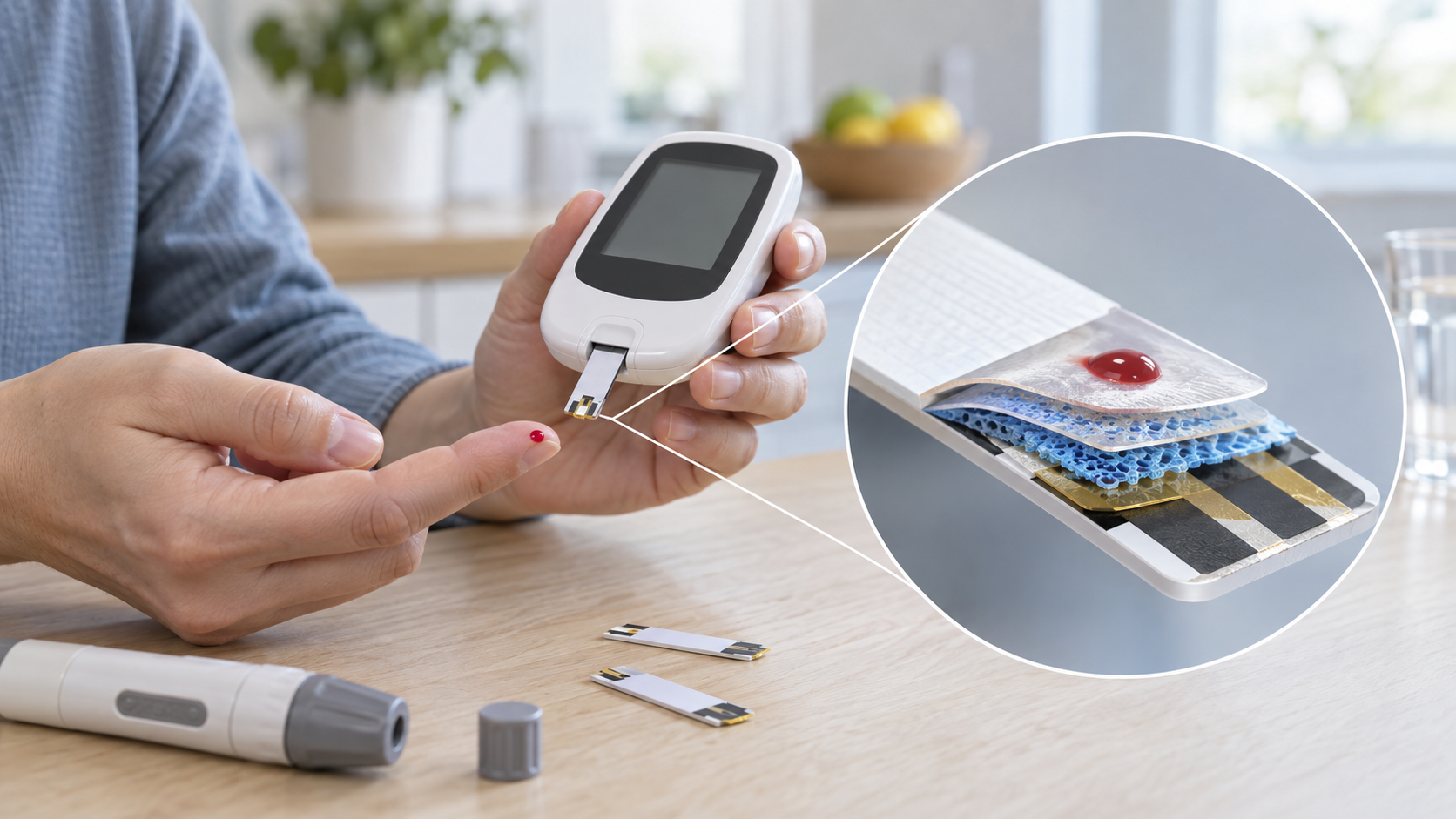
| Diabetes: CONTOUR blood glucose meters | CONTOUR PLUS BLUE, CONTOUR NEXT GEN and CONTOUR NEXT ONE. An amperometric biosensor that measures glucose in whole blood in five seconds (the FDA submission summary). Bluetooth transfer of readings to a smartphone app (CONTOUR DIABETES App); a color indicator for readings above, within or below the target range (smartCOLOR). The company says it sells in more than 100 countries and regions to about 10 million people (integrated report; the overview says 90 or more) | Manufacturer's stated values. How to read an individual's reading is a matter for their healthcare professional |
| Diabetes: digital management | A diabetes management solution for patients, caregivers and healthcare professionals to share data (company overview) | Links the meter to an app |
| Diabetes: Eversense (CGM) | An implantable optical sensor usable for up to one year (Eversense 365). Developed by Senseonics and sold by Ascensia. The sales business was transferred to Senseonics on 1 January 2026 (the US part the same day) | No longer a PHC product |
| Diagnostics: PATHFAST | A mobile immunoluminescence analyzer for markers of heart disease, sepsis and gonadal function. For hs-cTnI-II, a sample goes into a reagent cartridge and is incubated for five minutes; unbound reagent is removed with magnetic particles; then the light emitted is measured. One kit gives 60 determinations (FDA summary). Sold in the U.S. through a distributor (integrated report) | Manufacturer's stated values. For clinical laboratory or POC use |
| Diagnostics: reagents and OEM | Latex agglutination reagents (the first instrument was in 1982), a fully automated coagulation system, and rapid influenza and COVID-19 test reagents. OEM supply of a POC biochemistry analyzer (HbA1c, lipids, CRP) to Roche | Diagnostic reagent revenue fell 7.6% in the year to March 2026 |
| Research and pathology | CO2 incubators, ultra-low-temperature freezers, a live-cell metabolic analyzer for cell culture (its own in-line sensor), and pathology instruments and consumables (Epredia) | Biosensor technology applied to cell culture |
| Healthcare Solutions | Clinical testing (LSI Medience), electronic medical records and claims software (Wemex), and clinical-trial and non-clinical studies (Mediford) | Not sensor products; about 35% of consolidated revenue (our calculation) |
According to the FDA summary for PATHFAST hs-cTnI-II, antibody-coated magnetic particles capture cardiac troponin I in the sample, an alkaline phosphatase-labeled antibody binds, a magnetic step removes unbound material (Magtration technology), and a photomultiplier tube then counts the light given off by a chemiluminescent substrate (CDP-Star) Sourced. From a materials standpoint, how antibodies are immobilized on the particle surface, how well the particles resist aggregation, and the stability of the substrate and enzyme bear on sensitivity and reproducibility Not yet confirmed. The CONTOUR strip is electrochemical and PATHFAST is luminescent: one company, two different detection methods. For neither are the specific materials of the strip or particles given in the documents retrieved. For the underlying ideas on immunoassay materials, see our explainers on biomarkers in body fluids and on label-free detection and limits of detection.
11. The risks this company carries
| Risk | Detail | Category |
|---|---|---|
| A shrinking BGM market | The earnings report says the developed-market BGM market keeps shrinking and shifting to low-price channels. The integrated report says the end of a US sales collaboration cut revenue by more than the market trend | Sourced |
| Effect of exiting CGM | The CGM sales business has been transferred and has no effect on revenue from April 2026. For the year to March 2027, Diabetes Management revenue is forecast to fall because of the CGM transfer | Sourced (company forecast) |
| Takeover approach and shareholder base | An initial approach from Toho Holdings was received (nothing decided). A KKR-affiliated fund holds 37.96% of voting rights, and Mitsui & Co. ceased to be a major shareholder in September 2026. The effect on strategy and businesses cannot be confirmed at present | Not yet confirmed |
| Currency and tariffs | Pre-tax profit for the year to March 2026 fell 66.1%, including foreign exchange losses. Diagnostics & Life Sciences profit fell on about ¥1.0 billion of US tariff effects; tariff refunds helped the first quarter of the year to March 2027 | Sourced |
| Subsidiary compliance incident | In December 2023 the company disclosed an improper quality-control matter at the central laboratory of its subsidiary LSI Medience; in July 2024 it disclosed the cancellation of ISO 15189 accreditation, and in December 2025 its reacquisition (titles of timely disclosures). Not a biosensor product matter | Sourced (titles and dates only) |
| Profit concentration | Of operating profit of ¥22.7 billion in the year to March 2026, Diabetes Management accounted for ¥20.1 billion. The other two areas together were about ¥10.1 billion (with corporate and other adjustments) | Sourced (our arrangement) |
| Hard to verify | Revenue and profit of the BGM business alone, and R&D spending for diabetes and diagnostics, are not disclosed | Not yet confirmed |
12. Glossary
- BGM (blood glucose monitoring)
- Measuring blood glucose from a small blood sample, usually from a fingertip, with a meter and a single-use strip (sensor). How to read results and use them in treatment depends on the instructions of a healthcare professional.
- CGM (continuous glucose monitoring)
- A system in which a sensor worn on or implanted in the body measures a glucose-related value continuously.
- Amperometry
- A method in which a voltage is applied to an electrode and concentration is derived from the current that flows in the reaction. Widely used in glucose meters.
- OEM supply
- Making a product and delivering it to be sold as another company's product.
- Chemiluminescent enzyme immunoassay
- A method that captures the target with antibodies and measures its amount from the light produced by an enzyme reaction. Used in PATHFAST.
- High-sensitivity troponin I (hs-cTnI)
- A test that measures a heart-muscle protein in the blood from very low concentrations. How to read the result is a matter for healthcare professionals.
- POC (point of care)
- Testing performed near the patient. Results come quickly, but quality control and record-keeping have to be organized separately.
- 510(k) clearance
- The U.S. FDA route for devices found substantially equivalent to a device already on the market. Distinct from PMA approval and De Novo authorization.
- IFRS / adjusted EBITDA
- The international accounting standard PHC reports under, and a profit measure that excludes one-off items. Adjusted EBITDA is not an IFRS measure.
- ROIC
- Return on invested capital. A measure PHC uses to position each business.
- Carve-out
- Separating part of a company so that it can operate independently.
13. References
- PHC Holdings Earnings Report for the fiscal year ended March 2026, IFRS, consolidated (13 May 2026; in Japanese). Consolidated results, revenue and operating profit by segment, forecast for the year to March 2027 and the change in business classification. https://www2.jpx.co.jp/disc/65230/140120260512525855.pdf
- PHC Holdings Earnings Report for the first quarter of the fiscal year ending March 2027, IFRS, consolidated (6 August 2026; in Japanese). First-quarter revenue and operating profit, and Diabetes Management. https://www2.jpx.co.jp/disc/65230/140120260730503873.pdf
- PHC Holdings Notice of the memorandum on transferring a consolidated subsidiary's business (4 September 2025; in Japanese). The Eversense sales business, its revenue and operating result, and the reasons. https://www2.jpx.co.jp/disc/65230/140120250820544998.pdf
- PHC Holdings Notice on the progress of a disclosed matter: transfer of a consolidated subsidiary's business (5 January 2026; in Japanese). The resolution and the price. https://www2.jpx.co.jp/disc/65230/140120260105528388.pdf
- PHC Holdings Notice regarding certain press reports about the company (1 October 2026; in Japanese). Receipt of an initial approach from Toho Holdings. https://www2.jpx.co.jp/disc/65230/140120260930543785.pdf
- PHC Holdings Notice on matters concerning controlling shareholders (12 June 2026; in Japanese). KKR PHC Investment L.P. at 37.96% of voting rights as of 31 March 2026. https://www2.jpx.co.jp/disc/65230/140120260528552357.pdf
- PHC Holdings Notice of a change in a major shareholder (2 September 2026; in Japanese). Change in Mitsui & Co.'s holding. https://www2.jpx.co.jp/disc/65230/140120260821524633.pdf
- PHC Holdings PHC GROUP Integrated Report 2025 (in Japanese). Medium-Term Management Plan 2027, positioning of businesses, R&D spending and capital expenditure, descriptions of CONTOUR and Eversense, core technologies. https://www.phchd.com/~/Media/phchd/sustainability/integratedreport2025/pdf/integratedreport2025.pdf
- PHC Holdings PHC Group Company Overview (presentation issued May 2026; in Japanese). History, headcount, business areas, OEM partnerships (ARKRAY, Sanwa Kagaku Kenkyusho, Roche Diagnostics and others) and the live-cell metabolic analyzer. https://www.phchd.com/jp/~/Media/phchd/about/PHC_Group_Overview_Presentation_Slide.pdf
- PHC Holdings Company overview (official website; in Japanese). Consolidated revenue, headcount and number of group companies. https://www.phchd.com/jp/about/overview
- PHC Holdings Stock information (official website; in Japanese). Listing on the Tokyo Stock Exchange Prime Market, code 6523. https://www.phchd.com/jp/ir/overview
- U.S. Food and Drug Administration 510(k) K260545 "CONTOUR PLUS BLUE, CONTOUR NEXT GEN, CONTOUR NEXT ONE Blood Glucose Monitoring Systems": clearance letter and summary (27 August 2026). Use, measurement principle (amperometric biosensor) and five seconds. https://www.accessdata.fda.gov/cdrh_docs/pdf26/K260545.pdf
- U.S. Food and Drug Administration 510(k) K231974 "PATHFAST hs-cTnI-II": clearance letter and summary (20 March 2024). Use and measurement principle (chemiluminescent enzyme immunoassay). https://www.accessdata.fda.gov/cdrh_docs/pdf23/K231974.pdf
- U.S. Food and Drug Administration (openFDA) 510(k) database API (thirteen records with Ascensia in the applicant name; the database was last updated on 21 September 2026). Registration details for K241787, K210687, K160682 and others. https://api.fda.gov/device/510k.json?search=applicant:Ascensia&limit=20
- PHC Holdings Official website (source of the logo image; in Japanese). https://www.phchd.com/jp
14. Claim-to-source audit
| Claim in the text | Category | Source |
|---|---|---|
| Legal name, listing on the Tokyo Stock Exchange Prime Market (code 6523), establishment in 1969, capital of ¥48.785 billion | Sourced | Reference 9 https://www.phchd.com/jp/~/Media/phchd/about/PHC_Group_Overview_Presentation_Slide.pdf Reference 11 https://www.phchd.com/jp/ir/overview |
| Consolidated revenue of ¥364.4 billion, operating profit of ¥22.7 billion, profit attributable to owners of the parent of ¥0.49 billion (year to March 2026) | Sourced | Reference 1 https://www2.jpx.co.jp/disc/65230/140120260512525855.pdf |
| Diabetes Management revenue of ¥101.6 billion (+2.9%) and operating profit of ¥20.1 billion (+44.6%); segment figures for Healthcare Solutions and Diagnostics & Life Sciences | Sourced | Reference 1 https://www2.jpx.co.jp/disc/65230/140120260512525855.pdf |
| Diabetes Management at about 28% of consolidated revenue and Healthcare Solutions at about 35% | Our calculation | Our own division (segment revenue / consolidated revenue). The company does not disclose these shares |
| First-quarter revenue of ¥90.67 billion (+8.1%) and operating profit of ¥10.41 billion; Diabetes Management revenue of ¥27.81 billion (+20.2%) and operating profit of ¥9.18 billion | Sourced | Reference 2 https://www2.jpx.co.jp/disc/65230/140120260730503873.pdf |
| 8,647 employees (3,771 overseas), 80 group companies, overseas share of 58% (March 2026) | Sourced | Reference 9 https://www.phchd.com/jp/~/Media/phchd/about/PHC_Group_Overview_Presentation_Slide.pdf Reference 10 https://www.phchd.com/jp/about/overview |
| The shrinking BGM market and shift to low-price channels, and the effect of the end of a US sales collaboration | Sourced | Reference 1 https://www2.jpx.co.jp/disc/65230/140120260512525855.pdf Reference 8 https://www.phchd.com/~/Media/phchd/sustainability/integratedreport2025/pdf/integratedreport2025.pdf |
| Revenue and profit of the BGM business alone; Diabetes and diagnostics R&D spending; R&D headcount; named universities or public grants | Not yet confirmed | Not in References 1 and 8. Undisclosed or not found; not estimated in this article Reference 1 https://www2.jpx.co.jp/disc/65230/140120260512525855.pdf Reference 8 https://www.phchd.com/~/Media/phchd/sustainability/integratedreport2025/pdf/integratedreport2025.pdf |
| R&D spending of ¥10.7 billion, capital expenditure of ¥11.6 billion and depreciation of ¥27.9 billion (year to March 2025) | Sourced | Integrated report data. Reference 8 https://www.phchd.com/~/Media/phchd/sustainability/integratedreport2025/pdf/integratedreport2025.pdf |
| Acquisition of Bayer AG's diabetes care business and creation of Ascensia (2016); acquisition of Thermo Fisher's pathology business and creation of Epredia (2019); the 2014 carve-out; the 2018 brand change; listing on 14 October 2021 | Sourced | Reference 9 https://www.phchd.com/jp/~/Media/phchd/about/PHC_Group_Overview_Presentation_Slide.pdf |
| Transfer of the Eversense sales business to Senseonics (memorandum 4 September 2025; resolution and US completion 1 January 2026; price US$1.1 million plus net assets) | Sourced | Reference 3 https://www2.jpx.co.jp/disc/65230/140120250820544998.pdf Reference 4 https://www2.jpx.co.jp/disc/65230/140120260105528388.pdf |
| Revenue of ¥3.06 billion and operating result of -¥9.00 billion for the transferred business (year to March 2025, unaudited) | Sourced | Company disclosure. Reference 3 https://www2.jpx.co.jp/disc/65230/140120250820544998.pdf Reference 4 https://www2.jpx.co.jp/disc/65230/140120260105528388.pdf |
| Launch of Eversense 365 in the United States (October 2024), the Senseonics-developed and Ascensia-sold relationship, and the patented optical sensor | Sourced | Reference 3 https://www2.jpx.co.jp/disc/65230/140120250820544998.pdf Reference 8 https://www.phchd.com/~/Media/phchd/sustainability/integratedreport2025/pdf/integratedreport2025.pdf |
| Receipt of a non-binding initial approach from Toho Holdings (1 October 2026); nothing decided | Not yet confirmed | Company disclosure. Whether a deal will happen is unknown. Reference 5 https://www2.jpx.co.jp/disc/65230/140120260930543785.pdf |
| KKR PHC Investment L.P. at 37.96% of voting rights (end of March 2026) | Sourced | Reference 6 https://www2.jpx.co.jp/disc/65230/140120260528552357.pdf |
| Change in Mitsui & Co.'s holding (11.05% to 9.92%, 2 September 2026) | Sourced | Reference 7 https://www2.jpx.co.jp/disc/65230/140120260821524633.pdf |
| Forecast for the year to March 2027 (revenue ¥359.7 billion, operating profit ¥27.0 billion, adjusted EBITDA ¥53.6 billion) and the Diabetes Management outlook | Not yet confirmed | Reference 1 https://www2.jpx.co.jp/disc/65230/140120260512525855.pdf |
| Priorities of Medium-Term Management Plan 2027, the fiscal 2027 effect (¥8 to 12 billion from profitability and ¥2 to 3 billion from capital efficiency) and the Phase 2 policy | Not yet confirmed | Company target. Reference 8 https://www.phchd.com/~/Media/phchd/sustainability/integratedreport2025/pdf/integratedreport2025.pdf |
| OEM delivery destinations (ARKRAY, Sanwa Kagaku Kenkyusho, Roche Diagnostics, JCR Pharmaceuticals, Pfizer, Teijin Pharma, NIOX) | Sourced | Stated in PHC's company overview. Reference 9 https://www.phchd.com/jp/~/Media/phchd/about/PHC_Group_Overview_Presentation_Slide.pdf |
| FDA 510(k) clearance of CONTOUR (K260545, 27 August 2026, Class II, 21 CFR 862.1345), home use by one person, amperometric biosensor, five seconds, app changes | Sourced | Manufacturer's 510(k) summary. Reference 12 https://www.accessdata.fda.gov/cdrh_docs/pdf26/K260545.pdf |
| CONTOUR NEXT ONE (K160682, K210687), K241787 and other Ascensia records (thirteen in total) | Sourced | Database registration details only; use statements not checked. Reference 14 https://api.fda.gov/device/510k.json?search=applicant:Ascensia&limit=20 |
| FDA 510(k) clearance of PATHFAST hs-cTnI-II (K231974, 20 March 2024, Class II, 21 CFR 862.1215), use, chemiluminescent enzyme immunoassay | Sourced | Reference 13 https://www.accessdata.fda.gov/cdrh_docs/pdf23/K231974.pdf |
| Number of countries where CONTOUR is sold (the overview says 90 or more; the integrated report says 100 or more) and about 10 million people | Sourced | Manufacturer's stated values. The two documents word the country count differently. Reference 8 https://www.phchd.com/~/Media/phchd/sustainability/integratedreport2025/pdf/integratedreport2025.pdf Reference 9 https://www.phchd.com/jp/~/Media/phchd/about/PHC_Group_Overview_Presentation_Slide.pdf |
| Status of CONTOUR and PATHFAST in Japan and the EU | Not yet confirmed | Not in the documents retrieved. Not confirmed Reference 1 https://www2.jpx.co.jp/disc/65230/140120260512525855.pdf Reference 8 https://www.phchd.com/~/Media/phchd/sustainability/integratedreport2025/pdf/integratedreport2025.pdf |
| Electrochemical biosensing as a core technology, also used in an in-line cell-culture sensor | Sourced | Reference 8 https://www.phchd.com/~/Media/phchd/sustainability/integratedreport2025/pdf/integratedreport2025.pdf Reference 9 https://www.phchd.com/jp/~/Media/phchd/about/PHC_Group_Overview_Presentation_Slide.pdf |
| Live-cell metabolic analyzer, POC analyzer OEM supply to Roche, and the 7.6% decline in diagnostic reagents | Sourced | Reference 1 https://www2.jpx.co.jp/disc/65230/140120260512525855.pdf Reference 9 https://www.phchd.com/jp/~/Media/phchd/about/PHC_Group_Overview_Presentation_Slide.pdf |
| LSI Medience quality-control matter (December 2023), cancellation of ISO 15189 accreditation (July 2024) and its reacquisition (December 2025) | Sourced | Titles and dates of timely disclosures only. Reference 1 https://www2.jpx.co.jp/disc/65230/140120260512525855.pdf |
| Pre-tax profit down 66.1% including foreign exchange losses; about ¥1.0 billion of US tariff effects on Diagnostics & Life Sciences | Sourced | Reference 1 https://www2.jpx.co.jp/disc/65230/140120260512525855.pdf |
| The reading that the large loss lies behind the reason given for exiting CGM | Inference | This article's interpretation. The company does not name the loss as the reason. Reference 3 https://www2.jpx.co.jp/disc/65230/140120250820544998.pdf Reference 4 https://www2.jpx.co.jp/disc/65230/140120260105528388.pdf |
| The reading of where the Toho Holdings approach might lead | Inference | This article's interpretation. Reference 5 https://www2.jpx.co.jp/disc/65230/140120260930543785.pdf |
| Materials demands of magnetic particles, antibodies and chemiluminescent substrate, and of electrochemical biosensing for different samples | Inference | This article's reading of the FDA summary and integrated report (sourced) into materials requirements. Specific materials of the strip and particles are not disclosed. Reference 13 https://www.accessdata.fda.gov/cdrh_docs/pdf23/K231974.pdf Reference 8 https://www.phchd.com/~/Media/phchd/sustainability/integratedreport2025/pdf/integratedreport2025.pdf |
| The four types of company (diabetes and continuous monitoring / in vitro diagnostics and POCT / wearables and consumer devices / materials and components) and the example company names | Our calculation | Our own classification. Company names are examples from the companies covered in this series |
| The framing "not a glucose-meter specialist but a broad healthcare group with three areas" | Our calculation | Our own framing, drawn from the segment structure (Reference 1). |
Last updated 4 October 2026 / Troy Technical
Every figure in this article comes from PHC Holdings' earnings reports, timely disclosures, integrated report and company overview, and from FDA public documents. No research-firm estimates or press-based figures have been used (for the press reports of 1 October 2026, only what the company itself disclosed is stated). Passages marked "Inference" are this article's interpretation of primary sources, not statements made by the company. The company's forecasts and targets (the forecast for the year to March 2027 and Medium-Term Management Plan 2027) are company expectations, not accomplished facts.