COMPANY PROFILE / BIOSENSORS
Roche
A diagnostics leader known for central-laboratory analyzers also fields point-of-use sensors, from glucose meters to its own continuous glucose monitor
Roche appears in any discussion of biosensors because it is a very large in vitro diagnostics (IVD) company whose portfolio includes blood glucose meters, point-of-care coagulation testing, hospital glucose testing and, more recently, a continuous glucose monitor (CGM) it developed itself. According to its Finance Report 2025, Diagnostics Division sales were CHF 13,847 million. Near Patient Care, the customer area for testing outside the central laboratory and the one that includes glucose testing, accounted for 14.3% of that. This profile covers the Diagnostics Division only (not the pharmaceuticals business). Using primary sources, it sets out the products that count as biosensors, their regulatory status, and what Roche has invested and acquired.
- Roche in 30 seconds, and where it stands in biosensors
- The logo and how the name is written
- Where the company sits in the field
- Scale
- Resources committed to biosensors
- What it has done so far
- What comes next
- What the company is aiming for in biosensors
- Map of partnerships in biosensors
- Technologies, products and services
- The risks this company carries
- Glossary, references and claim-to-source audit
1. Roche in 30 seconds, and where it stands in biosensors
(secondary: diabetes & continuous monitoring)The pharmaceuticals business is outside this profile
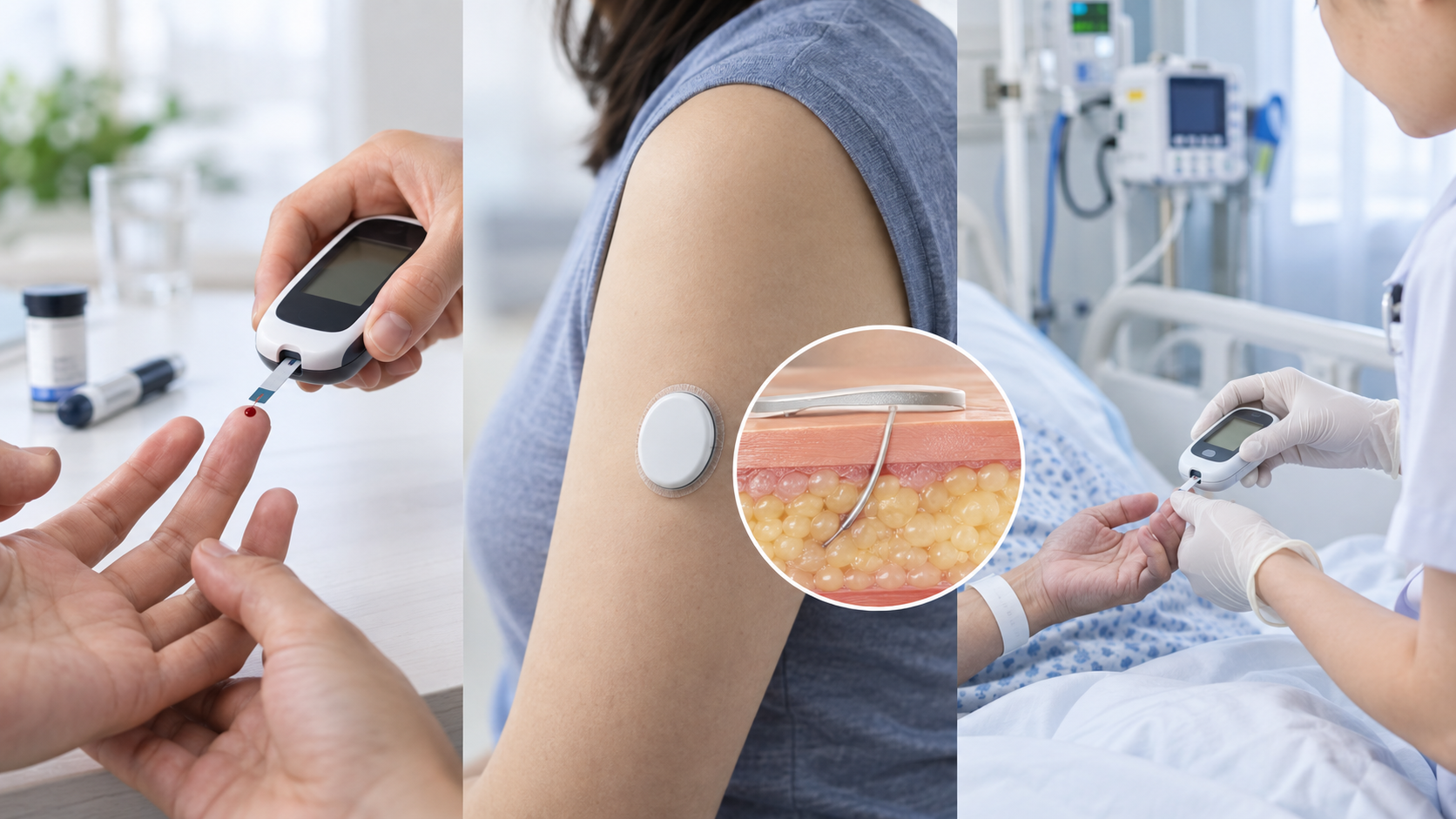
glucose in interstitial fluidSelf-testing, hospital use and continuous monitoring
Roche's Diagnostics Division is mainly a maker of central-laboratory analyzers and reagents: 55% of its sales (CHF 7,614 million) come from the Core Lab area. What counts as a biosensor, a small device that measures on the spot, is a part of Near Patient Care: glucose testing, continuous glucose monitoring, coagulation testing and the like Our calculation. Near Patient Care fell 3% in 2025 at constant exchange rates (CER), and 11% in Swiss francs in the first half of 2026. For 2025 the company named lower blood glucose monitoring sales, attributed to competitive pressure, among the reasons Sourced. At the same time, the financial documents say the company is spending to ramp up its new continuous glucose monitor, the Accu-Chek SmartGuide. Separate sales figures for glucose meters and for continuous monitoring are not disclosed Not yet confirmed.
2. The logo and how the name is written

A note on names: the listed company is Roche Holding Ltd, and the main operating company for medicines and diagnostics is F. Hoffmann-La Roche Ltd. Roche Diagnostics, the subject of this profile, is the name of one of the Group's two divisions (the other is Pharmaceuticals). Roche Diabetes Care is the name used for the diabetes business; the subsidiary list in the Finance Report includes 14 companies carrying that name, by country. The manufacturer named in the instructions for use is Roche Diabetes Care GmbH (Mannheim, Germany). Accu-Chek, cobas, CoaguChek and mySugr are product and brand names, not companies. The logo was taken from the version embedded in the page of the company's official website (roche.com).
Official site: https://www.roche.com/3. Where the company sits in the field
4. Scale
Roche has two divisions, Pharmaceuticals and Diagnostics; this profile concerns Diagnostics. The Group as a whole is shown only briefly Sourced.
| Measure (CHF million) | 2024 | 2025 | Change (at constant exchange rates) |
|---|---|---|---|
| Group sales | 60,495 | 61,516 | +7% |
| Diagnostics Division sales | 14,324 | 13,847 | +2% (-3% in CHF) |
| Diagnostics core operating profit | 2,402 | 1,998 | -4% |
| Diagnostics core operating margin | 16.8% | 14.4% | -1.1 points |
| Of which Near Patient Care sales | 2,160 | 1,983 | -3% |
"Core operating profit" is Roche's own measure, which excludes items such as restructuring costs and amortization of intangible assets. For the lower core operating profit, the company points to the growing installed base of instruments, manufacturing ramp-up costs for new products (notably the Accu-Chek SmartGuide), U.S. tariffs and healthcare pricing reforms in China Sourced.
| Diagnostics customer areas (2025) | Sales (CHF million) | Growth at CER | The company's description |
|---|---|---|---|
| Core Lab | 7,614 | 0% | Immunoassay and clinical chemistry for central labs. 55.0% of sales |
| Molecular Lab | 2,527 | +4% | Pathogen detection and genomics |
| Near Patient Care | 1,983 | -3% | Emergency rooms, doctors' offices and individuals. Includes diabetes management products. Cites lower blood glucose monitoring sales due to competitive pressure |
| Pathology Lab | 1,723 | +14% | Tissue staining and companion diagnostics |
In the first half of 2026 (January to June), Diagnostics sales were CHF 6,735 million (+3% at CER, -3% in CHF), and Near Patient Care was CHF 909 million (-5% at CER, -11% in CHF). The company attributes the decline mainly to a shorter respiratory-illness season that reduced molecular point-of-care sales, and says higher demand for blood glucose monitoring products partly offset it Sourced.
Near Patient Care covers more than glucose testing: it also includes molecular (PCR) and immunoassay point-of-care testing. Movements in Near Patient Care are therefore not movements in biosensor sales. Neither the Finance Report nor the half-year report discloses separate sales for glucose meters, test strips, SmartGuide or hospital glucose testing. This profile does not estimate them Not yet confirmed.
5. Resources committed to biosensors
Roche reports at the division level (Diagnostics). There are no figures for headcount, R&D or capital spending limited to biosensors (glucose testing and continuous monitoring). The table shows what could be confirmed.
| Resource | What primary sources confirm | Status |
|---|---|---|
| People | The Diagnostics Division had 43,102 employees at the end of 2025 (a headcount that, under the European reporting standard, includes apprentices, interns and others). Headcount for diabetes and continuous monitoring is not disclosed. The company says its Indianapolis site hosts U.S. R&D, laboratories, manufacturing and distribution. The manufacturer named in the SmartGuide instructions for use is Roche Diabetes Care GmbH in Mannheim, Germany | Sourced / partly undisclosed |
| Money (R&D) | Diagnostics core R&D was CHF 1,844 million in 2025 (13.3% of sales), and the report explicitly lists continuing investment in cardiometabolic disease, particularly continuous glucose monitoring, among the main activities. In the first half of 2026, continuous glucose monitoring is again listed among the main activities (CHF 870 million, 12.9% of sales). R&D for continuous monitoring alone is not disclosed | Sourced / partly undisclosed |
| Money (capital spending) | Additions to property, plant and equipment in Diagnostics were CHF 352 million in 2025 (CHF 307 million in 2024). The company cites higher instrument placements and site investments in Germany. On 12 May 2025 it announced a plan to invest up to US$550 million in its Indianapolis diagnostics site by 2030, making it a manufacturing hub for continuous glucose monitoring | Sourced / Not yet confirmed (plan) |
| Acquisitions and investments | Corange/Boehringer Mannheim (1997); Medingo (2010, insulin pump; its CHF 39 million goodwill was fully impaired in 2025); mySugr (2017, diabetes management app); selected subsidiaries of LumiraDx (26 July 2024, US$353 million in cash, reported in Near Patient Care, a point-of-care testing platform). In 2026 there are also SAGA Dx (US$408 million) and PathAI (agreed), but both relate to pathology and cancer, not biosensors | Sourced |
| Universities, research institutes, public funding | The Finance Report and Annual Report name no university or public grant, and give no amount, for diabetes or continuous monitoring. ClinicalTrials.gov lists two SmartGuide clinical studies: one led by Roche itself (sites in Poland and Türkiye), and one led by the German diabetes research institute FIDAM RDC with Roche Diabetes Care as a collaborator | Not found (clinical studies with a research institute confirmed) |
Regulatory status (as far as could be confirmed)
| Product | Intended use | Category | Date | Source |
|---|---|---|---|---|
| Accu-Chek Guide (blood glucose meter) | Quantitative measurement of glucose in fresh capillary whole blood from the fingertip, palm and upper arm, as an aid in monitoring the effectiveness of glucose control (OTC) | FDA 510(k) clearance (K160944) | 31 August 2016 | Reference 9 |
| Accu-Chek Guide Me | Same (capillary whole blood; finger, palm, upper arm) | FDA 510(k) clearance (K181131) | 13 December 2018 | Reference 10 |
| Accu-Chek Guide Solo diabetes manager | Quantitative measurement of glucose in fresh capillary whole blood from the fingertip, for self-testing at home by individuals. Not for diagnosis or screening of diabetes or for neonatal use | FDA 510(k) clearance (K213131) | 10 August 2023 | Reference 11 |
| Accu-Chek Solo micropump (for reference: the delivery side, not a sensor) | Subcutaneous insulin delivery (ages 2 and over, prescription, single-patient home use). Can communicate with compatible digitally connected devices | FDA 510(k) clearance (K213134) | 10 August 2023 | Reference 12 |
| cobas pulse (hospital glucose testing) | Point-of-care, multiple-patient use by healthcare professionals. Quantitative glucose in venous, arterial, neonatal arterial or neonatal heel-stick whole blood; not for capillary fingerstick blood. Not for screening or diagnosis of diabetes; indicated for determining dysglycemia | FDA 510(k) clearance (K252323; earlier same-technology clearance K220272) | 12 June 2026 (K220272: 26 April 2024) | Reference 8 |
| CoaguChek XS Plus | Quantitative prothrombin time testing by healthcare professionals for monitoring warfarin therapy, using capillary or non-anticoagulated venous whole blood | FDA 510(k) clearance (K253188; Special 510(k)) | 24 October 2025 | Reference 13 |
| Accu-Chek SmartGuide CGM | Continuous measurement of glucose in subcutaneous interstitial fluid. Intended users: adults 18 and older with diabetes, and their caregivers (instructions for use). In Europe, announced for adults with type 1 or type 2 diabetes on flexible insulin therapy | Europe: CE mark. U.S.: not found in the FDA database (a company slide from May 2025 says a 510(k) submission was pending). Japan: could not be confirmed | CE mark announced 9 July 2024 | References 4, 5, 7 |
An FDA "510(k) clearance" recognizes substantial equivalence to a device already on the market. It is different from "De Novo authorization", which is used for novel devices, and from "PMA approval".
Roche's disclosures take the shape of a company built around central-laboratory analyzers and reagents. The materials story (electrodes, enzymes, membranes) is found mostly in FDA review documents and the instructions for use. For example, the hospital cobas pulse test strip oxidizes glucose with a flavin adenine dinucleotide-dependent glucose dehydrogenase (FAD-GDH) enzyme and measures the resulting current (amperometry). The FDA document gives a sample volume of 0.6 microliters and a hematocrit range of 5 to 70% Sourced. The SmartGuide instructions for use describe the sensor as an electrochemical sensor inserted subcutaneously, but do not state the enzyme, electrode materials or the material of the diffusion-limiting membrane Not yet confirmed. Chapter 10 goes into more detail.
6. What it has done so far
| When | What happened | Why it matters |
|---|---|---|
| 1896 | Founded in Basel (per the company) | This profile covers the Diagnostics Division |
| 1990s | The FDA database still holds 510(k) entries from Boehringer Mannheim for Accu-Chek blood glucose testing (1996) and CoaguChek coagulation testing (from 1993). The Finance Report lists the 1997 acquisition of Corange/Boehringer Mannheim as a "strategic transaction" | The lineage of point-of-use glucose and coagulation products came through that acquisition |
| 2010 | Acquired Medingo (insulin pump) | The CHF 39 million goodwill was fully impaired in 2025 (see below) |
| 2015-2018 | FDA 510(k) clearances for the Accu-Chek Connect app (3 June 2015), Accu-Chek Guide (31 August 2016) and Guide Me (13 December 2018) | The period when meter-to-app connection became a product |
| 2017 | Acquired mySugr (diabetes management app), listed in the Finance Report as a "technology transaction" | Later integrated as the app for viewing SmartGuide data |
| 10 August 2023 | FDA 510(k) clearances for the Accu-Chek Solo micropump and the Guide Solo diabetes manager | Devices for insulin delivery and for measurement, not sensor-side |
| 26 April 2024 | FDA 510(k) clearance for the hospital cobas pulse (K220272) | Its scope was widened in 2026 (see below) |
| 13 May 2024 | The company initiated a recall of some Accu-Chek Guide units (limited serial numbers) because the meter might display the wrong unit of measurement. The FDA classified it as Class II (Z-2174-2024) | Only facts from the FDA's public record are given here. See Reference 14 for the scope and response |
| 9 July 2024 | Announced that the Accu-Chek SmartGuide CGM received the CE mark, with launch planned in selected European markets | The entry point for its in-house continuous glucose monitoring. The Annual Report says "launched in 2024" |
| 26 July 2024 | Acquired selected subsidiaries of LumiraDx for US$353 million in cash | Acquisition of a point-of-care testing platform |
| 2025 | Expanded SmartGuide to more than 30 countries. Obtained the CE mark for integration with mySugr (mySugr Glucose Insights). On 12 May announced up to US$550 million for Indianapolis. Fully impaired the Medingo goodwill | More CGM manufacturing, and linkage on the app side |
| 14 April 2025 | Started a randomized clinical study comparing SmartGuide with self-monitoring of blood glucose (NCT06704672) | Planned enrollment 270; expected completion 30 May 2027 |
| 1 February 2026 | Started a clinical study on the effect of the predictive features on psychological and behavioral outcomes (NCT07814508, led by FIDAM RDC) | Planned enrollment 89 |
| 12 June 2026 | FDA 510(k) clearance for cobas pulse (K252323), widening it to venous whole blood throughout all hospital and professional healthcare settings, including intensive therapy | No change to the hardware or test strips; a change to software and labeling |
7. What comes next
Everything below is a company plan or target, not something already achieved. It is based on the Diagnostics Day 2025 materials (20 May 2025), an official release, and the dates planned in ClinicalTrials.gov Not yet confirmed.
Integration with mySugrAlso integration with pen-based insulin delivery systems, launch in 30+ countries and scaled-up manufacturing
More than 75 countriesAdditional parameters and non- or minimally invasive technologies are also mentioned
- U.S. launch: A May 2025 company slide notes that SmartGuide is not sold in the U.S. and that a 510(k) submission was pending with the FDA. A search of the FDA 510(k) database by applicant name and product code, run by us on 3 October 2026, did not find a Roche continuous glucose monitor. A company statement on the current status or expected timing of the submission could not be confirmed.
- Clinical studies: NCT06704672 has a planned enrollment of 270, an expected primary completion of 15 November 2026 and an expected overall completion of 30 May 2027. NCT07814508 is expected to complete on 31 October 2026.
- Financial targets: The same materials give a medium- to long-term ambition of mid- to high-single-digit sales growth for Diagnostics, and expected low- to mid-single-digit growth for 2025. These are division-wide targets, not targets for continuous monitoring.
Sales of continuous monitoring, glucose meters and test strips; shipments or users by country of launch; the current status and timing of the SmartGuide submission to the FDA; its status in Japan (PMDA); the enzyme, electrode and membrane materials of the sensor; SmartGuide's contract manufacturers and component suppliers; the diabetes share of R&D spending and headcount; and named collaborations with universities or public bodies (apart from one clinical study).
8. What the company is aiming for in biosensors
This chapter separates what the company says directly from what we have read into its materials. Inference marks our interpretation of primary sources.
| What can be read | Primary evidence | Status |
|---|---|---|
| With the market for glucose meters shrinking, it is shifting its weight to continuous monitoring | Finance Report 2025: Near Patient Care's decline cites lower blood glucose monitoring sales due to competitive pressure, and the EMEA discussion cites a continuing contraction of the blood glucose monitoring market. The same report mentions R&D investment in continuous glucose monitoring and ramp-up costs for SmartGuide | Inference |
| It aims to sell the sensor together with the app, prediction and a clinician-facing management system, not the sensor alone | SmartGuide has three elements: sensor, app and predictive app. The roadmap lists the link to the clinician-facing Accu-Chek Care, integration with mySugr (CE mark), and integration with pen-based insulin delivery and AID systems | Sourced (composition) / Inference (intent) |
| It sees the U.S. as an important place to manufacture and sell | The investment to make Indianapolis a CGM manufacturing hub (up to US$550 million), and the slide noting a pending FDA submission | Sourced (investment, submission noted) / Inference (market positioning) |
| It is extending hospital glucose testing to every setting in the hospital | The June 2026 clearance widening cobas pulse to venous whole blood and all hospital settings, including intensive therapy | Sourced |
| Longer term it has measurements beyond glucose and less invasive technologies in view | The roadmap for 2030 and beyond mentions "additional parameters and non- or minimally invasive technologies" (no specific technology or date is given) | Sourced (the mention) / Inference (feasibility is unconfirmed) |
The reading "from meters to continuous monitoring" rests on two statements in the same year's financial report. The Finance Report 2025 gives lower blood glucose monitoring sales due to competitive pressure as a reason for Near Patient Care's decline, and says the contraction of the blood glucose monitoring market is continuing. The same report lists continuing investment in continuous glucose monitoring as an R&D priority for Diagnostics, and ramp-up costs for SmartGuide as a reason for higher cost of sales Sourced. The pattern is that one of the established lines (meters and test strips) is shrinking while the company invests in a new, cost-heavy product. However, sales and profit of continuous monitoring are not disclosed, so whether this investment has become a profit pillar cannot be checked from outside Not yet confirmed.
9. Map of partnerships in biosensors
The only relationships in Roche's materials where the counterparty can be named are acquisitions Sourced. The FDA document for the Accu-Chek Solo micropump says it can communicate with compatible digitally connected devices, including automated insulin dosing software, but does not name them. The suppliers of SmartGuide sensor components (electrodes, enzymes, membranes, battery) and any contract manufacturers are likewise not named in the materials we reviewed Not yet confirmed.
10. Technologies, products and services
The Diagnostics Division's products run from central-laboratory analyzers (cobas, Elecsys and others) to point-of-care testing. This profile keeps to what counts as biosensors. Performance figures are manufacturer's stated values from the instructions for use or FDA review documents; they must be read together with the reference method, population and conditions, and values from different studies cannot be lined up to rank products.
| Category | What the official materials say | Note |
|---|---|---|
| Glucose meters and test strips (Accu-Chek Guide, Guide Me, Guide Solo and others) | For self-testing, applying a drop of capillary blood to a test strip. The strip enzyme is FAD-dependent glucose dehydrogenase and the principle is amperometry (the comparison table in the Guide Me review document) | In FDA terms, an over-the-counter (OTC) blood glucose meter category (product code NBW). See our explainer on electrochemical sensors |
| Hospital glucose testing (cobas pulse) | FAD-GDH, amperometry, a 0.6-microliter sample, hematocrit 5-70%, underdose detection, and a rechargeable lithium battery (FDA review document comparison table) | Used by healthcare professionals on multiple patients. Not for personal use |
| Coagulation testing (CoaguChek XS Plus) | For healthcare professionals; quantitative prothrombin time for monitoring warfarin therapy | The October 2025 510(k) was a change that does not alter the measurement principle (Special 510(k)) |
| Continuous glucose monitoring (Accu-Chek SmartGuide) | Three elements: sensor, app and predictive app. Sends a glucose value every 5 minutes; 14-day wear; single-use all-in-one applicator. Predictions: risk of hypoglycemia within 30 minutes, glucose trend up to 2 hours ahead, and risk of nocturnal hypoglycemia | Intended use in the instructions: continuous measurement of glucose in subcutaneous interstitial fluid |
| Apps and clinician-facing management | mySugr (more than six million registered accounts), including mySugr Glucose Insights (CE mark) for SmartGuide data. Link to the clinician-facing Accu-Chek Care | The side that displays and analyzes data, separate from the measurement itself |
| Molecular and immunoassay point-of-care testing | cobas liat (PCR; the STI tests take 20 minutes) and others. The Diagnostics Day materials list several point-of-care platforms under Near Patient Care | The molecular recognition method differs from a sensor, so this profile does not go into detail |
Performance values in the SmartGuide instructions for use (manufacturer's stated values)
| Item | Value | Conditions and source |
|---|---|---|
| Overall MARD | 9.2% | Controlled study at 3 centers, 48 adults (18 or older) with type 1 or insulin-dependent type 2 diabetes. Each wore 3 sensors for 14 days on the back of the upper arms. Compared with fingertip capillary blood on 3 sampling days with glucose manipulation. 15,993 pairs, range 40-400 mg/dL, 3 sensor batches |
| By glucose range | 9.8% at 70-180 mg/dL; 8.0% at >180-250; 7.3% at >250-350; 4.9% at >350 | Same study. Below 70 mg/dL, absolute rather than relative differences are given (7.5 mg/dL below 54; 7.0 mg/dL at 54-69) |
| By wear period | Start 8.3% / middle 9.0% / end 10.8% | Same study |
| Parkes error grid | 99.8% in zones A and B | From the official release, citing a poster at the American Diabetes Association (ADA) 2024 meeting. Carries a note that calibration is required for insulin dosing |
| Storage and operating conditions | Storage 2-27 °C / operating 10-40 °C | For the unopened sensor. Water protection is IP28 (1 m depth for up to 60 minutes). Sterilization is by radiation |
| Sensor dimensions | About 5.9 mm tall, 33.3 mm diameter, 5 g; needle about 8.2 mm | Height includes the adhesive pad. Technical data in the instructions for use |
MARD (mean absolute relative difference) is the average of the relative gaps between sensor values and comparator values (here, fingertip blood measurements); a smaller figure means closer agreement with the comparator. Values from studies with different comparison methods, participants, glucose manipulation and wear sites cannot be compared directly. The instructions for use state that interstitial glucose may not match blood glucose (especially during rapid rises or falls), that values should be used for therapy decisions such as insulin dosing only after the calibration the app requests, and that the sensor is not for critically ill patients or patients on dialysis Sourced. This article is not guidance on reading measurements or on using the product.
In a glucose test strip, the basic idea is that the enzyme (FAD-GDH) drives a reaction and an electrode reads it as a current. The FDA document highlights a 0.6-microliter sample, a 5-70% hematocrit range and underdose detection, which shows that electrode area, the flow path and keeping red blood cells from interfering are the core of the materials design Sourced. FAD-GDH is generally described as less affected by oxygen concentration than glucose oxidase, which uses oxygen as its electron acceptor (the enzyme of StatStrip, the comparison device for cobas pulse) Not yet confirmed. See our explainer on enzyme and electrode interface materials.
SmartGuide stays in contact with body fluid for 14 days, through an adhesive pad on the skin and a needle-type sensor under it. The technical data in the instructions for use point to several materials issues Sourced.
- Interfering substances for an electrochemical sensor: Ascorbic acid (more than 500 mg/day orally, or any intravenous amount), supplements containing gentisic acid and methyldopa may falsely raise CGM values (the document says to consult a healthcare professional if taking them). Substances that are easily oxidized at the electrode can add to the current; this is a general issue for electrochemical methods (our commentary).
- A narrow storage range: 2-27 °C unopened. The stability of enzyme-containing parts may be what sets storage and transport conditions (inference; no reason is given).
- Radiation sterilization: A sensor with a needle and enzyme is sterilized by radiation, so the materials must keep enzyme activity and membrane properties afterward (our commentary).
- Battery substance: The document states that the battery contains 1,2-dimethoxyethane, a REACH candidate-list substance of very high concern (SVHC), above 0.1% by weight, and that there is no direct exposure in use.
- Waterproofing and adhesion: IP28 (1 m for 60 minutes) must be combined with an adhesive pad that holds for 14 days (see our explainer on patch sensors and skin adhesion).
However, the enzyme type, mediator, electrode material and the material of the diffusion-limiting membrane are not stated in the materials we reviewed. This article does not fill the gap by guessing.
11. The risks this company carries
| Risk | Detail | Status |
|---|---|---|
| Shrinking glucose meter and test strip business, and competition | The Finance Report 2025 cites lower blood glucose monitoring sales due to competitive pressure for Near Patient Care, and a continuing contraction of the blood glucose monitoring market in EMEA. It also says demand for blood glucose monitoring products rose in the first half of 2026 | Sourced |
| Position of continuous monitoring in the U.S. | SmartGuide is not sold in the U.S. (company slide, May 2025). Our search of the FDA 510(k) database did not find an entry, and the current status and timing of the submission could not be confirmed. Investment in U.S. manufacturing has come first | Sourced / Not yet confirmed |
| Ramp-up costs and margin | Diagnostics core operating profit fell 4% at CER in 2025. The core cost-of-sales ratio was 51.9% (up 3.4 points); the company cites a larger instrument base, manufacturing ramp-up costs for new products such as SmartGuide, U.S. tariffs and healthcare pricing reforms in China. Cost of sales in the first half of 2026 again includes new-product costs and tariffs | Sourced |
| Currency | Diagnostics sales in 2025 were up 2% at CER but down 3% in Swiss francs; the first half of 2026 shows the same pattern (+3% and -3%). The strong Swiss franc weighs on reported figures | Sourced |
| Uncertainty over the insulin pump business | Goodwill from the 2010 Medingo acquisition was fully impaired in 2025 after a strategic reassessment. The materials we reviewed do not say what the company will do with the business as a result | Sourced / Not yet confirmed |
| Regulator-published quality records | The FDA recall database holds multiple records with Roche Diabetes Care as recalling firm between 2017 and 2024 (test-strip vials, meter power, app connectivity and so on; in 2024, possible display of the wrong unit on some Accu-Chek Guide units). The content and scope are as in each record | Sourced |
| Limited disclosure | Sales and costs for continuous monitoring and for glucose meters, and sensor materials and component suppliers, are all undisclosed, so the scale and profitability of the business are hard to check from outside | Not yet confirmed |
| Materials regulation | The instructions for use state that the sensor battery contains the REACH candidate-list substance 1,2-dimethoxyethane at more than 0.1% by weight. Depending on future regulation, the materials may need to be reviewed | Sourced (the content) / Inference (possible review) |
12. Glossary
- Near Patient Care
- The name Roche uses for one customer area of its Diagnostics Division: diagnostics used outside the central laboratory, such as emergency rooms, doctors' offices and individuals. Includes diabetes management products.
- Core operating profit
- Roche's own measure of operating profit, excluding items such as restructuring costs and amortization of intangibles.
- Growth at constant exchange rates (CER)
- Sales growth excluding currency effects. Reported separately from growth in Swiss francs.
- 510(k) clearance
- An FDA category recognizing substantial equivalence to a device already on the market. Different from De Novo authorization and PMA approval.
- OTC (over the counter)
- Available without a prescription. FDA product code NBW is for over-the-counter blood glucose test systems.
- CGM (continuous glucose monitoring)
- Measuring glucose in subcutaneous interstitial fluid continuously with a sensor, sending values at fixed intervals such as every 5 minutes.
- MARD
- Mean absolute relative difference: the average relative gap between sensor values and comparator values. It changes with study conditions.
- Amperometry
- An electrochemical method that applies a fixed voltage and derives concentration from the current produced by an enzyme reaction.
- FAD-GDH
- Flavin adenine dinucleotide-dependent glucose dehydrogenase. An enzyme used on test strips that oxidizes glucose and passes electrons toward the electrode.
- SMBG
- Self-monitoring of blood glucose: measuring a fingertip blood sample with a test strip.
13. References
- Roche Finance Report 2025. Diagnostics Division sales, profit and sales by customer area; R&D; capital spending; acquisitions and goodwill (Medingo, mySugr, LumiraDx); subsidiary list; listing information. https://assets.roche.com/f/176343/x/fca190f63e/fb25e.pdf
- Roche Annual Report 2025. Diagnostics business review, SmartGuide expansion and mySugr integration, employees by division. https://assets.roche.com/f/176343/x/fa3c863601/ar25e.pdf
- Roche Half-Year Report 2026. First-half 2026 Diagnostics sales, Near Patient Care, R&D and cost of sales. https://assets.roche.com/f/176343/x/8a0b362d66/hy26e.pdf
- Roche Diagnostics Day 2025 presentation (20 May 2025). SmartGuide roadmap, U.S. status note, financial ambition, composition of Near Patient Care. https://assets.roche.com/f/176343/x/7656180b53/diagnostics-day-20-05-2025.pdf
- Roche Media & Investor Release, "Roche receives CE Mark for its AI-enabled continuous glucose monitoring solution" (9 July 2024). https://assets.roche.com/f/176343/caf466c9d0/09072024_mr_accu-chek-smartguide-cgm-solution_en.pdf
- Roche Diagnostics Media Release, "Roche announces $550 million investment to expand its Indianapolis diagnostics manufacturing hub" (12 May 2025). https://diagnostics.roche.com/content/dam/diagnostics/us/en/news-releases/pdf/indianapolis-investment-press%20release-051225.pdf
- Roche Diabetes Care User's Manual, Accu-Chek SmartGuide device (September 2025 edition). Intended use, limitations, technical data, performance data, manufacturer. https://tools.accu-chek.com/documents/dms/en/smartguide_device_manual/smartguide_device_app_manual_en_2025-09.pdf
- FDA 510(k) K252323, cobas pulse blood glucose monitoring system (clearance letter and 510(k) summary, 12 June 2026). https://www.accessdata.fda.gov/cdrh_docs/pdf25/K252323.pdf
- FDA 510(k) K160944, Accu-Chek Guide Blood Glucose Monitoring System (31 August 2016). https://www.accessdata.fda.gov/cdrh_docs/pdf16/K160944.pdf
- FDA 510(k) K181131, Accu-Chek Guide Me Blood Glucose Monitoring System (13 December 2018). Comparison table of strip enzyme and measurement principle. https://www.accessdata.fda.gov/cdrh_docs/pdf18/K181131.pdf
- FDA 510(k) K213131, Accu-Chek Guide Solo diabetes manager blood glucose monitoring system (10 August 2023). https://www.accessdata.fda.gov/cdrh_docs/pdf21/K213131.pdf
- FDA 510(k) K213134, Accu-Chek Solo micropump system with interoperable technology (10 August 2023). https://www.accessdata.fda.gov/cdrh_docs/pdf21/K213134.pdf
- FDA 510(k) K253188, CoaguChek XS Plus System (24 October 2025, Special 510(k)). https://www.accessdata.fda.gov/cdrh_docs/pdf25/K253188.pdf
- FDA Medical Device Recalls: Class 2 Device Recall Roche Diabetes Care, Inc., AccuChek Guide Meter (Z-2174-2024). https://www.accessdata.fda.gov/scripts/cdrh/cfdocs/cfres/res.cfm?id=207936
- FDA (openFDA) 510(k) K944459, ACCU-CHEK INSTANT PLUS G-C/DM (Boehringer Mannheim Corp., 17 April 1996), database record. https://api.fda.gov/device/510k.json?search=k_number:K944459
- FDA (openFDA) 510(k) K930454, BOEHRINGER MANNHEIM COAGUCHEK SYSTEM (5 August 1993), database record. https://api.fda.gov/device/510k.json?search=k_number:K930454
- FDA (openFDA) 510(k) K150910, ACCU-CHEK Connect Diabetes Management App (3 June 2015), database record. https://api.fda.gov/device/510k.json?search=k_number:K150910
- FDA (openFDA) 510(k) K220272, cobas pulse blood glucose monitoring system (26 April 2024), database record. https://api.fda.gov/device/510k.json?search=k_number:K220272
- ClinicalTrials.gov NCT06704672: Accu-Chek SmartGuide CGM compared with self-monitoring of blood glucose (led by Hoffmann-La Roche; recruiting). https://clinicaltrials.gov/study/NCT06704672
- ClinicalTrials.gov NCT07814508: Effect of the Accu-Chek SmartGuide CGM and Predict App on person-reported outcomes and behavior (led by FIDAM RDC with Roche Diabetes Care as collaborator; recruiting). https://clinicaltrials.gov/study/NCT07814508
- Roche Official website (source of the logo image). https://www.roche.com/
- Mader JK et al. "1924-LB: Clinical Performance of a Novel CGM System," Diabetes 2024; 73 (Supplement_1) (poster abstract at ADA 2024, cited in the official release). https://doi.org/10.2337/db24-1924-LB
- FDA 510(k) Premarket Notification Database (search page; searched by applicant name and product code on 3 October 2026). https://www.accessdata.fda.gov/scripts/cdrh/cfdocs/cfpmn/pmn.cfm
- FDA (openFDA) Device Recall database, records for Roche Diabetes Care (search result). https://api.fda.gov/device/recall.json?search=recalling_firm:%22Roche+Diabetes+Care%22&limit=30
14. Claim-to-source audit
| Claim in the text | Status | Source |
|---|---|---|
| Legal name (listed company), headquarters, listing, 1896 founding, stock codes | Sourced | Reference 1 https://assets.roche.com/f/176343/x/fca190f63e/fb25e.pdf Reference 6 https://diagnostics.roche.com/content/dam/diagnostics/us/en/news-releases/pdf/indianapolis-investment-press%20release-051225.pdf |
| Group sales (CHF 61,516 million in 2025; CHF 60,495 million in 2024); Diagnostics sales, core operating profit and margin | Sourced | Reference 1 https://assets.roche.com/f/176343/x/fca190f63e/fb25e.pdf |
| Sales by customer area (Core Lab 7,614; Molecular Lab 2,527; Near Patient Care 1,983; Pathology Lab 1,723) and descriptions; lower blood glucose monitoring sales (competitive pressure); contraction of the glucose monitoring market | Sourced | Reference 1 https://assets.roche.com/f/176343/x/fca190f63e/fb25e.pdf |
| First-half 2026 Diagnostics sales of CHF 6,735 million, Near Patient Care CHF 909 million and the reasons for the decline | Sourced | Reference 3 https://assets.roche.com/f/176343/x/8a0b362d66/hy26e.pdf |
| Diagnostics employees 43,102; Group 112,774 | Sourced | Reference 2 https://assets.roche.com/f/176343/x/fa3c863601/ar25e.pdf |
| Diagnostics core R&D of CHF 1,844 million (mentions investment in continuous glucose monitoring); first half of 2026: CHF 870 million | Sourced | Reference 1 https://assets.roche.com/f/176343/x/fca190f63e/fb25e.pdf Reference 3 https://assets.roche.com/f/176343/x/8a0b362d66/hy26e.pdf |
| Diagnostics additions to property, plant and equipment of CHF 352 million (CHF 307 million the year before); reasons for higher capital spending | Sourced | Reference 1 https://assets.roche.com/f/176343/x/fca190f63e/fb25e.pdf |
| Plan to invest up to US$550 million in the Indianapolis diagnostics site by 2030, making it a CGM manufacturing hub (12 May 2025) | Not yet confirmed | Reference 6 https://diagnostics.roche.com/content/dam/diagnostics/us/en/news-releases/pdf/indianapolis-investment-press%20release-051225.pdf |
| Acquisitions of Corange/Boehringer Mannheim (1997), Medingo (2010) and mySugr (2017); full impairment of the CHF 39 million Medingo goodwill (2025) | Sourced | Reference 1 https://assets.roche.com/f/176343/x/fca190f63e/fb25e.pdf |
| Acquisition of selected LumiraDx subsidiaries on 26 July 2024 for US$353 million in cash, reported in Near Patient Care | Sourced | Reference 1 https://assets.roche.com/f/176343/x/fca190f63e/fb25e.pdf |
| 2026 agreements for SAGA Dx (US$408 million) and PathAI relate to pathology and cancer | Sourced | Reference 3 https://assets.roche.com/f/176343/x/8a0b362d66/hy26e.pdf |
| 1990s Boehringer Mannheim 510(k) entries for Accu-Chek (1996) and CoaguChek (1993) | Sourced | Reference 15 https://api.fda.gov/device/510k.json?search=k_number:K944459 Reference 16 https://api.fda.gov/device/510k.json?search=k_number:K930454 |
| 510(k) clearance of the Accu-Chek Connect app (3 June 2015) | Sourced | Reference 17 https://api.fda.gov/device/510k.json?search=k_number:K150910 |
| Accu-Chek Guide (K160944, 31 August 2016): intended use and category (OTC, product code NBW) | Sourced | Reference 9 https://www.accessdata.fda.gov/cdrh_docs/pdf16/K160944.pdf |
| Accu-Chek Guide Me (K181131, 13 December 2018): intended use; FAD-GDH and amperometry | Sourced | Reference 10 https://www.accessdata.fda.gov/cdrh_docs/pdf18/K181131.pdf |
| Accu-Chek Guide Solo (K213131) and Solo micropump (K213134): intended use and age range (10 August 2023) | Sourced | Reference 11 https://www.accessdata.fda.gov/cdrh_docs/pdf21/K213131.pdf Reference 12 https://www.accessdata.fda.gov/cdrh_docs/pdf21/K213134.pdf |
| cobas pulse (K252323, 12 June 2026): intended use; strip enzyme, sample volume and hematocrit range; earlier K220272 (26 April 2024) | Sourced | Reference 8 https://www.accessdata.fda.gov/cdrh_docs/pdf25/K252323.pdf Reference 18 https://api.fda.gov/device/510k.json?search=k_number:K220272 |
| CoaguChek XS Plus (K253188, 24 October 2025): intended use and Special 510(k) | Sourced | Reference 13 https://www.accessdata.fda.gov/cdrh_docs/pdf25/K253188.pdf |
| Recall of some Accu-Chek Guide units initiated 13 May 2024; FDA Class II classification (Z-2174-2024) and reason | Sourced | Reference 14 https://www.accessdata.fda.gov/scripts/cdrh/cfdocs/cfres/res.cfm?id=207936 |
| Multiple recall records with Roche Diabetes Care as recalling firm between 2017 and 2024 | Sourced | Reference 24 https://api.fda.gov/device/recall.json?search=recalling_firm:%22Roche+Diabetes+Care%22&limit=30 |
| SmartGuide CE mark announcement (9 July 2024); three elements (sensor, app, predictive app); a value every 5 minutes; 14-day wear; description of the predictive functions | Sourced | Reference 5 https://assets.roche.com/f/176343/caf466c9d0/09072024_mr_accu-chek-smartguide-cgm-solution_en.pdf Reference 7 https://tools.accu-chek.com/documents/dms/en/smartguide_device_manual/smartguide_device_app_manual_en_2025-09.pdf |
| SmartGuide launched in 2024 and expanded to more than 30 countries in 2025; CE mark for the mySugr integration; more than six million mySugr accounts | Sourced | Reference 2 https://assets.roche.com/f/176343/x/fa3c863601/ar25e.pdf |
| SmartGuide intended use (continuous measurement of glucose in subcutaneous interstitial fluid), intended users (18 and older), limitations, interfering substances, dimensions, storage and operating conditions, IP28, radiation sterilization, battery SVHC, manufacturer | Sourced | Reference 7 https://tools.accu-chek.com/documents/dms/en/smartguide_device_manual/smartguide_device_app_manual_en_2025-09.pdf |
| SmartGuide MARD of 9.2%, values by glucose range and by wear period, and the study conditions | Sourced | Reference 7 https://tools.accu-chek.com/documents/dms/en/smartguide_device_manual/smartguide_device_app_manual_en_2025-09.pdf |
| Parkes error grid: 99.8% in zones A and B (official release) | Sourced | Reference 5 https://assets.roche.com/f/176343/caf466c9d0/09072024_mr_accu-chek-smartguide-cgm-solution_en.pdf Reference 22 https://doi.org/10.2337/db24-1924-LB |
| A May 2025 company note that SmartGuide is not sold in the U.S. and a 510(k) submission was pending | Sourced | Reference 4 https://assets.roche.com/f/176343/x/7656180b53/diagnostics-day-20-05-2025.pdf |
| No Roche continuous glucose monitor was found in the FDA 510(k) database | Our calculation | Reference 23 https://www.accessdata.fda.gov/scripts/cdrh/cfdocs/cfpmn/pmn.cfm |
| Status in Japan (PMDA); SmartGuide enzyme, electrode and membrane materials; contract manufacturers and component suppliers | Not yet confirmed | Not stated in the materials we reviewed. Not confirmed; we do not claim they do not exist. Reference 7 https://tools.accu-chek.com/documents/dms/en/smartguide_device_manual/smartguide_device_app_manual_en_2025-09.pdf |
| SmartGuide clinical study NCT06704672 (started 14 April 2025, planned enrollment 270, expected completion 30 May 2027) | Sourced | Reference 19 https://clinicaltrials.gov/study/NCT06704672 |
| Clinical study NCT07814508 (led by FIDAM RDC, started 1 February 2026, planned enrollment 89) | Sourced | Reference 20 https://clinicaltrials.gov/study/NCT07814508 |
| Roadmap for 2025-2026, 2027-2029 and 2030 onward; financial ambition | Not yet confirmed | Reference 4 https://assets.roche.com/f/176343/x/7656180b53/diagnostics-day-20-05-2025.pdf |
| Sales, R&D and headcount limited to diabetes and continuous monitoring; named universities or public grants and amounts | Not yet confirmed | Not stated in the Finance Report or Annual Report. This article does not estimate them. Reference 1 https://assets.roche.com/f/176343/x/fca190f63e/fb25e.pdf Reference 2 https://assets.roche.com/f/176343/x/fa3c863601/ar25e.pdf |
| Diagnostics at about 22.5% of Group sales; Near Patient Care at 14.3% | Our calculation | Our own division using figures from Reference 1 |
| The four-type classification and the example company names | Our calculation | Our own grouping; company names are examples from the companies covered in this series |
| The reading that Roche is shifting its weight from glucose meters to continuous monitoring | Inference | Our interpretation of how statements line up in Reference 1 (Chapter 8) - this article's own reading |
| The reading that it aims to supply the app, prediction and clinician-facing management as a package | Inference | Our interpretation of the composition in References 5, 7 and 4 - this article's own reading |
| The reading that it sees the U.S. as an important market for manufacturing and sales | Inference | Our interpretation of References 4 and 6 - this article's own reading |
| FAD-GDH being generally described as less affected by oxygen concentration; interference from substances easily oxidized at the electrode; materials design after radiation sterilization | Commentary | Commentary in this article (A materials engineer's view), organizing the facts in References 7 and 8 from a materials viewpoint |
| The reason for the narrow storage range | Inference | No reason is given in the instructions for use (Reference 7). This article's own interpretation |
Last updated: 3 October 2026 / Troy Technical
The figures in this article come from Roche's financial documents, official releases and instructions for use, FDA public documents and ClinicalTrials.gov. Market-research estimates and press-report figures are not used (market-size figures in Roche's own materials are not adopted). Passages marked "Inference" are our own readings of primary sources and are not statements by the company. This article does not recommend any product, and it is not guidance on reading measurements or on treatment.