COMPANY PROFILE / BIOSENSORS
Samsung Electronics
A smartphone maker that puts biosensors in a watch and a ring, with some features authorized or cleared in the U.S. and Korea
Samsung Electronics appears in a biosensor series not because it sells diagnostic instruments or glucose meters, but because the "BioActive Sensor" on the Galaxy Watch and the Galaxy Ring (which the company describes as combining optical pulse-wave, electrocardiogram and bioelectrical impedance sensing in one), and some of the software features that run on it, are the subject of U.S. Food and Drug Administration (FDA) authorizations and clearances. In the FDA databases we found three lines of biosignal-related features: an ECG app, irregular heart rhythm notifications and sleep apnea notifications. Blood pressure estimation has been announced by the company as cleared by Korea's Ministry of Food and Drug Safety (MFDS), but we could not find a record at the FDA. Body composition and various indices are labelled by the company as not for diagnosis. This profile sets out, from primary sources only, what the company puts into this area, which features were authorized or cleared under which pathway, and how much it discloses.
- Samsung Electronics in 30 seconds, and where it stands in biosensors
- The logo and how the name is written
- Where the company sits in the field
- Scale
- Resources committed to biosensors (including the regulatory position)
- What it has done so far
- What comes next
- What the company is aiming for in biosensors
- Map of partnerships in biosensors
- Technologies, products and services
- The risks this company carries
- Glossary, references and claim-to-source audit
1. Samsung Electronics in 30 seconds, and where it stands in biosensors
(a user of sensors)Not a dedicated maker of sensor parts or diagnostic instruments
blood oxygen (during sleep)Rhythm suggestive of AFib, breathing disturbances in sleep. Blood pressure estimation has no FDA record
Samsung's biosensor features fall into three regulatory layers Our calculation. The first layer holds features with FDA authorization or clearance (the ECG app, irregular rhythm notifications and sleep apnea notifications). The second holds features the company says Korea's MFDS has cleared, but for which we could not find an FDA record (blood pressure estimation). The third holds features the company labels "not for diagnosis" or "for wellness only" (body composition, Heart Health Score, Vitals and various indices) Sourced. The key point is that on the same watch, the regulatory position differs by feature and by country.
This article is an explainer on companies and regulation. It is not diagnosis, treatment or advice on how to read any measurement for an individual reader, and it does not recommend using any product. Please ask a healthcare professional what a notification or measurement means and whether to seek care. Performance figures are results of specific studies described in FDA documents and are meaningful only together with their conditions (population, reference method and analysis set).
2. The logo and how the name is written

A note on naming: the legal entity is Samsung Electronics Co., Ltd. and the FDA databases use the same applicant name. Galaxy Watch, Galaxy Ring, Samsung Health and Samsung Health Monitor are product and app names, not corporate names. "BioActive Sensor" is the name of a sensor, and "Sleep Apnea Feature" and "ECG Monitor App" are names of features. Other companies in the same group (Samsung Medison, Samsung Display, Samsung Biologics and so on) are separate legal entities. The logo image is the one that samsung.com specifies as its "logo" in the site's structured data.
Official website: https://www.samsung.com/3. Where the company sits in the field
Samsung Electronics' main category is wearables & consumer devices. Its main businesses are smartphones, televisions, home appliances and semiconductors, and its biosensing is offered as features combining the Galaxy Watch and Galaxy Ring with the Samsung Health app on a smartphone Sourced. We assign no secondary category: we could not confirm a continuous glucose monitor or an in vitro diagnostic instrument currently on sale from its official materials Our calculation. (In the past, clinical evaluations of a portable in vitro diagnostic device called "LABGEO" were registered on ClinicalTrials.gov, but they are listed as terminated in 2014 and we could not trace what followed; see Section 6.) As our explainers on wearable biosensors and on regulatory categories for medical devices and home use describe, the regulatory burden depends on what is measured and what is claimed.
4. Scale
Samsung Electronics is a very large company spanning semiconductors, smartphones, televisions, home appliances, displays and automotive electronics (Harman), and the company as a whole is not the subject here. We give group-wide figures briefly and cover what bears on biosensors from Section 5 onward.
| Indicator (KRW million) | 2024 | 2025 | Change |
|---|---|---|---|
| Group sales (consolidated) | 300,870,903 | 333,605,938 | +10.9% (our calculation) |
| Operating profit (consolidated) | 32,725,961 | 43,601,051 | +33.2% (our calculation) |
| Profit for the period (consolidated) | 34,451,351 | 45,206,805 | +31.2% (our calculation) |
| R&D expenditure (company-wide) | 35,021,531 | 37,754,815 | +7.8% (11.3% of sales) |
The fiscal year runs from January to December. The headquarters in Korea (separate basis, including employees on leave) had 128,881 employees on 31 December 2025 (50,817 in the DX Division and 78,064 in the DS Division); we could not obtain a consolidated headcount from the materials we checked Sourced. The MX (mobile) business, which covers the watch and ring, is reported together with the Networks business. For the fourth quarter of 2025, MX and Networks posted sales of KRW 29.3 trillion and operating profit of KRW 1.9 trillion; for the second quarter of 2026, sales of KRW 33.2 trillion and an operating loss of KRW 0.7 trillion Sourced. The company says the MX business achieved "double-digit annual profit" in 2025 through, among other things, "stable sales of tablets and wearables", but sales and profit for wearables alone are not disclosed.
"MX business figures" and "biosensor figures" are not the same thing. The ECG and sleep apnea features are provided as part of a device, and sales, profit and users by feature are not disclosed; this article does not estimate them Not yet confirmed. Group sales in the second quarter of 2026 were KRW 171.5 trillion, and the company says sales of its DS (semiconductor) Division rose 56% quarter on quarter (a movement in a business unrelated to biosensors).
5. Resources committed to biosensors (including the regulatory position)
Samsung Electronics does not disclose staffing, spending or investment limited to wearable health. The table below shows, for four viewpoints, what primary sources confirm and what they do not ("not stated" is itself a finding).
| Resource | What primary sources confirm | Category |
|---|---|---|
| People | 128,881 employees at the Korean headquarters (separate basis, 31 December 2025). Company announcements name the heads of the "Health R&D Group" and the "Digital Health Team" of the MX Business, but headcount for health R&D is not disclosed | Sourced / partly undisclosed |
| Money (R&D and investment) | Company-wide R&D expenditure was KRW 37,754.8 billion in 2025 (11.3% of sales; the company calls it a record). R&D and capital spending limited to wearable health are not disclosed | Sourced / partly undisclosed |
| Outside investments, acquisitions, joint ventures and divestments | Samsung acquired 100% of the shares of Xealth, Inc., a U.S. digital health platform for healthcare providers, on 16 October 2025 (Business Report). The agreement was announced on 8 July 2025; the price was not confirmed. The company says Xealth connects more than 500 U.S. hospitals and more than 70 digital health companies | Sourced / price not confirmed |
| Universities, research institutions and public funding | Stanford University (sleep apnea collaboration; ClinicalTrials.gov lists a Stanford-led study with Samsung as collaborator, 152 participants), Massachusetts General Hospital (a clinical validation study and a GLP-1 therapy study), Chung-Ang University Gwangmyeong Hospital (syncope prediction) and Wonju Severance Christian Hospital (a smartwatch blood-pressure estimate versus ambulatory blood pressure monitoring, 30 participants). Public funding: government subsidies against company-wide R&D were about KRW 14.4 billion in 2025 (no breakdown for health) | Sourced / partly undisclosed |
Regulatory position (as far as FDA public documents and company announcements confirm)
The table below lists, among FDA 510(k) database (openFDA) records under applicants whose name contains "Samsung Electronics", five biosignal-related records and one related historical record, plus the functions for which we could not confirm an FDA or Korean position. De Novo authorization (classification of a new type of low-to-moderate-risk device), 510(k) clearance (substantial equivalence to an existing device) and PMA approval are separate pathways. We found no PMA record for the applicant name "Samsung" in the openFDA PMA search Sourced.
| Feature | Use (summary of the regulator's document) | Pathway | Date | Source |
|---|---|---|---|---|
| Samsung ECG Monitor Application | On a Galaxy Watch and Galaxy phone, records and displays a single-lead (Lead I-like) ECG and classifies AFib versus sinus rhythm. Over the counter (OTC), ages 22 and over. Not a substitute for diagnosis | 510(k) clearance K201168 (21 CFR 870.2345, QDA; predicate: Apple's DEN180044) | 4 August 2020 | Reference 5 |
| ECG Monitor App with Irregular Heart Rhythm Notification (IHRN) | Analyzes the photoplethysmograph (PPG) pulse signal for rhythm suggestive of AFib and prompts the user to record an ECG. OTC, ages 22 and over. The absence of a notification does not mean the absence of disease | 510(k) clearance K230292 (21 CFR 870.2790, QDB / QDA; primary predicate: Apple's DEN180042; secondary: K201168) | 2 May 2023 | Reference 6 |
| Samsung ECG App v1.3 | Adds "high heart rate (non-AFib)" and "AFib with high heart rate" to the ECG classifications | 510(k) clearance K240909 (predicate: K230292; reference device: Apple's K201525) | 2 August 2024 | Reference 7 |
| Sleep Apnea Feature | For users 22 and over without a sleep apnea diagnosis, uses changes in blood oxygen (SpO2) to flag breathing disruptions suggestive of moderate-to-severe obstructive sleep apnea over two nights (within 10 days). Not a substitute for diagnosis. OTC | De Novo authorization DEN230041 (21 CFR 868.2378, Class II, QZW). Created this device type | Submitted 31 May 2023 / decided 6 February 2024 | Reference 8 |
| Sleep Apnea Feature v2.0 | Ages 18 and over. Galaxy Watch or Galaxy Ring. From PPG, accelerometer and PPG-derived pulse oximetry, a positive result is given if the two-night average is 15 or more breathing disruptions per hour (a binary result). Includes a PCCP | 510(k) clearance K261011 (predicate: DEN230041; reference device: Apple's K240929) | 20 July 2026 | Reference 9 |
| S Health (historical record) | A mobile app for use at home to review and monitor vital signs such as blood pressure, blood glucose and weight from optional add-on devices (not a watch sensor feature) | 510(k) clearance K132148 (product code DRG) | 4 December 2013 | Reference 10 |
| Blood pressure estimation (Samsung Health Monitor) | Company description: requires calibration with a cuff (every four weeks); not intended for diagnosis or treatment; available in select markets only | Korea's MFDS clearance announced by the company (2020). No FDA record found (no match in the openFDA 510(k) search) | 2020 | References 11, 12, 13 |
| Body composition (BIA), Antioxidant Index, AGEs, Heart Health Score, Vitals | Company description: for wellness and personal reference only, not for diagnosis or treatment | No FDA or Korean regulatory position found | - | References 14, 15, 16 |
The company says the sleep apnea feature obtained approval from Korea's MFDS (announced 5 October 2023), De Novo authorization from the FDA, and approval from Brazil's National Health Surveillance Agency (ANVISA; announced April 2025), and is available in 78 markets (March 2026, company). The content of each country's permission differs, so this article is written within the scope of the U.S. FDA documents Sourced.
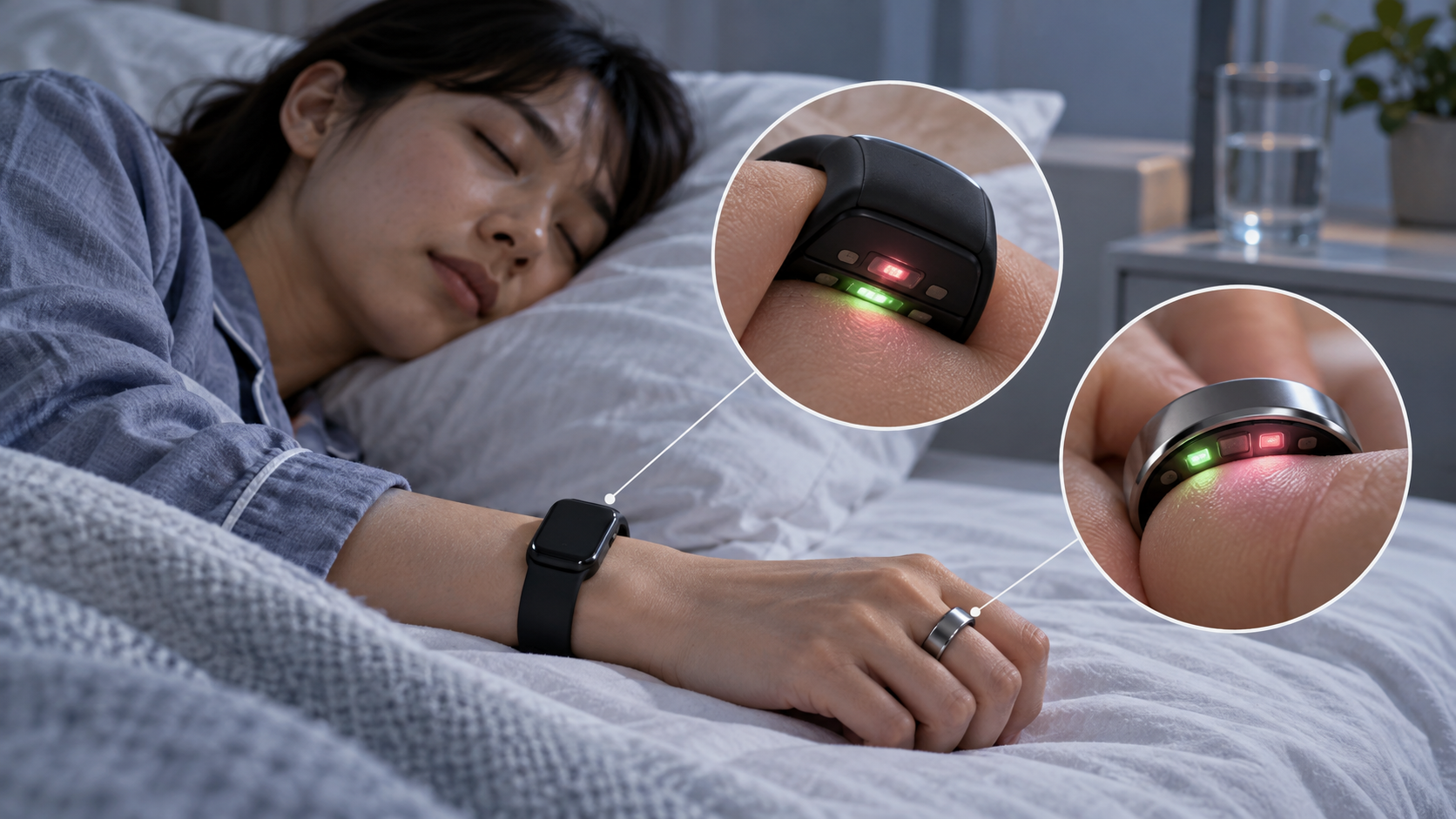
The company describes the BioActive Sensor as one chip combining an optical pulse-wave (PPG) sensor, an electrocardiogram (ECG) sensor and a bioelectrical impedance (BIA) sensor, carried on the Galaxy Watch since the Watch4 (2021) Sourced. The FDA documents list platform tests that include material safety for skin contact, thermal safety for skin contact, resistance to electrostatic discharge and water ingress, and blood-oxygen accuracy under low perfusion (the sleep apnea De Novo and the v2.0 510(k)). Blood-oxygen accuracy was compared against arterial-line arterial oxygen saturation (the standard ISO 80601-2-61:2017) on subjects of varied skin tones Sourced. With dry electrodes (ECG), multi-wavelength green, red and infrared light (blood oxygen) and BIA electrodes, the more skin-contact parts there are, the more contact stability and resistance to sweat and dryness would be expected to matter for signal quality, but we could not confirm the specific electrode or window materials Not yet confirmed.
6. What it has done so far
| When | What happened | Why it matters |
|---|---|---|
| November 2013 to September 2014 | Clinical evaluations of a portable in vitro diagnostic device, the "LABGEO PT10" (a hepatic panel, 32 participants) among others, are registered on ClinicalTrials.gov with Samsung Electronics as lead sponsor (status: terminated) | A past venture into in vitro diagnostics. We could not trace what followed from our materials |
| 4 December 2013 | The mobile app "S Health" received 510(k) clearance (K132148) | An app for viewing blood pressure, blood glucose and weight data from optional devices, not a watch sensor feature |
| May-June 2020 | On 24 May the company announced that the ECG function of the Samsung Health Monitor app had been cleared by Korea's MFDS. Blood pressure estimation had also been cleared by the MFDS earlier in 2020, and on 18 June it launched in Korea for the Galaxy Watch Active2 | Provided in Korea as medical-device software ahead of the FDA |
| 4 August 2020 | The ECG Monitor App (K201168) received 510(k) clearance. The predicate was Apple's ECG app (DEN180044) | Entered the same category on the strength of another company's De Novo |
| 2021 | The Galaxy Watch4 began carrying the BioActive Sensor (which the company describes as putting PPG, ECG and BIA on one chip) | Three kinds of signal taken by one component |
| 2 May 2023 | The ECG Monitor App with irregular heart rhythm notification (K230292) received 510(k) clearance. The primary predicate was Apple's IRNF (DEN180042) | A notification function was added |
| 5 October 2023 | Announced that the sleep apnea feature had been approved by Korea's MFDS | Korea first |
| 6 February 2024 (announced 10 February) | The sleep apnea feature (DEN230041) received FDA De Novo authorization (submitted 31 May 2023) | Created a new device type, "OTC device to assess risk of sleep apnea" (21 CFR 868.2378). Apple later used it as a predicate |
| 2 August 2024 | ECG App v1.3 (K240909) received 510(k) clearance, adding a high-heart-rate classification | Reference device: Apple's ECG 2.0 (K201525) |
| 8 April 2025 | Announced a sleep apnea collaboration with Stanford Medicine; approval by Brazil's ANVISA brought availability to 29 markets | ClinicalTrials.gov lists a Stanford-led, Samsung-supported study (152 participants, December 2024 to December 2025) |
| 8 July / 16 October 2025 | Announced an agreement to acquire Xealth (8 July). Acquired 100% of the shares on 16 October (Business Report) | Acquired a platform that connects watch data to the workflows of healthcare providers |
| 13 March 2026 | In a World Sleep Day announcement, said the sleep apnea feature is available in 78 markets | The number of markets is the company's statement |
| 7 and 28 May 2026 | Announced a syncope-prediction study with Chung-Ang University Gwangmyeong Hospital (7 May) and a GLP-1 therapy study with Massachusetts General Hospital (28 May) | Both are announcements of research, not of feature authorization or availability |
| 4 June 2026 | Announced a Samsung Health update (Vitals, Heart Health Score, Daily Cardio Load, Fitness Index and others), stating "for wellness only, not for the diagnosis or treatment of any medical condition" | The group of features not taken through regulation |
| 20 July 2026 | Sleep Apnea Feature v2.0 (K261011) received 510(k) clearance. It covers the Galaxy Ring in addition to the Galaxy Watch, and the age is now 18 and over | An example of a ring appearing in an FDA document |
| 22 July 2026 | Announced the Galaxy Watch9 and Galaxy Watch Ultra2, describing an "upgraded" sleep apnea feature | We could not confirm how this corresponds to the FDA document (Section 7) |
7. What comes next
Primary sources also contain the following Not yet confirmed.
- The company says it will keep improving the sleep apnea feature, but gives no timing or specification (March 2026 announcement).
- The July 2026 announcement says the upgraded sleep apnea feature analyzes breathing disruptions per hour with AI and classifies them into three levels. The FDA document cleared the same month (K261011), by contrast, describes a binary result: positive if the two-night average is 15 or more per hour. We could not confirm how the two correspond (a difference of country or version, or not).
- The FDA document (K261011) contains a predetermined change control plan (PCCP), which defines in advance the scope and validation methods of software changes after clearance.
Whether a U.S. FDA submission exists for blood pressure estimation; an official description of work on new measurement targets such as glucose; R&D spending, capital spending and headcount limited to wearable health; the price paid for Xealth; a consolidated headcount; sales or users by feature; and how the three-level sleep apnea classification of the Galaxy Watch9 corresponds to the FDA document. None of these is stated in the Business Report, FDA documents or official announcements we checked.
8. What the company is aiming for in biosensors
We separate what the company says directly from what we read into it. Inference marks our interpretation of primary sources; it is not something the company has said.
| What can be read | Primary evidence | Category |
|---|---|---|
| It builds the watch's health functions in two layers: "wellness" and "medical-device software" | The ECG, irregular rhythm and sleep apnea features are authorized or cleared by the FDA. Vitals, Heart Health Score, body composition and various indices are explicitly stated by the company not to be for diagnosis | Sourced (the two layers) / Inference (the intent) |
| It follows a sequence of obtaining approval in Korea first and then extending to the U.S. and other countries | MFDS came first for ECG and blood pressure (2020) and sleep apnea (2023). Sleep apnea is in 78 markets (company) | Sourced (the sequence) / Inference (the policy) |
| It enters categories opened by others by using predicate devices | The ECG and irregular rhythm notification features used Apple's De Novo records (DEN180044, DEN180042) as predicates | Sourced |
| It extends the measuring hardware to rings | K261011 adds the Galaxy Ring to the sleep apnea feature. The Business Report says the ring provides "customized health information" | Sourced |
| It is moving toward the workflows of healthcare providers | It acquired Xealth (500+ hospitals) and the Business Report says it will strengthen Samsung Health through "Connected Care". Joint research with MGH, Stanford and Chung-Ang | Sourced (acquisition, research) / Inference (the direction beyond) |
| It has not stepped into diagnosis-like measurement such as glucose, at least for now | Glucose is not among the BioActive Sensor's three sensors. On 21 February 2024 the FDA warned against smartwatches and smart rings that claim to measure blood glucose (no brand names given) | Sourced (the specification) / Inference (the policy) |
The reading that "it enters categories opened by others by using predicate devices" rests on the predicate device field of the 510(k). The ECG Monitor App (K201168) names Apple's ECG app (DEN180044) as predicate and lists the differences: the finger goes on the top button of the Samsung watch rather than Apple's Digital Crown, and the hardware and operating systems differ. The irregular rhythm notification (K230292) likewise names Apple's IRNF (DEN180042) as primary predicate Sourced. In 2024, when Apple obtained clearance for its sleep apnea notification (K240929), it in turn used Samsung's sleep apnea feature (DEN230041) as predicate. The two companies thus appear to take turns being the first to open a category and the follower Not yet confirmed. Performance figures from different studies are separate results, and we do not rank products by them.
9. Map of partnerships in biosensors
The collaborations and acquisitions that Samsung makes public are limited to those in Samsung Newsroom, the Business Report and ClinicalTrials.gov. Component makers, material suppliers and contract manufacturers for the sensors are not named in the biosensor-related materials Sourced. We therefore cannot draw a material or component supply chain. "Predicate" in the figure refers to another company's device used as a benchmark in regulatory documents; it is not a partnership.
10. Technologies, products and services
We set out the configuration as described in company materials and FDA documents. Because conditions differ by product, we give no performance figures except those in FDA documents.
| Element | What official materials list | Note |
|---|---|---|
| BioActive Sensor | The company describes a technology that puts an optical pulse-wave (PPG) sensor, an electrocardiogram (ECG) sensor and a bioelectrical impedance (BIA) sensor on one chip. Carried since the Galaxy Watch4 (2021) | Company statement (three sensors integrated) |
| Optical (PPG) | Multi-wavelength green, red and infrared PPG plus an accelerometer (sleep apnea De Novo document). A PPG array on the back of the watch touches the dorsal side of the wrist (K230292) | Blood oxygen is also calculated from the PPG |
| Electrical (ECG) | Dry electrodes on the back of the watch and a finger on the top button produce a single-lead ECG (K201168, K240909). The company says a measurement takes about 30 seconds | Assumes the electrodes are in contact with skin |
| Blood pressure estimation | Estimated by analyzing the PPG pulse waveform. Calibration with a cuff-type monitor is required at the start and every four weeks (28 days). The company states it is not for diagnosis or treatment | No U.S. FDA record found |
| Body composition (BIA) | Estimates weight, body fat, skeletal muscle, body water and basal metabolic rate. The company states it is "not intended to specifically diagnose or treat a medical condition" | No FDA or Korean regulatory position found |
| Ring | The Galaxy Ring is added to the scope of the FDA sleep apnea clearance (K261011). The document says the ring provides the same types of sensors as the Galaxy Watch | Ring support for other features could not be confirmed |
| Software | Sleep apnea v2.0 uses a deep-learning model trained on about 2,400 recordings of concurrent in-lab polysomnography (PSG) from more than 1,100 subjects; the model was locked before verification and validation | A PCCP defines the scope of updates |
| Performance in FDA documents (with conditions) | Population and conditions | Result |
|---|---|---|
| ECG Monitor App (K201168) | 544 enrolled (268 with AFib, 261 in sinus rhythm, 15 with other arrhythmias). Reference: cardiologists' reads of a 12-lead ECG. Evaluated on recordings for which the algorithm gave a classification | AFib sensitivity 98.1% (95% CI 96.3-99.9), specificity 100% (100-100). Inconclusive 2.9% (1.1-4.7) |
| IHRN (K230292) | 888 enrolled (people at risk of AFib), 810 analyzed. Worn with a 7-day ECG patch; notifications compared with clinician-adjudicated patch ECG | Subject-level sensitivity 68.0% (CI 60.5-75.5), specificity 98.8% (98.0-99.6). PPV 95.7% (94.7-96.7) on a selected set of tachograms |
| Sleep apnea (DEN230041) | 620 enrolled (47 did not complete), an enriched adult population. Two nights in a sleep lab; reference: physician assessment of PSG from an FDA-cleared PSG device. AHI of 15 or more counts as moderate-to-severe | Sensitivity 82.7% (167/202; 95% CI 76.7-87.6), specificity 87.7% (235/268; 83.1-91.4). The FDA document records that specificity did not meet the pre-specified acceptance criterion; the sponsor's post hoc modified calculation gave 91.1%. Insufficient data on 16.7% of nights |
| Sleep apnea v2.0 (K261011) | An enriched population aged 18 and over wearing devices during two-night PSG. Watch 475 subjects, ring 469 | Watch: sensitivity 90.8% (86.0-94.4), specificity 90.3% (86.1-93.6). Ring: sensitivity 77.9% (71.5-83.5), specificity 95.9% (92.8-97.9). A result was given for 87.9% of sleep sessions on the watch and 86.0% on the ring |
These values come from different studies with different references and populations, and they do not show which feature or company is better. The FDA documents state that the absence of a notification or result does not mean the absence of disease Sourced.
The sleep apnea De Novo document states that optical SpO2 is known to perform less well on darker skin pigmentation, then reports this study's results by skin tone (for example sensitivity 87.5% and specificity 90.9% at Fitzpatrick 5-6) and results for 47 subjects with low baseline perfusion Sourced. The v2.0 510(k) also splits results by the Monk scale into three groups, and on the ring sensitivity differs between groups (for example 71.0% in the 5-6 group and 80.9% in the 1-4 group). The clarity of the optical window on the back of the watch, its arrangement relative to the photodiodes, and the stability of contact provided by the band or ring would be expected to help reduce such differences related to skin tone and blood flow Not yet confirmed. However, the materials of the back cover, electrodes, the inside of the ring and the bands are not stated in the official materials we checked, so we could not confirm the effect of any particular material. See also our explainers on wearable biosensors, patch sensors and skin adhesion, and electrochemical sensors.
11. The risks this company carries
| Risk | Detail | Category |
|---|---|---|
| Limits on what can be claimed | Authorizations and clearances carry conditions on use, age and history. The limitations section of the sleep apnea De Novo document says not to use the feature if diagnosed with conditions such as heart failure, atrial fibrillation, Parkinson's disease or chronic obstructive pulmonary disease, or if pregnant | Sourced |
| Performance limits | The sleep apnea De Novo document records that specificity did not meet the pre-specified acceptance criterion. Subject-level sensitivity of the IHRN was 68.0% under the FDA study conditions | Sourced |
| Differences in permission by market | The company says the blood pressure feature is available only in select markets, and that availability of the sleep apnea feature and others varies by device and market and may not work where approval or registration as medical-device software has not been obtained | Sourced |
| Correspondence between company statements and regulatory documents | We could not confirm how the three-level sleep apnea description in the July 2026 announcement corresponds to the FDA document (binary result) | Not yet confirmed |
| Earnings of the MX business | The MX and Networks businesses posted an operating loss (KRW 0.7 trillion) in the second quarter of 2026. The company cites industry-wide component cost pressures | Sourced |
| Difficulty of external verification | Wearable health sales, R&D, user numbers and the Xealth price are not disclosed, so the scale of the business is hard to verify from outside | Not yet confirmed |
| Recalls and safety communications | The openFDA medical device recall search showed no record for a firm named "Samsung" (a different spelling could cause a miss) | Could not be confirmed |
12. Glossary
- De Novo (new classification)
- A pathway under which the FDA classifies a new type of low-to-moderate-risk device that has no equivalent; later devices can use it as a predicate in a 510(k).
- 510(k) clearance
- The FDA's finding that a device is substantially equivalent to an existing (predicate) device. Distinct from PMA approval.
- PCCP (predetermined change control plan)
- A plan, agreed with the FDA in advance, that defines the scope and validation of software changes to be made after clearance.
- MFDS
- Korea's Ministry of Food and Drug Safety, which approves and clears medical-device software.
- ANVISA
- Brazil's National Health Surveillance Agency, which registers medical devices.
- PPG (photoplethysmography)
- A method that measures changes in blood volume from how light shone into the skin returns; also used to calculate blood oxygen.
- SpO2 (peripheral oxygen saturation)
- The share of hemoglobin in the blood that is bound to oxygen; a watch calculates it from differences in light absorption.
- BIA (bioelectrical impedance analysis)
- A method that passes a weak current through the body and estimates body composition from how hard it is for the current to pass.
- AHI (apnea-hypopnea index)
- The number of apnea and hypopnea events per hour of sleep; 15 or more is classed as moderate-to-severe.
- PSG (polysomnography)
- An overnight test, usually in a sleep lab, that records brain waves, breathing, blood oxygen and more; used as the reference in FDA documents.
- Predicate device
- The existing device to which a new device is compared for equivalence in a 510(k).
13. References
- Samsung Electronics 2025 Business Report (year ended December 2025; 4Q Interim Report). Company profile, headquarters, listing, consolidated results, R&D, government subsidies, employees, Xealth acquisition, description of smartwatches and rings. https://images.samsung.com/is/content/samsung/assets/global/ir/docs/2025_4Q_Interim_Report.pdf
- Samsung Newsroom Samsung Electronics Announces Fourth Quarter and FY 2025 Results (January 2026). Annual sales and operating profit, R&D, MX business commentary. https://news.samsung.com/global/samsung-electronics-announces-fourth-quarter-and-fy-2025-results
- Samsung Newsroom Samsung Electronics Announces Second Quarter 2026 Results (30 July 2026). MX and Networks sales and operating loss, group sales. https://news.samsung.com/global/samsung-electronics-announces-second-quarter-2026-results
- U.S. Food and Drug Administration (FDA) Do Not Use Smartwatches or Smart Rings to Measure Blood Glucose Levels: FDA Safety Communication (21 February 2024). https://www.fda.gov/medical-devices/safety-communications/do-not-use-smartwatches-or-smart-rings-measure-blood-glucose-levels-fda-safety-communication
- U.S. Food and Drug Administration (FDA) 510(k) K201168 (Samsung ECG Monitor Application): clearance letter and 510(k) summary, 4 August 2020. Predicate DEN180044, clinical study. https://www.accessdata.fda.gov/cdrh_docs/pdf20/K201168.pdf
- U.S. Food and Drug Administration (FDA) 510(k) K230292 (Samsung ECG Monitor Application with Irregular Heart Rhythm Notification Feature): clearance letter and 510(k) summary, 2 May 2023. https://www.accessdata.fda.gov/cdrh_docs/pdf23/K230292.pdf
- U.S. Food and Drug Administration (FDA) 510(k) K240909 (Samsung ECG App v1.3): clearance letter and 510(k) summary, 2 August 2024. https://www.accessdata.fda.gov/cdrh_docs/pdf24/K240909.pdf
- U.S. Food and Drug Administration (FDA) De Novo Classification Request for Sleep Apnea Feature (DEN230041), decision summary. Use, limitations, sensors, clinical study, results by skin tone. https://www.accessdata.fda.gov/cdrh_docs/reviews/DEN230041.pdf
- U.S. Food and Drug Administration (FDA) 510(k) K261011 (Sleep Apnea Feature v2.0): clearance letter and 510(k) summary, 20 July 2026. Galaxy Watch and Galaxy Ring, clinical study, PCCP. https://www.accessdata.fda.gov/cdrh_docs/pdf26/K261011.pdf
- U.S. Food and Drug Administration (FDA) 510(k) K132148 (S Health): clearance letter and 510(k) summary, 4 December 2013. https://www.accessdata.fda.gov/cdrh_docs/pdf13/K132148.pdf
- Samsung Newsroom Samsung Launches the Samsung Health Monitor Application with Blood Pressure Measurement (18 June 2020). Korean clearance and launch of blood pressure, calibration. https://news.samsung.com/global/samsung-launches-the-samsung-health-monitor-application-with-blood-pressure-measurement
- Samsung Newsroom Electrocardiogram Monitoring Cleared for Galaxy Watch Active2 by South Korea's Ministry of Food and Drug Safety (24 May 2020). https://news.samsung.com/global/electrocardiogram-monitoring-cleared-for-galaxy-watch-active2-by-south-koreas-ministry-of-food-and-drug-safety
- U.S. Food and Drug Administration (FDA) openFDA 510(k) API (search by applicant name "Samsung Electronics"). Confirms the biosignal-related records and the absence of a blood pressure record. https://api.fda.gov/device/510k.json?search=applicant:%22Samsung%20Electronics%22&limit=100&sort=decision_date:desc
- Samsung Galaxy Watch9 (U.S.) product page and footnotes. FDA-regulation statement for sleep apnea, calibration and cautions for blood pressure, BIA, AGEs, ECG use. https://www.samsung.com/us/watches/galaxy-watch9/
- Samsung Newsroom Samsung Introduces Next-Gen Galaxy Watch Features for AI-Powered Everyday Health Companion (4 June 2026). Vitals, Heart Health Score and the "wellness only" note. https://news.samsung.com/global/samsung-introduces-next-gen-galaxy-watch-features-for-ai-powered-everyday-health-companion
- Samsung Newsroom [World Heart Day] Taking Care of Your Heart Every Day, Starting From Your Wrist (29 September 2026). Description of the BioActive Sensor; footnotes on blood pressure, ECG and IHRN. https://news.samsung.com/global/world-heart-day-taking-care-of-your-heart-every-day-starting-from-your-wrist
- Samsung Newsroom Samsung Brings Sleep Apnea Feature to Galaxy Watch Upon Approval by Korea's Ministry of Food and Drug Safety (5 October 2023). https://news.samsung.com/global/samsung-brings-sleep-apnea-feature-to-galaxy-watch-upon-approval-by-koreas-ministry-of-food-and-drug-safety
- Samsung Newsroom Samsung's Sleep Apnea Feature on Galaxy Watch First of Its Kind Authorized by US FDA (10 February 2024). https://news.samsung.com/global/samsungs-sleep-apnea-feature-on-galaxy-watch-first-of-its-kind-cleared-by-us-fda
- Samsung Newsroom Samsung Announces Collaboration With Stanford Medicine To Advance Sleep Apnea Detection and Beyond (8 April 2025). https://news.samsung.com/global/samsung-announces-collaboration-with-stanford-medicine-to-advance-sleep-apnea-detection-and-beyond
- Samsung Newsroom Samsung Electronics Acquires Xealth, Bridging The Gap Between Wellness and Medical Care (8 July 2025). Announcement of the acquisition agreement. https://news.samsung.com/us/samsung-electronics-acquires-xealth-bridging-gap-between-wellness-medical-care
- Samsung Newsroom [World Sleep Day] How Samsung Is Tackling Sleep Apnea to Energize Your Days (13 March 2026). 78 markets and technology description. https://news.samsung.com/global/world-sleep-day-how-samsung-is-tackling-sleep-apnea-to-energize-your-days
- Samsung Newsroom Samsung Announces World-First Breakthrough in Fainting Prediction With Galaxy Watch (7 May 2026). Joint study with Chung-Ang University Gwangmyeong Hospital. https://news.samsung.com/global/samsung-announces-world-first-breakthrough-in-fainting-prediction-with-galaxy-watch
- Samsung Newsroom Samsung and Massachusetts General Hospital Launch Joint Study To Investigate GLP-1 Treatment Monitoring With Galaxy Watch (28 May 2026). https://news.samsung.com/global/samsung-and-massachusetts-general-hospital-launch-joint-study-to-investigate-glp-1-treatment-monitoring-with-galaxy-watch
- Samsung Newsroom [Galaxy Unpacked July 2026] A First Look at Galaxy Watch Ultra2 and Galaxy Watch9 (22 July 2026). Description of the upgraded sleep apnea feature. https://news.samsung.com/global/galaxy-unpacked-july-2026-a-first-look-at-galaxy-watch-ultra2-and-galaxy-watch9
- ClinicalTrials.gov NCT06603441 Reliability of the Samsung Galaxy for the Detection of Moderate to Severe Obstructive Sleep Apnea (led by Stanford University; collaborator Samsung Electronics; 152 participants). https://clinicaltrials.gov/study/NCT06603441
- ClinicalTrials.gov NCT05767593 Clinical Validation of Samsung Smartwatch (led by Massachusetts General Hospital; collaborator Samsung Electronics). https://clinicaltrials.gov/study/NCT05767593
- ClinicalTrials.gov NCT04553861 Smartwatch ABPM vs. Conventional ABPM (led by Wonju Severance Christian Hospital; collaborator Samsung Electronics; 30 participants). https://clinicaltrials.gov/study/NCT04553861
- ClinicalTrials.gov NCT02104154 Evaluation of the Samsung LABGEO PT10 Hepatic Panel in a Point-of-Care Setting (led by Samsung Electronics; 32 participants; terminated). https://clinicaltrials.gov/study/NCT02104154
- U.S. Food and Drug Administration (FDA) openFDA PMA API (search by applicant name "Samsung" returned no match). https://api.fda.gov/device/pma.json?search=applicant:%22Samsung%22&limit=3
- U.S. Food and Drug Administration (FDA) openFDA device recall API (no match for "Samsung"). https://api.fda.gov/device/recall.json?search=recalling_firm:%22Samsung%22&limit=30
- Samsung Official website samsung.com (source of the logo image, specified as the logo in structured data). https://www.samsung.com/us/
14. Claim-to-source audit
| Claim in the article | Category | Source |
|---|---|---|
| Legal name, headquarters, Korea Stock Exchange listing date, employees at the Korean headquarters (DX and DS), consolidated results, R&D, government subsidies | Sourced | Reference 1 https://images.samsung.com/is/content/samsung/assets/global/ir/docs/2025_4Q_Interim_Report.pdf |
| Annual sales of KRW 333.6 trillion, operating profit of KRW 43.6 trillion, R&D of KRW 37.7 trillion, MX business double-digit annual profit, fourth-quarter 2025 MX and Networks figures | Sourced | Reference 2 https://news.samsung.com/global/samsung-electronics-announces-fourth-quarter-and-fy-2025-results |
| Second-quarter 2026 MX and Networks sales of KRW 33.2 trillion and operating loss of KRW 0.7 trillion; group sales of KRW 171.5 trillion; DS Division up 56% quarter on quarter | Sourced | Reference 3 https://news.samsung.com/global/samsung-electronics-announces-second-quarter-2026-results |
| FDA warning: it has not authorized, cleared or approved any smartwatch or smart ring that measures or estimates blood glucose on its own (21 February 2024, no brands named) | Sourced | Reference 4 https://www.fda.gov/medical-devices/safety-communications/do-not-use-smartwatches-or-smart-rings-measure-blood-glucose-levels-fda-safety-communication |
| ECG Monitor App (K201168): use, predicate Apple DEN180044, number of participants, sensitivity and specificity, inconclusive share | Sourced | Reference 5 https://www.accessdata.fda.gov/cdrh_docs/pdf20/K201168.pdf |
| ECG Monitor App with IHRN (K230292): use, predicate Apple DEN180042, subject-level sensitivity and specificity, PPV | Sourced | Reference 6 https://www.accessdata.fda.gov/cdrh_docs/pdf23/K230292.pdf |
| ECG App v1.3 (K240909): use and the Apple K201525 reference device | Sourced | Reference 7 https://www.accessdata.fda.gov/cdrh_docs/pdf24/K240909.pdf |
| Sleep apnea De Novo (DEN230041): use, limitations, SpO2, two-night observation, study size, sensitivity and specificity, specificity criterion not met, results by skin tone and low perfusion | Sourced | Reference 8 https://www.accessdata.fda.gov/cdrh_docs/reviews/DEN230041.pdf |
| Sleep apnea v2.0 (K261011): Watch and Ring, ages 18 and over, binary result, sensitivity and specificity for 475 watch and 469 ring subjects, PCCP, results by Monk scale | Sourced | Reference 9 https://www.accessdata.fda.gov/cdrh_docs/pdf26/K261011.pdf |
| S Health (K132148): use and date | Sourced | Reference 10 https://www.accessdata.fda.gov/cdrh_docs/pdf13/K132148.pdf |
| Blood pressure estimation cleared by Korea's MFDS and launched (18 June 2020); calibration every four weeks | Sourced | Reference 11 https://news.samsung.com/global/samsung-launches-the-samsung-health-monitor-application-with-blood-pressure-measurement |
| Announcement of the ECG function's MFDS clearance (24 May 2020); MFDS clearance for blood pressure | Sourced | Reference 12 https://news.samsung.com/global/electrocardiogram-monitoring-cleared-for-galaxy-watch-active2-by-south-koreas-ministry-of-food-and-drug-safety |
| List of Samsung Electronics' five biosignal-related FDA records, and the absence of a blood pressure record | Sourced | Reference 13 https://api.fda.gov/device/510k.json?search=applicant:%22Samsung%20Electronics%22&limit=100&sort=decision_date:desc |
| FDA-regulation statement for sleep apnea; cautions for blood pressure, BIA, AGEs; ECG and IHRN use | Sourced | Reference 14 https://www.samsung.com/us/watches/galaxy-watch9/ |
| Vitals, Heart Health Score, Daily Cardio Load, Fitness Index and others stated to be for wellness only | Sourced | Reference 15 https://news.samsung.com/global/samsung-introduces-next-gen-galaxy-watch-features-for-ai-powered-everyday-health-companion |
| Description of the BioActive Sensor (PPG, ECG, BIA); footnotes on blood pressure, ECG and IHRN | Sourced | Reference 16 https://news.samsung.com/global/world-heart-day-taking-care-of-your-heart-every-day-starting-from-your-wrist |
| Announcement of the sleep apnea feature's MFDS approval (5 October 2023) | Sourced | Reference 17 https://news.samsung.com/global/samsung-brings-sleep-apnea-feature-to-galaxy-watch-upon-approval-by-koreas-ministry-of-food-and-drug-safety |
| Announcement of the sleep apnea feature's FDA De Novo authorization (10 February 2024); age 22 and over | Sourced | Reference 18 https://news.samsung.com/global/samsungs-sleep-apnea-feature-on-galaxy-watch-first-of-its-kind-cleared-by-us-fda |
| Collaboration with Stanford Medicine (8 April 2025); ANVISA approval bringing availability to 29 markets | Sourced | Reference 19 https://news.samsung.com/global/samsung-announces-collaboration-with-stanford-medicine-to-advance-sleep-apnea-detection-and-beyond |
| Announcement of the agreement to acquire Xealth (8 July 2025) | Sourced | Reference 20 https://news.samsung.com/us/samsung-electronics-acquires-xealth-bridging-gap-between-wellness-medical-care |
| Acquisition of 100% of Xealth's shares (16 October 2025); the "Connected Care" concept | Sourced | Reference 1 https://images.samsung.com/is/content/samsung/assets/global/ir/docs/2025_4Q_Interim_Report.pdf |
| World Sleep Day announcement: 78 markets; description of blood-oxygen-based detection | Sourced | Reference 21 https://news.samsung.com/global/world-sleep-day-how-samsung-is-tackling-sleep-apnea-to-energize-your-days |
| Syncope-prediction study (Chung-Ang University Gwangmyeong Hospital, 132 patients, published in European Heart Journal - Digital Health) | Sourced | Reference 22 https://news.samsung.com/global/samsung-announces-world-first-breakthrough-in-fainting-prediction-with-galaxy-watch |
| GLP-1 therapy study with Massachusetts General Hospital (100 adults); description of the BioActive Sensor | Sourced | Reference 23 https://news.samsung.com/global/samsung-and-massachusetts-general-hospital-launch-joint-study-to-investigate-glp-1-treatment-monitoring-with-galaxy-watch |
| Announcement of the Galaxy Watch9 and Watch Ultra2 (22 July 2026); upgraded sleep apnea feature and three-level classification | Sourced | Reference 24 https://news.samsung.com/global/galaxy-unpacked-july-2026-a-first-look-at-galaxy-watch-ultra2-and-galaxy-watch9 |
| Stanford-led sleep apnea study (152 participants, December 2024 to December 2025) | Sourced | Reference 25 https://clinicaltrials.gov/study/NCT06603441 |
| MGH-led clinical validation study (registered completion: December 2026) | Sourced | Reference 26 https://clinicaltrials.gov/study/NCT05767593 |
| Wonju Severance Christian Hospital study of smartwatch blood-pressure estimation versus ambulatory monitoring (30 participants) | Sourced | Reference 27 https://clinicaltrials.gov/study/NCT04553861 |
| LABGEO PT10 clinical evaluation (November 2013 to September 2014, 32 participants, terminated) | Sourced | Reference 28 https://clinicaltrials.gov/study/NCT02104154 |
| No PMA record found for the applicant name Samsung in openFDA | Sourced | Reference 29 https://api.fda.gov/device/pma.json?search=applicant:%22Samsung%22&limit=3 |
| No medical device recall record found | Sourced | Reference 30 https://api.fda.gov/device/recall.json?search=recalling_firm:%22Samsung%22&limit=30 |
| Price paid for Xealth; R&D, capital spending and headcount limited to wearable health; consolidated headcount; sales and users by feature | Not yet confirmed | Not stated in the Business Report or official announcements. Could not be confirmed; we do not claim they do not exist. Reference 1 https://images.samsung.com/is/content/samsung/assets/global/ir/docs/2025_4Q_Interim_Report.pdf |
| Whether a U.S. FDA submission exists for blood pressure estimation | Not yet confirmed | Could not be confirmed in the FDA database. We do not claim it does not exist. Reference 13 https://api.fda.gov/device/510k.json?search=applicant:%22Samsung%20Electronics%22&limit=100&sort=decision_date:desc |
| Plans for blood glucose measurement | Not yet confirmed | No plan stated in official materials. Could not be confirmed. Reference 16 https://news.samsung.com/global/world-heart-day-taking-care-of-your-heart-every-day-starting-from-your-wrist |
| Component suppliers, and the materials of electrodes, windows, bands and the ring | Not yet confirmed | Not stated in the official materials we checked. Could not be confirmed. Reference 8 https://www.accessdata.fda.gov/cdrh_docs/reviews/DEN230041.pdf Reference 9 https://www.accessdata.fda.gov/cdrh_docs/pdf26/K261011.pdf |
| How the three-level sleep apnea classification of the Galaxy Watch9 corresponds to the FDA document (binary result) | Not yet confirmed | The company's description (Reference 24) and the FDA document (Reference 9) are worded differently. The correspondence could not be confirmed. Reference 24 https://news.samsung.com/global/galaxy-unpacked-july-2026-a-first-look-at-galaxy-watch-ultra2-and-galaxy-watch9 Reference 9 https://www.accessdata.fda.gov/cdrh_docs/pdf26/K261011.pdf |
| The framing of Samsung as mainly a wearables & consumer company whose main businesses lie elsewhere (the type) | Our calculation | Our own framing, an interpretation of the Business Report (Reference 1) and FDA documents (References 5-9) |
| The framing that regulatory treatment falls into three layers (FDA / Korea only / wellness) | Our calculation | Our own framing, an interpretation of FDA documents (References 5-9) and company announcements (References 11, 12, 15) |
| The four-type classification and the example company names | Our calculation | Our own classification; the companies are examples drawn from those covered in this series |
| Year-on-year change in sales, operating profit, profit and R&D (+10.9%, +33.2%, +31.2%, +7.8%) | Our calculation | Our own calculation from Reference 1 figures |
| Reading that the watch's health functions are built in two layers, wellness and medical-device software | Inference | This article's interpretation of the list of authorizations and clearances and the wellness-only statements (References 9, 15) |
| Reading that it follows a sequence of obtaining approval in Korea first and then extending elsewhere | Inference | This article's interpretation of MFDS announcements (References 12, 17) and FDA dates (References 8, 18) |
| Reading that it enters categories opened by others using predicates, and that two companies take turns as first mover and follower | Inference | This article's interpretation of predicate fields (References 5, 6, 8 and Apple's 510(k) summary) |
| Reading that it is moving toward the workflows of healthcare providers | Inference | This article's interpretation of the Xealth acquisition (References 1, 20) and joint research (References 19, 22, 23) |
| Reading that it has not stepped into diagnosis-like measurement such as glucose | Inference | This article's interpretation of the sensor configuration (Reference 16) and the FDA warning (Reference 4) |
| The explanation that skin tone, blood flow and contact stability affect optical signals | Not yet confirmed | This article's interpretation of FDA test results (References 8, 9); the effect of particular materials could not be confirmed |
Last updated 3 October 2026 / Troy Technical
Figures in this article come from Samsung Electronics' Business Report and results announcements, FDA public documents, Samsung Newsroom announcements and product pages, and ClinicalTrials.gov. No research-firm estimates or press-based figures have been used. Passages marked "Inference" are this article's interpretation of primary sources, not statements made by the company. This article is not medical advice for any individual reader.