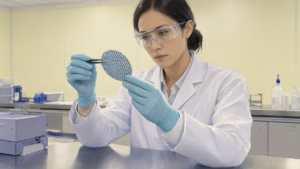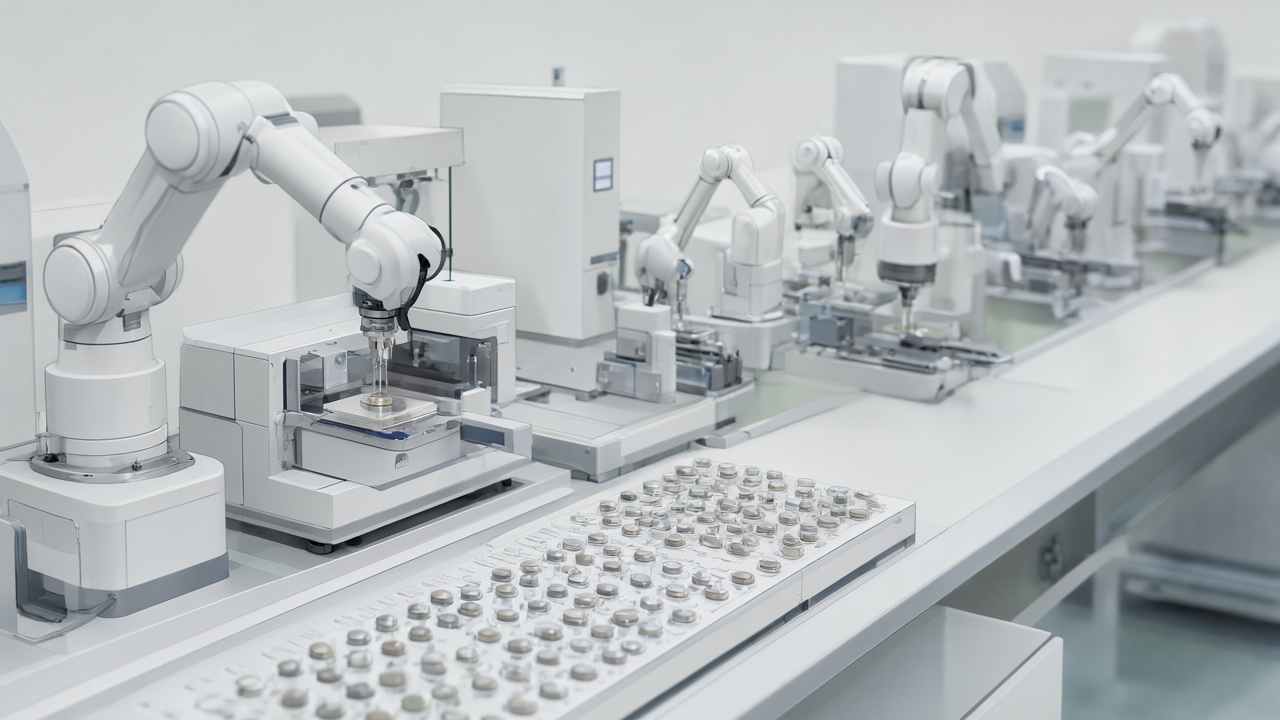
Lila Sciences has leveraged its AI-driven, closed-loop laboratory to discover a breakthrough catalyst that resolves a critical bottleneck in green hydrogen production: the acidic oxygen evolution reaction (OER). In just three months, the company’s autonomous lab proposed, synthesized, and screened 2,942 catalyst compositions, identifying non-obvious palladium-based catalyst compositions that would have been challenging to find through traditional trial-and-error methods.
Technical & Process Details
Lila Sciences’ AI-driven lab functions as a closed-loop system, automating and optimizing the entire process from hypothesis generation to experimentation, data analysis, and subsequent experimental design. This system integrates existing chemical knowledge with new experimental data using machine learning algorithms to efficiently explore vast material design spaces for promising catalyst candidates. For this OER catalyst discovery, the platform identified iridium- and ruthenium-free palladium-based complex oxides, such as InMnPdOx and NiTaPdOx. Notably, InMnPdOx demonstrated remarkable operational stability, maintaining an overpotential below 0.5 V for over 1,000 hours, matching or exceeding the durability of conventional noble metal catalysts.
Background & Industry Context
The economic viability and sustainability of green hydrogen production depend heavily on the development of highly efficient and inexpensive electrolysis catalysts. Acidic OER, in particular, has been a major bottleneck due to its sluggish kinetics and heavy reliance on costly noble metal catalysts like iridium and ruthenium. Lila Sciences’ achievement represents a significant step towards discovering alternative catalysts with performance comparable to these noble metals, potentially contributing significantly to reducing the cost and broadening the adoption of green hydrogen. The combination of AI and automated laboratories is introducing a new paradigm of “accelerated scientific discovery” in chemical research.
Strategic Significance & Outlook
The success of AI-driven closed-loop labs suggests their applicability to other complex chemical and material science problems, including new drug discovery and novel materials identification. We are entering an era where scientific breakthroughs can be achieved with unprecedented speed and efficiency by combining human expertise with AI’s exploration capabilities. This approach is expected to play a crucial role in accelerating technological development to address climate change and achieve a sustainable society.
Source: https://www.lila.ai/news/how-an-ai-run-lab-cracked-open-green-hydrogens-catalyst-problem
Get our weekly technology intelligence — free
Receive an infographic that lets you judge at a glance whether each field’s analysis report is worth reading.
Subscribe Free — Weekly Tech Intelligence
By subscribing, you’ll receive Troy-Technical’s weekly technology intelligence newsletter.
- Your email and selected fields are used only to deliver the newsletter.
- We never share your information with third parties.
- You can unsubscribe anytime via the link in each email.
See our Privacy Policy for details.
Takes about a minute · Unsubscribe anytime