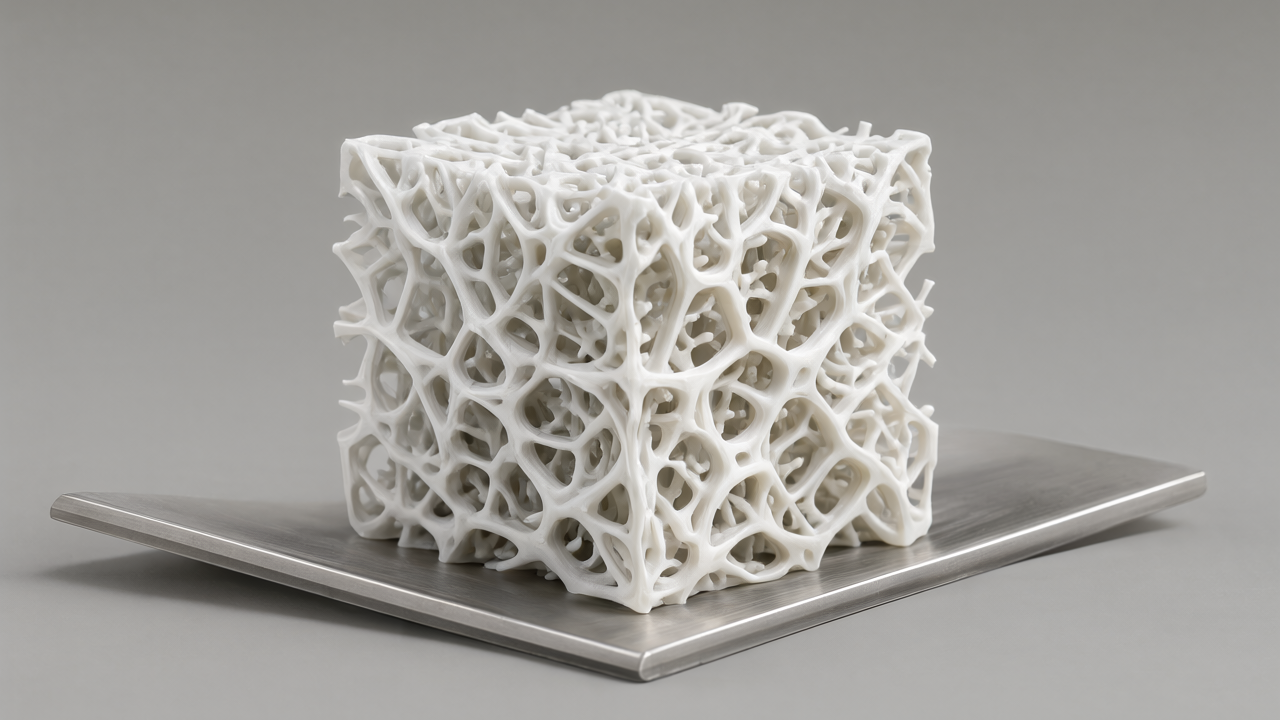
A new paper published on arXiv introduces a morphogenetic graph-generation framework, inspired by natural growth processes, demonstrating a breakthrough in the inverse design of mechanical lattices. This framework leverages a Graph Convolutional Neural Network (GCNN) to learn the complex mapping between material topology and mechanical properties, enabling high-accuracy prediction of compressive stiffness.
Technical & Process Details
The framework developed in this study integrates the following key elements:
- Morphogenetic Graph Generation: Mechanical lattices with complex graph structures are generated using algorithms that mimic biological growth patterns. This allows for the exploration of diverse structures unattainable through conventional periodic lattices.
- Dot Matrices Database Augmentation: A database is constructed to efficiently associate generated structures with their mechanical properties, enriching the training data for the GCNN.
- Graph Convolutional Neural Network (GCNN): The GCNN directly learns geometric and connectivity features from material structures represented in graph format. This enables a deep understanding of how material topology influences mechanical properties, leading to highly accurate property predictions.
- Inverse Design Capability: Utilizing the topology-property mapping learned by the GCNN, the framework automatically designs mechanical lattices with specific target compressive stiffness values. The paper demonstrates that target stiffness values can be achieved with very high accuracy.
Background & Industry Context
The design of mechanical lattices is critical in a wide range of fields requiring specific mechanical performance (e.g., lightweighting, high strength, energy absorption), such as aerospace, automotive, and biomedical engineering. However, designing these complex structures has traditionally been computationally expensive and inefficient with conventional simulation and optimization methods. The integration of AI, particularly GCNNs and generative models, offers a powerful means to overcome this challenge and accelerate the material design process. The nature-inspired generative approach broadens the potential for discovering innovative structures.
Strategic Significance & Outlook
This growth-inspired graph generation framework holds significant promise for the rapid development of custom materials with specific mechanical properties. The enhanced inverse design capability will accelerate the shift towards a “design-driven” materials engineering paradigm, where designers can specify desired performance, and AI proposes optimal material structures. This will not only shorten material development cycle times and reduce manufacturing costs but also facilitate the creation of novel materials with unprecedented functionalities. The technology has the potential to offer new solutions to contemporary engineering challenges that demand both sustainability and high performance.
Source: https://arxiv.org/abs/2609.29024
Get our weekly technology intelligence — free
Receive an infographic that lets you judge at a glance whether each field’s analysis report is worth reading.
Subscribe Free — Weekly Tech Intelligence
By subscribing, you’ll receive Troy-Technical’s weekly technology intelligence newsletter.
- Your email and selected fields are used only to deliver the newsletter.
- We never share your information with third parties.
- You can unsubscribe anytime via the link in each email.
See our Privacy Policy for details.
Takes about a minute · Unsubscribe anytime