TECHNOLOGY EXPLAINER
Methanol
— a liquid fuel made from hydrogen and carbon dioxide, and what it does to materials
Methanol (CH3OH) is the simplest alcohol and a liquid at ambient temperature and pressure. E-methanol, made from hydrogen and carbon dioxide (CO2), lets hydrogen be handled as a liquid, but it needs a carbon source. As a ship fuel, the IMO has issued interim guidelines and vessels able to run on it are in service. For materials, metal corrosion (above all between dissimilar metals in contact) and the swelling of rubbers and plastics with leaching of their additives are issues of a different kind from those with ammonia or liquid hydrogen.
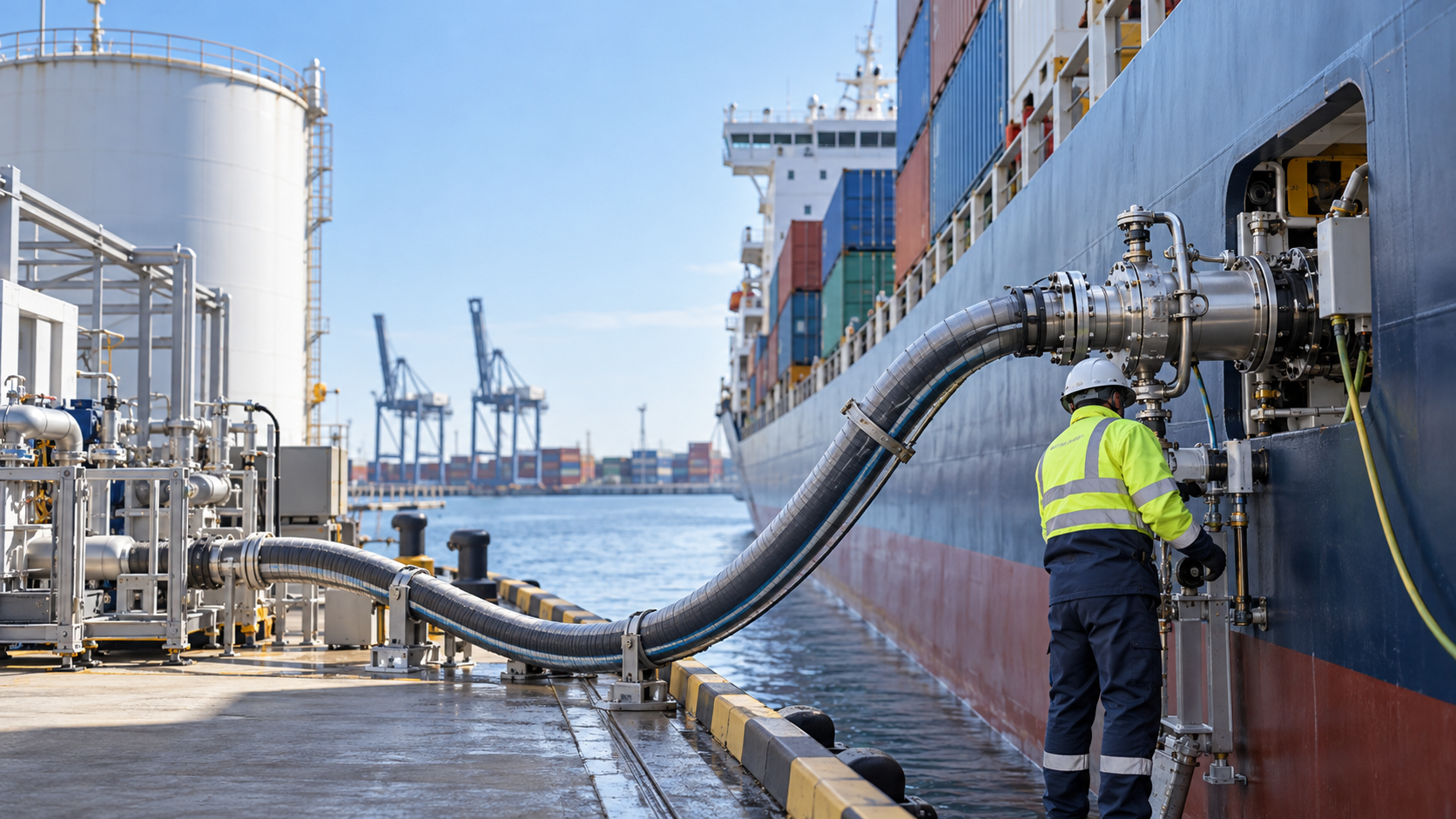
- What methanol is, in three lines
- Making it from hydrogen and CO2: the reaction and the balance
- Where it is made, and how carbon is accounted for
- As a ship fuel: IMO developments
- Policy: how Japan and the EU treat it
- Toxicity and safety: what public sources say
- Effects on materials: corrosion, swelling, leaching (a materials engineer's view)
- Open issues, and what this article could not confirm
- Glossary / References / Claim-to-source audit
Sourced = stated in material published by a public body, standards body, peer-reviewed paper, industry association or company (source linked)
Our calculation = a value this article derived from explicitly stated assumptions
Not yet confirmed = plans, targets or outlooks for which no result has been confirmed
Readings of structure or materials design are marked separately as Commentary. Industry association and company material is treated as the industry's or company's own claim.
This article explains materials, principles, evaluation and policy. It is not advice on handling or operating methanol or hydrogen.
1. What methanol is, in three lines
- What it is: molecular formula CH3OH, molar mass 32.04. According to NIST its normal boiling point is 337.8 ± 0.3 K (about 64.7 °C), the saturation pressure at 25 °C is about 17 kPa, and the liquid density is 786.24 kg/m3 Sourced [Ref. 1, 2]. Being liquid at ambient temperature, it is in some respects easy to handle with the arrangements used for existing liquid fuels.
- Relation to hydrogen: about 12.6% of the mass of the molecule is hydrogen (4.032 / 32.042) Our calculation, so 1 m3 of the liquid contains about 99 kg of hydrogen (786.24 kg/m3 × 0.1258) Our calculation. IRENA's table gives a storage density of 12.5% [Ref. 7]. Extracting that hydrogen needs reforming or similar steps, which this article does not cover.
- What is difficult: it needs hydrogen and CO2, so the carbon source (industrial flue gas, biomass or CO2 from the air) becomes the question. And there are material issues such as corrosion of metals and swelling of polymers.
Methanol is less "a liquid carrier of hydrogen" than "a liquid fuel that carries hydrogen and carbon together". The hydrogen part depends on electricity for electrolysis, the carbon part on obtaining CO2, and burning it releases CO2 again. How that carbon is accounted for is the heart of the policy rules (Commentary).
How to align conditions when comparing carriers is covered in our explainer on energy carriers, ammonia in our explainer on ammonia, the electrolysis that makes the hydrogen in our explainers on PEM and alkaline electrolysis, and synthetic fuels for aviation and road use in our explainer on SAF and e-fuels. This article keeps to what is specific to methanol.
2. Making it from hydrogen and CO2: the reaction and the balance
In a 2005 essay, Olah described methanol as a convenient liquid fuel and a raw material for synthetic hydrocarbons that can be made by reacting H2 with CO2 from industrial effluents or the atmosphere, and discussed the "methanol economy" Sourced [Ref. 5]. Industrial methanol synthesis uses a Cu/ZnO/Al2O3 catalyst of copper and zinc oxide nanoparticles on an alumina support. In their 2012 Science paper Behrens et al. report that the high activity depends on steps on the copper nanoparticles stabilised by defects such as stacking faults, and that partial coverage of the copper by zinc oxide is critical for stabilising surface intermediates such as HCO and lowering the energetic barriers Sourced [Ref. 6]. That paper dealt with synthesis from hydrogen and carbon monoxide, but similar catalysts are used when CO2 is the feed (Commentary; the optimal composition and conditions for CO2 feed were not checked here).
Reaction and mass balance
The basic reaction is CO2 + 3H2 → CH3OH + H2O. From molar masses we can compute the balance for one tonne of methanol.
Assumptions: molar masses CH3OH 32.042, CO2 44.009, H2 2.016 and H2O 18.015 g/mol. No losses. The lower heating value of methanol is taken as 637.7 kJ/mol = 19.90 MJ/kg: NIST's enthalpy of combustion (liquid, −725.7 kJ/mol) less the heat of vaporisation of 2 mol of water (44.0 kJ/mol from the difference in the enthalpies of formation) [Ref. 2, 4]. The lower heating value of hydrogen is 241.83 kJ/mol (725.5 kJ for 3 mol).
- One tonne of methanol needs 6.048 / 32.042 = 188.8 kg of hydrogen and 44.009 / 32.042 = 1.373 t of CO2, and co-produces 0.562 t of water.
- Heating value retained: 637.7 / 725.5 = about 87.9% (lower heating value basis). On a higher-heating-value basis, 725.7 / (3 × 285.83) = about 84.6%. The difference leaves as heat of reaction.
- Heat of reaction (CO2 as gas, methanol and water as liquids, 25 °C): −239.5 − 285.83 − (−393.51) = about −132 kJ/mol. Counting the products as gases, using the gaseous enthalpy of formation of methanol (−205 ± 10 kJ/mol, an average value in NIST), gives about −53 kJ/mol, so the number depends heavily on the phases counted (because of the heats of vaporisation).
- Electricity for the hydrogen (electrolyser-system consumption taken as an illustrative 45, 50 and 55 kWh/kg-H2): 188.8 kg × consumption = 8.5 / 9.4 / 10.4 MWh per tonne of methanol, about 1.5 / 1.7 / 1.9 times the 5.53 MWh in the methanol. CO2 capture and compression, synthesis and purification are not included.
Our calculation This ratio (about 1.7) is at nearly the same level as the ammonia case calculated in our explainer on ammonia. The step from hydrogen to liquid fuel retains most of the heating value, and the large electricity demand lies in making the hydrogen itself (Commentary).
The result of Behrens et al. shows that the catalyst's activity rests not on an "ideal crystal face" but on imperfect structures such as steps and stacking faults [Ref. 6]. Together with the paper's point that activity can vary by orders of magnitude depending on preparation, this suggests that catalyst performance cannot be compared by composition alone and has to be judged by preparation, pretreatment and operating history (Commentary; note that the paper dealt with synthesis from hydrogen and CO).
3. Where it is made, and how carbon is accounted for
Examples of production (company announcements)
- Carbon Recycling International (Svartsengi, Iceland): according to the company, the George Olah plant was built in 2010-2012 and began operating in 2012, purifying CO2 from the flue gas of an adjacent geothermal power plant and reacting it catalytically with hydrogen from water electrolysis to make methanol. The company calls it the first industrial-scale facility to produce fuel from CO2, and cites an emissions reduction of up to 80-90% (an audit by SGS Germany) Sourced (company claim) [Ref. 8].
- European Energy and Mitsui & Co. (Kassø, Denmark): the facility, for which an inauguration on 13 May 2025 was announced, has a capacity of 42,000 tonnes of e-methanol a year (equivalent to 53 million litres), and the company calls it the first large-scale commercial e-methanol facility in the world. It names A.P. Moller - Maersk as a main off-taker, to use it as fuel for Laura Maersk Sourced (company claim; the capacity is a design figure) [Ref. 9].
What could not be confirmed: the utilisation, actual annual output and production cost of these facilities are not in the material checked and are not covered.
Cost structure (IRENA's estimate)
IRENA's 2022 report sets out that the cost of renewable methanol depends strongly on the cost of CO2 and of hydrogen. Each USD 100/t rise in the CO2 cost raises the methanol cost by about USD 140/t (a 1.4:1 ratio), and even a low hydrogen cost of USD 2/kg-H2 corresponds to about USD 430/t of methanol, at least double the current fossil-based benchmark. As sustainable CO2 sources it names biogenic CO2 and direct air capture (DAC), stating that DAC currently costs several hundred dollars per tonne and consumes about 10-12 GJ/t-CO2 (possibly about 6 GJ/t-CO2 in future) Sourced (includes estimates and outlooks) [Ref. 7].
The CO2 ratio is consistent with the calculation in the previous chapter (1.373 t of CO2 per tonne of methanol). Applying the DAC energy range above, CO2 capture alone could be about 8.2-16.5 GJ per tonne of methanol (6-12 GJ/t-CO2 × 1.373 t), a scale approaching the 19.9 GJ heating value of the methanol Our calculation (a guide for the DAC case; it does not apply to carbon sources such as flue gas where capture needs less energy).
How carbon is "accounted for"
Burning methanol releases, in principle, 1 mol of CO2 per mole burned: 44.0 g of CO2 per 637.7 kJ of lower heating value, that is about 69.0 g-CO2/MJ Our calculation. Annex II of the EU's FuelEU Maritime lists rows for methanol (from natural gas) and e-methanol, with a lower calorific value of 0.0199 MJ/g and a CO2 emission factor of 1.375 per gram of fuel Sourced [Ref. 13]. These two figures nearly coincide with the stoichiometric values computed above (19.9 MJ/kg; 1.373 t-CO2/t) (the table is garbled in typeset form, so the column assignments should be checked in the text of the Regulation). The premise of the schemes is that the CO2 released on burning e-methanol is offset by the CO2 captured as feedstock, and the conditions for that offset are what chapter 5 sets out.
4. As a ship fuel: IMO developments
The IMO guidelines
IMO circular MSC.1/Circ.1621 (dated 7 December 2020) holds the interim guidelines for the safety of ships using methyl/ethyl alcohol as fuel. The Maritime Safety Committee approved them at its 102nd session (4-11 November 2020), aware of the increased use of methyl/ethyl alcohol as fuel and the lack of relevant provisions in the IGF Code (the international code for ships using gases or other low-flashpoint fuels) Sourced [Ref. 11]. The document says it will be kept under review in light of operational experience [Ref. 11].
According to DNV, the classification society, the IMO Sub-Committee on Carriage of Cargoes and Containers (CCC 12, 14-18 September 2026) finalised a revision of these guidelines. It gives more flexibility in fuel tank placement and leakage-handling arrangements, introduces a new concept for ventilation of fuel spaces, and adds guidance on the design of bunkering stations and fire extinguishing and on bunkering operations and personal protective equipment. The sub-committee's decisions need approval by the Maritime Safety Committee (MSC), and the timing of that approval could not be confirmed (the official IMO meeting summary could not be checked here; this relies on DNV's report) Sourced (DNV report) [Ref. 12].
Ships in service
On 14 September 2023 Maersk announced the naming of "Laura Maersk" (2,100 TEU), which it calls the world's first methanol-enabled container vessel (its wording), and said it has 24 further methanol vessels on order for delivery between 2024 and 2027 Sourced (company claim) and the latter Not yet confirmed (deliveries not checked) [Ref. 10]. A 2018 review by Svanberg et al. treats the potential of renewable methanol as a shipping fuel (only the title and journal were checked [Ref. 20]).
International and regional rules
- EU FuelEU Maritime (Regulation (EU) 2023/1805): from 1 January 2025 it caps the greenhouse gas intensity of the energy used on board ships (reductions from a reference value of 91.16 gCO2e/MJ of 2% in 2025, 6% in 2030 and so on to 80% in 2050). The text also says that for renewable fuels of non-biological origin (RFNBO) a multiplier of 2 can be used in the calculation from 1 January 2025 to 31 December 2033 Sourced [Ref. 13]. E-methanol is listed in Annex II as a fuel category [Ref. 13].
- IMO Net-Zero Framework: approved at MEPC 83 in April 2025, but the extraordinary session in October 2025 adjourned adoption for a year. It is not treated as an adopted regime [Ref. 21] (details in our explainer on ammonia).
5. Policy: how Japan and the EU treat it
| Measure | Stage | Date | What was confirmed |
|---|---|---|---|
| Enforcement Regulations of the Hydrogen Society Promotion Act (METI Ordinance No. 69 of Reiwa 6) | In force | 23 October 2024 | Names, among the hydrogen compounds, liquids synthesised from hydrogen with CO or CO2 (such as methanol) and synthetic methane. The requirement for synthetic fuels is, among other things, that emissions from production, transport, storage and use per MJ of heat, less all or part of the CO2 captured as feedstock, be 39.9 g-CO2 or less. The hydrogen used as feedstock must also meet the hydrogen requirement (3.4 kg-CO2 or less per kg) Sourced [Ref. 15] |
| The same ordinance, conditions for synthetic fuels made abroad | In force | 23 October 2024 | Where made from captured biogenic or atmospheric CO2, the Japanese business using the fuel must, among other things, deduct the CO2 released on use from its own emissions in its reporting, so that double counting is avoided. In other cases, an agreement and reporting between the foreign emitter and the Japanese business are required Sourced [Ref. 15] |
| EU Delegated Regulation (EU) 2023/1184 (RFNBO) | Adopted, in force | Adopted 10 February 2023 / published 20 June 2023 | Sets additionality and temporal correlation for the electricity used (calendar-month matching until the end of 2029, one-hour matching from 1 January 2030). Installations starting before 1 January 2028 are exempt from some conditions until 1 January 2038 Sourced [Ref. 14] |
| EU FuelEU Maritime (Regulation (EU) 2023/1805) | Adopted, applying | Adopted 13 September 2023 / applying from 1 January 2025 | As in chapter 4 Sourced [Ref. 13] |
Checked 5 October 2026. EU dates follow the Official Journal. The RFNBO regulation requires the Commission to report on its impact by 1 July 2028; debate about revising it appears in the press, but adoption of any amendment could not be confirmed here.
6. Toxicity and safety: what public sources say
According to the US NIOSH pocket guide (last reviewed 30 October 2019), the recommended exposure limit (REL) for methanol is 200 ppm as a time-weighted average and 250 ppm short-term (with a skin notation); the OSHA permissible exposure limit (PEL) is 200 ppm; and the concentration immediately dangerous to life or health (IDLH) is 6,000 ppm. The flash point is 52 °F (about 11 °C), the explosive range in air is 6.0% to 36%, and the boiling point is 147 °F (about 64 °C) Sourced [Ref. 16]. The Methanol Institute names, as a key consideration for storage, that the upper flammability limit of methanol (36 vol%) is far higher than that of gasoline (6-7 vol%), so vapour can burn even inside the vapour space of a tank Sourced (industry association material) [Ref. 17]. The text of the IMO interim guidelines (MSC.1/Circ.1621) also says that special consideration should be given to toxicity in the design of the vapour detection system [Ref. 11].
This is a summary of what public bodies and industry associations record, and is not advice on handling or operation. Japanese exposure limits and the treatment under the Poisonous and Deleterious Substances Control Act were not checked here.
7. Effects on materials: corrosion, swelling, leaching (a materials engineer's view)
Methanol is a polar, conductive solvent that mixes with water in any proportion. It acts on materials differently from a non-polar, non-conductive liquid like gasoline. The Methanol Institute records that methanol is hygroscopic and takes in moisture from the air through a tank's vapour space, and that, being a polar solvent, electrochemical (dissimilar-metal) corrosion is more prevalent with methanol than with other commonly used motor fuels Sourced (industry association material) [Ref. 17].
Metals: beware of dissimilar metals in contact
| Item | What the Methanol Institute says (industry association material) |
|---|---|
| Tank material | Carbon steel or 300-series austenitic stainless steel. Carbon steel has lower capital cost but higher life-cycle cost because of corrosion-protection maintenance. Stainless steel costs more up front but has lower maintenance cost and makes contamination of the methanol less likely |
| Fittings (trim) | Dissimilar-metal corrosion can be accelerated with aluminium, lead, magnesium, copper, zinc and platinum alloys. It cites, as a conclusion of the US Chemical Safety Board (CSB), a tank fire in which an aluminium-alloy flame arrester had corroded over 12 years until it no longer worked. Galvanised steel is described as unsuitable |
| Internal coatings | Epoxy lining of tank interiors has had limited success, with a typical coating life of under seven years; the coating forms an electrically insulating layer that complicates bonding and grounding. Progress is said to be under way on conductive spray-on tank liners |
| Stress corrosion cracking | Methanol is one of the few specialised environments that can cause SCC in titanium alloys (failures in dry methanol and in methanol/acid and methanol/halide mixtures; water acts as an inhibitor). In the weld heat-affected zones of high-carbon, non-molybdenum-stabilised austenitic stainless steel, local exposure to water with high chloride concentrations can cause SCC (in extreme cases). SCC observed in ethanol tanks has not been reported for methanol |
All Sourced (Methanol Institute, Atmospheric Above Ground Tank Storage of Methanol [Ref. 17]). This is industry association material and is treated as the industry's claim. Avoid generalising the coating life or the case history.
Rubbers and plastics: swelling, and leaching of additives
Zhang, Abdellah and Kentish (2022, International Journal of Energy Research) studied how methanol affects high-density polyethylene (HDPE) piping and the associated elastomers used in natural gas distribution networks. The results were as follows Sourced [Ref. 18].
- Methanol had a considerably higher diffusion coefficient than methane in HDPE, giving a permeability two orders of magnitude greater.
- The flexibility of HDPE pipe (tensile strain) fell on exposure to methanol.
- Sorption of methanol into rubbery SBR and NBR was orders of magnitude greater than into HDPE.
- For commercial elastomers, additives were extensively leached during methanol immersion and mechanical properties were significantly compromised.
- The authors' conclusion: existing HDPE pipelines are compatible for methanol transport, but elastomer materials will be localised points of methanol loss and failure.
Halada Nandakrishnan et al. (2022, Journal of Elastomers & Plastics) immersed PTFE, PET and HDPE, used in fuel tanks, pipes and injection systems, in P100, M15 and M30 fuel mixtures for 4, 10 and 30 days. Mass gain was in the order HDPE > PTFE > PET and the loss of hardness was also largest in HDPE; PTFE and PET lost strength while HDPE gained tensile strength; and changes were smallest in P100 and largest in M30 Sourced [Ref. 19] (the abstract does not define the test-condition codes; M15 and M30 read as methanol-containing fuel mixtures).
The Methanol Institute says plastics are generally not recommended for storage because plasticisers deteriorate over the long term, mechanical integrity is lost and contamination is possible, whereas many resins, nylons and rubbers, notably nitrile (Buna-N), ethylene-propylene, Teflon and neoprene, are used satisfactorily as components of equipment in methanol service Sourced [Ref. 17]. Zhang et al., on the other hand, report that sorption into rubbery NBR is orders of magnitude greater and that additives leach from commercial products, degrading their properties [Ref. 18].
Commentary: the two are looking at different yardsticks (long-term record and recommendation as a component, versus sorption, leaching and mechanical properties in immersion). The conclusion changes with the compound (plasticiser, filler, crosslinking), immersion time, temperature, methanol concentration, and whether leakage can be tolerated or sealing is essential. Compatibility should not be judged from a material name such as NBR alone; the view needed is to test the actual compound at the intended temperature and concentration, looking at mass change, hardness, tensile properties and extractables (the evaluation items of Halada Nandakrishnan et al. take this form [Ref. 19]).
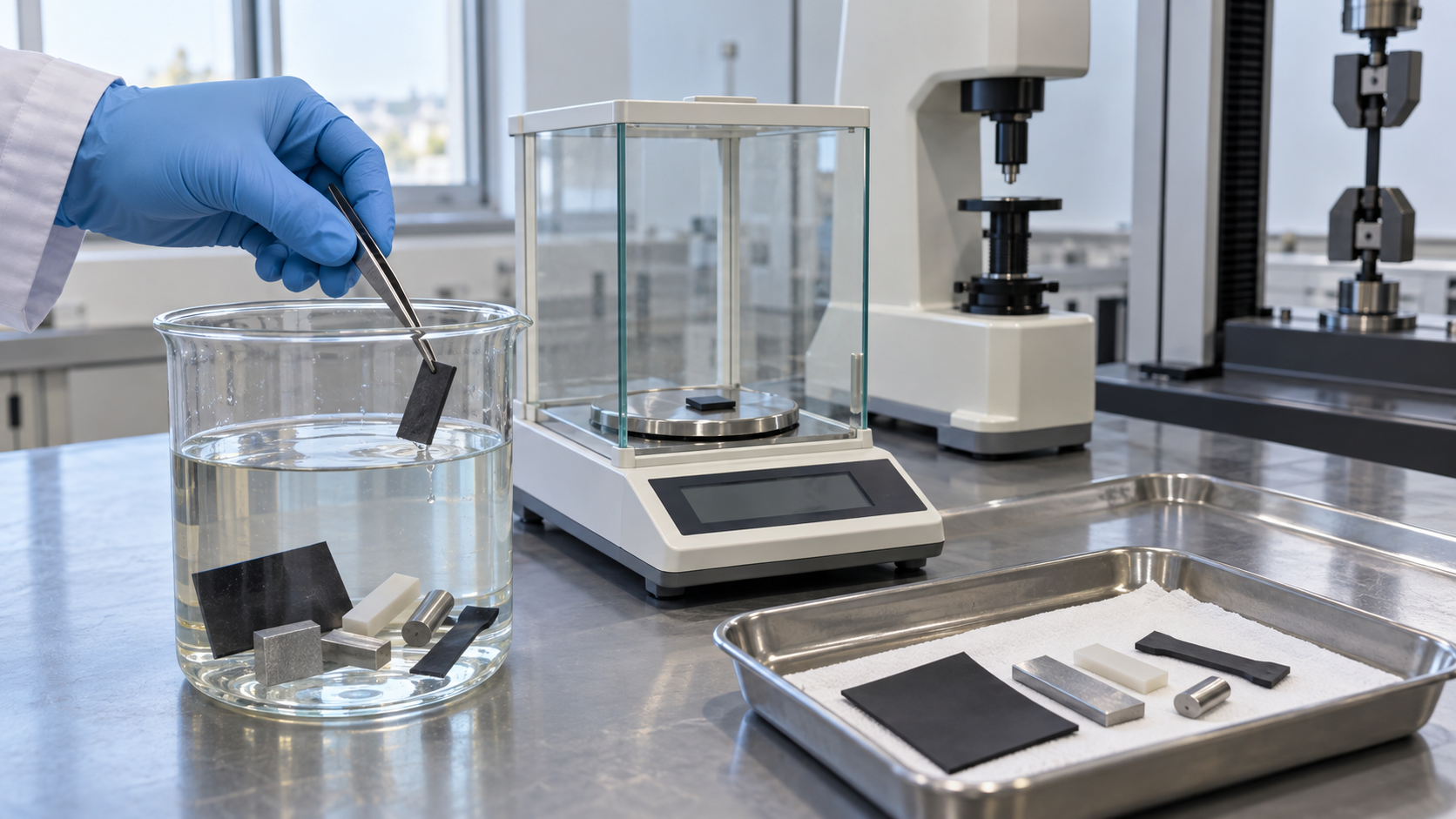
Numerical compatibility of individual materials such as FKM (fluoroelastomer), EPDM, silicones and polyamides with methanol, the details of the materials chapter of the IMO guidelines for ships, and low-temperature effects could not be checked against primary text and are not stated. For the general properties of fluoropolymers see our explainer on fluoropolymers and PFAS, and for barrier performance our explainer on barrier properties and coatings.
8. Open issues, and what this article could not confirm
- Carbon supply and accounting: the sustainability of CO2 sources and the treatment of deducting captured CO2 are defined differently by each scheme. The DAC energy figures include outlooks.
- Cost: IRENA's estimate is a model based on its 2022 report, not a current price. Actual production costs of the facilities could not be confirmed.
- IMO revised guidelines: approval by the MSC of the revision finalised at CCC 12 has not been confirmed (per DNV's report). The official IMO meeting summary also could not be confirmed.
- Facility performance: the utilisation and actual output of CRI's and Kassø's plants could not be confirmed.
- Domestic law: treatment under Japan's Fire Service Act, the Poisonous and Deleterious Substances Control Act and ship safety legislation was not checked.
- Materials: metal corrosion rates, the compatibility of individual rubbers and plastics, and coating life stay within what the industry association and papers state, and no design-grade figures were confirmed.
9. Glossary
- E-methanol
- Methanol synthesised from hydrogen made with renewable electricity and captured CO2.
- RFNBO
- Renewable fuels of non-biological origin; a term in the EU Renewable Energy Directive.
- Lower heating value (LHV)
- The heat of combustion excluding the condensation heat of the water vapour formed.
- DAC
- Direct air capture: technology that captures CO2 directly from the atmosphere.
- IGF Code
- The international safety code for ships using gases or other low-flashpoint fuels. Provisions for methanol are supplied by interim guidelines.
- Interim guidelines
- Guidance the IMO issues before formal amendment of a code (MSC.1/Circ.).
- Bunkering
- Supplying fuel to a ship.
- Galvanic (dissimilar-metal) corrosion
- When metals of different potential touch in an electrolyte, one corrodes preferentially.
- SCC
- Stress corrosion cracking: cracking of a metal under the combination of stress and a corrosive environment.
- Sorption
- Uptake of a liquid or gas into a polymer; the cause of swelling.
- M15 / M30
- Codes for methanol-containing fuel test conditions (per the abstract; definition not checked).
10. References
- NIST NIST Chemistry WebBook, Thermophysical Properties of Fluid Systems: Methanol — webbook.nist.gov
- NIST NIST Chemistry WebBook: Methanol (enthalpies of formation and combustion, boiling point) — webbook.nist.gov
- NIST NIST Chemistry WebBook: Carbon dioxide (enthalpy of formation) — webbook.nist.gov
- NIST NIST Chemistry WebBook: Water (enthalpy of formation) — webbook.nist.gov
- Olah Beyond Oil and Gas: The Methanol Economy, Angew. Chem. Int. Ed. 44, 2636-2639 (2005) — doi.org/10.1002/anie.200462121
- Behrens et al. The Active Site of Methanol Synthesis over Cu/ZnO/Al2O3 Industrial Catalysts, Science 336, 893-897 (2012) — doi.org/10.1126/science.1219831
- IRENA Global hydrogen trade to meet the 1.5°C climate goal: Part II – Technology review of hydrogen carriers (2022) — irena.org
- Carbon Recycling International George Olah: Industrial Scale Renewable Methanol Plant — carbonrecycling.com
- European Energy European Energy & Mitsui & Co. to inaugurate Kassø e-methanol facility in May 2025 (14 March 2025) — europeanenergy.com
- Maersk EU Commission President Names Landmark Methanol Vessel "Laura Maersk" (14 September 2023) — maersk.com
- IMO MSC.1/Circ.1621 Interim Guidelines for the Safety of Ships Using Methyl/Ethyl Alcohol as Fuel (7 December 2020) — imo.org
- DNV IMO CCC 12: Revised guidelines for methanol as fuel (2026) — dnv.com
- European Union Regulation (EU) 2023/1805 (FuelEU Maritime), EUR-Lex — eur-lex.europa.eu
- European Union Commission Delegated Regulation (EU) 2023/1184 (RFNBO), EUR-Lex — eur-lex.europa.eu
- Japan (e-Gov Law Search) Enforcement Regulations of the Act on Promotion of Supply and Use of Low-Carbon Hydrogen and Its Derivatives (METI Ordinance No. 69 of Reiwa 6; in Japanese) — laws.e-gov.go.jp
- US CDC/NIOSH NIOSH Pocket Guide to Chemical Hazards: Methyl alcohol — cdc.gov
- Methanol Institute Atmospheric Above Ground Tank Storage of Methanol (technical document, PDF) — methanol.org
- Zhang et al. The compatibility of high-density polyethylene piping and elastomers with the future fuel methanol, Int. J. Energy Res. 46, 8376-8388 (2022) — doi.org/10.1002/er.7739
- Halada Nandakrishnan et al. Exposure of thermoplastics to methanol-gasoline blends: A material compatibility study, J. Elastomers Plast. 54, 605-619 (2022) — doi.org/10.1177/00952443211058844
- Svanberg et al. Renewable methanol as a fuel for the shipping industry, Renew. Sustain. Energy Rev. 94, 1217-1228 (2018) — doi.org/10.1016/j.rser.2018.06.058
- IMO IMO net-zero shipping talks to resume in 2026 — imo.org
11. Claim-to-source audit
| Claim in the text | Basis | Type |
|---|---|---|
| Methanol normal boiling point 337.8 ± 0.3 K; saturation pressure at 25 °C about 17 kPa and liquid density 786.24 kg/m3; enthalpy of combustion (liquid) −725.7 kJ/mol; enthalpy of formation (liquid) −239.5 ± 0.2 kJ/mol, (gas) −205 ± 10 kJ/mol (average) | NISTReference 1 https://webbook.nist.gov/cgi/fluid.cgi?ID=C67561&Action=PageReference 2 https://webbook.nist.gov/cgi/cbook.cgi?ID=C67561 | Sourced |
| Enthalpy of formation of CO2 (gas) −393.51 kJ/mol; of water (gas) −241.826 and (liquid) −285.83 kJ/mol | NIST Chemistry WebBookReference 3 https://webbook.nist.gov/cgi/cbook.cgi?ID=C124389Reference 4 https://webbook.nist.gov/cgi/cbook.cgi?ID=C7732185 | Sourced |
| Methanol is a convenient liquid fuel that can be made from H2 and CO2 (the methanol economy) | Abstract of Olah (2005)Reference 5 https://doi.org/10.1002/anie.200462121 | Sourced |
| High activity of Cu/ZnO/Al2O3 depends on steps and defects on copper nanoparticles, and partial ZnO coverage stabilises intermediates (synthesis from hydrogen and CO) | Abstract of Behrens et al. (2012)Reference 6 https://doi.org/10.1126/science.1219831 | Sourced |
| Each USD 100/t rise in CO2 cost adds about USD 140/t to methanol; about USD 430/t at USD 2/kg-H2, at least double the fossil benchmark; DAC energy 10-12 GJ/t-CO2 (possibly about 6); storage density 12.5%; heat of reaction 2.3 kWh/kg-H2 | IRENA (includes estimates)Reference 7 https://www.irena.org/-/media/Files/IRENA/Agency/Publication/2022/Apr/IRENA_Global_Trade_Hydrogen_2022.pdf | Sourced / estimate |
| Construction period, CO2 origin and start of operation (2012) of the George Olah plant (Iceland); reduction of 80-90% (audit) | CRI (company claim)Reference 8 https://carbonrecycling.com/projects/george-olah | Sourced |
| Kassø facility capacity of 42,000 t/year (53 million litres), inauguration on 13 May 2025, main off-taker | European Energy (company claim)Reference 9 https://europeanenergy.com/2025/03/14/european-energy-mitsui-co-to-inaugurate-kasso-e-methanol-facility-in-may-2025/ | Sourced / design value |
| Naming of Laura Maersk on 14 September 2023, 2,100 TEU, 24 methanol vessels on order for delivery in 2024-2027 | Maersk announcement (company claim)Reference 10 https://www.maersk.com/news/articles/2023/09/14/eu-commission-president-names-landmark-methanol-vessel-as-laura-maersk | Sourced / plan |
| Status of MSC.1/Circ.1621 (dated 7 December 2020), approval at MSC 102 (4-11 November 2020), special consideration of toxicity in the vapour detection system | IMOReference 11 https://wwwcdn.imo.org/localresources/en/MediaCentre/MeetingSummaries/Documents/MSC.1-Circ.1621%20-%20Interim%20Guidelines%20For%20The%20Safety%20Of%20ShipsUsing%20MethylEthyl%20Alcohol%20As%20Fuel%20(Secretariat)%20(2).pdf | Sourced |
| CCC 12 (14-18 September 2026) finalised the revision, its content, and the need for MSC approval | DNV (classification society) reportReference 12 https://www.dnv.com/news/2026/imo-ccc-12/ | Sourced (report) |
| FuelEU Maritime reference value 91.16 gCO2e/MJ and reductions, the period in which RFNBO can use a multiplier of 2 (1 January 2025 to 31 December 2033), the methanol and e-methanol rows of Annex II | EUR-Lex Regulation (EU) 2023/1805Reference 13 https://eur-lex.europa.eu/eli/reg/2023/1805/oj | Sourced |
| RFNBO delegated regulation: additionality, temporal correlation, transitional period, report by 1 July 2028 | EUR-Lex Delegated Regulation (EU) 2023/1184Reference 14 https://eur-lex.europa.eu/eli/reg_del/2023/1184/oj | Sourced |
| Range and requirements for synthetic fuels in the Enforcement Regulations (39.9 g-CO2/MJ, feedstock hydrogen requirement) and conditions for fuels made abroad | e-Gov Enforcement RegulationsReference 15 https://laws.e-gov.go.jp/law/506M60000400069 | Sourced |
| Methanol REL, PEL, IDLH 6,000 ppm, flash point 52 °F, explosive range 6.0-36%, boiling point 147 °F | NIOSH Pocket GuideReference 16 https://www.cdc.gov/niosh/npg/npgd0397.html | Sourced |
| Upper flammability limit 36 vol% (gasoline 6-7 vol%), hygroscopicity, dissimilar-metal corrosion, tank and trim materials, flame arrester case, galvanised steel unsuitable, internal coatings, SCC of titanium, assessments of plastics and rubbers | Methanol Institute (industry association material)Reference 17 https://www.methanol.org/wp-content/uploads/2018/03/atmosphericabovegroundstorage.pdf | Sourced (industry) |
| Compatibility of HDPE and elastomers with methanol: permeability two orders greater, reduced flexibility, sorption into SBR and NBR, leaching of additives, elastomers as points of loss and failure | Abstract of Zhang et al. (2022)Reference 18 https://doi.org/10.1002/er.7739 | Sourced |
| Results of immersing PTFE, PET and HDPE in methanol-containing fuel mixtures (changes in mass, hardness and strength; smallest in P100, largest in M30) | Abstract of Halada Nandakrishnan et al. (2022)Reference 19 https://doi.org/10.1177/00952443211058844 | Sourced |
| A review of renewable methanol as a shipping fuel exists (title and journal) | Svanberg et al. (2018)Reference 20 https://doi.org/10.1016/j.rser.2018.06.058 | Sourced |
| Adoption of the IMO Net-Zero Framework adjourned (October 2025) | IMO announcementReference 21 https://www.imo.org/en/mediacentre/pressbriefings/pages/imo-net-zero-shipping-talks-to-resume-in-2026.aspx | Sourced |
| Per tonne of methanol: 188.8 kg of hydrogen, 1.373 t of CO2, 0.562 t of water; heating value retained 87.9% (84.6% on a higher-heating-value basis); heat of reaction about −132 kJ/mol (about −53 with gaseous products); electricity for hydrogen 8.5 / 9.4 / 10.4 MWh/t; about 99 kg-H2/m3; combustion CO2 about 69.0 g/MJ; DAC capture of 8.2-16.5 GJ/t | Our calculation (assumptions stated at each place); reference values from NIST [Ref. 1-4] and IRENA [Ref. 7] | Our calculation |
| The organisation of carbon-accounting questions, the reading of defects in the catalyst, the way to read materials evaluations (different yardsticks), and the dissimilar-metal corrosion diagram | Commentary of this article (readings based on facts confirmed in primary sources) | Commentary |
| Facility utilisation, actual output and cost; MSC approval of the revised guidelines; compatibility of individual rubbers and plastics; treatment in domestic law; corrosion rates of metals | This article could not confirm them in the primary sources within its scope (not stated) | Commentary |
| Figs. 1 and 5 are AI-generated images, and Figs. 2, 3 and 4 are explanatory drawings | Note by this article | Commentary |
Last updated 8 October 2026. Sources are limited to primary material (NIST, the IMO, EU and Japanese legislation, IRENA, peer-reviewed papers, and industry association and company publications). Industry association and company material is treated as the industry's or company's own claim. Facility utilisation, actual output and cost, MSC approval of the revised guidelines, compatibility of individual rubbers and plastics, treatment in domestic law and corrosion rates of metals could not be confirmed in published primary sources and so are not stated. Figs. 2, 3 and 4 are vector drawings and Figs. 1 and 5 are AI-generated images; none of them shows a real facility, ship or test. This article explains materials, principles, evaluation and policy; it is not advice on handling or operating methanol or hydrogen.