COMPANY PROFILE / HYDROGEN ENERGY
AGC
A glass and chemicals maker extending the fluorinated ion exchange membranes it built for salt electrolysis into membranes and electrode materials for PEM electrolysis and fuel cells
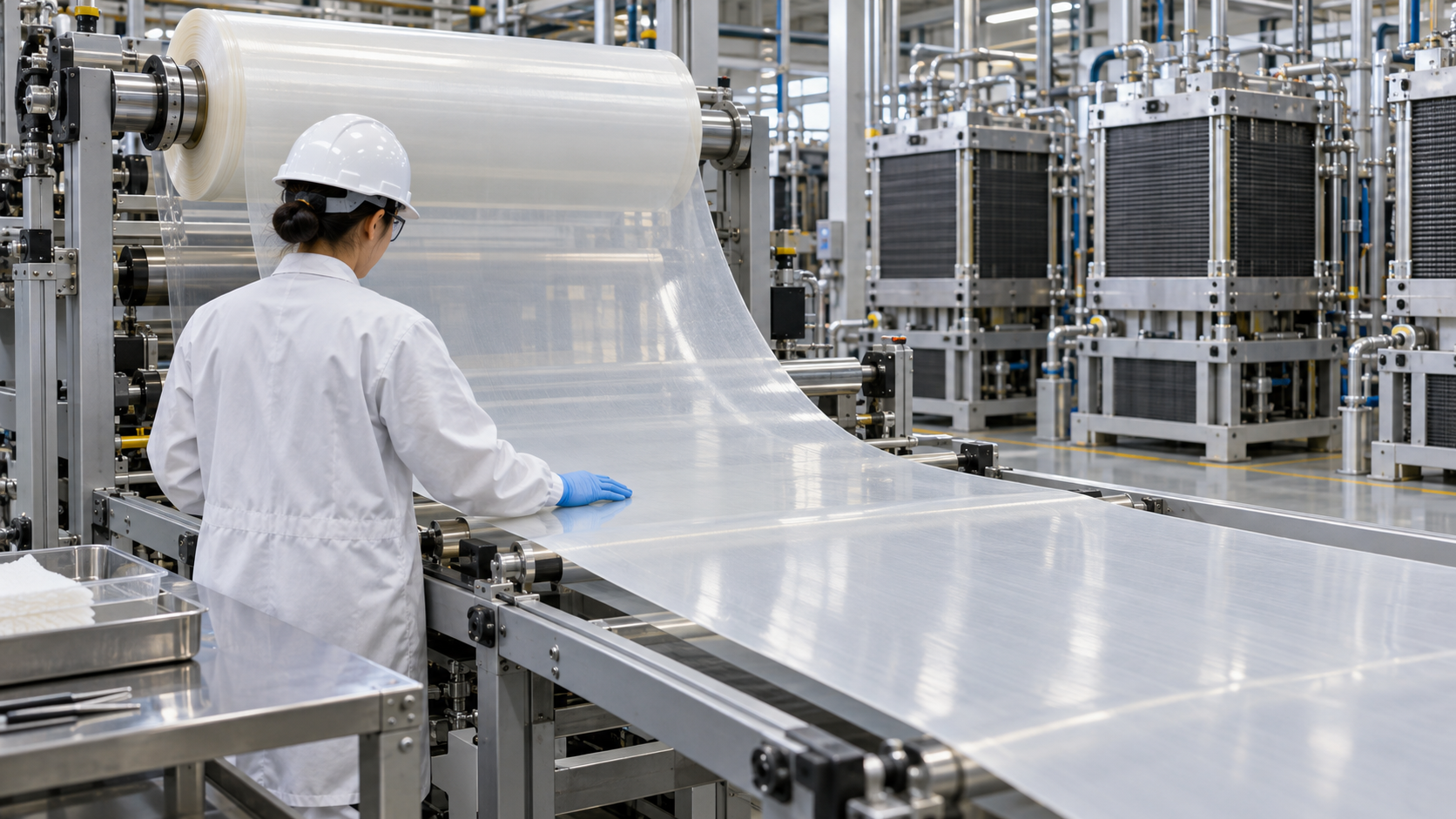
AGC comes up in any discussion of hydrogen because its chemicals business makes the fluorinated ion exchange membranes and electrolyte polymers at the heart of water electrolysis and fuel cells. AGC is a broad materials maker with architectural glass, automotive glass, electronics, chemicals and life science. Sales for the year to December 2025 were ¥2,058.8 billion and it had 52,896 employees. Hydrogen-only sales are not disclosed. The hydrogen core is FORBLUE S-SERIES, a membrane for PEM water electrolysis (a new plant in Kitakyushu is planned, with an investment of about ¥15 billion), FORBLUE i-SERIES, an electrolyte polymer dispersion for fuel cells, and FLEMION, the membrane for salt electrolysis (chlor-alkali), which also yields hydrogen as a by-product. This profile sets out, from the company's results documents and official announcements, what it commits to hydrogen and how far along it is. It is not advice on handling hydrogen.
- AGC in 30 seconds, and where it stands in hydrogen energy
- The logo and how the name is written
- Where the company sits in the field
- Scale (centered on what relates to hydrogen)
- Resources committed to hydrogen energy
- What it has done so far
- What comes next
- What the company is aiming for in hydrogen energy
- Map of partnerships in hydrogen energy
- Technologies, products and services
- The risks this company carries
- Glossary, references and claim-to-source audit
1. AGC in 30 seconds, and where it stands in hydrogen energy
securities code 5201Per AGC Report 2026
AGC's hydrogen business is a materials business that extends its salt-electrolysis membrane technology to water-electrolysis membranes. Its Chemicals business has long operated a business making caustic soda and chlorine (and hydrogen) with the fluorinated ion exchange membrane FLEMION, and against consolidated sales above ¥2 trillion in 2025, no hydrogen figure is disclosed Sourced. Only two figures are given in official announcements: the investment in the new Kitakyushu plant (about ¥15 billion) and the FY2030 sales target for S-SERIES (about ¥30 billion), and the latter is a company target, not a result Not yet confirmed. By our calculation, ¥15 billion is about 6% of consolidated capital expenditure for the year to December 2025 (¥251.3 billion) Our calculation (a comparison of figures with different scopes, not a statement of how much goes to hydrogen).
2. The logo and how the name is written

A note on names: the company is AGC Inc.. AGC Chemicals Company is its chemicals company, not a separate legal entity (reorganized in January 2026). FLEMION, FORBLUE, SELEMION and sunsep are product brands. The logo was taken from the company's official website (agc.com).
Official site: https://www.agc.com/en/3. Where the company sits in the field
4. Scale (centered on what relates to hydrogen)
AGC is a large company, and group-wide detail is not the subject here. Company-wide figures are kept brief, and for hydrogen only what is disclosed is given Sourced.
| Item (consolidated) | Year to Dec 2024 | Year to Dec 2025 | Note |
|---|---|---|---|
| Net sales | ¥2,067.6 billion | ¥2,058.8 billion | Financial Review 2025 (IFRS) |
| Operating profit | ¥125.8 billion | ¥127.5 billion | - |
| Profit attributable to owners of the parent | -¥94.0 billion | ¥69.2 billion | A loss in 2024 |
| Chemicals segment net sales | ¥593.6 billion | ¥584.2 billion | Operating profit ¥53.0 billion (-6.6%). Lower PVC prices and worse manufacturing costs; fluorine-related products rose (company explanation) |
| Chemicals segment R&D expense | - | ¥11.27 billion | Develops products on fluorine, polymer, inorganic and electrochemical technologies. Hydrogen alone is not disclosed |
| R&D expense / capital expenditure (company-wide) | ¥61.8 billion / ¥257.5 billion | ¥60.3 billion / ¥251.3 billion | The amount for hydrogen alone is not disclosed |
| Employees | 53,687 | 52,896 | Consolidated |
The figures above are for the company and its segment. Hydrogen sales and profit are not disclosed Not yet confirmed. The Chemicals segment consists of basic chemicals such as PVC resin and caustic soda (Essential Chemicals) and higher-value products such as fluorine products (Performance Chemicals); the PEM electrolysis membrane relates to the latter (the July 2024 announcement places Performance Chemicals among its strategic businesses when it mentions the hydrogen membrane). AGC Report 2026 lists hydrogen energy components as one of 21 focus areas under seven key technology areas, without giving sales.
5. Resources committed to hydrogen energy
| Resource | What primary sources confirm | Category |
|---|---|---|
| People | 52,896 employees on a consolidated basis. Hydrogen headcount is not disclosed. The R&D division of the Chemicals Company develops new products on fluorine, polymer, inorganic and electrochemical chemistry (Financial Review). The Kitakyushu site had 8 employees at the end of 2023 (mainly logistics and property management); staffing for the new plant has not been published | Sourced / partly undisclosed |
| Money (R&D) | R&D expense of the Chemicals segment was ¥11.27 billion (year to December 2025). Hydrogen alone is not disclosed | Sourced / partly undisclosed |
| Money (capital investment) | About ¥15 billion for the new FORBLUE S-SERIES plant at the Kitakyushu site (announcement of 30 January 2024). Construction began on 4 September 2024, and start-up is planned for June 2026. The company aims for S-SERIES sales of about ¥30 billion in FY2030 "after further capacity expansion" (company target) | Sourced / target Not yet confirmed |
| Investments, acquisitions, joint ventures, divestments | None for hydrogen was found in the official material checked for this article. The notice for ECS PRiME 2024 says "joint research and investments of production facilities started this year" but names no partner or amount | Not confirmed |
| Universities, institutes, public funding | JAXA adopted S-SERIES for a test model of an oxygen generation system for human space habitation (July 2024). A technical talk was given at ECS PRiME 2024 (Honolulu, 8 October 2024). Government grants for hydrogen (for example NEDO's Green Innovation Fund) are not mentioned in the material checked | Sourced / grants not confirmed |
Status of major projects
| Project | Location | Scale | Stage (as confirmed on 5 October 2026) | Source |
|---|---|---|---|---|
| New plant for FORBLUE S-SERIES (PEM electrolysis membrane) | Kitakyushu site (Tobata-ku, Kitakyushu) | About ¥15 billion. Capacity not disclosed | Decided in January 2024; groundbreaking on 4 September 2024; start-up planned for June 2026. No official start-up announcement was found | References 3, 4 |
| FORBLUE i-SERIES (electrolyte polymer dispersion for fuel cells) | - | Not disclosed | On sale. Adopted as an electrode material for the fuel cells in Toyota's second-generation MIRAI. On 19 May 2026 it announced adoption in the electrodes of a water electrolysis demonstration system (operator, location and scale are not in the announcement) | References 6, 9 |
| FLEMION (membrane for salt electrolysis) | - | Not disclosed | On sale. Used in plants worldwide that make caustic soda or potash, chlorine and hydrogen (company statement). Latest grade F-9060 | References 10, 11 |
6. What it has done so far
| When | What happened | Why it matters |
|---|---|---|
| 1907 | Founded (as Asahi Glass), starting from domestic production of flat glass (AGC Report 2026) | It widened from glass into electronics and chemicals |
| 1960s to 1980s | Started salt-electrolysis plants in Thailand (1960s) and Indonesia (1980s), and says it is the top caustic soda maker in Southeast Asia | Chlor-alkali yields hydrogen as a by-product (AGC Chemicals page) |
| Development of FLEMION | Established chlor-alkali electrolysis with a fluorinated ion exchange membrane. The company says the carboxylic polymer is its own invention and that it worked for 40 years to lower the membrane's electrical resistance | The technical base for water-electrolysis membranes |
| 2017 | Pilot sales of FORBLUE S-SERIES began (announcement of January 2024) | First market entry of a membrane for PEM electrolysis |
| 16 May 2022 | i-SERIES (electrolyte polymer dispersion for fuel cells) received an industrial contribution award from Japan's Fuel Cell Development Information Center (reference in the May 2026 announcement) | A track record in fuel cells |
| 30 January 2024 | Announced a new FORBLUE S-SERIES plant at the Kitakyushu site: about ¥15 billion, start-up planned for June 2026, a target of about ¥30 billion of sales in FY2030. It restarts its chemicals business in Kitakyushu after 24 years | The first large investment in mass-production capacity for hydrogen |
| 25 July 2024 | S-SERIES adopted for a test model of JAXA's oxygen generation system. The company describes "world-leading voltage performance" and "high gas barrier performance" | It intends to use a track record in harsher space conditions for terrestrial electrolysis |
| 4 September 2024 | Groundbreaking ceremony for the new plant | Construction stage reached |
| October 2024 | Presented the PEM electrolysis membrane at ECS PRiME 2024 (Honolulu) and exhibited at Hydrogen Technology Expo Europe | Outreach to international markets |
| January 2025 | Exhibited at the Hydrogen & Fuel Cell Seminar in North America (AGC Chemicals notice) | Outreach to North American hydrogen demand |
| November 2025 | Published the FORBLUE S-SERIES product catalog (November 2025 edition) | Product lineup and main specifications made public |
| January 2026 | Reorganized the Chemicals Company, setting up an Integrated Chemicals General Division that combines Japan's basic and high-value chemicals (AGC Report 2026) | Aims to optimize the chain from electrolysis (upstream) to high-value products (downstream) |
| 19 May 2026 | Announced that i-SERIES was adopted in the electrode material of a PEM water electrolysis demonstration system | Extended from using hydrogen (fuel cells) to making it |
7. What comes next
None of the following appears in the official material checked for this article Not yet confirmed.
An announcement of start-up and the capacity of the new Kitakyushu plant / actual sales, volumes and profit for hydrogen / the names of buyers of S-SERIES and the scale of the electrolyzers using it / the operator, location and scale of the water electrolysis demonstration system / public grants for hydrogen and partners in joint research / the test conditions for durability and performance values (the catalog values are test data, not guaranteed).
8. What the company is aiming for in hydrogen energy
This section separates what the company says directly from what this article reads into it. Inference marks this article's interpretation of primary sources.
| What can be read from it | Primary evidence | Category |
|---|---|---|
| It covers hydrogen with membranes and materials for both making and using it | S-SERIES (PEM electrolysis) and i-SERIES (fuel cells, and now electrodes for electrolysis). The 2026 announcement says the use has widened from "using" hydrogen to "producing" it | Sourced (company statement) |
| It extends salt-electrolysis technology to water electrolysis | i-SERIES is described as based on ion exchange membrane technology cultivated in the chlor-alkali business (May 2026 announcement). S-SERIES is a membrane with sulfonic acid groups on a fluorinated polymer | Sourced (company statement) |
| It invests in volume production on the premise that PEM grows | January 2024 announcement: alkaline systems suit stable-load power and are not suited to sources such as solar whose load fluctuates, so interest in PEM is growing (company's view) | Sourced (company's view) / Inference (investment premised on demand outlook) |
| It makes stable supply a strength | JAXA announcement: the plan for a new plant was recognized for ensuring stable supply | Sourced (company statement) |
| Hydrogen is one of its strategic businesses, not the core of the group | Hydrogen sales are not disclosed against group sales above ¥2 trillion; the ¥15 billion is about 6% of consolidated capital expenditure; Chemicals earnings depend on basic chemicals such as PVC | Inference |
The reading that "hydrogen is one of its strategic businesses, not the core of the group" rests on the proportions of the figures. Consolidated sales for the year to December 2025 were ¥2,058.8 billion and no hydrogen sales are disclosed. The one hydrogen-related target the company gave is about ¥30 billion for S-SERIES in FY2030, about 1.5% of consolidated sales Our calculation (¥30 billion ÷ ¥2,058.8 billion; a comparison of figures for different years and scopes). Meanwhile, Chemicals segment operating profit was ¥53.0 billion, down from the year before because of lower PVC prices and other factors Sourced. From this, this article reads the company as growing the hydrogen membrane as a strategic business for growth, not as a pillar that decides group earnings Inference Not yet confirmed.
9. Map of partnerships in hydrogen energy
10. Technologies, products and services
What AGC offers to hydrogen is ion exchange membranes and electrolyte polymers, not finished equipment. AGC Chemicals Company's FORBLUE line is a family of products for separating various chemicals, and three of them relate to hydrogen Sourced.
| Product | What the company says | Link to hydrogen | Source |
|---|---|---|---|
| FORBLUE S-SERIES | A fluorinated cation exchange membrane with sulfonic acid groups. It is reinforced with special PTFE (polytetrafluoroethylene) fiber, and all materials including the reinforcing fabric are fluororesin. Grades range from membranes with up to 37% more ion exchange groups than conventional membranes to membranes with very high cation selectivity | PEM water electrolysis, redox flow batteries, electrolysis and electrodialysis | References 7, 8 |
| FORBLUE i-SERIES | A fluorinated electrolyte polymer dispersed in a solvent, used for fuel cell electrolyte membranes and electrodes. Described as having high power generation performance and long-term stability | Fuel cells (electrodes of Toyota's second-generation MIRAI); electrode material for electrolysis (a 2026 demonstration system) | References 6, 9 |
| FLEMION | A fluorinated cation exchange membrane for salt electrolysis (making caustic soda or potash, chlorine and hydrogen). Described as having low electrical resistance, high current efficiency and resistance to impurities | Chlor-alkali. Hydrogen is a by-product. Not for water electrolysis | References 10, 11 |
| SELEMION / sunsep | SELEMION is a hydrocarbon ion exchange membrane (wastewater purification, recovery of valuables). sunsep is a perfluorinated hollow fiber membrane (gas drying and humidifying) | No description for hydrogen was found | Reference 13 |
The FORBLUE S-SERIES lineup (manufacturer's test data, not guaranteed)
| Grade | Thickness (µm) | Characteristic (company description) | Counter ion | Dry / wet |
|---|---|---|---|---|
| Sx-0935DH | 90 | Very low voltage | H⁺ | Dry |
| Sx-1235DH | 140 | Low voltage | H⁺ | Dry |
| Sx-2301DH | 280 | High cation selectivity | H⁺ | Dry |
| S-2301WN | 330 | High cation selectivity | Na⁺ | Wet |
| Sx-1831WN | 360 | Low voltage | Na⁺ | Wet |
The table is the product page's lineup; thickness is the dry-state value (DH) or wet-state value (WN). The November 2025 catalog gives, for three of these grades, ion exchange capacity (1.0 meq/g for Sx-2301DH and S-2301WN, 1.25 meq/g for Sx-1831WN) and the polymer's moisture content (35 to 100 wt%, after converting to the H⁺ form and immersing in 100 °C water for one hour). In its 2024 announcements AGC cites "world-leading voltage performance" and "high gas barrier performance" as features of the series, but gives no values or test conditions. For the latest FLEMION grade, F-9060, AGC states "40 mV lower voltage than F-9010", measured in AGC's laboratory electrolyzer at 6 kA/m² (manufacturer's stated value, under salt-electrolysis conditions). These values are not to be lined up against other conditions or other companies' products to rank them.
The product table shows how a membrane is chosen. The thinnest, Sx-0935DH (90 µm), is described as "very low voltage", while the thicker Sx-2301DH (280 µm) is described as "high cation selectivity" Sourced. That follows the general design trade-off: thinner means lower electrical resistance and easier power saving, and thicker means harder passage of gases and unwanted ions (see our explainers on PEM water electrolysis and water electrolyzer stacks and materials). S-SERIES is described as keeping strength with PTFE fiber reinforcement while using fluororesin throughout, including the reinforcing fabric, for chemical resistance. There are also membranes handled dry (DH) and wet grades recommended for constant contact with liquid (WN), and the catalog says the counter ion can be exchanged by pretreatment. At the same time, the fully fluorinated backbone is also what draws PFAS regulation debates. AGC Report 2026 lists a trend toward stricter regulation of fluorine products in each country and region among the risks of its chemicals business Sourced (see our explainer on fluoropolymers and PFAS). Operating lifetimes in real electrolyzers, and track records of thickness and operating-condition combinations, are not found in AGC's public material Not yet confirmed.
11. The risks this company carries
| Risk | Detail | Category |
|---|---|---|
| Start-up of the new plant cannot be confirmed | The Kitakyushu plant was planned to start in June 2026, but no official start-up announcement is within the material checked here. Capacity is also undisclosed | Not yet confirmed |
| It assumes PEM will grow | The investment rests on growing interest in PEM, which suits fluctuating power better than alkaline (company's view). If hydrogen demand or the choice of technology differs from expectations, the sales target (about ¥30 billion in FY2030) is affected | Sourced (company's view) / Inference (the effect) |
| Hydrogen earnings are invisible | Hydrogen sales and profit are undisclosed. Chemicals segment operating profit fell 6.6% in 2025 (¥53.0 billion). AGC Report 2026 says demand for Performance Chemicals was "unexpectedly stagnant" with products moving "extremely slowly" | Sourced |
| Regulation of fluorine products | AGC Report 2026 lists "a trend toward stricter regulation of fluorine products in each country and region" among risks to its chemicals business. The details of PFAS rules and their application to membranes for electrolysis and fuel cells could not be confirmed here | Sourced / Not yet confirmed |
| Verification of performance values | The S-SERIES values are stated to be "test data, without guarantee". No values or conditions are published for voltage performance or gas barrier performance | Sourced |
| Competition | AGC's public material names no competitors and makes no comparison | Sourced |
| Decarbonizing electricity | Chlor-alkali electrolysis uses a lot of electricity, and the trend toward carbon-neutral power is described as a risk. It is a different business from the hydrogen membranes, but it affects earnings of the same Chemicals segment | Sourced |
12. Glossary
- Ion exchange membrane
- A membrane that passes only certain ions. A cation exchange membrane passes ions such as H⁺ and Na⁺ and resists gases and anions.
- PEM water electrolysis
- Water electrolysis with a proton exchange (solid polymer) membrane. AGC says it suits fluctuating power sources.
- Chlor-alkali
- The industry that electrolyzes brine to make chlorine and caustic soda (and hydrogen). The use of FLEMION.
- Electrolyte polymer dispersion
- A liquid in which an ion-conducting polymer is dispersed in a solvent; a material for electrodes and membranes in fuel cells and electrolysis.
- Ion exchange capacity
- The amount of ion exchange groups per gram of polymer (meq/g). Higher tends to pass ions more easily.
- Gas barrier performance
- The property of resisting gas passage. In electrolysis it prevents hydrogen and oxygen from mixing through the membrane.
- Strategic business
- A growth-area business that AGC defined in 2016, distinct from its core businesses. It includes Performance Chemicals.
- PFAS
- A group name for per- and polyfluoroalkyl substances. Definitions differ by jurisdiction. The specific rules were not checked in this article.
13. References
- AGC Financial Review 2025 (year to December 2025, IFRS). Consolidated results, segments, R&D, capital expenditure, employees, climate scenario analysis. https://www.agc.com/en/ir/library/financial/pdf/financial2025e.pdf
- AGC AGC Report (integrated report) 2026. History, chemicals business overview, technology strategy, risks, company profile. https://www.agc.com/en/company/agc_report/pdf/agc_report_en_2026.pdf
- AGC News release "AGC to Build New Facility in Kitakyushu City for FORBLUE S-SERIES..." (30 January 2024). Investment of about ¥15 billion, start-up planned for June 2026, FY2030 sales target. https://www.agc.com/en/news/pdf/20240130e.pdf
- AGC Chemicals Company News "AGC Held the Groundbreaking Ceremony for the New Facility of FORBLUE S-SERIES" (4 September 2024). https://www.agc-chemicals.com/jp/en/fluorine/news/20240904.html
- AGC News release "AGC's Water Electrolysis Ion-Exchange Membrane FORBLUE S-SERIES Adopted for JAXA's Test Model of Oxygen Generation System" (25 July 2024). https://www.agc.com/en/news/pdf/20240725e.pdf
- AGC News "AGC's FORBLUE i-SERIES Fluorinated Electrolyte Polymer Dispersion Adopted as Electrode Material for PEM Water Electrolysis Demonstration System" (19 May 2026). https://www.agc.com/en/news/detail/1211355_2814.html
- AGC Chemicals Company Product page "FORBLUE S-SERIES". Features of the series, table of thicknesses and uses. https://www.agc-chemicals.com/jp/en/fluorine/products/detail/index.html?pCode=JP-EN-F027
- AGC Chemicals Company Product catalog "FORBLUE S-SERIES" (November 2025 edition). Grades, thickness, ion exchange capacity. https://www.agc-chemicals.com/jp/en/products/pdf/S-series_EN.pdf
- AGC Chemicals Company Product page "FORBLUE i-SERIES". Electrolyte polymer dispersion for fuel cells. https://www.agc-chemicals.com/jp/en/fluorine/products/detail/index.html?pCode=JP-EN-F032
- AGC Chemicals Company Product page "FORBLUE FLEMION". Membrane for salt electrolysis, voltage comparison of the latest grade. https://www.agc-chemicals.com/jp/en/fluorine/products/detail/index.html?pCode=JP-EN-F020
- AGC Chemicals Company "Chlor & Alkali Business" page. The chlor-alkali business and the place of FLEMION. https://www.agc-chemicals.com/jp/en/company/chemical_chain/chloralkali/index.html
- AGC Chemicals Company News "AGC's ion exchange membranes for PEM water electrolysis will be presented at ECS PRiME 2024" (30 September 2024). https://www.agc-chemicals.com/jp/en/fluorine/news/20240930.html
- AGC Chemicals Company "FORBLUE Family" page. The place of FLEMION, S-SERIES, i-SERIES, SELEMION and sunsep. https://www.agc-chemicals.com/jp/en/fluorine/products/forblue/
- AGC Official website (source of the logo image). https://www.agc.com/en/
14. Claim-to-source audit
| Claim in the article | Category | Source |
|---|---|---|
| AGC Inc., Marunouchi in Tokyo, Tokyo Stock Exchange (5201), founded in 1907 | Sourced | Reference 2 https://www.agc.com/en/company/agc_report/pdf/agc_report_en_2026.pdf Reference 8 https://www.agc-chemicals.com/jp/en/products/pdf/S-series_EN.pdf Reference 14 https://www.agc.com/en/ |
| Consolidated sales of ¥2,058.8 billion for the year to December 2025 (¥2,067.6 billion the year before), operating profit of ¥127.5 billion, profit attributable to owners of the parent of ¥69.2 billion (-¥94.0 billion the year before) | Sourced | Reference 1 https://www.agc.com/en/ir/library/financial/pdf/financial2025e.pdf |
| Chemicals segment net sales of ¥584.2 billion, operating profit of ¥53.0 billion (-6.6%), R&D expense of ¥11.27 billion | Sourced | Reference 1 https://www.agc.com/en/ir/library/financial/pdf/financial2025e.pdf |
| Consolidated R&D expense of ¥60.3 billion, capital expenditure of ¥251.3 billion, 52,896 employees | Sourced | Reference 1 https://www.agc.com/en/ir/library/financial/pdf/financial2025e.pdf |
| ¥15 billion for Kitakyushu is about 6% of consolidated capital expenditure; the S-SERIES FY2030 target of ¥30 billion is about 1.5% of consolidated sales | Our calculation | Our own division of figures in References 1 and 3, comparing figures of different scopes. Reference 1 https://www.agc.com/en/ir/library/financial/pdf/financial2025e.pdf Reference 3 https://www.agc.com/en/news/pdf/20240130e.pdf |
| Sales, profit, volumes, headcount, R&D spending and capital expenditure for hydrogen alone | Not yet confirmed | Not found in the material checked for this article. This article does not estimate them. |
| New FORBLUE S-SERIES plant at Kitakyushu: about ¥15 billion, start-up planned for June 2026, target of about ¥30 billion of sales in FY2030, pilot sales from 2017 | Sourced | Reference 3 https://www.agc.com/en/news/pdf/20240130e.pdf |
| Groundbreaking on 4 September 2024; restart of the chemicals business in Kitakyushu after 24 years | Sourced | Reference 4 https://www.agc-chemicals.com/jp/en/fluorine/news/20240904.html Reference 3 https://www.agc.com/en/news/pdf/20240130e.pdf |
| An official announcement of the new plant's start-up, and its capacity | Not yet confirmed | Not found in the material checked for this article. This article does not say it has or has not started. |
| S-SERIES adopted for a test model of JAXA's oxygen generation system (25 July 2024); "world-leading voltage performance" and "high gas barrier performance" (no values given) | Sourced | Reference 5 https://www.agc.com/en/news/pdf/20240725e.pdf |
| i-SERIES: adopted in electrodes for Toyota's second-generation MIRAI fuel cells and, on 19 May 2026, in a water electrolysis demonstration system | Sourced | Reference 6 https://www.agc.com/en/news/detail/1211355_2814.html Reference 9 https://www.agc-chemicals.com/jp/en/fluorine/products/detail/index.html?pCode=JP-EN-F032 |
| The operator, location and scale of the demonstration system | Not yet confirmed | Not stated in Reference 6 (only that the photo was provided by Toyota). This article does not infer it. Reference 6 https://www.agc.com/en/news/detail/1211355_2814.html |
| FORBLUE S-SERIES: sulfonic acid fluorinated cation exchange membrane, PTFE fiber reinforcement, up to 37% more ion exchange groups, PEM electrolysis among its uses | Sourced | Reference 7 https://www.agc-chemicals.com/jp/en/fluorine/products/detail/index.html?pCode=JP-EN-F027 Reference 8 https://www.agc-chemicals.com/jp/en/products/pdf/S-series_EN.pdf |
| S-SERIES lineup (Sx-0935DH 90 µm, Sx-1235DH 140 µm, Sx-2301DH 280 µm, S-2301WN 330 µm, Sx-1831WN 360 µm), ion exchange capacity and moisture content (test data, not guaranteed) | Sourced | Reference 7 https://www.agc-chemicals.com/jp/en/fluorine/products/detail/index.html?pCode=JP-EN-F027 Reference 8 https://www.agc-chemicals.com/jp/en/products/pdf/S-series_EN.pdf |
| FLEMION: for chlor-alkali, hydrogen as a by-product, the latest F-9060 has 40 mV lower voltage than F-9010 (AGC laboratory electrolyzer, 6 kA/m²) | Sourced | Reference 10 https://www.agc-chemicals.com/jp/en/fluorine/products/detail/index.html?pCode=JP-EN-F020 Reference 11 https://www.agc-chemicals.com/jp/en/company/chemical_chain/chloralkali/index.html |
| Thailand (1960s) and Indonesia (1980s) electrolysis plants; top caustic soda maker in Southeast Asia | Sourced | Reference 11 https://www.agc-chemicals.com/jp/en/company/chemical_chain/chloralkali/index.html |
| Position of SELEMION and sunsep (no description for hydrogen found) | Sourced | Reference 13 https://www.agc-chemicals.com/jp/en/fluorine/products/forblue/ |
| ECS PRiME 2024 talk (S-0935DH, next-generation membranes, joint research and production-facility investment started) and exhibitions at hydrogen events | Sourced | Reference 12 https://www.agc-chemicals.com/jp/en/fluorine/news/20240930.html |
| Investments, acquisitions, joint ventures or divestments for hydrogen; public grants; partners in joint research | Not yet confirmed | Not found in the material checked for this article. This article does not say they do not exist. |
| The company's view that alkaline systems suit stable-load power while PEM is drawing interest for fluctuating power | Sourced | Reference 3 https://www.agc.com/en/news/pdf/20240130e.pdf |
| AGC Report 2026: hydrogen energy components as a technology focus area, a trend toward stricter regulation of fluorine products listed as a risk, stagnant demand for Performance Chemicals | Sourced | Reference 2 https://www.agc.com/en/company/agc_report/pdf/agc_report_en_2026.pdf |
| Reorganization of the Chemicals Company in January 2026 (Integrated Chemicals General Division) | Sourced | Reference 2 https://www.agc.com/en/company/agc_report/pdf/agc_report_en_2026.pdf |
| The statement that it covers hydrogen with membranes and materials for both making and using it (2026 announcement) | Sourced | Reference 6 https://www.agc.com/en/news/detail/1211355_2814.html |
| The reading that it extends salt-electrolysis technology to water electrolysis | Inference | This article's interpretation of References 6, 7 and 10 (Reference 6 says i-SERIES is based on technology from the chlor-alkali business). |
| The reading that it invests on the premise that PEM grows, and the reading of the effect | Inference | This article's interpretation of Reference 3. |
| The reading that hydrogen is one of its strategic businesses, not the core of the group | Inference | This article's interpretation of the figures in References 1 and 3. |
| The materials reading (the thickness trade-off, dry and wet grades) | Inference | This article's interpretation of References 7 and 8. |
| AGC's type (materials & components) and the classification in Fig. 1 | Our calculation | Our own grouping; company names are examples drawn from the companies covered in this series. |
Last updated 5 October 2026 / Troy Technical
Figures in this article come from AGC's results documents (Financial Review 2025), AGC Report (integrated report) 2026, official news releases, and AGC Chemicals Company's product pages and catalog. No research-firm market estimates or press-based figures have been used. Product performance values are the manufacturer's test data (not guaranteed) and do not rank the product against others. Passages marked "Inference" are this article's interpretation of primary sources, not statements made by the company. Company plans and targets (start-up dates, sales targets) are unconfirmed forward-looking statements. This article is not advice on handling or operating hydrogen, which is subject to laws and standards.