COMPANY PROFILE / HYDROGEN ENERGY
Daimler Truck
A commercial vehicle maker that treats fuel cell trucks as a second path alongside battery-electric ones; series production has slipped to the early 2030s
Daimler Truck comes up in hydrogen discussions as the company furthest along with fuel cell trucks. It has put liquid-hydrogen fuel cell trucks (the GenH2, and now the next-generation NextGenH2) into the hands of real customers, and says they have covered about 600,000 km in total. The fuel cell itself is made by cellcentric, a 50:50 joint venture with the Volvo Group. In July 2026 an agreement was signed for Toyota to join the same venture, so that the three companies would hold one third each once it closes. Series production of fuel cell trucks, however, is targeted for the early 2030s, and cellcentric booked a €281 million impairment in 2024. This profile covers only the hydrogen-related parts of the business: what Daimler Truck has, what it plans and what remains open, as far as primary sources allow.
- Daimler Truck in 30 seconds, and where it stands in hydrogen
- The logo and how the name is written
- Where the company sits in the hydrogen field
- Scale
- Resources committed to hydrogen
- What it has done so far
- What comes next
- What the company is aiming for in hydrogen
- Map of partnerships in hydrogen
- Technologies, products and services
- The risks this company carries
- Glossary, references and claim-to-source audit
1. Daimler Truck in 30 seconds, and where it stands in hydrogen
Daimler Truck is best understood not as "a hydrogen company" but as "a maker that sells more than 400,000 trucks a year and is developing hydrogen as a second path beside battery-electric" Our calculation. The annual report describes decarbonization as a dual track of battery-electric and hydrogen-based drives, and says that, besides fuel cells, it has pursued hydrogen combustion engines since 2023 Sourced. The fuel cell itself sits in cellcentric, an equity-accounted joint venture whose 2025 revenue was only €1 million Sourced. Whether hydrogen trucks become a business of real scale is not yet settled Not yet confirmed.
2. The logo and how the name is written

A note on names: the listed holding company is Daimler Truck Holding AG and the operating company is Daimler Truck AG. The hydrogen trucks are the Mercedes-Benz GenH2 Truck (first-generation prototypes) and the Mercedes-Benz NextGenH2 Truck (the next generation presented in 2026), sold under the Mercedes-Benz Trucks brand. The fuel cell company cellcentric is a separate legal entity, and is unrelated to the UK pharmaceutical company CellCentric, which is spelled the same way. The logo image was taken from the company's official website.
Official website: https://www.daimlertruck.com/3. Where the company sits in the hydrogen field
4. Scale
Daimler Truck is one of the world's largest commercial vehicle makers. Group-wide figures are large, so the hydrogen business is likely a small part of the whole. The table gives company-wide figures briefly; hydrogen-specific items follow in the next chapter.
| Item | 2025 | 2024 |
|---|---|---|
| Group revenue (€ million) | 49,387 | 54,077 |
| Adjusted EBIT (€ million) | 3,778 | 4,667 |
| R&D expenditure, including capitalized (€ million) | 2,272 | 2,174 |
| Investment in property, plant and equipment (€ million) | 1,117 | 1,417 |
| Unit sales (units) | 422,510 | 460,409 |
| of which emission-free vehicles (units) | 6,726 | 4,035 |
| Employees (at year-end) | 108,476 | 108,201 |
The table combines continuing and discontinued operations (part of the Asian truck business), as the annual report presents them Sourced. From 1 April 2026, Mitsubishi Fuso was deconsolidated and its parent ARCHION is accounted for under the equity method, so figures from 2026 cover a different scope (first-half 2026 interim report).
Revenue, profit, R&D spending and headcount for hydrogen alone are not disclosed as separate figures in the annual report. The report names zero-emission vehicles and automated driving as R&D priorities, without breaking out hydrogen. This article does not estimate these amounts Not yet confirmed.
5. Resources committed to hydrogen
Daimler Truck's hydrogen resources fall into its own truck development and its stake in the cellcentric joint venture. Few figures are hydrogen-specific, so the table shows what could be confirmed.
| Resource | What primary sources confirm | Category |
|---|---|---|
| People | 108,476 employees across the Group (end of 2025). Hydrogen headcount is not disclosed. cellcentric describes itself as having more than 560 employees (Kirchheim/Teck, Esslingen, Stuttgart and Burnaby in Canada) and roughly 700 patents | Sourced / partly not disclosed |
| Money (investment and equity) | The company says it will invest a mid-three-digit million euro amount in hydrogen trucks by the end of the decade (no exact figure). Contributions to cellcentric were €210 million from both shareholders in 2025 (Daimler Truck's share €105 million), €230 million in 2024 (€115 million) and €150 million in the first half of 2026 (€75 million). The equity-method result for cellcentric was -€120 million in 2025 and -€404 million in 2024 (including a €281 million impairment) | Sourced / partly not disclosed |
| Acquisitions, investments, joint ventures, divestments | cellcentric is a joint venture held 50% by Daimler Truck and 50% by the Volvo Group (2021). The 2020 preliminary agreement had the Volvo Group paying about €0.6 billion for 50% (the final deal value was not checked here). A binding agreement for Toyota to join as a one-third shareholder has been signed (closing expected around the end of 2026 or the start of 2027); on closing Daimler Truck's stake falls from 50% to one third. Daimler Truck also cooperates with Linde Engineering (refueling method) and KEYOU (hydrogen combustion engines) | Sourced |
| Universities, research institutes, public funding | Development, production and use of the NextGenH2 Truck are supported with a total of €226 million from Germany's Federal Ministry of Transport and the states of Rhineland-Palatinate and Baden-Württemberg. No specific EU Clean Hydrogen Partnership programs or named university collaborations were found in the documents reviewed | Sourced / partly not found |
Status of key projects
| Project | Location | Scale | Stage | Date and source |
|---|---|---|---|---|
| Small-series production of the NextGenH2 Truck | Wörth, Germany (Mercedes-Benz plant) | 100 trucks | Planned (customer operation to begin from the end of 2026) | Announced 26 January 2026; still planned in the joint release of 15 September 2026 (references 4, 6) |
| GenH2 Truck customer trials (round 1) | Customers' routes (location not stated) | 5 trucks, over 225,000 km, 5 customers (Air Products, Amazon, Holcim, INEOS Inovyn, Wiedmann & Winz) | Completed | Annual report for 2025 (reference 1) |
| GenH2 Truck customer trials (round 2) | Customers' routes in Germany | 5 customers (Hornbach, Reber Logistik, Teva Deutschland, Rhenus, DHL Supply Chain). About 600,000 km cumulative across the program | Under way | Started October-November 2025 (references 1, 6) |
| Public sLH2 (subcooled liquid hydrogen) refueling station | Wörth am Rhein, Germany | One station | Operating (used for customer trials) | Announced 7 February 2024; customer trials from mid-2024 (reference 7) |
| Hydrogen combustion engine trucks | - | Could not be confirmed | Planned (market launch planned for 2027) | Cooperation with KEYOU (Q2 2026 interim report, reference 2) |
| Study of liquid hydrogen supply chains | Abu Dhabi to Europe (Masdar); via the Port of Hamburg (HHLA, Kawasaki Heavy Industries) | Could not be confirmed | Under study (memorandum / declaration of intent) | Among 2025 highlights in the annual report (reference 1); no month given |
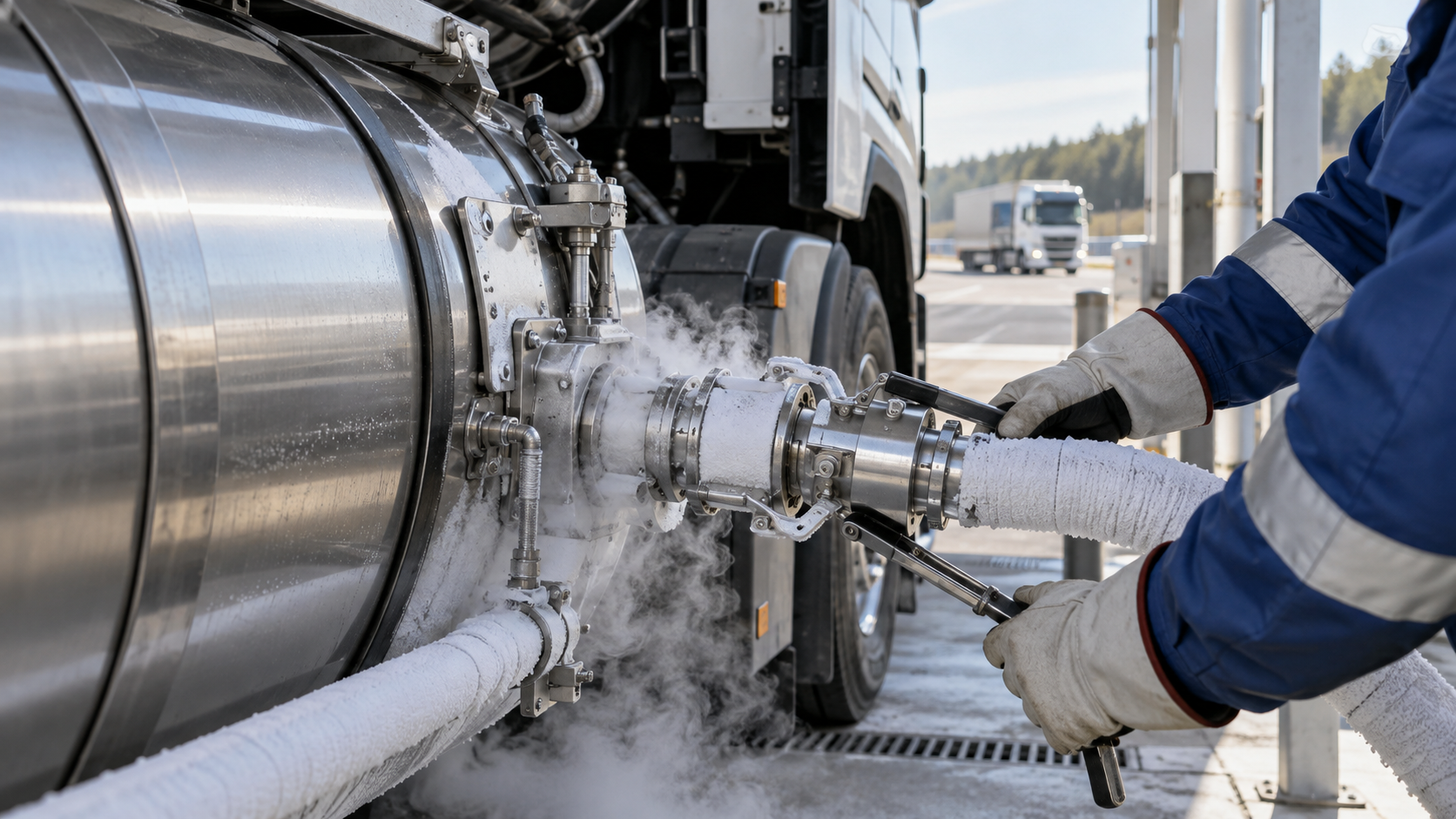
Daimler Truck prefers liquid hydrogen for hydrogen-based drives. At -253°C liquid hydrogen packs more into the same volume than gas, which extends range, and the company says its tanks are lighter and cheaper than gaseous high-pressure tanks Sourced. For materials, a liquid hydrogen tank and its piping need metals that stay tough at cryogenic temperatures, insulation, and control of evaporation (boil-off) through joints and fittings. The company says the new truck adds a boil-off management system, a sensor that responds to hydrogen leaks, and a side panel with crash elements to protect the tanks Sourced. The fuel cell type (for example whether it is a PEM design) and the stack materials are not stated in the documents reviewed. In fuel cell trucks in general, the membrane, platinum-group catalysts and metal bipolar plates decide performance and durability (general background) Not yet confirmed. See our explainers on liquid hydrogen, high-pressure hydrogen tanks, fuel cell vehicles and PEM fuel cells, and platinum group metals and catalysts.
6. What it has done so far
| When | What happened | Why it matters |
|---|---|---|
| 21 April 2020 | Daimler Truck and the Volvo Group announced a preliminary, non-binding agreement to form a fuel cell joint venture. The Volvo Group would buy 50% for about €0.6 billion. The aim was series production of heavy-duty fuel cell vehicles in the second half of the decade | The starting point of the hydrogen partnership |
| March-April 2021 | Daimler Truck Holding AG was established. On 29 April the cellcentric launch was announced, with the start of series operation planned for 2025 | The original production timing |
| December 2021 | Spun off from Daimler AG and listed | An independent commercial vehicle maker |
| 2023 | Began pursuing hydrogen combustion engines alongside fuel cells. A GenH2 Truck covered 1,047 km on one fill of liquid hydrogen (September 2023 per the February 2024 release; end of 2023 per the January 2026 release) | Widening the technology options and demonstrating range |
| 7 February 2024 | Presented sLH2 refueling with Linde Engineering and aims to make it an ISO standard. The public station in Wörth am Rhein was used for customer trials from mid-2024 | Moving toward a standard for liquid hydrogen refueling |
| 2024 (full year) | €281 million impairment on cellcentric, attributed to delayed green hydrogen infrastructure in Europe and the U.S. and to uncertainty over the U.S. framework | The slow build-up of hydrogen recognized as a loss |
| 8 July 2025 | At the Capital Market Day, fuel cell market ramp-up was pushed to after 2029, at lower volume and Europe first, and the industrialization of high-volume cellcentric production was slowed | A revision of timing |
| 2025 | The first round of GenH2 customer trials was completed (over 225,000 km); a second round began in October-November | Building real-world experience |
| 26 January 2026 | Presented the NextGenH2 Truck: 100 built at Wörth for customer operation from the end of 2026; series production of fuel cell trucks targeted for the early 2030s; €226 million of public funding | Series-production timing stated as later |
| End of March 2026 | Memorandum of understanding for Toyota to join cellcentric | A plan for three shareholders |
| July 2026 | A binding agreement on Toyota's entry. The press release says 27 July; the first-half 2026 interim report says 17 July (the primary sources differ on the date) | Closing expected around the end of 2026 or the start of 2027 |
| 15 September 2026 | At IAA Transportation, the Volvo Group, Daimler Truck, Toyota, Bosch, Air Liquide, TotalEnergies and others presented a plan for a hydrogen mobility supply chain | Vehicles and hydrogen supply planned together |
7. What comes next
The primary sources also describe the following plans Not yet confirmed.
- Hydrogen supply: the September 2026 joint release argues that the conditions for scaling hydrogen trucks by 2030 are in place in Germany and aims at high-capacity stations that can refuel up to 100 trucks per day. It asks governments to align funding for stations and vehicles with the EU's Alternative Fuels Infrastructure Regulation (AFIR) targets
- cellcentric: with Toyota, to strengthen its technological lead, industrial scale and competitiveness. It continues to operate as an independent company
- Buses: fuel cell coaches are to enter series production as the step after battery-electric coaches (annual report)
Revenue, profit, headcount and R&D spending for hydrogen alone; the location, timing and size of cellcentric's high-volume plant; target volumes at fuel cell truck series production; a breakdown of the contributions after Toyota joins; specifications and volumes for hydrogen combustion trucks; and the next stage of the arrangements with Masdar and with HHLA and Kawasaki Heavy Industries. None of these is stated in the annual report, interim report or press releases reviewed.
8. What the company is aiming for in hydrogen
The table separates what the company says it is aiming for from what this article infers. Inference marks this article's own reading of primary sources.
| What can be read | Primary evidence | Category |
|---|---|---|
| It pursues decarbonization on two tracks, battery-electric and hydrogen | The annual report describes "two complementary technologies", battery-electric and hydrogen-based; the Capital Market Day deck says "decarbonize faster and less capital intensive with BEV and hydrogen" | Sourced |
| It sees hydrogen as an option for long distances and heavy loads | The 2021 release says batteries suit lighter loads and shorter distances, while fuel cells tend to suit heavier loads and longer distances | Sourced |
| In fuel cells, it will share investment and bundle volume | The Capital Market Day deck says "keep technology leadership, share invest and bundle volume"; cellcentric is to grow with additional customers and partners | Sourced |
| Toyota's entry splits the investment burden and the difficulty of reaching volume among three companies | The stated purpose of the entry is to strengthen technological lead, industrial scale and competitiveness; annual contributions to cellcentric are around €200 million from both shareholders together | Inference |
| It is building vehicles, refueling and supply chains around liquid hydrogen | The preference for liquid hydrogen, joint development of refueling with Linde Engineering, and studies of supply chains with Masdar, HHLA and Kawasaki Heavy Industries | Sourced (each item) / Inference (the overall direction) |
The reading that "Toyota's entry splits the investment burden and the difficulty of reaching volume" rests on the shifting production timeline and the losses. The target for series production has moved from "the second half of the 2020s" in the 2020 agreement, to "after 2029" in July 2025, to "the early 2030s" in January 2026. cellcentric's 2025 revenue was €1 million and its loss after tax €239 million, and it took a €281 million impairment in 2024 Sourced. The inference is that a third shareholder joins a venture whose losses two companies had been sharing equally. What Toyota will contribute in capital or technology is not disclosed. The reasons the companies give for the entry stop at technology, industrial scale and competitiveness Not yet confirmed.
9. Map of partnerships in hydrogen
Daimler Truck's hydrogen relationships in the primary sources are equity (cellcentric), joint development (Linde Engineering, KEYOU), studies of supply chains (Masdar, HHLA and Kawasaki Heavy Industries) and public funding (the German transport ministry and states) Sourced. Of these, the arrangements that are contractually settled and operating are cellcentric and the joint development with Linde Engineering; the supply-chain relationships are at memorandum or declaration-of-intent stage. Toyota's entry has a signed agreement but awaits regulatory approval. Many of these activities are shared with the Volvo Group, yet the company states that the partners will continue to compete independently in other areas.
10. Technologies, products and services
Daimler Truck's hydrogen products are fuel cell trucks (prototypes and a small series), hydrogen combustion engines and buses. Performance figures are the manufacturer's stated values, shown with their conditions and scale.
| Item | What company documents say | Conditions, scale, source |
|---|---|---|
| Mercedes-Benz NextGenH2 Truck | A long-haul tractor. Two cellcentric BZA150 fuel cell units (150 kW each, 300 kW in total), two liquid hydrogen tanks (up to 85 kg), a 101 kWh LFP battery and the e-axle from the eActros 600. 100 trucks to enter customer operation from the end of 2026 | Manufacturer's stated values (release of 26 January 2026). Range is stated as "well over 1,000 km" at full load. Battery capacity is the nominal value of a new battery under internally defined parameters |
| Range and hydrogen consumption results | In a 2023 test, a GenH2 Truck covered 1,047 km on one fill of liquid hydrogen (the timing is given as September or end of 2023, depending on the release). In early customer trials hydrogen consumption averaged 5.6-8 kg/100 km | Manufacturer's stated values. The 1,047 km run was at a gross combined weight of about 40 tonnes; 5.6-8 kg/100 km was at 16-34 tonnes. Values under different conditions are not ranked against each other |
| sLH2 refueling | Refueling with subcooled liquid hydrogen. The company says it improves storage density, range, refueling time, cost and energy efficiency over gaseous hydrogen. Fill time is 10-15 minutes | Manufacturer's stated values (jointly with Linde Engineering). The aim is an ISO standard |
| Hydrogen combustion engines | Trucks that burn hydrogen in an internal combustion engine. KEYOU handles the hydrogen conversion of existing vehicle and engine variants, with market launch planned for 2027 | Planned. Specifications could not be confirmed |
| Buses | The eCitaro city bus has been offered with a fuel cell range extender since 2023. The Setra "H₂ Coach" fuel cell coach began test drives in September 2025 (minimum range 800 km) | Manufacturer's stated values. The H₂ Coach is a technology showcase (pre-series) |
11. The risks this company carries
| Risk | Detail | Category |
|---|---|---|
| Slipping production timeline | The target moved from "second half of the 2020s" (2020), to operation from 2025 (2021 plan), to "after 2029" (July 2025), to "early 2030s" (January 2026) | Sourced |
| Losses in the joint venture | cellcentric's equity-method result was -€120 million in 2025 and -€404 million in 2024. Revenue was €1 million in 2025. Annual contributions are around €200 million from both shareholders together | Sourced |
| Delayed hydrogen infrastructure | The annual report names delayed green hydrogen infrastructure in Europe and the U.S. as the reason for the impairment. The September 2026 joint release asks governments for support through incentives, hydrogen pump prices and toll exemptions | Sourced |
| Reliance on public funding | €226 million of public support for the development, production and use of the NextGenH2 Truck. A change in funding frameworks could affect the plan | Sourced / Inference (the size of any effect) |
| Change in shareholders | Toyota's entry depends on regulatory approval, with closing expected around the end of 2026 or the start of 2027. On closing, Daimler Truck's stake falls from 50% to one third. The primary sources give different dates for the agreement (17 July / 27 July) | Sourced / Not yet confirmed |
| Immature supply chain | Liquid hydrogen supply chains (Masdar, HHLA and Kawasaki Heavy Industries) are at memorandum or intent stage. The company names competitiveness with diesel on hydrogen price as essential | Sourced |
| Competition from battery-electric | The company itself puts battery-electric first (the eActros 600 and others) and hydrogen as a complement. If the market leans toward batteries, hydrogen volumes may stay small | Inference |
| Handling and regulation of hydrogen | Hydrogen is subject to laws and standards. The company has added leak detection and boil-off management to its new truck. This article is not handling advice | Sourced (company statement) |
12. Glossary
- FCEV (fuel cell electric vehicle)
- A vehicle that converts hydrogen to electricity on board in a fuel cell. See our explainer on fuel cell vehicles and PEM fuel cells.
- cellcentric
- The fuel cell joint venture of Daimler Truck and the Volvo Group, launched in 2021. Toyota is to join.
- Liquid hydrogen (LH₂)
- Hydrogen cooled to -253°C into a liquid. See our explainer on liquid hydrogen.
- sLH2 (subcooled liquid hydrogen)
- A refueling method that supplies liquid hydrogen slightly below its boiling point. Developed by Daimler Truck and Linde Engineering.
- BZA150
- The model name of cellcentric's fuel cell unit, at 150 kW each. The NextGenH2 Truck uses two for 300 kW.
- Small series
- Limited production ahead of full series production, so that real customers can use the vehicles. The NextGenH2 run is 100 trucks.
- Equity method
- Accounting that includes a share of an investee's profit or loss, in proportion to ownership. Used for cellcentric.
- AFIR
- The EU's Alternative Fuels Infrastructure Regulation, which sets targets for hydrogen stations and similar infrastructure.
- RED III
- The revised EU Renewable Energy Directive, which includes targets for renewable hydrogen in industry.
- Gross combined vehicle weight (GCVW)
- The total weight of a truck with its trailer and load. Range and hydrogen consumption must be compared at the same weight.
13. References
- Daimler Truck Annual Report 2025 (published March 2026). Group key figures; cellcentric ownership, contributions, results and impairment; R&D spending; GenH2 customer trials; liquid hydrogen partnerships; the dual-technology strategy. https://www.daimlertruck.com/fileadmin/user_upload/documents/investors/reports/annual-reports/2025/daimler-truck-ir-annual-report-2025-incl-combined-management-report-dth-ag.pdf
- Daimler Truck Interim Report Q2 2026 (first half of 2026). Contributions to cellcentric, the notes on Toyota's entry (memorandum and binding agreement) and the cooperation with KEYOU on hydrogen combustion engines. https://www.daimlertruck.com/fileadmin/user_upload/documents/investors/reports/interim-reports/q2/2026/daimler-tuck-ir-interim-report-q2-2026.pdf
- Daimler Truck Capital Market Day 2025 presentation (8 July 2025). Technology strategy for hydrogen, battery and diesel, and the revised timing for fuel cells. https://www.daimlertruck.com/fileadmin/user_upload/documents/investors/presentations/daimler-truck-ir-capitalmarketday-2025-07-08.pdf
- Daimler Truck Press release "Daimler Truck presents Mercedes-Benz NextGenH2 Truck with small-series production planned from end of 2026" (26 January 2026). Specifications, small-series production, €226 million public funding and the series-production timing. https://www.daimlertruck.com/en/newsroom/pressrelease/daimler-truck-presents-mercedes-benz-nextgenh2-truck-with-small-series-production-planned-from-end-of-2026-53330597
- Daimler Truck Press release "Daimler Truck, Volvo Group and Toyota Motor Corporation sign binding agreement for Toyota to join cellcentric as equal shareholder" (27 July 2026). Description of cellcentric and the change in its shareholders. https://www.daimlertruck.com/en/newsroom/pressrelease/daimler-truck-volvo-group-and-toyota-motor-corporation-sign-binding-agreement-for-toyota-to-join-cellcentric-as-equal-shareholder-53549918
- Volvo Group Press release "Industry leaders scale full value chain for hydrogen mobility across Europe" (15 September 2026; a joint announcement with Daimler Truck and others). Cumulative fuel cell truck mileage, the 100-truck small series, the statement on hydrogen investment and cooperation on supply chains. https://www.volvogroup.com/en/news-and-media/news/2026/sep/industry-leaders-scale-full-value-chain-for-hydrogen-mobility-across-europe.html
- Daimler Truck Press release "Safe, Fast and Simple: Daimler Truck and Linde Set New Standard for Liquid Hydrogen Refueling Technology" (7 February 2024). The sLH2 refueling method. https://www.daimlertruck.com/en/newsroom/pressrelease/safe-fast-and-simple-daimler-truck-and-linde-set-new-standard-for-liquid-hydrogen-refueling-technology-52581266
- Volvo Group Press release "Volvo Group and Daimler Truck AG fully committed to hydrogen-based fuel-cells - launch of new joint venture cellcentric" (29 April 2021). https://www.volvogroup.com/en/news-and-media/news/2021/apr/news-3960135.html
- Volvo Group Press release "The Volvo Group and Daimler Truck AG to lead the development of sustainable transportation by forming joint venture for large-scale production of fuel cells" (21 April 2020). The preliminary agreement and Volvo's purchase price. https://www.volvogroup.com/en/news-and-media/news/2020/apr/news-3640568.html
- Daimler Truck Company website, "Share" (listing venue and index membership). https://www.daimlertruck.com/en/investors/share
- Daimler Truck Company website (source of the logo image). https://www.daimlertruck.com/
14. Claim-to-source audit
| Claim in the article | Category | Source |
|---|---|---|
| Founding of Daimler Truck Holding AG (March 2021), spin-off from Daimler AG, listing in December 2021, registered office (Stuttgart) and headquarters (Leinfelden-Echterdingen) | Sourced | Reference 1 https://www.daimlertruck.com/fileadmin/user_upload/documents/investors/reports/annual-reports/2025/daimler-truck-ir-annual-report-2025-incl-combined-management-report-dth-ag.pdf |
| Listed on the Frankfurt Stock Exchange, a DAX member, ticker DTG | Sourced | Reference 10 https://www.daimlertruck.com/en/investors/share |
| Group revenue in 2025 of €49,387 million (prior year €54,077 million), adjusted EBIT of €3,778 million, R&D spending of €2,272 million, capital expenditure on property, plant and equipment of €1,117 million, 108,476 employees, 422,510 units sold | Sourced | Continuing and discontinued operations combined (as presented in the annual report). Reference 1 https://www.daimlertruck.com/fileadmin/user_upload/documents/investors/reports/annual-reports/2025/daimler-truck-ir-annual-report-2025-incl-combined-management-report-dth-ag.pdf |
| cellcentric GmbH & Co. KG is a joint venture held 50% by Daimler Truck and 50% by the Volvo Group (Kirchheim unter Teck); it develops, produces and markets fuel cell systems | Sourced | Reference 1 https://www.daimlertruck.com/fileadmin/user_upload/documents/investors/reports/annual-reports/2025/daimler-truck-ir-annual-report-2025-incl-combined-management-report-dth-ag.pdf Reference 5 https://www.daimlertruck.com/en/newsroom/pressrelease/daimler-truck-volvo-group-and-toyota-motor-corporation-sign-binding-agreement-for-toyota-to-join-cellcentric-as-equal-shareholder-53549918 |
| Contributions to cellcentric: €210 million in 2025 from both shareholders together (Daimler Truck share €105 million), €230 million in 2024 (€115 million), €150 million in the first half of 2026 (€75 million) | Sourced | Reference 1 https://www.daimlertruck.com/fileadmin/user_upload/documents/investors/reports/annual-reports/2025/daimler-truck-ir-annual-report-2025-incl-combined-management-report-dth-ag.pdf Reference 2 https://www.daimlertruck.com/fileadmin/user_upload/documents/investors/reports/interim-reports/q2/2026/daimler-tuck-ir-interim-report-q2-2026.pdf |
| Equity-method result for cellcentric: -€120 million in 2025 and -€404 million in 2024 (including a €281 million impairment, attributed to delayed green hydrogen infrastructure in Europe and the U.S. and uncertainty over the U.S. framework) | Sourced | Reference 1 https://www.daimlertruck.com/fileadmin/user_upload/documents/investors/reports/annual-reports/2025/daimler-truck-ir-annual-report-2025-incl-combined-management-report-dth-ag.pdf |
| cellcentric summarized IFRS figures: revenue of €1 million in 2025 (€10 million in 2024), loss after tax of €239 million | Sourced | Annual report table C.43; the column reading is this article's understanding of the table layout. Reference 1 https://www.daimlertruck.com/fileadmin/user_upload/documents/investors/reports/annual-reports/2025/daimler-truck-ir-annual-report-2025-incl-combined-management-report-dth-ag.pdf |
| cellcentric has more than 560 employees, sites in Kirchheim/Teck, Esslingen, Stuttgart and Burnaby (Canada), and roughly 700 patents | Sourced | The company's (cellcentric's) own description. Reference 5 https://www.daimlertruck.com/en/newsroom/pressrelease/daimler-truck-volvo-group-and-toyota-motor-corporation-sign-binding-agreement-for-toyota-to-join-cellcentric-as-equal-shareholder-53549918 |
| Binding agreement for Toyota Motor Corporation to join cellcentric as an equal shareholder (one third each); completion expected around the end of 2026 or the start of 2027; Daimler Truck's stake falls from 50% to one third on completion | Sourced | Reference 2 https://www.daimlertruck.com/fileadmin/user_upload/documents/investors/reports/interim-reports/q2/2026/daimler-tuck-ir-interim-report-q2-2026.pdf Reference 5 https://www.daimlertruck.com/en/newsroom/pressrelease/daimler-truck-volvo-group-and-toyota-motor-corporation-sign-binding-agreement-for-toyota-to-join-cellcentric-as-equal-shareholder-53549918 |
| Date of the binding agreement: the press release says 27 July 2026, while the interim report says 17 July 2026 | Sourced | The two primary sources give different dates. This article could not determine which is correct. Reference 2 https://www.daimlertruck.com/fileadmin/user_upload/documents/investors/reports/interim-reports/q2/2026/daimler-tuck-ir-interim-report-q2-2026.pdf Reference 5 https://www.daimlertruck.com/en/newsroom/pressrelease/daimler-truck-volvo-group-and-toyota-motor-corporation-sign-binding-agreement-for-toyota-to-join-cellcentric-as-equal-shareholder-53549918 |
| Memorandum of understanding on Toyota's entry (end of March 2026) | Sourced | Reference 2 https://www.daimlertruck.com/fileadmin/user_upload/documents/investors/reports/interim-reports/q2/2026/daimler-tuck-ir-interim-report-q2-2026.pdf Reference 5 https://www.daimlertruck.com/en/newsroom/pressrelease/daimler-truck-volvo-group-and-toyota-motor-corporation-sign-binding-agreement-for-toyota-to-join-cellcentric-as-equal-shareholder-53549918 |
| Preliminary non-binding agreement of 21 April 2020 (Volvo to acquire 50% for about €0.6 billion; series production targeted for the second half of the decade) | Sourced | Reference 9 https://www.volvogroup.com/en/news-and-media/news/2020/apr/news-3640568.html |
| Announcement of the cellcentric launch on 29 April 2021 (start of series operation planned for 2025) | Sourced | Reference 8 https://www.volvogroup.com/en/news-and-media/news/2021/apr/news-3960135.html |
| Investment in hydrogen trucks of a "mid-three-digit million euro amount" by the end of the decade (company statement) | Sourced | Company statement; the breakdown is not disclosed. Reference 6 https://www.volvogroup.com/en/news-and-media/news/2026/sep/industry-leaders-scale-full-value-chain-for-hydrogen-mobility-across-europe.html |
| Small-series production of the NextGenH2 Truck (Wörth plant, 100 units, customer operation from end of 2026) and €226 million public funding (Federal Ministry of Transport and the states of Rhineland-Palatinate and Baden-Württemberg) | Sourced | Reference 4 https://www.daimlertruck.com/en/newsroom/pressrelease/daimler-truck-presents-mercedes-benz-nextgenh2-truck-with-small-series-production-planned-from-end-of-2026-53330597 |
| NextGenH2 Truck specifications (two cellcentric BZA150 units for 300 kW, up to 85 kg of liquid hydrogen, range above 1,000 km, 10-15 minute refueling, 101 kWh battery) | Sourced | Manufacturer's stated values. Range is stated at full load; test conditions are limited to what the release gives. Reference 4 https://www.daimlertruck.com/en/newsroom/pressrelease/daimler-truck-presents-mercedes-benz-nextgenh2-truck-with-small-series-production-planned-from-end-of-2026-53330597 |
| 1,047 km on one liquid hydrogen fill in 2023 (gross combined weight of about 40 tonnes); hydrogen consumption of 5.6-8 kg/100 km in customer trials (16-34 tonnes) | Sourced | Manufacturer's stated values. The timing of the run is given as September 2023 in the February 2024 release and as the end of 2023 in the January 2026 release. Reference 4 https://www.daimlertruck.com/en/newsroom/pressrelease/daimler-truck-presents-mercedes-benz-nextgenh2-truck-with-small-series-production-planned-from-end-of-2026-53330597 Reference 7 https://www.daimlertruck.com/en/newsroom/pressrelease/safe-fast-and-simple-daimler-truck-and-linde-set-new-standard-for-liquid-hydrogen-refueling-technology-52581266 |
| Series production of fuel cell trucks targeted for the early 2030s (January 2026) | Not yet confirmed | Company target. Reference 1 https://www.daimlertruck.com/fileadmin/user_upload/documents/investors/reports/annual-reports/2025/daimler-truck-ir-annual-report-2025-incl-combined-management-report-dth-ag.pdf Reference 4 https://www.daimlertruck.com/en/newsroom/pressrelease/daimler-truck-presents-mercedes-benz-nextgenh2-truck-with-small-series-production-planned-from-end-of-2026-53330597 |
| Fuel cell market ramp-up after 2029 and a slower industrialization of high-volume cellcentric production (July 2025) | Sourced | Reference 3 https://www.daimlertruck.com/fileadmin/user_upload/documents/investors/presentations/daimler-truck-ir-capitalmarketday-2025-07-08.pdf |
| First GenH2 customer trials (5 trucks, over 225,000 km, 5 customers), a second round (started October-November 2025, 5 customers), and about 600,000 km in total (September 2026) | Sourced | Reference 1 https://www.daimlertruck.com/fileadmin/user_upload/documents/investors/reports/annual-reports/2025/daimler-truck-ir-annual-report-2025-incl-combined-management-report-dth-ag.pdf Reference 6 https://www.volvogroup.com/en/news-and-media/news/2026/sep/industry-leaders-scale-full-value-chain-for-hydrogen-mobility-across-europe.html |
| Jointly developed sLH2 (subcooled liquid hydrogen) refueling with Linde Engineering, the public station in Wörth am Rhein, and the aim of an ISO standard | Sourced | Reference 7 https://www.daimlertruck.com/en/newsroom/pressrelease/safe-fast-and-simple-daimler-truck-and-linde-set-new-standard-for-liquid-hydrogen-refueling-technology-52581266 |
| Memorandum of understanding with Masdar (Abu Dhabi) and declaration of intent with HHLA and Kawasaki Heavy Industries (liquid hydrogen supply chains) | Sourced | The annual report gives no month; these are among its 2025 highlights. Reference 1 https://www.daimlertruck.com/fileadmin/user_upload/documents/investors/reports/annual-reports/2025/daimler-truck-ir-annual-report-2025-incl-combined-management-report-dth-ag.pdf |
| Cooperation with KEYOU on hydrogen combustion engines, with market launch planned for 2027; hydrogen combustion pursued alongside fuel cells since 2023 | Sourced | Reference 1 https://www.daimlertruck.com/fileadmin/user_upload/documents/investors/reports/annual-reports/2025/daimler-truck-ir-annual-report-2025-incl-combined-management-report-dth-ag.pdf Reference 2 https://www.daimlertruck.com/fileadmin/user_upload/documents/investors/reports/interim-reports/q2/2026/daimler-tuck-ir-interim-report-q2-2026.pdf |
| September 2026 hydrogen ecosystem plan (Volvo Group, Daimler Truck, Toyota, Bosch, Air Liquide, TotalEnergies, TEAL Mobility, MB Energy); high-throughput stations able to refuel up to 100 trucks per day | Sourced | Reference 6 https://www.volvogroup.com/en/news-and-media/news/2026/sep/industry-leaders-scale-full-value-chain-for-hydrogen-mobility-across-europe.html |
| Setra H2 Coach (fuel cell coach, minimum range 800 km) and the eCitaro fuel cell range extender (since 2023) | Sourced | Reference 1 https://www.daimlertruck.com/fileadmin/user_upload/documents/investors/reports/annual-reports/2025/daimler-truck-ir-annual-report-2025-incl-combined-management-report-dth-ag.pdf |
| Revenue, headcount, R&D spending and capital expenditure for hydrogen alone | Not yet confirmed | No hydrogen-only breakdown in the annual report. This article does not estimate it. Reference 1 https://www.daimlertruck.com/fileadmin/user_upload/documents/investors/reports/annual-reports/2025/daimler-truck-ir-annual-report-2025-incl-combined-management-report-dth-ag.pdf |
| Location, timing and size of cellcentric's high-volume plant | Not yet confirmed | Could not be confirmed in the documents reviewed. Reference 3 https://www.daimlertruck.com/fileadmin/user_upload/documents/investors/presentations/daimler-truck-ir-capitalmarketday-2025-07-08.pdf |
| General explanation of fuel cell and liquid hydrogen tank materials and how they affect performance and durability | Our calculation | Commentary (general background; kept separate from what the company documents state). |
| The framing "not a hydrogen company, but a commercial vehicle maker treating hydrogen as a second path" | Our calculation | This article's framing, interpreted from the revenue and investment structure (reference 1) and the strategy statements (reference 3). |
| The four company types and the example company names | Our calculation | This article's classification; example companies are drawn from this series. |
| The reading that Toyota's entry shares the investment burden and the difficulty of reaching volume | Inference | This article's interpretation of the Capital Market Day wording on sharing investment and bundling volume, and of the entry announcement. Reference 3 https://www.daimlertruck.com/fileadmin/user_upload/documents/investors/presentations/daimler-truck-ir-capitalmarketday-2025-07-08.pdf Reference 5 https://www.daimlertruck.com/en/newsroom/pressrelease/daimler-truck-volvo-group-and-toyota-motor-corporation-sign-binding-agreement-for-toyota-to-join-cellcentric-as-equal-shareholder-53549918 |
| The reading that it is building out supply-chain partnerships around liquid hydrogen | Inference | This article's interpretation of the partnerships and technology choices described. Reference 1 https://www.daimlertruck.com/fileadmin/user_upload/documents/investors/reports/annual-reports/2025/daimler-truck-ir-annual-report-2025-incl-combined-management-report-dth-ag.pdf Reference 4 https://www.daimlertruck.com/en/newsroom/pressrelease/daimler-truck-presents-mercedes-benz-nextgenh2-truck-with-small-series-production-planned-from-end-of-2026-53330597 Reference 7 https://www.daimlertruck.com/en/newsroom/pressrelease/safe-fast-and-simple-daimler-truck-and-linde-set-new-standard-for-liquid-hydrogen-refueling-technology-52581266 |
Last updated 8 October 2026 / Troy Technical
Every figure in this article comes from Daimler Truck's annual report, interim report and official press releases, and from the Volvo Group's official releases. No research-firm estimates or press-based figures have been used. The company's performance values and targets are the company's own statements and have not been independently verified. Passages marked "Inference" are this article's interpretation of primary sources, not statements made by the company. Handling hydrogen is subject to laws and standards, and this article is not handling advice.